This guide is independent and contains no paid placement. Show rules change from year to year, so check the official guidance before you travel.
Most large UK country shows welcome dogs on a short lead, but the day works only if you plan it around your dog: pick a show with space and shade, skip the zones your dog cannot cope with, keep livestock encounters distant and controlled, and build in shade, water and rest breaks from the start. If the forecast is hot, the show is very crowded, or your dog is stressed by noise and livestock, a shorter visit or a different day is the kinder choice.
Choosing the right show for your dog
A country show is not one kind of event. The term covers a wide range of gatherings, and the difference between them matters more to a dog than the name on the poster. A traditional agricultural show is built around livestock judging, farm machinery and rural crafts. A county show is usually larger, with several show rings running at once, a big trade area, a food hall and a full entertainment programme. A game fair leans towards country sports, gundog demonstrations, fishing, shooting and falconry, and often has more working dogs on site than pet dogs. Smaller village shows, horticultural shows and steam rallies can be calmer, but they may have tighter space, fewer shaded rest areas and less room to escape a crowd. None of these formats is automatically better for a dog. The right choice depends on your dog's temperament, the weather, the size of the site and how much control you will have over distance from noise, animals and people.
Start with the show's dog policy, and read it for the current year. A policy from last summer may not apply this summer, because organisers change rules after incidents, weather problems or changes to a venue. Look for five things in particular. First, whether pet dogs are admitted at all, and whether any charge applies. Second, whether dogs are allowed everywhere on the showground or only in named areas. Third, the lead rule: most shows require a short lead, and some specify a maximum length or ban extendable leads outright. Fourth, whether dogs are allowed in food halls, marquees, grandstands and seating areas, because those restrictions shape where you can eat and watch. Fifth, whether there are dog-specific facilities, such as a dog exercise area, water points, shade or a dog show ring. If any of these points is unclear on the show website, check the official guidance before you travel, and contact the organisers if the answer still is not clear. Do not assume that a show described as dog-friendly in a general listing has the same rules as the show's own site.
Size is the next filter. A very large county show can be a wonderful day for a confident, social dog that enjoys people, movement and new smells, and a miserable one for a nervous dog that freezes in crowds. Large shows usually offer more escape routes, more shade options and a wider choice of quiet corners, but they also bring louder public address systems, bigger vehicle movements, denser crowds around popular rings and longer walks between car park and facilities. A smaller show may feel gentler, yet a single narrow lane between trade stands can become a bottleneck with no easy way out. Look at the showground map before you go, if one is published. Note the car park location, the main entrance, the dog ring, the livestock lines, the food court and any open grass where a dog can rest away from foot traffic. A show with a clear one-way system and wide avenues is easier than a show where every route funnels through one marquee entrance.
Think about your dog honestly, not hopefully. A dog that settles quickly in a busy pub garden, walks past other dogs without lunging and recovers fast after a startling noise is a plausible candidate for a full show day. A dog that barks at every passing dog, panics at loudspeakers, chases anything that moves or cannot settle without a quiet room is not a bad dog, but a country show is probably the wrong day out for that dog at that stage of training. Puppies need extra thought: they tire fast, they need frequent toilet breaks, they are more vulnerable to heat and disease, and they may not yet have the impulse control for a crowded ring side. Older dogs and dogs with arthritis, heart conditions or breathing difficulties need shade, short walks, frequent water and a realistic limit on time on site. Brachycephalic breeds, meaning flat-faced breeds such as bulldogs, pugs and French bulldogs, overheat faster than most dogs, and a warm show day can become dangerous for them even when other dogs are coping. If you are unsure whether your dog is ready, choose a shorter, quieter event first, or visit for a single morning session rather than a whole day.
Timing and weather belong in the choice too. Country shows run mainly from late spring to early autumn, which means the season overlaps with the hottest part of the year. A show on a cool, overcast day is a different proposition from the same show at 28 degrees on exposed grass with no shade. Check the forecast the night before and again on the morning, and have a threshold in advance: a temperature, a crowd level or a behaviour signal at which you will cut the visit short. Morning sessions are usually cooler, quieter and easier for parking, while afternoons bring peak crowds, peak heat and the loudest main-ring entertainment. Some shows run over two or three days, and the quieter day is often the first or last day rather than the middle Saturday, but that varies, so check the official guidance before you travel. Multi-day shows also mean you can plan a shorter first visit, learn the layout, and return the next day with a better plan, if tickets allow.
Finally, consider the journey and the base. A show two hours away adds two car journeys, a hot car park and a tired dog at both ends, while a show near home leaves room for a short visit and an easy retreat. If the show is part of a longer break, the accommodation matters as much as the show itself. A base where the dog can rest properly the night before and after the show makes the show day far more manageable, and our guide to dog-friendly holiday parks in the UK explains how to compare sites on boundaries, walks and quiet locations rather than headline price alone. Travelling with a dog that has already had a settled night, a normal morning walk and a familiar breakfast is a much better start than arriving after a rushed, noisy morning.
The showground, zone by zone
Walking a showground with a dog is easier when you treat it as a set of zones rather than one big field. Each zone has its own smells, sounds, rules and risks, and the sensible route through a show is the one that visits the zones your dog enjoys and avoids, or passes quickly through, the zones that cause trouble. Before you enter, take a few minutes at the gate to study the map, locate the toilets, water points, first-aid post, dog exercise area and the nearest exit, and agree a simple plan: where you will go first, where the dog will rest, and where you will go if the dog needs to leave quickly. That short pause prevents the common mistake of drifting into the busiest avenue with no idea where the quiet grass is.
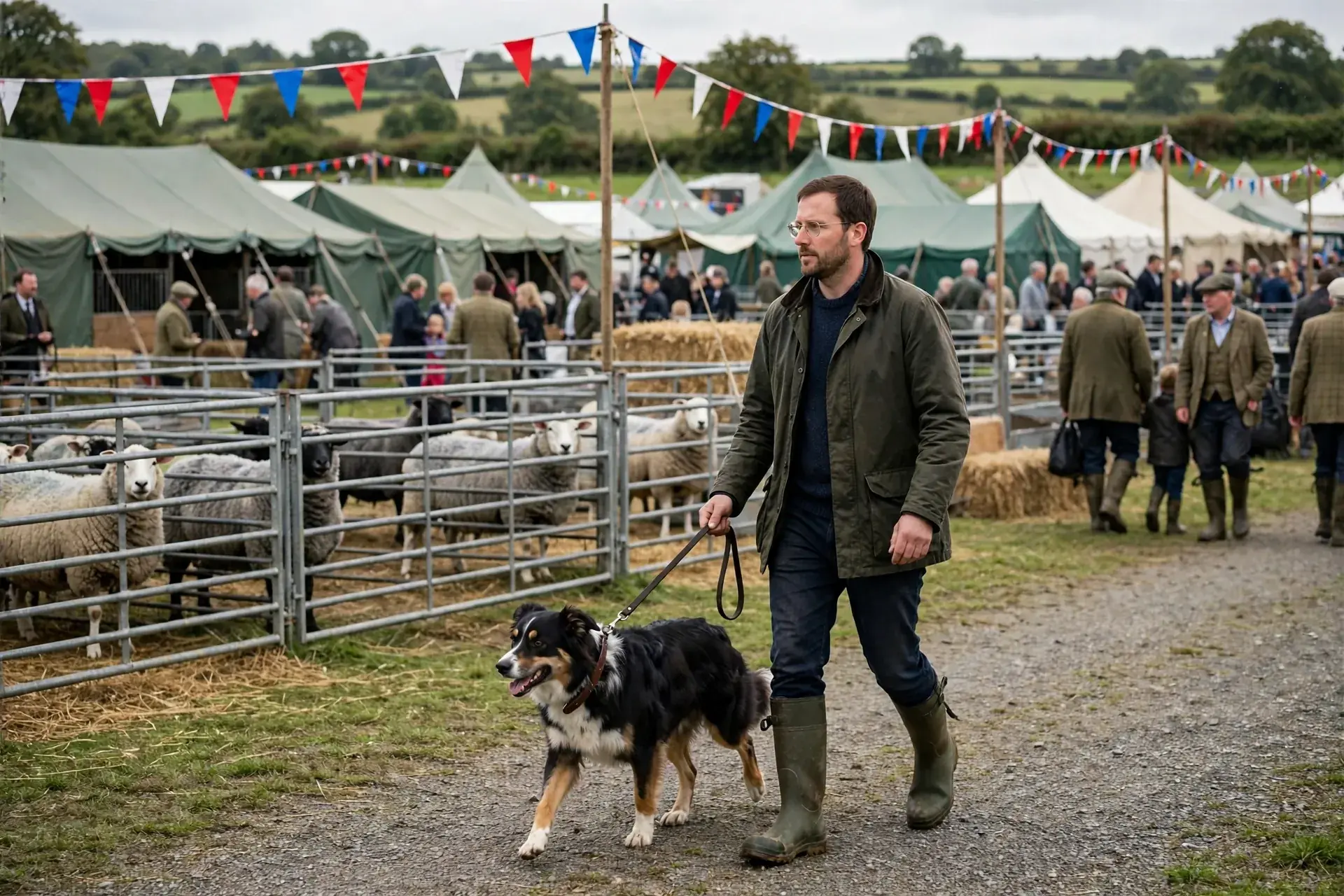
Livestock areas are the heart of an agricultural show and the zone that needs the most care. Cattle lines, sheep pens, pig units and horse boxes concentrate strong smells, sudden movement and vocal animals in a small space. Many shows allow dogs in livestock areas only on a short lead, and some close judging rings and cattle lines to dogs entirely, so follow the signs at each entrance rather than assuming one rule covers the whole site. Keep a generous distance from pens, never let a dog put its nose through a fence, bark at penned animals or pull towards a horse, and be especially careful around loading areas where animals are moved and vehicles reverse. Even a calm dog can become excited by the smell and movement of sheep, and a herding breed may fixate, crouch and stare in a way that stresses the livestock even without barking. If your dog shows that fixation, stiff body language, intense staring or an inability to look away, move on calmly and do not try to train through it in the middle of a busy livestock line. The animals are working and being judged, and the show is not a training ground for livestock desensitisation.
Trade stands and craft marquees are the busiest enclosed spaces on most showgrounds. Aisles are narrow, stalls display food, leather goods, dog treats and clothing at nose height, and visitors stop suddenly to browse, which means a dog on a lead is constantly being stepped over, bumped or approached by strangers. In a marquee the sound changes too: voices echo, music plays and the air can become warm and stuffy. Some marquees ban dogs, some allow them only if carried or on a short lead, and food marquees often have stricter rules, so check the sign at each entrance. If you do enter, keep the dog close on your inside, away from the stall front, keep the lead short and untangled, and do not let the dog sniff food displays, lick samples or take treats from strangers. A polite refusal helps: thank the person, explain the dog is on a restricted diet or in training, and move on. If the marquee is crowded, hot or full of loose children running between stalls, skip it. The same stands can usually be visited from the outside, or on a quieter second pass later in the day.
Food courts and picnic areas need a separate plan, because they combine dropped food, hot cooking equipment, queues and dogs at their most interested. Keep the dog away from barbecue grills, hot plates and open flames, and never tie a lead to a table leg in a busy food court where the table can be knocked or the dog can be tripped over. If you are eating with a group, decide who holds the dog while others order, and choose a table at the edge of the seating area with a clear exit route rather than a table in the middle of the crowd. Bring the dog's own water bowl and a chew or a stuffed food toy to give the dog a job while you eat, and clean up any dropped food before the dog reaches it. Cooked bones, onions, chocolate, grapes, corn on the cob and fatty scraps are all hazards that appear regularly around food courts, and a dog that scavenges quickly can swallow something dangerous before you can intervene. If the food hall bans dogs, plan for one person to stay outside with the dog in shade, or eat at an outdoor picnic area where dogs are welcome.
Dog rings, demonstration arenas and have-a-go areas are usually the most dog-friendly zones, but they still have rules. Spectator dogs are expected to stay outside the ring, on a lead, at a distance that does not distract competing dogs. Do not let a spectator dog bark at a dog working in the ring, approach the ring entrance or run up to a dog that has just finished. Demonstration areas for gundogs, agility, flyball or sheepdog trials can be exciting and noisy, with whistles, gunfire effects, applause and fast-moving dogs, so watch your own dog's reaction from a distance first. If your dog becomes over-aroused, barking, lunging or unable to settle, move further back or leave that arena for a calmer zone. The dog exercise area, where one exists, is the place for a toilet break, a drink and a stretch, but it is not an off-lead free-for-all: keep an eye on other dogs, pick up fouling immediately and leave if play becomes rough or your dog looks overwhelmed.
Car parks, entrances and main avenues deserve as much attention as the rings. Car parks at shows are large, dusty or muddy, full of moving vehicles, trailers and reversing horseboxes, and dogs are at risk if they are allowed to wander while owners unload. Keep the dog on a lead from the moment the car door opens, walk on the marked pedestrian route where one exists, and avoid cutting between parked trailers. Main avenues are where crowds, pushchairs, mobility scooters and dogs on extendable leads collide, so keep your lead short, walk on the quieter side of the avenue and step aside into a gap when a large group approaches. Finally, remember that zones change through the day: a quiet craft area in the morning can become a bottleneck after the main ring parade, and a shaded picnic area at noon can become a sun trap by mid-afternoon. Re-check your route after lunch, and be willing to change it.
Dog show classes and have-a-go events explained
Many country shows run a companion dog show, often called a fun dog show, alongside the main programme. These are not pedigree breed shows, and they are not judged against a breed standard. They are open, light-hearted classes designed for pet dogs of any breed, crossbreed or age, and they are one of the best reasons to bring a dog to a show, provided the dog enjoys the atmosphere. Entry is usually on the day: you pay a small fee per class at a tent near the ring, receive a number, and wait for your class to be called. Classes are often grouped by broad categories rather than breed, and the schedule is usually published on the show website or posted at the ring on the day. Arrive early if you want to enter, because popular classes fill quickly and judging may start at a fixed time even if the queue is still long.
The most common classes are easy to understand once you see them listed. Best puppy covers dogs under a certain age, often under twelve months, and is judged on general condition, temperament and presentation rather than pedigree. Best veteran celebrates older dogs, often over seven years, and rewards condition and character. Handsomest dog and prettiest bitch are appearance classes with a deliberately informal feel. Best crossbreed, sometimes called best mongrel, is for dogs without a pedigree. Waggiest tail, best trick, best fancy dress and dog most like its owner are novelty classes judged for fun, and they suit dogs that enjoy attention but may not suit a shy dog that dislikes costumes or crowds. Best rescue, best junior handler and best condition classes appear at many shows, and some shows add a best six legs class for a dog and owner pair, or a best sausage catcher for dogs that catch treats. Read the exact class list for the show you are attending, because names, age limits and entry rules vary, and check the official guidance before you travel if the schedule is not published in advance.
Judging in a fun class is usually brief and informal. The judge will ask you to walk the dog around the ring, stand the dog for a brief look, and sometimes show a simple trick or gait. The judge may handle the dog, check teeth or coat, and ask a question about age or rescue background. Keep the dog on a lead throughout, unless the judge or steward explicitly asks you to let the dog move freely for a moment in a controlled way. Speak calmly, keep treats in a pocket rather than in a waving hand, and do not crowd the judge or other entrants. Rosettes are often awarded to the first six places, and the winners of each class may be invited back for a best in show final at the end of the day. If your dog does not place, that is normal: fun classes are busy, subjective and designed for participation, not for ranking pet dogs seriously. The useful prize is a dog that leaves the ring happy and relaxed, not a rosette.
Have-a-go events sit alongside the fun classes and are often more enjoyable for active dogs. Agility have-a-go sessions let dogs try low jumps, tunnels and weaves under supervision, usually on a lead or in a fenced area with a handler guiding them. Flyball taster sessions, scent work games, gun dog scurries and terrier racing demonstrations are common, and some shows run a dog dash, a timed sprint down a straight track, or a swim or dock-diving demonstration where facilities allow. These events are excellent enrichment, but they need judgement: a dog that has never tried agility should start with low jumps and a short tunnel, not a full course, and a dog with joint problems, a heart condition or a recent injury should skip jumping and racing altogether. Watch a session first, check the surface for slipperiness, ask the steward about age or health restrictions, and stop while the dog is still keen rather than pushing for one more run. Over-aroused dogs that bark continuously, refuse to leave the start line or chase other dogs should be taken out calmly and given a rest.
Formal pedigree shows and working dog trials are a different world, and spectator dogs are not participants in them. Championship breed shows, gundog working tests, sheepdog trials and obedience competitions have their own entry systems, often closing weeks in advance, with dogs entered by registered name and judged to a strict standard. If you are interested in entering one of those, the show's schedule and the relevant governing body's rules are the place to start, and check the official guidance before you travel. As a spectator, the etiquette is simpler: stay outside the ring, keep quiet during judging, do not use a squeaky toy or call a competing dog, and do not photograph with flash near working dogs. Gundog demonstrations may include blank gunfire or dummy launchers, which can startle a pet dog that has never heard them, so watch from a distance on your first visit and leave if your dog shows distress.
Children handling dogs in junior classes deserve a mention, because country shows are often a child's first experience of showing. Junior handler classes judge the child's handling, not just the dog, and they work best when the dog is calm, the child is confident and an adult stays nearby. If a child in your group wants to enter, practise the basics at home first: walking on a loose lead, standing still for a few seconds, and moving around a simple triangle or circle. Keep the practice short and rewarding, and let the child decide on the day whether they still want to enter. A child who feels pressured in a busy ring will remember the stress longer than the rosette, and a dog that is pulled, chased or overwhelmed by an excited handler will not enjoy the experience either.
Heat, noise, crowds and livestock safety
Heat is the most serious risk at a summer country show, and it builds quietly. Showgrounds are often large, exposed fields with limited natural shade, and a dog walking on tarmac or dry grass in direct sun can overheat faster than its owner expects. The signs to watch for are heavy panting that does not settle in shade, drooling, a bright red tongue, restlessness, seeking shade, vomiting, unsteadiness or collapse. Flat-faced breeds, overweight dogs, older dogs and dogs with thick coats are at higher risk, and a dog that has been running, playing or pulling on the lead will heat up faster than a dog walking calmly. Prevention is straightforward but needs discipline: visit in the cooler morning, take regular shade breaks, offer small amounts of water often rather than a huge bowl once, wet the belly and paws with cool water, and use a cooling coat or damp bandana if your dog tolerates it. Never leave a dog in a parked car at a show, even for a few minutes with a window open, because a car heats to dangerous levels far faster than most people realise. If you need to fetch something from the car, take the dog with you or leave the dog with a companion in shade.
Noise at a country show is constant and layered: public address announcements, music, applause, vehicle engines, machinery demonstrations, fairground rides, gunfire effects in gundog displays and the general roar of a crowd. Most dogs habituate to steady background noise, but sudden loud sounds close by can cause panic, bolting or a bite risk if a startled dog is grabbed. Keep the lead short and secure at all times, use a harness or collar the dog cannot slip, and avoid tying the dog to a fence or stand while you browse. If your dog is noise-sensitive, choose a position further from the main ring and loudspeakers, avoid the fairground and machinery areas, and bring a familiar blanket or mat that smells of home for rest breaks. Desensitisation to show noise cannot be done on the day itself; if your dog has a known noise phobia, a country show is not the place to test it. For dogs that are mildly unsettled, a calm exit to the car park, a quiet walk away from the noise and an early departure are better than pushing through the loudest part of the programme.
Crowds create a different kind of pressure. Dogs are approached, stroked, photographed and offered food by strangers, often without asking, and children may run up, hug or grab a dog before an adult intervenes. Teach a simple, polite script for your group: please ask before stroking, the dog is resting, or please do not feed the dog. Step aside, turn the dog away or move on if a stranger ignores the request. A dog that is tired, hot or overstimulated is more likely to snap, and the showground is not the place to discover that limit. Watch for stress signals throughout the day: lip licking, yawning when not tired, turning away, a tucked tail, whale eye where the whites of the eyes show, pacing, panting in shade, or a refusal to walk. One or two signals may mean nothing, but a cluster of them, or a change from the dog's normal behaviour, means the dog needs a break. A break is not a failure; it is the point of bringing a dog responsibly.
Livestock safety is about distance, control and respect for working animals. Cattle, sheep, horses and pigs at a show are often stressed by transport, noise and unfamiliar surroundings, and a dog barking, lunging or staring at them adds to that stress. Keep a short lead, keep well back from pens, do not let a dog chase, herd or approach livestock, and never lift a small dog over a pen fence for a photograph. Horses in particular can kick if startled, and a dog running loose near horse boxes is in serious danger. Be careful around farm dogs too: working collies and gundogs at a show are often highly trained and focused, but they may not welcome a loose pet dog running up to them. Keep greetings brief, controlled and on lead, and move on if either dog stiffens, stares or growls. If your dog has a strong prey drive or a history of chasing livestock, the honest choice is to avoid livestock zones entirely, or to leave the dog at home for that show. The legal and welfare consequences of a dog worrying livestock are serious, and a show is a concentrated version of that risk.
Other hazards are smaller but common. Showground surfaces vary from muddy grass to gravel, tarmac and temporary flooring, and all of them can injure paws, especially in heat or after rain. Check paws during rest breaks for cuts, thorns, mud balls between toes or signs of soreness, and carry a basic first-aid kit with saline, gauze, tape and a spare lead. Stinging insects gather around food stalls and bins in summer, and a dog that snaps at a wasp can be stung in the mouth, which may need veterinary attention if swelling affects breathing. Barbecue areas, hot food stalls and generator cables are hazards to avoid, and temporary electric fencing around some livestock or display areas must be treated with respect. Finally, keep identification up to date: a collar tag with a mobile number, a microchip with current details, and a lead that will not break if the dog lunges. If a dog does get loose on a showground, do not chase it through livestock areas; alert stewards and show security immediately, and follow their directions.
Assistance dogs have a different legal position from pet dogs, and show organisers should not treat them as pets. An assistance dog is trained to perform tasks for a disabled handler, and access rules reflect that role. If you handle an assistance dog, check the show's assistance dog information in advance, and if you meet an assistance dog on the showground, do not distract it, stroke it, feed it or let your dog approach it. Our guide to assistance dog rights in the UK explains the legal framework in more detail, and it is worth reading before a busy public event where working dogs and pet dogs mix.
What to pack and the arrival routine
Packing for a country show is packing for a long, hot, muddy, crowded day with no shop that sells exactly what your dog needs. Start with the non-negotiables: a secure lead and a spare lead, a harness or collar that fits, a water bottle and a collapsible bowl, enough water for the whole day plus a reserve, the dog's normal food if you will be out over a mealtime, any medication, and more poo bags than you think you will need. Add a familiar mat or blanket for rest breaks, a towel for mud or rain, a cooling coat or damp cloth in warm weather, a drying coat or waterproof coat in wet weather, and a chew or food toy for quiet settling. A basic first-aid kit, a copy of the dog's vaccination record if the show asks for it, and the number of the nearest vet are worth packing too. If your dog is on a restricted diet, bring treats that you control, so you are not forced to accept treats from strangers or stalls.
Think about the car as part of the kit. A boot guard, a crate or a harness for the journey, a sunshade for the parked car, a spare towel and a bottle of water for the return journey all matter. On a warm day, park in shade if possible, even if it means a longer walk, and check the car temperature before loading the dog for the drive home. A dog that has spent the day in the sun will be hotter, thirstier and more tired than at arrival, and the car needs ventilation from the start. For the journey itself, our day-trip packing checklist covers car safety, food, water and rest stops in a form you can reuse for any show, and it pairs well with the show-specific items in this section. The principle is the same: pack the day before, lay the dog's kit by the door, and avoid a morning scramble that starts the day with stress for both of you.
Arrival sets the tone for the whole show. Give the dog a toilet break and a drink before you enter, preferably away from the main entrance crowd, and let the dog sniff and settle for a few minutes rather than marching straight into the busiest avenue. Walk the perimeter of a quiet area first, find shade and water, and let the dog learn the new smells at its own pace. Then follow your planned route: one calm zone, a rest break, a busier zone, another rest break, and so on. Rest breaks are not wasted time. A dog that rests on a familiar mat in shade for twenty minutes every hour or two will enjoy the show far more than a dog dragged from stand to stand for five hours without a pause. Use rest breaks to check paws, offer water, check the lead and harness, and watch the dog's body language. If the dog is lying flat, panting heavily or refusing treats it normally loves, that is information, not stubbornness.
Toilet routines need planning on a showground. Dogs cannot use the human toilets, and the designated dog toilet area may be a long walk from the main rings. Learn where it is on arrival, and visit it regularly, not only when the dog is desperate. Always carry bags, pick up immediately, and use the bins provided, even if the bin is a walk away. Fouling on a showground is more than an embarrassment: it spreads disease, it spoils the ground for livestock and other dogs, and it is one of the reasons shows tighten dog rules. If your dog fouls in a ring, a marquee or a food area, clean it up calmly and thoroughly, and alert a steward if you need cleaning materials. The same discipline applies to urine on trade stands, display materials and other people's belongings: steer the dog away from stalls and displays, and do not let marking become a tour of the showground.
Etiquette is the thread that runs through the whole day, and it is mostly about keeping a dog under control in a place designed for people, animals and machines to mix. Keep the lead short, keep the dog on your side away from stalls and crowds, do not let the dog jump up at strangers, steal food or bark continuously, and do not leave the dog tied up unattended while you go into a marquee. If your dog barks at other dogs, increase distance, cross to the other side of the avenue, or step into a gap until the other dog passes. If your dog is reactive, a show may still be possible with careful route planning, early arrival and a willingness to leave early, but it requires honest assessment and a plan for the worst moments, not just the best ones. Apologise briefly if your dog causes a problem, fix it, and move on. Other visitors remember a calm, responsible owner far longer than they remember a perfect dog.
Finally, plan for weather changes, because British show days change fast. A morning of sunshine can become an afternoon thunderstorm, and a dry field can become mud within an hour. Pack a waterproof coat for the dog if the dog tolerates one, a towel for drying, a spare lead in case one gets muddy or wet, and a change of clothes or a waterproof layer for yourself. In rain, avoid waterlogged areas where a dog could slip or drink contaminated water, and watch for slippery temporary flooring in marquees. In a thunderstorm, move away from metal fences, tall structures and open fields, and head for a building or the car if stewards advise it. A dog that is frightened by thunder needs a calm handler, a secure lead and a quiet place, not a continued tour of the showground. Check the official guidance before you travel for the show's wet-weather and cancellation policy, because some shows cancel or curtail events in severe weather, and ticket terms vary.
Leaving and the drive home
Leaving well is part of enjoying a show, and it starts before you are exhausted. Decide in advance roughly when you will leave, and watch for the dog's signals rather than the programme's final event. A dog that has had a full day, with heat, noise, crowds and new smells, will often be tired long before its owner is ready to go home. Leaving while the dog is still coping, rather than after the dog has become overstimulated or distressed, makes the drive home calmer and the next show day easier. If you entered a fun class final or a demonstration late in the day, build a rest break into the time before it, and have a clear exit route in mind so you are not trapped in a crowd when you need to leave quickly.
The exit itself needs the same care as arrival. Main exits become bottlenecks at the end of the day, with vehicles, pedestrians, pushchairs and dogs all moving in different directions. Keep the dog on a short lead, walk on the pedestrian route, and avoid cutting through car parks between vehicles. Give the dog a final toilet break and a drink before the car journey, and check paws, coat and harness for mud, thorns, ticks or debris picked up during the day. A quick brush or towel-down in the car park saves a muddy car and lets you spot a cut or a tick while there is still daylight. If the dog has been in water, has rolled in something unpleasant or has eaten something it should not have, note what happened and when, because that information helps a vet if symptoms appear later.
The drive home deserves a plan of its own. A tired, hot dog should travel in a cool, ventilated car with water available at stops, not in a hot boot with no airflow. Stop for a break on a long journey, offer water, let the dog stretch and toilet in a safe place away from traffic, and check the dog's temperature and breathing before continuing. Do not feed a large meal immediately after a hot, exciting day; offer a smaller meal once the dog has cooled down and settled, and watch for vomiting, diarrhoea or lethargy in the evening. If the dog was stung, cut, overheated or exposed to something unusual during the show, monitor it closely and contact a vet if you are concerned, rather than waiting until the morning. A show day is a big event in a dog's life, and the evening after it should be quiet, familiar and restful.
When you get home, unpack the show kit, wash bowls and mats, restock poo bags and water bottles, and note what worked and what did not. Did the show have enough shade? Was the dog ring well organised? Were livestock areas clearly signed? Did the dog cope with the noise, or was the main ring too loud? Those notes turn a single show visit into a useful guide for the next one, and they help you choose a different show, a different day or a shorter visit next time. If you are planning a longer break around a show, the same notes help with accommodation: a quiet base, a good walk nearby and a place to dry a muddy dog matter more after a show day than a pretty view. For ideas on combining a show with a short break, our guide to dog-friendly beaches and their seasonal rules is a useful contrast, because beach rules, like show rules, change by season and location, and checking them in advance prevents a wasted journey.
A country show with a dog can be one of the best days out in the British summer: the smell of fresh straw, the sound of a brass band, a dog show ring full of wagging tails, and a picnic on the grass with a tired dog at your feet. It works when the day is planned around the dog, not around the programme. Choose a show your dog can enjoy, learn the zones before you enter, enter a fun class only if the dog enjoys it, protect the dog from heat, noise and livestock pressure, pack for a long day outdoors, and leave while the dog is still happy. Do that, and the show becomes a memory worth repeating, rather than a day you both need to recover from.
Practical questions
Before you go
Are dogs allowed at all UK country shows?
No. Most large shows welcome dogs on a lead, but some events restrict dogs to certain areas or ban pet dogs from livestock and judging areas, and a few do not admit dogs at all. Always check the official guidance before you travel, and check the show's own dog policy for that year rather than relying on a previous visit.
Can my dog enter a fun dog show class at a country show?
Usually yes, if the show runs a companion or fun dog show. Entry is normally on the day, with a small fee per class, and classes are judged for fun rather than breed standard. Arrive early, read the ring rules, and keep your dog on a lead outside the ring unless a steward tells you otherwise.
Do dogs need to stay on a lead at a country show?
In almost all cases, yes. Shows commonly require dogs to be on a short lead at all times, and many require leads in livestock areas, food courts and trade stands without exception. Off-lead exercise is usually limited to a designated dog exercise area, if one exists, so check the official guidance before you travel.
What should I do if my dog gets too hot at a show?
Move to shade immediately, offer small amounts of cool water, and cool the dog gradually with a damp cloth on the belly and paws. Do not pour ice-cold water over a very hot dog or force large amounts of water. If panting does not settle, or the dog seems unsteady, confused or sick, find the show's first-aid point or a vet straight away.
Can I take my dog near livestock at a country show?
Often only at a distance and on a short lead, and some livestock lines and judging rings are closed to dogs altogether. Never let a dog approach, bark at or chase cattle, sheep, horses or pigs, and keep well back from pens and loading areas. If your dog is strongly excited by livestock, skip those zones entirely.
What happens if my dog fouls on the showground?
Clean it up immediately, bag it and use the bins provided. Shows rely on visitors doing this without being asked, and fouling near food areas, rings or livestock pens is a particular problem. Carry more bags than you expect to need, because showground bins can be a long walk apart on a busy day.