This guide is independent and contains no paid placement. Rules vary by operator and by site, so check the signs and the staff on duty at the stop you actually use.
Assume the dog cannot enter the shop, never let the dog loose on a forecourt, and park away from the pumps. Use pay at pump when you can, take toilet breaks on grass away from traffic, and never leave a dog in a warm car while you pay. If you are travelling alone, choose your stops for pay at pump first and everything else second.
Choosing where to stop before you leave
A petrol stop is decided at the kitchen table, not at the slip road. On a long drive the difference between a calm ten minutes and a stressful twenty is usually the site you picked, and the three kinds of stop in Britain behave very differently with a dog in the car. Motorway service areas are the largest and the most predictable: they have bigger car parks, more grass, toilets, food outlets and, at many sites, a marked dog exercise area. Their buildings are also the most likely to have a clear dogs policy, because they handle thousands of travelling dogs a year. The trade-off is price and detour time: fuel at motorway services is typically more expensive, and the stop itself takes longer because the car park is large and the walk to the grass can be several minutes each way. For a proper break on a long journey, that is usually a fair exchange.
An A-road or town forecourt is the middle option and the most variable. A rural filling station may have a generous grass verge, a quiet corner and staff who are relaxed about a well-behaved dog waiting by the door, while a busy urban forecourt may have no grass at all, no space to park away from the pumps, and a constant stream of vehicles cutting across the site. Independent stations and small village forecourts often have more room and less pressure than a town-centre site, but they are also more likely to close early, to have no pay-at-pump option, and to have a shop that doubles as the village store, where food hygiene rules are applied strictly. Supermarket forecourts are a third case: fuel is usually cheaper and pay at pump is common, but the site is shared with shoppers, trolleys, delivery vehicles and pedestrians crossing from the store, which makes the forecourt busier and the dog's walk harder to manage. A supermarket stop works well for fuel alone and poorly as a dog break, unless the store has a grass edge or a quiet corner of its car park.
Plan stops around the dog's needs rather than the fuel gauge alone. Most dogs are comfortable for around two hours in a car, and many vets and welfare organisations recommend a break at least every two hours on a long journey, so mark a stop roughly every 100 to 120 miles and treat fuel as a secondary reason to pull in. When you plan the route, look at each candidate stop on a map before you leave: is there grass visible at the edge of the site, is the car park separate from the pump lanes, and is there a way to walk the dog without crossing the forecourt? A site with a separate parking area and a grass verge beats a site with cheaper fuel and nowhere to walk. If you are travelling with a puppy, an older dog or a dog that needs frequent toilet breaks, shorten the interval and favour motorway services or larger sites, where the grass is more reliable and the toilets are open longer.
Think about who is travelling, too. Two adults travelling together can run almost any stop, because one person stays with the dog while the other pays. A lone driver has a much narrower set of good options, and should plan around pay at pump: check before departure whether your chosen stations offer it, and keep a backup station in mind in case the pump payment terminal is out of order. If you are travelling with more than one dog, the same logic applies with extra force: two dogs on leads at a busy forecourt need two hands, a clear route and somewhere to stand that is not in anyone's way. Our guide to dog-friendly motorway services in the UK covers the larger rest stops in more detail and is worth reading alongside this guide before a long motorway journey.
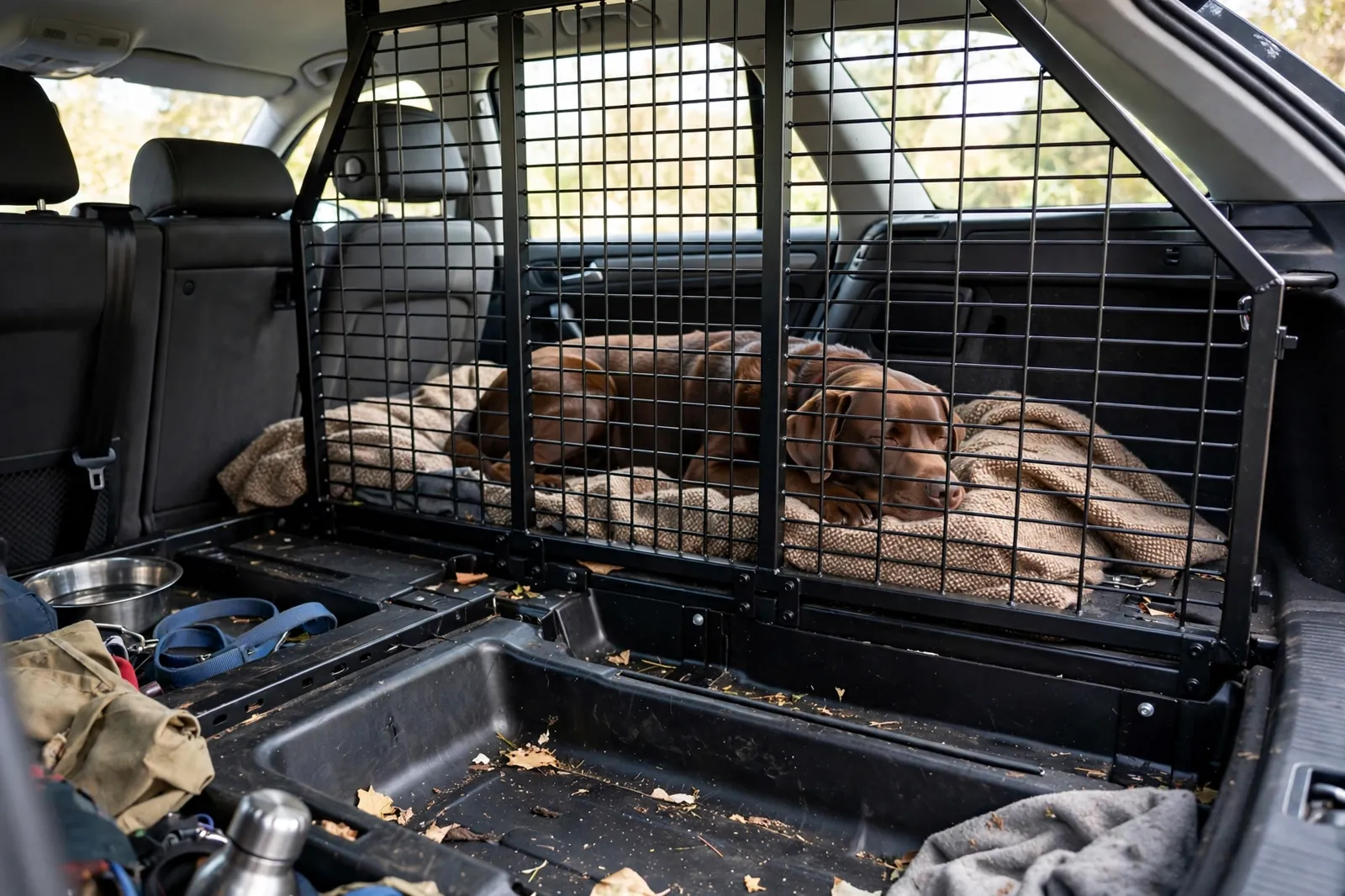
Finally, pack the stop before you need it. A petrol stop is no place to discover that the water bottle is empty, the poo bags are in the boot under the luggage, or the lead is tangled around the seatbelt. Keep a small stop kit within reach of the driver's door: a short lead, a collapsible bowl, a bottle of water, poo bags, a towel for wet paws, and a spare lead in case one breaks or gets soiled. Keep the dog's restraint in good order as well: the Highway Code's Rule 57 requires dogs to be suitably restrained in a vehicle so they cannot distract the driver or injure themselves or others if the car stops quickly, and a dog that arrives at a forecourt already settled is far easier to handle than one that has spent an hour loose on the back seat. For the restraint itself, see our comparison of dog car harness versus crate options and our advice on choosing a dog car boot guard that actually fits your car.
Arriving and parking safely away from pumps
Drive in slowly and treat the forecourt as a shared space full of people who are not looking for a dog. Drivers on a forecourt are watching pump numbers, prices, mirrors and their own passengers, and a dog at ankle height is easy to miss, especially a small or dark-coated dog in poor light. Enter at walking pace, indicate clearly, and head for a parking space rather than stopping in a pump lane while you work out where the dog will go. Never block a pump lane, an exit or the air and water bay while you sort out leads and bowls: other drivers will manoeuvre around you, and that is exactly when a loose dog becomes a hazard.
Choose the parking space as if the dog mattered as much as the car. The best space is away from the pumps, away from the main flow of vehicles, and on the side of the site nearest the grass, so the dog's walk does not cross the forecourt at all. Avoid spaces next to the shop entrance, where foot traffic is constant and the dog will meet every entering and exiting customer, and avoid spaces beside heavy goods vehicles, whose drivers have large blind spots and whose engines and air brakes can startle a nervous dog. If the only spaces are close to the pumps, it is better to take a short walk from a quieter corner of the site, or to move on to the next stop, than to unload a dog into the busiest part of the forecourt. Shade matters as much as distance: in warm weather, a space under a tree or a canopy, or on the shaded side of the building, keeps the car cooler for the minutes the dog may wait in it, and gives you a cooler surface to stand on while you settle the dog.
Do not open the car door until the lead is on and in your hand. This is the single most common forecourt mistake, and it is also the easiest to prevent. Clip the lead to the harness before you release the boot or open the door, check that the clip is fully closed, and only then let the dog out. For dogs travelling in the boot, a dog car boot guard is worth its weight here: it lets you open the tailgate, clip the lead on, and bring the dog out in a controlled way, rather than having the dog leap past you into a forecourt full of moving cars. For dogs on the back seat, open the door on the pavement side, away from traffic, and keep the dog close while you close the door and lock the car. If you have two dogs, bring them out one at a time and secure the first to a fixed point or hand the lead to your travelling companion before releasing the second.
Before the dog takes a step, scan the ground. Forecourts collect the things that hurt paws and tempt mouths: fuel spills, broken glass, discarded food, cigarette ends, chewing gum and puddles that may hold fuel or cleaning chemicals. Keep the dog on a short lead, walk around the edge of the site, and steer clear of drains, spillages and the area directly around the pumps. Hot tarmac is a real hazard in summer: if the surface is too hot for the back of your hand, it is too hot for paws, and a dog that has been sitting in a cool car will feel the difference sharply. In winter the risks change to ice, grit and de-icer on paths, all of which can irritate paws, so a quick wipe with a towel after the stop is a sensible habit in any season.
While you are parked, think about the car itself. Switch the engine off at the pump and while parked on the forecourt, as forecourt rules require, and never leave the engine running with the dog inside while you go into the shop: it wastes fuel, it breaches forecourt safety rules, and it does not reliably keep the car cool. Lock the car whenever the dog is left in it, even for a minute, and take the keys with you. If the dog is waiting in the car, leave a window open only a crack for ventilation, never wide enough for the dog to get its head or paws out, and never rely on an open window as a cooling system. A sunshade on the windscreen and a reflective shade on the side window help, but they are a supplement to shade and short waits, not a substitute for either.
The forecourt itself: rules, hazards, and where the dog can and cannot go
Every forecourt has rules, and most of them exist for fire safety rather than for dogs. Petrol vapour is flammable, so smoking, naked flames and mobile phone use at the pump are restricted, engines must be off while refuelling, and static electricity is a genuine concern: getting back into the car and then touching the pump can build a charge, which is why drivers are advised to stay outside the vehicle while filling up. None of this is dog-specific, but all of it shapes how a dog stop works: the driver filling up cannot also be holding a lead, the dog cannot wait beside the pump, and the person with the dog cannot be the person refuelling at the same moment. Plan the stop as two jobs done by two people, or as two jobs done one after the other by one person.
The shop is where most dog owners meet the site's actual policy, and the usual answer is that dogs are not allowed inside. The reason is food: most petrol station shops sell food and drink, including open food such as sandwiches, pastries and hot drinks, and food businesses must keep animals out of areas where food is stored, prepared or sold. The law provides an exception for assistance dogs, which must be allowed, but pet dogs are a different matter, and individual operators set their own policies on top of the legal minimum. Some sites allow dogs in a porch or lobby area, some allow a small dog carried in arms, and some have a sign at the door that is unambiguous. The policy can also differ between the shop and an attached cafe or seating area, and between the main brand's sites and a franchised site under the same sign. Do not argue the point at the door: check the sign, ask a member of staff if it is unclear, and plan on the assumption that the dog stays outside. If you are unsure about a specific operator's policy, check the official guidance before you travel.
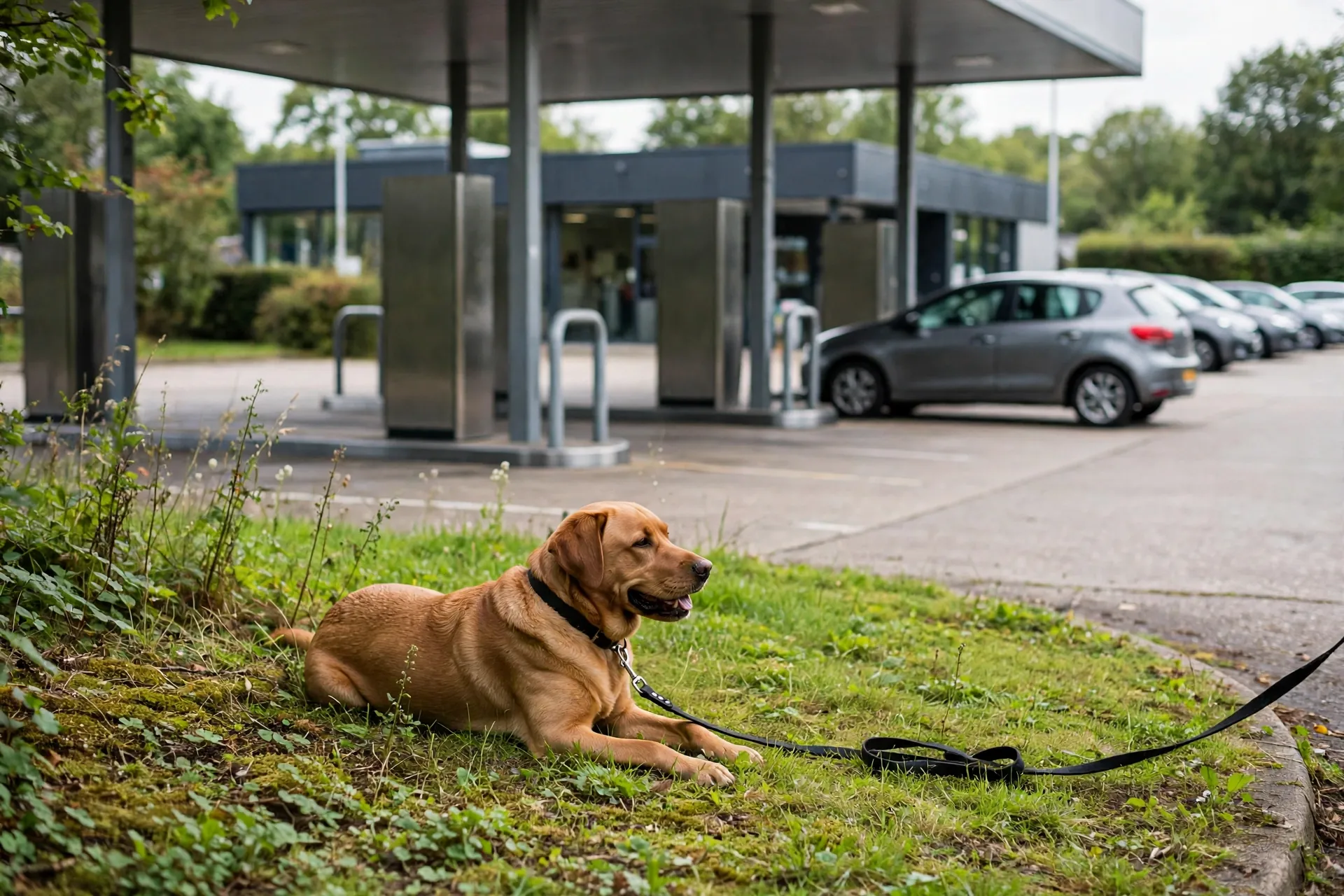
The forecourt itself is not a dog-walking area, even where no sign says so. Dogs should not be walked between pumps, across the lanes where vehicles reverse, or through the area where tankers unload, and they should never be allowed off the lead anywhere on the site. A long lead or an extendable lead is a liability on a forecourt: it lets the dog wander into a vehicle's path, wrap around a pump or a bollard, or reach a spill while the handler is looking the other way. Use a short, fixed-length lead, keep the dog on your side away from traffic, and walk the perimeter rather than cutting across the middle. If the dog needs to pass the pumps to reach the grass, cross at the quietest point, keep the walk brisk, and do not stop to let the dog sniff around the pump islands.
Other hazards are less obvious but worth knowing. Car washes and jet wash bays produce noise, spray and slippery surfaces that can panic a dog, so keep the dog well clear of them and never walk the dog through a wash bay to reach a bin. Air lines and vacuum bays attract queues of vehicles and sudden bursts of compressed air, which startle many dogs. Electric vehicle charging bays, increasingly common at larger forecourts, add cables across the ground and vehicles that arrive silently, so a dog that relies on hearing traffic needs extra care around them. Delivery vehicles and tankers have the largest blind spots on the site and may reverse without seeing a dog behind them; if a tanker is unloading, keep the dog at the far side of the site and wait until it has gone before walking anywhere near the pump area.
Behaviour matters as much as position. A dog that barks at strangers, lunges at other dogs or pulls hard on the lead turns a ten-minute stop into a confrontation, and forecourts are full of triggers: people carrying food, children running to the shop, other dogs waiting in cars, and the general noise of engines and doors. If your dog is reactive, choose quieter sites, park further away, keep the walk short and purposeful, and do not try to socialise the dog with strangers or other dogs on a forecourt. A muzzle is a reasonable precaution for a dog that may snap when startled in a busy place, provided the dog has been trained to accept it at home first; a forecourt is no place to introduce a muzzle for the first time. Equally, never tie a dog to a post, a pump or a trolley bay and walk away: an unattended tied dog can be stolen, can panic and slip its collar, and can be approached by strangers or other dogs while its owner is inside. If nobody can stay with the dog, the dog stays in the locked car for the shortest possible time in safe conditions, or the stop is postponed to a site where pay at pump works.
The shop and the pay-at-pump problem: who stays with the dog
The core problem of a petrol stop with a dog is simple: the shop usually cannot take the dog, the car cannot always safely hold the dog, and the driver cannot be in two places at once. Pay at pump solves most of it. Where pay at pump is available, the driver fuels up, pays at the pump terminal with a card, and never leaves the dog at all, except for the moments spent standing beside the car. The dog can stay in the car with the doors locked for the short time the driver is at the pump, or a second adult can stay with the dog while the driver fuels. Check that pay at pump is working before you commit to the site: terminals fail, some pumps are cash-only or kiosk-only, and some sites reserve pay at pump for certain pumps or certain cards. If the terminal is out of order, treat the site as a kiosk-payment site and plan accordingly.
With two adults, the routine is straightforward and worth agreeing before you arrive. One adult fuels the car while the other walks the dog on the grass or waits with the dog in a quiet corner away from the pumps. Then the roles swap if the dog needs a longer break, or the fuelling adult pays at the kiosk while the other stays with the dog. The person with the dog should be the one who is comfortable handling the dog in a busy place, not simply whoever happens to be free, and the person paying should know exactly what is needed in the shop so the trip inside is quick. Keep the shop visit short: buy fuel, water and anything essential, and leave the browsing, the coffee queue and the souvenir aisle for a proper service area stop where the dog has a better place to wait.
A lone driver has to be more disciplined. The best lone-driver stops are pay-at-pump sites with grass at the edge of the site: fuel up, pay at the pump, park in a quiet space, walk the dog, and leave, without ever needing the shop. If the site has no pay at pump and the dog cannot go into the shop, the options narrow. In cool weather, with the car parked in shade and the dog settled, a brief, brisk shop visit may be acceptable, but it must be genuinely brief, and the dog must have water, ventilation and a comfortable temperature. In warm weather, it is not acceptable at all: a car in sunlight can reach dangerous temperatures within minutes, even with a window cracked open, and a dog left in those conditions can suffer heatstroke quickly. Welfare organisations and police advise never leaving a dog in a hot car, and members of the public may call the police or break a window to free a dog in distress, so the legal and practical risks of a long shop visit in warm weather are serious. If the weather is warm and there is no pay at pump and no second person, the right answer is to drive on to a site where pay at pump works, or to a motorway service area where the dog has a proper place to wait.
There are a few workarounds worth knowing, and a few that are not. Asking a member of staff whether the dog may wait in a porch or lobby sometimes works, especially at quiet rural sites, but it is a favour, not a right, and it should never be assumed. Asking another customer to watch the dog is not a good idea: a stranger has no duty to your dog and may not handle it safely. Leaving the dog tied outside the shop is, as noted above, a poor option in every case. A better workaround for regular solo travellers is a loyalty or fuel card and a payment app where the operator supports it, because some operators allow payment through an app without entering the shop; check the official guidance before you travel, because app payment availability varies by operator and by site. Whatever the workaround, keep the principle intact: the dog is either with a responsible person, in a safe car for a very short time in safe conditions, or the stop does not happen at that site.
Children add a further layer. A child should never be left alone with a dog on a forecourt while an adult pays, and a child should never be asked to hold a strong or reactive dog beside moving traffic. If you are travelling with children and a dog, the same two-adult logic applies: one adult manages the children and the dog together in a safe spot, the other fuels and pays. If you are alone with children and a dog, favour motorway services or large sites where the car park, the grass and the building are separated from the pump lanes, and accept that the stop will take longer. Rushing a stop with children, a dog and a fuel pump is how leads get dropped and doors get opened at the wrong moment.
Toilet breaks, water, shade and the ten-minute stop routine
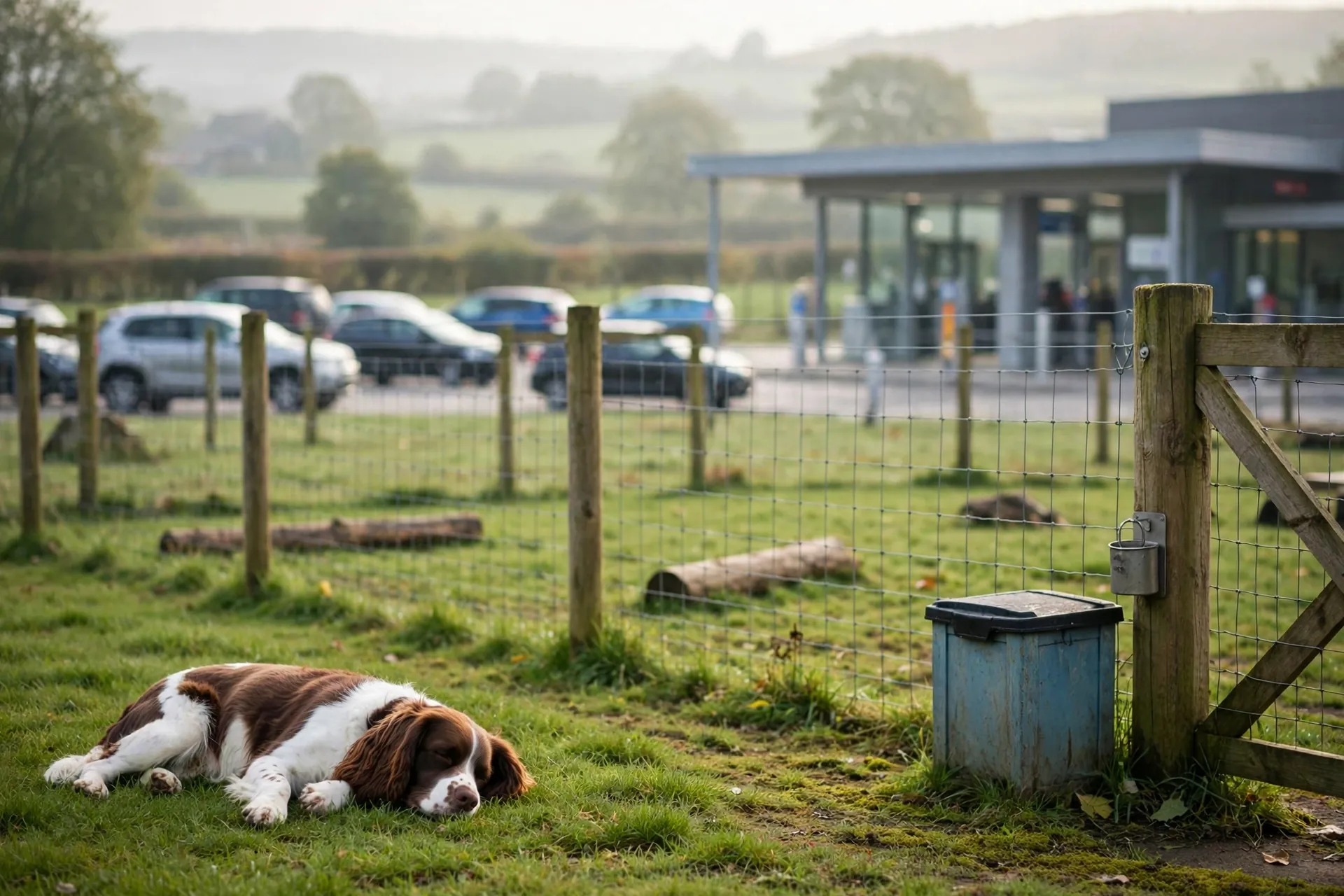
The toilet break is the reason most petrol stops with dogs exist, and it deserves a proper routine rather than a hurried wander. The right spot is grass away from the pumps, away from footways and food areas, and away from the main vehicle flow. Motorway services often provide a marked dog area, which is the best option where it exists. At an ordinary forecourt, the grass verge at the edge of the site, the strip beside the car park boundary, or a quiet corner behind the building usually serves. What matters is that the dog is not toileting on the forecourt surface, on a footway, or in a children's play area, and that the handler can see approaching vehicles and pedestrians. Avoid flower beds, ornamental planting and the grass immediately beside a food outlet, and never let the dog toilet on the area where fuel is dispensed or where tankers unload.
Pick up waste immediately, every time, without exception. Dog fouling on a forecourt or a service area is not only unpleasant but also a legal matter: in England, Wales and Scotland, failing to clean up after a dog in a public place can lead to a fixed penalty, and many sites display their own rules and fines. Carry more bags than you think you need, because a long journey with a nervous dog can produce more than one stop's worth of waste, and double-bag if the bin is some distance away. Use the bin provided: most larger sites have litter bins near the shop entrance and many have dedicated dog-waste bins near dog areas. If there is no bin, or the bin is full, take the bagged waste with you in the car and dispose of it at the next suitable bin. Do not leave bagged waste on the ground, on a wall or beside a full bin, and do not put dog waste in a recycling bin. A small lidded container in the car for bagged waste is an unglamorous but genuinely useful piece of kit on a long trip.
Water is the second essential of the stop. Offer water at every stop, even if the dog does not seem thirsty, because dogs lose moisture through panting in a warm car and many will not drink enough while travelling. Use your own bottle and bowl rather than a communal bowl, which can spread infection, and offer small amounts frequently rather than a huge bowl all at once, which can cause vomiting in a car-sick or excited dog. In summer, carry more water than the dog's usual daily amount: a litre bottle for the dog alone is a reasonable minimum for a long day's driving, on top of water for the humans. Check the bowl is clean before each use, and do not let the dog drink from puddles on the forecourt, which may contain fuel, oil or cleaning chemicals. If the site has a tap, use it to refill, but do not assume every forecourt tap is drinking water: ask staff if you are unsure, and check the official guidance before you travel if the water supply is in doubt.
Shade and temperature control the whole stop in warm weather. A dog's body temperature rises faster than a human's, and breeds with flat faces, older dogs, overweight dogs and dogs with thick coats are at particular risk. Park in shade, walk the dog in shade where possible, and keep the stop short when the temperature is high. Wetting the dog's paws and belly with cool water can help, but never pour ice-cold water over a hot dog or cover it with a wet towel and leave it, as rapid cooling can cause other problems; if a dog shows signs of heatstroke, such as heavy panting, drooling, vomiting, confusion or collapse, move it to shade, offer small amounts of cool water, wet its paws and belly, and seek veterinary help urgently. A car seat cover for dogs that is light-coloured and breathable can help keep the back seat cooler than dark leather or fabric, and it protects the seat from muddy paws after a grass stop, but it is no substitute for shade and ventilation.
Put it together as a ten-minute routine that works at almost any site. Minutes one to two: park away from the pumps, lead on before the door opens, walk to the grass. Minutes three to five: toilet break on the grass, waste picked up and binned, water offered, paws checked for stones, glass or heat. Minutes six to eight: a short, calm walk or sniff around the grass edge so the dog stretches its legs, then back to the car, paws wiped if wet or muddy. Minutes nine to ten: fuel and pay, either by pay at pump or by a second person, dog settled back in the car with ventilation and water available, and a final check that the lead, bowl and bags are stowed before driving off. If the dog is unsettled, skip the sniff walk and keep the stop shorter rather than longer: a stressed dog does not benefit from extra time on a noisy forecourt, and the real walk can wait for a proper rest stop or the destination.
Multi-dog households need a small adjustment to the same routine. Walk dogs one at a time if either dog pulls, reacts to other dogs, or is a puppy still learning lead manners, because two leads at a forecourt tangle easily around bollards, legs and pump islands. If both dogs are calm and well trained, walk them together on two short leads held in one hand, or one lead each if a second adult is present, and keep both dogs on the same side, away from traffic. Give each dog its own water bowl or offer water in turn, because sharing a bowl at a busy site can trigger resource guarding in dogs that are perfectly polite at home. Count heads before driving off: a dog left behind at a service area is a rare but real occurrence, and a quick headcount and lead check before every departure prevents it.
Night, rain and motorway-service variations
Night changes a forecourt stop in ways that have nothing to do with the dog's bladder. Lighting is uneven: the pump area is usually brightly lit, but the car park edges, the grass verge and the walk to the toilets may be dim or dark, and a dark-coated dog on a dark lead is effectively invisible to a reversing driver. Use a reflective lead and collar or a clip-on light for the dog, wear something light or reflective yourself, and keep the dog close rather than letting it range on a long lead in the dark. Park under a light where possible, but not in the pump lanes, and walk the dog on the lit side of the site even if the grass is better on the dark side. If the site feels unsafe, whether because of poor lighting, aggressive behaviour from other visitors or a deserted and unstaffed forecourt, trust that instinct and move on: a lone driver with a dog is not obliged to use a stop that feels wrong.
Unstaffed and pay-at-pump-only sites are common at night, especially in rural areas, and they change the shop problem entirely: there is no shop to enter and no staff to ask, so the stop becomes fuel and toilet only. That can be an advantage for a lone driver, because pay at pump works without leaving the dog, but it also means no help if something goes wrong, no toilet for the humans, and no indoor place to wait out a downpour. Before a night journey, note which stations on your route are staffed around the clock and which close their shops at night, and favour staffed sites for the stops where the dog needs a proper break. Motorway services, which are open twenty-four hours, are the safest night option, with lit car parks, staffed buildings, toilets and dog areas, even though the dog may not be allowed inside the building itself. Our guide to dog-friendly motorway services explains the night-time layout of service areas in more detail.
Rain brings its own set of forecourt problems. Wet tarmac is slippery, drains overflow, and grass verges turn to mud, which means muddy paws in the car and a dog that needs towelling before it gets back in. Pack a towel and a spare blanket in the stop kit, and wipe paws and belly before the dog re-enters the car, both for the car's sake and because road grit and de-icer can irritate paws if left on. A waterproof dog coat helps on a wet stop, not for fashion but because a wet dog in a car with the heating on creates condensation and a damp smell that lingers for the rest of the journey. Avoid letting the dog drink from puddles, as noted above, and be extra careful around drains and gullies in heavy rain, where water can hide a drop or a sharp edge. If the rain is heavy enough that visibility on the forecourt is poor, keep the dog in the car, fuel up, and take the toilet break at the next larger site: a five-minute delay is better than a dog loose in a downpour among moving vehicles.
Motorway services deserve a final word because they are the exception to almost every rule in this guide. They are larger, better lit, staffed around the clock, and far more likely to have a fenced dog exercise area, a dedicated dog-walking route, water points and bins placed where dog owners actually need them. Some services allow dogs in parts of the building, such as a seating area or a specific outlet, while others keep dogs outside the building entirely; the policy varies by operator and by site, so check the signs on arrival rather than assuming. The same tag-team principle applies in the building as at a forecourt shop, and the same car-heat rule applies in the car park, but the overall experience is calmer because the dog areas are separated from the traffic. For a long journey, the sensible pattern is to use forecourts for fuel and short toilet breaks, and motorway services for the longer breaks where the dog can stretch, drink, toilet properly and settle before the next leg.
Whatever the site and whatever the weather, the habits that make a petrol stop work are the same: choose the site before you need it, park away from the pumps, lead on before the door opens, keep the dog off the forecourt and out of the shop, use pay at pump when you can, and never leave a dog in a warm car. A petrol stop is not a walk, a play session or a sightseeing break, and it does not need to be. It needs to be safe, quick and boring, so that the dog arrives at the destination calm, hydrated and ready for the walk that actually matters.
Practical questions
Before you go
Can I take my dog into a petrol station shop in the UK?
Usually not. Most petrol station shops sell food, so dogs are normally kept out of the shop itself, and the decision rests with the operator and the staff on duty. Assistance dogs are the exception. Plan as if the dog stays outside with a second person or in the car only when it is safe to do so, and use pay at pump when it is available.
Can I leave my dog in the car while I pay for fuel?
Only briefly and only when the car is safe: cool, shaded, well ventilated, with water available and the dog settled. Never leave a dog in a warm or sunlit car, even for a few minutes, because the temperature inside can rise dangerously fast. If the car is warm, use pay at pump or take it in turns with another adult instead.
Where can my dog go to the toilet at a petrol station?
Use a grass verge or a designated dog area away from the pumps, footways and food areas, never the forecourt itself. Keep the dog on a short lead, pick up waste immediately and use the litter or dog-waste bin provided. If there is no grass and no bin, bag the waste, take it with you and dispose of it at the next suitable bin.
Is it safe to let my dog walk across the forecourt?
Keep forecourt walking to an absolute minimum. A forecourt has moving vehicles, fuel spills, slippery surfaces and drivers who are watching pumps and prices rather than a low dog. Keep the dog on a short lead, walk around the edge rather than between pumps, and never let the dog off the lead anywhere on a forecourt.
What should I do if I am travelling alone with my dog?
Choose stops with pay at pump so you never have to leave the dog to pay, and plan toilet breaks at motorway services or larger sites with grass away from the pumps. Before a solo trip, practise short waits in the car in safe conditions, pack water and a bowl, and accept that some stops will simply be fuel-only stops with the real break taken somewhere better.