This guide is independent and contains no paid placement. Garden centre policies change by store and by season, so treat every summary here as a starting point and confirm the detail for your local centre before you travel.
Yes, in most of them. Most UK garden centres welcome dogs on short leads in the outdoor plant areas, and many allow them through the main shop too. Cafes and restaurants vary most — expect a dog-friendly corner, a terrace or a no-dogs rule — and while Dobbies, British Garden Centres, Notcutts and Blue Diamond are broadly dog-welcoming, always check the individual store first.
The short answer: most welcome, none guaranteed
Picture the Saturday-morning version. You need compost, two shrubs and a birthday card. Your dog needs a change of scene that is not the same park loop. A garden centre looks like the obvious compromise — under cover if it rains, outdoors among the plant tables if it does not, with a coffee at the end. For a lot of British dog owners, that is exactly how it plays out. Garden centres have quietly become one of the most reliably dog-tolerant forms of retail in the country, closer in spirit to a farm shop or a market than to a high-street store.
The catch is that there is no single national rule, and there is no law that requires a garden centre to admit pet dogs at all. Each business sets its own policy, and each branch can apply it slightly differently. The pattern that repeats almost everywhere is a split welcome: dogs are expected and prepared for in the plant areas, tolerated with conditions in the gift and home shop, and negotiated carefully around food. If you understand that three-zone pattern, most individual policies stop being surprising.
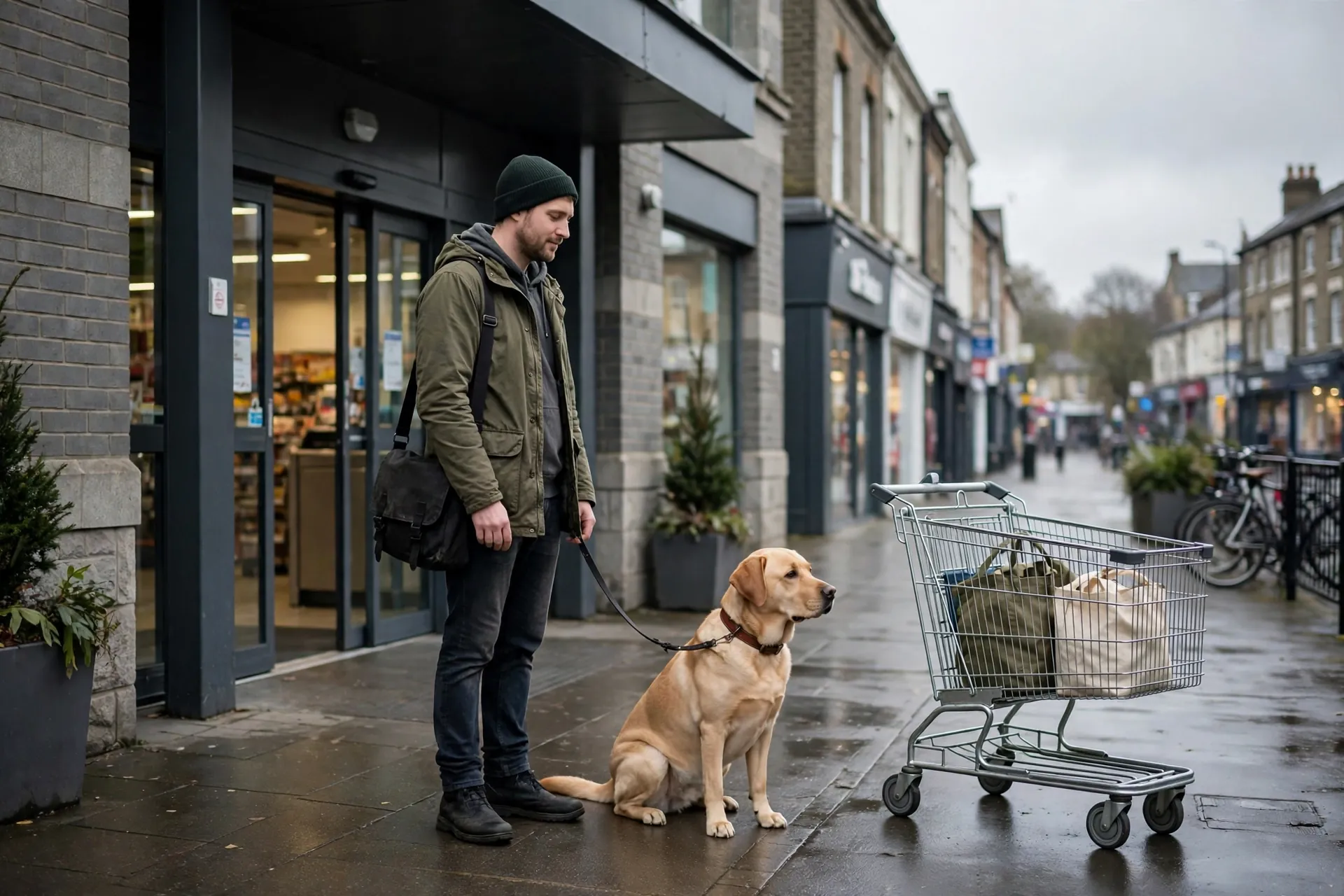
That split is worth contrasting with other shops. In supermarkets the default answer is no for pet dogs, as our guide to dogs in UK supermarkets sets out, because the whole premises is a food environment. A garden centre is the reverse layout: most of the floor area is plants, pots and outdoor furniture, and food is contained in one cafe or restaurant at the side. The building itself explains the policy. Where the plants stop and the plates start is where the welcome usually changes.
So the honest short answer is yes, probably, in most of the building, on a lead, with the food areas decided case by case. The sections below break that down by chain, by area and by the practical details — heat, trolleys, plant toxicity and toilet accidents — that decide whether the visit is relaxed or faintly stressful for everyone involved.
The big chains, one by one
Dobbies is the name most owners ask about first, because it is one of the largest garden centre groups in Britain and has built part of its identity around being dog-friendly. Most Dobbies stores welcome well-behaved dogs on leads in the main shop and plant areas, provide water bowls, and set aside a designated dog-friendly seating area within the restaurant rather than excluding dogs from eating areas altogether. Some stores run dog-related events and stock a pet department, which tells you the welcome is commercial as well as tolerant. Even so, the detail is set store by store: a smaller or food-led site may draw the line differently, so the store page for your branch is the document that counts.
British Garden Centres, the family-run group that has taken over many former Wyevale sites, is also broadly welcoming. Dogs on leads are commonly allowed in the plant areas and main shop across its centres, and many of its restaurants and coffee shops provide a dog-friendly seating section. Because the group grew by acquiring individual centres, the buildings vary enormously — a sprawling rural site with acres of outdoor plant tables handles dogs very differently from a compact centre where the restaurant is half the floor space. Expect the principle to be consistent and the layout to be local.
Notcutts, the long-established group concentrated in the south and east of England, generally welcomes dogs on leads in its garden centres and plant areas, with water available and dogs permitted in designated parts of its restaurants and outdoor seating. Blue Diamond, whose centres include some of the largest destination sites in the country, likewise allows dogs on leads in most areas of most centres, again with restaurant access usually limited to a specific section or terrace. Both groups state their policies centre by centre, and both reserve the right for staff to ask an owner to leave if a dog is causing a genuine disturbance — a clause worth reading as a description of the deal: welcome, conditional on behaviour.
Independent garden centres and nurseries are where the real variation lives. A traditional working nursery, where plants are grown on site, trolleys and forklifts move through the rows and the shop is a small hut by the till, may allow dogs everywhere without thinking twice — or may ban them from the glasshouses entirely because of narrow aisles and irrigation hoses. A polished independent with a farm shop and a busy bistro may be stricter about food areas than any chain. There is no shortcut here: independents reward a phone call, and most are pleased to be asked. If a centre has a farm shop attached, also read the food rules in our guide to dog friendly cafes in the UK, because the cafe counter is usually where an otherwise relaxed policy tightens.
Two smaller patterns complete the picture. Garden centres inside larger retail parks or department stores inherit the host store policy, which may be assistance-dogs-only even when the plant department looks outdoors. And chains that have changed hands recently sometimes run a new owner policy with an old owner signs still on the door. When the sign and the website disagree, believe the staff on the day — and tell the centre, politely, that the mismatch sent you in with the wrong expectations.
Where inside you can and cannot go
It helps to walk the centre in your head as four separate territories, because your dog welcome can change at each threshold without any sign you would notice while pushing a trolley.
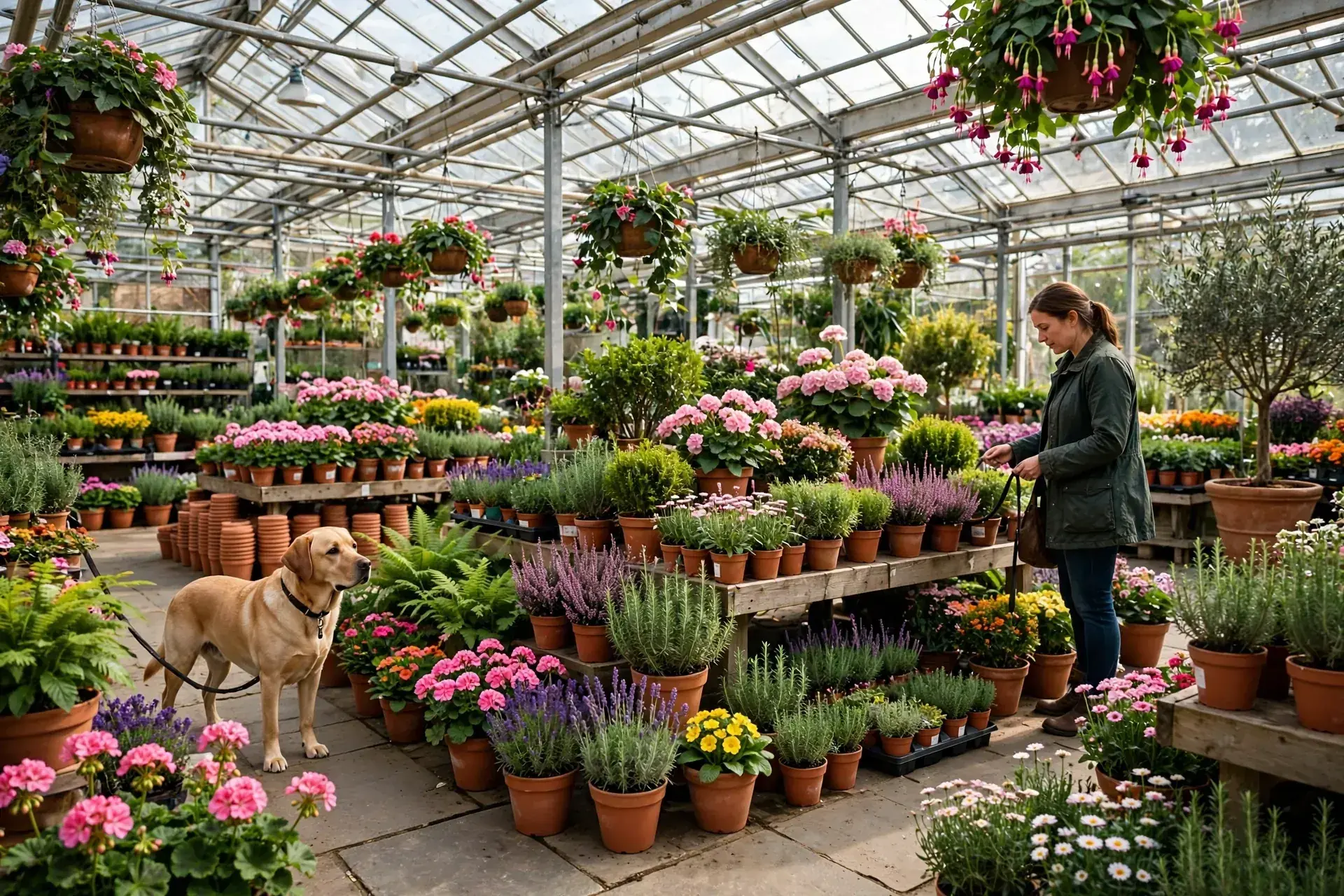
The outdoor plant area — shrubs, trees, perennials and seasonal bedding laid out on open-air tables — is the most reliably open territory in British garden retail. Dogs on leads are the norm here, water bowls appear by the doors in summer, and staff are used to stepping around a spaniel while they water. The covered plant area and glasshouses come next: usually open to dogs, but with conditions that make physical sense. Aisles are narrower, the floor can be wet, and a sweeping tail clears a shelf of small pots efficiently. Some centres exclude dogs from the houseplant glasshouse specifically, where stock is denser and more valuable.
The indoor shop — gifts, cards, clothing, food hall and Christmas department — is the middle territory. Most large chains allow dogs throughout; some restrict them to a route through to the plant area; a few with a substantial food hall draw the line at the food hall door, on the same hygiene logic as a supermarket. Watch for the paw-print stickers and door signs that mark the boundary, because they are often at ankle height, exactly where you are not looking while steering.
The cafe, restaurant and any children play area form the most restricted territory, covered in detail in the next section. Play areas, whether indoor soft play or outdoor adventure playgrounds attached to bigger centres, are almost universally no-dogs zones, and that includes the seating immediately around them at some sites. Toilets are a final practical point: you cannot take a dog into the customer toilets at most centres, which is a genuine logistics problem for solo owners. The workable solutions are to go before you go in, to use an accessible outdoor break midway, or to ask a companion — or, at a friendly independent, a member of staff — to hold the lead for two minutes. Plan that in advance rather than discovering it mid-visit.
Cafe versus restaurant: the food rule that decides everything
Food hygiene law does not ban dogs from cafes. What the law requires is that food is protected from contamination, and businesses interpret that duty conservatively in the places where food is prepared and served uncovered. That single fact explains the whole range of arrangements you will meet. A centre can lawfully seat your dog beside you; many choose to, in a defined area; some decide the layout of their servery makes it impractical; and all of them will keep dogs away from the counter, the cake display and the kitchen door.
Learn the vocabulary, because centres use it precisely. A cafe in garden-centre language usually means counter service, drinks, cakes and light lunches, often with a terrace. Dogs are most often welcome in part of it. A restaurant usually means table service, a longer menu and a more formal room — and dogs, if admitted at all, are typically confined to a marked section near the entrance or to outdoor tables. Some large centres run both, with opposite rules, under one roof. Asking are dogs allowed in the restaurant and being told yes may still mean yes, in six specific tables by the door, which matters if you have booked for a family group expecting to sit together in the main room.
Where dogs are seated, the etiquette is consistent everywhere and worth treating as a rule set rather than a suggestion. Dogs stay on the floor, never on chairs or benches, and never with paws or noses at table height. Bring a mat or settle blanket if your dog struggles to relax on hard floors — it gives the dog a defined place and keeps hair off the walkway. Water comes from the bowl provided or your own travel bowl, not from a glass. Feeding your dog scraps at the table is discouraged at many centres and feeding other people dogs is out of the question. If your dog cannot settle within a few minutes, barks at passing plates or fixates on the next table toddler, the kind and expected move is to finish your drink outside. Our guide to dog friendly restaurants in the UK covers table manners in more depth, and almost all of it applies unchanged to a garden-centre restaurant.
Booking deserves a mention, because destination centres at weekends and in December can queue for tables. If you book, say clearly that a dog is coming and ask which seating you have been given. Turning up with a reservation for the main restaurant and a large dog, to be reseated in a smaller dog section that is already full, is an entirely avoidable disappointment — for you and for the greeter who has to solve it.
Glasshouses, heat and the plants that can harm dogs
A glasshouse on a bright day is a solar oven with plants in it. Temperatures under glass climb far faster than the outdoor reading, ventilation is often set for the stock rather than for visitors, and the air at dog height among dense foliage can be hotter and stiller than the air at your shoulder. A dog that was comfortable in the car park can be panting hard within ten minutes in a tropical houseplant section in July. Treat glasshouses the way you would treat a parked car in miniature: short visits, constant checks, and a low threshold for stepping back outside. Panting that does not settle, drooling, restlessness or a dog pulling towards the door all mean the tour of the orchids is over.
Timing solves most of it. Walk the outdoor plant areas first, use the glasshouses in a short, purposeful pass, and leave the cafe — where the dog can lie on a cool floor with water — until last. On genuinely hot days, skip the glasshouse entirely and shop the shaded outdoor tables. Never leave a dog in the car while you browse instead: garden centre car parks are large, exposed and frequently hotter than owners estimate, and just ten minutes for compost stretches easily to forty.
The plants themselves need a moment of thought. Garden centres concentrate, in one retail space, a long list of species that are unkind to dogs if chewed — among them lilies, yew and laburnum in the outdoor lines, and philodendrons, dieffenbachia and other common houseplants indoors, alongside bulbs in autumn, which are a particular risk because dogs find them interesting to dig and chew. A browsing dog on a short lead, with its nose in a shrub, is normal garden-centre behaviour; a dog actively eating leaves or worrying at a bulb display needs redirecting, and any plant bought for a home with a chewer should be checked for pet safety before it goes on the floor by the door. The same caution applies to the chemical shelves: slug pellets, fertilisers and weedkillers are displayed at dog height, in packaging that smells interesting. Keep the lead short in the chemical aisle, and at home store anything you buy shut away — the centre shelving is not a guide to safe storage.
Water points round out the section. Many centres place dog bowls at entrances and cafe doors, but bowls empty, get kicked over and disappear in winter. Carry your own water and a foldable bowl as standard, exactly as you would for a walk, and offer a drink at every transition between areas rather than waiting for obvious thirst.
Leads, trolleys and garden-centre etiquette
The lead rule is universal and non-negotiable: a short, fixed lead for the whole visit. Extending leads are the single most common source of friction in garden centres, because they let a dog drift round a corner into another shopper, tangle round plant-table legs, and wrap around trolley wheels at exactly the moment someone is reversing a trolley of compost. Clip the extension shut or, better, bring a standard short lead and leave the flexi for the field afterwards. Our explainer on dogs on leads law in the UK covers the wider legal picture, but inside a private shop the house rule is what applies, and the house rule is short and close.
Trolley choreography deserves its own paragraph, because it is the skill that separates a calm visit from a chaotic one. Keep the dog on the side away from other shoppers, position the trolley between the dog and passing distractions in narrow aisles, and park both dog and trolley fully out of the thoroughfare when you stop to read a plant label. Never tie the lead to the trolley: a startled dog can pull a loaded trolley over, and an unattended trolley with a dog attached counts as an unattended dog. If you need two hands for a large pot, ask staff for help to the car — most centres offer it routinely — rather than improvising an anchor.
Meeting other dogs in the aisles follows shop rules, not park rules. Do not let dogs greet nose to nose between the plant tables: the space is enclosed, exits are blocked by trolleys, and a dog that is fine in a field may be defensive on a lead in a corridor of smells. Step aside, create distance, and let the other dog pass. The same applies to children, who at garden centres are often at exactly dog height, in pushchairs, with biscuits. A quick, cheerful he is friendly but we will keep moving protects everyone, including your dog.
The basics still apply and still get forgotten. A toilet break on the grass verge by the car park before you go in. Bags in your pocket, not in the car. Muddy paws wiped if you have come straight from a walk — centres mop constantly in winter, and a dog trailing mud through the gift department spends goodwill you may want later in the cafe. And if your dog does something antisocial — cocks a leg on a display, barks down the card aisle, steals a dropped scone — own it immediately, apologise, offer to pay for damaged stock, and learn the limit for next time. Staff forgive accidents quickly; they remember owners who pretend nothing happened.
Planning a proper garden-centre day out
The best garden-centre trips treat the centre as a destination with a rhythm, not a single errand. Arrive, toilet break in the car park, outdoor plant areas while energy is high and the dog is keen to sniff, a short pass through the shop, then the cafe while the dog settles on a mat, then a final loop for the heavy items with help to the car. That order keeps the hardest test — lying still while food passes — until the dog has had forty minutes of interesting smells and gentle walking, which is the closest retail equivalent of a proper walk warm-up.
Choose your timing with the dog in mind. Weekday mornings are the calmest slot in most centres, followed by late afternoons; Saturday late morning in spring and any weekend in December are the peaks, when queues, trolleys and other dogs multiply. Seasonal displays change the calculation too. The Christmas department is magical for humans and a sensory assault for dogs — grottos, animatronics, crowds and dropped chocolate all in one glittering aisle. Browse it while a companion waits outside with the dog, or visit on a quiet weekday and keep the pass brief.
Pair the centre with a walk and the day improves for everyone. Many rural centres sit near footpaths, canal towpaths or country parks, and a thirty-minute leg-stretch before or after shopping turns a tolerated outing into a genuinely good dog day. Check the map before you travel rather than hoping: a centre on a busy A-road with no pavement is a shop, not a day out, however good its plant policy is. In that case, walk first at home, shop efficiently, and do not dress the trip up as exercise.
First visits with a puppy or a nervous dog should be deliberately small. Ten minutes in the outdoor plant area, one calm interaction, a drink from the bowl by the door, and home. Garden centres are actually excellent socialisation environments — trolleys, mobility scooters, rustling foliage, strangers in hats — precisely because the stimuli arrive one at a time in a wide space with easy exits. Build up over several short visits and most dogs learn the routine: sniff the shrubs, ignore the trolleys, settle in the cafe, expect a gravy bone at the till where centres keep them.
How to check a centre in two minutes
Almost every confusion in this guide dissolves with a two-minute check before you leave home. Work through it in order. First, the centre own website: look for a visiting or FAQ page, because most chains publish their dog policy there, store by store, including which areas are included. Second, the individual store page rather than the group homepage — group statements describe the general welcome, store pages carry the exceptions. Third, if the website is silent or contradictory, phone the centre and ask three precise questions: are pet dogs allowed in the plant areas and main shop, is there dog-friendly seating in the cafe or restaurant, and are there any areas that are assistance-dogs-only today. Write the answers down; if the door staff disagree, a named answer from that morning is worth more than a printed sign from last season.
On arrival, do a ten-second scan before you get the dog out of the car. Door signs, paw-print stickers and a water bowl by the entrance confirm the welcome; an assistance-dogs-only sign means the dog stays in the car only if the weather and duration make that safe — and on a warm day, it means you go elsewhere or go home. If nothing is signed either way, ask at the entrance before you walk through, not at the till after a full shop. Asking early is never held against you; being asked to leave mid-visit is miserable for everyone.
Finally, leave the policy better than you found it. Centres review dog access when complaints accumulate, and every well-behaved dog on a short lead, settled under a cafe table, is an argument for keeping the doors open. The welcome described in this guide exists because, on balance, garden-centre dogs have been good business and good company. Keeping it that way is a collective project, and your visit is a vote either way.
Practical questions
Before you go
Are dogs allowed in Dobbies garden centres?
Most Dobbies stores welcome well-behaved dogs on short leads in the main shop and plant areas, and many provide water bowls and a designated dog-friendly seating area in the restaurant. Access can vary by store and food areas can be more restricted, so check the individual store page or ask at the entrance before you go in.
Can my dog come into the garden centre cafe?
Often yes, but rarely everywhere in it. Many centres allow dogs in a marked section of the cafe, on a terrace or in an outdoor seating area, while keeping them out of the main restaurant and away from food counters for hygiene reasons. Follow the signs on the day, keep your dog on the floor and off the furniture, and never let a dog approach another table uninvited.
Do garden centres allow dogs off the lead anywhere inside?
No. Dogs are expected to stay on a short, fixed lead throughout the shop, plant areas and cafe seating, and off-lead exercise is not permitted inside the centre. A few larger centres have an outdoor dog area or are next to a public walk, but the retail areas themselves are always on-lead. Use a short lead rather than an extending one in aisles and queues.
What if my dog needs the toilet inside the centre?
Take your dog outside to a grass verge, car-park edge or designated relief area as soon as you notice the signs, and always clean up afterwards, even outdoors. If an accident happens inside, tell a member of staff straight away so it can be cleaned safely, apologise and offer to help. A toilet break in the car park before you go in prevents most accidents.
Are assistance dogs treated differently in garden centres?
Yes. Assistance dogs are working dogs and must be allowed into all public areas of a garden centre, including restaurants and food areas where pet dogs may be restricted, under the Equality Act 2010. Staff should not ask for proof beyond the recognised identification an assistance dog normally carries, and refusing access to a genuine assistance dog is unlawful.