This guide is independent and contains no paid placement. Store policies change and can differ between locations, so check the official latest policy before you travel.
In most IKEA UK stores, pet dogs are not allowed inside — only assistance dogs are welcome. Do not plan around leaving your dog in the car. The workable options are leaving the dog safely at home, shopping with a second adult who stays outside with the dog, or using click and collect or home delivery to keep the trip short.
The short answer at the door
Nobody plans an IKEA trip the way they plan a holiday. It starts as a quick errand — one shelving unit, perhaps a lamp — and it ends, reliably, ninety minutes later with a trolley, a hot dog you did not intend to buy, and a box that only just fits in the car. That mismatch between the trip you imagine and the trip you actually take is exactly why the dog question matters here more than it does for a ten-minute shop. So start with the plain position: in most IKEA stores in the United Kingdom, pet dogs are not allowed inside the store, and only assistance dogs are welcome. Treat that as the working rule for every store unless the official information for that specific store, checked shortly before you travel, says something clearly different.
That answer frustrates people for understandable reasons. IKEA stores feel spacious, warehouse-like and informal compared with a small high-street shop, and many owners reason that a calm dog on a short lead among the shelving aisles would cause no trouble at all. Some owners have also seen photographs online of dogs in IKEA stores in other countries, or in trolleys, or in carriers, and assume the same welcome applies in Britain. It does not follow. Policies differ between countries, they differ over time, and a photograph proves only that a dog was there on one day — not that it was allowed to be there, and not that you will be admitted with yours this weekend. Arriving on the strength of a social media post is one of the most reliable ways to have an awkward conversation at the entrance with a full day planned around it.
There are two other half-beliefs worth clearing away at the start. The first is that a small dog in a bag, carrier or trolley is somehow not counted as a dog in the store. No sensible plan should rely on that distinction. If a store operates an assistance-dogs-only approach, staff are entitled to apply it to pet dogs however they are carried, and being asked to leave halfway round the one-way route, with a loaded trolley, is considerably worse than being refused at the door. The second is that a quiet, well-behaved dog will be waved through as an exception. Staff at the entrance should not be put in the position of grading individual dogs, and you should not build a trip on hoping that they will. Plan for the rule as written, not for the exception you hope to be granted.
None of this means an IKEA trip and a dog are incompatible. It means the dog part of the plan has to be solved before the furniture part, not improvised in the car park. The rest of this guide works through the pieces in the order they actually arise: who the exception is for, why food areas are a separate and stricter question, why the car is not the fallback it appears to be, and then the alternatives — click and collect, delivery, and the two-adult swap — that genuinely work.
The assistance dog exception
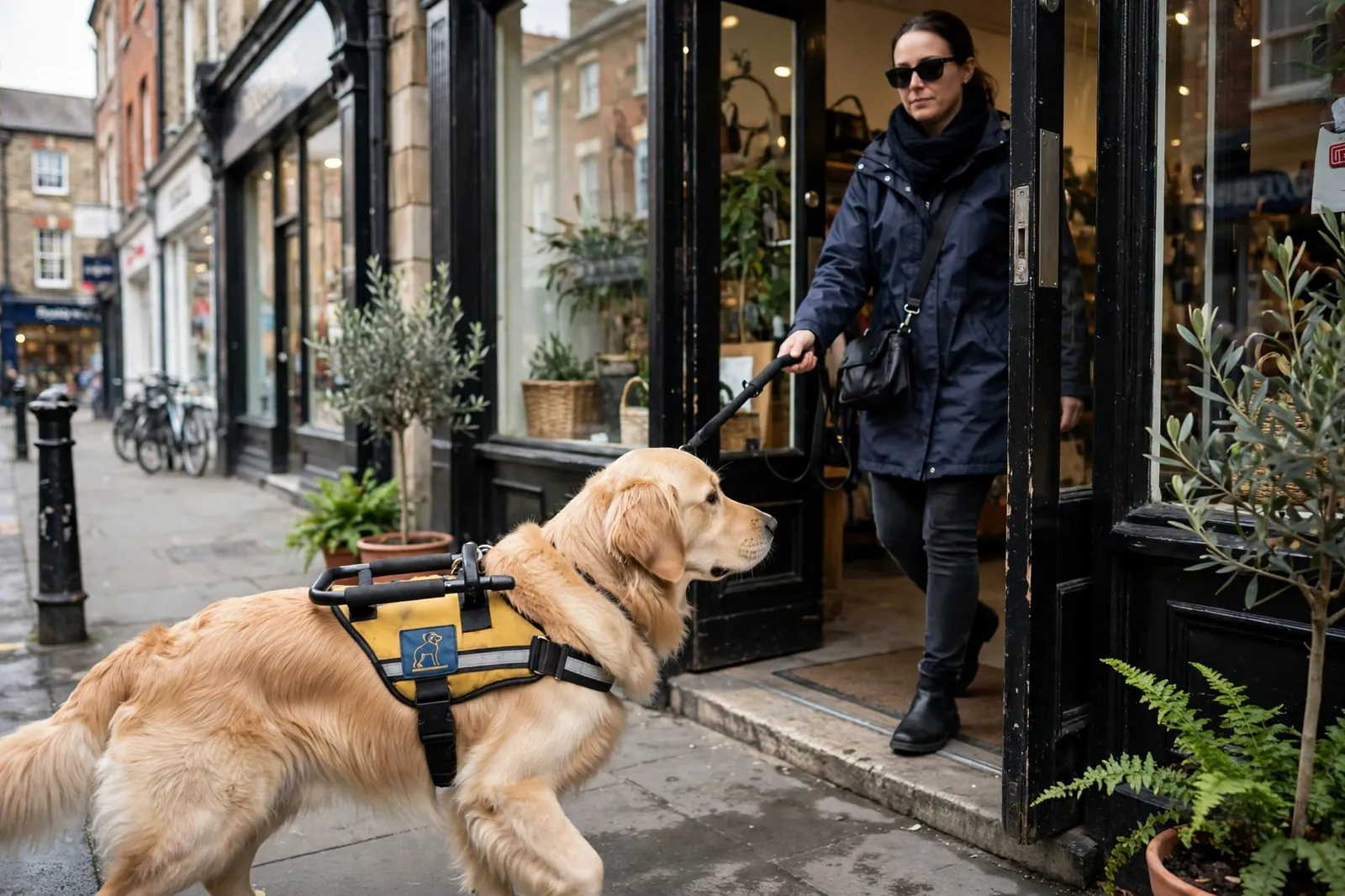
The exception to the pet-dog rule is for assistance dogs — dogs trained to support a disabled person with specific tasks, such as guiding a blind or visually impaired handler, alerting a deaf handler to sounds, or carrying out trained medical or mobility support. Assistance dogs should be welcomed in IKEA UK stores alongside their handlers, in the areas of the store that are open to the public. That welcome is not a favour granted by an individual member of staff; it reflects the legal position on assistance dogs in the United Kingdom and the responsibilities of service providers. If you want the wider picture on access, identification and what to do if you are challenged, read our guide to assistance dog rights in the UK, which covers the law and practical steps in detail.
In practice, a little preparation still makes an assistance-dog visit smoother, because IKEA stores have features that challenge any working dog. The showroom route is long and deliberately winding, the marketplace is busy with trolleys at ankle height, and weekends bring queues, children at dog height, dropped food and sudden noises from demonstrations and announcements. Consider visiting at the quietest time you can manage — typically a weekday morning or a later evening rather than a Saturday lunchtime — and build in rest and water breaks on a route that may take well over an hour. The warehouse section, with forklift activity nearby and very tall racking, deserves extra care; follow any staff directions there promptly, even if they briefly change your route.
Carry whatever identification you normally carry for your assistance dog, not because you should expect an interrogation, but because it resolves a mistaken challenge in seconds rather than minutes. If a member of staff does question you, a calm, brief explanation that yours is an assistance dog should settle it; if it does not, ask politely for a manager rather than debating at the door while a queue forms. Should a refusal ever happen, note the store, the date and time, and what was said, and follow it up in writing afterwards — that record is what makes a complaint effective, and it is far harder to reconstruct from memory a week later. And because store-level arrangements can occasionally be affected by refurbishments or temporary layouts, check the official latest policy before you travel, especially if you are making a long journey to a store you do not usually use. The same check-first logic applies at DIY stores: see our guide to dogs in B&Q, where each store manager can decide.
One boundary deserves to be stated plainly, because confusion here causes real harm: an emotional support animal, a therapy dog that visits settings by arrangement, and a pet that makes its owner feel calmer are not the same thing as a trained assistance dog, and presenting a pet as an assistance dog undermines access for the handlers who depend on it. If your dog is a pet, use the pet plans in this guide — they work well — rather than borrowing a status that is not yours.
Food areas are stricter still
Even owners who accept the showroom rule sometimes hope the restaurant will be different. It feels like a cafe, the reasoning goes, and plenty of cafes welcome dogs. But the IKEA restaurant, the bistro by the checkouts and the Swedish food market sit inside a food business, and food hygiene expectations make them the strictest part of the building for animals. Expect pet dogs to be refused in food areas, full stop. Do not plan a trip that depends on your dog sitting under the table while you eat, and do not assume that an outdoor-looking seating area, if a store has one, is automatically dog-friendly — ask the specific store in advance, or treat it as unavailable. After a big store trip, most dogs are ready for a rest — dog friendly cafes in the UK explains how to find places that welcome dogs indoors.
This matters for the shape of the whole trip, because for many families the restaurant is not an optional extra. It is the meal break in the middle of a long shop, the reward promised to children, and sometimes the main reason for choosing one retail park over another. If you are travelling with a dog using one of the outside-the-store plans below, the food stop needs its own arrangement: one adult eats or collects food while the other stays outside with the dog, you eat before or after the store visit at a genuinely dog-friendly place nearby, or you skip the in-store food entirely on this trip. Deciding that in the car, in advance, takes thirty seconds. Discovering it hungry, with a dog and a trolley, is how tempers and trips unravel.
Assistance dogs are again the exception here: a handler should not be separated from their assistance dog in order to eat, and assistance dogs should be accommodated in restaurant areas open to the public. Handlers can help staff help them by choosing, where possible, a table position where the dog can settle out of the main walking route between the counter and the seating — not as a condition of entry, but as the practical arrangement that lets the dog rest undisturbed through a meal in a crowded room. As everywhere in this guide, if a store has specific current arrangements, check the official latest policy before you travel.
Why the car park is not a plan
Faced with the rule at the door, the thought arrives quickly: the dog can wait in the car; it will not be long; the car park has shade at the far end; the window can be left open a crack. This guide's position, without qualification, is that you should not plan an IKEA trip around leaving your dog in the car. Not because every dog left for every short period comes to harm, but because an IKEA visit is close to the worst errand in Britain on which to rely on a car staying cool and a trip staying short. The reasoning has four parts, and each one is enough on its own.
First, heat. A parked car warms up far faster than most people intuitively expect, and it does so on days that do not feel hot to a person standing outside in a breeze. A mild, bright day in the late teens or low twenties can push the inside of a closed car to dangerous temperatures surprisingly quickly, and cracking the windows makes far less difference than people hope. Dogs cannot cool themselves as effectively as humans, and older dogs, puppies, flat-faced breeds and dogs with thick coats or existing health conditions are at greater risk still. Heatstroke is not a slow, gentle decline that gives you plenty of warning; it can become a veterinary emergency with lasting consequences. Our guide to dog car safety explains temperatures, warning signs and travelling arrangements in much more detail, and it repays reading before any summer errand, not just this one.
Second, shade moves. The shady corner you carefully chose at eleven o'clock may be in full sun by twelve, because that is simply what the sun does while you are somewhere between kitchens and picture frames with no phone signal of consequence and no sense of time passing. Multi-storey and covered sections of car parks, where they exist, are not a reliable fix either: they can still be warm, poorly ventilated and noisy, and you cannot assume a space will be available. A plan that depends on a shadow staying still is not a plan.
Third, the trip expands. IKEA is engineered, openly and skilfully, to be walked through in full. The showroom leads to the marketplace, the marketplace leads to the warehouse, the item you came for is out of stock in the colour you wanted, the alternative needs measuring, the measure needs a discussion, and the discussion needs a coffee. Add checkout queues and the flatpack loading puzzle at the car and a planned forty minutes becoming two hours is normal, not unlucky. Any arrangement for the dog has to survive the realistic version of the trip, not the optimistic one.
Fourth, there are risks beyond temperature. A dog visible and alone in a car can become distressed by passers-by, trolleys, alarms and other dogs being walked past the windows, and barking, scrambling dogs injure themselves in cars more often than owners expect. There is also the risk of interference: a genuinely concerned passer-by or member of staff may act on seeing a dog in a warm car, up to and including breaking in or calling the police, and theft of dogs from vehicles, while not an everyday event, is a known risk that a large, busy, anonymous car park does nothing to reduce. If you ever see a dog in distress in a hot car yourself, the standard advice is to note the registration, try to locate the owner via the store, and call the police if the dog appears to be in danger. For your own dog, the simple rule in our guide to driving with a dog and UK law applies here too: plan the journey around the dog's needs, not around the hope that nothing goes wrong while you are elsewhere.
Click and collect and other workarounds that actually work
The good news is that the way IKEA shopping has changed in recent years mostly helps dog owners, because the best alternatives shorten or eliminate the time anyone needs to spend wandering the store. The strongest of them is click and collect. You browse and pay online at home — with the dog asleep in its usual spot and a tape measure in your hand, which is also how measurements should be taken — and then travel to collect a prepared order. Depending on the store and the service, collection may involve a dedicated desk, a collection point or lockers, and in some cases a process that keeps your time inside the building to a few minutes. That transforms the dog problem: a collection trip can be timed precisely, combined with a second adult or a dog-at-home window, and it removes the open-ended showroom wander that makes car-park timing so unreliable.
Be precise about the details before relying on it, because they vary. Check whether your chosen items are eligible, what the collection charge is if any, how long the store holds an order, what identification or order confirmation you need, and exactly where the collection point is — at a large store, the difference between a collection entrance by the car park and a desk deep inside the showroom is the difference between a workable plan and a broken one. If any part of the process requires a longer indoor wait, treat the trip as a normal store visit for dog-planning purposes. And check the official latest policy before you travel, because collection arrangements are exactly the kind of operational detail that stores adjust.
Home delivery is the second workaround, and for bulky furniture it is often the best answer of all: the dog never travels, nobody waits anywhere, and the flatpack problem becomes a delivery-slot problem. Delivery charges and availability depend on the item and your postcode, and for a single small item the cost may outweigh the benefit — but compare it honestly against the true cost of the alternative, which includes fuel, time and a dog plan. For small items, remember also that much of the marketplace range can simply be ordered online for ordinary parcel delivery, turning a two-hour round trip into no trip at all.
The third option is to move the dog part of the day somewhere better. If the real purpose of the outing is a family day that happens to include IKEA, research what is near your store before you go: many stores sit on retail parks or near country parks, riverside paths or ordinary dog-walking routes within a short drive. One adult does the store while the other has a proper walk with the dog, and everyone meets back at the car in better spirits. What does not work is assuming a retail park itself offers a walk — expanses of tarmac, delivery traffic and novelty smells make most of them poor and stressful dog environments, useful for a brief toilet stop on a lead at the quiet edge, and for nothing more.
The two-adult swap and other honest plans
If you want to browse in person — and for kitchens, sofas and storage systems, many people reasonably do — the most reliable plan is also the oldest: go with another adult and take turns. One person shops while the other stays outside with the dog, then you swap, using phones to compare photographs and measurements. It works best when it is planned like a relay rather than improvised like a favour. Agree the list in advance, decide which decisions genuinely need both of you in front of the product, and put those items first, in a joint visit to that section if the store layout allows it efficiently, or by photographing options and deciding together outside. Take the measurements of your room, your car boot and any doorway the item must pass through before you leave home, and photograph the spaces — more IKEA trips are wasted on a missing measurement than on any other single cause.
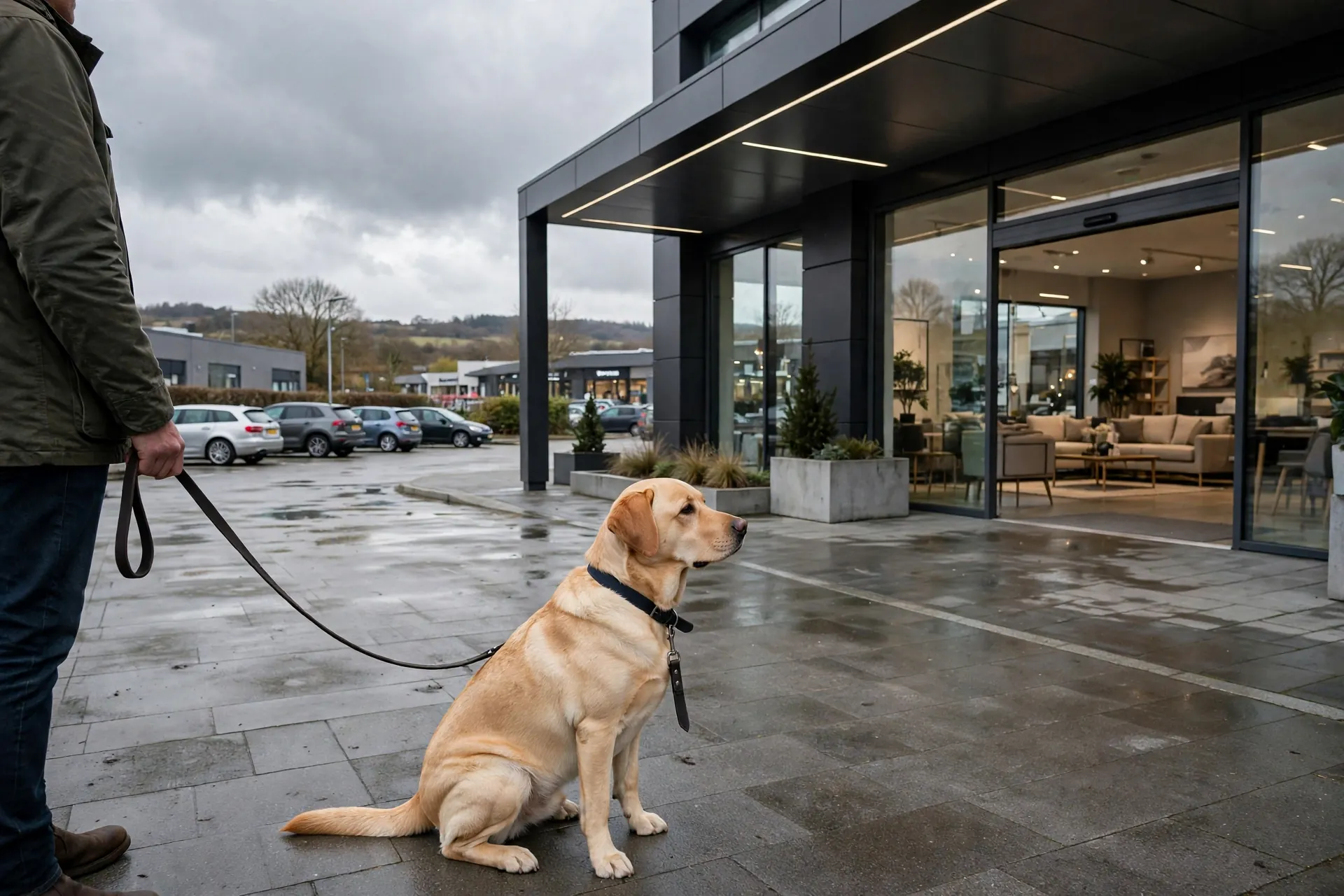
While one adult is inside, the outside adult's job is a real one, not a car-park vigil. Keep the dog outside the vehicle, on a lead, in the calmest spot available away from the trolley routes and the loading area, with water offered and shade if the day is warm. Better still, if there is a suitable walking route nearby, use it, and time the return to the swap. What the outside adult should not do is tie the dog up outside the entrance and go in together for just a few minutes. Dogs left tied outside shops are vulnerable to theft, to fright from trolleys and automatic doors, to well-meaning interference and to tangles and escapes; a few minutes has a way of becoming twenty, and the entrance of a large store is one of the busiest, least predictable places a dog can wait. If a store provides any designated waiting arrangement, use only that, and only as directed — otherwise, a dog waits with a person, or not at all.
Solo shoppers have fewer options, and it is better to say so than to pretend otherwise. If nobody can stay with the dog and the dog cannot stay home alone, the honest choices are delivery, click and collect with a short and certain collection process, or postponing the visit to a day when the dog has care. Leaving the dog at home, for most dogs and most trips, is genuinely the kindest option on the list: a settled dog on its own sofa, within its normal alone-time limits, with a walk before you leave and water down, is having a better afternoon than a dog watching a car park. Plan the trip inside that alone-time window with a margin for the checkout queue, ask a neighbour or a professional sitter to cover longer projects such as kitchen planning appointments, and never stretch a young, old or anxious dog's tolerance to fit a shopping trip — the savings on a bookcase are not worth a distressed dog or a damaged front door.
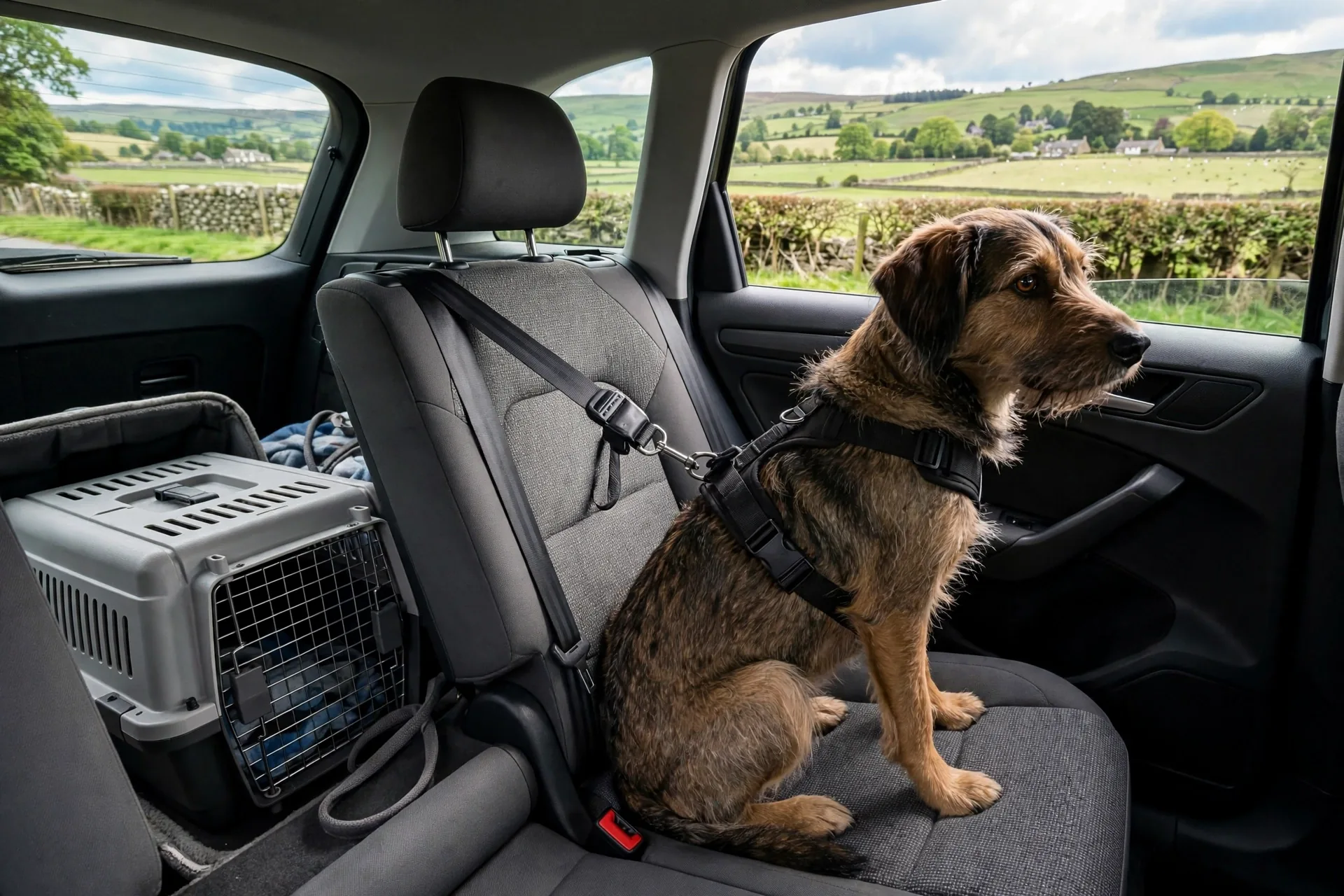
Whichever plan you choose, walk the dog properly before you set off and keep the pre-trip routine boring. A dog that has had exercise, a toilet opportunity and a normal morning settles at home or waits with a person far more calmly than a dog bundled into the car at the exciting start of an adventure that then excludes it. Travel itself should follow the usual rules: the dog secured safely in the car, never loose among flatpack boxes on the way home, and the load arranged so that nothing can slide onto the dog if you brake. Bulky purchases and dogs share boot space badly; if the boxes fill the car, the dog plan and the shopping plan were never compatible, and delivery was the answer all along.
England, Scotland, Wales and Northern Ireland: is it different?
Owners often ask whether the answer changes across the four nations of the United Kingdom — whether a store in Scotland, Wales or Northern Ireland might welcome pet dogs where an English store does not. The practical answer is that you should expect the same assistance-dogs-only position across IKEA stores in all four nations, because the pet policy is set by the retailer rather than by four separate legal regimes, and nothing in the general law of any nation requires shops to admit pet dogs. Retailers are free to welcome pets if they choose, and some do; they are equally free not to, and a store's choice does not become a right just because a different shop on the same retail park has made a different choice.
Where the nations do matter is the law around assistance dogs and equality, which sits within a broadly shared framework — the Equality Act 2010 covers England, Scotland and Wales, while Northern Ireland operates under its own disability discrimination legislation with a similar practical effect for service providers. For a dog owner planning a shopping trip, those differences rarely change what happens at the door: assistance dogs should be welcomed, pet dogs may lawfully be refused. Local details can still vary for reasons that have nothing to do with nationhood — an individual store's layout, a temporary refurbishment, a collection point in a different building, or a food area arranged differently — and a store in any nation can update its arrangements at any time.
So the working method is the same wherever your store is, from Exeter to Edinburgh, Cardiff to Belfast: assume pet dogs are not admitted, build your plan on that assumption, and then, if the detail matters to your trip, check the official latest policy for that specific store before you travel. Do not rely on a review, a forum answer or a friend's experience at a different store last year, however confident it sounds. Policies are exactly the kind of fact that expires quietly, and the only version that counts is the current one for the store you are actually visiting.
If you are turned away at the entrance
It is worth rehearsing the refused-at-the-door moment, because it happens to well-meaning people who were told by the internet that it would be fine, and how it goes depends mostly on the next two minutes. If staff explain that only assistance dogs are allowed inside, accept it gracefully and without negotiation. The person at the entrance did not write the policy, cannot suspend it for a dog they agree is lovely, and may be dealing with the same conversation several times a day. Arguing, or attempting to enter by another door, helps nobody and can end with you being asked to leave the premises altogether — a poor outcome when the same store's collection point might have solved your problem in ten minutes.
Instead, convert the trip on the spot. Ask where the click and collect point is and whether the items you need can be ordered for collection or delivery; many purchases can be salvaged from the car, on your phone, with the dog getting a walk while you wait for a collection slot or a decision. If a second adult is with you, switch to the swap plan. If you are alone and the purchase cannot wait, the realistic options are a much shorter, clearly bounded shop only if the dog has a safe place to be — which, to be clear, is not the car on a warm day — or going home and reordering the day. Going home feels like failure and is actually the system working: the rule existed before you arrived, and a wasted journey is a lesson about checking first, not an injustice to contest.
Then, for next time, do the thing that prevents a repeat: check the store's official information before travelling, save it, and plan the dog's day with the same care as the shopping list. If you believe you and an assistance dog were wrongly refused, that is a different and serious matter — follow it up in writing with the store and the retailer's customer service, with dates, times and names if you have them, and use the assistance dog guidance linked earlier in this guide. Keeping those two situations distinct — a pet refusal to accept politely, an assistance refusal to challenge properly — is part of how access stays protected for the people who need it most.
Checklist before you set off
Run through this list the night before, and an IKEA trip with a dog in your life becomes routine rather than a gamble. First, decide which of the three workable plans you are using — dog at home within its comfortable alone-time, two-adult swap, or click and collect or delivery — and say it out loud to everyone travelling, so nobody arrives with a different assumption. Second, check the official latest policy and the specific store's arrangements, including where the collection point is and when it closes. Third, if the dog is staying home, arrange the walk, feeding and water around the realistic trip length, with margin, and line up a neighbour, friend or sitter for any trip that includes a planning appointment or a kitchen design session.
Fourth, pack for the version of the day the dog will actually have: lead, water and a portable bowl, poo bags, a familiar blanket or toy for a home-alone settle or a wait with the second adult, and any medication the dog needs if the trip could stretch across a dose. Fifth, measure everything at home — the room, the wall, the boot, the doorway — and photograph the spaces, because a return trip doubles every dog problem in this guide. Sixth, think about food honestly: if the restaurant was part of the attraction, decide now how eating works under your plan, rather than at the restaurant door. Seventh, look at the weather with the dog in mind, not just yourselves; a hot day strengthens the case for delivery or for leaving the dog at home in a cool house, and it removes the car from consideration completely.
Finally, keep a short list of other dog-welcoming errands separate in your mind, so that IKEA's rule does not sour you on shopping with your dog altogether. Plenty of garden centres, pet shops and independent stores do welcome dogs, and our guides to dog-friendly markets in the UK and free dog days out in the UK will give you outings where the dog is genuinely part of the day rather than a logistics problem to be solved. The skill this guide is really teaching is matching the dog to the errand: bring the dog where the dog is welcome and has something to enjoy, and give the dog a quiet day at home for the warehouse run. Both of you will prefer it that way.
Practical questions
Before you go
Are dogs allowed in IKEA stores in the UK?
In most IKEA UK stores, pet dogs are not allowed inside and only assistance dogs are welcome. The rule can vary by store and can change, so check the official latest policy for your specific store before you travel and do not assume a dog in a carrier or trolley will be admitted.
Can my dog come into the IKEA restaurant or food area?
No, not as a pet. Food areas are the strictest part of the store because of food hygiene rules, and pet dogs should be expected to be refused there even if you have managed a brief errand elsewhere. Assistance dogs are different and should be allowed to accompany their handler, subject to the official latest policy.
Can I leave my dog in the car while I shop at IKEA?
You should not plan to do this. Cars heat up far faster than most people expect, shade moves, and an IKEA trip routinely takes much longer than planned. Leaving a dog in a car park also risks distress, theft and intervention by passers-by or staff. Keep the dog at home or use a plan where a responsible adult stays with the dog outside the car.
Does IKEA UK offer click and collect if I have my dog with me?
Yes, click and collect and home delivery are the most practical alternatives for most dog owners because they shorten or remove the time inside the store. Availability, collection points and charges vary by store and by item, so confirm the details for your order and check the official latest policy before you travel.
Are assistance dogs allowed in every part of an IKEA UK store?
Assistance dogs should be welcomed in IKEA UK stores, including alongside their handler in areas open to the public. If you rely on an assistance dog, carry any identification you normally use, plan for busy periods, and check the official latest policy before you travel in case a particular store has temporary arrangements in place.