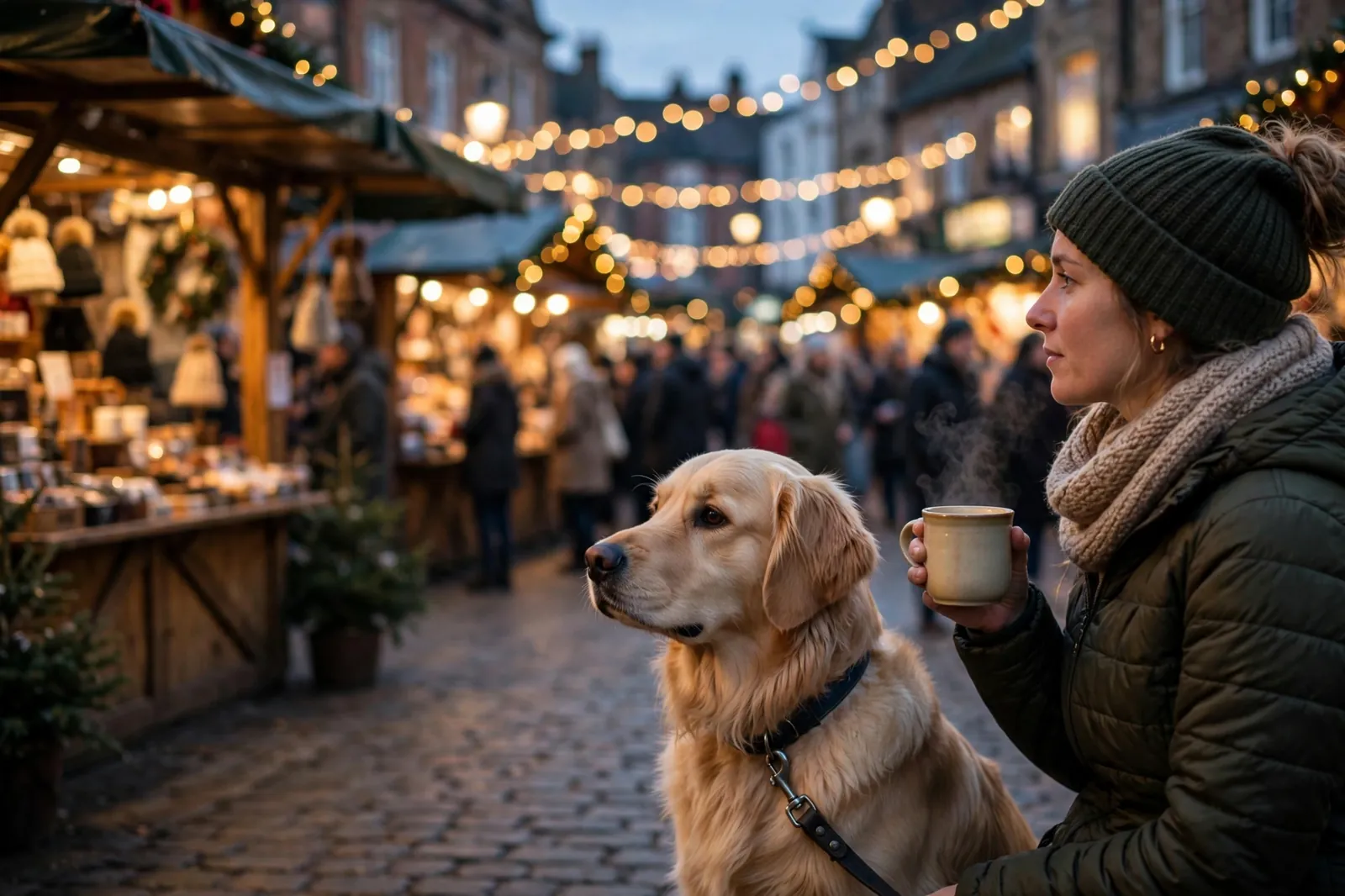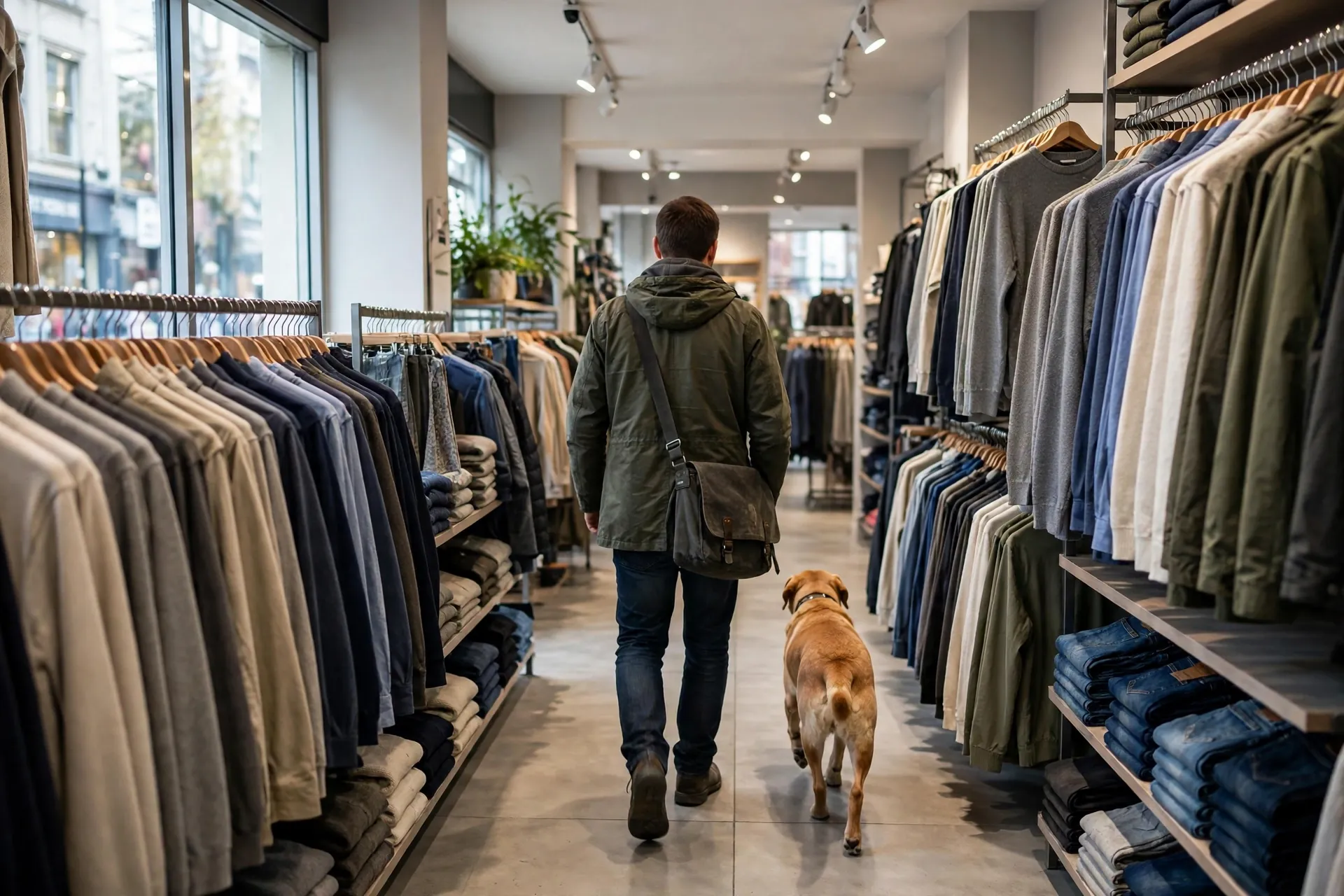
This guide is independent and contains no paid placement. Store practice can change and varies by location, so treat this guide as a planning aid and confirm the position at the store you intend to visit.
No in the food hall, often yes elsewhere. Expect pet dogs to be more welcome in M&S clothing and home departments than in food halls, assistance dogs to be welcome throughout, and individual stores to apply the details differently. Confirm with your specific store before you travel.
The direct answer
If you are standing outside a Marks and Spencer store with a dog and need one sentence, it is this: ask first, and do not treat the answer from one store as a promise for the next. That sounds cautious, and it is meant to be. Marks and Spencer operates stores of very different sizes and layouts, from large high street flagships with separate clothing, home and food departments to smaller food-only shops, railway station units, outlet stores and concessions inside other buildings. A rule that works neatly in a spacious clothing floor can be impractical in a compact food hall, and a manager dealing with a crowded Saturday will sometimes apply a rule more strictly than the same store does on a quiet weekday morning.
The distinction that matters most is between pet dogs and assistance dogs. Pet dogs are welcome in many retail settings at the discretion of the retailer, and that discretion can be limited by department, by store, by time of day or by local conditions. Assistance dogs, by contrast, are not a discretionary extra. Under equality law, a disabled person who relies on an assistance dog should not be refused access to a service because of the dog, and that protection applies across the store, including areas where pet dogs are not admitted. If you travel with an assistance dog, the rest of this guide still helps you plan the practicalities, but the legal starting point is different, and it is covered in its own section below.
For pet dogs, the pattern most shoppers describe is consistent enough to plan around, even though it is not a guarantee. Clothing and home areas are the parts of the store where dogs are most often welcome. Food halls are the parts where restrictions are most likely, because food hygiene rules and the practicalities of narrow aisles, open food displays and busy trolleys make managers understandably careful. Cafes inside stores sit somewhere in between: some welcome dogs, some restrict them to a particular seating area, and some do not admit them at all. The safest mental model is a store with zones, not a store with a single yes or no answer.
That zone model changes how you should plan a trip. Instead of asking, in general terms, whether Marks and Spencer allows dogs, ask three sharper questions. Which departments in this particular store welcome pet dogs? Does the route to those departments pass through a food hall or another restricted area? And what happens if the answer changes on the day, because the store is unusually busy or because a particular department is closed for refurbishment? If you can answer those three questions before you set off, you will rarely be caught out at the door. If you cannot, build in a fallback: another adult who can wait with the dog, a nearby dog-friendly cafe where you can regroup, or a decision to visit without the dog on that occasion.
It is also worth being honest about what this guide cannot do. It cannot give you a definitive, store-by-store list that will stay accurate, because local practice changes, individual managers make judgement calls, and seasonal layouts move departments around. Christmas displays, sale events and refurbishments all change floor plans. A store that welcomed dogs in its clothing department last year may route shoppers differently this year, and a store that refused dogs last winter may have changed its approach since. That is why the repeated advice in this guide is not filler: check the official guidance before you travel and confirm with the specific store. The five minutes that takes is far cheaper than a wasted journey with a disappointed dog.
Finally, remember that your dog is part of the calculation, not just the policy. A calm dog that settles beside a rail of coats is a very different visitor from a young dog that pulls towards every stranger, barks at other dogs or tries to investigate low displays. Even in a store that welcomes dogs, staff are entitled to ask you to leave if a dog is causing a disturbance or creating a safety problem. Planning for the policy is only half the job; planning for your dog's behaviour in a bright, noisy, scent-rich indoor space is the other half, and it is covered in detail later in this guide.
Food hall versus clothing and home: where the line usually falls
The food hall is where most confusion happens, so start there. Food retailers in the United Kingdom operate under food hygiene rules that require them to keep food safe from contamination, and dogs in a food preparation or open-food area are an obvious risk to manage. That does not automatically mean that every food hall bans every dog in every circumstance, but it does mean that food areas are treated with far more caution than clothing rails. If you arrive expecting to browse the food hall with a pet dog, you are setting yourself up for the most common disappointment in this whole topic. Plan on the basis that the food hall is off limits for pet dogs, and treat any permission to enter it as a welcome surprise rather than an expectation.
Clothing and home departments are a different environment. There is no open food, aisles are generally wider, and the main concerns are practical rather than hygiene-related: dogs knocking over displays, soiling carpet, barking at other shoppers or getting tangled in rails and cables. A well-behaved dog on a short lead is much easier to accommodate there, and that is why many stores are relaxed about dogs in those departments even when they draw a firm line at the food hall. Home departments deserve a little extra care, because they often contain low displays, candles, glassware, bedding and furniture at nose height. A dog that is calm beside a coat rail can still be a hazard beside a display of glass vases, so keep the lead short and steer wide around fragile displays.
The tricky part is the journey between departments. In many stores, clothing and food are not sealed off from each other by a single obvious door. You may need to cross a shared entrance, pass a food display near the tills, or use a lift or escalator that serves both areas. If your route to the clothing department passes through the food hall, the practical answer may be that you cannot reach the dog-friendly department with the dog, even though dogs are welcome once you are there. Ask about the route, not just the destination. A useful question is: can we reach the clothing department without passing through the food hall, and if not, is there an alternative entrance or a member of staff who can advise?
Cafes and seating areas inside stores need their own check. Some in-store cafes welcome dogs throughout, some welcome them only in a defined seating area, and some do not admit pet dogs at all, particularly where food is served at tables. The same store can therefore have three different answers depending on whether you mean the clothing floor, the cafe and the food hall. If a coffee stop is part of your plan, ask about the cafe separately, and have a backup in mind. Our guide to dog friendly cafes in the UK explains how to check cafe policies and what good cafe etiquette looks like, which is useful preparation for any in-store cafe visit.
Tills and entrances are another grey area. A dog that is welcome on the clothing floor still needs to get through the entrance and, eventually, to a till. Most stores handle this sensibly, but a busy entrance with trolleys, queues and automatic doors is a pinch point, especially for a nervous dog. Keep the dog close, avoid blocking the doorway while you get your bearings, and move promptly to a quieter part of the floor. If you are paying at a till that serves both clothing and food, ask staff where to stand so that you are not blocking a food queue with a dog that should not be in that zone.
Seasonal changes can move the line. At Christmas, food halls expand, gift displays spill into walkways, and clothing departments gain seasonal food and drink displays. A route that was clear in September may be lined with open food in December. Sale events have a similar effect: temporary displays narrow aisles, crowds increase, and managers may tighten the rules for a weekend to keep the store safe. If you are visiting during a sale or the festive period, re-check the position rather than relying on what was true in a quiet month.
The practical conclusion is simple. Treat the store as a set of zones, plan your visit zone by zone, and never assume that permission for one zone implies permission for another. That approach also makes conversations with staff much easier, because you are asking a precise question about a precise area instead of demanding a blanket answer that the member of staff may not be authorised to give.
Assistance dogs: the exception that matters
Assistance dogs are in a different category from pet dogs, and it is important not to blur the two. A person who uses an assistance dog, such as a guide dog, hearing dog or other trained assistance dog, has legal protection against being refused a service because of the dog. In practice, that means an assistance dog should be welcome throughout a Marks and Spencer store, including the food hall and any in-store cafe, because refusing access would amount to refusing the service to the person who relies on the dog. This is not a favour or a local concession; it is the starting point for how the law expects retailers to behave.
That protection does not mean that every interaction will be smooth. Staff turnover is high in retail, training varies, and a new member of staff may not recognise every type of assistance dog or may confuse an assistance dog with a pet dog or an emotional support animal, which does not carry the same legal status. If you are challenged, the calmest and most effective response is usually a short, clear explanation that the dog is a trained assistance dog, followed, if necessary, by a request to speak to a manager. Carrying any identification or documentation your assistance dog organisation provides can help, although you should not be required to produce paperwork on demand as a condition of entry, and you should not feel obliged to disclose more about your disability than you wish to.
Other shoppers can also be a source of friction. People may try to pet, feed or distract an assistance dog, or may question why a dog is in a food area when their own pet dog was refused. You do not owe strangers an explanation, and staff should support you if a situation becomes uncomfortable. If you are travelling with an assistance dog and want a fuller picture of your rights, including what to do if access is refused, our guide to assistance dog rights in the UK sets out the position in detail and is worth reading before a trip that involves several different retailers.
For everyone else, the assistance dog exception is a reason to be gracious rather than resentful. If you see an assistance dog in a food hall while your pet dog waits outside, that is not inconsistency or favouritism; it is the law working as intended. It is also a reason not to misrepresent a pet dog as an assistance dog. Doing so undermines the access of people who genuinely rely on assistance dogs, puts staff in an impossible position, and, if discovered, will rightly damage your credibility for future visits. Keep the categories honest and the system works better for everyone.
One further practical point: assistance dogs are trained to work calmly in busy public places, to ignore food on the ground, and to settle under tables and beside tills. If your pet dog is still learning those skills, that is not a criticism; it is simply a reminder that the two categories are judged by different standards for good reason. The behaviour section later in this guide offers realistic steps for building up to a store visit, rather than expecting a first visit to go perfectly.
Why stores differ: size, layout, landlords and local judgement
Once you accept that stores differ, the next question is why, because understanding the reasons makes the variation easier to predict and easier to discuss politely with staff. The first reason is size and layout. A large out-of-town store with wide aisles, a separate clothing floor and a food hall behind its own entrance can welcome dogs in one area without creating problems in another. A small high street store where clothing, food and tills share a single floor cannot separate the zones so neatly, so the stricter food rule may effectively govern the whole shop. A station or airport unit may be governed by the rules of the station or airport as well as the retailer, which adds another layer of restriction.
The second reason is the landlord and the building. Stores inside shopping centres, retail parks and railway stations operate under leases and centre rules that can restrict animals beyond the retailer's own policy. A shopping centre may allow dogs in its malls but not in food courts, or may require dogs to be carried in certain areas. A listed building with narrow corridors or a store with a single lift may have safety reasons for limiting dogs at busy times. When a member of staff says that the rule comes from the centre rather than the store, that is often literally true, and arguing with the store will not change the centre's rule.
The third reason is local judgement. Store managers are responsible for safety in their store on the day, and they may tighten or relax a general approach in response to what is happening in front of them. A store that normally welcomes dogs in clothing may ask dog owners to wait outside during a fire alarm practice, a refurbishment, a particularly crowded sale day or a health and safety inspection. Conversely, a store that is normally cautious may be relaxed on a quiet Tuesday morning when the manager can see that the dog is calm and the aisles are empty. Neither decision is necessarily a change of policy; both are examples of local judgement being applied to local conditions.
The fourth reason is history. If a store has had incidents involving dogs, such as fouling on carpet, damage to displays, a bite or a near miss with a trolley, managers will understandably become more cautious. If a store has had years of uneventful dog visits, managers will be more relaxed. You will rarely be told this history, and you should not ask for it, but it helps to understand why two stores that look identical on paper can feel very different in practice. Your own behaviour on the day becomes part of that history for the next dog owner, which is a good reason to leave a positive impression.
Finally, policy itself changes over time. Retailers review their approach to dogs periodically, sometimes in response to customer feedback, sometimes after a change in food hygiene guidance, and sometimes as part of a broader move to become more or less dog-friendly. A blog post from three years ago, a social media comment from another shopper, or a friend's experience last Christmas may all be out of date. The only reliable sources are the retailer's current official guidance and the store itself, checked close to the day of your visit.
All of this points to the same practical habit: check locally, check recently, and check the specific departments you intend to visit. It also points to a useful attitude when you are told no. A refusal is rarely personal, and it is often explained by one of the factors above. Thanking staff, asking what alternative they can suggest, and moving on gracefully will get you further than arguing about what another store allowed last month.
A practical visit plan: from the car park to the till
A good store visit with a dog is mostly decided before you leave home. Start with the check: look at the official guidance, then contact the specific store and ask which departments welcome pet dogs, whether the route to those departments avoids the food hall, and whether there are any times when the rule is applied more strictly. Note the name of the person you spoke to and the date, not because you intend to argue, but because it helps you remember what was actually said if you return weeks later and the layout has changed.
Next, choose your timing. Quiet weekday mornings are almost always easier than Saturday afternoons, sale opening hours or the week before Christmas. A quiet store means wider effective aisles, fewer dogs and children to react to, shorter queues and staff with more time to help. If you must visit at a busy time, keep the visit short, have a clear list, and consider splitting the trip: one person handles the food hall while the other waits with the dog, then you swap for the clothing department if the dog is welcome there.
Before you enter, give the dog a proper toilet break and a short settling walk. A dog that has just arrived after a car journey, without a chance to toilet or sniff, is far more likely to be restless indoors. Bring water and a portable bowl, especially in warm weather, and bring a bag for waste even though you do not expect to need it indoors. Check the lead: a short, fixed lead gives you control in aisles, while a retractable lead is a poor choice indoors because it lets the dog wander into displays and other shoppers' paths.
On arrival, pause just inside the entrance rather than striding straight to the first rail. Look for signs about dogs, check the layout, and ask a member of staff to confirm which areas are open to your dog today. That thirty-second conversation prevents the most common problem, which is discovering halfway around the store that you have wandered into a restricted area. It also signals to staff that you are a considerate visitor, which makes them far more likely to help if you need directions or a quiet corner.
Inside the clothing and home departments, walk the edges of aisles rather than the centre where trolleys and other shoppers converge, and keep the dog on the side away from displays. Pause regularly and let the dog settle beside you while you browse, rather than dragging a dog that is still scanning the environment from rail to rail. If the dog becomes restless, barky or distressed, treat that as information, not failure: step outside, give the dog a break, and decide whether to continue alone or to cut the visit short. A short, calm visit that ends well is worth far more than a long visit that ends with the dog being asked to leave.
At the till, keep the dog close and clear of the queue behind you. If the till area serves food as well as clothing, ask staff where to stand. Pay promptly, gather your bags without blocking the aisle, and leave by the most direct route. If you need to visit the food hall as well, do it as a separate leg of the trip, with one adult waiting with the dog outside the food area while the other shops. Agree the meeting point in advance, keep the food shop as quick as possible, and do not leave the waiting adult and the dog in a spot that blocks an entrance or a fire exit.
After the visit, reflect briefly on what worked. Which entrance was easiest? Which department was calmest? Did staff confirm the policy you expected, or did they add a local detail worth remembering? A short note on your phone will make the next visit to the same store much smoother, and it will help you give accurate advice to other dog owners instead of repeating a vague impression.
For a broader picture of how supermarkets handle dogs, including the food hygiene reasoning that shapes many of these rules, our guide to dogs in UK supermarkets is a useful companion read. It explains why food retailers are cautious, how different chains approach the same problem, and what alternatives exist when a food shop and a dog trip have to be combined.
If your dog cannot come in: sensible alternatives
There will be visits when the answer is no, or when the dog-friendly part of the store is not the part you need. That does not have to ruin the trip, provided you have a plan that does not involve leaving the dog in a risky situation. The best alternative depends on how many people are travelling, how long the shop will take, and what the weather is doing, so think through the options before you need them.
Travelling with another adult is the simplest solution. One person shops while the other waits with the dog, and you swap if the second person also needs to browse. Choose the waiting spot carefully: shade in summer, shelter in rain, away from busy entrances and delivery bays, and somewhere the dog can settle without being approached by a constant stream of strangers. Keep the wait as short as you honestly can, and agree a time to meet rather than leaving the waiting adult to guess. If you are travelling alone, this option disappears, which is why solo shoppers need a different plan.
Click and collect and home delivery are underused alternatives for dog owners. If the main purpose of the visit is food shopping, ordering online and collecting from a car park collection point, or having the order delivered at home, removes the conflict entirely. If the purpose is clothing, ordering several sizes online and returning what does not fit is often less stressful than trying on clothes while managing a dog in a fitting room area. Fitting rooms deserve a specific warning: even in a dog-friendly clothing department, fitting rooms are often restricted or impractical with a dog, so ask before you assume you can take the dog in with you.
A nearby dog-friendly cafe or park can turn a refused entry into a pleasant diversion rather than a wasted journey. One person can shop while the other walks the dog nearby, then you meet for coffee. Our guide to dog friendly cafes in the UK can help you find a suitable stop, and planning that stop in advance is far better than searching for one while standing outside a store with a restless dog. If the town has a dog-friendly market or a pleasant high street walk, the same logic applies: split the trip so that the dog gets something enjoyable while the shopping gets done.
What you should not do is leave the dog in the car. Cars heat up surprisingly fast, even on mild or overcast days, and a dog left alone in a car can overheat, become distressed, or attract well-meaning intervention from passers-by. The same warning applies to tying a dog up alone outside a store. A tied dog outside a busy entrance is vulnerable to theft, to unwanted attention from strangers, and to distress if it cannot see you or move away from something frightening. If neither a waiting adult nor a delivery or collection option is available, the responsible choice is to visit without the dog on that occasion.
Daycare, a trusted friend, or a pet sitter is another option for a longer shopping trip, particularly if the trip involves several stores or a whole day out. Even a short stay with a familiar person is kinder than a long wait in an unfamiliar place. If you are on holiday and staying nearby, check whether your accommodation allows the dog to be left briefly, and read our guide to dog friendly hotels in the UK for the questions to ask about leaving a dog in a room. Never assume that a hotel room is a suitable waiting place without checking the hotel's own rules.
For another everyday errand: Our guide to dogs in the Post Office explains branch-by-branch rules before you queue with a parcel.
Store formats and what changes
Marks and Spencer is not one type of shop, and recognising the format you are visiting helps you predict the likely answer. Large high street and retail park stores with full clothing, home and food departments offer the most scope for a zoned approach, because the departments are large enough to be treated separately. These are the stores where a dog-friendly clothing floor alongside a restricted food hall is most plausible, and where staff are most likely to be able to direct you to a suitable route.
Food-only stores and smaller Simply Food style shops are a different proposition. Where the whole store is essentially a food hall, there may be no non-food zone for a pet dog to visit, and the practical answer is likely to be no for pet dogs, with assistance dogs excepted. Do not be surprised by this, and do not treat it as a contradiction of what a larger store allowed. The format, not the brand name on the door, is what determines the answer.
Outlet stores add another variation. Outlets are often in retail villages with their own centre rules, wider outdoor areas and a mix of clothing and home stock with limited or no fresh food. Dogs may be welcome in the outlet itself while the wider centre has its own rules about dogs in malls, food courts and outdoor seating. Check both the store and the centre if you are planning an outlet trip, and remember that a dog-friendly outlet does not guarantee a dog-friendly lunch stop in the same village.
Concessions and stores inside other buildings are the hardest to predict. A Marks and Spencer food unit inside a railway station, hospital, motorway service area or another retailer's store will be governed by the host building's rules as well as the retailer's. Station rules, in particular, can be strict about dogs in food areas and may require dogs to be on leads and under control throughout. If you are passing through a station and hoping to pop into a food unit, assume the stricter rule applies and plan accordingly.
Seasonal pop-ups, Christmas shops and temporary gift areas can also blur the picture. A temporary display in a clothing department may include food and drink gifts, which can change how staff view that area for a few weeks. Similarly, a refurbishment may close one department, move the entrance, or route all shoppers through the food hall for a period. If you have visited a store before, do not assume the layout is unchanged; check again if the visit matters.
The lesson from all these formats is to name the format when you ask. Instead of asking whether Marks and Spencer allows dogs, ask whether this particular store, in its current layout, welcomes pet dogs in its clothing department, and how to reach that department without passing through food areas. A precise question gets a precise answer, and a precise answer is what you need to plan a stress-free visit.
Behaviour that keeps the welcome open
Retailers keep welcoming dogs when dog visits go well, and they tighten the rules when visits go badly. Every dog owner who visits a store is therefore, whether they realise it or not, shaping the welcome for the next dog owner. That is not a reason to feel guilty; it is a reason to prepare well and to be realistic about what your dog can cope with.
Start with the basics that matter indoors: a reliable recall to your side, a settle on a mat or beside your feet, tolerance of strangers passing close by, and no lunging at other dogs, children or trolleys. These are not advanced skills, but they are different from the skills a dog uses on a country walk. Practice them in quieter indoor settings first, such as a dog-friendly cafe at a quiet time, a garden centre, or a pet shop, before attempting a busy department store. Short, successful visits build confidence far faster than one long, overwhelming visit.
Lead handling matters more indoors than outdoors. Keep the lead short enough that the dog cannot reach displays, other shoppers' bags or food on the floor, but loose enough that the dog is not constantly being pulled back. Avoid retractable leads entirely in a store. If your dog pulls strongly, consider whether a store visit is the right goal yet, or whether more lead training in quieter places should come first. A front-clip harness can help with control, but it is not a substitute for training, and it should be fitted comfortably before the visit, not tried for the first time at the entrance.
Toileting is another basic that deserves preparation. Give the dog a proper toilet opportunity immediately before entering, and know where the nearest outdoor toilet spot is in case you need to leave quickly. If an accident happens indoors, deal with it promptly, discreetly and thoroughly: clean up, inform staff, apologise, and offer to help. Accidents happen, even with well-trained dogs in new environments, but how you handle them determines whether staff remember you as a responsible owner or as a problem.
Watch for stress signals and act on them early. Lip licking, yawning, panting when it is not warm, pacing, whining, tucked tail, avoidance or sudden stillness can all indicate that a dog is finding the environment difficult. A dog that is stressed is more likely to bark, toilet indoors or react to another dog, so stepping outside for a break at the first signs is not giving up; it is good management. Keep visits short at first, reward calm behaviour, and end on a success rather than pushing on until the dog is overwhelmed.
Children, other dogs and food smells are the three most likely triggers in a store. Children may run towards a dog, try to pet it without asking, or drop food. Other dogs may appear around a corner at close quarters with no escape route. Food smells, especially in and near food halls, can be intensely distracting. If your dog struggles with any of these, choose quieter times, avoid narrow aisles where encounters are forced, and be ready to step aside into a wider area to let others pass. A little spatial awareness prevents most incidents.
Finally, respect other shoppers. Not everyone likes dogs, some people are allergic or fearful, and some are shopping with their own reactive dog. Keep your dog close, do not let it approach strangers uninvited, and do not assume that everyone wants to say hello. A dog that is under control and largely unnoticed is the best advertisement for dog-friendly retail, and it is also the most pleasant companion to shop with.
Questions to ask the store
A short, polite set of questions will give you everything you need, and it will also show staff that you have thought about their constraints. Use these questions when you contact the store, and adapt them to the departments you actually intend to visit. There is no need to ask all of them on every occasion; pick the ones that affect your plan.
- Which departments in this store welcome pet dogs today? Ask for departments by name, not for a general yes or no.
- Can we reach those departments without passing through the food hall? The route matters as much as the destination.
- Does the rule change at busy times, during sales or at Christmas? A weekday answer may not hold on a Saturday.
- Are dogs welcome in the in-store cafe, and if so, in which seating area? Cafes often have a separate rule from the shop floor.
- Where should a waiting adult stand if one person shops in the food hall? Ask for a spot that does not block entrances or fire exits.
- Are there any fitting room restrictions for shoppers with dogs? Do not assume you can take a dog into a fitting room area.
- Is there a quieter entrance, lift or route that suits a nervous dog? Staff often know a calmer way in that is not obvious from outside.
- Has the layout changed recently, for example because of refurbishment or seasonal displays? A previous visit is not a guarantee of the current layout.
When you ask, be specific about your dog as well. A calm older dog that settles quietly is different from a large, excitable puppy, and staff can give better advice if they know what to expect. You do not need to give a full behaviour history, but a sentence such as that your dog is calm on a short lead and used to shops, or that your dog is still learning and you plan a short visit, helps staff help you. If the answer is no, thank them, ask what alternative they suggest, and note the answer for next time. Politeness costs nothing and often produces a helpful suggestion, such as a nearby collection point or a quieter time to return.
If you are told different things by different members of staff, do not assume that one of them is wrong in bad faith. Retail guidance can be interpreted differently, and a manager's decision on the day may override a general approach. In that case, the manager's decision is the one that governs your visit, and it is worth accepting gracefully even if it is disappointing. You can follow up later through official channels if you believe the decision was inconsistent with published guidance, but the shop floor is not the place for a lengthy dispute, especially with a dog that is picking up on your tension.
Common mistakes to avoid
The most common mistake is assuming that one store's answer applies everywhere. A dog-friendly experience in a large clothing store does not entitle you to take the dog into a small food-only shop, and a refusal in one town does not mean that every store in the chain refuses dogs. Treat each store as a fresh check, and you will avoid most arguments and most disappointments.
The second mistake is heading straight for the food hall with a pet dog because the clothing department welcomed dogs. Food areas are governed by different considerations, and staff who are relaxed about a dog beside a coat rail may quite properly stop the same dog at the food hall entrance. Plan the food shop as a separate task from the start, and you will never have to improvise at the threshold of the food hall with a trolley and a dog.
The third mistake is leaving a dog in the car or tied up outside while you shop. Both options are risky, and both are unnecessary when collection, delivery, a waiting adult or a different day are available. If you find yourself considering the car as a plan, treat that as a signal to change the plan, not to proceed. The same applies to leaving a dog with a stranger outside the store, which is never a sensible option.
The fourth mistake is overestimating what a first store visit can achieve. A dog that has never been in a large indoor retail space may cope beautifully, but it may also find the lights, sounds, smells and close encounters overwhelming. Building up through shorter, quieter visits, rewarding calm behaviour, and leaving before the dog becomes distressed will produce a dog that enjoys shopping trips in the long term. Pushing for a full weekly shop on the first visit is a common way to create a dog that dreads stores.
The fifth mistake is relying on outdated online comments. Social media posts, forum threads and older blog articles about dog policies age quickly, and they often describe a single store on a single day as if it were national policy. Use them as a prompt to check, never as proof. The official guidance and the specific store, checked recently, are the only sources that matter for your visit.
The sixth mistake is forgetting the human side of the visit. Staff are more helpful when visitors are polite, specific and realistic. Shoppers are more relaxed when dogs are under control and not blocking aisles. Other dog owners benefit when each visit goes well. A little courtesy, a short lead, a quick question at the entrance and a willingness to step outside if the dog is struggling will do more for dog-friendly shopping than any amount of arguing about policy. Check the official guidance before you travel, confirm with the specific store, and enjoy the visit on the terms that store can actually offer.
Practical questions
Before you go
Can I take my pet dog into Marks and Spencer?
Do not assume a single nationwide answer. Many stores welcome dogs in clothing and home areas but not in food halls, and individual stores can apply the rules differently, so check with the specific store before you travel and ask staff on arrival.
Are dogs allowed in the Marks and Spencer food hall?
Food areas are the most restricted part of the store, because of food hygiene rules. Plan on the basis that a pet dog cannot enter the food hall, and shop for food separately or leave the dog with another adult outside the food area.
Are assistance dogs allowed in Marks and Spencer?
Assistance dogs are treated differently from pet dogs and should be welcome throughout the store, including food areas, under equality law. If you are challenged, stay calm, explain that the dog is an assistance dog, and ask for a manager if needed.
What should I do if one person is shopping and the other is waiting with the dog?
Agree the plan before you enter: one person shops while the other waits with the dog in a suitable spot outside the food hall, then swap if needed. Keep the wait short, choose shade in warm weather, and never leave a dog tied up alone outside a busy store for a long period.
Can I leave my dog in the car while I shop at Marks and Spencer?
Do not rely on the car as a plan. Cars heat up fast even on mild days, and a dog left alone can become distressed or unwell. If no one can wait with the dog, choose a different shop, use click and collect, or come back without the dog.
How do I check the dog policy at my local Marks and Spencer store?
Check the official guidance before you travel, then call or ask the specific store which areas welcome dogs, whether the rule changes at busy times, and where a waiting adult should stand. Store-by-store practice varies, so the local answer is the one that matters.