This guide is independent and contains no paid placement. If affiliate links are added later, they will be clearly marked and will not change our editorial checks.
Two dogs travel free per passenger on LNER, on a lead or in a carrier, and off the seats. Dogs are welcome in Standard and First Class, and in the First Class Lounges. Book a seat with floor space, walk the dog well before boarding, and choose a quieter service — the rules are simple, but the seat you pick decides whether four hours feels easy or endless.
The LNER dog rules in full
LNER, or London North Eastern Railway, runs the East Coast Main Line from London King’s Cross to Edinburgh Waverley, with branches to Leeds, Lincoln, Harrogate, Hull, Aberdeen and Inverness. Its dog policy follows the National Rail Conditions of Travel, the shared rulebook behind every train ticket in Great Britain, and then adds a few operator-specific details of its own. The headline is generous: up to two dogs, cats or other small domestic animals can travel with each passenger for free. There is no dog ticket to buy, no advance notification to make and no form to fill in before you travel.
The conditions attached to that free travel are straightforward, and they are worth taking seriously because they are the rules staff will actually enforce. Dogs must be kept on a lead throughout the journey, or carried in a fully enclosed pet carrier. A dog on a lead must stay under control at all times, which in practice means a short lead rather than a long line trailing across the aisle. Dogs are not allowed on the seats, and they are not allowed on the tables either. A dog travels on the floor by your feet, or in a carrier kept out of the aisle where it will not trip other passengers. Carriers must be designed for the purpose and large enough for the animal to stand and lie down comfortably; the National Rail guidance puts the maximum carrier size at 85 by 60 by 60 centimetres, so check the official guidance before you travel if your carrier is close to that limit.
More than two animals changes the picture. For each additional pet beyond the first two, LNER may charge up to £5 per journey, so a household travelling with three dogs should expect to pay for the third. There is no published peak-hour ban on dogs with LNER, which sets it apart from some commuter operators, but the general conditions still apply: staff can refuse carriage, or ask you to move, if an animal is causing a nuisance or poses a danger to other passengers. That is a judgement call made on the day, and a dog that barks continuously, lunges at passers-by or blocks the aisle is the kind of case it is aimed at. A calm dog that lies quietly on a mat is very unlikely to attract any attention at all.
Assistance dogs are a separate category and are welcome on board without restriction, including in areas where pet dogs are not allowed, such as restaurant cars. If you travel with an assistance dog and need extra legroom or a specific seat, LNER’s Assisted Travel team can help with the reservation, and it is worth contacting them in advance rather than leaving it to the day. For ordinary pet dogs, no contact with LNER is needed before travel — the dog simply comes along, on a lead, as part of your party.
Two practical points catch people out. First, the free allowance is per passenger, not per booking, so two adults travelling together can bring up to four dogs free between them, although four dogs and two people in one row of seats is a very different proposition from four dogs spread across a table of four. Second, the rules cover the train itself, not everything around it: dogs are welcome in LNER waiting rooms, and well-behaved dogs on leads are welcome in the First Class Lounges, but individual station facilities, cafes and connecting operators have their own policies. If your journey involves a change onto another operator, check that operator’s rules too, because the National Rail baseline is shared but the details can differ. Our general guide to taking a dog on UK trains covers how the baseline rules work across operators and where the differences sit.
First Class vs Standard with a dog
The most common question about dogs on LNER is whether First Class is worth it, and the honest answer depends on your dog rather than on the catering. Dogs are welcome in both classes, and the dog rules do not change between them: lead on, off the seats, on the floor by your feet. What changes is the space around the dog, the noise level of the carriage and the service that comes to your seat, and each of those matters more on a four-hour journey than on a forty-minute one.
Standard Class on LNER’s Azuma trains is a 2+2 layout with airline-style seats and some tables. It is perfectly workable with a dog, and most dogs travel in Standard without any problem. The floor space under and beside a standard seat is enough for a small or medium dog to curl up, and a table seat gives a larger dog room to lie across the footwell. The trade-offs are that Standard coaches are busier, the aisles see more foot traffic, and the trolley service passes regularly, which means more people stepping past your dog’s nose. For a nervous dog, or a dog that watches every passer-by, that traffic is the main problem to manage, not the seat itself.
First Class on the Azuma is a 2+1 layout, so the seats are wider, the legroom is deeper and there is noticeably more floor space in front of each seat. That extra floor space is the real prize for a dog owner: a large dog that would be folded into a Standard footwell can lie flat in First Class without spilling into the aisle. The carriages are quieter, with fewer passengers and less through-traffic, and the at-seat service means food and drink come to you rather than you queueing at a buffet with a dog in tow. On many services First Class includes complimentary food and drink served at your seat, with a menu that changes through the day — breakfast items in the morning, lighter dishes and drinks later — although the exact menu varies by service and time, so check the official guidance before you travel if the catering is part of your decision.
First Class also opens the station lounges. Well-behaved dogs on leads are welcome in all LNER First Class Lounges, including the lounges at London King’s Cross, York, Newcastle, Darlington, Doncaster, Leeds and Edinburgh Waverley, where First Class ticket holders can wait with complimentary hot and cold drinks, light snacks and free Wi-Fi. Lounge access is normally limited to two hours before departure, and to one hour before departure during peak periods on some days, so it is a waiting room rather than a place to spend the morning. For a dog, though, a lounge is often a calmer place to wait than a busy concourse: fewer people, somewhere to sit, and a chance to settle before boarding. Bring the dog’s mat into the lounge so it has a familiar place to lie down, and keep the lead short — lounges are shared spaces and other passengers will be eating and drinking close by.
Whether First Class is worth the upgrade comes down to three questions. How big is the dog, and how much floor space does it need to lie flat? How reactive is the dog to foot traffic and noise? And how much cheaper is the Advance First Class fare than the Standard fare on your specific service? On some off-peak services the First Class Advance fare is only a modest step up from Standard, and for a large or nervous dog that step buys the two things that matter most: space and quiet. On a busy Friday evening service, the price gap is usually wide and the First Class coach may be nearly as full as Standard, so the gain is smaller. Check both fares for your exact train before deciding, and remember that the dog travels free either way — the upgrade is for you and the floor space, not for the dog’s ticket.
Booking, seats and tickets
Booking an LNER journey with a dog is mostly the same as booking without one, with a few choices that matter more than they look. The dog needs no ticket and no reservation, so everything below is about your ticket and your seat. Get those two right and the dog’s part of the journey largely takes care of itself.
Start with the service, not the price. LNER runs roughly every half hour between London and Edinburgh during the day, and the stopping pattern changes the journey by up to half an hour. The fastest services stop only at York and Newcastle and take about 4 hours 8 minutes; the slower ones call at Peterborough, Newark, Doncaster, Northallerton, Darlington, Durham, Morpeth, Alnmouth, Berwick-upon-Tweed and Dunbar, and take around 4 hours 20 to 30 minutes. For a dog, the slower train is not automatically worse: more stops mean more chances to step off for a quick toilet break if you are breaking the journey, and a mid-morning or early-afternoon service is usually calmer than the first train of the day or the Friday evening peak. Avoid the busiest commuter windows — Friday evenings out of London, Sunday evenings back into London, and the first trains on Monday morning — because a full train means a full aisle, nowhere to put a bag, and a dog with people stepping over it.
Advance tickets are the cheapest fares and they tie you to a specific train, which is fine for a planned trip but unforgiving if the dog has a bad morning and you miss your departure. If your dog is unpredictable — a puppy still settling, a rescue on its first long journey, an older dog that may need an unplanned stop — an Off-Peak or Anytime ticket that lets you take a later train is worth the extra cost. The booking window for Advance fares typically opens about twelve weeks before departure, and the cheapest fares sell first, so book early if your dates are fixed, but weigh that against the flexibility you might need. Check the official guidance before you travel if you are unsure which ticket type allows a later train, because the conditions differ between Advance, Off-Peak and Anytime fares.
Seat choice is where a dog journey is won or lost. On the Azuma, the best seats for a dog are at a table, where the footwell is shared and a medium or large dog can lie across it, or in a row with an empty seat beside you on a quiet service. Window seats give the dog a wall on one side, which helps a dog that dislikes being stepped past, while aisle seats leave the dog exposed to every passenger and trolley that passes. Avoid seats near the doors and the toilets, where foot traffic never stops, and avoid the quiet coach if your dog is likely to bark or whine — the quiet coach is the one place where a noisy dog will draw complaints fastest. When you book, use the seat selector to pick a specific seat rather than accepting the automatic allocation, and look for a seat with a table or at the end of a coach where the dog can tuck against the wall.
If you are travelling with two dogs, book a table of four where possible, or two seats together with the dogs on the floor between you. A single dog and a single passenger fit comfortably in a pair of airline seats, but two large dogs in one footwell will be cramped for four hours, and a cramped dog is a restless dog. For a group, it is worth booking early enough to secure a whole table, and worth paying a little more for a quieter service rather than squeezing onto the cheapest crowded train. Families with children and dogs should think about the same trade-off: a table gives everyone room, but it also puts the dog in the middle of the family’s food, crumbs and dropped snacks, so keep the dog’s mat on the far side and the food on the table.
Finally, check the platform and boarding details before the day. LNER services from London King’s Cross usually board from the main departure boards about twenty minutes before departure, and the platform is announced on the boards rather than fixed in advance. Arrive with enough time to find a toilet spot for the dog outside the station, walk through the concourse calmly, and board without rushing. If you need step-free access, a ramp, or help with luggage and a dog together, LNER’s Assisted Travel service can arrange it, and it is better to book that help in advance than to ask on the day. Keep your ticket, your seat reservation and the dog’s lead in the same easy-to-reach pocket, because you will need all three within a minute of boarding.
On board the Azuma: four hours with a dog
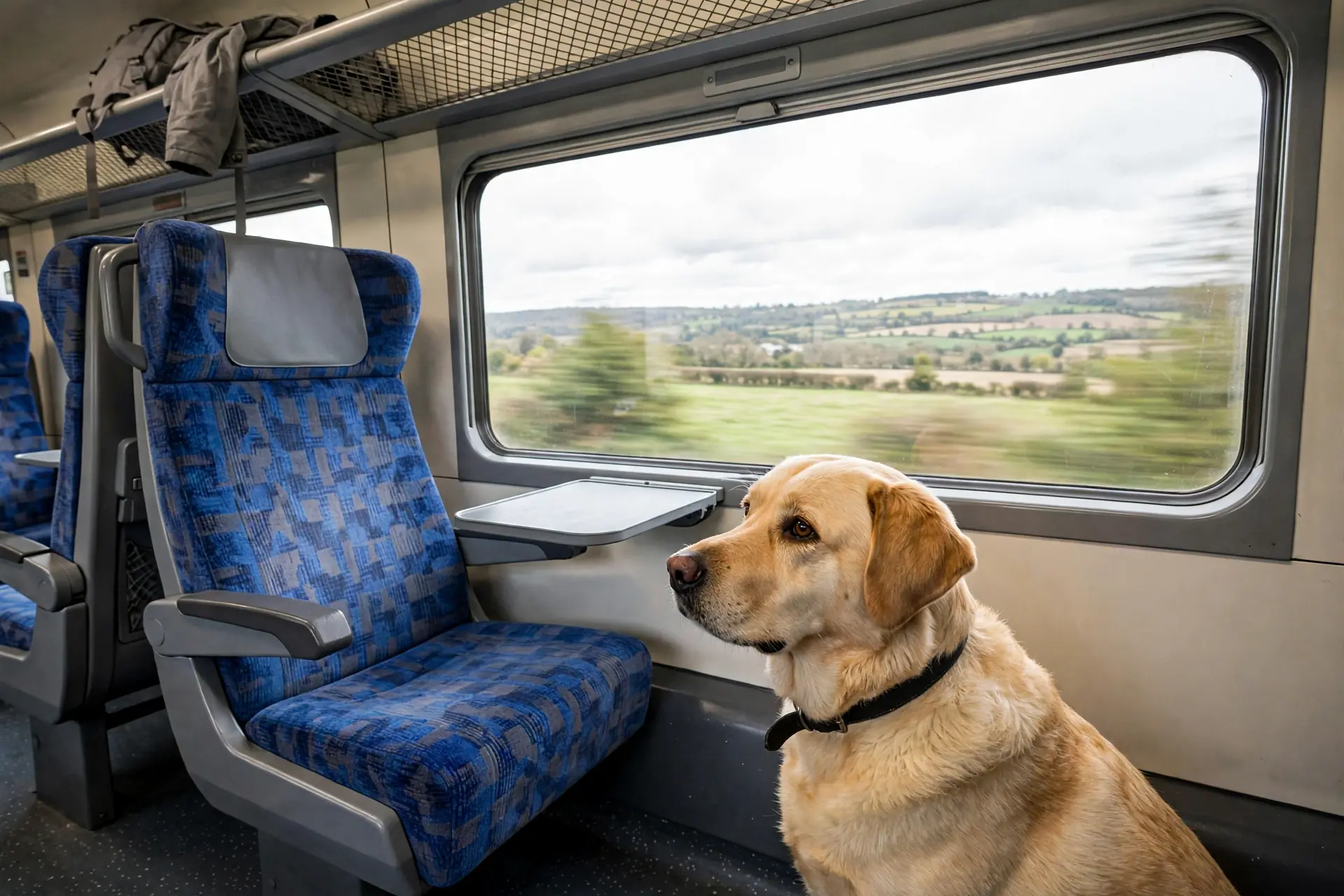
The Azuma is LNER’s main long-distance train, a bi-mode unit that runs the whole London to Edinburgh route. Inside, it is a modern intercity carriage: wide windows, power sockets at most seats, free Wi-Fi, and a buffet or trolley service depending on the train. For a dog, the important features are the floor space, the temperature and the rhythm of the journey — long stretches of quiet running broken by station stops — and each of those can be managed with a little preparation.
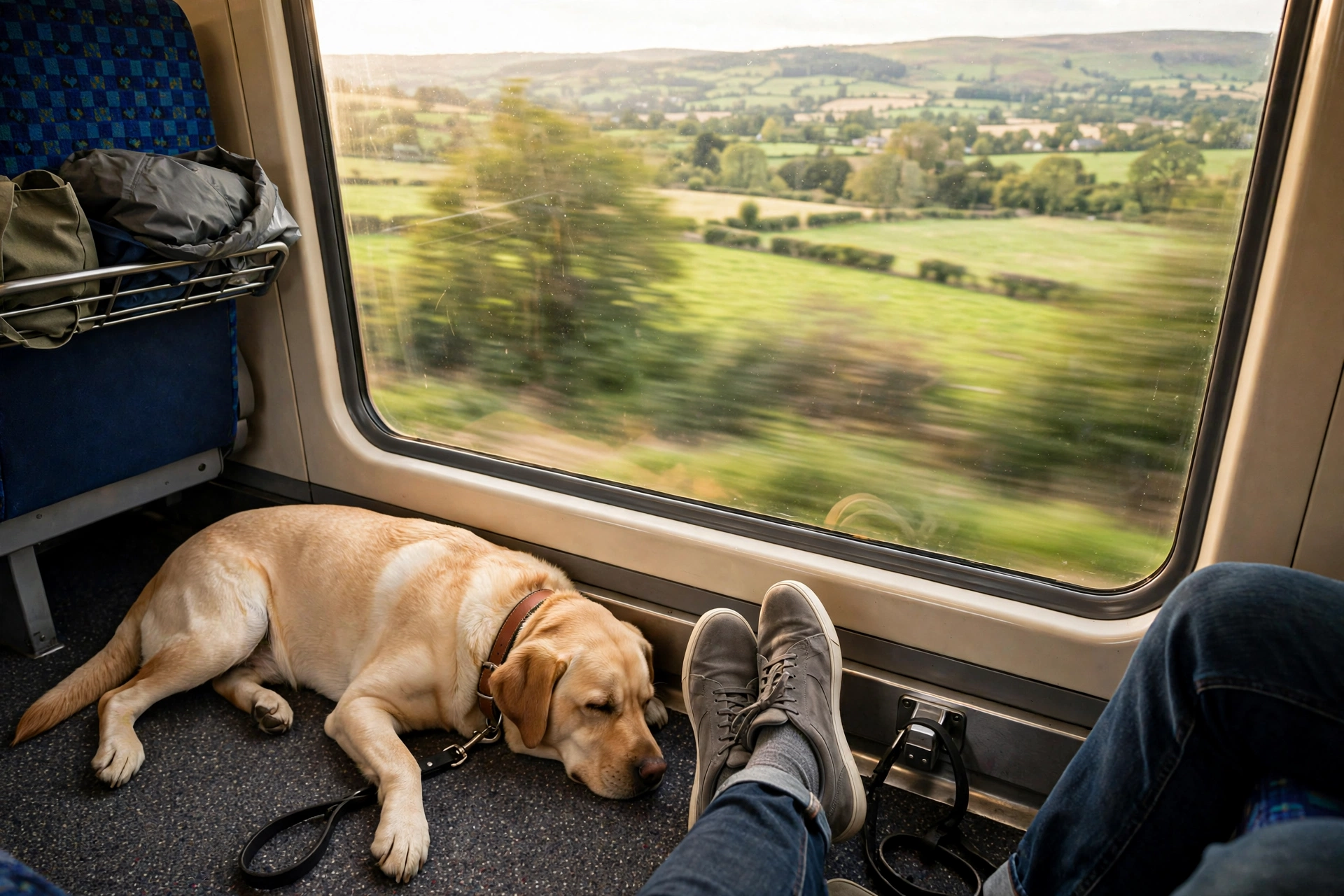
Settle the dog before the train moves. As soon as you reach your seat, put the dog’s mat or blanket on the floor in its spot, clip the lead short to something secure or keep it looped around your wrist, and offer water. A dog that knows where its place is will settle faster than a dog left to choose between the aisle and your lap, and the mat gives the dog a clear boundary that survives the whole journey. Give the dog a chew or a stuffed Kong for the first twenty minutes, while the train is pulling out of London and the carriage is at its noisiest, and then let the dog sleep. Most dogs, once the train is up to speed and the motion is steady, will doze for long stretches, waking at stations and settling again between them.
Water and food need a plan. Bring a collapsible bowl and a bottle of water, and offer small drinks at intervals rather than a full bowl at once, which risks a spill across the carriage floor. Feed the dog a normal meal a few hours before departure rather than just before boarding, because a full stomach and a moving train is a combination that can end badly, and skip feeding on the train itself unless the journey is very long. If your dog is prone to travel sickness, ask your vet about it before the trip rather than experimenting on the day, and bring cleaning supplies — paper towels, a plastic bag and a small bottle of water — because a sick dog on a train with no cleaning kit is a miserable experience for everyone in the carriage.
Toilet breaks are the hardest part of a four-hour journey, because there is no dog toilet on the train and the dog cannot be taken off at an intermediate stop unless you are prepared to catch a later train. This is why the walk before boarding matters so much: give the dog a proper walk, with a chance to empty its bladder and bowels, in the hour before departure, and choose a service that leaves after the dog’s normal morning routine rather than before it. Older dogs, puppies and dogs with medical conditions may not manage four hours without a break, and for them the honest answer is to break the journey — get off at York or Newcastle, walk the dog properly, and catch a later train. That turns a four-hour endurance test into two comfortable legs with a real break in the middle, and it is almost always the kinder choice for the dog.
Noise and other passengers deserve attention too. The Azuma is not a loud train, but the doors, the announcements and the trolley all add up, and a dog that is sound-sensitive may flinch at each station stop. A familiar blanket draped over the carrier, or a mat that smells of home, helps more than any gadget. If another passenger objects to the dog — because of allergies, fear or simply dislike — stay calm, keep the dog close, and offer to move if there is space elsewhere in the carriage. Staff will generally support a reasonable solution, and a short, polite conversation solves most complaints before they become a problem. Keep the dog’s lead short in the aisle at all times, and never let the dog approach another passenger’s food, bag or child uninvited.
London to Edinburgh, stop by stop
The East Coast Main Line is one of Britain’s great railway journeys, and it is also one of the most dog-friendly long routes in the country, because the whole journey is a single train with no change required. The line runs 393 miles from London King’s Cross to Edinburgh Waverley, following the old Great North Road for much of its length, and the fastest services cover it in about 4 hours 8 minutes. Most services take a little longer, around 4 hours 20 to 30 minutes, depending on how many stations they call at. Trains run roughly every half hour during the day, so if you miss one, the next is rarely far away — although an Advance ticket will not transfer to it, so the frequency helps only if your ticket allows it.
Heading north from King’s Cross, the train runs through north London and Hertfordshire farmland before the first main stop at Peterborough, about fifty minutes out. Peterborough is a useful early break point if you are travelling from further south, with a cathedral close to the station, but most London to Edinburgh passengers stay on. Grantham and Newark Northgate follow on some services, then Doncaster, a major junction where the line to Leeds and Sheffield branches off. Doncaster is about an hour and three quarters from London, and it is the last stop before the line enters Yorkshire proper.
York comes at about the two-hour mark, and it is the stop that shapes the journey more than any other. Almost every LNER service calls at York, it has one of the best First Class Lounges on the network, and it is the natural place to break a long journey with a dog. Beyond York the line runs north through Northallerton and Darlington, then to Durham, where the cathedral and castle appear on the left as the train crosses the viaduct over the River Wear, and on to Newcastle, where the bridges over the Tyne appear on the right. Newcastle is about two hours and fifty minutes from London on a fast service, and it is the last big city before the coast.
North of Newcastle the character of the journey changes completely. The line runs along the Northumberland coast between Alnmouth and Berwick-upon-Tweed, and on a clear day this is the finest forty minutes of the whole route: cliffs, beaches, the sea on the right heading north, and Holy Island and Bamburgh Castle visible from the window. Sit on the right going north, and on the left going south, for the coastal view. Berwick-upon-Tweed, the last town in England before the border, is about three hours and twenty minutes from London, and from there the train runs through Dunbar and into Edinburgh Waverley, arriving in the heart of the city. The full route is worth knowing in advance, because it tells you where the natural breaks are, which stops have facilities, and how long the dog will need to last between proper walks.
York and Durham: the best break points
York is the obvious place to break the London to Edinburgh journey with a dog, and it earns that position for practical reasons as well as scenic ones. The station is large, step-free and easy to navigate with a dog, the First Class Lounge welcomes dogs on leads, and the city centre is a short walk from the station. If you break the journey here, you can give the dog a proper walk along the city walls or the River Ouse, find water and a toilet spot, and catch a later train refreshed. York is about two hours from London, which is the point at which many dogs start to get restless, so the timing works as well as the geography.
York itself is one of the most dog-friendly cities on the route, with a compact centre that suits a dog on a lead, plenty of outdoor seating where dogs are welcome, and parks within walking distance of the station. Our guide to York with a dog covers the walks, the dog-friendly cafes and the practical details of visiting the city with a dog, including where to find green space close to the station. If you are breaking the journey for a night rather than an hour, York has a good range of dog-friendly places to stay, and the station’s left-luggage and waiting facilities make a short stop straightforward. The one thing to watch is the crowds: York is a popular tourist city, and the streets around the Minster and the Shambles can be very busy at weekends and in school holidays, so if your dog dislikes crowds, stick to the quieter riverside paths and the city walls rather than the central shopping streets.
Durham is the quieter alternative, and for some dogs it is the better one. The station sits above the city, and the walk down to the river and the cathedral is steep, so it suits a fit dog better than an older one, and the station itself has fewer facilities than York. What Durham offers is a shorter break: fifty minutes beyond York, about two hours and fifty minutes from London, with a spectacular view of the cathedral and castle from the viaduct as the train arrives. If you break here, plan the walk in advance, because the station is not beside the riverside paths and the climb back up is real. For a dog that needs a quick leg-stretch rather than a city visit, Durham works as a thirty-minute stop — off the train, down to the river, back up, and on to the next service — but it is not as forgiving as York for a longer break.
Choosing between them comes down to how long the dog needs and how much time you have. York gives you a proper break with facilities, food and green space; Durham gives you a shorter, steeper, more scenic stop. Either is better than pushing a restless dog all the way to Edinburgh without a break, and both are on the main line, so you will not need to change trains or book a separate ticket to stop there, provided your ticket allows a break of journey. Check the official guidance before you travel if your ticket is an Advance fare, because break of journey is not always permitted on the cheapest tickets.
Newcastle, Alnmouth and Berwick
Newcastle is the last major city on the route before the coast, and it is a practical break point as well as a destination in its own right. The station is large and busy, with a First Class Lounge that welcomes dogs on leads, and the city centre is a short walk away, with the Quayside and the bridges offering a good riverside walk for a dog. Newcastle is about twelve minutes beyond Durham, and about an hour and a half from Edinburgh, so it is the natural last stop for a proper walk before the final leg. If the dog has managed the journey well so far, a short stop here — off the train, a walk along the Quayside, water, and back on — sets the dog up comfortably for the last stretch.
The station itself deserves a mention, because Newcastle is one of the busiest interchanges on the line and it can be confusing with a dog. The platforms are long, the concourse is wide, and the crowds at peak times are dense, so keep the dog close, the lead short, and your bearings clear before you move. If you are changing trains here — onto a local service to the coast, to Carlisle, or to the Metro — allow more time than the connection suggests, because a dog, luggage and a platform change at Newcastle is a slower combination than the timetable assumes. Our guide to dog-friendly train stations in the UK covers how big hubs and small stops differ for dogs, including waiting rooms, platform rules and the practicalities of changing trains with an animal in tow.
North of Newcastle, the stops get smaller and the scenery gets better. Morpeth and Alnmouth are the gateways to the Northumberland coast, and Alnmouth in particular is worth knowing about: it is the station for Alnwick and the coast, it is a small, quiet station where a dog can wait without the crush of a city terminus, and the coastal walks from here are among the best in England. Not every LNER service calls at Alnmouth, so check your specific train before planning a stop there. Berwick-upon-Tweed is the last stop before Scotland, a border town with a station that is easy to navigate and a riverside and coastal walk close by. Berwick is about forty-five minutes from Edinburgh, and it is the last sensible place to give the dog a break before arrival.
The coastal stretch between Alnmouth and Berwick is the part of the journey to plan your seating around. Sit on the right-hand side going north for the sea views, and keep the dog settled with a chew for this section, because the train slows and the views invite you to look out of the window rather than at the dog. If you are travelling south, the same views are on the left. This is also the section where the train can be delayed by coastal weather, so build a little slack into your arrival plans, and remember that a delay on this stretch usually means a few minutes rather than a cancellation.
Stations, platforms and changing trains
The train is only half the journey. The other half is the stations at each end and any change in the middle, and for a dog owner the station is where most of the practical problems actually happen: crowds, stairs, escalators, ticket gates, and the long walk from the entrance to the far end of a platform. LNER’s main stations are generally well equipped, but they are also busy, and a little planning goes a long way.
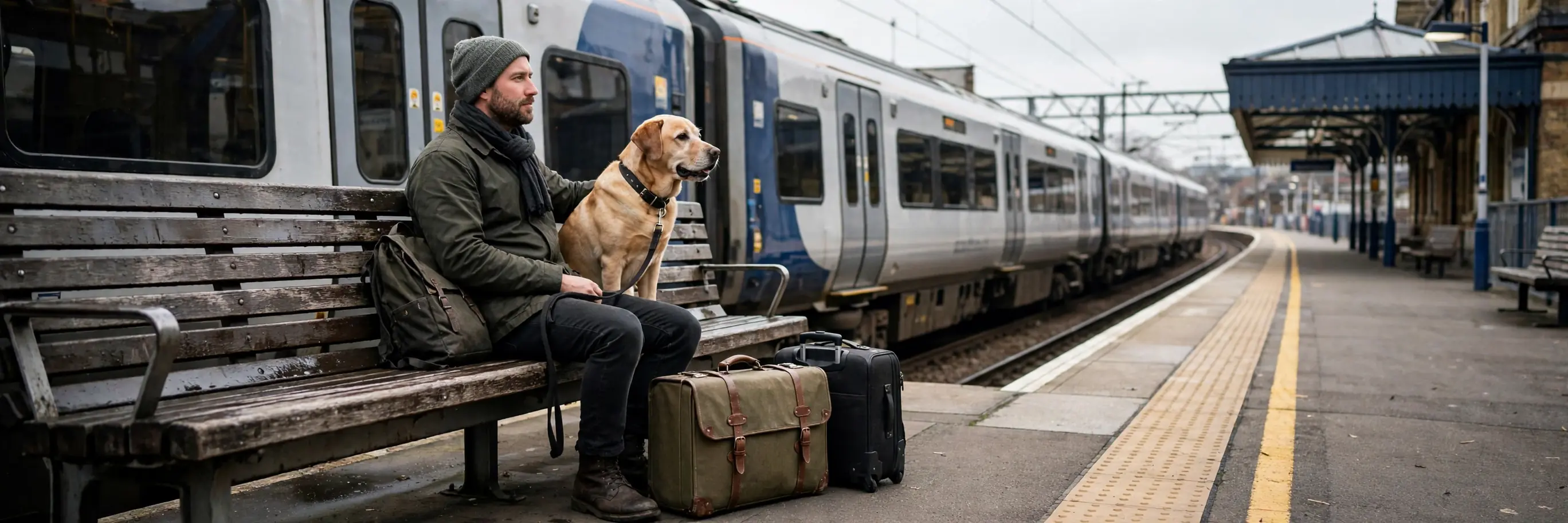
London King’s Cross is the starting point for most LNER journeys, and it is a large, busy terminus with a wide concourse, shops, cafes and a First Class Lounge. Dogs are welcome in the station, on a lead, and the concourse is step-free, but it is also one of the busiest stations in the country at peak times, with passengers moving fast in every direction. Arrive early, give the dog a toilet break outside the station before you go in — there is green space a short walk away, and the area around the station has pavements rather than grass, so plan the walk in advance — and then head for the departure boards, find your platform, and board calmly. If you have a First Class ticket, the lounge is a calmer place to wait than the concourse, and it welcomes dogs on leads.
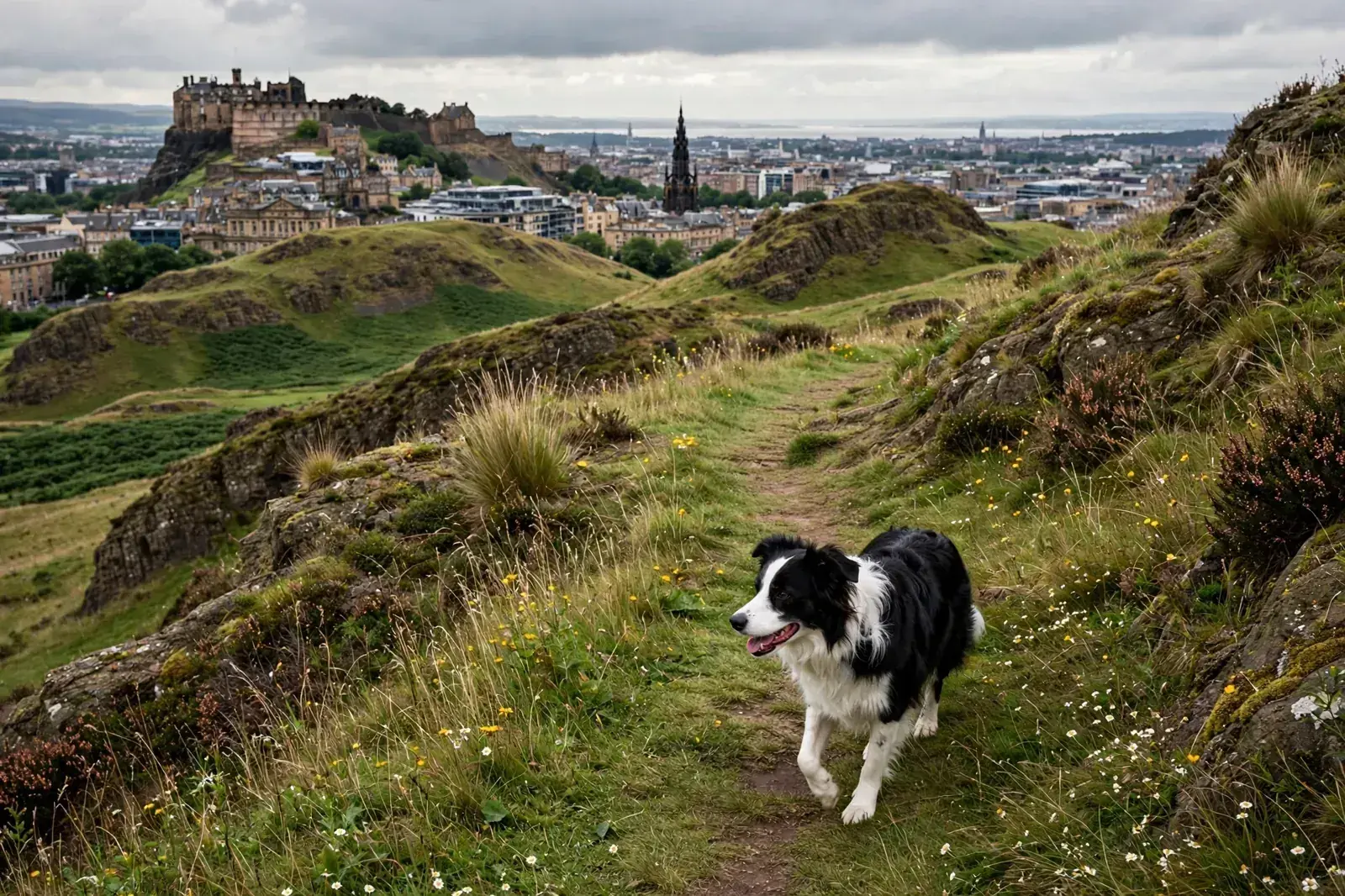
Edinburgh Waverley, at the other end, is a large station set in a valley in the heart of the city, with multiple levels, long ramps and a layout that can confuse first-time visitors. It is step-free in the main, with lifts and ramps, but the walk from the platforms to the street can be long, and the station is busy with passengers changing between services. Give the dog a moment to settle after arrival, find water, and then walk out into the city rather than rushing. Our guide to Edinburgh with a dog covers the walks, parks and practical details of the city once you arrive, including Arthur’s Seat, the Water of Leith and the dog-friendly cafes near the station.
Changing trains with a dog needs more time than the timetable suggests. Allow at least twenty minutes for a change at a large station, and longer if you need to change platforms, use a lift, or find a toilet spot for the dog between trains. Keep the dog on a short lead through ticket gates — most gates have a wide accessible gate that is easier with a dog and luggage — and avoid escalators with a dog, because the moving steps can frighten or injure an animal. Use the lift or the stairs instead. If the change is tight and the dog is slow, ask staff for help; station staff can advise on the quickest step-free route and, at larger stations, can arrange assistance. LNER also has Pet Champions at several stations, including York, Darlington, Berwick-upon-Tweed, Wakefield, Retford, Newark and Grantham, who can advise on pet-friendly facilities and the best coaches and times to travel, so look out for them if you need local advice.
Smaller stations on the route — Alnmouth, Morpeth, Dunbar, Northallerton — are a different experience: quieter, easier to navigate, and often without a staffed ticket office or a waiting room. That quiet is a benefit for a nervous dog, but it also means fewer facilities, so check in advance whether the station has toilets, shelter and step-free access, and whether the platform is long enough for your train, because at some smaller stations only part of the train is alongside the platform. Check the official guidance before you travel if you are boarding at a small station, because the details vary by station and by service.
Delays, disruption and busy trains
Even the best-planned LNER journey can go wrong, and a dog makes every disruption a little harder. A delayed train means a dog waiting on a platform with no toilet, a cancelled train means a crowded replacement service, and a diversion means a longer journey than the dog was prepared for. The way to handle disruption is to plan for it before it happens, so that a bad day is an inconvenience rather than a crisis.
Start with the basics: carry more water, food and cleaning supplies than you think you will need, and keep the dog’s lead, mat and a chew in your hand luggage rather than in a bag in the luggage rack. If the train is delayed before boarding, use the time to walk the dog again outside the station, and if the delay is long, find a quiet corner of the station where the dog can lie down rather than standing in the middle of the concourse. If the train is cancelled, speak to staff before joining the queue for the next service — they can advise whether the next train has space, whether your ticket is valid on it, and whether a quieter service is coming shortly afterwards. An Advance ticket is normally valid only on the booked train, but during disruption operators often accept tickets on later services, so ask rather than assuming.
Busy trains are the most common problem, and they are also the most predictable. Friday evenings, Sunday evenings, school holidays and the days around Christmas are the busiest times on the East Coast Main Line, and a train that is full of standing passengers is a poor place for a dog. If you must travel at a busy time, book a seat, arrive early, board as soon as the platform is announced, and settle the dog before the carriage fills up. A dog that is already lying quietly on its mat when the crowd arrives will be left alone; a dog that is still pacing the aisle when the train is full will attract attention and complaints. If the train is so full that there is no floor space for the dog, speak to the train manager — they may be able to find a quieter coach or a seat with more room, and they would rather help you settle than deal with a complaint later.
Heat is a particular risk in summer, and cold is a risk in winter. Azuma carriages are air-conditioned, but a crowded carriage on a hot day can still be warm, and a dog in a thick coat will feel it before you do. Offer water regularly, keep the dog out of direct sunlight through the window, and watch for signs of overheating — heavy panting, restlessness, drooling — because a dog cannot tell you it is too hot. In winter, the risk is the wait on an exposed platform rather than the train itself, so keep the dog moving, use a coat if your dog wears one, and get inside the train or the waiting room as soon as you can. If the dog is ill, injured or recovering from surgery, think carefully about whether a long train journey is the right choice at all, and ask your vet if you are unsure.
Finally, know your rights if things go wrong. If a delay is significant, you may be entitled to compensation under the Delay Repay scheme, and the claim is made after the journey rather than on the day. Keep your ticket and note the times, because the details are easier to record at the time than to reconstruct later. Compensation does not help the dog in the moment, but it does mean a disrupted journey is not a wasted fare, and it is worth claiming. Check the official guidance before you travel if you are unsure how Delay Repay applies to your ticket, because the thresholds and the claim process change from time to time.
Packing list for an LNER trip
A good packing list for an LNER journey is short, because everything you bring has to be carried through a station and stowed on a train, and a dog owner already has more to carry than most passengers. The rule is to pack for the dog’s needs first, and for your own comfort second, because a settled dog makes the whole journey easier and a restless dog makes everything harder.
The essentials are a short lead and a spare, a harness if your dog normally wears one, a mat or blanket that smells of home, a collapsible water bowl and a bottle of water, a chew or a stuffed Kong for the first part of the journey, poo bags, paper towels and a plastic bag for cleaning up, and any medication the dog needs. Add a small bag of the dog’s normal food if the journey is long or if you are breaking it with an overnight stay, and a familiar toy if the dog finds comfort in one. A dog coat is worth bringing in winter or in wet weather, even if the dog does not normally wear one, because the walk to and from the station can be cold and wet even when the train is warm.
For the journey itself, think about what the dog will need at each stage. Before boarding, the dog needs a walk, a toilet break and a drink. On the train, the dog needs a place to lie down, water at intervals, and something to chew while the train is at its busiest. At a break point, the dog needs a proper walk, water and a toilet spot, and a few minutes to stretch and sniff. On arrival, the dog needs water, a walk and a chance to settle before you start the next part of the trip. If you plan the packing around those four stages, you will not forget anything important, and you will not carry anything you do not need.
What not to bring matters too. Do not bring a long extending lead, because it is a hazard in a crowded carriage and on a busy platform. Do not bring a large crate unless you have booked a seat with room for it and you are certain it will fit, because a crate that blocks the aisle will be moved by staff. Do not bring strong-smelling food for the dog or for yourself, because the smell will fill the carriage and attract the dog’s attention for the whole journey. And do not bring anything that rattles, squeaks or crinkles loudly, because a train carriage amplifies every sound and a noisy bag is the fastest way to keep a dog awake for four hours.
One last piece of advice: do a trial run. Before the first long LNER journey, take the dog on a shorter train ride — half an hour to a nearby town and back — and see how the dog copes with the station, the boarding, the motion and the noise. A dog that settles happily on a short journey will usually settle on a long one, and a dog that struggles on a short journey will struggle more on a long one. The trial run tells you what to pack, what seat to book and whether to break the journey, and it costs an afternoon rather than a ruined holiday. If the trial goes well, the London to Edinburgh line is waiting, and it is one of the finest train journeys in Britain to share with a dog.
Practical questions
Before you go
Can dogs travel in LNER First Class?
Yes. Well-behaved dogs on leads are welcome in LNER First Class coaches and in all LNER First Class Lounges. The same lead and off-the-seats rules apply, and the dog travels on the floor by your seat. First Class gives you a wider seat and more floor space, which helps a larger dog settle, but it does not change the dog rules.
How many dogs can I take on an LNER train for free?
Up to two dogs, cats or other small domestic animals travel free with each passenger. Each additional pet may cost up to 5 pounds per journey, so check the official guidance before you travel if you are taking three or more animals, and expect to pay the extra charge.
Do I need to book a ticket or a seat for my dog on LNER?
No ticket or reservation is needed for the dog itself, and there is no advance notification to make. What you should book is your own seat reservation, choosing a seat with floor space for the dog, ideally at a table or in a quieter coach, and avoiding peak services where the train is likely to be full.
Can my dog sit on the seat next to me on LNER?
No. Dogs must stay off the seats and off the tables at all times, in both Standard and First Class. A dog travels on the floor by your feet, or in a carrier kept out of the aisle. Bring a mat or blanket so the dog has a defined place to lie down.
How long is the LNER journey from London to Edinburgh with a dog?
The fastest LNER services take about 4 hours 8 minutes from London King's Cross to Edinburgh Waverley, stopping only at York and Newcastle. Most other services take around 4 hours 20 to 30 minutes, with more stops. Plan toilet breaks around the stops, and give the dog a good walk before boarding.
What happens if my dog is noisy or another passenger objects?
Staff can ask you to move your dog, or refuse carriage, if the animal is causing a nuisance or a danger to other passengers. If your dog is unsettled, move to a quieter area of the train, offer water and a chew, and keep the lead short. If the dog cannot settle, consider breaking the journey at the next suitable station rather than pressing on.