This guide is independent and contains no paid placement. If affiliate links are added later, they will be clearly marked and will not change our editorial checks.
Dogs travel free on London Overground, need no ticket and no carrier, and can travel at any time of day. Keep your dog on a short lead, carry small dogs on escalators, use lifts where you can, and avoid the weekday rush if your dog is nervous in crowds.
The rules in plain English
Dogs are allowed on London Overground. That is the headline, and it is a generous one by the standards of public transport in many other cities. Dogs travel free, which means you do not buy a ticket for your dog, you do not need to book a dog place in advance, and there is no published limit on the number of dogs one person can bring — although common sense sets a real limit. One person with one well-controlled dog is unremarkable. One person with three large, excited dogs on a crowded platform is a different proposition, and staff are entitled to take a view about whether the animals are under control.
The core condition is control. Your dog must be on a lead or in a carrier, must not obstruct the aisle, the doors or the gangway, and must not be a danger or a serious nuisance to other passengers. That last phrase matters, because it gives staff discretion. A dog that lunges at other dogs, barks continuously, jumps up at strangers or blocks a doorway can be refused, even though dogs in general are welcome. The rule is not really about breed or size. It is about behaviour on the day, in that station, on that train.
There is no general requirement for a muzzle or a carrier on London Overground. Small dogs often travel best in a carrier, and many owners use one as a matter of habit, but it is a choice rather than a rule. A muzzle is likewise not required as standard. If your dog is anxious in crowds, reactive to other dogs, or has a history of snapping when startled, a muzzle can still be a sensible precaution — and it can also reassure staff and fellow passengers — but do not assume that every large dog must wear one. If your dog falls into a category with specific legal controls, check the official guidance before you travel, because general transport rules do not override the law.
Assistance dogs are treated separately from pet dogs. An assistance dog travelling with its handler should not be refused, should not be charged, and should not be asked to travel in a carrier. If you travel with an assistance dog, the practical advice in this guide about lifts, quiet carriages and boarding positions still applies, but the right to travel is stronger and clearer. If you are refused while travelling with an assistance dog, note the station, the time and the member of staff, and raise it with Transport for London afterwards rather than arguing on the platform.
One point that surprises first-time travellers is the escalator rule. Dogs should not stand on escalators on their own paws. The moving steps, the comb at the top and the gap at the sides are a genuine hazard for paws and claws. Carry a small dog, and take a larger dog by the lift or the stairs. This is the rule that most often catches people out at interchange stations, where the escalator looks like the obvious route and the lift is tucked away down a corridor. Build the extra two minutes into your plan, and check the official guidance before you travel if you are unsure whether a particular station has a working lift.
Fares for the human half of the party follow the normal London rules. You tap in and out with a contactless card, a phone or an Oyster card, and the fare is charged according to the zones you travel through. Your dog adds nothing to that fare. There is also no need to declare the dog at the ticket barrier, and there is no dog ticket to show. If a barrier is narrow, ask a member of staff to open the wide gate, or use the accessible gate where one is provided. Many Overground stations are unstaffed at quieter times, so at a small suburban station you may need to manage the gate yourself: keep the lead short, go through first, and call the dog through after you.
Finally, remember that the rules can change, and that engineering works, station closures and temporary crowd controls can change what a journey looks like on a particular day. This guide describes the standard position. Before a long or important journey — a vet appointment, a flight connection, a first trip with a new rescue dog — check the official guidance before you travel and check the live service status on the day.
The lines, line by line
London Overground is not one line. It is a network of six named lines that share a brand, a fare system and orange trains, but run through very different parts of the city. The names were introduced in 2024, and older Londoners still use the old route names, so it helps to know both. The lines below are the ones most useful to dog owners, because they connect central London with the parks, heaths and suburbs where a dog can actually run.
The Mildmay line: the North London line
The Mildmay line runs across north London, from Richmond in the west through Kew, Willesden, Gospel Oak and Camden Road to Stratford in the east. For dog owners this is arguably the most useful line in the network. It serves Richmond Park and the Thames towpath at one end, Hampstead Heath from Gospel Oak and Hampstead Heath stations in the middle, and the Olympic Park and the Lea Valley from Stratford at the other end. A single line can therefore take a dog from a riverside walk to a heath walk to a riverside park without a single change.
The stations on this line vary a great deal. Richmond and Stratford are large, busy interchanges with lifts and wide gates. Gospel Oak, Hampstead Heath and Kentish Town West are smaller, and their platforms can feel narrow when a train unloads. The trains themselves are walk-through, with open gangways, which is good news for dogs: you can move through the train to find a quieter spot, and there is no need to squeeze past a closed door with a dog on a lead. Sit near a door if your journey is short, and move to the middle of the carriage if you want to be away from the flow of people getting on and off.
Watch the western end of the line carefully. Trains from Richmond run less frequently than the central section, and a missed connection at Willesden Junction can add twenty minutes to a journey. If you are heading to Richmond Park, allow time for the walk from the station to the park gate, and remember that deer roam the park: keep your dog on a lead near deer, even if your dog is normally reliable off lead, because a deer encounter can end badly for both animals.
The Windrush line: the East London line
The Windrush line runs from Highbury and Islington in the north, through Shoreditch and Whitechapel, to New Cross, Clapham Junction, Crystal Palace and West Croydon in the south. It is the line that most directly serves the inner-city dog owner who lives in east or south London and wants a quick escape. The stretch through Shoreditch High Street and Hoxton is busy and built-up, but south of the river the line opens out: Crystal Palace Park is a short walk from Crystal Palace station, and the green spaces around Dulwich and Sydenham are within reach of the southern branches.
This line has a particular quirk worth knowing. South of Surrey Quays the line splits into four branches, so the destination on the front of the train matters. A train for Clapham Junction will not take you to Crystal Palace, and a train for West Croydon will not take you to New Cross. Check the destination board before you board, and if you are unsure, ask a member of staff or a fellow passenger. Getting the branch wrong with a dog is not a disaster — you can change at Surrey Quays or Canada Water — but it adds time and an extra change, and each change is another moment when a nervous dog has to cope with a new platform.
Canada Water is the key interchange on this line, where it meets the Jubilee line, and Whitechapel is the other, where it meets the Elizabeth line and the District and Hammersmith and City lines. Both are busy, and both involve lifts or long escalators. If you are changing at either, allow an extra five minutes and look for the lift signs rather than following the crowd to the escalators.
The Lioness line: the Watford DC line
The Lioness line runs from Euston in central London, through Queen's Park, Wembley Central and Harrow and Wealdstone, to Watford Junction. It is a slower, stopping service that shadows the West Coast Main Line, and for dog owners its value is the way it connects central London with the suburbs of north-west London without the pressure of a mainline train. The trains are less crowded than the fast services to the same places, the stations are mostly above ground, and the pace of the journey is calmer.
For a day out, the useful stops are Wembley Central, for the open spaces around Wembley Park, and Watford Junction, for Cassiobury Park, which is a short walk from the station and one of the best dog-walking parks in the Watford area. Closer to the centre, Queen's Park station gives access to Queen's Park itself, a compact and very dog-friendly park with a cafe and a well-used dog-walking circuit. The line also serves Kilburn High Road and South Hampstead, which are handy for owners who live in those neighbourhoods and want to avoid the Tube altogether.
One caution: Euston is a major terminus and can be overwhelming for a nervous dog, especially at rush hour. The concourse is large, loud and full of people moving in every direction, and the Lioness line platforms are a walk from the main entrance. If you are starting from Euston, arrive early, keep your dog close, and use the quieter side of the concourse. If you can start your journey one stop out, at Euston Square or Queen's Park, the experience is usually calmer.
The Weaver line: the Lea Valley lines
The Weaver line runs from Liverpool Street through Hackney and Walthamstow to Chingford, Enfield Town and Cheshunt. It is the line for Epping Forest, the Lea Valley and the marshes of east London, and it deserves more attention from dog owners than it usually gets. Chingford station is the gateway to Epping Forest, one of the largest open spaces in London, and the walk from the station into the forest is short and straightforward. Walthamstow Central and Blackhorse Road give access to Walthamstow Marshes and the Lea Valley, where flat, open paths suit older dogs and dogs that are still building up their fitness.
The Liverpool Street end of the line is the busy end. Liverpool Street is one of the busiest stations in the country, and the Weaver line platforms sit alongside mainline services to East Anglia. If your dog is nervous, consider starting at Bethnal Green or Cambridge Heath instead, where the stations are smaller and the platforms are quieter. The trains are generally less crowded than the central section of the Mildmay line, and off-peak you will often find a whole bay of seats to yourself, which is the ideal arrangement for a dog that likes to settle at your feet.
The Suffragette line: Gospel Oak to Barking
The Suffragette line runs from Gospel Oak through Kentish Town, Haringey and Walthamstow to Barking, crossing north and east London on a route that many visitors never use. For dog owners it is a useful cross-city shortcut: it connects the Mildmay line at Gospel Oak with the Weaver line at Blackhorse Road and the District line and c2c services at Barking, without going through central London at all. That matters, because a journey that avoids the centre is usually a quieter journey, and a quieter journey is usually a better journey for a dog.
The stations on this line are mostly small and above ground, with short platforms and a local, neighbourhood feel. Barking station is the exception: it is a busy interchange with mainline services, and it can be confusing on a first visit. If you are changing at Barking, follow the signs rather than the crowd, and give yourself time. The line also serves Walthamstow Queen's Market, which is handy for the market and the surrounding streets, and Leytonstone High Road, which is a short walk from the open spaces of Wanstead Flats.
The Liberty line and the Romford to Upminster shuttle
The Liberty line is the shortest in the network: a shuttle between Romford and Upminster, with one stop at Emerson Park. It is easy to overlook, but it serves dog owners in Havering who want to reach the open spaces around Upminster and the Ingrebourne Valley without driving. The trains are short, the journey is brief, and the stations are quiet. If you live in the area, it is a low-stress way to start a walk. If you do not, it is unlikely to feature in your plans, but it completes the picture of a network that reaches into the suburbs rather than stopping at the edge of the centre.
Across all six lines, one pattern holds. The further from the centre you go, the quieter the train becomes, the more space there is for a dog to settle, and the closer you are to somewhere green. The Overground is at its best when it is used as a bridge: a short ride from a busy neighbourhood to a park, a heath or a riverside path, rather than as a way of crossing the whole city at rush hour.
Overground vs Underground: what changes for dogs
Dog owners often ask whether the Overground is better than the Tube, and the honest answer is that it usually is, with a few exceptions. The rules are the same in the important respects: dogs travel free on both, must be on a lead, and must not be a nuisance. The difference is the environment, and the environment is what a dog actually experiences.
The first difference is light and air. Overground trains run mostly above ground, with windows, daylight and fresh air, and stations that are open to the sky. Underground trains run in tunnels, with artificial light, warm air and the low rumble of a confined space. Many dogs cope perfectly well with the Tube, and thousands do it every day, but a dog that is anxious, noise-sensitive or new to London will usually find the Overground calmer. The same applies to the owner: you can see where you are, you can see the next station coming, and you can step off at the next stop if your dog needs a break.
The second difference is the escalator problem. Deep-level Tube stations rely on long escalators, and some rely on them entirely, with no lift and a long flight of stairs as the only alternative. Overground stations are generally shallower, and many have lifts or a step-free route from street to platform. That does not mean every Overground station is step-free — it is not — but the odds are better, and the lift is usually easier to find. Our guide to dogs on London Underground covers the Tube rules in detail, including which lines and stations are hardest for dogs, and it is worth reading if your journey mixes the two networks.
The third difference is space. Overground trains are walk-through and generally less crowded than the central Tube lines at peak times, although the Mildmay line through Camden and the Windrush line through Shoreditch can be just as busy. The open gangway means you can move away from a crowded doorway, and the seats near the doors are easier to reach with a dog. On the Tube, a dog can end up trapped in a vestibule between two sets of doors, which is stressful for everyone.
There are exceptions. If your journey is short and entirely within the centre — say, two stops on the Central line — the Tube may be quicker and simpler than a long Overground loop around the outside. If your destination is a deep-level station with no Overground alternative, the Tube is the only option. And at the weekend, when engineering works close parts of the Overground, the Tube may be the more reliable choice. The practical rule is to choose the route with the fewest changes, the shortest time underground, and the easiest station at each end. For most cross-London journeys with a dog, that route will involve the Overground.
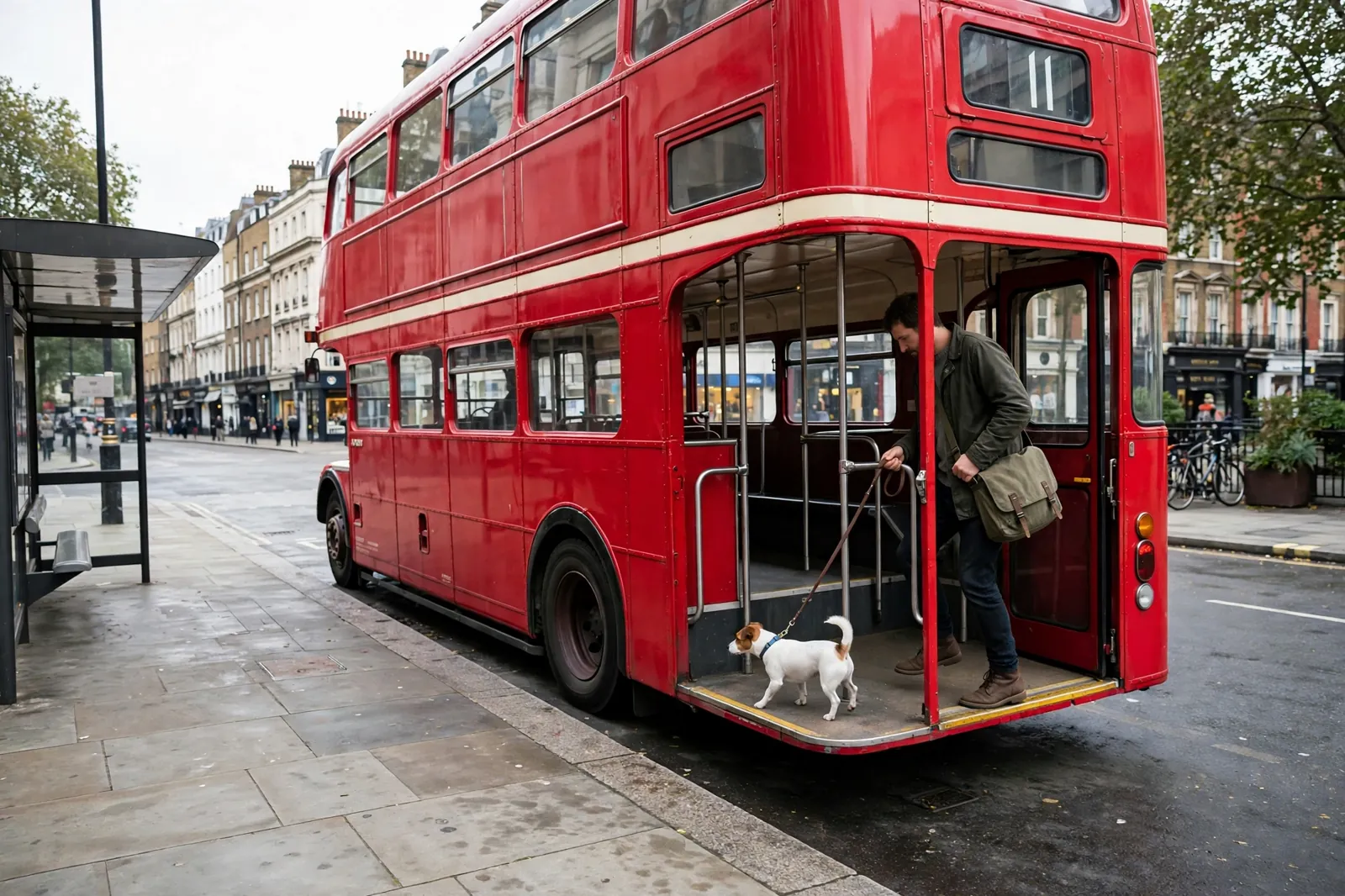
One more comparison matters: buses. London buses are also free for dogs and can be a good option for a short hop, but a bus is a smaller, more enclosed space, and the driver has discretion to refuse a dog if the bus is full. Our guide to dogs on London buses explains that discretion and how to board smoothly. As a general rule, use the Overground for distance, the Tube for a short central hop, and the bus for the last mile when the station is further from the park than you would like to walk.
Interchanges and step-free stations
Interchanges are where a dog journey succeeds or fails. A well-chosen interchange is a short, level walk from one platform to another. A badly chosen one is a ten-minute trek through a crowded concourse, up an escalator, along a tunnel and down another escalator, with a dog that is getting more anxious at every step. Planning the interchange is therefore as important as planning the line.
The best Overground interchanges for dogs are the ones where both lines are on the surface. Willesden Junction, where the Mildmay and Lioness lines meet, is a good example: the platforms are close together, the station is above ground, and the change is straightforward. Gospel Oak, where the Mildmay and Suffragette lines meet, is another. Highbury and Islington, where the Windrush line meets the Victoria line and National Rail services, is busier but manageable, because the Overground platforms are near the surface and the station is well signed.
The harder interchanges are the ones where the Overground meets a deep Tube line. Canada Water, where the Windrush line meets the Jubilee line, involves a long change with escalators and a busy concourse. Whitechapel, where the Windrush line meets the Elizabeth line, is a large station with a long walk between platforms. Stratford is large and busy but has lifts throughout and wide, level routes, so it is easier than it looks if you follow the lift signs rather than the escalator signs. Clapham Junction, the southern terminus of the Windrush line, is a major station with many platforms; allow extra time and check the platform number before you move.
Step-free access deserves its own check. Transport for London publishes step-free information for every station, and it is worth consulting before a journey with a large dog, an older dog, a dog in a carrier, or a pushchair alongside the dog. A station can be step-free from street to platform but not from platform to train, if there is a gap or a step up into the carriage. A station can have a lift that is out of service on the day you travel. And a station can be step-free in one direction only, which matters if you are returning by a different route. Check the official guidance before you travel, and have a backup station in mind.
At the station, look for the wide gate. Most Overground stations have one, usually at the end of the barrier line, and it is designed for wheelchairs, pushchairs and luggage — and it works just as well for a dog on a lead. Go through the gate yourself first, then invite the dog through, keeping the lead short so the dog cannot wander into the path of the closing barrier. At unstaffed stations, the gate may be open or may need a button press; take your time, and do not let the dog run ahead onto the platform.
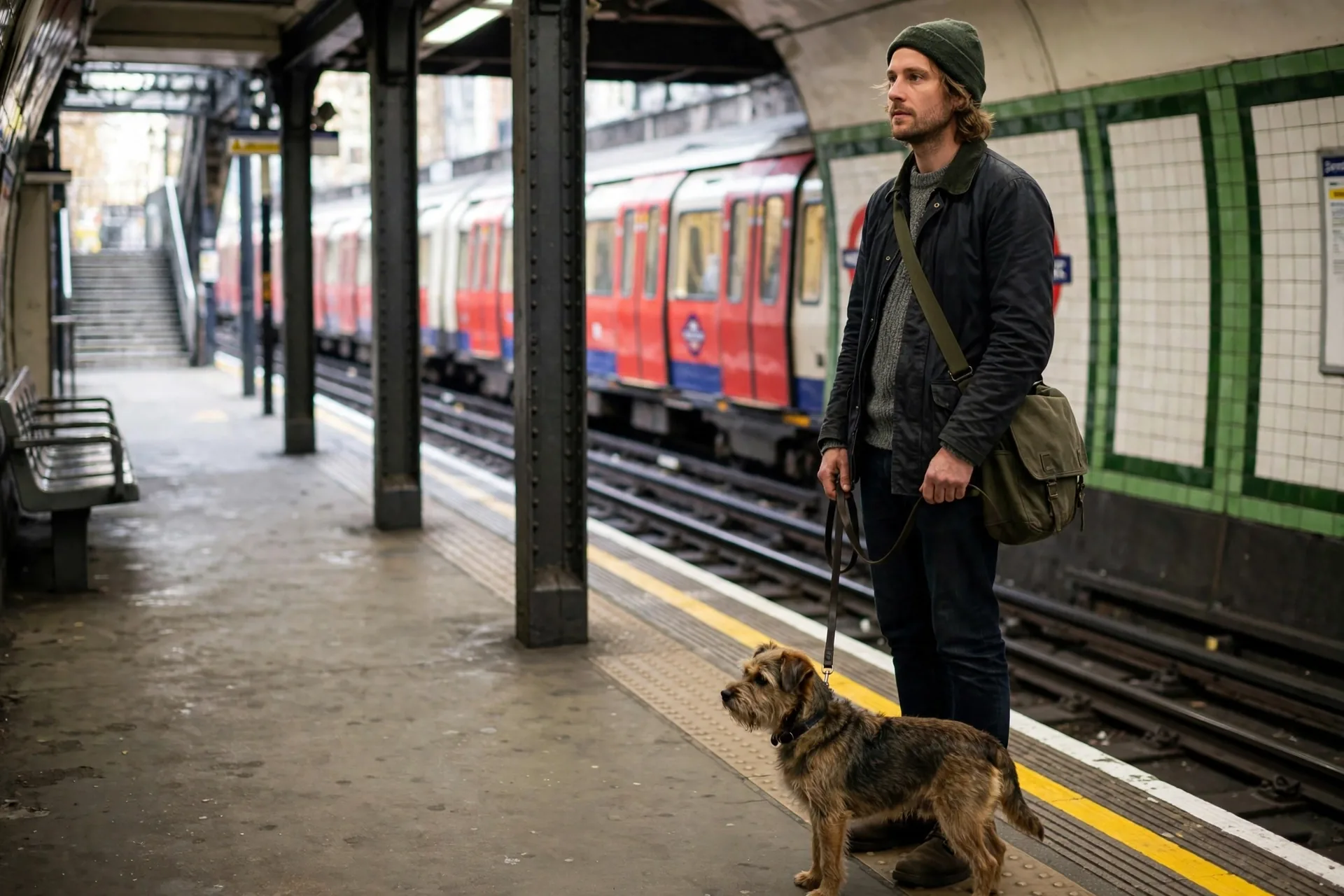
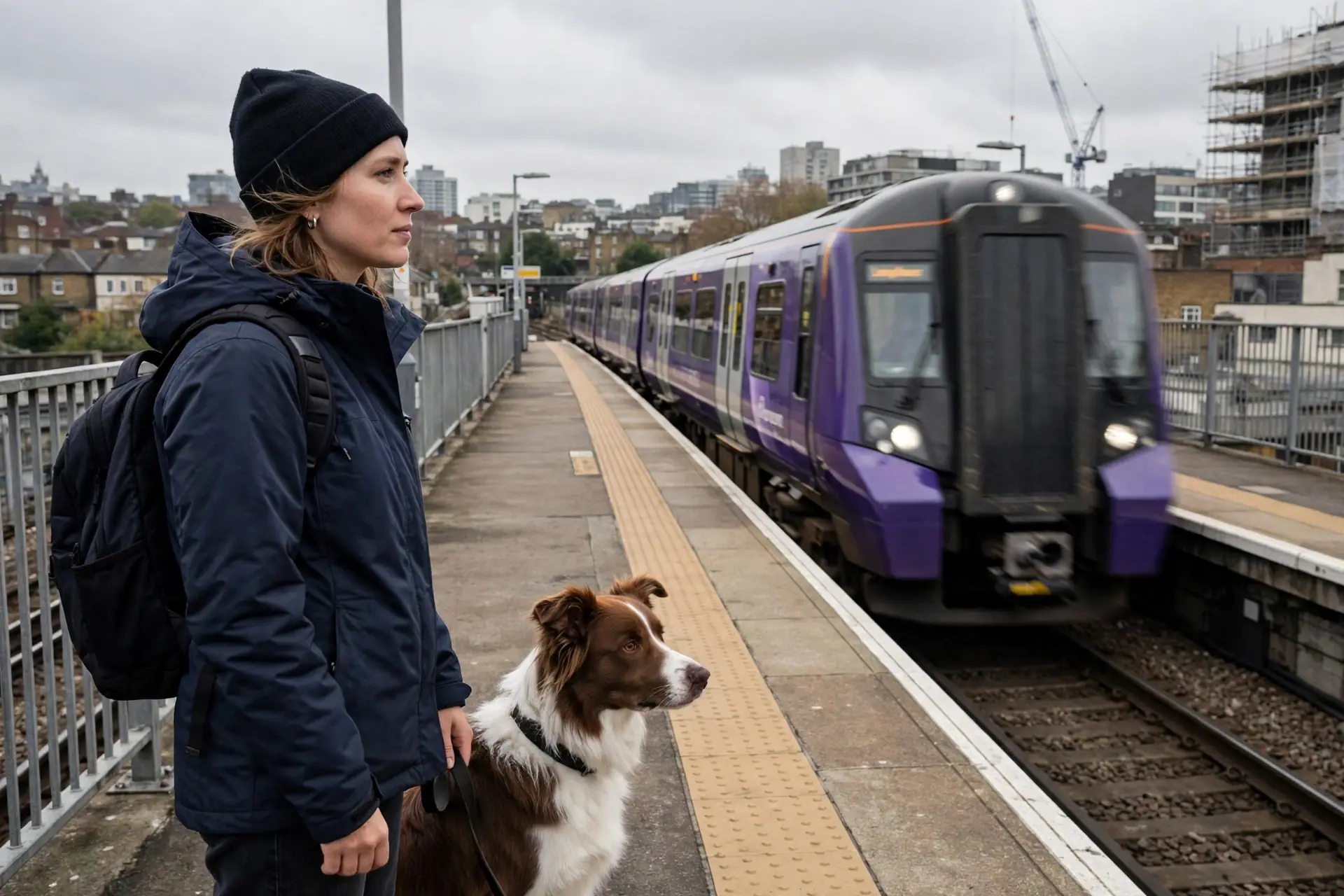
On the platform, position matters. Stand away from the platform edge, with your dog on the side away from the track, and keep the lead short enough that the dog cannot reach the yellow line. Avoid the very end of the platform, where the train arrives fastest and the wind is strongest, and avoid standing directly behind the doors of a crowded train. A quiet spot halfway along the platform, near a bench or a shelter, is usually the calmest place to wait. If the platform is crowded, stand back from the edge until the train has stopped and the doors have opened, then board after the main rush.
Peak hours and busy times
There is no peak-hour ban on dogs on London Overground, which is good news, but there is a practical peak-hour problem. Weekday mornings between about 7.30 and 9.30, and weekday evenings between about 5 and 7, the trains into and out of central London are crowded. Platforms are crowded too. A dog that is calm at midday can be stressed at 8.15 on a Tuesday, and a dog that is stressed can become reactive, which is when the trouble starts.
If you have a choice, travel outside those hours. Mid-morning, from about 10 to noon, is usually the calmest time on the network, and early afternoon is nearly as good. Late evening, after 8, is quiet again, although some smaller stations feel empty and unstaffed, which is a different kind of concern if you are travelling alone. At the weekend, the pattern changes: Saturday late morning and early afternoon are busy with shoppers and day-trippers, but the trains are rarely as packed as a weekday rush hour, and the mood is more relaxed.
Events change the picture. A match at Wembley, a concert at the O2 or a big event at the Olympic Park can fill the Mildmay and Lioness lines in both directions, and the crowds will include people who are excited, in a hurry and not looking where they step. Check whether an event is happening near your destination, and if it is, either travel earlier or choose a different station. The same applies to school holidays, when families with children and pushchairs fill the trains, and to the Christmas shopping period, when central London stations are busy all day.
On a crowded train, your job is to make your dog as small and as unobtrusive as possible. Keep the dog at your feet, between your legs or under a seat if there is room, and keep the lead short and still. Do not let the lead trail across the aisle, where it can trip another passenger or catch in a door. Do not let the dog sit in the doorway or block the gangway. If the train is full and you cannot find a space where your dog is comfortable, it is better to wait for the next train than to squeeze in. Overground trains run frequently on the central sections — every few minutes at peak times — so the next one is rarely far away.
Heat is a related concern. Overground trains are generally cooler than Tube trains, because they are above ground and ventilated, but a crowded carriage on a hot summer day can still be warm. Carry water for your dog, offer it at the station before you board, and watch for signs of overheating: heavy panting, restlessness, drooling or a reluctance to settle. If your dog shows those signs, get off at the next station, find shade and water, and wait for a quieter, cooler train. Never leave a dog in a car to travel to the station on a hot day, and never rush a hot dog onto a crowded train.
From the centre to the parks
The best reason to use London Overground with a dog is that it turns a city walk into a proper day out. The network reaches the heaths, forests, marshes and riverside paths that make London a surprisingly good city for dogs, and it does so without a car. The routes below are starting points, not itineraries: check the walking route from the station, the local dog rules, and the official guidance before you travel, because park rules and access can change.
Hampstead Heath from Gospel Oak and Hampstead Heath stations
Hampstead Heath is the classic Overground dog walk, and for good reason. Gospel Oak station drops you at the southern edge of the Heath, and Hampstead Heath station is a short walk from the western side. The Heath is large, open and varied, with ponds, woodland, open grass and long views across London. Dogs are welcome across much of the Heath, although some areas, including the bathing ponds, have restrictions, and dogs should be kept under control near the ponds and the wildlife areas. The walk from Gospel Oak up to Parliament Hill is a gentle climb that suits most dogs, and the view from the top is one of the best in London.
Plan the return as carefully as the outward journey. A wet, muddy dog on a crowded train is nobody's idea of fun, so carry a towel, wipe paws at the station, and consider a drying coat in winter. The stations near the Heath have limited shelter, so if it is raining, wait under cover and let the worst of it pass rather than standing on an exposed platform with a shivering dog.
Richmond Park and the Thames from Richmond station
Richmond is the western terminus of the Mildmay line, and Richmond Park is one of the largest green spaces in London. The park is home to herds of red and fallow deer, and that is the single most important fact for a dog owner. Keep your dog on a lead near deer, at all times of year, and be especially careful during the rutting season in autumn and the birthing season in spring, when deer are more unpredictable. A dog that chases a deer can be injured, can injure a deer, and can cause a serious incident. The park authorities take this seriously, and so should you.
Outside the deer areas, Richmond Park offers long, open walks, woodland paths and the Thames towpath, which runs from Richmond towards Twickenham and Kingston. The towpath is flat and easy, and it suits older dogs and dogs that are still building fitness. The town of Richmond itself has cafes with outdoor seating where dogs are welcome, which makes it a good base for a longer day out.
Epping Forest from Chingford station
Chingford station, on the Weaver line, is the gateway to Epping Forest, a vast ancient woodland that feels a world away from the city. The forest is criss-crossed with paths, and dogs are welcome on most of them, although they should be kept under control and on a lead near livestock and in the more sensitive areas. The walk from Chingford station into the forest is short, and the Queen Elizabeth's Hunting Lodge is a useful landmark and a good place to start.
Epping Forest is large enough to get lost in, so carry a phone with a charged battery, and keep an eye on the time. The light fades quickly under the trees in winter, and the walk back to the station can feel longer in the dark. If you are visiting for the first time, choose a short, well-marked loop rather than a long expedition, and build up from there.
The Lea Valley and Walthamstow Marshes
The Weaver line also serves the Lea Valley, where the River Lea runs through marshes, reservoirs and nature reserves. Walthamstow Central and Blackhorse Road are the useful stations, and the marshes offer flat, open walking that suits dogs of all ages. The paths are generally good, but they can be muddy after rain, and some sections are exposed, so bring water and sun protection in summer and a towel in winter. The area is popular with cyclists, so keep your dog close on shared paths and use a short lead when a cyclist approaches.
Crystal Palace Park and the south
Crystal Palace station, on the Windrush line, serves Crystal Palace Park, a large Victorian park with lakes, woodland, a maze and the famous dinosaur sculptures. Dogs are welcome in the park, and the open spaces suit a good run, although the park can be busy at weekends. The station itself is above ground and the walk to the park is short, which makes this one of the easiest Overground park trips of all. Nearby, the green spaces around Dulwich and Sydenham offer quieter alternatives if Crystal Palace Park is crowded.
Whatever park you choose, the principle is the same: use the Overground to get close, walk the last stretch, and let the dog do the work of enjoying the day. The train is a means to an end, not the experience itself, and the best dog days in London are the ones where the train ride is short, calm and forgettable, and the park is the part you remember.
A practical boarding routine
A calm journey starts before you leave the house. Exercise your dog lightly before you travel — a short walk and a toilet break — so the dog boards with an empty bladder and some of the energy already spent. A dog that has been cooped up all morning and is bursting for a wee is a dog that will be restless on the train. Feed at the usual time, but do not feed a large meal immediately before a journey if your dog is prone to travel sickness. Offer water before you leave, and carry a small bottle and a collapsible bowl for the journey home.
Pack a small dog bag. The essentials are a short lead, a spare lead or a slip lead, poo bags, a towel, water, and a treat or two for rewarding calm behaviour. A blanket or a mat that smells of home can help a nervous dog settle on the train floor, and a carrier is worth bringing for a small dog even if you do not use it on the way out — it gives you an option if the return train is crowded. If your dog wears a harness, use it for the journey: it gives you more control on a platform than a collar alone, and it is easier to hold a dog steady in a moving train.
At the station, keep the routine boring. Walk calmly to the platform, stand in a quiet spot, and let the dog sniff and settle. Do not let the dog greet every other dog on the platform: a brief sniff is fine, but a prolonged greeting in a crowded space can escalate quickly, and not every dog wants to be greeted. If another dog approaches yours, step aside, shorten the lead, and move away. You are not being unfriendly; you are being a responsible owner in a space that is not designed for dog socialising.
When the train arrives, let passengers off first. Stand back from the doors, wait for the flow to clear, and then board calmly, guiding the dog in front of you or beside you. Choose a seat near a door if your journey is short, or a quieter spot in the middle of the carriage if it is longer. Sit down, settle the dog at your feet, and reward the dog for lying down. If the dog will not settle, stand with the dog in the vestibule area, keeping the lead short and the dog out of the doorway. If you are comparing modes of travel for a longer trip, our guide on driving versus taking the train with a dog weighs the trade-offs of car and rail for a day out or a longer break.
On the train, watch your dog rather than your phone. Look for the early signs of stress: yawning, lip-licking, panting when it is not hot, a tucked tail, a reluctance to lie down, or scanning the carriage constantly. If you see them, speak calmly, offer a treat, and move to a quieter part of the train if you can. If the dog is clearly distressed, get off at the next station, let the dog decompress on the platform, and catch the next train. A ten-minute delay is a small price for a dog that arrives calm rather than panicked.
Alighting is the mirror of boarding. Stand up a stop early, gather your bags and the lead, and wait by the door. Let the dog off first, onto the platform, and then follow, keeping the lead short until you are clear of the doors and the platform edge. Give the dog a moment to sniff and reorient, offer water, and then walk calmly out of the station. If you need a toilet stop, look for a patch of grass outside the station rather than letting the dog use the platform, the concourse or a planter.
When things go wrong
Most Overground journeys with a dog pass without incident, but it helps to know what to do when they do not. The common problems are a missed train, a crowded train, a reactive encounter with another dog, a lift out of service, and a dog that is refused by staff. None of them is a crisis if you have a plan.
If you miss a train, the answer is usually to wait for the next one. Overground services on the central sections run every few minutes, and even on the outer branches the wait is rarely more than fifteen minutes. Use the time to give the dog water, let the dog sniff around the platform, and check the departure board. If the next train is also crowded, wait for the one after. Patience is the cheapest tool in a dog owner's kit.
If another dog reacts to yours, the priority is distance. Step away, put yourself between the dogs if you can do so safely, and move to another part of the platform or carriage. Do not try to hold two dogs apart by their leads in a confined space, and do not pick up a large dog in a crowded carriage. If a fight breaks out, make noise, use a coat or a bag as a barrier, and seek help from staff or other passengers. After the incident, check both dogs for injuries, exchange details if necessary, and report the incident to staff if it happened on a train or in a station.
If a lift is out of service, you have three options: use the stairs, use the escalator with the dog carried, or go to a different station. For a large dog, the stairs are usually the best option, provided the dog is fit and the stairs are not too long. For a small dog, carrying the dog on the escalator is acceptable, provided you hold the dog securely and keep paws and tails away from the sides. For an older or disabled dog, the right answer is usually a different station or a different route, even if it adds time. Check the official guidance before you travel if step-free access is essential for your dog.
If staff refuse your dog, stay calm and ask what the concern is. It may be that the dog is barking, lunging or blocking a doorway, in which case the fix is to shorten the lead, move away and let the dog settle. It may be a misunderstanding, in which case a calm explanation and a demonstration that the dog is under control can resolve it. If the refusal stands, do not argue on the platform. Wait for a quieter train, use a carrier if you have one, or choose another route. You can raise the matter with Transport for London afterwards, with the station, the time and a description of what happened.
Finally, keep your dog's identification up to date. A dog in a public place in the UK must wear a collar with the owner's name and address, and microchipping is a legal requirement. If your dog slips the lead in a station, a collar tag and a microchip are what bring the dog home. Make sure the details are current before a journey, and keep your phone charged so you can be contacted if the worst happens.
Practical questions
Before you go
Do dogs travel free on London Overground?
Yes. Dogs travel free on London Overground and do not need a ticket of their own. There is no size limit in the published rules, but your dog must be under control on a lead or in a carrier, and you must be able to manage them safely in a busy station and on a moving train.
Do I need a carrier or muzzle for my dog on the Overground?
No carrier or muzzle is required by the standard rules for London Overground. A lead is expected, and a carrier is a sensible choice for a small or nervous dog. A muzzle can still be a useful tool for a dog that is anxious in crowds, but it is not a general requirement, so check the official guidance before you travel if your dog has a history of reacting to strangers or other dogs.
Can dogs use escalators on London Overground stations?
Dogs should not ride escalators standing on their own paws. Carry small dogs, and use the lift or stairs with larger dogs. Many Overground stations are step-free or have lifts, but not all of them do, so check the step-free status of both stations before you travel, especially at interchange stations.
Are dogs allowed on London Overground during peak hours?
Yes, there is no peak-hour ban on dogs on London Overground. That said, weekday mornings and evenings are crowded, platforms are narrow at some stations, and a large dog can be hard to keep comfortable. If you can travel outside the rush, your dog will usually have more space and a calmer journey.
Which London Overground line is best for a trip to a park with a dog?
It depends on the park. The Mildmay line serves Hampstead Heath and the North London corridor, the Lioness line reaches Wembley and Watford, and the Weaver line serves the Lea Valley and Epping Forest edges. Pick the line that puts you closest to the green space you want, then check the walking route from the station before you set off.
What should I do if my dog is refused on London Overground?
Stay calm and ask what the concern is. Staff can refuse a dog that is out of control or appears dangerous, so keep your dog close, short-lead them, and move away from other passengers. If you think the refusal was a misunderstanding, wait for a quieter train, use a carrier if you have one, and check the official guidance before you travel again.