This guide is independent and contains no paid placement. If affiliate links are added later, they will be clearly marked and will not change our editorial checks.
Dogs travel free on Manchester Metrolink, on a short lead and on the floor, not on the seats. The yellow M5000 trams have low floors that sit almost flush with the platform, the network has 99 stops across four fare zones, and the easiest trips with a dog are the ones that avoid the morning and evening peaks and the match-day crush.
The network at a glance
A yellow tram pulls into the stop, slows, and stops with its floor almost exactly level with the platform edge. The doors open, a dog walks straight on without a step, a jump or a lift, and the tram glides away down the street. That small, undramatic moment is the whole reason Metrolink works so well with a dog. There is no barrier to wrestle through, no escalator to negotiate with a nervous animal, and no long staircase between the street and the carriage. You arrive, you wait on an open platform, and you step on.
Manchester Metrolink is a light-rail tram network, not a heavy-rail railway and not a bus. Its bright yellow M5000 trams run on a mix of former railway lines, dedicated tracks and street-running sections through the city centre, which means the same vehicle can carry you from a quiet suburban stop at Bury or Altrincham right into the middle of Piccadilly Gardens. The network covers 99 stops across Greater Manchester, organised into eight lines: Airport, Altrincham, Bury, East Manchester, Eccles and MediaCityUK, Rochdale, South Manchester and Trafford Park. Trams are frequent through the day on most routes, typically every 12 minutes on a single line and more often where lines share tracks, although frequencies, first and last trams and engineering works change, so check the official guidance before you travel.
For a dog owner, the shape of the network matters more than any single timetable. Almost every worthwhile day out in Greater Manchester sits within a short walk of a stop: Heaton Park from Heaton Park or Bowker Vale, the Bridgewater Canal from Sale or Stretford, Altrincham Market from Altrincham, MediaCityUK from MediaCityUK or Broadway, the Etihad Campus from Etihad Campus, and Manchester Airport itself from the Airport stop. The tram does the long, dull, traffic-bound part of the journey, and the dog gets the interesting part on foot at the other end. That division of labour is what makes a tram day out feel easy rather than exhausting, for both of you.
The other thing to understand early is that Metrolink is an open, street-level system. Stops are not stations in the heavy-rail sense: most have no ticket office, no gate line and no staffed concourse, just platforms, shelters, ticket machines, departure boards and, at the busier stops, lifts. That openness is good for dogs — there is fresh air, space to wait away from the platform edge, and no crowded underground passages — but it also means the responsibility sits with you. Nobody checks your dog in, nobody holds a door for you, and nobody will stop a dog that slips its lead on an open platform. Keep the lead short, keep the dog behind the platform edge, and treat every stop as a street corner with a tram running through it, because that is effectively what it is.
Planning by line, rather than by individual stop, is the simplest way to learn the network. Each line has its own character: the Airport line is long, green and suburban; the Altrincham line runs through comfortable south Manchester suburbs and canal country; the Bury line is the fast commuter spine to the north; the Rochdale line threads through Oldham and the Pennine fringe; the East Manchester line is short, flat and event-driven; the Trafford Park line is the newest and quietest; and the South Manchester line serves Chorlton and Didsbury, two of the most dog-friendly neighbourhoods in the city. The sections below follow that logic, line by line, so you can pick the route that fits your dog and ignore the rest until you need it.
Dogs ride free: rules and tram etiquette
The headline rule is simple and generous: dogs travel free on Manchester Metrolink. There is no dog ticket, no pet fare and no need to book a place for your dog, and that applies across the network, from a one-stop hop in the city centre to the full run out to Manchester Airport or Rochdale. You pay only your own fare for the zones you travel through. Assistance dogs travel free too, and they are not subject to the ordinary conditions that apply to pet dogs, which is worth knowing if you travel with an assistance dog and are ever challenged.
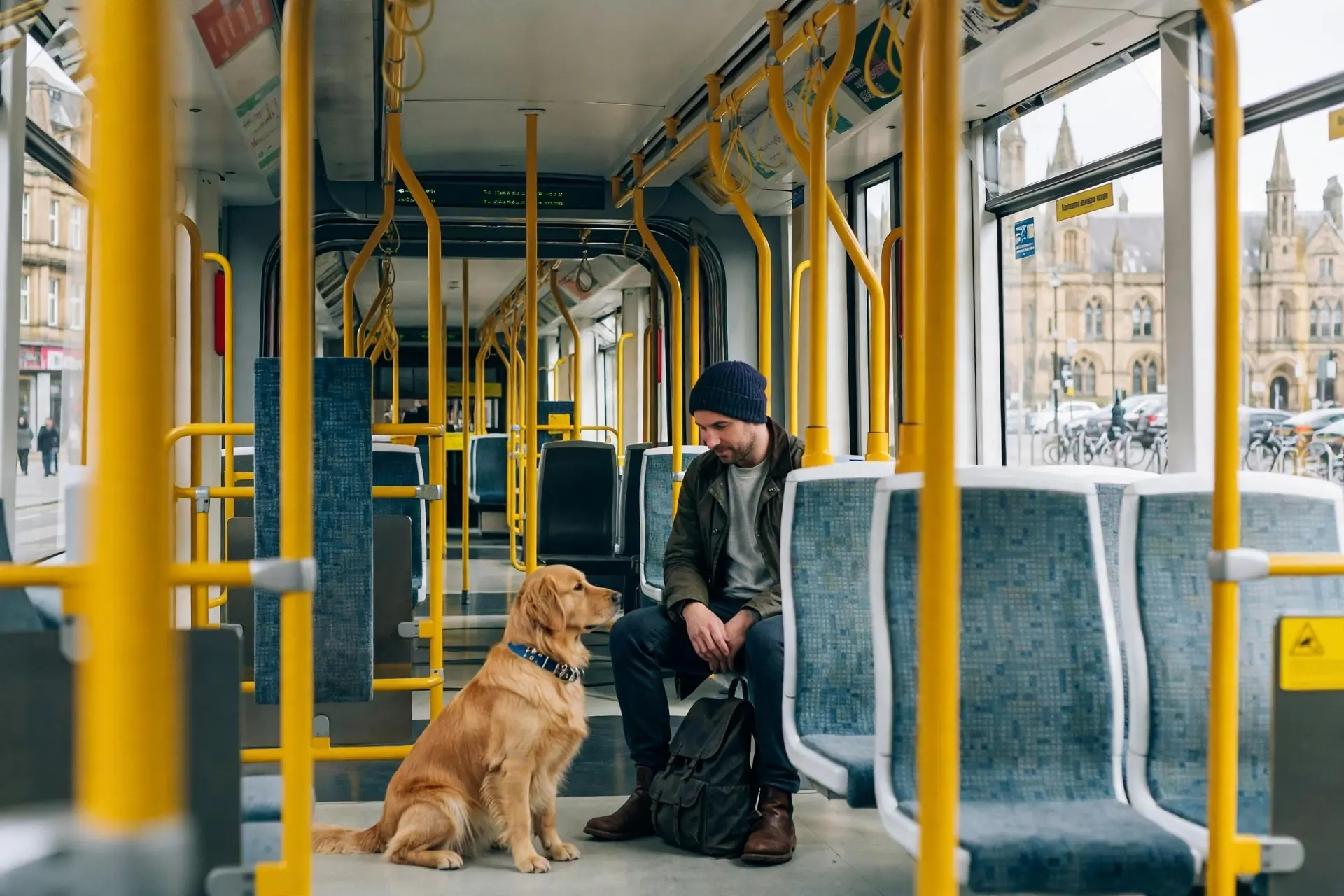
The conditions that come with free travel are mostly common sense, but they are worth stating plainly because a tram is a shared, enclosed space. Keep your dog on a short lead at all times, on the platform and on board, and keep the dog on the floor, not on the seats. Keep the dog under control and close to you, especially near the doors, where a long lead can tangle around poles, other passengers and the door mechanism itself. If your dog is large, nervous, reactive or simply excitable, choose the least crowded part of the carriage, usually the open area near the centre doors, and be ready to move or wait for the next tram if the one that arrives is already full.
A carrier is not required on Metrolink, and most dogs travel perfectly well on the floor on a lead. A carrier is a sensible choice for a small, very young, elderly or anxious dog, and it also helps if your dog is prone to snapping at passing feet or gets overwhelmed by noise and movement. If you do use one, keep it on the floor between your feet rather than on a seat, and make sure the dog can breathe, turn and lie down inside it. Muzzles are not a general requirement, but they are a reasonable precaution for a dog with a known history of reacting to strangers or other dogs in close quarters, and many owners find that a muzzle, a short lead and a calm spot together make a tram journey far less stressful than any one of them alone.
Tram etiquette is really about reading the carriage. Sit or stand where your dog has a little floor space and is not blocking the aisle, the doors or the priority seats. Do not let the dog approach other passengers, sniff shopping bags or greet other dogs unless the other owner clearly invites it — and on a moving tram, even a friendly greeting can go wrong fast. If another dog boards, shorten the lead, move your dog to your far side, and keep both animals apart rather than letting them sort it out in a space neither can leave. If your dog barks, whines or paces, do not scold it loudly; instead, get off at the next stop, let it settle, and either walk the rest of the way or wait for a quieter tram.
Finally, plan for the practical details that catch people out. Bring water and a collapsible bowl on warm days, because trams can be hot in summer and there is nowhere to buy water on board. Carry poo bags and use them before you board, not after you arrive, so the dog is comfortable for the journey. If your dog is in season, elderly, unwell or recovering from an operation, think twice about a tram at all — the vibration, noise and proximity to strangers are manageable for a healthy dog and genuinely hard work for one that is not. And if anything about the rules is unclear on the day, check the official guidance before you travel rather than relying on what another passenger tells you, because conditions and byelaws do change.
Fares, zones and paying without a ticket office
Metrolink fares are based on four zones, numbered 1 to 4, radiating out from the city centre. Zone 1 covers the city centre itself; zone 2 covers the inner suburbs; zone 3 reaches further out to places such as Sale, Prestwich and Chorlton; and zone 4 covers the outer ends of the network, including Bury, Altrincham, Rochdale, Ashton-under-Lyne and Manchester Airport. Your fare depends on how many zones you travel through, not on the distance in miles, and a journey entirely within one zone costs less than one that crosses three. The dog, as always, travels free, so you only ever buy a ticket for yourself.
There are no ticket offices and no barriers at most stops, which surprises first-time visitors. You buy before you board, from a ticket machine on the platform, or you pay by contactless bank card, phone or watch at the smart readers on the platform. Contactless is the simplest option for most dog owners because it leaves both hands free for the lead: touch in on the reader at your starting stop and touch out on the reader at your destination stop, and the system charges the correct fare for the zones you travelled through. If you use a paper or mobile ticket instead, buy it from the machine before the tram arrives, because there is no conductor on board selling tickets and no time to fumble with a machine while holding a lead and a dog.
Day tickets and travelcards are worth considering if you plan to hop on and off. A one-day ticket covering the zones you need can be cheaper than two or three single fares, and it removes the small anxiety of touching in and out correctly at every stop with a dog in tow. Weekly and season products exist for regular commuters, and there are concessionary options for older and disabled passengers, but the details and prices change, so check the official guidance before you travel and buy the product that matches the zones you will actually use. Do not assume a ticket that covers zones 1 and 2 will also cover a trip out to the Airport or to Bury, because it will not.
The practical risk with an open system is travelling without a valid ticket, which can lead to a penalty fare. Inspectors do board trams and do check tickets, and “the dog was pulling” is not a defence. Make buying your ticket part of your boarding routine: arrive a minute earlier than you think you need, touch in or buy first, and only then settle the dog at the platform edge. If the ticket machine at your stop is out of order, use contactless if you can, and if neither works, check the official guidance before you travel about what to do — do not simply board and hope. Keep your ticket or your contactless card until you have left the destination platform, because you may need to show it on arrival.
One more point matters for dog owners in particular: the fare system rewards short, deliberate trips. A single stop in the city centre is cheap and quick, and it is often better than a long walk through crowds with a dog that is already tired. Equally, a longer ride out to Heaton Park or the Trafford Centre is good value precisely because the dog rides free and the tram does the work. Think in zones, not in miles, and you will quickly learn which journeys are worth a tram and which are better done on foot. Our guide to Manchester with a dog pairs these tram routes with canal towpaths and parks, so you can plan the walk at the far end before you buy the ticket.
Step-free boarding and platform safety
Level boarding is Metrolink's greatest gift to dog owners. The floor of a yellow M5000 tram sits almost flush with the platform, with only a small horizontal gap to cross, so a dog walks on and off as if stepping across a threshold. That matters for older dogs with stiff joints, for small dogs that cannot manage a high step, for puppies that are still learning, and for owners carrying a lead, a bag and a coffee at the same time. It also matters for owners using a wheelchair or a pushchair, because the same level floor that helps a dog helps everyone else too. Stand back from the edge, let passengers off first, and then walk the dog straight on in one calm movement.
The gap is small, but it is still a gap, and it deserves respect. Keep the dog on a short lead and step on first, guiding the dog in behind you, rather than letting a long lead trail across the gap or allowing the dog to jump on ahead of you. Watch paws on wet platforms, where the edge can be slippery, and on icy mornings, when both you and the dog need to slow down. At street-running stops in the city centre, the platform is essentially a raised pavement beside a road, so treat the edge like a kerb: keep the dog behind it, keep the lead short, and never let the dog wander towards the tracks while you look at your phone.
Getting to the platform is a separate question from boarding the tram. Most Metrolink stops are reached at street level or by a ramp, which is ideal. Some of the busier interchange stops have lifts, and a few stops involve steps or a footbridge, so access is not identical everywhere. If your dog struggles with steps, if you use a wheelchair, or if you are travelling with a pushchair and a dog at the same time, check the official guidance before you travel for the specific stops on your route. The difference between a ramp and a staircase at one interchange can decide whether a journey is easy or whether you should choose a different stop a short walk away.
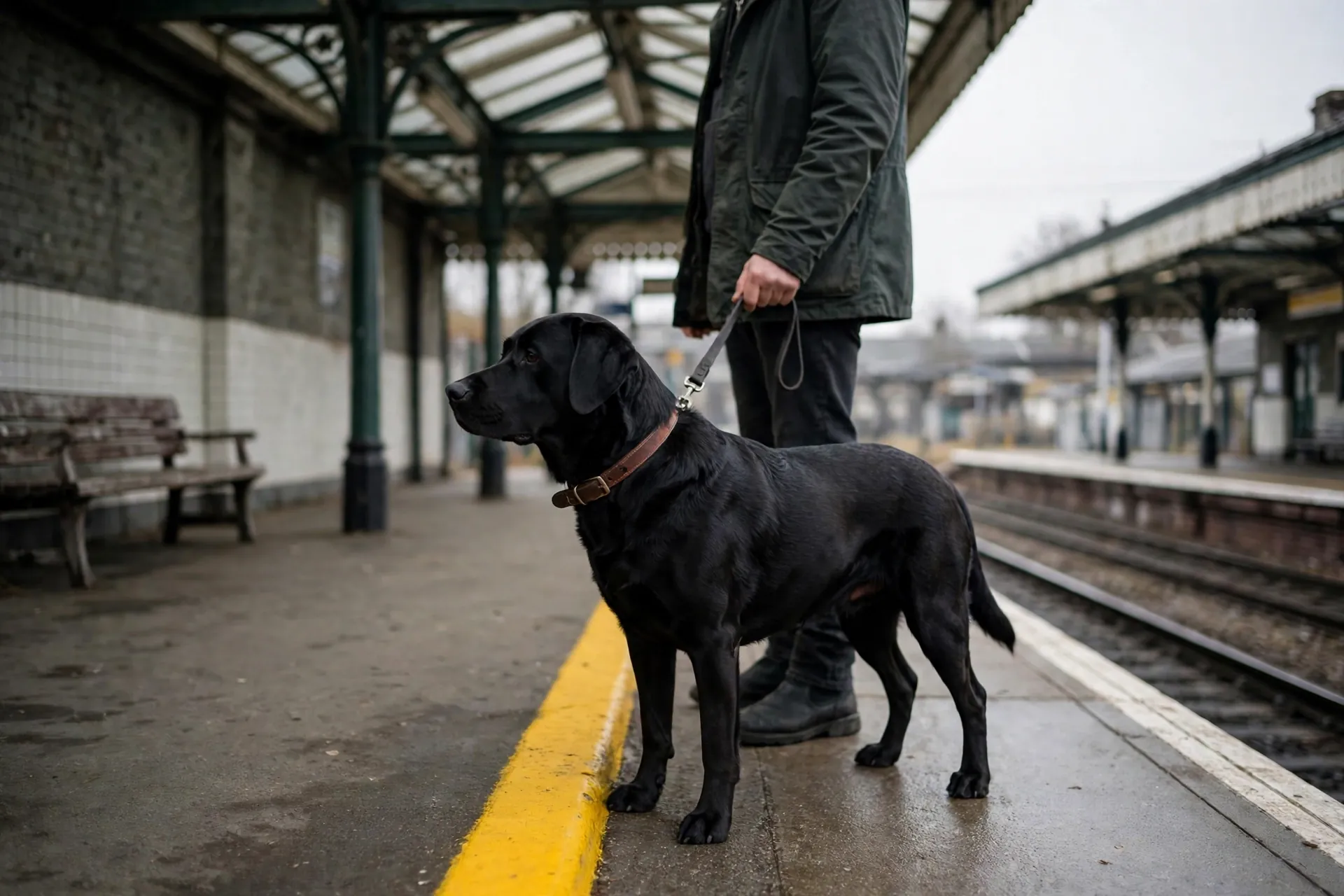
On the platform, the yellow line and the edge deserve the same respect they get on a heavy-rail station. Our guide to dogs on UK train platforms covers the same principles in detail, and they apply here too: keep the dog well back from the edge, keep the lead short enough that the dog cannot reach the tracks, and do not let the dog sit or lie with its tail or paws near the edge. Trams approach quietly, especially the newer vehicles, and a dog that is sniffing the platform edge may not hear one coming. Stand behind the shelter or the seating if the platform is busy, and move forward only when the tram has stopped and the doors have opened.
Inside the tram, choose your spot with the dog's comfort in mind. The open areas near the centre doors give a large dog room to lie down without blocking the aisle, while the seats at the ends of the carriage are better for a small dog that can settle at your feet. Avoid standing in the doorway, avoid the priority seats unless you need them, and keep the lead wrapped once around your hand so it cannot slip. If the tram brakes suddenly — and it will, especially in street-running sections where cars and pedestrians cross the tracks — a short lead and a dog at your feet are far safer than a long lead and a dog wandering. When your stop approaches, stand up early, gather the lead, and be ready to step off promptly, because dwell times at stops are short.
City-centre interchanges
The city centre is where Metrolink stops being a set of separate lines and becomes a single network, and it is also where a dog owner needs to think most carefully. Five stops do most of the connecting work: Piccadilly, Victoria, Deansgate-Castlefield, Cornbrook and St Peter's Square. Each one has a different feel, a different level of crowding, and a different kind of change, so it pays to know which one suits your dog before you arrive.
Piccadilly is the big one. Metrolink Piccadilly sits below Manchester Piccadilly railway station, with trams running through to Bury, Altrincham, the Airport and Ashton-under-Lyne, and it is the natural change point if you arrive by train with a dog. The interchange is well signed and step-free by lift, but it is also busy, echoing and full of hurrying passengers, which can overwhelm a nervous dog. Give yourself extra time here, keep the lead short through the concourse, and use the quieter end of the platform rather than the middle, where crowds gather. If you are changing from a train to a tram, allow at least ten minutes with a dog, even if the journey planner says five.
Victoria is the northern hub, connecting Metrolink with heavy-rail services to the north and east, and with the Bury and Rochdale lines. The station has been rebuilt and is far lighter and easier to navigate than it used to be, but it is still a large, busy interchange at peak times. The Metrolink platforms sit inside the station, which shelters you and the dog from the weather but also concentrates noise and foot traffic. If your dog is sound-sensitive, consider changing at a quieter stop instead, or time your journey outside the morning and evening peaks. Deansgate-Castlefield, by contrast, is a calmer, more open stop on the southern edge of the centre, with easy access to the canals, Castlefield Basin and the Bridgewater Canal towpath. It is a good place to start or finish a walk with a dog, and the change between lines here is a short, level walk across the platforms.
Cornbrook is the quiet workhorse of the network, where the Altrincham, Airport, South Manchester and Trafford Park lines meet just south-west of the centre. It is less crowded than Piccadilly or Victoria, the platforms are open to the sky, and the change is usually a simple cross-platform move. If you are travelling from the south to MediaCityUK or the Trafford Centre, or from the Airport line to Altrincham, Cornbrook is often the easiest place to change with a dog. St Peter's Square, in the heart of the city centre, is the other key interchange, connecting the Altrincham, Bury, Airport, South Manchester and East Manchester lines with the Second City Crossing. It is also the most exposed to street crowds, shoppers and events in the square itself, so it is best used outside the busiest shopping hours if your dog dislikes crowds.
A few practical rules apply at every interchange. Check the departure board before you commit to a platform, because the next tram on your line may leave from a different platform than the one you expected. Keep the dog close while you read the board, and do not let the lead trail across a platform while other passengers hurry past. If you miss a connection, do not rush: trams are frequent, and the next one will usually arrive within twelve minutes. And if the interchange feels too busy for your dog, remember that you can often walk between city-centre stops in ten to fifteen minutes, which may be calmer than a second crowded tram ride. The walk from St Peter's Square to Piccadilly, or from Deansgate-Castlefield to Cornbrook, is straightforward and often quicker than waiting for a connection.
The Airport line
The Airport line is the longest and greenest of the Metrolink lines, running from Manchester Airport through Wythenshawe, Sale Water Park and Northern Moor into Cornbrook and the city centre. For dog owners, it is useful in two quite different ways: as a practical way to reach the airport without a car, and as a route to a string of parks, water and open space in south Manchester that are otherwise awkward to reach by public transport.
Starting at the airport end, the Airport stop sits close to the terminals, and the walk from the tram to the terminal buildings is short and level, though the terminal area itself is busy and full of trolleys, queues and announcements. Dogs are welcome on the tram, but the airport buildings have their own rules about where dogs may go, and a pet dog is not the same as an assistance dog inside a terminal. If you are meeting someone at the airport, plan to meet outside or in a clearly dog-friendly area, keep the dog on a short lead, and do not assume you can take the dog through check-in or security. For a simple pick-up or drop-off, the tram is far easier than driving, because you avoid parking charges and the stress of the airport road system.
Moving inward, the line passes through Wythenshawe, with stops at Shadowmoss, Peel Hall, Robinswood Road, Wythenshawe Town Centre, Crossacres, Benchill, Martinscroft and Roundthorn, then Baguley and Moor Road. This is residential south Manchester, with parks, playing fields and green corridors close to many stops, and it is a good area for a local dog walk that starts and ends at a tram stop. Wythenshawe Park itself is a large, historic park with woodland, meadows and a hall, and it is an easy walk from the nearby stops, though you should check the official guidance before you travel about current access and any local dog rules. Sale Water Park, a stop further in, sits beside a large lake and the River Mersey, with waterside paths that are popular with dog walkers and a café nearby, making it one of the best tram-accessible waterside walks in the city.
The journey from the Airport to the city centre takes around forty minutes, which is a long time for a dog that is not used to trams, so build up to it. Start with a short ride of two or three stops, reward calm behaviour, and only then attempt the full length of the line. Bring water, especially in summer, because the tram can be warm and there is no shade or water on board. Choose a seat near the centre doors where the dog has floor space, and avoid the busiest airport services in the early morning and late evening, when the tram fills with travellers and luggage. If the tram arrives already crowded with suitcases, wait for the next one — luggage and dogs do not mix well in a narrow aisle.
One final point about the Airport line: it is the line most likely to be affected by engineering works and timetable changes, because it is long and shares tracks with other lines through Cornbrook and the city centre. Check the official guidance before you travel, especially on Sundays and bank holidays, and have a backup plan, such as a bus or a walk to a nearby stop on another line, if your preferred service is not running. The line is worth the small amount of planning, though, because it turns a car-dependent corner of Manchester into a place you can reach with a dog, a lead and a contactless card.
Altrincham and South Manchester lines
The Altrincham line and the South Manchester line share tracks through Cornbrook and the city centre, then split to serve two of the most dog-friendly parts of Greater Manchester. The Altrincham line runs south-west through Old Trafford, Stretford, Sale, Brooklands, Timperley and Navigation Road to Altrincham, largely on a former railway alignment with open views, cuttings and embankments. The South Manchester line runs south through Trafford Bar, Firswood, Chorlton, Stretford Road and the Didsbury stops — West Didsbury, Burton Road, Withington, Barlow Moor Road and Didsbury Village — to East Didsbury, passing through leafy suburbs, parks and the Mersey valley.
Altrincham itself is the destination that justifies the line. Altrincham Market, in the town centre a short walk from the tram stop, is one of the most dog-friendly markets in the North West, with dogs welcome in the market hall area and in many of the surrounding cafés and bars, though individual businesses set their own rules and it is worth checking before you sit down. The town has a compact, walkable centre, with independent shops, coffee spots and the Bridgewater Canal nearby, and the walk from the tram stop to the canal towpath is short and level. Come on a weekday morning if your dog dislikes crowds, because the market is at its busiest on Saturday, when the tram itself is also busier.
Chorlton, on the South Manchester line, is the other neighbourhood worth a dedicated trip. Chorlton-cum-Hardy has a village feel, with independent cafés, bars and shops that are famously relaxed about dogs, and Chorlton Water Park and the Mersey valley are a short walk from the tram stop, offering lakeside paths, meadows and woodland. Didsbury Village, further down the same line, is similarly gentle: a small, green centre with cafés, Fletcher Moss Park and the River Mersey close by, and a tram stop that drops you almost into the village. Both Chorlton and Didsbury reward a slow visit — a tram in, a long walk, a coffee with the dog at your feet, and a tram home — rather than a rushed dash.
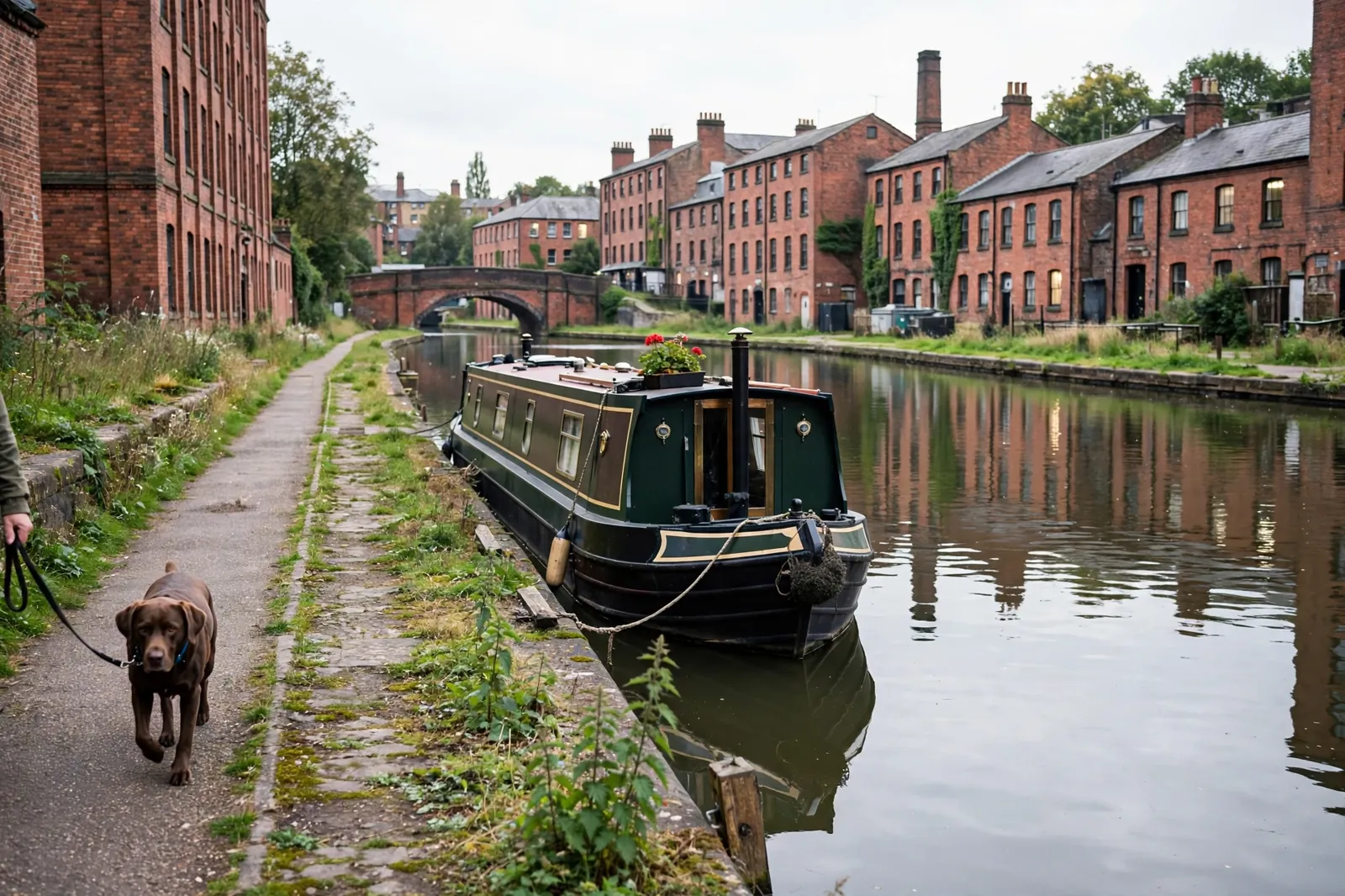
Between the two lines, the canal is the thread that ties the journey together. The Bridgewater Canal runs through Sale, Stretford and Altrincham, and the towpath is one of the best dog walks in south Manchester: flat, traffic-free, and long enough for a proper outing. You can ride the tram to Sale or Timperley, walk a stretch of the towpath, and catch the tram back from a different stop, which is the kind of linear walk that only a tram network makes easy. Keep the dog on a lead on the towpath, watch for cyclists, and remember that the canal is unfenced water, so a dog that loves to swim needs to be kept close near locks and bridges.
On both lines, the practical details are the same: trams are frequent, the stops are open and level, and the journey from the city centre to Altrincham or East Didsbury takes around thirty minutes. The busiest times are the morning and evening peaks, when commuters fill the trams, and Saturday afternoons, when shoppers and market visitors join them. Travel outside those times with a nervous dog, choose a carriage away from the doors, and use the quieter stops — Brooklands, Timperley, West Didsbury — as starting points for walks rather than the busiest interchanges. And if you want to compare these tram routes with the bus network, our guide to dogs on London buses explains the different rules that apply when a dog rides a bus, which is a useful contrast even though the cities are different.
The Bury line
The Bury line is the fast northern spine of Metrolink, running from Bury through Radcliffe, Whitefield, Prestwich, Heaton Park, Bowker Vale, Crumpsall, Abraham Moss and Queens Road into Victoria. It is a former heavy-rail line, so the stops are further apart, the trams run faster between them, and the journey feels more like a train than a street tram. For dog owners, that speed is the attraction: you can be from the city centre to Heaton Park in about twenty minutes, and to Bury in about half an hour, without a car.
Heaton Park is the reason most dog owners will ever use this line, and it deserves a trip of its own. Heaton Park station — served by the tram stop of the same name, with Bowker Vale a short walk away — drops you at the edge of one of the largest municipal parks in Europe, with 600 acres of parkland, woodland, lakes, a hall, a farm and miles of paths. Dogs are welcome in much of the park, though some areas, such as the formal gardens and the farm, have their own rules, so check the signs and the official guidance before you travel. The park is big enough that you can walk for an hour without retracing your steps, and the tram home is a welcome sight at the end of a long, muddy walk, especially in winter.
Prestwich and Whitefield, further up the line, are quieter suburban stops with parks, woods and the Irwell valley close by, and they suit a local walk that starts at the tram and loops back to it. Prestwich Forest Park, also known as Drinkwater Park, is a large area of woodland and meadow along the River Irwell, and it is an easy walk from Prestwich stop, though the paths can be muddy after rain and the river is unfenced in places, so keep the dog close. Bury itself, at the end of the line, is a market town with a compact centre, a market hall and the East Lancashire Railway nearby, and it makes a good half-day trip: tram up, market and coffee, a walk along the Irwell, and tram back.
The Bury line is also the line where platform safety matters most, because the trams arrive faster and the stops are more exposed to the wind. Keep the dog well back from the edge, keep the lead short, and do not let the dog stand at the very end of the platform, where the tram arrives. At Heaton Park and Bowker Vale, the platforms are open and the wind can be strong, so use the shelter and keep the dog close. At Victoria, the city-centre terminus of the line, the platforms are inside the station, which is calmer in bad weather but busier with passengers changing to trains.
Because the Bury line is a commuter route, it is busiest in the morning peak into the city and the evening peak out of it. If you are travelling to Heaton Park for a walk, aim for a mid-morning tram, after the commuters have cleared, and travel back before the evening peak builds. On a fine weekend, the park trams can be busy with families, so be prepared to wait for a quieter service if the first tram is full. And if your dog is not used to faster trams, start with a short ride to Crumpsall or Abraham Moss and build up to the full journey to Bury, rewarding calm behaviour at each stage.
Rochdale and East Manchester lines
The Rochdale line and the East Manchester line sit at opposite ends of the network, but they share a useful quality for dog owners: both are lines where the tram is the easy way to reach places that are otherwise a long drive or an awkward bus ride. The Rochdale line runs north-east from Victoria through Monsall, Central Park, Newton Heath and Moston, Failsworth, Hollinwood, South Chadderton, Freehold, Westwood, Oldham King Street, Oldham Central, Oldham Mumps, Derker, Shaw and Crompton, Newhey, Milnrow, Kingsway Business Park and Newbold to Rochdale Town Centre and Rochdale Railway Station. The East Manchester line runs east from Piccadilly through New Islington, Holt Town, Etihad Campus, Velopark, Clayton Hall, Edge Lane, Cemetery Road, Droylsden, Audenshaw, Ashton Moss and Ashton West to Ashton-under-Lyne.
The Rochdale line is the longer and more varied of the two. Oldham, in the middle of the line, is a Pennine-edge town with a compact centre, a market and the start of walks up towards the moors, though the moorland itself is a drive or a longer walk from the tram, not a tram stop. Shaw and Crompton and Milnrow are quieter stops with access to local parks and the Rochdale Canal, which runs through the area and offers flat, traffic-free towpath walking. Rochdale itself, at the end of the line, has a restored town centre, a riverside walk and the Rochdale Canal, and it makes a good half-day trip for a dog owner who wants somewhere different from the city centre. The line is also one of the quieter Metrolink routes outside the peaks, which makes it a good choice for a nervous dog that needs space.
The East Manchester line is shorter, flatter and more event-driven, and it needs a different approach. The stops from Piccadilly to Ashton-under-Lyne pass through New Islington, with its canals and new housing, Holt Town, and then the Etihad Campus and Velopark, which are dominated on event days by football and concerts. On a non-event day, the line is quiet and easy, and the canal towpaths around New Islington and the Ashton Canal make for a pleasant, flat walk. Droylsden and Ashton-under-Lyne are small town centres with markets and canal walks, and Ashton-under-Lyne in particular has a compact centre that is easy to explore with a dog on a lead. The journey from Piccadilly to Ashton takes around half an hour, and the tram is frequent through the day.
Both lines reward the same planning habit: check whether an event is on before you travel. The East Manchester line is transformed on match days and concert nights, when trams to Etihad Campus fill with supporters and the platforms are crowded, noisy and stressful for a dog. The Rochdale line is less event-driven, but Oldham and Rochdale both host markets and events that can make the town-centre stops busier than usual. A quick check of the official guidance before you travel, and a look at the events calendar for the Etihad Campus, will tell you whether to travel earlier, later, or on a different day altogether.
For a dog that is still learning to ride trams, these two lines are good training ground. The Rochdale line offers long, quiet rides with space to settle, while the East Manchester line offers short, flat hops between Piccadilly and New Islington that can be built up gradually. In both cases, start short, reward calm behaviour, and do not attempt a full end-to-end journey on the first trip. And if you are changing at Victoria or Piccadilly to reach either line, allow extra time for the interchange, keep the lead short through the station, and use the quieter end of the platform while you wait.
The Trafford Park line
The Trafford Park line is the newest line on the network, opened in 2020, and it is also one of the quietest, which makes it a good choice for a dog that is still getting used to trams. It branches from Cornbrook through Pomona, Village, Imperial War Museum, Wharfside and the Trafford Centre, running through the Trafford Park industrial and leisure area to one of the largest shopping centres in the North West. The line is short, the trams are frequent, and the stops are modern, open and level, with clear signage and good sightlines.
The Imperial War Museum North stop is the most interesting on the line for a dog owner, not because dogs can go inside the museum — they cannot, except for assistance dogs — but because the stop sits on the banks of the Manchester Ship Canal, with waterside paths, the Lowry Bridge and the MediaCityUK area a short walk away across the canal. The area around the museum is open, windswept and spacious, with views across the water, and it is a good place for a short, flat walk before or after a tram ride. Keep the dog on a lead near the water, because the canal is deep, unfenced in places and busy with boats, and watch for cyclists on the shared paths.
MediaCityUK itself is not on the Trafford Park line, but it is closely connected to it, and the distinction matters when you plan a trip. MediaCityUK is served by the Eccles line, via Broadway and MediaCityUK stops, with a change at Cornbrook from most other lines. The area around MediaCityUK — the quays, the waterfront, the Lowry and the BBC and ITV buildings — is open, pedestrianised and popular with dog walkers, with waterside paths, grassy areas and cafés that welcome dogs outside. It is one of the best tram-accessible waterside walks in Greater Manchester, and it is at its best on a weekday, when the quays are quieter than on a weekend. The walk from MediaCityUK across the Lowry Bridge to the Imperial War Museum is a short, flat loop that works well with a dog, and it connects the Eccles line with the Trafford Park line on foot.
The Trafford Centre, at the end of the line, is a large indoor shopping centre, and dogs are not generally welcome inside shopping centres except for assistance dogs, so do not plan a shopping trip with a pet dog in mind. The value of the line for a dog owner is not the centre itself but the journey to it: the tram ride, the waterside walk at the Imperial War Museum, and the open space around the canal. If you do need to visit the centre, plan a split visit, with one person staying outside with the dog, or leave the dog at home for that trip. The same split-visit logic applies to the museum and to any indoor attraction on the network: check the official guidance before you travel about which venues welcome dogs and which do not.
Practically, the Trafford Park line is easy. Trams run from Cornbrook, so you will usually change there if you are coming from the city centre or from the south, and the change is a simple cross-platform move. The line is quiet outside shopping peaks, which are Saturday afternoons and the run-up to Christmas, so aim for a weekday morning if your dog dislikes crowds. The stops are all step-free and level, the platforms are wide, and the journey from Cornbrook to the Trafford Centre takes only a few minutes, which makes it a good first line for a dog that is new to trams. If the tram is busy with shoppers, wait for the next one — they are frequent, and a quieter carriage is worth a few minutes' wait.
Match days, concerts and crowds
Two places on the Metrolink network change completely on event days: Etihad Campus, on the East Manchester line, and Old Trafford, on the Altrincham line. On a match day at the Etihad Stadium or Old Trafford, or on a concert night at either venue or at the nearby arenas, the trams fill with supporters, the platforms fill with queues, and the ordinary calm of a tram ride disappears. A dog that is happy on a quiet mid-morning tram can be genuinely distressed on a packed match-day service, and it is your job to keep the two apart.
The pattern is predictable, which means it can be planned around. Before a match, trams towards the stadium fill from about two hours before kick-off, with the busiest services in the final hour. After the match, the crush is worse, because thousands of people leave at the same time and queue for the next tram, and the platforms at Etihad Campus and Old Trafford can be crowded for an hour or more. Concerts follow a similar pattern, with a slower build-up and a sharp peak at the end. If you need to travel on an event day, travel well before the build-up or well after the peak, or avoid the affected line altogether and walk the last stretch from a quieter stop. The walk from Piccadilly to the Etihad Campus, for example, is long but flat and largely canal-side, and it may be calmer than a packed tram.
If you do find yourself on a busy tram with a dog, a few habits help. Keep the dog at your feet, between your legs or against the side of the carriage, where it is protected from passing feet and luggage. Shorten the lead to a few inches, wrap it once around your hand, and do not let it trail. Avoid the doors, where passengers push in and out, and avoid standing in the aisle, where the dog will be stepped on. If the tram is already full when it arrives, do not squeeze on: wait for the next one, even if the platform is crowded, because a dog that is stressed on a packed tram is more likely to bark, snap or panic, and that helps nobody. And if your dog does become distressed, get off at the next stop, let it settle in a quiet spot, and walk or wait rather than continuing.
The same advice applies to other crowded occasions: Christmas shopping Saturdays in the city centre, the Manchester Christmas Markets, Pride weekend, and the summer festivals that fill St Peter's Square and Piccadilly Gardens. On those days, the city-centre stops — St Peter's Square, Piccadilly Gardens, Market Street and Exchange Square — are the busiest on the network, and the trams that pass through them are full. If your dog dislikes crowds, avoid the city centre on those days, or travel early in the morning before the crowds build. If you do need to cross the city, consider walking between stops rather than taking a tram through the busiest section, or use the Second City Crossing, which runs via Exchange Square and can be quieter than the original city-centre route through Piccadilly Gardens, depending on the time of day.
Finally, remember that event days also affect the return journey. A dog that coped well on the way out, when the tram was quiet, may struggle on the way back, when the tram is full of tired, noisy supporters. Build in a buffer: allow an extra hour, have water and a snack for the dog, and know where the nearest quiet stop is if you need to get off and walk. If in doubt, check the official guidance before you travel for event-day service patterns, because extra trams, queueing systems and station closures are often put in place on match days, and they change from event to event.
Dog-friendly day trips by tram
The best way to use Metrolink with a dog is to treat the tram as the boring part and the walk at the far end as the point. Three day trips, each built around a single line, show how that works in practice, and each one can be shortened or extended to fit your dog's energy, age and confidence.
First, MediaCityUK and the quays. Take the Eccles line to MediaCityUK, changing at Cornbrook if you are coming from the south or the city centre, and step out onto the waterfront. The quays are open, flat and pedestrianised, with wide paths along the water, grassy areas where a dog can sniff and settle, and the Lowry Bridge leading across to the Imperial War Museum North. Walk the loop around the quays, stop at a waterside café that welcomes dogs outside, and then either retrace your steps to the tram or walk across the bridge to the Trafford Park line and catch a tram back from the Imperial War Museum stop. The whole loop is flat, step-free and easy, and it suits an older dog as well as a young one, though you should keep the dog on a lead near the water and watch for cyclists.
Second, Heaton Park. Take the Bury line to Heaton Park or Bowker Vale, and spend a morning in the park. Start with the woodland paths near the tram stop, then work your way to the lake, the hall and the open meadows, choosing a route that fits your dog: a short, flat loop for an older dog, or a longer, hillier walk for a fit one. Bring water and poo bags, because the park is large and the facilities are spread out, and check the signs for areas where dogs need to be on a lead or are not allowed. The tram home is the reward at the end: a level boarding, a quiet carriage, and a dog that is happily tired. If the park is busy on a fine weekend, start early, before the families arrive, and aim for the woodland paths rather than the busiest lawns.
Third, Altrincham Market and the Bridgewater Canal. Take the Altrincham line to Altrincham, spend an hour at the market and in the town centre, and then walk a stretch of the Bridgewater Canal towpath towards Sale or Timperley. The market is dog-friendly in the outdoor and market hall areas, though individual stalls and cafés set their own rules, so check before you sit down. The canal towpath is flat, traffic-free and long, so you can walk as far as your dog wants and then catch the tram back from a different stop — Sale, Timperley or Brooklands — which is the kind of linear walk that only a tram network makes simple. Keep the dog on a lead on the towpath, watch for cyclists, and carry water, because there is little shade on a hot day.
Whichever trip you choose, the same preparation applies. Check the official guidance before you travel for the day's service pattern, especially on Sundays and bank holidays. Pack water, a bowl, poo bags, a short lead and a spare lead, and a towel if the walk is muddy. Travel outside the peaks, choose a quiet carriage, and let the dog settle at your feet. And if the day does not go to plan — the tram is full, the park is closed, the market is too busy — do not force it. Get off, walk somewhere quiet, and try again another day. The network will still be there, the yellow trams will still be running, and your dog will remember the calm trip far longer than the crowded one.
For the city itself, before you plan the tram and the walk together, read our Manchester with a dog guide, which covers canal towpaths, Heaton Park, the Northern Quarter and dog-friendly places to stay, and pairs naturally with the routes in this guide.
Practical questions
Before you go
Can dogs travel on Manchester Metrolink for free?
Yes. Dogs travel free on Metrolink and do not need a ticket of their own. You only pay your own fare for the zones you travel through. Keep your dog on a short lead, under control and off the seats, and be ready to move if the tram fills up. Check the official guidance before you travel, because conditions can change.
Do dogs need to be in a carrier on Metrolink?
No, a carrier is not required. Most dogs travel on the floor on a short lead, and a carrier is a sensible choice only for a small, nervous or very young dog. A loose lead is the main problem on a tram: it can tangle around poles, doors and other passengers, so keep the lead short and the dog close to your feet.
Are all Metrolink stops step-free for dogs and owners?
Metrolink is designed around level boarding: the low floor of the yellow M5000 trams sits almost flush with the platform, so most dogs walk straight on without a step. Access to the platform itself varies by stop, and some stops are reached by ramps, lifts or steps, so check the official guidance before you travel if your dog struggles with steps or you use a pushchair or wheelchair.
Can I take my dog on Metrolink to Manchester Airport?
Yes. The Airport line runs from Manchester Airport through Wythenshawe and Sale Water Park into the city centre, and dogs travel free on it like any other line. Allow extra time at the airport end, keep your dog close in the busy terminal area, and remember that airport buildings and the tram stop have their own rules about where dogs may go.
What should I do with my dog on a busy match day tram?
Avoid the peak if you can. Trams to Etihad Campus and Old Trafford fill fast before and after matches and concerts, and a nervous dog will find the crush, noise and standing passengers stressful. Travel earlier or later, wait for a quieter tram, keep the dog at your feet away from the doors, and have a plan to get off and walk the last stretch if the next tram is already packed.
Can I change between Metrolink lines in the city centre with a dog?
Yes, and it is one of the easiest parts of the network. Piccadilly, Victoria, Deansgate-Castlefield, Cornbrook and St Peter's Square all connect lines, and most changes are a short walk across the same platform or to an adjacent platform. Allow a few extra minutes with a dog, keep the lead short on crowded platforms, and check the departure boards before you commit to a platform.