This guide is independent and contains no paid placement. If affiliate links are added later, they will be clearly marked and will not change our editorial checks.
Base the dog in Dorchester itself and let the town do the work: a flat Frome-side circuit from Grey's Bridge in the morning, the sheep-grazed ramparts of Maiden Castle after lunch, and an evening lap of Borough Gardens and the Walks. Dorset Museum, The Keep and Max Gate stay human-only, so slot those in while the dog sleeps at your lodgings, and treat Wednesday and Saturday market mornings on High East Street as a separate, busier outing from the quiet lanes east to Higher Bockhampton.
Get the lay of the land first
Dorchester sits where the chalk downs meet the River Frome, and its shape still follows the Roman town of Durnovaria: a compact grid inside the line of the old walls, now the tree-lined Walks, with High East Street and High West Street running through the middle, the Corn Exchange and the Town Pump marking the historic centre, and the Frome curling past the southern edge below South Walks. Poundbury, the Prince of Wales's new quarter with its Queen Mother Square and Duchess of Cornwall Inn, spreads westwards on the hill, while the A35 skirts the town to the south and the railway splits into Dorchester South and Dorchester West at opposite ends of the centre. Because everything — river, gardens, hillfort road and station — sits within a mile of the Town Pump, a dog can walk out of a High Street doorway and be on grass beside the Frome in ten minutes, which is the single most useful fact about planning a stay here.
Begin with the Walks themselves, because they teach you the town's scale in one loop. North Walks, East Walks, South Walks and West Walks trace the Roman defences, and the stretch past Borough Gardens on West Walks is the calmest opening circuit for a dog fresh off a train or out of a car: lawns, the Victorian clock tower and bandstand, benches under the trees, and a short, flat return along High West Street. The gardens reward a slow first lap — sniff the hedges, watch the pigeons from a distance, let the dog settle — rather than a march through, and the flower beds are planted displays to steer around, not a run-around. From there, cut south down South Street past the Town Pump, cross to the Frome at Grey's Bridge, and you have already seen the three Dorchester landscapes that matter: walled town, Victorian park, and river meadow.
Hardy's Dorchester — his Casterbridge — is not a single attraction but the reason the streets feel the way they do. Max Gate, the house Hardy designed for himself on Alington Avenue, stands a short walk east of the centre; Hardy's Cottage, where he was born in 1840, sits in the woods at Higher Bockhampton two miles east; and St Michael's Church at Stinsford, where his heart is buried, lies between the two along the Frome valley. You can walk the whole Hardy triangle on footpaths and quiet lanes, and the point for a dog owner is practical, not literary: these are the lanes with the least traffic, the most hedgerow shade, and the easiest turning points when a dog tires. Keep the first day inside the Walks and the Frome, save Higher Bockhampton for a morning when you have three hours, and let the town's smallness work for you — nowhere in Dorchester is far enough from a bench, a tap, or a quiet side street to become a problem.
The River Frome and the water meadows
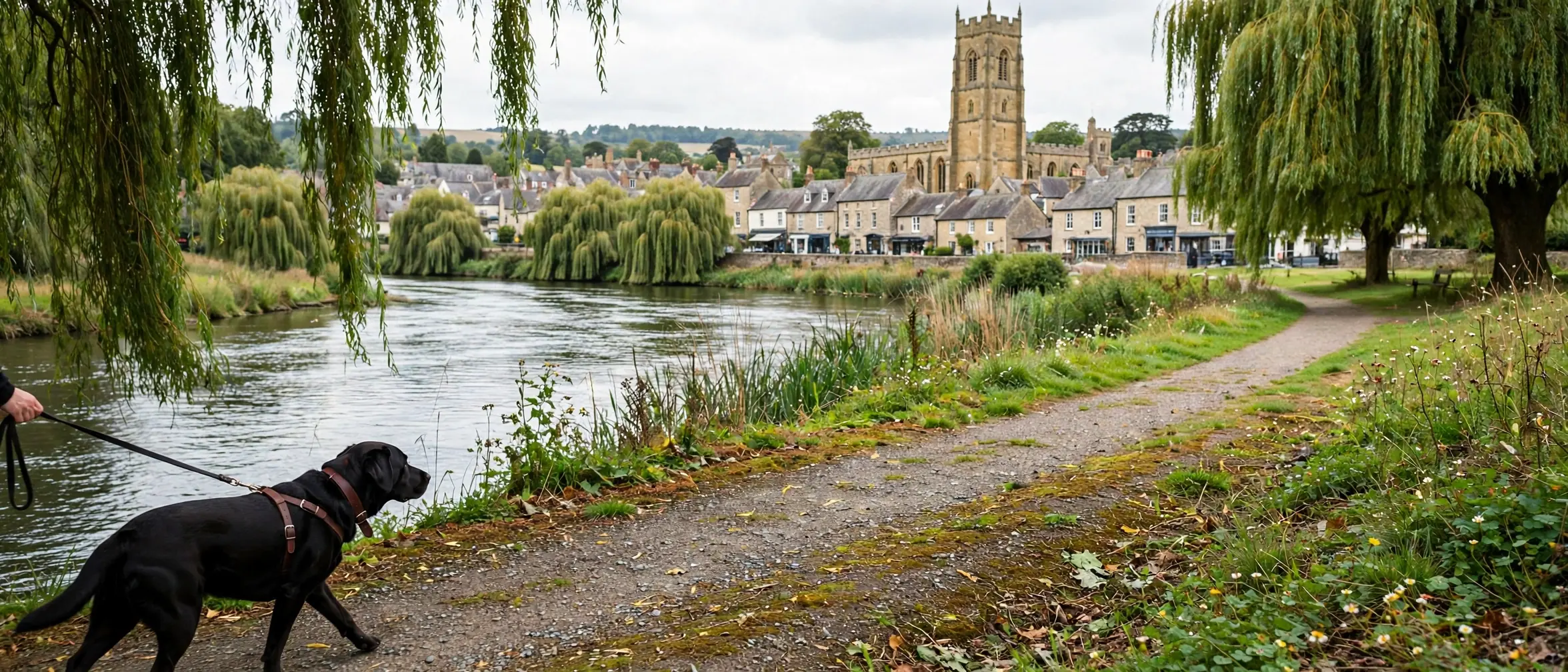
The Frome at Dorchester is a chalk stream, clear, cold and fast in its middle channel, and the riverside path south of the town follows it through the water meadows that once fed the town's mills. Start at Grey's Bridge, the footbridge at the southern end of town, and head downstream along the south bank: the first stretch runs past riverside gardens and the backs of houses on the edge of the meadows, then opens into broad, flat grass where the river bends and the ground drops to marshy edges after rain. This is the walk to give an older dog, a puppy on its first Dorset morning, or any dog that needs a gentle hour before the climb to Maiden Castle. The surface is mostly short grass and a worn dirt path, level enough for stiff hips, with willows and alders giving shade in summer and a view back over the rooftops and the tower of St Peter's Church in the centre.
Time the Frome by its water, not by the clock. After heavy rain the meadows between Grey's Bridge and the lower reaches flood in shallow sheets, the path edges turn to slick mud, and the river runs high and brown against the banks; in a dry July the same ground is firm, the water drops to reveal gravel shallows, and kingfishers flash along the channel while trout hold in the deeper pools. Swans nest on the Frome in spring, and a cob defending a nest near the bank will hiss and advance at a dog that crowds the water's edge, so give every swan family a wide arc and keep the dog on the bank path rather than in the reeds from March to June. Ducks and moorhens work the margins all year, and the temptation for a spaniel to plunge after them is strongest where the bank is low and the water looks inviting — pick a shallow, slow gravel bar well away from the bridges if your dog needs a paddle, and towel them dry before the walk back through town.
For a longer Frome day, follow the river east from Grey's Bridge towards Stinsford and Lower Bockhampton, where the valley narrows, the path runs under riverside trees, and the water meadows give way to the Kingston Maurward estate on the north bank. The estate's gardens and animal park are a separate, ticketed visit with their own dog rules — check before you go — but the public footpath along the river keeps going, and the turning point at Stinsford, with its churchyard and the bridleway back towards Higher Bockhampton, makes a satisfying three-hour circuit. West from Grey's Bridge the river runs towards Poundbury and the villages of the lower Frome, a flatter, more open stretch where the path is shared with cyclists coming in from the A35 side, so shorten the lead on the narrow sections and step onto the grass verge when a bike approaches. Either direction, carry water: there is no tap on the meadow paths, and the Frome itself is not a drinking supply for a dog after a long hot walk.
Anglers work the Frome through much of the year, and the best way to share the bank is to read their setup before you pass. A rod resting on a bank stick, a keepnet in the water, or a bivvy tucked under the willows means a fished swim — cross to the far side of the path, keep the dog tight to your heel, and do not let them splash through the swim or nose at bait boxes and discarded line. Discarded monofilament tangles paws and, swallowed, injures guts, so scan the bank at the popular pegs below Grey's Bridge and pick up any line you spot. In summer, check the riverside grass for ticks after every Frome walk, especially around the dog's ears, belly and between the toes, and rinse muddy paws at your lodgings before the dog climbs onto the bed — the meadow mud here is fine, grey and persistent.
Maiden Castle: the big open walk
Maiden Castle rises two miles south-west of Dorchester on Maiden Castle Road, DT2 9PP, a hillfort so large that English Heritage measures it at fifty football pitches, its inner rampart alone running about two kilometres around the plateau. The climb from the small car park at the foot of the fort is short and steep, up through the eastern entrance where the banks funnel you between deep ditches, and then the ground opens into a windswept grass plateau with views back over Dorchester, the Frome valley, and the South Dorset Ridgeway running east and west along the high ground. The scale is the point: where the town is enclosed and hedged, the hillfort is exposed and enormous, and a dog that has spent the morning on a lead in the Walks can finally move at its own pace across open chalk grass — on a lead, because the sheep are always there.
Those sheep are the hillfort's gardeners, and English Heritage is explicit: dogs are welcome, but they must stay on a lead because sheep graze the site. The flock keeps the grass short and the scrub from swallowing the earthworks, and it is present through the year, with lambs at foot in spring making the rule doubly important — a dog running at a ewe with a lamb in April is not a countryside anecdote, it is the situation that ends visits. Keep the lead short on the rampart top, where the sheep often graze in the lee of the banks and appear suddenly over a crest, and do not let the dog drop into the ditches after them: the ditches are steep, the chalk underfoot is exposed and slippery where walkers have worn it bare, and a dog scrambling out of a ditch on a hot day is a vet visit waiting to happen. The Roman temple foundations in the centre of the plateau are a good halfway landmark — stop there, water the dog, and take in the view before the second half of the circuit.
There is no water, no shade, no cafe and no shelter on Maiden Castle, and the dewpond — the square clay-lined pond dug in the 1860s for the sheep — is not a dog water source. Carry a bottle and a collapsible bowl, offer water at the temple ruins and again at the western rampart, and plan the visit for early morning or late afternoon in summer: the plateau is a sun trap at midday, the chalk reflects heat, and an older or dark-coated dog will feel it within twenty minutes. Winter is the opposite problem and the best reward — frost on the ramparts, a huge empty sky, and almost no other visitors — but the wind cuts across the plateau from the south-west, the chalk paths turn to slick mud, and a short-coated dog will want a coat for the circuit. The inner rampart loop takes most walkers forty-five minutes to an hour with stops; add forty minutes each way if you walk from Dorchester along Maiden Castle Road instead of driving to the car park, and remember that small car park fills on sunny weekends.
From the western rampart you can extend the day along the South Dorset Ridgeway, the ancient track that runs along the high ground above Dorchester towards Weymouth in one direction and the Cerne valley in the other, passing Bronze Age barrows and the long views that make this one of the finest ridge walks in Dorset. Treat the Ridgeway as a proper hill walk, not an extension of the town: map, water, food, and a clear plan for getting back, because there are no facilities for miles and no easy bail-out once you are past the hillfort. Dogs that are fit and used to open ground will love the Ridgeway's long grass and big skies; dogs that are nervous in open space, or that fixate on the sheep grazing the ridge, will find the Maiden Castle circuit alone is plenty. Either way, finish back at the car park, not on the road: Maiden Castle Road is narrow, with no pavement and fast traffic, and the walk back to Dorchester is best done on the footpath, not the tarmac.
Hardy country: lanes, heath and villages
East of Dorchester, the Hardy triangle runs from the town to Higher Bockhampton, Stinsford and back, and it is the best half-day lane walk in the area. Start at the eastern edge of town and take the quiet lanes towards Higher Bockhampton, where Hardy's Cottage — the cob-and-thatch cottage built by his great-grandfather, where Hardy was born on 2 June 1840 — sits in Thorncombe Wood under the National Trust's care. The cottage and its visitor centre are a human-only interior, assistance dogs excepted, but the woodland paths around it are the real prize for a dog: cool, shaded, soft underfoot, with a network of marked trails through Thorncombe Wood and out onto the heath, and a National Trust car park that makes a clean starting point. The woods hold their damp after rain, so the paths are muddy in winter and the dog will come back with bracken and leaf litter in its coat; in summer they are the coolest walk within miles of Dorchester.
From Hardy's Cottage, follow the bridleway down towards Stinsford, the hamlet Hardy called Mellstock, where St Michael's Church stands in its churchyard with the grave of Hardy's heart at the east end, beside the graves of his wives Emma and Florence. The churchyard is a place to walk through slowly on a lead, not a dog exercise area: keep the dog on the path, clear of the graves, and out of the church itself unless a notice says otherwise. The lane from Stinsford back towards Dorchester runs beside the Frome's tributary streams and through Lower Bockhampton, where Hardy went to the National School as a boy, and the whole loop is about five and a half miles of hedged lanes, woodland and heath edge — long enough to tire a fit dog, short enough to finish before lunch, and best done clockwise so the heath section comes last, when the dog is already settled.
That heath is Egdon Heath, the wild ground behind Hardy's Cottage that Hardy made the setting of The Return of the Native, and it demands a different lead discipline from the lanes. Ground-nesting birds — nightjars, woodlarks and Dartford warblers — nest on the heath from 1 March to 31 July, and the local guidance is to keep dogs on a lead through the breeding season and to the paths at all times; adders bask on the sandy tracks on warm days, so keep the dog out of the bracken and heather and on the open path from late spring to early autumn. Rushy Pond, the small heath pond in Thorncombe Wood that Hardy wrote about, is a good turning point for a shorter walk, but it is shallow, boggy at the edges, and not a swimming spot — let the dog drink from your bottle instead. In autumn the heath turns purple and gold and the birds have fledged, and a dog can range a little wider on the open ground, though the sheep pasture between Higher and Lower Bockhampton still calls for a lead whenever the flock is in sight.
West and south-west of Dorchester, the Frome valley villages give a greener, gentler alternative to the heath. Puddletown, in the valley east of the town, and Tolpuddle, famous as the home of the Tolpuddle Martyrs, sit on quiet lanes with river paths, village greens and pubs that draw walkers in from the fields. Tolpuddle's small museum and green make a natural mid-walk stop, and the lanes between Puddletown and the town are the ones to choose when the heath is too hot or the hillfort too exposed. For a bigger woodland day, Puddletown Forest, the Forestry England woodland south-east of the town, offers miles of forest tracks and rides where a dog can walk for hours under the trees, with the same ground-nesting-bird care in spring and a car park that keeps the start simple. Whichever direction you choose, the Hardy lanes reward the same approach: one village, one pub or churchyard, one river crossing, and a route back that does not repeat the outward road.
Museums, churches and the town's past
Dorchester's museums are the one part of the town where the dog stays behind, and planning around that split is the difference between a good day and a frustrated one. Dorset Museum on High West Street, in the centre of town, covers the county from prehistory to the present — the Maiden Castle finds, the Roman mosaics, Hardy's study — and it is a human-only interior, assistance dogs excepted. The Keep Military Museum, in the old barracks on Barrack Road at the eastern end of town, tells the story of Dorset's regiments from its parade ground and galleries, and it follows the same rule. The Dinosaur Museum on Icen Way, a short walk from the centre, is a smaller, family-oriented stop with its own policy — check its latest notice before you go. None of these is a place to tie a dog outside while you browse; leave the dog resting at your lodgings, or take turns with a companion, and treat the museum hour as the dog's nap, not a problem to solve at the door.
The town's churches and Roman remains are easier to fold into a dog walk, because they are outdoors and free. St Peter's Church in the centre, with its distinctive tower, anchors the High Street, and its churchyard is a calm green pause between shops; All Saints and Holy Trinity, on the town's eastern and southern edges, are quieter still, with small churchyards where a dog on a lead can sit while you look at the stonework. The Roman Town House in Colliton Park, off the southern end of town, is the finest surviving Roman house in Britain — a mosaic-floored villa discovered in 1937 and now open in its own walled garden — and it is best visited as a human-only stop with the dog resting, then walked past again on the way to the Frome, when the dog can sniff the park's paths. The Roman walls themselves survive in fragments along the Walks, most visibly where the modern road drops into the old ditch, and the Hangman's Cottage, the thatched house by the river at the foot of the town, is a Hardy landmark to photograph from the lane rather than a place to enter with a dog.
Max Gate, on Alington Avenue, is the third Hardy stop and the one most visitors miss: the house Hardy designed and built for himself in 1885, where he wrote Tess of the D'Urbervilles and The Mayor of Casterbridge and where he died in 1928, now in the National Trust's care with a garden that is worth an hour on its own. Dogs are not admitted inside the house, and the garden has its own rules, so check the National Trust's latest notice before you walk over — the approach from the town centre along Alington Avenue is itself a pleasant dog walk, past the houses Hardy knew, and the return can loop through the Walks and Borough Gardens. The point of all three Hardy sites is the same: the buildings are human-only, but the streets, lanes and woods between them are the dog's part of the story, and a day that pairs one house with one long lane walk is a better day than a day that tries to do all three houses and leaves the dog waiting.
If the weather turns and you still want history with the dog included, the outdoor sites are the answer: Maiden Castle's ramparts, Maumbury Rings — the Neolithic henge and Roman amphitheatre just south of the town on Weymouth Avenue, where the grass bowl makes a calm, enclosed walk and a good first off-town stop for a nervous dog — and the Ridgeway barrows are all open-air history that a dog can walk through. Maumbury Rings deserves a specific mention: it is a ten-minute walk from the centre, it is flat, it is enclosed enough that a dog on a long lead can explore without disappearing, and its scale — a vast grass amphitheatre that once held gladiatorial shows — is best appreciated from the rim, looking down into the bowl. For the coastal half of Dorset's past, our guide to Weymouth with a dog covers Nothe Fort and the harbour a short drive south, where the sea, not the downs, sets the rules.
Pubs, cafes and market day
Eating out in Dorchester works best when you choose the spot by its floor plan, not its reputation. The King's Arms, the historic coaching inn on High East Street, is the town-centre anchor: a large, old inn with a bar area and a garden where a dog can settle under a table, and the sort of place where the staff will bring a water bowl without being asked — but check its latest dog policy before you travel, because the dining room and the bar have different rules and the policy has changed with refurbishments. The Blue Raddle, on Church Street just off the High Street, is smaller, darker and quieter, and suits a dog that prefers a corner by the fire to a busy garden; again, confirm the current position on the door or by phone, because a small pub's dog rule can change with a change of landlord. Brewery Square, the redeveloped brewery quarter at the western end of the centre, has cafes and bars with outdoor seating where a dog can sit at your feet on the paving, and the square's open layout means you can see the dog, the menu and the street at the same time.
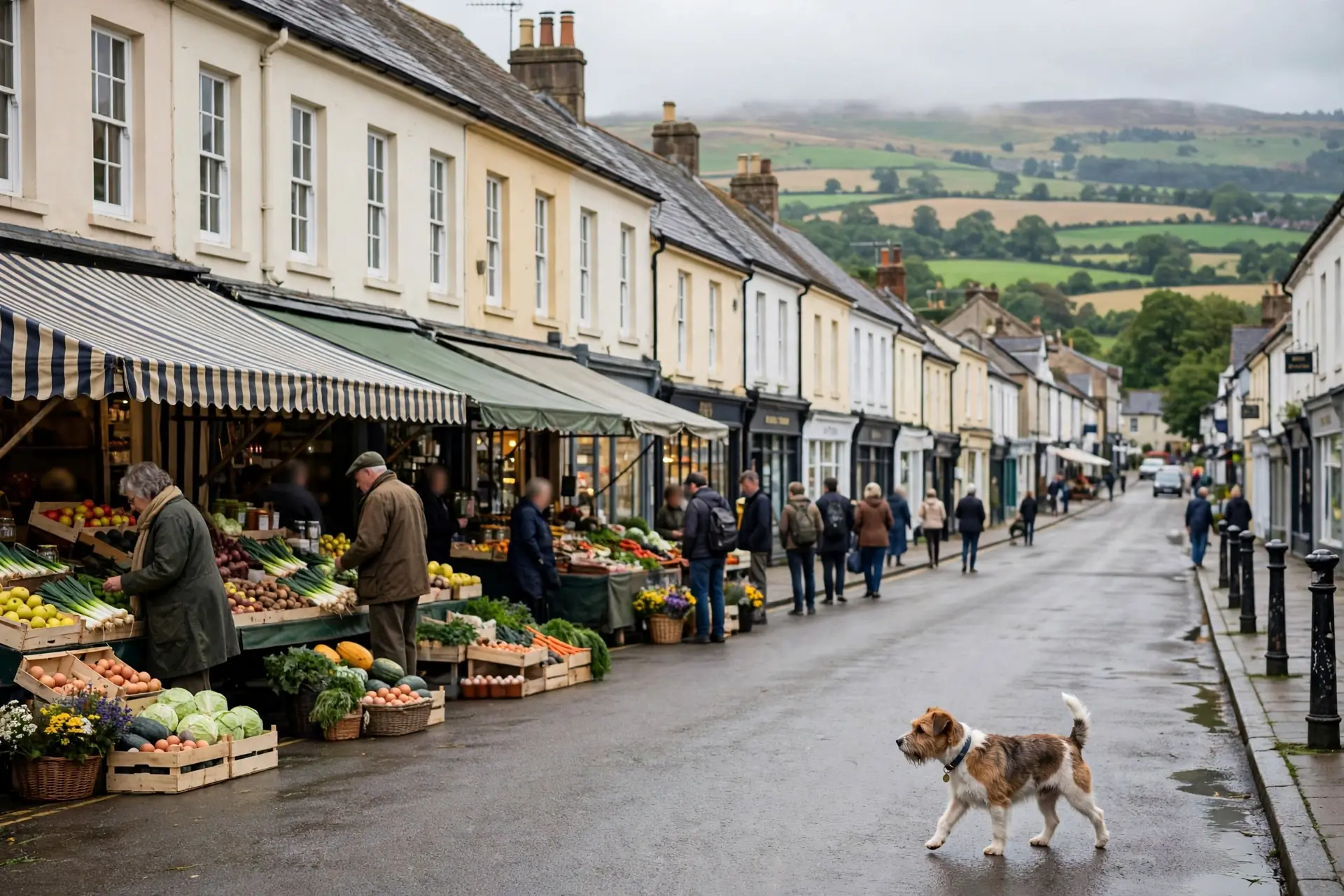
Market day in Dorchester is Wednesday and Saturday, and the market fills the Fairfield site at the western end of town and spills into the streets around the Corn Exchange — a different town from the weekday version, louder, denser, and full of food smells that will pull a dog's nose in every direction. A confident, food-proof dog will enjoy the bustle; a nervous or reactive dog will do better on a Tuesday or Thursday, when the same streets are quiet and the same cafes have tables free. On market mornings, keep the lead short through the stalls, steer clear of the food stands, watch for dropped fruit and hot food at dog height, and choose a cafe table on the edge of the market rather than in the middle of it — the cafes around the Corn Exchange and on High East Street are the best vantage points, and many of them welcome a dog at an outside table or in a bar area. Arrive before ten if you want a table; by noon on a Saturday the market is at its busiest and the pavements are a single-file shuffle.
The village pubs around Dorchester are often the better lunch after a long walk, because they have the space the town-centre pubs do not: bigger gardens, a field edge to walk the dog before you sit down, and a slower pace. The pubs in the Frome valley villages — Puddletown, Tolpuddle and the lanes towards Cerne Abbas — are the natural end to a Hardy-country loop, and the right move is to phone ahead, mention the dog and its size, ask for a garden table or a table by the door, and book for a time that lets you walk the dog first so it arrives tired and ready to settle. Bring a mat for the dog to lie on, a chew to keep it occupied while you eat, and a water bowl of your own, because a village garden does not always have one. In summer, ask for shade; in winter, ask for the table nearest the fire, and be ready to move if the dog cannot settle — a pub lunch that ends early with a happy dog is better than one that drags on with a stressed one.
Self-catering in Dorchester is easy, and for a dog that cannot settle in a pub it is often the kindest option. The town's food shops on High East and High West Street, the market stalls on Wednesday and Saturday, and the supermarket on the edge of town between the centre and Poundbury cover bread, cheese, vegetables and dog food, and a cottage or apartment with a kitchen lets you eat with the dog relaxed on its own bed rather than under a pub table. If you do eat out, build the dog's needs into the booking from the start: a table in the garden or bar area, a water bowl, a walk beforehand, and a realistic sense of how long your dog will lie still. A dog that has just walked the Frome and Maiden Castle in one day will sleep through a two-hour lunch; a dog that has spent the day in a car will not, and no pub in Dorchester can fix that.
Where to stay with a dog
Dorchester's dog-friendly stays split into three distinct shapes, and the right one depends on the dog, not the price. In the town centre, the King's Arms on High East Street and the smaller guest houses and hotels around the centre put you on the river walk and in the pubs, but they also put you on a busy street with traffic outside the door, a first and last toilet trip that means a walk to the Walks or Borough Gardens, and a room where the dog will hear every footstep in the corridor. A town-centre room suits a short stay and a dog that is used to hotels, that settles quickly in a new room, and that can hold its bladder until you reach the grass; it does not suit a dog that barks at corridor noise or needs a garden at midnight.
Poundbury, the new quarter west of the centre, offers a different shape: modern apartments and houses around Queen Mother Square and the Duchess of Cornwall Inn, with quieter streets, a village-green feel, and a walk into the centre that takes fifteen minutes along the road or the footpath. A Poundbury stay suits a dog that needs a calm street to toilet on, a short walk to a green, and a base that feels residential rather than commercial; it does not suit a visitor who wants to step out of the door and into a pub, because the pubs and shops are a walk away. The third shape is the cottage in the villages around Dorchester — Higher Bockhampton, Puddletown, Tolpuddle, Winterborne Monkton below Maiden Castle — where a cottage with a garden gives the dog a secure toilet area at night, a lane to walk from the door, and the quietest nights of the three options, at the price of needing a car for everything, including the morning coffee.
Whatever shape you choose, ask the same Dorchester-specific questions before you book, because the answers change with the location. Is the garden genuinely enclosed, and how high is the fence — a cottage garden near the Frome may be fenced to waist height, which is enough for a small dog and not for a deer-chasing lurcher? Is there a charge per dog, and is there a limit on the number of dogs, because a two-dog household can be turned away from a room that welcomes one? Are dogs allowed in all rooms or only in selected ones, and can they be left alone while you visit Dorset Museum — most places in Dorchester prohibit leaving a dog unattended, so plan as if you will take the dog everywhere, and split the museum visits between companions. Is there a drying space and a hose or an outside tap for a dog that has come back from the Frome meadows covered in grey mud? Our guide to dog-friendly holiday parks in the UK explains how to compare pet fees and boundaries, and the same questions apply to a Dorchester hotel, a Poundbury apartment, and a cottage at Winterborne Monkton.
Book early for summer weekends and for the literary festivals and events that fill Dorchester, when the best dog-friendly rooms in the centre and the cottages at Higher Bockhampton sell out first. May, June, September and October are often the better months for a dog trip: Maiden Castle is quieter, the Frome is at its best, the pubs have space, and the weather is kind enough for a long lane walk without the midday heat. In winter, check the heating, the drying space, and whether the garden gets muddy — a cottage garden on the Frome's flood plain can turn to a bog in January, which matters for a dog that needs a clean toilet area after dark. And if you are staying for a week, choose the cottage or the Poundbury apartment over the town-centre hotel: a dog that has a garden and a lane to walk from the door will be a happier dog on day five than one that has spent five nights listening to High East Street.
Parking and arriving by train
Dorchester's car parks are arranged around the centre in a ring, and the choice of car park sets the start of your walk. Top o' Town, the coach and car park on Poundbury Road at the western end of town, is the long-stay workhorse: a large, flat site within a short walk of Brewery Square and the Walks, and the best choice for a full day that starts with the river and ends with Maiden Castle, because you can leave the car there all day and walk everywhere from it. Fairfield, at the western end of the centre by the market site, is the market-day car park — closest to the Wednesday and Saturday stalls, busiest on those mornings, and best avoided after ten on a Saturday unless you enjoy queuing. Charles Street car park, just off High East Street, is the short-stay centre option, closest to the shops and Dorset Museum, and the one to choose for a museum-and-lunch day when the dog is resting at your lodgings and you want to be in and out in two hours.
Acland Road and Trinity Street, the smaller car parks on the southern and eastern sides of the centre, are the dog walker's secret: both are a short walk from the river at Grey's Bridge, both are quieter than Top o' Town and Charles Street, and both put you on the Frome path in five minutes without crossing the High Street. The Maiden Castle car park, the small site at the foot of the fort on Maiden Castle Road, is a different kind of parking — it fills on sunny weekends, it has no facilities, and it is the only sensible start for the hillfort itself, because the walk from the town along Maiden Castle Road is forty minutes each way on a narrow road with no pavement. Check Dorset Council's latest charges and time limits before you travel, because the tariffs and the pay-by-phone arrangements change, and note that some of the town's car parks are pay-and-display while others use a phone app — have the app ready before you arrive, not while the dog is pulling at the lead in the rain.
Arriving by train is a real option in Dorchester, which is unusual for a Dorset town, because the town has two stations and both are within walking distance of the centre. Dorchester South, on the line from London Waterloo to Weymouth, sits at the southern end of town, a five-minute walk from the Frome at Grey's Bridge and the start of the riverside path — the best station for a dog, because you can step off the train and be on grass in ten minutes. Dorchester West, on the Heart of Wessex line from Bristol to Weymouth, sits at the western end of town near Poundbury Road and Top o' Town, and is the better station for a stay in Poundbury or a walk that starts with the Walks. Dogs travel free on most trains, usually on a lead and on the floor rather than on a seat, so check the operator's policy before you travel, and avoid the busiest commuter trains with a large dog.
Driving the lanes around Dorchester needs care, and the lanes are the reason the town's dog walks are so good. The lanes to Higher Bockhampton, Stinsford, Puddletown and Tolpuddle are narrow, hedged, with blind bends and high banks, and there is little room to pull over when a tractor or a delivery van comes the other way. Keep the dog secure in the car — a harness or a crate, not a loose dog on the back seat — and never leave a dog in a parked car on a warm day, even with the windows open, because the town's car parks have little shade and a car heats up fast in summer. If you are parking for a long walk, leave the dog's water and a spare lead in the car, make sure the dog has had a toilet break on the Walks or at Grey's Bridge before you set off, and lock the car knowing that the walk back will be muddy, the dog will be wet, and the towel needs to be in the boot, not in the cottage.
Seasons: when Dorchester suits dogs best
Spring in Dorchester belongs to the Frome and the lanes. The water meadows are green, the hedgerows along the lanes to Higher Bockhampton are full of birdsong, and the town is quiet before the summer visitors arrive, which makes April and May the best months for a nervous dog or a first visit. Spring is also the season to be most careful: lambs are at foot on the fields around Maiden Castle and the Ridgeway, ground-nesting birds are settling on Egdon Heath from 1 March, and swans are nesting on the Frome, so the lead stays on around the sheep, on the heath, and at the river's edge, and the dog's freedom is the woodland paths of Thorncombe Wood, where the trees give cover and the ground is soft.
Summer in Dorchester is a tale of two towns: the quiet lanes and the river on a weekday morning, and the market crowds and the heat on a Saturday. Walk early or late, use the shade of the willows along the Frome and the trees of Thorncombe Wood, and carry water on every walk, because the hillfort has none and the town's car parks have no shade. Midday on Maiden Castle in July is the hottest walk in Dorset — the chalk reflects the sun, the wind drops, and the plateau is a sun trap — so save the hillfort for the morning or the evening, and give the dog the river at noon. The pubs with gardens — the King's Arms, the Blue Raddle, the Brewery Square bars — come into their own in summer, and the long evenings mean you can have a proper walk after dinner when the town has quietened down and the market stalls are gone.
Autumn is Dorchester's quiet star. The crowds thin after the school holidays, the light on Maiden Castle is low and golden, the lanes to Stinsford and Puddletown are full of colour, and September and October are the best months for a dog trip to the town: the weather is usually kind, the pubs have space, the Frome is at its clearest, and the heath has turned purple and gold. The harvest brings tractors and grain lorries on the lanes, so keep the dog on a lead on the roads and step into a gateway when a lorry approaches; the ground-nesting birds have fledged, so the heath is more open, but the sheep are still on the hillfort and the lead stays on there. A dog that has walked the Frome in the morning and the Ridgeway in the afternoon, and then slept through a pub lunch in a quiet October pub, has had the best Dorchester day of the year.
Winter is the town's most underrated season. Dorset Museum and The Keep are quiet, the pubs are warm, and Maiden Castle in frost is magnificent — the ramparts white, the sky huge, and almost nobody else there. The paths are muddy, the wind is cold, and the Frome meadows flood in wet winters, so bring a coat for a short-coated dog, proper footwear for yourself, and a towel for the car. The town's Christmas market and lights in December are a good reason to visit, though the market is crowded and best tackled early with a confident dog, and the short days mean the Maiden Castle walk needs to start by mid-morning. Whatever the season, Dorchester rewards a slow pace: a morning on the Frome, an afternoon on the hillfort or in the lanes, and an evening in a pub garden, with the dog setting the pace and the town fitting around it.
Practical bits: vets, livestock and leads
Save the details of a vet in Dorchester and an out-of-hours vet in the wider area before you travel, and keep the numbers in your phone, not in a notebook in the car. The town has veterinary practices in the centre and on the edge of town, and the nearest out-of-hours cover is usually in Dorchester itself or in Weymouth, so check the latest details before you travel and save the out-of-hours number separately — a dog that eats something on the Frome bank at six in the evening needs a number you can dial, not a website you have to search for. If your dog takes regular medication, bring more than you need, plus the prescription details, in case you need a replacement from a Dorchester practice, and carry a small first-aid kit with paw balm, a tick remover and saline for eyes on every walk.
Maiden Castle's sheep are the main lead question in Dorchester, and they are a year-round presence, not a seasonal one. The flock grazes the hillfort to keep the grass short and the scrub from damaging the earthworks, and English Heritage's rule is that dogs stay on a lead because the sheep are there — a rule that matters most in spring, when ewes have lambs at foot and a dog running at the flock can cause a ewe to abandon a lamb or a farmer to act. On the Ridgeway and the downland around the town, the same sheep graze the open fields, and a dog that can see sheep from a long way off in open country needs a lead before it sees them, not after. On the heath, adders are the second hazard: they bask on the sandy tracks of Egdon Heath and Puddletown Forest on warm days, so keep the dog on the path and out of the bracken and heather from late spring to early autumn, and know the signs of a bite — swelling, pain and lethargy — and the route to the nearest vet.
Water and shade need planning on the hillfort and the Ridgeway, because there is no fresh water and no shade on the open downland. The dewpond on Maiden Castle is a sheep pond, not a dog water source, and the Ridgeway has no taps for miles, so carry a bottle and a collapsible bowl on every hillfort walk, offer water at the temple ruins and again at the western rampart, and walk early or late in summer. On the Frome, the problem is the opposite: the water is there, but it is cold, fast and full of swans, anglers and ticks, so let the dog paddle only in a shallow, slow gravel bar away from the fished swims, and check for ticks in the riverside grass after every walk, especially around the ears, belly and between the toes. Check paws after the chalk paths of Maiden Castle and the stony tracks of the Ridgeway, where the exposed chalk is sharp and slippery, and after the muddy meadow paths, where the fine grey mud cakes between the toes.
Finally, plan around the dog you actually have, not the dog in the guidebook. A fit, confident dog will love the Maiden Castle circuit and the Ridgeway, and will sleep through a pub lunch afterwards; an older dog will prefer the Frome from Grey's Bridge and the Borough Gardens loop, with a bench every ten minutes and a flat path underfoot. A sociable dog will enjoy a Wednesday market morning; a reactive dog will be happier on a Tuesday in the lanes to Stinsford, with the hedges to itself. A dog that cannot settle in a pub needs a cottage with a kitchen, not a town-centre hotel room, and a dog that barks at corridor noise needs Poundbury, not High East Street. Dorchester rewards owners who choose the walk, the pub and the stay for the dog in front of them, and the best days here are the ones where the dog sets the pace. For the rules that apply to beaches on a day trip to the coast, our guide to dog-friendly beaches in the UK explains seasonal bans, lead orders and how to read the signs.
Day trips from Dorchester
Dorchester sits in the middle of Dorset, which makes it a base for day trips in every direction, and the best of them are the ones that start with a single destination and a single walk. South to the coast, Weymouth is about twenty minutes away, with a long sandy bay, the harbour and Nothe Fort, and our guide to Weymouth with a dog covers the beach rules, the Rodwell Trail and the harbour — a day that pairs well with a morning walk on the Frome, because the dog arrives at the coast already tired. Swanage, a little further east, is the Purbeck day: the bay, the steam railway and Durlston Country Park, covered in our guide to Swanage with a dog, and a day that needs an early start, because the road through Wareham and the Purbeck hills is slow in summer and the bay car parks fill by mid-morning.
West along the coast, Bridport and West Bay are about half an hour away, with the market town, the harbour and the Jurassic Coast walks to Eype and Golden Cap — a day for a fit dog that can manage the cliff paths, with the harbour at West Bay as the reward at the end. East, the Purbeck villages and the heaths around Wareham make a quieter day, with lanes, commons and pubs that suit a slower pace, and the heathland around Wareham has the same ground-nesting-bird care as Egdon Heath in spring. North, the lanes towards Sherborne and the Blackmore Vale are worth a drive, with old towns, abbeys and country houses — though the houses themselves have their own rules about dogs, so check before you travel, and treat the house as a human-only stop with the dog walking the lanes outside.
Inland, the Cerne Abbas Giant is a short drive north of Dorchester, and the village of Cerne Abbas is worth a wander, with a stream, old cottages and a pub. The giant itself is best viewed from the viewpoint on the hillside above the village, and the walk up is short but steep, with sheep grazing the hillside nearby, so keep the dog on a lead on the viewpoint path and do not let it drop onto the chalk figure itself. The village is a good stop on the way to Sherborne or the Blackmore Vale, and the stream through Cerne Abbas makes a cool pause for a dog on a hot day, with a pub garden at the end of the lane. A Cerne Abbas morning, a Sherborne afternoon, and a Dorchester evening is a full day — do not add a third destination, because the dog will be tired and the car will be hot.
Plan day trips the same way you plan the Dorchester days: one main activity, a pub or cafe stop, and a realistic amount of driving. Dogs cope badly with a day of being driven from place to place and left in the car between stops, so choose one destination and enjoy it properly, keep the car cool, stop for water and toilet breaks on the A35 and the coast road, and end the day back at your base with a familiar walk — the Frome from Grey's Bridge, or a lap of Borough Gardens — rather than a new one. A week in Dorchester with a dog is best spent slowly, with a day on the hillfort, a day in the Hardy lanes, a day on the coast, and a day doing nothing more than the river and a pub, and the county will still be there tomorrow.
Practical questions
Before you go
Can dogs walk the Maiden Castle ramparts, and what about the sheep?
Yes — Maiden Castle is free, open in daylight, and dogs are welcome on the two-kilometre inner rampart circuit from the small car park on Maiden Castle Road, DT2 9PP. English Heritage asks that dogs stay on a lead because sheep graze the hillfort all year to keep the grass short, with lambs at foot in spring. There is no water, shade or cafe on the plateau, so carry a bottle and a bowl, allow forty-five minutes to an hour for the circuit, and avoid midday in summer and the slippery chalk after rain.
Where is the best Frome walk for an older dog in Dorchester?
Start at Grey's Bridge at the southern end of town and follow the south bank downstream through the water meadows: it is flat, mostly short grass and a worn dirt path, with willows for shade and benches and side streets to turn back on. Allow forty minutes to an hour at a dog's pace. Avoid the low meadow path after heavy rain, when it floods and turns to slick mud, and give the spring swans a wide arc — a cob defending a nest will advance at a dog that crowds the bank.
Can I take my dog inside Dorset Museum, The Keep or Max Gate?
No — Dorset Museum on High West Street, The Keep Military Museum on Barrack Road, and Max Gate on Alington Avenue are all human-only interiors, assistance dogs excepted, and the cottage at Hardy's Cottage in Higher Bockhampton follows the same rule. Leave the dog resting at your lodgings or take turns with a companion, and pair each museum or house with a dog walk — the Frome from Grey's Bridge, the Walks, or the woodland paths around Hardy's Cottage — rather than trying to fit all three buildings into one day.
Where should I park for a dog walk in Dorchester, and which station is best?
For the river, use Acland Road or Trinity Street, both a five-minute walk from Grey's Bridge; for a full day in town, use Top o' Town on Poundbury Road, the long-stay site by Brewery Square; for a short centre stop, use Charles Street off High East Street. On Wednesday and Saturday market mornings, Fairfield fills early, so arrive before ten or park at Top o' Town and walk in. By train, Dorchester South is best for the river — it is five minutes from Grey's Bridge — while Dorchester West, by Poundbury Road, suits a Poundbury stay. Check Dorset Council's latest charges before you travel.
What is the best Hardy-country walk from Dorchester with a dog?
The Higher Bockhampton loop: quiet lanes east from Dorchester to Hardy's Cottage in Thorncombe Wood, then the bridleway down to St Michael's Church at Stinsford — where Hardy's heart is buried — and back through Lower Bockhampton, about five and a half miles in all. The woodland paths are cool and shaded, the heath beyond the cottage is Egdon Heath, and ground-nesting birds nest there from 1 March to 31 July, so keep the dog on a lead on the heath in that season and on the paths at all times. Adders bask on the sandy tracks in warm weather, so keep the dog out of the bracken.