This guide is independent and contains no paid placement. If affiliate links are added later, they will be clearly marked and will not change our editorial checks.
Walk the dog on the public paths below Dumbarton Rock, along the River Leven and through Levengrove Park. The castle itself admits only assistance dogs, so plan a split visit: one person climbs the 500-plus steps while the other walks the dog on the Clyde shore. Keep your dog on a short lead at Overtoun Bridge, and check tide times before letting any dog near the Clyde mud.
Start at the Rock
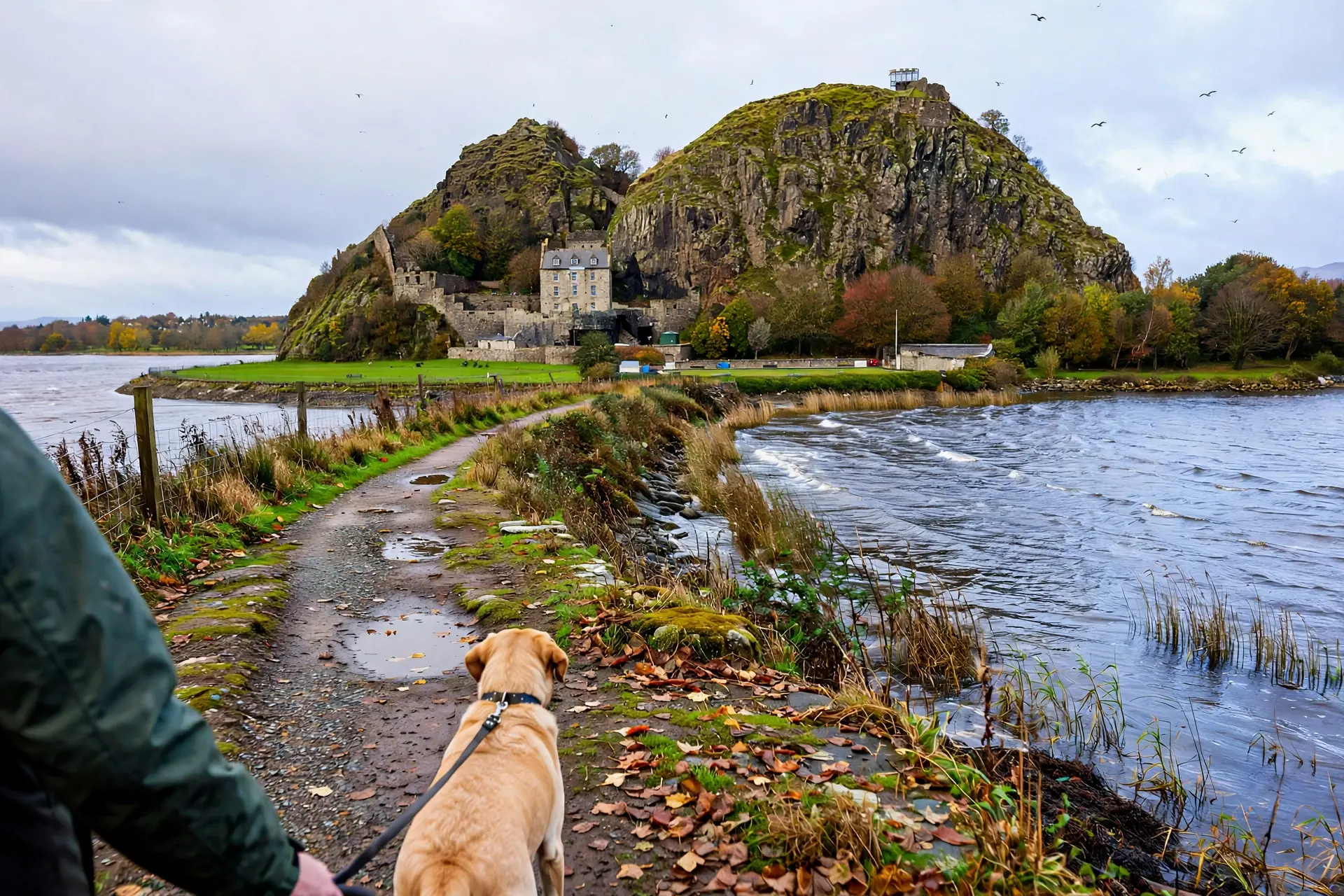
Every dog walk in Dumbarton begins with the same sight. Dumbarton Rock rises out of the flat land where the River Leven meets the Clyde, a dark twin-peaked plug of basalt about 73 metres high and roughly 250 metres across at its base. It was formed between 330 and 340 million years ago, when magma hardened inside the throat of a volcano and the softer rock around it weathered away over the following millennia. What remains is one of the most recognisable silhouettes in Scotland, visible from the Erskine Bridge, from the trains running along the Clyde, and from much of the town itself.
The two summits have their own names and characters. The higher western peak is White Tower Crag, a pointed top named after a medieval tower that once stood there. The lower eastern peak is the Beak, flatter on top and about 10 metres lower. A deep cleft between them gives access to the upper parts of the Rock, and it is through that cleft that the castle's defences were arranged. From the paths below, a dog will notice none of this history, but the shape of the place still sets the walk: everything in Dumbarton is either towards the Rock, away from it, or along one of the two rivers that meet at its foot.
The Rock's Gaelic name, Dun Breatainn, means the fortress of the Britons, and the site has the longest recorded history of any stronghold in Scotland. It was the capital of the ancient kingdom of Strathclyde, known then as Alt Clut, the Rock of the Clyde. In 870, after a siege lasting fifteen weeks, Viking attackers took the fortress and carried its people away. Centuries later the castle sheltered the infant Mary, Queen of Scots, for several months in 1548 before she sailed from here to France on 13 July of that year. William Wallace is said to have been held at the castle after his capture in 1305, and Queen Victoria visited in 1847, by which time the fortress was already as much a curiosity as a garrison. The whole Rock is now in state ownership and legally protected as a scheduled ancient monument, which is one reason the rules about where dogs may go are strict rather than flexible.
For a dog owner, the Rock works best as a landmark rather than a destination. The climb to the top involves more than 500 steep, narrow steps, and the site is exposed to wind and rain from the Clyde. Dogs are not part of that climb at all, as the next section explains. What the dog gets instead is the ground around the base: the riverside path, the grass and the views of the Rock itself, which are arguably better from below than from the summit. Photograph the Rock from the Leven walkway or from Levengrove Park, where the whole twin-peaked outline sits above the river, rather than trying to fit a dog into a fortress built for soldiers.
Time your first look at the Rock for the morning if you can. The sun rises behind the town and lights the western face, and the Clyde at the base of the Rock is at its busiest with gulls, cormorants and the occasional grey heron. At low tide the mudflats spread wide and the Rock looks taller; at high tide the water comes right up to the paths and the whole scene feels closer and louder. Either way, keep the dog on a lead near the water's edge. The shore here is tidal, the mud is deep, and a dog that chases a bird out onto the flats can get into trouble faster than its owner can follow.
The castle visit, split in two
Here is the fact that shapes every dog-owning visit to Dumbarton Castle: Historic Environment Scotland, which cares for the site, permits only assistance dogs inside the castle. Pet dogs cannot enter the grounds, climb the steps or wait in the visitor areas. Older guides and review sites sometimes say dogs are welcome in the outdoor areas on a lead, but the current official position is that no dogs except assistance dogs are allowed, so plan on that basis and check the official guidance before you travel in case the policy changes.
The practical answer is a split visit, and it works well because the castle and the riverside walk sit side by side. One person in the party goes up the Rock while the other walks the dog along the public Clyde path below it, and you meet afterwards at the small car park on Castle Road. The climber should allow at least an hour and a half, and closer to two hours if they want to read the interpretation panels, visit the Governor's House exhibition and stand on both summits. The dog walker, meanwhile, has a flat riverside route in either direction and a view of the Rock that changes with every few hundred metres.
Opening times follow a seasonal pattern. In the summer season, from 1 April to 30 September, the castle is open daily from 9.30am to 5pm. In winter, from 1 October to 31 March, it opens from 10am to 4pm on Mondays, Tuesdays, Wednesdays, Saturdays and Sundays, and is closed on Thursdays and Fridays. Last entry is 45 minutes before closing, and the site is closed from 24 December to 4 January. Because the castle is largely outdoors and exposed, it can also close in bad weather, so check the official guidance before you travel rather than assuming a winter weekday visit will go ahead.
Admission is ticketed, with Historic Environment Scotland members entering free. Adult tickets were listed at around £7.50 when booked online and £8.50 on the day, with concessions and children's tickets cheaper, but prices change, so check the official guidance before you travel and treat any figure in a guide as a starting point rather than a promise. The climb itself is the main event: more than 500 steps, some of them steep and narrow, lead through the 14th-century Portcullis Arch, past the artillery batteries and the Georgian Governor's House, and up to the twin summits. On a clear day the view from White Tower Crag reaches across the Clyde to the hills of Argyll and north towards Ben Lomond.
Never leave a dog waiting in the car while someone climbs. A car parked at the base of the Rock in summer sun heats quickly, and in winter a dog left alone in a strange car park is stressed and conspicuous. The split visit only works when one person is genuinely with the dog the whole time. If you are travelling alone with a dog, the honest choice is to skip the interior and enjoy the Rock from the paths below, which cost nothing and are open all day. The castle has been there for 1,500 years; it will still be there on a return trip with a second person.
One more practical point: the castle car park on Castle Road is small, and it fills on sunny weekends. If it is full, use the parking at Levengrove Park or in the town centre and walk down to the Rock along the river. The walk from Dumbarton Central station to the castle takes around 20 minutes on foot, mostly flat, and it doubles as the dog's warm-up before the riverside paths.
The River Leven walkway to Balloch
The best dog walk in Dumbarton is not a loop but a line: the River Leven walkway, which follows the river from its meeting with the Clyde all the way north to Balloch and Loch Lomond. The full route is about 11.4 miles one way, and it takes most walkers four to four and a half hours, so very few dog owners walk the whole thing. Its strength is that it is flat, mostly paved and easy to join or leave at several points, which makes it simple to cut to the length your dog actually needs.
The path starts near Dumbarton Rock and the mouth of the Leven, where the river is tidal and the banks are muddy at low water. From there it runs north through the town, past Dumbarton East station and Dalreoch, then out into open country towards Renton, Alexandria and Balloch. The surface is a shared path used by walkers, runners and cyclists, and it is waymarked for much of its length. Heritage boards along the route explain the valley's industrial past: this was shipbuilding and engineering country, and the river once carried the materials and the finished work of yards and factories that have now mostly gone. The boards give a slow walker something to stop for, and they give a dog a reason to pause and sniff while you read.
For a dog, the first section out of Dumbarton is the most useful. The path is wide, the ground is level, and there are benches at intervals for a rest. The river is close on one side for most of the way, which is cooling in summer and distracting in the best sense for a dog that likes water. But the lower Leven is tidal, and the banks near Dumbarton can be soft and slippery, so keep the dog on a lead until you are well upstream of the tidal reach. Ducks, swans and herons work the river all year, and a dog that lunges at water birds will find plenty of temptation in the first mile.
Turnaround points are what make the walkway work for different dogs. A short out-and-back from Dumbarton to Renton gives a comfortable hour or so of flat walking. Continuing to Alexandria roughly doubles that, and the full walk to Balloch is a proper half-day expedition that ends at Loch Lomond Shores, where there are cafes, open grass and the shore of the loch itself. The railway follows the valley, so a one-way walk with a train back is possible: Balloch station sits at the far end of the route, and Dumbarton East, Dalreoch and Dumbarton Central all sit close to the path at the Dumbarton end. Dogs travel free on ScotRail trains, on a lead, which makes the one-way option genuinely practical rather than a logistical puzzle.
Shared-path manners matter here more than on a hill track, because the path is busy with cyclists. Keep the dog on a lead, keep to one side, and use a short lead rather than a long line when cyclists are approaching. A long line stretched across a cycle path is the single most common cause of friction on the Leven walkway. If your dog is nervous of bikes, walk on the river side of the path where there is usually a grass verge, and step aside with the dog on your far side from the traffic when a cyclist calls out.
There are no shops or cafes on the middle stretches of the path, so carry water for the dog in warm weather and a couple of poo bags more than you think you will need. Bins are provided at the main access points, including near the stations, but not along every mile. In wet weather the paved surface holds up well, which is one of the path's advantages over the hill routes, but the riverside grass gets soft and the lower sections can be muddy after heavy rain. In winter, daylight is short and the path is unlit away from the town, so start early and carry a torch if you are walking the Balloch section in the afternoon.
Levengrove Park
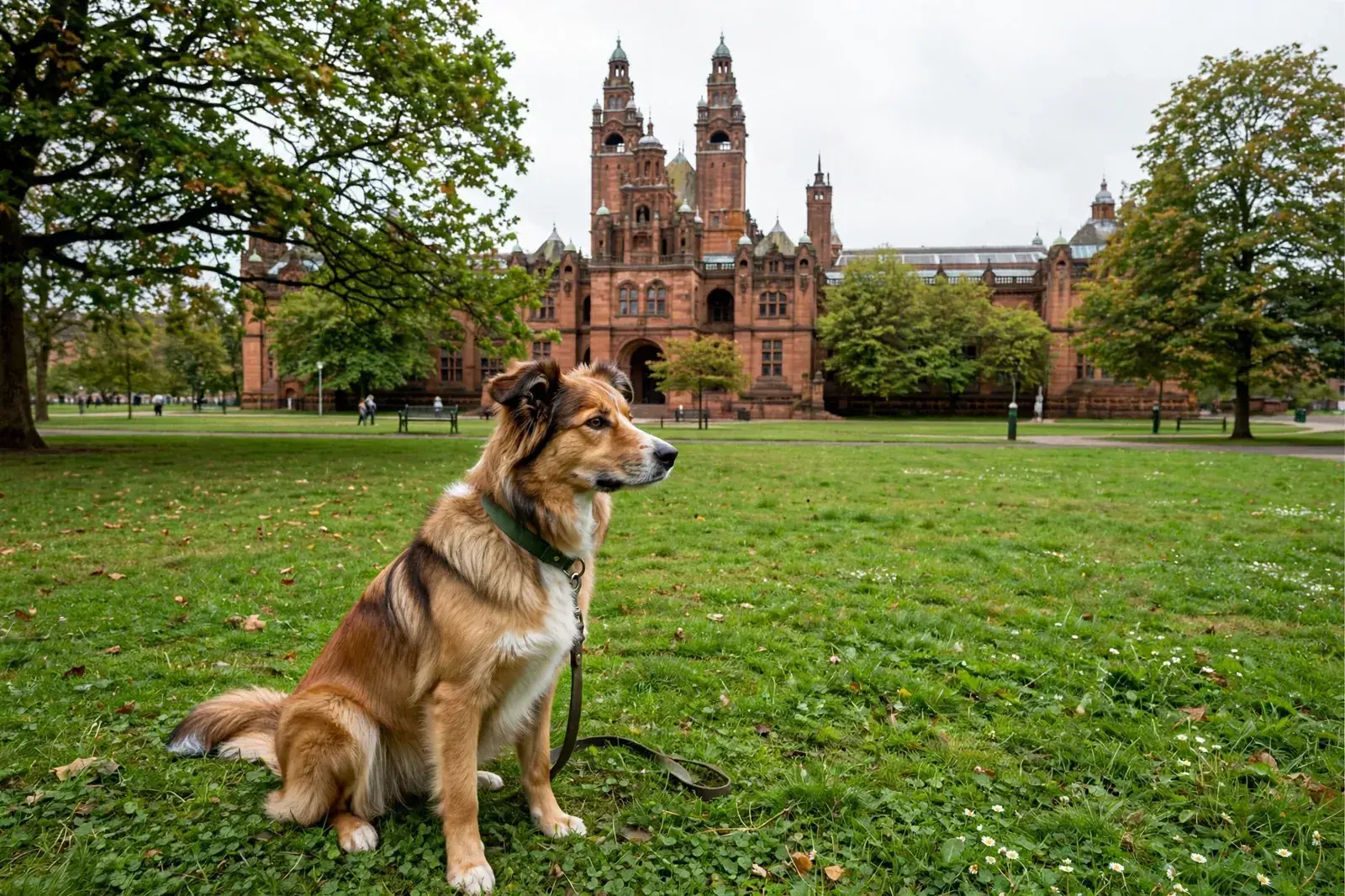
Levengrove Park is Dumbarton's front lawn: a large, well-kept park on rising ground above the Clyde, a short walk from Dumbarton Central station and the town centre. It is free to enter, generally open from dawn to dusk, and it has its own car park, which makes it the easiest place in town to start a dog walk without any planning at all. Dogs are welcome throughout the park provided they are kept under control, and the wide paths and open grass suit dogs that need space more than they need a destination.
The park's great advantage is its view. From the higher paths you look straight across the Clyde to Dumbarton Rock and the castle, with the river in the foreground and the Kilpatrick Hills behind the town. On a clear morning the whole scene is laid out in a single glance, which is why the park is busy with local dog walkers at the start and end of the day. The lower paths run closer to the water and connect with the Clyde shore path, so a walk in Levengrove Park can easily extend into a longer riverside loop without ever getting into a car.
The park is not flat. The ground rises from the river towards the upper paths, and some of the slopes are steep enough to tire an older dog or a puppy. The sensible approach is to work along the contours: use the lower paths for a gentle walk and save the climb to the upper viewpoints for a fit dog on a dry day. In wet weather the grass slopes get slippery, and the paths are the safer option. There is a formal garden area with flower displays, an arboretum with a collection of trees, and the Maple Garden, a sensory garden designed for children and adults with additional support needs. Keep dogs on the paths around the planted areas rather than letting them run through the beds.
Facilities in the park include a play park, open grassland that works well for picnics, and the Park Pavilion, which houses a cafe and the Greenspace Community Ranger Service. The cafe is a useful stop for a drink and a rest, but check the official guidance before you travel if you are counting on taking the dog inside, because cafe policies change and the outdoor seating is the safer bet in any case. The play park is fenced, and dogs should stay out of it. Bins for dog waste are provided around the park; use them, because the park is heavily used by families and the rangers notice when owners do not.
Levengrove Park also works as the town's meeting point for longer walks. The Dalreoch, River Clyde and Levengrove Park circular is an easy 4.2-kilometre loop that links the park with the Leven and the Clyde shore and takes most walkers under an hour. It starts near Dalreoch station, follows the rivers beside the town, and returns through the park. It is a good first walk for a dog that is new to Dumbarton: flat, short, varied, and with the car or the station never far away if the dog decides it has had enough.
The Clyde shore
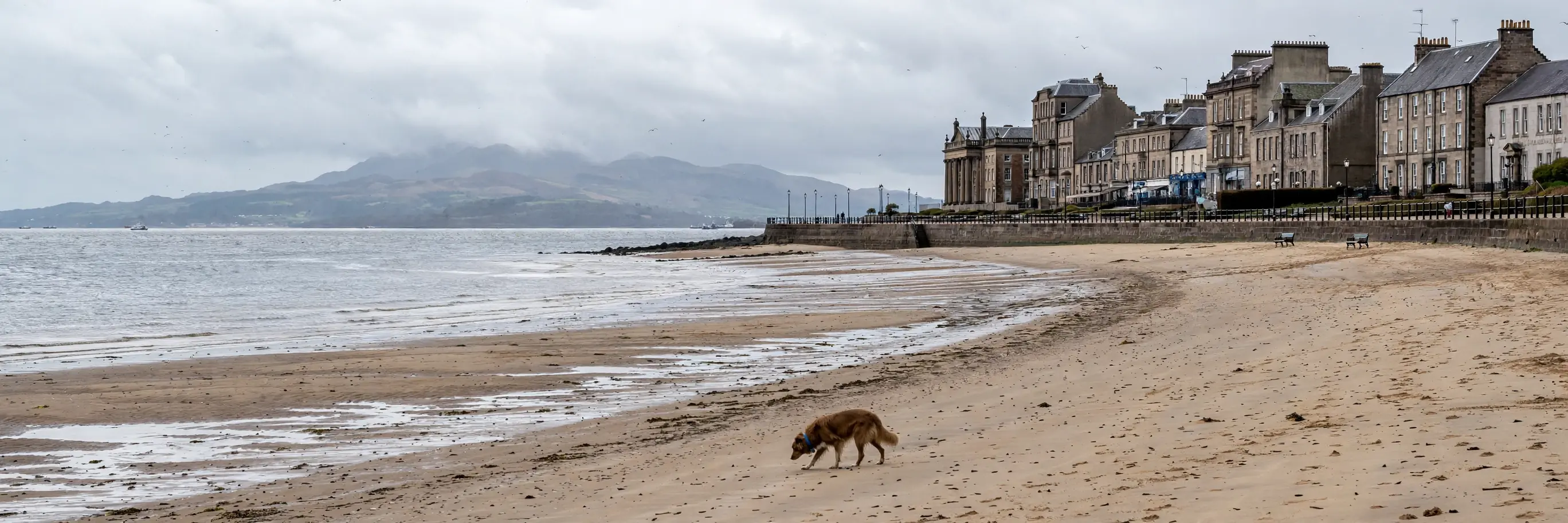
East and west of the Rock, the Clyde shore path gives Dumbarton its second great dog walk, and its most tidal one. The river here is an estuary, wide and grey-green, and the shore is a mix of path, grass and mudflat that changes completely between high and low water. At low tide the mud stretches out and wading birds feed on it in numbers: oystercatchers, redshank, curlew and the cormorants that perch on the rocks below the castle. At high tide the water covers the mud and laps at the path, and the whole shore feels narrower and busier.
The shore path runs from the Rock towards the town centre in one direction and towards Cardross and Helensburgh in the other. The town-centre stretch is the easiest, passing the mouth of the Leven and the older parts of Dumbarton, while the westward stretch becomes quieter and more open. Both directions are flat, and both are best walked with the tide in mind. Check tide times before you go, and plan to be on the firm path rather than the mud when the tide is turning. Clyde mud is famously deep and sticky, and a dog that chases a bird onto the flats can sink to its belly and panic. Keep the dog on a lead near the shore, and do not throw a ball towards the water at low tide.
Swimming is a poor idea in the Clyde at Dumbarton. The current is strong, the water is cold and tidal, and the banks are muddy rather than shelving. A dog that loves water will find safer paddling in the shallow edges of the Leven upstream, or on the firmer shore at Balloch, than in the estuary below the Rock. If your dog does get muddy on the Clyde shore, rinse it off before the drive home; the mud stains and dries hard, and it is not the sort of thing to leave in a car boot. Our guide to dog-friendly beaches and the rules that apply to them explains how tidal shores, seasonal restrictions and access law work in practice, and much of it applies to estuary shores like this one even though Dumbarton has no sandy beach of its own.
The Clyde shore is also where Dumbarton's industrial past is most visible. The town built ships for generations, and the Denny yard, whose name still appears on the Denny Tank Museum on Castle Street, was one of the most famous on the river. The museum itself is a small, specialised attraction, and it is worth checking its current access arrangements before assuming a dog can go in. From the shore, though, the story is free and obvious: the width of the river, the slipways and quays, and the Erskine Bridge downstream, carrying the road across the Clyde towards Glasgow Airport.
Wildlife is the shore's quiet reward. Grey herons stand motionless in the shallows at the mouth of the Leven, and seals are occasionally reported in the estuary. A dog that is steady around wildlife will get more from this walk than a dog that pulls at every bird, so use the shore as a training walk as well as a scenic one: short lead, rewards for looking away from the birds, and a steady pace rather than a rush to the next stretch of path.
Overtoun House and its bridge
Above Dumbarton, on the edge of the Kilpatrick Hills, stands Overtoun House, a 19th-century mansion set in wooded grounds. The house and its estate are a popular walking area, and the approach to the house crosses Overtoun Bridge, a stone bridge over a deep ravine cut by the Overtoun Burn. The bridge is famous far beyond Dumbarton, and every dog owner who walks here needs to know why before they arrive rather than after.
The bridge has low parapets and a drop of about 15 metres to the rocks and the burn below. Since the 1950s, dogs have jumped or fallen from it, and the story has grown into the nickname the Dog Suicide Bridge. The numbers are disputed: some reports claim hundreds of dogs over the decades, while the local veterinary practice that covers the area recorded only two incidents coming to its attention, and the Scottish SPCA has said it holds no records of incidents at the bridge. The truth sits somewhere between the legend and the scepticism, but the practical advice is not disputed at all. The sign at the entrance to the bridge reads "Dangerous bridge — keep your dog on a lead", and the Scottish SPCA has advised owners in the area to keep dogs on a lead for their safety.
The most widely discussed explanation comes from canine psychologist David Sands, who suggested that the scent of mink in the ravine below, carried upwards on clear, dry days, could draw scent-driven dogs towards the parapet. Long-nosed breeds such as collies, Labradors and other retrievers feature heavily in the reports, which fits a scent theory, and the incidents are said to happen mostly on clear, sunny days. Other explanations involving sound or the shape of the bridge have been suggested and not confirmed. What matters for a dog owner is not the explanation but the behaviour: dogs have gone over the parapet, some of them more than once, and the drop is high enough to kill.
Cross the bridge on a short lead, with the dog in the middle of the roadway and away from the parapet. Do not let the dog peer over the edge, sniff at the wall, or climb onto the sloping stonework. If your dog is a scent-driven breed, or is excitable and hard to recall, consider skipping the bridge altogether and walking the lower estate paths instead. The Overtoun House and Silverton circular, and the Doughnot Hill route, both cross the bridge, so check the route before you set out rather than discovering the crossing halfway through a walk. Keep the dog on a lead for the whole estate walk, not just the bridge: the grounds are wooded, the burn runs through a steep gorge known as the Spardie Linn, and the A82 Stirling Road at the edge of the estate is a very busy road where pedestrian crossings must be used.
Overtoun House itself is worth a look from the outside, and the woodland around it is attractive in all seasons, but the bridge is the reason this section exists. It is the one place in Dumbarton where a moment's inattention can have serious consequences, and it is also the place where the simplest rule in dog walking — a short lead, every time — is most obviously worth following.
Into the Kilpatrick Hills
North of Dumbarton, the Kilpatrick Hills rise steeply from the town and the Clyde, and they hold the longer, rougher walks for dogs that need more than a flat riverside path. The best-known route is the Doughnot Hill walk, which climbs from the Overtoun estate into open hill ground, and the Lang Craigs ridge beyond it. These are proper hill walks rather than park strolls: the ground is rough and boggy in places, the paths are less obvious, and there are no facilities once you leave the town.
The rewards are real. From the higher ground the view opens over the Clyde, the Rock far below, the Erskine Bridge and, on a clear day, the hills of Argyll and the southern Highlands. The hill paths are quieter than the Leven walkway, and a fit dog can run and sniff across open moorland in a way the town paths never allow. But the ground is the trade-off. Walkers report long boggy stretches where sturdy boots are essential, and after rain the lower sections hold water. Sheep graze on the hills, so dogs must be kept on a lead or under very close control near livestock, as the Scottish Outdoor Access Code requires. A dog that chases sheep is not only a danger to the animals; its owner can be liable, and the walk ends there.
Plan a Kilpatrick walk as a half-day rather than an afterthought. Carry water for the dog, because there are no taps on the hill, and take a towel for the car, because a dog that has crossed boggy ground will be wet to the belly. Start from the Overtoun estate or from the edge of town near Dumbarton East, and allow extra time for navigation: the paths are waymarked in places but not everywhere, and mist can come down quickly off the Clyde. In summer, midges trouble the hills from June to August, so take repellent for yourself and keep the dog moving rather than standing still in sheltered hollows. In winter, daylight is short and the hills are exposed to wind from the estuary, so start early and turn back well before dusk.
For most visitors, the sensible way to use the Kilpatrick Hills is as a second-day walk after the Leven and the park. The first day gives the dog the flat riverside miles; the second day gives it the hills. A dog that has already had a good run on the Leven walkway will settle better on a hill path, and an owner who has already seen the Rock from below will appreciate seeing it from above even more.
Getting there and getting around
Dumbarton sits about 15 miles north-west of Glasgow, on the A82, the main road from Glasgow to Loch Lomond and the Highlands. By car it is a straightforward drive from the city, and the A82 continues north past Balloch and along the western shore of Loch Lomond, which makes Dumbarton an easy first stop on a longer Highland journey with a dog. Parking in the town is practical rather than plentiful: the car park at Levengrove Park is the most useful for dog walkers, the small car park on Castle Road serves the Rock, and there is parking at the St James Retail Park on the edge of the town centre. On sunny weekends all three fill, so arrive early or use the train.
The train is the better option for most dog owners. Dumbarton has three stations on the North Clyde line: Dumbarton Central, Dumbarton East and Dalreoch. Trains run from Glasgow Queen Street low level and from Helensburgh, with the Balloch branch serving Dumbarton Central and Dalreoch. The journey from Glasgow takes around 35 to 45 minutes, and dogs travel free on ScotRail trains provided they are on a lead and under control. Dumbarton Central is the most useful station for the town centre and Levengrove Park, Dumbarton East is the closest to the start of the Leven walkway, and Dalreoch sits beside the circular riverside route. Check the official guidance before you travel for current timetables, because Sunday services are thinner than weekday ones.
Buses also serve the town from Glasgow Buchanan Street bus station, and local buses run between Dumbarton, Balloch, Helensburgh and the surrounding villages. Dogs are generally allowed on local buses at the driver's discretion, on a lead and on the floor rather than a seat, but this is not a guaranteed right, so ask before boarding if you are relying on a bus for the return leg of a walk. If you walk the Leven path to Balloch and plan to catch the train back, that is straightforward; if you plan to catch a bus back from a hill route, have a backup plan.
Once in Dumbarton, almost everything a dog owner needs is within walking distance. The town centre, Levengrove Park, the Rock and the start of the Leven walkway are all within about 20 minutes of each other on foot, and the ground between them is mostly flat. The exception is the climb to Overtoun House and the Kilpatrick Hills, which is steep from the town and best reached by car or by a deliberate hill walk. The A82 itself is a busy dual carriageway at the edge of town: keep dogs on a lead near it, use the pedestrian crossings, and do not let a dog off the lead anywhere near the road.
If you are coming from further afield, Dumbarton works well as a first night stop on a Loch Lomond trip. It is closer to Glasgow than Balloch, the accommodation is cheaper, and the dog gets the Rock, the park and the Leven path on the first day, before the loch itself on the second. Drivers heading north on the A82 pass the town without needing to leave the main road, which is both the town's advantage and the reason many people drive straight past it. Stop, and the dog will be glad you did.
Eating and drinking with the dog
Dumbarton is a working town rather than a tourist resort, and its eating and drinking reflect that. The High Street and Church Street in the town centre hold cafes, bakeries and takeaways, and the St James Retail Park on the edge of the centre has the larger chain options. The most useful stop for a dog owner is the cafe in the Park Pavilion at Levengrove Park, which sits at the top of the town's best dog walk and has outdoor seating where a dog can settle after a run. Check the current dog policy at any cafe before you assume your dog can sit inside: policies in Dumbarton change, and a terrace is often the reliable option where the interior is not.
The practical approach is to plan lunch around the walk rather than the other way round. Walk the dog first, let it settle, and then eat somewhere with outdoor seating or a takeaway you can carry to a bench. The benches along the Leven walkway and in Levengrove Park are good picnic spots, and a takeaway from the High Street eaten on a bench above the Clyde is a better lunch with a dog than a long sit-down meal in a crowded room. Bring a mat or a blanket for the dog to lie on, and a water bowl: cafes that welcome dogs do not always provide water, and a dog that has walked the Leven path will be thirsty.
If you want a longer lunch, Balloch is a short drive or train ride up the Leven, and Loch Lomond Shores there has cafes with outdoor seating overlooking the loch. Helensburgh, across the Clyde, has a seafront and a town centre with cafes of its own. Both are easy extensions of a Dumbarton day, and both are covered in our guide to Glasgow with a dog, which treats the city as the gateway to Loch Lomond and the Clyde coast. For a weekend away, the smarter plan is often to eat in Dumbarton, where it is quieter, and save the busier lochside cafes for a weekday.
A few habits make eating out with a dog easier anywhere in town. Feed the dog before you sit down, so it is not watching every plate. Choose a table at the edge of the seating area rather than in the middle of the foot traffic. Keep the lead short and under the table, not stretched across a walkway. And if the dog is restless, cut the meal short rather than trying to train through it in a busy cafe; a dog that has had a long walk and a settled rest is a much better cafe companion than one that is still full of energy.
Staying over with a dog
Dumbarton itself has limited dog-friendly accommodation, and most visitors who stay over sleep in Balloch, on the shore of Loch Lomond, or across the Clyde in Helensburgh. That is not a problem: Balloch is about six miles up the Leven, a short drive or train ride, and it has the loch, the park and the visitor facilities that Dumbarton does not. The town works best as a day-trip base from Glasgow or as the first stop of a longer stay, rather than as a place to book a whole week.
If you do stay in the area, the questions to ask are the same as anywhere else in Scotland. Confirm that the specific room or unit accepts dogs, and get the pet fee in writing before you pay. Ask whether there is a secure garden or a nearby toilet walk for last thing at night, and whether the dog can be left alone in the room for a short time while you eat. Our guide to dog-friendly holiday parks in the UK covers the fee, boundary and small-print questions that matter most, and they apply just as much to a lochside lodge near Balloch as to a caravan park in Cornwall.
The wider area rewards a two- or three-night stay. From Dumbarton you can walk the Leven path one day, cross to Helensburgh and the Clyde coast the next, and drive up the western shore of Loch Lomond on the third. Ayr with a dog is further down the Clyde coast, about an hour's drive south, and it makes a natural second stop for a longer west-coast trip: beaches, the seafront and Burns country, with the same tidal and weather awareness that Dumbarton teaches on a smaller scale. The through-line is the Clyde itself, which connects all three towns, and the habit of checking tides and weather before every walk.
For a single night, look for accommodation with a fenced garden and a straightforward check-in, so the dog can settle quickly after the journey from Glasgow. For a longer stay, look for a washing machine or at least a drying area: a dog that has walked the Leven in November will be wet every day, and a place to dry a dog properly is worth more than a view of the loch. Book early in summer, when Loch Lomond accommodation fills, and expect better availability and lower prices in Dumbarton itself, where the town is a working place rather than a holiday destination.
Tides, mud and west-coast weather
Two forces shape every dog walk in Dumbarton: the tide and the weather off the Atlantic. The Clyde at the Rock is tidal, the lower Leven is tidal, and the mudflats below the castle appear and disappear twice a day. A walk planned without checking tide times can end with a dog on the wrong side of a rising tide, or with a planned shore walk turning into a mudflat. Tide times for the Clyde are published daily; check them the night before, and plan shore walks for the falling tide rather than the rising one, so the water is moving away from you rather than towards you.
The mud deserves its own warning. Clyde estuary mud is deep, soft and sticky, and it holds a dog's legs in a way that sand never does. A dog that runs onto the flats after a bird can sink quickly and panic, and an owner who follows in wellingtons can get stuck too. The rule is simple: dogs stay on the path or on firm ground, on a lead, whenever the tide is out. The same caution applies to the lower Leven, where the banks are soft at low water. Upstream, past the tidal reach, the river edges are firmer and paddling is safer, but the current is still strong after rain.
West-coast weather is changeable in every season. Rain can arrive from the Atlantic with little warning, wind funnels up the Clyde and hits the Rock hard, and a calm morning can turn into a wet afternoon. Dress for it: waterproofs for you, a drying coat for the dog, and a towel in the car. The castle, being exposed, can close in bad weather, and the hill paths become unpleasant in high wind, so have a low-level backup walk — the Leven walkway or Levengrove Park — for the days when the hills are not sensible. In summer, the same coast brings midges, worst from June to August in sheltered, damp places such as the Kilpatrick Hills and the wooded parts of the Overtoun estate. They bother people more than dogs, but a dog that stands still in a midge cloud will be bitten around the ears and belly, so keep moving and use repellent on yourself.
Winter in Dumbarton is mild by Scottish standards but dark: daylight is short, the sun sets early behind the Kilpatrick Hills, and the riverside paths are unlit. Start walks early, carry a torch, and put a light on the dog's collar or harness so you can see it on the path. Summer, by contrast, gives long evenings in which the Leven walkway and the Clyde shore are at their best, with the sun setting over the estuary and the Rock silhouetted against it. Whatever the season, the dog will be happier with a walk planned around the tide and the weather than with a walk planned around a timetable.
A practical checklist
A Dumbarton trip with a dog needs less kit than a hillwalking holiday and more thought than a park visit. Run through this list the night before, and the day will go smoothly.
- Lead, short lead and long line. A short lead for Overtoun Bridge, the castle approach and the town; a long line for the open grass in Levengrove Park and the quieter stretches of the Leven path, kept in when cyclists approach.
- Poo bags and a holder. Take more than you need. Bins are at the main access points in Levengrove Park and along the Leven path, but not on the hill routes.
- Water and a bowl. There is no drinking water on the Kilpatrick Hills or on the middle stretches of the Leven walkway, and river water is not a substitute after heavy rain.
- A towel and a drying coat. The Clyde mud, the Leven banks and the boggy hill paths will all wet a dog, and a wet dog in a car is a smell that lasts for days.
- Tide times. Check them before any walk on the Clyde shore or the lower Leven, and plan shore walks for the falling tide.
- Castle plan. Decide before you arrive whether you are doing the split visit, who climbs and who walks the dog, and where you will meet. Never leave the dog in the car.
- Overtoun rule. Short lead on the bridge, dog in the middle, no peering over the parapet. If in doubt, skip the bridge and walk the lower estate paths.
- Vet details. Save the number of the nearest vet before you need it, and keep your own vet's number in your phone. Rural practices around Loch Lomond close early, and Dumbarton's own vets are a short drive from the walks.
- Scottish Outdoor Access Code. Dogs must be under close control at all times, and on a lead near livestock, near roads and during the bird breeding season on open ground. The code is the law of the land in Scotland, and it is what keeps these paths open to dog walkers.
- Phone charge and a torch. The hill routes have no signal in places, and the riverside paths are unlit in winter. A charged phone and a small torch cover both.
With that list packed, Dumbarton is a straightforward town for a dog. The walks are flat where they need to be, the views are better than the town's reputation suggests, and the Rock gives every walk a landmark to aim for and a story to tell. Check the official guidance before you travel for the castle's opening times and prices, and let the tide and the weather set the pace of the day.
Practical questions
Before you go
Can my dog go into Dumbarton Castle?
No. Historic Environment Scotland permits only assistance dogs inside the castle site, so a pet dog cannot climb the Rock with you. The public riverside paths below the Rock are the dog's part of the visit: one person climbs while the other walks the dog along the Clyde, then you swap or meet at the car park on Castle Road.
Is the River Leven walkway suitable for dogs?
Yes. The waymarked path from Dumbarton to Balloch is flat and mostly paved, which suits older dogs and dogs that struggle on rough ground. It is shared with cyclists and runners, so keep your dog on a lead and to one side. The full route is about 11.4 miles one way, so most dog owners walk an out-and-back section and turn at Renton or Alexandria.
Are dogs allowed in Levengrove Park?
Yes. Dogs are welcome in Levengrove Park provided they are kept under control, and the wide paths and open grass make it one of the easiest dog walks in Dumbarton. Keep dogs out of the fenced play areas, pick up after them, and check the current dog policy at the Pavilion cafe before assuming your dog can sit inside.
What is the Overtoun Bridge warning about?
Overtoun Bridge, on the driveway to Overtoun House above Dumbarton, crosses a ravine about 15 metres deep and has low parapets. Dogs have jumped or fallen from it over the decades, and the sign at the entrance reads "Dangerous bridge - keep your dog on a lead". The exact number of incidents is disputed, but the practical advice is not: cross on a short lead, keep your dog in the middle of the bridge, and do not let it peer over the parapet.
Where can my dog paddle near Dumbarton?
The safest paddling is in the shallow edges of the River Leven upstream from the tidal reach, and on the firmer stretches of the Clyde shore at low tide. The Clyde mudflats below Dumbarton Rock are deep, sticky and tidal, so never let a dog chase birds out onto the mud. Check tide times before you go, keep your dog on a lead near the water, and rinse off afterwards.
How long should I allow for a day in Dumbarton with a dog?
A full day works well: an hour in Levengrove Park, the castle split-visit in the late morning, lunch in the town centre, and an afternoon out-and-back on the River Leven walkway. A half day is enough if you only want the Rock, the Clyde shore and the park. If you plan to walk the whole Leven path to Balloch, allow four to five hours and catch the train back from Balloch.