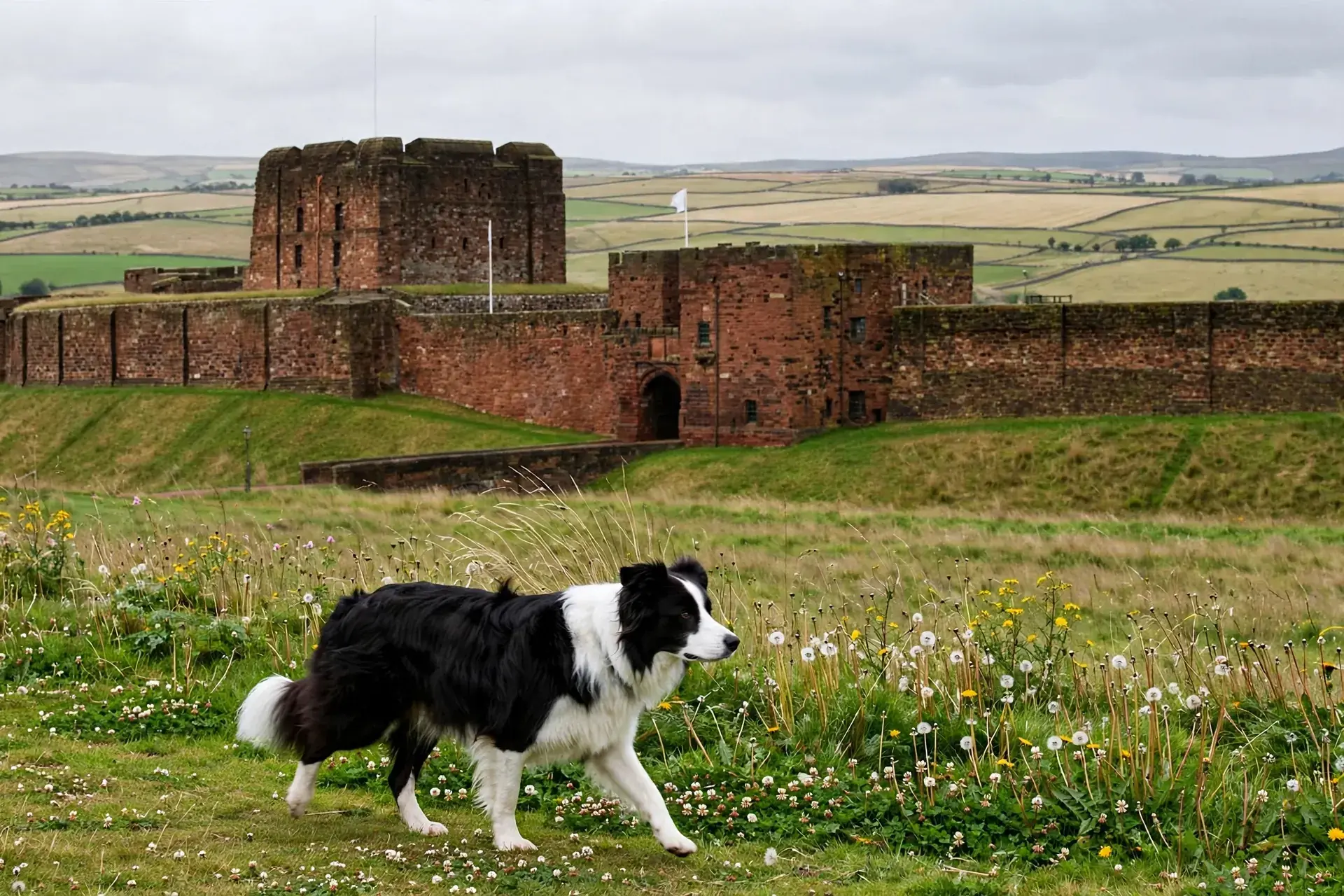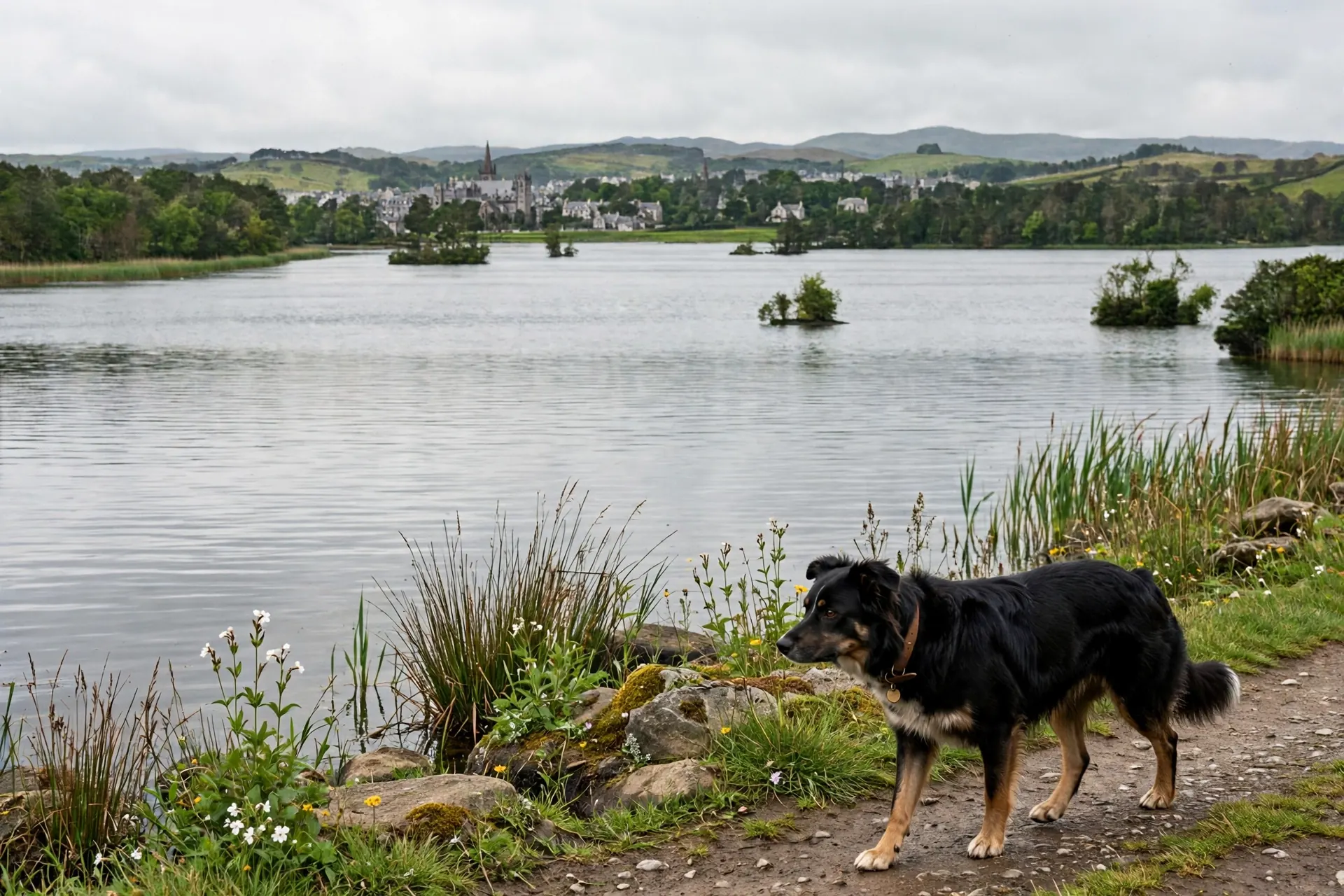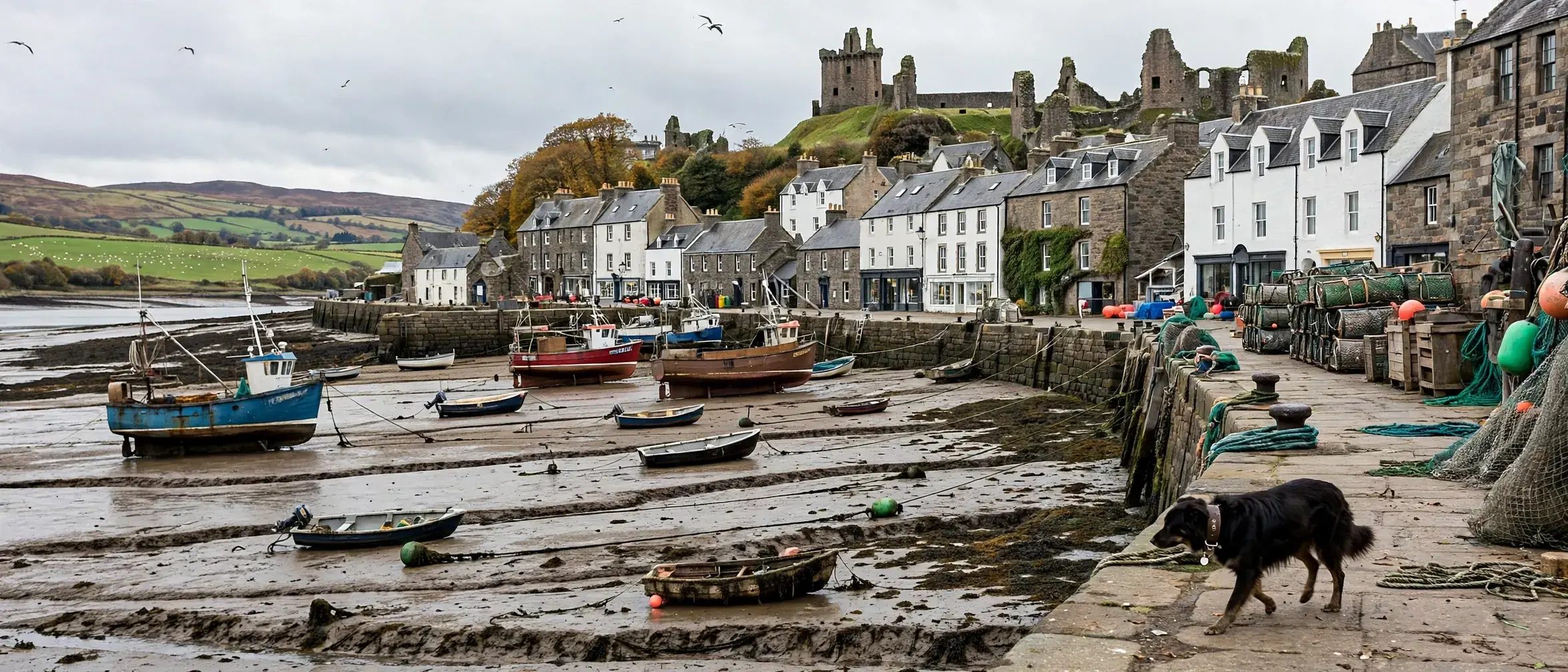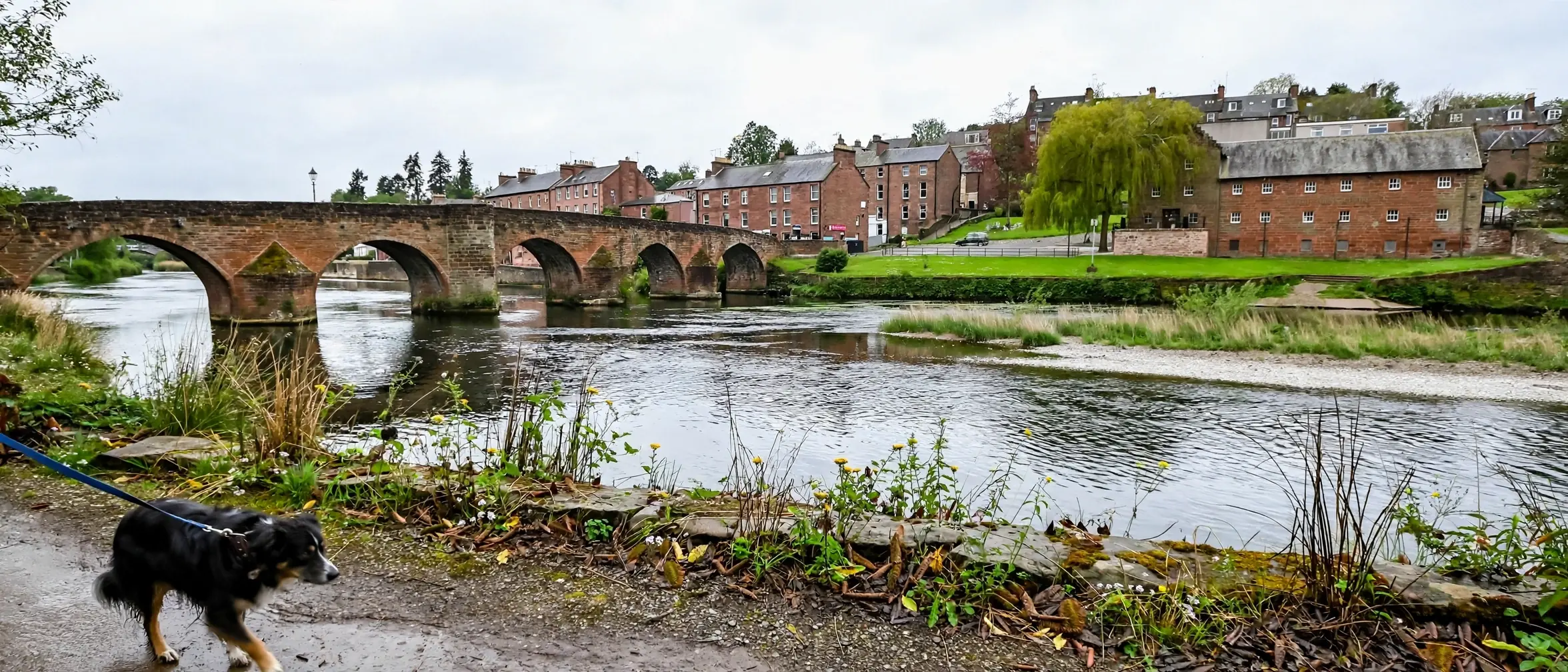
This guide is independent and contains no paid placement. If affiliate links are added later, they will be clearly marked and will not change our editorial checks.
Dumfries works best as a slow, riverside break: base yourself in town, walk the Nith in the morning, follow the Burns trail in the afternoon, and save Mabie Forest and Caerlaverock for a full day out. Keep dogs on leads by the river and in the parks, check opening hours and dog rules before you travel, and let the town set the pace.
Why Dumfries suits a dog break
Dumfries is the largest town in Dumfries and Galloway, and it is often called the Queen of the South. That nickname is a useful clue to what a visit feels like. This is a working market town rather than a resort, so it has supermarkets, vets, a railway station, a hospital and a proper high street, but it is also small enough to cross on foot with a dog in under half an hour. The River Nith runs through the middle of it, and the best of the town is arranged along its banks: the Whitesands, the old bridges, the parks and the paths that lead south towards the Solway Firth.
For dog owners, the appeal is the mix of short and long. A stiff-legged older dog can manage a flat riverside loop from the Whitesands to Dock Park and back without ever needing the car. A fit spaniel or collie can do that loop as a warm-up and then spend the afternoon in Mabie Forest, seven miles of trails through mixed woodland a short drive to the south-west. A family with children and a dog can split the day between the play areas in Dock Park and the wider, quieter paths along the river towards Kingholm Quay. Nobody has to choose between a town break and a country break, because Dumfries is both at once.
The town is also a sensible base for a longer stay in Galloway. Castle Douglas, with its loch and food shops, is about eighteen miles to the west. Kirkcudbright, the artists' town on the Dee estuary, is a similar distance further on. Carlisle and Hadrian's Wall country lie to the south-east, across the border in England. Staying in Dumfries means a different day out in each direction without the packing and unpacking that comes with moving every night, and it means coming back each evening to a town where you already know the nearest park, the nearest vet and the nearest dog-friendly pub.
There is a literary layer here that most British towns cannot match. Robert Burns moved to Dumfries in 1791 and lived in the town until his death in 1796. His last home, Burns House on Burns Street, still stands, and the Robert Burns Centre occupies the old town mill on the west bank of the Nith. The Globe Inn, where Burns drank and talked, is still a pub. St Michael's Churchyard holds the Burns Mausoleum. You do not need to be a Burns enthusiast to enjoy Dumfries, but the town makes more sense once you know that the poet spent his last years walking these same riverside paths, and the trail that links his house, his pub, his church and his river is one of the most rewarding short walks in southern Scotland.
Dumfries is not a place for ticking off a long list of attractions. Its pleasures are quieter: the light on the river at the Caul, the view back across the old bridge from the west bank, the sound of rooks in the trees at the Crichton, the smell of pine in Mabie Forest after rain. Dogs are good at this kind of holiday. They do not need a new attraction every hour; they need a good walk, a comfortable place to sleep, a pub that welcomes them and a routine that repeats itself. Dumfries provides all four without fuss, and that is the real reason it deserves a guide of its own.
First morning: the Whitesands to Dock Park loop
Start at the Whitesands car park, on the east bank of the Nith beside the town centre. The Whitesands takes its name from the pale sand that once lined the river here, and for centuries it was the working heart of Dumfries: a market place, a landing place for boats and a gathering place for the town. Today it is a broad, open riverside space with parking, benches and a clear view across the water to the Robert Burns Centre on the far bank. It is the natural meeting point for a first walk, and it is where most of the routes in this guide begin.
From the Whitesands, walk upstream towards Devorgilla Bridge, known locally as the Auld Brig. The stone bridge you cross today was built around 1431, replacing an earlier timber bridge, and it is one of the oldest bridges in Scotland. It is narrow, with passing places rather than pavements in the modern sense, so keep your dog close on a short lead, watch for traffic and do not stop in the middle to take photographs while cars are waiting. The view is worth a pause at either end instead: downstream towards the weir known as the Caul, and upstream towards the green banks and the hills beyond the town.
Cross the bridge and turn left, past the Old Bridge House on your left. This small building is the oldest house in Dumfries, and it now holds a small museum about the bridge and the town. Dogs are not admitted inside, but the outside is worth a look: the stonework, the low doorway and the way the house sits hard against the bridge tell you more about the old town than any plaque. From here, follow the riverside path south along the west bank, with the Nith on your left and the gardens and houses of the town on your right. The path is surfaced and mostly level, with benches at intervals, and it is shared with cyclists, so keep to one side and keep the lead short when a bike approaches.
Above the Caul, on a calm morning, the river can be almost still, and the reflections of the bridge and the buildings on the far bank are one of the classic Dumfries views. This is also a good place to watch for wildlife. Herons stand motionless in the shallows, goosanders and mallards work the river in winter, and otters are occasionally seen along this stretch, usually at dawn or dusk. Do not let your dog chase birds or enter the water here: the bank is steep in places, the current below the weir is stronger than it looks, and the path is close to the road in parts.
Continue south to the Suspension Bridge, built in 1875, a light iron footbridge that links the west bank with Dock Park. Cross it and turn into the park. Dock Park is the town's main riverside park, with wide lawns, mature trees, a play area, a bandstand, a cafe and a pub, the Riverside, at its edge. The park paths are surfaced and suitable for pushchairs and wheelchairs in most places, and the long riverside walk through the park is one of the most pleasant stretches in Dumfries. Dogs should be kept on a lead in the park, especially near the play area and the cafe terrace, and you should carry bags and use the bins provided.
Walk the length of Dock Park and then loop back towards the town along the east bank, or retrace your steps across the Suspension Bridge and return along the west bank to the Whitesands. Either way, allow about an hour at a gentle pace with stops, and closer to ninety minutes if you linger at the bridge, the Old Bridge House and the park. The whole loop is around three to four miles depending on the exact route you take through the park, and it is mostly flat, which makes it a good first walk for dogs that are still settling in after a journey.
A few practical notes make this walk smoother. The Whitesands car park can fill on market days and Saturdays, so arrive early or use the Dock Park car park at the southern end instead. The paths can be slippery with wet leaves in autumn and with ice in a cold snap, so wear shoes with grip and take your time on the bridge approaches. In summer, the west bank path has good shade from the trees, but carry water for the dog on a hot day, because there is no guarantee of a dog bowl at every stop. Finally, remember that this is a shared space: families, runners, cyclists and other dog walkers all use the same paths, so a recall that works in an empty field is not the same as a recall that works beside a busy river on a Saturday morning.
Following Burns on foot
The Burns trail in Dumfries is not a single marked route with signposts at every turn. It is a short, walkable cluster of places in the town centre, and the pleasure is in linking them on foot with a dog, stopping for a coffee or a pub lunch in between. Start at Burns House on Burns Street, the sandstone house where Robert Burns lived from 1793 until his death on 21 July 1796. The house is a small museum, furnished as it would have been in Burns's time, with manuscripts, portraits and personal objects. Dogs are not admitted inside, so if you are travelling as a pair, take turns to visit while the other waits outside with the dog, or simply admire the house from the street and move on to the places where the dog can join you.
From Burns House, walk the short distance to the Globe Inn on the High Street. The Globe dates from 1610 and was Burns's favourite pub in Dumfries. It is still a working pub and hotel, and it is worth going in for a drink or a meal if dogs are welcome in the bar area on the day you visit — check the official guidance before you travel, because pub dog policies can change with refurbishments and management. The Globe keeps Burns memorabilia, including the poet's chair and a bedroom associated with him, and it is the kind of place where a well-behaved dog settling under a table fits the atmosphere rather than disturbing it.
Next, head to St Michael's Church and churchyard, a short walk from the High Street. The church stands on a site that has been used for worship for many centuries, and the churchyard holds the Burns Mausoleum, a substantial monument to the poet and his family. Dogs on leads are generally welcome in the churchyard, but keep them on the paths, do not let them disturb other visitors, and remember that this is a burial ground as well as a historic site. The churchyard is also one of the quieter green spaces in the town centre, and it rewards a slow wander: old gravestones, mature trees and views back across the town.
Cross the river to the Robert Burns Centre, in the old town mill on the west bank of the Nith. The mill was built in 1781 and the centre now holds exhibitions about Burns, the town and the river, along with a film theatre and a cafe. The building itself is part of the story: the Caul, the weir just upstream, was built to divert water to power the mill, and you can still see the relationship between the river, the weir and the mill from the bridge. Dogs are not admitted inside the exhibition spaces, but the riverside setting is the point for a dog owner. Sit on the terrace or on a bench outside, look back across the Nith to the Whitesands, and you are looking at the view Burns would have known.
If you have time, add two more stops. Dumfries Museum, on Church Street, stands on the site of an old windmill and holds collections about the town and the region, including a camera obscura on the top floor that gives a panoramic view of Dumfries. Again, dogs wait outside, so this is a turn-taking stop. Ellisland Farm, a few miles north of the town on the banks of the Nith, is where Burns lived and farmed from 1788 to 1791, before he moved into Dumfries itself. It is a separate half-day trip rather than part of a town-centre walk, and it is best combined with a riverside walk along the Nith. Check opening hours for both the museum and Ellisland before you set out, because both keep seasonal hours and can close on certain days in winter.
The Burns trail works best when you do not try to do it all at once. Pick two or three stops, walk between them slowly, and let the dog set the pace. Burns himself was a walker, a farmer and an exciseman who covered long distances on foot and on horseback around Dumfries and Galloway, and the town still rewards that way of travelling. A dog that has had a good riverside walk in the morning will settle happily under a pub table in the afternoon, and that is as close as most visitors will get to the rhythm of Burns's own life in Dumfries.
Bridges, tides and the River Nith
The Nith is the thread that holds Dumfries together, and understanding a little about it makes every walk safer and more interesting. The river rises in the hills of East Ayrshire, flows south through Dumfries and Galloway, passes through Dumfries itself and then widens into the Nith estuary before joining the Solway Firth. At Dumfries the river is tidal, which means the water level rises and falls with the tide from the Solway, and the river can look very different at high and low water. At low tide, muddy banks and sandbars are exposed; at high tide, the river fills its channel and the current quickens.
Dumfries has more bridges than most visitors expect, and each one gives a different view of the town. Devorgilla Bridge, the Auld Brig, is the historic crossing, narrow and stone-built, with a history that goes back to a wooden bridge in the thirteenth century and the stone bridge of around 1431. The Buccleuch Street Bridge is the main road bridge, wider and busier, and not a pleasant crossing on foot with a nervous dog. St Michael's Bridge, at the southern end of Dock Park, carries traffic across the river near the park entrance. The Suspension Bridge of 1875 is a footbridge only, light and graceful, and it is the most enjoyable crossing for walkers. Further south, the Kirkpatrick Macmillan Bridge is another pedestrian crossing that links the riverside paths on either bank. Learning which bridge is which, and which ones are comfortable for your dog, is one of the small skills of a Dumfries visit.
River safety matters more than it might seem on a calm day. The Nith can rise quickly after heavy rain in the hills upstream, even when it is not raining in Dumfries itself, and the current below the Caul weir is deceptively strong. Dogs should be kept on a lead near the river, especially where the bank is steep, the path is close to the water or the ground is muddy. Do not throw sticks or balls into the river, and do not let a dog jump in after a duck or a ball that has gone in by accident. If a dog does go in, do not follow it into the water yourself; call the dog back to a shallow bank or a slipway, and seek help if the dog is in difficulty.
Flooding is part of the story of the Whitesands. The low-lying area beside the river has flooded many times over the centuries, and in recent years flood defences have been built to protect the town centre. After heavy rain, parts of the riverside paths can be closed or under water, and the Whitesands car park itself can be affected. Check the official guidance before you travel if there has been heavy rain, and be prepared to change your route: the higher paths through the Crichton or the forest trails at Mabie are a better choice on a day when the river is high.
Wildlife is one of the rewards of walking the Nith with a dog, provided the dog is under control. Herons, kingfishers, goosanders, mallards and mute swans are regular sights, and otters are present along the river, though they are shy and most often seen at dawn or dusk. The estuary downstream is important for wading birds, especially in winter, when large numbers of barnacle geese and other wildfowl arrive from the north. Keep your dog on a lead near roosting or feeding birds, and keep well back from the water's edge where birds are gathered. A dog that flushes a flock of geese on the estuary has done real harm, and it is entirely avoidable with a short lead and a little attention.
Parks and green corners
Dock Park is the park most visitors will use most, and it deserves a closer look. It runs along the east bank of the Nith at the southern end of the town, with a long riverside walk, wide lawns, mature trees, a children's play area, a bandstand and a cafe. The park is at its best in the morning, when the light comes across the river and the paths are quiet, and again in the early evening, when local dog walkers do their rounds. The Riverside pub sits at the edge of the park and is a natural stopping point for a drink after a walk, with outdoor seating where dogs are usually welcome.
Castledykes Park, on the west bank a little further south, is quieter and wilder than Dock Park. It takes its name from the castle that once stood nearby — the Royal Castle of Dumfries, built in the twelfth century — and it has a sunken garden, wooded paths and views across the river. It is a good choice for a dog that finds the busier park overwhelming, and it is a useful alternative when Dock Park is crowded with families and children. Keep your dog on a lead here too, and watch for the steps and slopes that make parts of the park less suitable for very old or unsteady dogs.
The Crichton is a different kind of green space altogether. This large estate on the southern edge of Dumfries was once a hospital and is now home to university and college campuses, offices and parkland. The grounds are open and walkable, with wide lawns, mature trees, historic buildings and long views across the countryside. It is popular with local dog walkers, and it is a good place for a longer, calmer walk away from traffic, especially in the evening. The Crichton also has a cafe and a shop, and it is a useful wet-weather fallback, because the paths are surfaced and the trees give shelter from light rain.
Smaller green spaces are scattered through the town and are worth knowing about. The churchyard at St Michael's is a quiet, green refuge in the town centre. The gardens around the Burns Centre and the Old Bridge House give a short, pleasant pause on a riverside walk. The paths along the Nith towards Dalscone and the Cuckoo Bridge retail park are less picturesque but useful for a quick toilet walk from a town-centre stay. In each case, the same rules apply: keep dogs on leads in built-up areas, pick up after them, and respect the fact that these are shared spaces used by children, older people and other dog owners.
For dogs that need off-lead time, Dumfries is best approached with a plan. The riverside paths and the parks are lead-on places, and that is not a hardship if you have a long line and a dog that enjoys sniffing. For a proper off-lead run, head out of town to Mabie Forest, where the trails are wider and the dog can stretch its legs, or to the Solway shore at low tide, where the open sand gives space to run. Do not let a dog off the lead in a park full of children, near a road, or on a narrow riverside path with cyclists, however well-behaved the dog is at home. The test is not whether the dog is friendly; it is whether the dog can be recalled instantly when a child, a cyclist or another dog appears without warning.
A forest day: Mabie
Mabie Forest, about four miles south-west of Dumfries on the road towards New Abbey, is the best full day out for a dog within easy reach of the town. The forest covers around a thousand hectares of mixed woodland, with waymarked walking trails from about one mile to seven miles, mountain-bike trails, a play area and a car park with toilets. It is part of the 7stanes network of forest trails in southern Scotland, and it is managed for timber, wildlife and recreation, which means some trails can be closed for felling work. Check the signs at the car park and the official guidance before you travel, and follow any diversions.
The walking trails are the heart of a Mabie visit. Short loops of one to two miles suit older dogs, puppies and anyone short on time, while the longer trails of four to seven miles, including the climb to Marthrown Hill, suit fit dogs and walkers who want a proper half-day in the woods. The Chinney Field loop, about a mile and a half, is a gentle introduction: mixed woodland, wildflowers in summer and views across to the Nith estuary. The Dalshinnie Glen trail leads through tall Douglas firs to a sheltered loch and nature reserve. Whichever trail you choose, wear boots with grip, because forest paths can be muddy and rooty after rain, and carry water for the dog, because there is no guarantee of a stream at the right moment.
Mabie is a shared forest, and that shapes how you walk it. Mountain bikers use many of the same trails, and they can approach quickly and quietly from behind, so keep your dog on a lead or on a short long line on shared paths, and step aside when you hear a bike. Forestry vehicles use the wider tracks, and dogs should never be allowed to chase them. Ticks are a real risk in Mabie, especially in bracken and long grass in spring and summer, so check your dog thoroughly after the walk, paying attention to ears, armpits, groin and between the toes, and carry a tick remover in your kit.
After the walk, Mabie Farm Park, next door to the forest, is a family attraction with animals, play areas and a cafe, but it is a separate visit with its own rules and admission, and dogs are not admitted to the farm park itself in the usual way. Check the official guidance before you travel if you are planning to combine the two. For most dog owners, the forest alone is enough for a morning, and the afternoon is better spent back in Dumfries, with a pub lunch and a short riverside walk to finish the day.
If Mabie is busy or closed for felling, the Forest of Ae, about ten miles north of Dumfries, is a good alternative, with its own network of forest trails and a quieter feel. The Annandale Way, a long-distance path that runs through the area, also offers shorter sections that can be walked as a day out, including the stretch near Lochmaben, with its castle ruins and lochside paths. Our guide to Dumfries and Galloway with a dog covers the wider region, including the Galloway Forest Park and the dark-sky country to the west, for visitors who want to build a longer trip around a Dumfries base.
Caerlaverock, New Abbey and the Solway shore
Caerlaverock Castle, about eight miles south of Dumfries on the Solway shore, is the most striking historic site near the town. It is a triangular castle, surrounded by a moat, built in the thirteenth century and fought over many times in the wars between Scotland and England. The castle grounds and the surrounding woodland walks are a pleasure with a dog on a lead, and the views across the Solway Firth towards England are wide and open. Dogs are not usually admitted inside the castle itself, so plan for a turn-taking visit or enjoy the grounds and the walks instead. Check the official guidance before you travel, because opening hours, admission and dog rules can change for events and conservation work.
Next to the castle, the Caerlaverock National Nature Reserve protects the salt marshes and mudflats of the Nith estuary. This is important wintering ground for barnacle geese, which arrive in large numbers from Svalbard in the autumn, and for many other wading birds. The reserve has trails, hides and a visitor centre, and it is a wonderful place for birdwatching in winter, but it is also a place where dogs must be kept strictly under control. Keep dogs on leads on the reserve, keep well away from roosting birds, and do not let a dog run on the mudflats or the salt marsh, where it can disturb feeding birds and where the mud itself can be dangerous.
New Abbey, the village a few miles south-west of Dumfries, is home to Sweetheart Abbey, founded in 1273 by Lady Devorgilla in memory of her husband, John Balliol. Devorgilla was the same Lady Devorgilla who gave her name to Devorgilla Bridge in Dumfries, and the abbey and the bridge are two parts of the same story. The abbey ruins are impressive — red sandstone, set against the hills — and the village itself is quiet and walkable, with a pub and a village shop. Dogs on leads are welcome in the abbey grounds, and the walk from New Abbey towards the coast, or the short drive on to the Solway shore at Glencaple, makes a good half-day out.
Glencaple, at the mouth of the Nith, is a small village on the Solway shore with a pub, a quay and views across the estuary. At low tide, the shore opens out into wide sands and mudflats, and it is a place where a dog can run and explore, provided you watch the tide and keep the dog in sight. The Solway tides are fast and the mud can be soft and deep in places, so do not walk far out on the sands, do not let a dog chase birds, and check tide times before you set out. The same caution applies to other Solway beaches in the area: they are beautiful and often empty, but they are not swimming beaches, and the tide and the mud deserve respect.
For a longer day out, continue west from Dumfries to Castle Douglas and Kirkcudbright. Our guide to Castle Douglas with a dog covers Carlingwark Loch, the food town's cafes and Threave Garden, while our guide to Kirkcudbright with a dog covers the harbour, the artists' town and the quiet Galloway coast. Both towns are an easy drive from Dumfries, and both reward a slow day rather than a rushed visit. If you are heading south instead, our guide to Carlisle with a dog covers the castle, the cathedral green and the Hadrian's Wall paths across the border.
Eating and drinking with your dog
Dumfries has a good choice of dog-friendly pubs and cafes, and the town centre is compact enough that you can try a different one each day. The Globe Inn, on the High Street, is the historic choice, and it is worth a visit for the Burns connection alone. The Riverside, in Dock Park, is the natural choice after a riverside walk, with outdoor seating and views over the park and the river. Other pubs in the town centre welcome dogs in the bar area, and several cafes welcome dogs inside or on a terrace, especially in the morning. Policies change, so ask when you arrive, and do not assume that a pub that welcomed dogs last year still does, or that a cafe that welcomes dogs on the terrace also welcomes them inside.
A few habits make pub and cafe visits smoother. Arrive with a dog that has already had a walk and a toilet break, so the dog is ready to settle rather than restless. Bring a mat or a blanket for the dog to lie on, a chew or a stuffed Kong to keep them occupied, and a water bowl if the pub does not provide one. Choose a table out of the main thoroughfare, away from the door and the bar, so the dog is not stepped over or startled by every passer-by. Keep the lead short and under your foot, and be ready to take the dog outside for a break if they become restless or vocal. A dog that settles quietly under a table will be welcomed back; a dog that barks at every new arrival will not.
For self-catering visitors, Dumfries has supermarkets in and around the town, including a large supermarket at the Cuckoo Bridge retail park, and smaller shops and delis in the town centre. The town also has a farmers' market and local food shops, and Castle Douglas, a short drive away, is known as a food town, with delis, butchers and a weekly market. If you are staying in a cottage or a caravan, stock up on arrival, because the smaller villages around Dumfries have limited shops, and a Sunday evening without dog food is a problem that is easily avoided.
Takeaway food is a useful fallback on a wet evening. Fish and chips, pizza and Indian and Chinese takeaways are all available in Dumfries, and eating in your accommodation with the dog settled beside you is often more relaxing than a restaurant meal after a long day. If you do want a restaurant meal, check in advance whether dogs are welcome, and be honest about your dog: a restaurant that welcomes a calm older dog in a quiet corner may not welcome a young, excitable dog at a busy table on a Saturday night.
Finally, remember that Dumfries is a small town, and the dog-friendly places are run by people who will remember you. Be polite, pick up after your dog, keep the dog off the furniture unless you are invited to do otherwise, and leave a good impression. The next dog owner who walks in will benefit from it, and so will you if you come back.
Where to stay with a dog
Dumfries has a reasonable choice of dog-friendly places to stay, from hotels in the town centre to cottages, bed and breakfasts and caravan and camping sites on the edge of town and in the surrounding countryside. Town-centre hotels are convenient for the riverside walks and the pubs, and they suit visitors who want to walk everywhere. Cottages and rural stays suit visitors who want a garden, a quieter night and a base for forest and coast days. Caravan sites suit visitors who want to bring their own accommodation and their own routine.
When you book, ask the questions that matter for your particular dog, and get the answers in writing. How many dogs are allowed, and is there a charge per dog per night or per stay? Is there a fenced garden or an enclosed area, and how high is the fence? Are dogs allowed in the bedroom, on the bed or on the furniture, or is there a dog bed provided? Is there a place to wash a muddy dog, or at least an outdoor tap? Where is the nearest toilet walk after dark, and is it lit? What happens if the dog barks and a neighbour complains? A host who answers these questions clearly is a host who has thought about dogs; a host who answers with a vague reassurance has probably not.
For a town-centre stay, check the parking arrangement and the route to the nearest green space. A hotel on a busy street with no garden is fine if the riverside path is two minutes away, but it is a poor choice if the nearest toilet walk involves crossing a busy road in the dark. For a rural stay, check the distance to the nearest shop, vet and pub, and whether the road outside the property is safe for a dog on a lead. For a caravan or a lodge, check the steps, the decking and the space around the unit, especially for older dogs or dogs that struggle with stairs.
Book early for the busiest times. The school summer holidays, the October half-term and the period around Burns Night on 25 January are all busy in Dumfries and Galloway, and the best dog-friendly cottages can book out months ahead. Shoulder-season stays in May, June and September often offer the best value, with quieter walks, longer daylight and fewer midges than the height of summer. Winter stays can be good value too, but check the heating, the daylight hours and whether the attractions you want to visit are open, because several sites in the area keep seasonal hours.
If you are staying for a week or more, consider splitting the stay: a few nights in Dumfries for the town, the river and the Burns trail, and a few nights further west in Galloway for the forests, the coast and the dark skies. That way you get the best of both, without a long drive every day, and the dog gets a change of walks halfway through the holiday. Our regional guide to Dumfries and Galloway with a dog has more on building a longer trip around the region.
Getting there, parking and getting around
Dumfries is on the main road network in southern Scotland, about seventy-five miles south of Glasgow and about thirty-five miles north-west of Carlisle. By car, the A75 runs east to west through Dumfries and Galloway, linking the town with Carlisle and the M6 to the east and with Castle Douglas, Kirkcudbright and Stranraer to the west. The A76 runs north from Dumfries towards Kilmarnock and Ayrshire. Driving times are short by Scottish standards, but the roads can be slow in summer, when caravans and agricultural traffic are common, and in winter, when the higher roads can be affected by snow and ice.
By train, Dumfries station is on the Glasgow South Western line, with services to Glasgow Central and to Carlisle, where you can change for the West Coast Main Line to London, Edinburgh and the north of England. The station is a short walk from the town centre and the Whitesands, which makes it a practical arrival point for a car-free break, though you will need to plan day trips by bus or taxi if you do not have a car. Dogs are welcome on trains in the UK, usually without a charge, but they must be kept on a lead or in a carrier, and they should not occupy a seat. Check the train operator's guidance before you travel, and avoid the busiest peak services if your dog is nervous in crowds.
By bus, Dumfries is a hub for local services across Dumfries and Galloway, with routes to Castle Douglas, Kirkcudbright, Lockerbie, Annan and Carlisle, among others. Buses are a useful option for a car-free day out, but services can be infrequent in rural areas, especially on Sundays, so check the timetable before you set out and allow plenty of time to get back. Dogs are generally allowed on buses at the driver's discretion, on a lead and on the floor, not on a seat, but this is not a legal right, so ask politely and be ready to wait for the next bus if the driver says no.
Parking in Dumfries is straightforward. The Whitesands car park is the most convenient for the riverside walks and the town centre, and the Dock Park car park is the most convenient for the park and the southern riverside paths. Both can fill on Saturdays and on market days, so arrive early or use one of the other town-centre car parks and walk in. Check the charges and the maximum stay before you leave the car, because some car parks have time limits that do not suit a long walk. Never leave a dog in a parked car, even for a short time, and especially not in warm weather: a car heats up quickly, even on a cloudy day, and a dog left in a car is at risk of heatstroke.
Once you are in Dumfries, the town centre is best explored on foot. The riverside paths, the parks and the Burns trail are all within a short walk of each other, and the town is mostly flat, which suits older dogs and older walkers. For day trips to Mabie Forest, Caerlaverock, New Abbey and the wider Galloway countryside, a car is by far the easiest option, and most visitors will want one. If you are travelling without a car, use taxis for the forest and the castle, and save the bus for the towns, where services are more frequent.
Seasons, midges and wet weather
Dumfries and Galloway has a mild, damp climate, with more rain and more wind than the east of Scotland, and with long summer evenings and short winter days. The best months for a dog break are usually May, June and September, when the days are long, the temperatures are comfortable, the midges are not yet at their worst or have begun to fade, and the town and the forests are quieter than in the school holidays. July and August are warmer and busier, with more visitors, more traffic and more midges, especially in the evenings near woodland and water.
Spring in Dumfries is a good time for riverside walks. The trees in Dock Park and along the Nith come into leaf, the daffodils and bluebells appear in the parks and the woods, and the birdsong along the river is at its best. The paths can be muddy after winter rain, so wear boots, and keep dogs on leads near nesting birds. Summer brings longer days and the chance of warm, settled weather, but also the midges. Midges are small biting flies that are worst on still, damp evenings from late spring to early autumn, especially near woodland, water and bracken. They are a nuisance for people and dogs alike, though dogs are less bothered by them than humans. Walk earlier in the day, choose breezy riverside paths, and use a midge repellent for yourself if you are sensitive to bites.
Autumn is one of the best seasons for Dumfries. The trees in the parks and the Crichton turn gold and red, the light on the river is low and warm, and the summer crowds have gone. The paths can be slippery with wet leaves, and the river can rise after autumn rain, so check conditions before a long riverside walk. Fireworks around the start of November can unsettle noise-sensitive dogs, so ask your host whether there are displays nearby, and plan a quiet evening indoors with the curtains drawn and the radio on if your dog is frightened by bangs.
Winter in Dumfries is quiet and often beautiful, with frost on the parks and mist on the river, but the days are short and several attractions keep reduced hours. Burns Night on 25 January is the town's biggest celebration, with suppers, readings and events, and it is a good time to visit if you want to see Dumfries at its most Burns-focused, though you should book accommodation well ahead. If you visit in winter, pack warm, waterproof clothing for yourself and a coat for a short-coated or older dog, carry a torch for the walk home in the dark, and check the official guidance before you travel for the opening hours of the Burns sites, the castle and the nature reserve.
Wet weather is not a reason to stay indoors in Dumfries. The riverside paths are surfaced, the Crichton grounds have tree shelter, and Mabie Forest is at its most atmospheric in light rain, when the pine scent is strong and the paths are quiet. Pack a waterproof coat for the dog as well as for yourself, bring towels and a drying coat for the journey home, and have a plan for drying a wet dog in your accommodation without soaking the bedding. A wet dog that is dried properly and given a warm, dry bed will settle happily, and a wet-weather walk is often the most memorable walk of the trip.
Practical kit, vets and the access code
A Dumfries trip does not need specialist kit, but a few items make a real difference. Pack a short lead and a long line, so you can give the dog more freedom on the forest trails and keep them close on the bridges and in the parks. Pack a harness that fits well, because a dog that pulls on a narrow bridge or a busy pavement is safer in a harness than on a collar alone. Pack poo bags, and more than you think you need, because the bins in the parks and the forest are not always where you expect them, and you should take bags home with you if there is no bin. Pack a water bottle and a collapsible bowl, a towel and a drying coat, a tick remover, and a basic first-aid kit for the dog, including a bandage and a muzzle for use in an emergency.
Know where the vets are before you need one. Dumfries has several veterinary practices in the town, and there are others in Castle Douglas, Kirkcudbright and Carlisle. Save the number of the nearest practice and the nearest out-of-hours emergency vet in your phone on arrival, and keep your dog's vaccination and insurance details with you. If your dog takes regular medication, bring enough for the whole trip plus a spare day, and keep it in its original packaging. If your dog has a health condition, such as epilepsy, diabetes or a heart condition, tell your host and carry a note of the condition and the vet's number in your pocket on walks.
Scotland has a different access system from England and Wales. The Scottish Outdoor Access Code gives a right of responsible access to most land and inland water, provided you act responsibly, respect the interests of other people, care for the environment and take responsibility for your own actions. For dog owners, that means keeping dogs under proper control at all times, keeping them on a lead or under close control around livestock, especially during lambing season in spring, and around ground-nesting birds in spring and summer. It does not mean dogs can roam freely everywhere: land can be closed for lambing, for forestry work or for conservation, and you must follow local signs and guidance.
Livestock is a serious issue around Dumfries. Sheep, cattle and horses graze the fields around the town, the forest and the Solway shore, and a dog that chases livestock can cause injury, abortion in pregnant ewes and even death, and can itself be shot by a farmer in the most serious cases. Keep your dog on a lead in fields with livestock, even if the dog has never chased before, and do not let a dog off the lead in a field where you cannot see what is around the next corner. If cattle approach you on a path, keep the dog close, move calmly to the edge of the field, and do not run. If you are in a field with cattle and feel threatened, let the dog off the lead so it can escape, and get yourself to safety.
Finally, a word about the dog itself. Dumfries is a town that rewards a dog that can settle, walk on a loose lead and cope with other dogs, children, cyclists and traffic. If your dog is reactive, nervous or newly adopted, Dumfries can still work, but choose your times and places carefully: walk early in the morning when the paths are quiet, use the wider forest trails rather than the narrow riverside paths at busy times, and pick a pub table in a quiet corner rather than the middle of a crowded bar. A reactive dog that has a good, calm holiday is a dog that will enjoy the next one more, and that is worth more than any number of attractions ticked off a list.
Three ready-made Dumfries plans
The two-hour plan is for a morning stop on a longer journey, or for a first visit with a dog that is still settling in. Park at the Whitesands, walk to Devorgilla Bridge and cross it, follow the west bank past the Old Bridge House and the Burns Centre, cross the Suspension Bridge into Dock Park, walk the riverside path through the park, and return to the Whitesands along the east bank. Stop for a coffee at the Burns Centre terrace or a drink at the Riverside if the dog is settled. This plan needs no car once you arrive, no booking and no special kit beyond a lead, bags and water, and it gives you the river, the bridges, the park and the Burns story in a single short loop.
The half-day plan adds the Burns trail and a pub lunch. Do the riverside loop in the morning, then walk into the town centre for Burns House, the Globe Inn and St Michael's Churchyard. Take turns to visit the house museum if you are travelling as a pair, have lunch at the Globe or at another dog-friendly pub, and finish with a slow walk through the Crichton grounds in the afternoon, when the light is softer and the paths are quieter. This plan suits a day trip from Carlisle or Castle Douglas, or the first full day of a longer stay, and it leaves the evening free for a takeaway and an early night.
The full-day plan is for a proper day out. Start with the riverside loop in the morning, then drive to Mabie Forest for a two- to three-hour forest walk, choosing a trail that suits your dog's fitness. Have a picnic in the forest car park or drive back to Dumfries for a late lunch, and finish the day with a short evening walk in Dock Park or the Crichton. The weekend plan adds a second day: Caerlaverock Castle and the nature reserve in the morning, New Abbey and Sweetheart Abbey in the afternoon, and a drive to the Solway shore at Glencaple for a low-tide walk if the tide times allow. That second day is the one that turns a Dumfries visit into a Galloway holiday, and it is the reason many visitors come back.
Whichever plan you choose, keep it flexible. The river may be high after rain, the forest may have a trail closed for felling, the castle may be closed for an event, or the dog may simply be tired. A plan that can be shortened, swapped or abandoned without disappointment is a better plan than a rigid itinerary that leaves no room for the dog. Dumfries rewards the visitor who is willing to sit on a bench by the Nith for half an hour and do nothing, and that is not a failure of planning. It is the point of the place.
Practical questions
Before you go
Can dogs go into Robert Burns House and the Robert Burns Centre?
Dogs are generally not admitted inside the house museum or the centre's exhibition spaces, so plan for one person to wait outside with the dog while the other visits, or enjoy the Burns trail from the street and the riverside instead. Assistance dogs are treated separately under access law. Opening hours change with the season, so check the official guidance before you travel.
Where is the best first walk with a dog in Dumfries?
Start at the Whitesands car park, cross Devorgilla Bridge, follow the west bank past the Old Bridge House and the Burns Centre, cross the Suspension Bridge and return through Dock Park. It is a short, mostly level loop of about an hour, with river views, benches and shade, and it works well as a first walk before a longer day out.
Can dogs swim in the River Nith?
Do not let a dog swim in the Nith as a matter of routine. The river is tidal near Dumfries, the current can be strong after rain, banks can be steep and slippery, and water quality varies. Keep dogs on a lead near the water, use the shallows only where access is safe and the dog is a confident swimmer, and check the official guidance before you travel if you are unsure about conditions on the day.
Are dogs allowed at Caerlaverock Castle?
Dogs on leads are generally welcome in the castle grounds and on the surrounding nature reserve paths, but they are not usually admitted inside the castle itself. Rules can change for events and conservation work, so check the official guidance before you travel, and keep dogs under close control around the moat, the water and grazing livestock.
What should I do about midges and ticks around Dumfries?
Midges are worst on still, damp evenings from late spring to early autumn, especially near woodland and water, so walk earlier in the day and choose breezy riverside paths when they are bad. Ticks are a year-round risk in long grass and bracken around Mabie Forest and the Solway shore: check your dog after every walk, carry a tick remover, and ask your vet about prevention before the trip.
Is Dumfries a good base for a longer dog-friendly holiday in Galloway?
Yes. Dumfries has supermarkets, vets, a railway station and a good choice of places to stay, and it sits within easy driving distance of Mabie Forest, Caerlaverock, New Abbey, Castle Douglas and Kirkcudbright. Staying in town means you can do a short riverside walk in the morning and a bigger forest or coast day out in the afternoon without packing up and moving on.