This guide is independent and contains no paid placement. If affiliate links are added later, they will be clearly marked and will not change our editorial checks.
Falkirk is one of the easiest dog-friendly bases in central Scotland. The Kelpies and the Falkirk Wheel both welcome dogs on leads outdoors, the canal towpath between them is flat and just over 4 miles, Callendar Park gives you 170 acres of woods and lawns, and trains reach Edinburgh, Glasgow and Stirling in under half an hour. Keep your dog on a lead by the water and around the sculptures, and check the official guidance before you travel for boat times and tour rules.
Why Falkirk works for dogs
Most Scottish towns offer a dog owner one good walk and a couple of tolerant cafes. Falkirk offers something rarer: a whole network of flat, traffic-free paths that connects its two biggest attractions, its largest park and its town centre. The town sits on the low ground between the Forth and Clyde Canal and the Union Canal, and the towpaths that once served working boats now serve walkers, cyclists and dogs. That matters more than it sounds. A flat route means an older dog, a puppy, a dog recovering from an operation and a fit collie can all enjoy the same day out at different speeds, without anyone tackling a hill they did not sign up for.
Falkirk is also genuinely central. It lies roughly halfway between Edinburgh and Glasgow, about 23 miles from each, and Stirling is only around 10 miles to the north. That geography turns the town into a base rather than a single stop: you can stay in one place, keep the dog's routine steady, and still reach three very different cities by train. For dogs that find new accommodation stressful, that stability is worth a lot. One bed, one morning walk, one evening routine, and a different day trip each day.
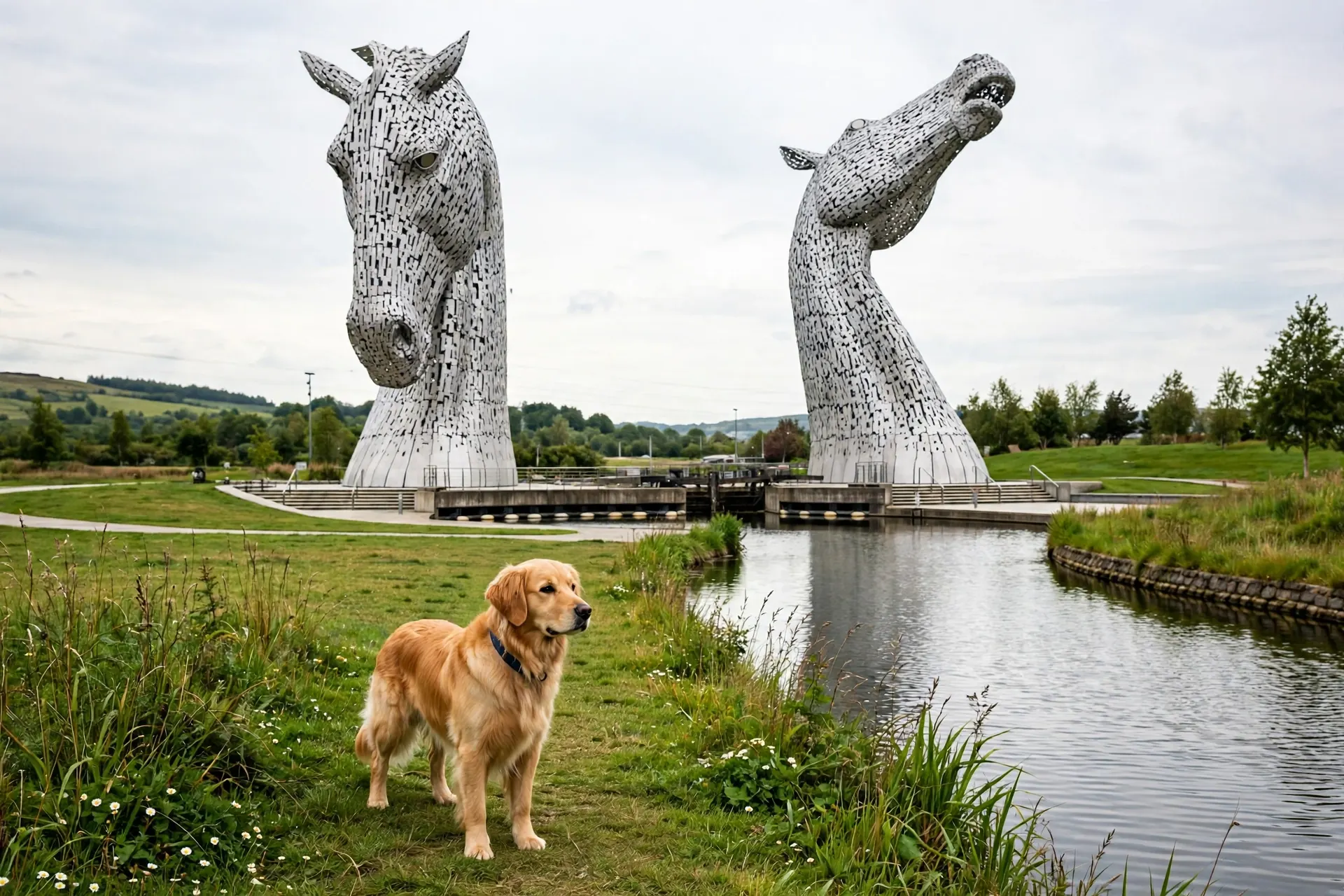
The town's industrial past is part of the appeal, too. The Kelpies, two 30-metre-high steel horse heads, celebrate the heavy horses that pulled barges along Scotland's canals. The Falkirk Wheel, the world's only rotating boat lift, connects the two canals where they meet at different heights. Both are outdoor, large-scale sights that are best experienced by walking around them slowly — which is exactly how a dog likes to experience anything. There is no queue of hushed galleries, no "dogs wait outside while we look at the main thing". The main thing is outside, and the dog is part of it.
None of this makes Falkirk a wilderness destination, and it is honest to say so. This is a working town in the Central Belt, not the Highlands. The walks are canal towpaths, parkland and woodland rather than mountain trails, and the scenery is green and industrial rather than dramatic. If your dog needs open moorland and empty beaches, Falkirk is a stop on the way, not the destination. But if you want an easy, low-friction few days where the dog is welcome almost everywhere you actually want to go, it is hard to beat.
The Kelpies and Helix Park
The Kelpies are the reason most visitors come to Falkirk, and they are the easiest of Scotland's big sights to visit with a dog. The sculptures stand in Helix Park, a large landscaped park on the eastern edge of town near Grangemouth, at the point where the Forth and Clyde Canal meets the River Carron. The park and the outdoor viewing areas around the sculptures are open 24 hours a day, 365 days a year, and walking around the park and viewing the sculptures is free. The Visitor Centre and gift shop keep daytime hours, typically 10am to 5pm.
Dogs are welcome across the outdoor pathways of Helix Park, but they must be kept on a lead at all times. That rule is easy to understand once you are there: the sculptures stand beside large water basins, the paths are wide and popular with families, cyclists and other dogs, and the Kelpies draw crowds on sunny weekends. A short lead beside the water is the practical choice, especially for dogs that like to launch themselves at ducks. Keep your dog close around the basins and the sculptures themselves, and give other visitors room on the narrow stretches.
The scale of the sculptures is difficult to grasp from photographs. Each horse head is 30 metres tall — about the height of a ten-storey building — and they are built from steel plates over a structural frame. Standing underneath one with a dog at your side is a genuinely memorable moment, and the wide, flat paths make it accessible for dogs of all ages and sizes, including dogs in pushchairs or on wheels. The park's paths are smooth and mostly tarmac, typically two to five metres wide, so a lead, a buggy and a passing cyclist can all share the space without a squeeze.
If you want more than the outside view, the guided Kelpies Tour takes visitors inside one of the horse heads to see the engineering from within. The tour lasts about 30 minutes and dogs are welcome to join it, which is unusual for an indoor attraction and worth booking ahead in busy periods. Dogs are not allowed inside the Visitor Centre itself, apart from assistance dogs, but there are lead clips on the picnic tables outside, so one person can pop in for tickets or the shop while the other stays with the dog. Check the official guidance before you travel for current tour times, prices and any changes to the dog rules.
Helix Park is bigger than the Kelpies alone, and it repays a longer wander. Beyond the sculptures there are lagoon paths, a play area, woodland trails and open grass where you can build a proper walk rather than a photo stop. The park is also the eastern end of the canal towpath walk from the Falkirk Wheel, so it works as either the start or the finish of a longer day. Arrive early or late in the day and the park empties out: the sculptures are lit at night, and an evening walk around them, when the crowds have gone and the steel catches the floodlights, is one of the best dog walks in central Scotland. Take a torch in winter, keep the dog on a lead after dark, and watch for cyclists, who use the towpath at all hours.
Practical points: parking at Helix Park is free, with designated accessible bays close to the Visitor Centre and the sculptures. There are toilets and a cafe at the Visitor Centre, and the paths are step-free. Water for dogs is not guaranteed at every point in the park, so carry a portable bowl and water, especially on warm days — the open ground around the sculptures offers little shade. Bins for dog waste are provided along the main paths, but carry spare bags anyway, as the busiest bins fill up on summer weekends.
The Falkirk Wheel and the canals
About three miles west of the Kelpies, the Falkirk Wheel does for canals what the Kelpies do for horses: it turns an engineering problem into a spectacle. The Wheel is a rotating boat lift that carries boats between the Forth and Clyde Canal below and the Union Canal above, a height difference of 24 metres. Watching a boat sail into a gondola, rise slowly into the air and sail off along an aqueduct is the kind of thing that holds a dog owner's attention for a good while — and the dog, on a lead beside you on the viewing terrace, gets a front-row seat.
The site is free to visit. You can walk around the basin, watch the Wheel turn, follow the towpaths and explore the visitor centre without paying anything. The only charge is for the boat trip itself, which lasts about 50 to 60 minutes and takes you up through the Wheel, through the Roughcastle Tunnel and along the upper canal before returning. Boat trips run through the day in season, and pre-booking online is strongly recommended on summer weekends.
Dogs are genuinely welcome here. Dogs are allowed on site, on the towpaths and woodland tracks, and in the lower levels of the visitor centre on a lead. They are not allowed in the main cafe seating area, although they can sit at the high tables, and assistance dogs are permitted everywhere. The boat trip is the question most owners ask about, and the answer is a qualified yes: confident, calm dogs are welcome on board, and dogs travel free. Scottish Canals advises that only confident dogs should board, because the ride is noisy and includes a dark tunnel, and suggests that nervous dogs stay on land if possible. That is sensible advice. A dog that is happy on a ferry or a busy train will probably enjoy it; a dog that hates the hoover will not. If you are travelling as a pair, the simplest plan is for one person to take the boat trip while the other walks the dog along the towpath, then swap — the towpath above the Wheel, along the Union Canal, is a lovely walk in its own right.
The Wheel sits at a junction of walks, not just a single viewpoint. From the basin you can follow the Forth and Clyde Canal east towards the Kelpies, follow the Union Canal west, climb the woodland paths above the Wheel for a view down over the whole site, or walk the short stretch to the Antonine Wall. The grounds, walking paths and canal basin are open 24 hours a day, while the visitor centre, cafe and ticket desk keep daytime hours, typically 10am to 5pm, and are closed on Christmas Day, Boxing Day, New Year's Day and 2 January. The address for navigation is Lime Road, Tamfourhill, Falkirk FK1 4RS.
Two warnings are worth taking seriously. First, the water. The basin is deep, the edges are hard stone, and a dog that slips in will struggle to climb out. Keep your dog on a short lead around the basin and the locks, and never let a dog swim in the canal. Second, the noise. The Wheel itself is quiet, but the boat trip, the tunnel and the crowds on a summer Saturday can be a lot for a sound-sensitive dog. If your dog is noise-sensitive, visit early, watch one rotation from the terrace, and skip the boat.
Callendar Park and Woods
If the Kelpies and the Wheel are Falkirk's famous sights, Callendar Park is its everyday treasure — and for many dogs, it is the best walk in town. The park covers more than 170 acres of designed landscape on the southern edge of the town centre, centred on Callendar House, a grand historic house that is free to visit. The park is free to enter, dogs are welcome, and there is even a dog wash station for muddy paws, which tells you everything about how the park is used by local owners.
The walking is varied enough to suit a whole week of morning outings. A circular trail of about 4.8 kilometres loops through Callendar Woods and around the park pond, passing old oaks, yew groves, tree-lined avenues, a family mausoleum, Victorian kennels and the remains of a hill fort. Paved paths run around the lake and the house for easy strolls, while rougher routes climb through the woods for dogs that need more of a workout. The ground is mostly good underfoot, with tarmac and a short section of gravel or unsurfaced path in the woods, so it stays walkable in wet weather better than most woodland.
Callendar House itself is worth a look from the outside even if you do not go in. The house sits above lawns with the woods behind it, and the terrace and gardens are a pleasant place to sit with a dog on a lead. Dogs are not allowed inside the house itself, apart from assistance dogs, so plan the visit as an outdoor one: walk the grounds, look at the house, and save the interior for a return trip without the dog. The cafe at the house is a useful stop, and the park also has a play area, a nine-hole par-three golf course set in woodland, seasonal swan pedalos on the pond from April to September, and public toilets.
The park is close to Falkirk High station, which makes it an easy first or last walk on a train-based trip: arrive, drop bags if you are staying nearby, and let the dog stretch its legs around the lake before you do anything else. It is also the southern anchor of a longer figure-of-eight walk that links Callendar Park, the Union Canal, the Falkirk Wheel and the Forth and Clyde Canal, a route of around 8 miles that experienced walkers do as a full day out. You do not have to do the whole thing. The pleasure of Callendar Park is that a twenty-minute loop around the pond is just as satisfying as a half-day hike, and the dog will not know the difference.
Keep your dog under control around the pond, where swans and ducks nest, and on the golf course, where balls and players cross the paths. The woods are home to squirrels and the usual small wildlife, so a dog with a strong chase instinct is better on a long line than off the lead. Pick up after your dog: this is a park used daily by families and school groups, and it stays welcoming to dogs only if owners keep it clean.
The Wheel to Kelpies towpath walk
The single best dog walk in Falkirk is the towpath between its two landmarks. The route runs just over 4 miles (about 6.5 kilometres) from the Falkirk Wheel to the Kelpies, following the Forth and Clyde Canal east through Summerford, Lock Sixteen, Grahamston and Camelon. It is almost entirely flat, the surface is mostly smooth tarmac, and it is suitable for cyclists as well as walkers, so it works for dogs of every age and fitness level.
Start at the Wheel and walk east. The first stretch passes the basin and the lower canal, then settles into the steady rhythm of a towpath: water on one side, hedgerow and houses on the other, narrowboats moored along the bank, and the occasional lock to watch. Lock Sixteen is a good halfway landmark and a natural place to stop, water the dog and check paws. From there the path continues past Camelon, where the canal bends towards the River Carron, and into Helix Park and the Kelpies. Most people take an hour and a half to two hours one way at a dog's pace, with stops.
You can walk it in either direction, and the choice matters. Starting at the Wheel means the Kelpies are the reward at the end, and the Wheel's car park and facilities are a convenient base. Starting at the Kelpies means you finish at the Wheel, where the cafe and visitor centre make a better lunch stop. If you are travelling by train, the walk is easy to reach from either end: Falkirk High station is about 2.5 miles from the Wheel by towpath, and Camelon station sits close to the canal near the Kelpies end. Buses run between the Kelpies and Falkirk High station if your dog has had enough by the finish.
A few practical notes for the towpath. Keep your dog on a lead: the path is shared with cyclists, the water is unfenced along most of its length, and narrowboats pass close by. Cyclists in Scotland are generally polite, but a dog that darts across a towpath in front of a bike is a real risk, so walk on the side away from the water and keep the lead short when you hear a bell. Take water and a bowl — there are few places to fill up along the way, and canal water is not safe for dogs to drink. In summer, the towpath is exposed in places, so walk early or late on hot days and check the ground temperature with the back of your hand. In winter, the tarmac can ice over, and the wind along the canal cuts through a short-coated dog quickly, so a coat is worth packing.
Part of the route has been affected by repair works on the canal in 2026, with a section near Lock Sixteen temporarily inaccessible at times. Check the official guidance before you travel for the current state of the towpath, and be ready to use a signed diversion or to walk the route in two halves. The diversions are generally short and well signed, but they can add road walking, which is not ideal for a dog that is nervous around traffic.
Falkirk town centre with a dog
Falkirk town centre is a compact, practical place to spend a morning with a dog, and it is worth an hour or two between the big sights. The High Street is the main shopping street, and while most shops do not admit dogs, the pavements are wide, the pace is relaxed, and there are cafes with outdoor seating where a dog can settle. Falkirk has two railway stations — Falkirk High on the hill above the town and Falkirk Grahamston in the centre — and both are an easy walk from the High Street, which makes a car-free visit straightforward.
Zetland Park, just east of the town centre, is the local park that visitors often miss. It is smaller and less grand than Callendar Park, but it is a proper neighbourhood green space with paths, lawns and a play area, and it works well as a short morning or evening walk if you are staying in town. It is the kind of park where local dogs do their daily circuit, and it gives a visiting dog a chance to sniff the local news before the day's main walk.
History runs through Falkirk in a way that is easy to miss if you only visit the new landmarks. The Antonine Wall, the Roman frontier that ran across central Scotland, passes close to the town, and sections of its ditch and rampart survive at Roughcastle, near the Falkirk Wheel, and at Callendar Park. The wall is a UNESCO World Heritage Site, and the surviving earthworks are best appreciated on foot with a dog on a lead — a flat, grassy walk along a 2,000-year-old frontier. The Battle of Falkirk in 1298, when William Wallace's army was defeated by Edward I, took place on ground south of the town, and the area is marked rather than built over. None of this needs a ticket or a timetable, which is exactly what makes it good dog walking: you can wander, read a panel, and move on at the dog's pace.
For a longer town walk, the John Muir Way passes through Falkirk on its way across Scotland from Helensburgh to Dunbar. You do not need to walk the whole thing to enjoy it: the sections through town and along the canal are waymarked and make a good half-day route. The Forth and Clyde Canal towpath west of the Wheel also continues towards Bowling and the Clyde, if you want to extend a stay into a longer canal walk. Check the official guidance before you travel for current path conditions, as sections can be closed for maintenance.
Day trips from Falkirk
Falkirk's greatest strength as a base is how much of Scotland sits within a short train ride. With the dog settled in one place, you can spend each day somewhere different and be home for the evening walk.
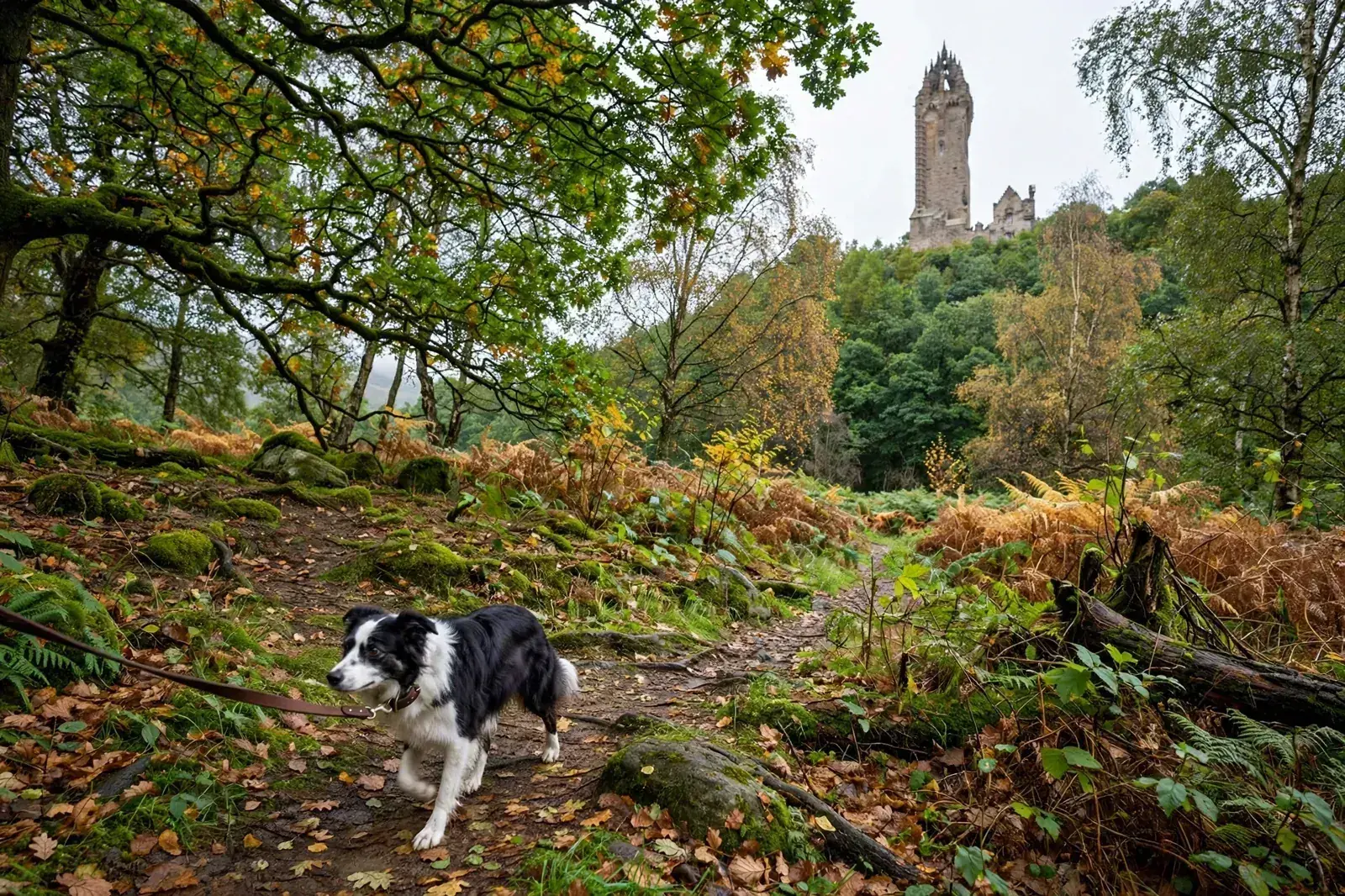
Stirling is the closest and the easiest. Trains from Falkirk take around 12 to 15 minutes, and the town is compact enough to explore on foot. Our guide to Stirling with a dog covers the Wallace Monument woods, the River Forth loops, the castle rules and the Old Town walks, and it pairs naturally with a Falkirk stay: do the Kelpies and the Wheel one day, Stirling the next.
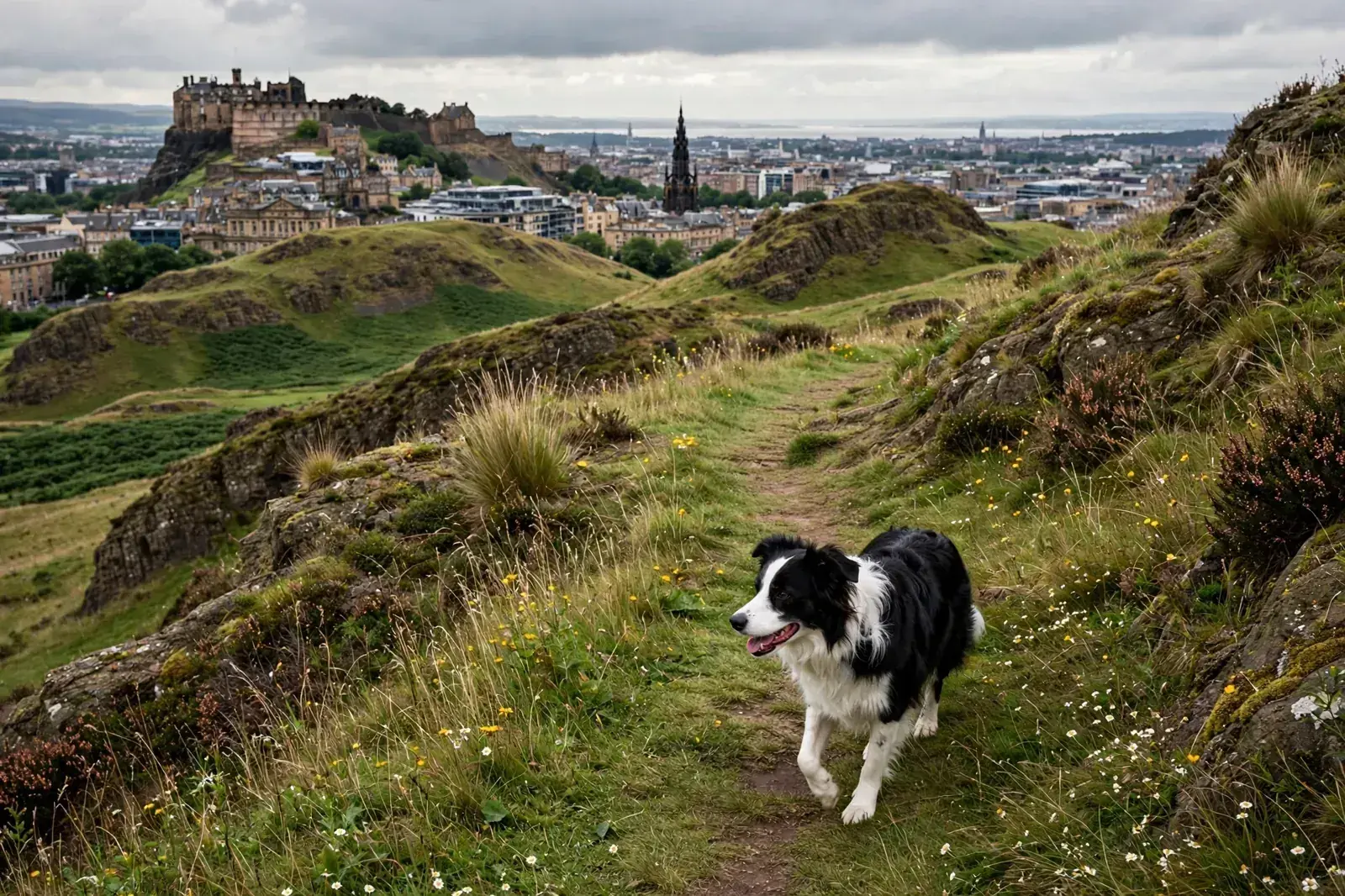
Edinburgh is about 25 to 30 minutes by train from Falkirk High or Falkirk Grahamston, and it rewards a full day. Arthur's Seat and Holyrood Park give a dog a proper hill walk inside a capital city, the Water of Leith is a long, green, traffic-free path, and there are dog-friendly cafes across the Old and New Towns. Our guide to Edinburgh with a dog has a workable city plan, including castle split-visit rules and a festival crowd strategy, which matters in August when the city fills up.
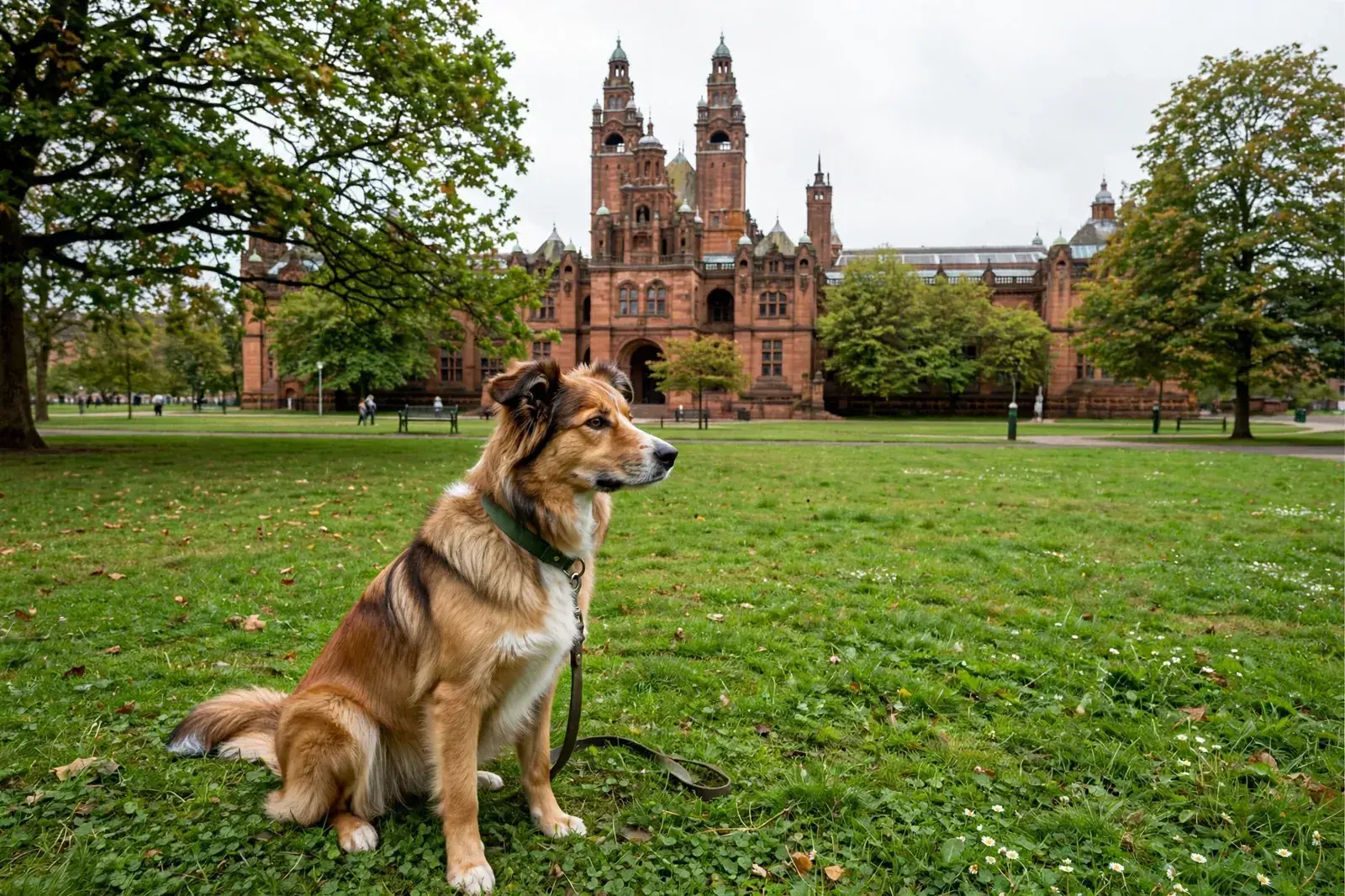
Glasgow is about 20 minutes in the other direction, and it is a different kind of day out: bigger parks, a riverside city, and the gateway to Loch Lomond. Kelvingrove Park, Pollok Park and Glasgow Green are all generous dog walks, and the Clyde riverside paths are flat and long. Our guide to Glasgow with a dog covers the parks, the cafes and the Loch Lomond day trips that work from the city.
Closer to home, Bo'ness (Borrowstounness) on the Firth of Forth is a short drive or bus ride away and offers a harbour, a heritage railway and coastal paths. The Bo'ness and Kinneil Railway is a heritage line where dogs are generally welcome on trains, which is a treat for a dog that enjoys new experiences — check the official guidance before you travel, as rules vary by event. Kinneil Estate, on the edge of Bo'ness, has woodland walks, a ruined palace and Antonine Wall remains, and it is quieter than Falkirk's main sights. Linlithgow, between Falkirk and Edinburgh, has a loch-side walk and the ruins of Linlithgow Palace, where Mary, Queen of Scots was born, and its peel is a pleasant, flat circuit for a dog.
If you are travelling by canal rather than by train, Falkirk is also a natural stop on a longer canal holiday. Our guide to canal boat holidays with dogs covers what to check before booking a narrowboat with a dog, including locks, towpaths and life jackets, and the Falkirk Wheel is the most memorable single feature on the Scottish canal network.
Where to eat and drink with a dog
Falkirk's eating scene is practical rather than fancy, and dogs are welcome in more places than you might expect — but the rules change from place to place, so the habit of checking before you sit down will serve you well. The visitor centres at the Kelpies and the Falkirk Wheel both have cafes where dogs are welcome in at least part of the seating: at the Wheel, dogs can sit at the high tables but not in the main cafe seating area, and at the Kelpies, dogs are not allowed inside the Visitor Centre, so the cafe is a takeaway-and-picnic-tables affair for owners. Both sites have outdoor seating and picnic tables with lead clips, which in good weather is the better option anyway.
In Callendar Park, the cafe at Callendar House is a useful stop after a woodland walk, and the park's open lawns are made for picnics. Bringing your own food is often the most relaxing choice in Falkirk: the parks, the towpaths and the Kelpies all have picnic tables and benches, and a dog that can lie on a mat beside you while you eat is a happier dog than one tied to a chair leg in a busy cafe.
In the town centre, look for cafes and pubs with outdoor seating on and around the High Street, and ask before you settle: many places that do not advertise themselves as dog-friendly will still welcome a calm dog on a lead outside, and some will welcome one inside. The honest pattern in a town like Falkirk is that dog-friendly provision is informal and changes often — a new manager, a new policy, a refurbishment — so a place that welcomed dogs last year may not this year, and vice versa. Check the official guidance before you travel, and have a picnic fallback in your bag. A spare lead, a water bowl, a mat for the dog to lie on and a chew to keep them occupied will make any cafe stop work, wherever you end up.
For supplies, Falkirk town centre has supermarkets and pet shops within walking distance of the stations, so you can stock up on food, treats and waste bags on arrival rather than carrying a week's supply. If your dog is on a prescription diet or a specific food, bring it with you: the range in a small town centre is narrower than in Edinburgh or Glasgow, and a special diet is not something to improvise.
Where to stay with a dog
Falkirk has a smaller range of dog-friendly accommodation than Edinburgh or Glasgow, so book early, especially for summer weekends and school holidays. The town has hotels, guesthouses and self-catering options in and around the centre, and the surrounding villages add cottages and farm stays within a short drive. The most useful approach is to filter for dog-friendly stays and then check the details that actually matter: is there a charge per dog, is there a limit on the number or size of dogs, and is the dog allowed to be left alone in the room?
Self-catering is often the best fit for a Falkirk stay. A cottage or flat with a small garden gives the dog a toilet area at night, a place to dry off after a canal walk, and a kitchen for preparing food. It also avoids the question of whether the dog can be left alone in a hotel room while you eat, which is the single most common source of friction on a dog holiday. If you do book a hotel, ask in writing whether the dog can be left unattended, whether there is a charge, and whether dogs are allowed in the bar or restaurant — the answers vary widely, and the website rarely gives them.
Location matters more than luxury. A stay near Callendar Park or the canal gives you a morning walk without a car; a stay near Falkirk High station gives you easy train days to Edinburgh, Glasgow and Stirling; a stay near the Kelpies gives you an evening walk around the sculptures when the crowds have gone. A stay on a busy road, by contrast, means every toilet trip is a lead walk in traffic, which wears thin by day three. Ask for the exact address and look at it on a map before you book, and check how far the nearest green space is on foot.
If Falkirk itself is full, consider staying in Stirling, Linlithgow or a village on the canal, and using Falkirk as a day trip instead. The train links are short enough that a base in any of the three towns works, and the dog will not mind which town it sleeps in as long as the bed and the routine are the same. Whatever you book, confirm the dog arrangements in writing, note the pet fee in the total, and check the cancellation terms: a dog that falls ill the week before a trip is the most common reason a booking changes, and a flexible cancellation policy is worth more than a slightly cheaper rate.
Getting there and getting around
Falkirk is easy to reach, and for many visitors the train is the best way to arrive with a dog. The town has two main stations: Falkirk High, on the hill above the town on the Edinburgh to Glasgow line, and Falkirk Grahamston, in the town centre on the line to Edinburgh via Polmont. Trains from Edinburgh take around 25 to 30 minutes, trains from Glasgow Queen Street take around 20 minutes, and trains to Stirling take around 12 to 15 minutes. Services are frequent through the day, and dogs travel free on trains in the UK, although they must be kept on a lead and off the seats. Check the official guidance before you travel for current timetables, as engineering works can change them.
Falkirk High is the more useful station for the Wheel: a signed path leaves the station and reaches the canal towpath about 70 metres away, and the towpath walk to the Wheel is about 2.5 miles, mostly flat and recently resurfaced. Falkirk Grahamston is the better station for the town centre and Callendar Park. Camelon station, on the eastern edge of town, is the closest station to the Kelpies by foot, and it is the natural start or finish for the towpath walk. All three stations are small and step-free in most directions, but Falkirk High has a footbridge with stairs between platforms and a long alternative route via a subway, so allow extra time if you are travelling with luggage, a buggy or a dog that dislikes stairs.
By car, Falkirk sits just off the M9 between Edinburgh and Glasgow, and the M876 and M80 connect it to Stirling and the north. The Kelpies and the Falkirk Wheel both have free car parks, and Callendar Park has parking near the house. Summer weekends can fill the Kelpies car park by late morning, so arrive early or use the bus. By bus, local services connect the town centre with the Kelpies, the Wheel and the surrounding villages, and dogs are generally allowed on local buses at the driver's discretion — keep the dog on a lead, on the floor, and out of the aisle.
Once you are there, the honest advice is to walk. The town centre, Callendar Park and the canal are all within walking distance of each other, and the towpath does the work of a bus route between the two big sights. A car is useful for Bo'ness, Kinneil and the wider area, but it is not necessary for a Falkirk-based stay, and leaving the car parked is one less thing for the dog to worry about.
Seasons and weather
Falkirk is a year-round destination, but the experience changes with the seasons, and a dog owner should plan around them. Spring, from April to June, is arguably the best time: the parks are green, the canal banks are in flower, the days are long, and the crowds have not yet arrived. The towpaths dry out, the woods in Callendar Park fill with bluebells and wild garlic, and the midges that trouble the Highlands in summer are rarely a problem in the Central Belt. This is the season for the full Wheel-to-Kelpies walk and for long evenings around the sculptures.
Summer brings the crowds. The Kelpies and the Wheel are at their busiest from late June to August, especially at weekends and during school holidays, and the car parks fill early. The attractions are still enjoyable — the sites are large and outdoors, so they absorb crowds well — but a reactive dog will find the main paths harder, and the open ground around the Kelpies offers little shade on a hot day. Walk early, carry water, and use the quieter woodland paths in Callendar Park for the middle of the day. The canal towpath is exposed in places, so check the ground temperature before a long walk, and never leave a dog in a parked car.
Autumn is Falkirk's quiet season and one of its best. September and October bring colour to Callendar Woods, cooler walking weather, and thinner crowds at both landmarks. The Kelpies lit against an early dusk is a fine sight, and the towpath is at its best in low autumn light. Fireworks around early November can unsettle noise-sensitive dogs, so check whether local displays are planned and keep the dog indoors in the evening if needed.
Winter is the hardest season to plan for, but it has its own rewards. The Wheel and the Kelpies are open all year, the parks are empty, and a crisp, frosty morning on the canal is beautiful. The trade-offs are short days, wet and sometimes icy towpaths, and reduced hours at the visitor centres. The Kelpies are lit at night, which makes an early-evening walk possible, but take a torch, keep the dog on a lead after dark, and carry a towel and a drying coat: a wet dog in a cold car is a miserable end to a walk. Whatever the season, Falkirk's weather is changeable central Scotland weather — rain is possible in any month, and a waterproof coat for the owner and a drying coat for the dog are the two most useful items you will pack.
Packing list for a Falkirk trip
Falkirk's walks are flat and easy, but the canals, the water basins and the changeable weather mean a little preparation goes a long way. Pack a short lead for the Kelpies, the Wheel basin and the town centre, and a long line for the open grass in the parks. Bring a portable water bowl and water for every walk: canal water is not safe to drink, and there are long stretches of towpath with no tap. Pack waste bags and spares, a towel and a drying coat for wet days, and a mat for the dog to lie on in cafes and picnic stops.
For the dog, add a coat for short-coated or older dogs in winter, paw balm for icy towpaths, and any medication in its original packaging with the prescription. For the owner, add waterproofs, layers, a torch for evening walks around the Kelpies, and a phone charger: the towpath walk is long enough that a flat phone battery becomes a real problem if you need a map or a taxi. Keep the dog's ID tag on its collar with your mobile number, and save the number of the nearest vet before you arrive — the nearest practices are in Falkirk itself, but their out-of-hours arrangements vary, so check the official guidance before you travel.
Finally, pack for the possibility that plans change. A towpath closure, a boat trip cancelled by wind, a cafe that no longer welcomes dogs — all of these happen, and a Falkirk trip survives them easily because there is always another park, another stretch of canal, or another train to Stirling. The packing list that matters most is the flexible one: water, a lead, a towel, and a willingness to walk the other way.
Practical questions
Before you go
Can dogs go inside the Kelpies?
Dogs are welcome throughout the outdoor areas of Helix Park on a lead, including right up to the sculptures and around the water basins. Dogs can also join the guided Kelpies Tour, which goes inside one of the horse heads. Dogs are not allowed inside the Visitor Centre itself, apart from assistance dogs, and there are lead clips on the picnic tables outside if one person wants to pop in while the other stays with the dog. Check the official guidance before you travel, as tour times and rules can change.
Can my dog ride the Falkirk Wheel boat trip?
Yes, confident and calm dogs are welcome on the boat trip, and dogs travel free. Scottish Canals advises that only confident dogs should board, because the ride is noisy and includes a dark tunnel, and suggests that nervous dogs stay on land if possible. Dogs are also welcome on site, on the towpaths and in the lower levels of the visitor centre on a lead. Assistance dogs are permitted everywhere.
How long is the walk from the Falkirk Wheel to the Kelpies?
The towpath walk from the Falkirk Wheel to the Kelpies is just over 4 miles (about 6.5 kilometres) each way, almost entirely flat, following the Forth and Clyde Canal east through Summerford, Lock Sixteen and Camelon. Most people walk it in around an hour and a half to two hours one way, and it is also suitable for cycling. There is a bus back from the Kelpies if your dog has had enough by then.
Is Falkirk a good base for a dog-friendly holiday in Scotland?
Yes, Falkirk is one of the most practical bases in central Scotland for a dog holiday. It sits between Edinburgh and Glasgow, with direct trains to both in roughly 20 to 30 minutes, and Stirling is about 15 minutes away. The town itself has two major dog-friendly attractions, flat canal towpaths for easy daily walks, and a large historic park, so you can fill several days without driving anywhere.
Are dogs allowed off the lead anywhere in Falkirk?
There is no single well-known enclosed off-lead field promoted for visitors in Falkirk town centre, so plan on leads for the main attractions: dogs must be on a lead at the Kelpies, on the canal towpaths and around livestock. Callendar Park and Helix Park have open grass and woodland where many local owners exercise dogs, but you should keep your dog under close control, respect any signs, and only let your dog off the lead where it is clearly permitted and your recall is reliable. Check the official guidance before you travel.
What should I do if my dog falls into the canal?
Do not jump in after your dog: canal water is cold, deep at the edges and hard to climb out of, and a panicking dog can pull a person under. Call your dog calmly towards a lock landing, a slipway or a shallow bank where it can scramble out, and use a long lead or a branch to guide it if you can do so safely from the bank. If the dog cannot get out, call the emergency services on 999. Keep your dog on a short lead beside the water, especially near locks and the Kelpies basins.