This guide is independent and contains no paid placement. If affiliate links are added later, they will be clearly marked and will not change our editorial checks.
Park in Haverfordwest, stay put, and let the county town do the travelling for you. Each morning take one road out — north to the cliffs, south to the beaches, east into the river valley — then come back to a level riverside walk, a castle view and a town with shops, vets and places to eat.
Why Haverfordwest works as a base camp
Haverfordwest is the county town of Pembrokeshire, and that ordinary fact is exactly what makes it useful for a dog trip. It is not a seaside resort, and it does not try to be one. Instead it sits inland on the Western Cleddau, roughly in the middle of the county, with roads running out in every direction towards the coast. That position turns a stay here into a base-camp holiday: one place to sleep, one car park to learn, one evening walk to repeat, and a different landscape every day.
The pattern suits dogs better than a trip that moves every night. Dogs settle when the sleeping place stays the same, the morning routine stays the same, and only the middle of the day changes. In Haverfordwest that routine is easy to build. Start with a short riverside walk before breakfast, drive out for the main walk of the day, return in the afternoon, and finish with the same calm loop along the river. A nervous dog learns the town loop in a day. A high-energy dog still gets a proper coast walk. An older dog can skip the big day out and still have a satisfying town walk without feeling left behind.
The town also solves the practical problems that coastal villages cannot. There are supermarkets for dog food and supplies, a choice of accommodation, veterinary practices, pharmacies, and a railway station with services towards Milford Haven and Carmarthen. If the weather turns, you are not trapped in a single exposed car park with a wet dog and nowhere to dry off. You can wait out a shower in town, do a short loop, and try the coast again when the rain passes. That flexibility matters in Pembrokeshire, where a morning of drizzle can clear into a bright afternoon, and where a forecast that looks hopeless at breakfast can still produce a good walk by lunchtime.
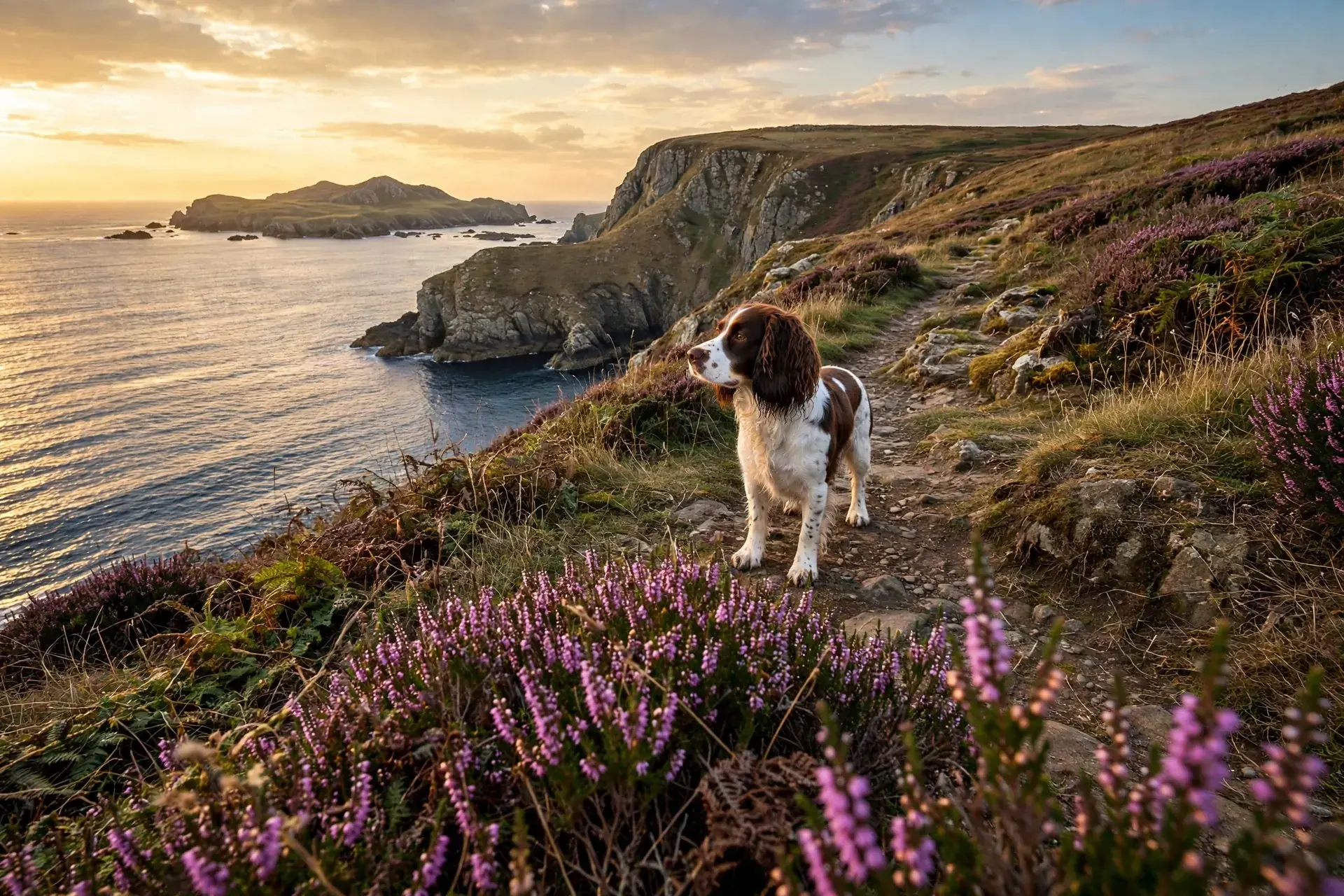
Think of the three directions as three different holidays sharing one bed. North is the wild coast: cliffs, the Pembrokeshire Coast Path, wide skies and the small city of St Davids. South is the holiday coast: sandy beaches, Tenby and Saundersfoot, harbour towns and family-friendly bays. East is the quiet coast of the imagination, or rather the quiet inland: the Cleddau valley, woodland, castle gardens and villages where the traffic thins and the lanes narrow. None of these is a long drive. Each is a round trip that leaves time for a proper walk, a stop for food, and an unhurried return.
This guide follows that shape. It starts in town, because the town is where you will spend your mornings and evenings, then it takes each direction in turn, with round-trip times, the kind of walk to expect, and the dog rules to check before you go. Beach rules, castle opening times and cafe policies change, so where a detail is uncertain the guide says so directly: check the official guidance before you travel, and treat the signs at the entrance as the final word on the day.
The town itself: river, bridges and old streets
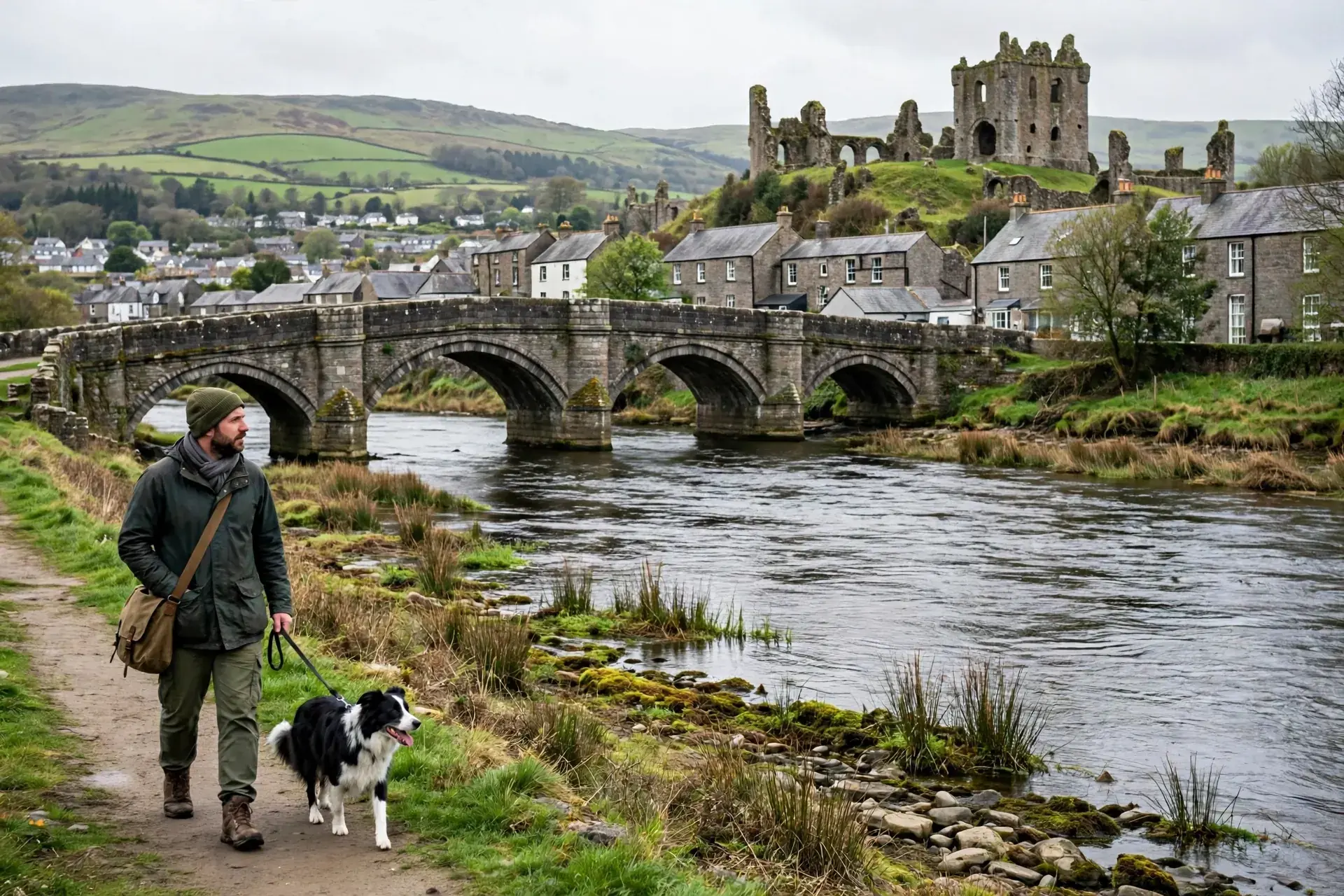
Haverfordwest grew up around a crossing of the Western Cleddau, and the river still sets the shape of the town. The old centre sits on the west bank, with the castle on its hill above the river, and the newer streets spreading out from the bridges. For a dog walk, that geography is a gift: the river gives you a level route through the middle of town, away from the busiest shopping streets, with water, birds and boats to watch.
Start at the Old Bridge, the stone bridge that has carried traffic across the Cleddau for centuries. It is narrow, handsome and worth a slow crossing on foot, with the castle above you on one side and the river below on the other. Keep your dog on a short lead here: the pavements are narrow, cyclists use the bridge, and the drop to the water is real. From the bridge, follow the riverside path downstream. The surface is generally level, the walking is easy, and the river is tidal this far inland, so the water level and the mud at the edges change through the day. At low tide you will see wading birds picking along the banks; at high tide the river fills out and the reflections of the town double in the water.
The riverside walk is also the best place to judge your dog before the bigger days out. Does your dog pull towards water, or is it happy to watch from the bank? Does it settle when other dogs pass on a narrow path, or does it need space? Is it comfortable with the sound of traffic on the bridge and the sight of boats? A short riverside loop answers all of those questions without committing you to a cliff path or a crowded beach. If your dog is unsettled, you can shorten the loop, cross back over the bridge, and try again in the evening when the town is quieter.
Behind the river, the old streets repay a slow wander. High Street and the streets around it hold a mix of independent shops, cafes and charity shops, with the market and the older buildings giving the town a working, lived-in feel rather than a polished tourist finish. That is part of the charm for a dog trip: nobody expects you to dress up, and a muddy dog after a coast walk does not look out of place. Keep to the pavements, keep the lead short, and use the quieter side streets if your dog finds busy pavements stressful. The town centre is compact enough that a loop from the river, up through the shopping streets and back down to the bridge makes a satisfying thirty to forty minute walk.
For a longer town walk, head along the river in the other direction, upstream towards the quieter stretches where the town thins out and the banks grow greener. The path here is less formal, so wear sensible shoes and watch for mud after rain. The reward is a calmer walk with fewer people, more birdsong, and space for a dog on a long line to sniff properly. Turn back at a sensible point rather than pushing on into unknown ground: the point of a town walk is to return to the car or the accommodation with a settled dog, not to discover a new route at dusk.
Evening is when Haverfordwest is at its best for dogs. The shops close, the traffic eases, and the riverside path becomes a local dog-walking route. You will meet other owners, swap notes on the day's walks, and learn which beaches were quiet and which car parks were full. That local knowledge is worth more than any guide, so take the time to ask. A five-minute conversation on the river path can save you an hour of driving to a beach that is closed to dogs that week.
Castle, priory and the old town walk
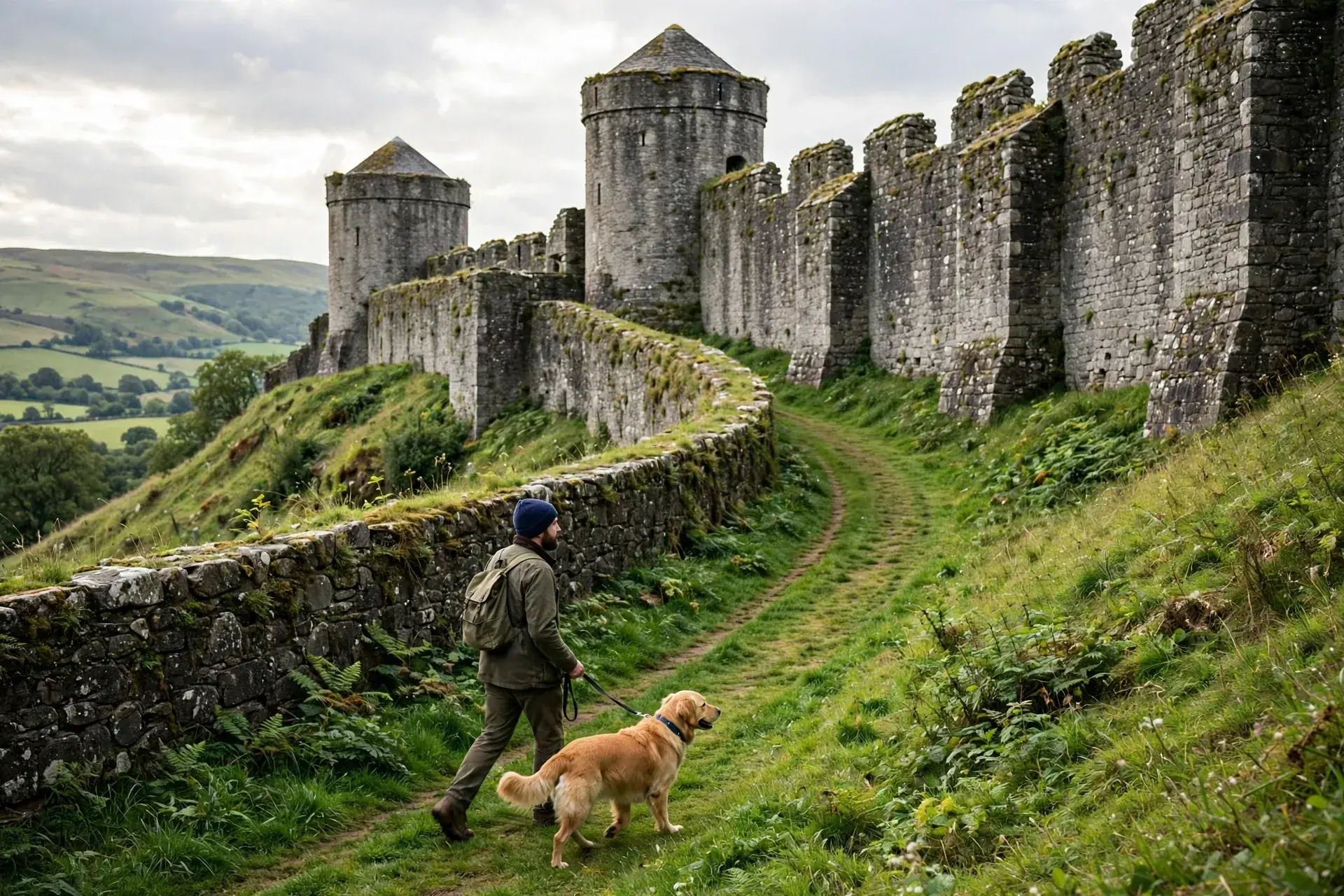
Haverfordwest Castle stands on a rocky outcrop above the river, and it dominates the town in the way that only a Norman castle can. The castle was founded in the twelfth century, rebuilt in stone, and held through centuries of Welsh and English conflict. Today it is a ruin, with walls, towers and a commanding view over the town and the river valley. For a dog owner, that is good news: the visit is an outdoor walk, not a tour of furnished rooms, and the pleasure is in the climb, the walls and the view.
The walk up to the castle is short but steep in places, with steps and uneven surfaces. It suits most dogs, but take care with very small dogs, older dogs and dogs that struggle with steps. A short lead is essential: the ground is open, the drops are real, and other visitors may be standing close to the edge to take photographs. Walk the perimeter slowly, let your dog sniff the walls and the grass, and then find a spot to sit and look over the town. From the castle you can see the river bending away, the bridges, the church towers and the green hills beyond the town. It is the best place in Haverfordwest to understand the base-camp idea: the whole county seems to spread out below you, and you can pick tomorrow's direction with your finger.
Check the official guidance before you travel for current opening times and dog rules at the castle, because the site has changed hands and uses over the years and indoor spaces may have different rules from the grounds. The castle has housed a museum and county archives in the past, and any indoor exhibition space should be treated as a separate question from the outdoor ruins. If an indoor area does not welcome dogs, plan to take turns with your travelling companions, or enjoy the grounds and save the indoor visit for a day when the dog can rest at your accommodation.
Below the castle, St Mary's Church stands in the centre of the old town, a large and handsome church with a tower that is another landmark of Haverfordwest. Churches in Wales generally ask that dogs stay outside, so admire the building from the churchyard and the street rather than taking your dog inside. The churchyard itself is a quiet, green space, but keep your dog on a lead, respect any signs, and remember that it is a place of worship and remembrance, not a dog exercise area.
A short walk from the centre, the remains of Haverfordwest Priory sit in a quieter spot by the river. The priory was an Augustinian house, and its ruins are more modest and more peaceful than the castle. The walk there is a good extension of the riverside route, and the site suits a calm dog that is happy to wander on a lead through grass and old stone. Again, check the official guidance before you travel for access and any seasonal restrictions, and keep your dog close to you among the ruins.
Put the three together — castle, church and priory — and you have a half-day old-town walk that needs no car at all. Start at the river, climb to the castle, come down through the old streets to St Mary's, and finish with the riverside path to the priory. The whole loop is a couple of hours at a dog's pace, with plenty of places to stop for water and a rest. It is also the walk to do on your arrival day, when the dog is tired from travelling and you want to learn the town without committing to a long drive.
North: cliffs, coast path and St Davids
North from Haverfordwest is the wild side of Pembrokeshire. The road runs towards St Davids, the smallest city in Britain, and to the coast at Newgale, Nolton Haven and Broad Haven. The round trip to St Davids and back is roughly an hour and a half of driving in total, plus the walking time, so this is a full day out rather than a quick trip. Plan for it as the big day of your stay, and keep the evening simple.
Newgale is the first proper beach on the north road, a long, straight sweep of sand and pebbles backed by a road and a car park. It is a good first stop for a dog that needs to stretch its legs after the drive, with space to run and a long beach to walk. The beach is exposed to the wind, and the surf can be strong, so keep your dog close to the shore and do not let it swim in rough conditions. Check the official guidance before you travel for current dog restrictions, because seasonal rules apply on many Pembrokeshire beaches and the signs at the car park are the final word.
From Newgale, the coast road continues to Nolton Haven and Broad Haven, two smaller bays with a more sheltered feel. Broad Haven is a family beach with a village, cafes and a car park close to the sand, while Nolton Haven is quieter and more rugged. Both make good short stops on the way to St Davids, and both reward a dog that likes to explore rock pools at low tide. Watch the tide times: the coast here has a large tidal range, and a beach that looks generous at low water can narrow quickly as the tide comes in. Check tide times before you set off, and never let your dog cut off by the tide around a headland.
St Davids itself is a small, walkable city with a cathedral, a ruined bishop's palace, and a main street of cafes, galleries and outdoor shops. Our guide to St Davids with a dog covers the cathedral and palace dog rules, Whitesands Bay and the St Davids Head walk in detail, so use that guide for the fine print and treat this section as the overview. In brief: the cathedral welcomes well-behaved dogs on leads in many areas, but check the official guidance before you travel, because rules for historic buildings can change; the palace ruins are an outdoor visit that suits a dog on a lead; and Whitesands Bay, a couple of miles from the city, is one of the finest beaches in Wales, with dunes, surf and a long walk at low tide.
The walk from Whitesands Bay to St Davids Head is the classic north-coast walk, and it is a serious one for a dog. The path climbs over headland, crosses heather and gorse, and runs close to cliff edges in places. It is exposed to wind, and there is little shade on a hot day. Take water for the dog as well as for yourself, keep the dog on a lead near the cliffs, and watch for adders in warm weather on heathland and coast path. The reward is a wide view across to Ramsey Island, where seals and seabirds gather, and a sense of space that is hard to find anywhere else in Britain. If your dog is not comfortable with heights or long exposed walks, enjoy Whitesands Bay itself and leave the headland for another trip.
On the way back to Haverfordwest, consider a stop at Solva, a pretty harbour village tucked into a narrow valley on the coast. The harbour, the boats and the village street make a gentle end to a big day, and the walk along the harbour wall is short and easy. Keep your dog on a lead near the water and the boats, and watch for fishing gear and ropes on the ground. Solva is also a good place for a late lunch or an early dinner before the drive back, with cafes and pubs that often welcome dogs outside, and sometimes inside — ask before you sit down, and check the official guidance before you travel if a particular place matters to you.
South: beaches, Tenby and Saundersfoot
South from Haverfordwest is the holiday coast, and the round trip to Tenby and back is roughly an hour and a half of driving in total, plus walking time. The road runs through Narberth and on to the south coast, where the beaches are sandy, the towns are colourful, and the pace is gentler than the north. This is the day for a dog that loves sand, swimming and a long beach walk, and for owners who want a town to wander in after the beach.
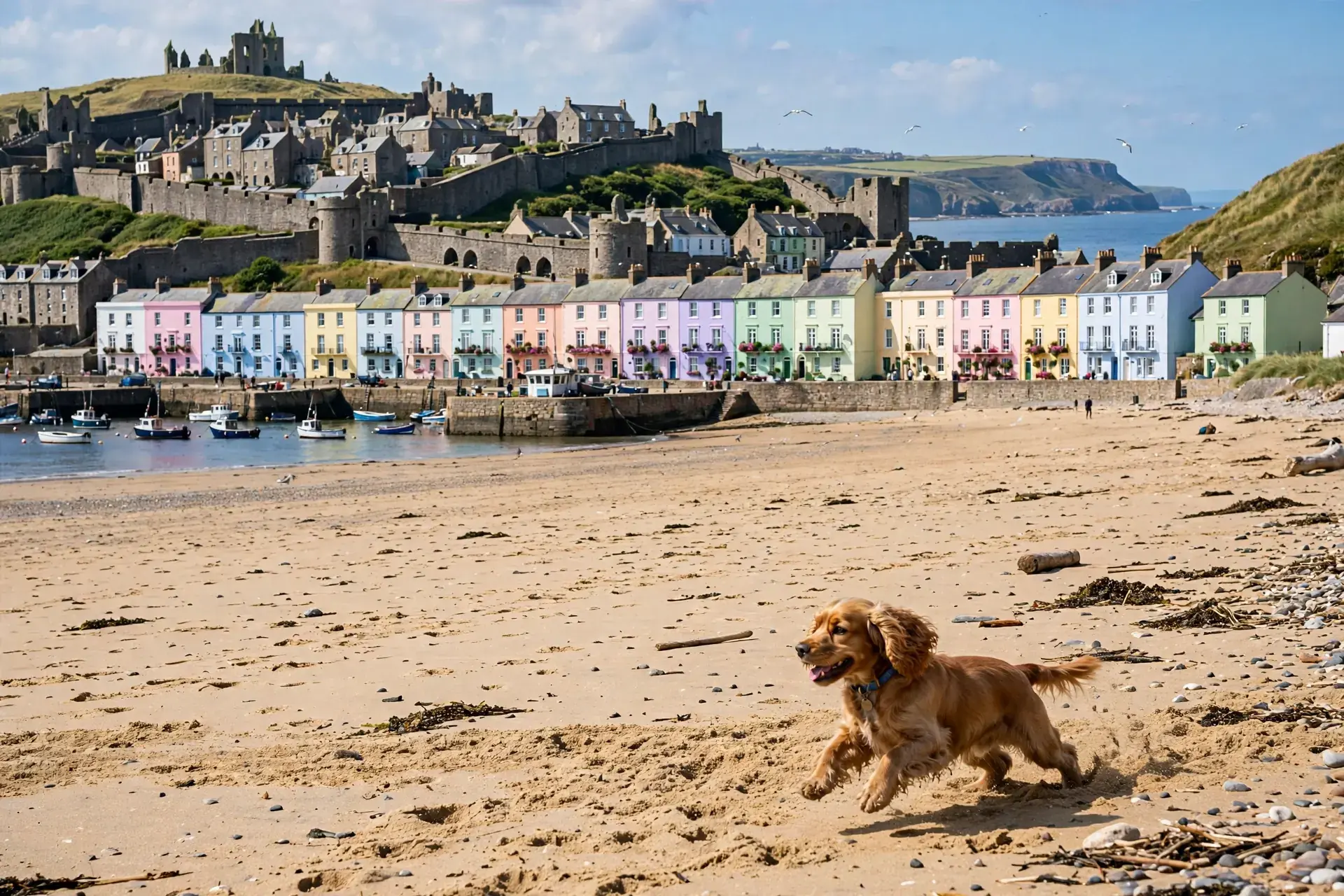
Tenby is the star of the south coast: a walled town on a headland, with pastel houses, a harbour, and four beaches within walking distance. Our guide to Tenby with a dog covers the beaches one by one, including the summer restrictions that apply to North Beach, South Beach, Castle Beach and Harbour Beach, so use that guide for the detail and treat this section as the plan. In brief: check the official guidance before you travel, because the seasonal dog bans on the main beaches are real and enforced, and the dates matter; outside the restricted season, the beaches are generous and the walks are long; and the coast path around the town gives a good walk even when the beaches are restricted.
The walk to take in Tenby is the town loop: start at the harbour, walk along the front to South Beach, climb the town walls, and come back through the old streets. The harbour is busy with boats and visitors, so keep your dog on a short lead and watch for dropped food and fishing gear. The walls give a view over the town and the sea, and the old streets are narrow and full of interest, with cafes, shops and pubs that often welcome dogs. Tenby is a place to take your time: sit outside a cafe, let the dog settle under the table, and watch the town go by.
Saundersfoot, a few miles from Tenby, is a smaller and quieter harbour village with a long beach, a harbour and a village street of cafes and shops. The beach at Saundersfoot is wide and sandy at low tide, and the walk along the beach towards Coppet Hall is a good one for a dog that likes a long, straight run. The village itself is friendly and low-key, with a harbour wall to walk and boats to watch. Check the official guidance before you travel for current dog rules on the beach, and keep your dog on a lead in the harbour area.
Between Haverfordwest and Tenby, Amroth is worth a stop on the way south. Amroth is a long, straight beach at the eastern end of the south coast, backed by a road and a car park, with views across Carmarthen Bay. It is quieter than Tenby, and the beach walk is long and easy. The village has a few cafes and pubs, and the pace is slow. Amroth makes a good first stop on the south day, especially if you want to give the dog a beach walk before the busier town.
The south day needs a little more planning than the north day, because the beaches are more likely to have seasonal restrictions and the towns are busier in summer. Go early if you can, park in the main car park rather than hunting for a street space, and have a backup beach in mind in case your first choice is restricted or crowded. A dog that can settle in a cafe is a great asset on the south coast, because the towns reward a slow lunch after a morning on the sand. Bring a blanket for the dog to lie on, water for the table, and a chew to keep it occupied while you eat.
East: river valley, woods and quiet villages
East from Haverfordwest is the quiet direction, and it is the one most visitors miss. The road runs along the Cleddau valley towards Narberth, with woodland, farmland and small villages, and the walking is gentler than the coast. The round trip to Narberth and back is roughly an hour of driving in total, plus walking time, so this is a half-day out that leaves the afternoon free for the town. It is also the best direction for a hot day, a wet day, or a day when the dog needs a rest from cliffs and sand.
The Cleddau valley is a landscape of river, woods and fields, with the Eastern and Western Cleddau joining near Haverfordwest. The valley walks are level or gently sloping, with shade from trees and plenty of water for a dog to drink and paddle in. Canaston Wood, east of the town, is a large area of woodland with paths through the trees, and it suits a dog that likes to sniff and explore rather than run in the open. Keep your dog on a lead in woodland during the bird nesting season, watch for ticks after a woodland walk, and check the official guidance before you travel for current access and any forestry work that may close paths.
Picton Castle, a few miles east of Haverfordwest, is a good stop on the valley day. The castle is a lived-in historic house with gardens, woodland walks and a walled garden, and the grounds are the part that matters for a dog owner. The gardens are formal in places and wilder in others, with paths through trees and along the valley. Dogs on leads are generally welcome in the gardens and grounds, but the house itself may have different rules, so check the official guidance before you travel. The visit is a gentle one: a walk through the gardens, a sit on a bench, and a look at the castle from the outside. It is a good choice for an older dog or a dog that prefers a calm walk to a cliff path.
Narberth, further east, is a small market town with a castle ruin, a main street of independent shops and cafes, and a friendly, unhurried feel. The town is compact enough to walk in an hour, with a short climb to the castle and a view over the surrounding countryside. Narberth is a good lunch stop on the valley day, with cafes that often welcome dogs, and it is also a useful place to buy supplies if you are staying in a self-catering cottage. The town's castle is a ruin on a mound, with a short walk up and a view; keep your dog on a lead and take care on the steps.
Llawhaden Castle, north-east of Narberth, is another quiet ruin worth a detour if you like castles and your dog likes a short walk. The castle stands above the Cleddau valley, with walls, towers and a view over the river. It is a smaller and quieter site than Haverfordwest Castle, and the walk there is short and easy. For more on castle visits with a dog across Wales, see our guide to dog-friendly castles in Wales, which explains how castle zones differ and where leads are required. Check the official guidance before you travel for current access and dog rules at each castle, because the rules are set site by site.
The valley day is also the day to slow down. Walk the river, sit in a garden, have a long lunch in Narberth, and be back in Haverfordwest in time for the evening riverside loop. A dog that has had two big coast days will appreciate a quieter third day, and an owner who has driven to the coast twice will appreciate a shorter drive. The valley is not a consolation prize; it is a different kind of pleasure, and for many dogs it is the day they enjoy most.
A three-day base-camp plan
Three days is enough to use all three directions without rushing, and the plan below is a starting point rather than a fixed itinerary. Adjust it to your dog, the weather and the season, and swap the days around if the forecast favours one coast over the other. The principle stays the same: one big walk a day, a calm town walk morning and evening, and nothing that leaves the dog exhausted for the next day.
Day one is arrival and town. Arrive, settle into your accommodation, and take the old-town loop: river, castle, old streets, priory. This is the day to learn the town, find the supermarket, locate the vet, and let the dog learn the evening walk. Keep the walking short, feed at the usual time, and let the dog sleep. A good first day sets up the whole trip, and a tired dog that has had too much on day one is a dog that will struggle on day two.
Day two is north to the cliffs and St Davids. Leave early, stop at Newgale for a beach walk, continue to St Davids for the cathedral and the town, and finish at Whitesands Bay for a long beach walk or a short headland walk, depending on the dog. Stop at Solva on the way back if you have time and energy. This is the longest day, so pack water, food and a towel, and plan for a quiet evening in town.
Day three is south to the beaches and Tenby. Leave in the morning, stop at Amroth for a beach walk, continue to Tenby for the town loop and a beach walk outside the restricted season, and finish at Saundersfoot for a harbour walk and a late lunch. Check the official guidance before you travel for beach restrictions, and have a backup beach ready. This is the day for sand, swimming and a long lunch, and it is the day most dogs remember best.
If you have a fourth day, spend it east in the valley. Walk Canaston Wood, visit Picton Castle gardens, have lunch in Narberth, and be back in Haverfordwest for a final evening on the river. A fourth day also gives you a spare day to repeat your favourite coast walk, or to do nothing at all except the town loop and a long sit by the river. That is a legitimate use of a holiday, and many dogs would choose it over another long drive.
For a longer stay, the same pattern repeats. Pick a different beach each time, a different section of the coast path, a different village for lunch. The base camp stays the same, the dog's routine stays the same, and the days stay different. That is the whole point of Haverfordwest: it is not the destination, it is the place that lets you reach all the destinations without moving house every night.
Where to stay with a dog
Haverfordwest has a useful range of dog-friendly places to stay, from hotels and bed and breakfasts in town to self-catering cottages and holiday parks in the surrounding countryside. The town options suit a base-camp trip best, because you can walk to the river, the shops and the restaurants, and you do not need to drive for the evening walk. Countryside cottages suit a quieter trip, with a garden for the dog and a shorter drive to the coast in one direction, but a longer drive in the other. Choose the location that matches the direction you will use most.
When you book, ask the specific questions that matter for your dog, not just whether dogs are accepted. Ask how many dogs are allowed, whether there is a pet fee and how much it is, whether the dog can be left alone in the room or cottage, and whether there is a garden or an enclosed area. Ask about stairs, because a town hotel may have narrow stairs and no lift, and a cottage may have steep stairs that an older dog cannot manage. Ask where the nearest practical toilet walk is after dark, and whether the dog is welcome in the breakfast room or only outside. Get the answers in writing with your booking confirmation.
For a longer stay or a stay with more than one dog, a self-catering cottage or a holiday park may work better than a hotel. A cottage gives you a kitchen, a garden and space to spread out, and a park gives you grounds to walk in without leaving the site. Our guide to dog-friendly holiday parks in Wales covers coast access, livestock rules, secure boundaries and booking checks for parks across Wales, and the same questions apply to a park near Haverfordwest. Check the boundary of any garden or park before you let your dog off the lead, and do not assume that a fence is secure until you have walked it yourself.
Pack for the accommodation as well as for the walks. Bring the dog's own bed or blanket, so the sleeping place smells familiar even though the room is new. Bring a towel for the door, a drying coat for wet days, and a lidded box for muddy leads. If your dog uses a crate, bring it and set it up exactly as at home. If your dog is a chewer, bring a chew and check the room for cables and cleaning products before you let the dog explore. Photograph any existing damage when you arrive, and report it to the host so you are not blamed for it later.
Finally, think about the first night. Dogs often sleep badly on the first night in a new place, and a dog that is overtired from a long journey and a long walk will sleep worse, not better. Keep the first day short, keep the feeding and walking times close to home, and give the dog time to settle. A calm first night is worth more than an extra beach on the first day.
Eating out and dog-friendly stops
Haverfordwest has cafes, pubs and restaurants in the town centre, and the coast towns have more, but dog rules vary from place to place and from season to season. The safest approach is to assume that dogs are welcome outside and to ask before you take a dog inside. Many cafes and pubs in Pembrokeshire welcome dogs in the bar area or in a specific dog-friendly section, and some welcome dogs throughout, but the only way to be sure is to ask at the door and to check the official guidance before you travel if a particular place matters to you.
A dog that can settle under a table is a great asset on a trip like this. Train the settle before you travel, if you can, by practising in cafes at home. Bring a blanket for the dog to lie on, a chew to keep it occupied, and water in a bowl you can put on the floor. Choose a table at the edge of the room, away from the main walkway, and keep the lead short so the dog cannot wander to other tables. If the dog cannot settle, do not force it: take the food away, eat outside, or cut the meal short. A short, calm meal is better than a long, stressful one.
On the coast, the best dog-friendly stops are often the simplest: a cafe with outdoor tables near the beach, a pub with a garden, a harbour-side kiosk with a bench. In St Davids and Tenby, the main streets have cafes with outdoor seating in good weather, and the harbour areas have benches where you can eat a takeaway with the dog beside you. In Saundersfoot and Solva, the harbour and the village street give you places to sit and watch the boats. Bring your own water and bowl, because not every cafe provides one, and carry poo bags so you can clean up quickly.
For supplies, Haverfordwest has supermarkets where you can buy dog food, treats and any forgotten items. Buy the dog's usual food if you can, rather than switching brands mid-trip, because a change of diet plus travel plus new water can upset a stomach. If you are staying in a self-catering cottage, buy the dog's food and your own food in one shop on arrival day, and keep a spare tin or a spare bag in the car for the coast days. A hungry dog on a long walk is a miserable companion, and a dog that has eaten well is a dog that will settle in the evening.
Practical details: parking, vets and seasons
Parking in Haverfordwest is straightforward compared with the coast towns. There are town-centre car parks, on-street parking in places, and car parks near the river. Learn one car park on your first day and use it for the whole stay, so the dog learns the route from the car to the river and back. On the coast, parking is the main constraint: the car parks at Newgale, Whitesands Bay, Tenby and Saundersfoot fill early on sunny days and in school holidays, so arrive early or have a backup beach in mind. Never leave a dog in a hot car, even for a few minutes, and never leave a dog in a car in direct sun. If you need to leave the dog in the car while you pop into a shop, keep it short, keep the car shaded and ventilated, and check on the dog often.
Before you travel, save the number of a veterinary practice in Haverfordwest and the number of an emergency vet, and keep them in your phone. Rural practices can be a drive away, and opening hours vary, so do not assume that the nearest practice is open when you need it. Carry a first-aid kit for the dog, with tick removers, antiseptic, bandages and any regular medication, and know the signs of heatstroke, adder bites and salt-water drinking. If your dog swims in the sea, offer fresh water afterwards and watch for vomiting or diarrhoea, which can follow drinking sea water. If your dog is bitten or stung, or shows signs of distress, contact a vet promptly rather than waiting to see if it passes.
Seasons change the trip in Haverfordwest as much as anywhere in Pembrokeshire. Spring brings lambs in the fields and nesting birds on the cliffs, so keep your dog on a lead near livestock and on the coast path, and watch for ground-nesting birds. Summer brings the beach restrictions, the crowds and the heat: walk early or late, carry water, and never let a dog run on hot sand or tarmac at midday. Autumn brings quieter beaches, falling leaves and the end of the restrictions on many beaches, and it is often the best season for a dog trip. Winter brings short days, wet paths and cold winds, but also empty beaches and a town that feels local rather than touristy. Dress for the season, and check the official guidance before you travel for beach rules and path closures in the month you are visiting.
Three safety notes deserve repeating. First, cliffs: keep your dog on a lead near cliff edges, and never let a dog chase birds or rabbits towards a drop. Second, livestock: keep your dog on a lead near sheep and cattle, and be ready to shorten the lead if livestock are close to the path. Third, tides: check tide times before any beach walk, and never let your dog go around a headland that the tide may cut off. These are not new rules, but they are the rules that matter most on the Pembrokeshire coast, and they are worth following every day.
Finally, leave the town and the coast as you found them. Pick up after your dog, every time, including on beaches and in woodland. Use the bins provided, or take the bag with you if there is no bin. Keep your dog under control around other walkers, children and other dogs, and ask before you let your dog approach another dog. A base-camp trip works because the town and the coast welcome dogs, and that welcome depends on owners behaving well. A clean beach, a quiet cafe and a calm riverside walk are the rewards for doing the simple things right.
Practical questions
Before you go
Can I use Haverfordwest as a base for Pembrokeshire coast walks with a dog?
Yes. Haverfordwest sits inland from the Pembrokeshire Coast Path, with St Davids and the north coast in one direction and Tenby and the south coast in the other. It works best as a base camp: stay in town, drive out for one coast walk each day, and return for a short riverside walk in the evening. Check road conditions and parking before you travel, especially in summer.
Are dogs allowed on beaches near Haverfordwest?
It depends on the beach and the season. Many Pembrokeshire beaches have seasonal dog restrictions in the summer months, while others welcome dogs all year. Rules can change, and signs at the beach entrance are the final word. Check the official guidance before you travel, and always keep your dog on a lead near cliffs, livestock and other beach users.
Is Haverfordwest Castle dog-friendly?
The castle grounds are a public open space where dogs on leads are generally welcome, but indoor museum areas and any ticketed spaces may have different rules. The castle is a ruin, so the main visit is an outdoor walk around the walls and the views over the river, rather than a tour of furnished rooms. Check the official guidance before you travel for current opening times and dog rules.
Where can I walk my dog in Haverfordwest town itself?
The riverside paths along the Western Cleddau are the easiest in-town walk, with level ground and plenty of sniffing spots. The walk up to the castle gives a short climb and a view over the town, and the quieter streets behind the main shopping streets suit a calm evening loop. Keep your dog on a lead in town, near roads and in the castle grounds.
How long does it take to drive from Haverfordwest to St Davids or Tenby?
Both are roughly a 30 to 45 minute drive in normal traffic, depending on your exact starting point, the route and the season. St Davids lies to the north-west and Tenby to the south-east, so they make natural day trips in opposite directions. Allow extra time in summer, when coast roads and car parks are much busier, and check the official guidance before you travel.
What should I pack for a dog trip based in Haverfordwest?
Pack a lead and a long line, a towel and a drying coat for wet coastal walks, drinking water and a bowl for the car, poo bags, a torch for evening riverside walks, and a blanket so your dog can settle in cafes and holiday accommodation. Pembrokeshire weather changes quickly, so a waterproof coat for the dog is useful in every season, and a first-aid kit with tick removers is worth carrying on coast and woodland walks.