This guide is independent and contains no paid placement. If affiliate links are added later, they will be clearly marked and will not change our editorial checks.
Hawick rewards a slow, river-led visit. Start in the town centre among the old mill buildings, follow the Teviot through Wilton Lodge Park on a short riverside circuit, then choose between a gentle town loop and a longer climb into the surrounding hills. Keep your dog on a lead by the river and in town, check water levels after rain, and plan cafes and parking before the busy summer weekends.
Reading Hawick through its mills and bridges
Hawick is the largest town in the Scottish Borders, and it does not look or feel like a polished tourist town. It feels like a working town, and that is the point. For more than two centuries its wealth came from wool: spinning, weaving and above all knitwear, including the fine cashmere and lambswool garments that still carry the town's name around the world. The River Teviot runs through the middle of that story. It powered the mills, carried away waste, set the shape of the streets, and still gives the town its best walking. If you arrive with a dog and try to treat Hawick as a checklist of sights, you will miss it. Walk it as a mill town instead, and the place starts to make sense.
Start at the confluence, where the Slitrig Water joins the Teviot near the town centre. Two rivers meeting in the middle of a town is not a small detail: it explains why Hawick grew here, why the streets bend the way they do, and why so many of the town's bridges matter. Stand on one of the town bridges with your dog on a short lead and look in both directions. Upstream the Teviot comes down from the hills to the south-west; downstream it runs on towards the Tweed, which it joins near Kelso. The water is usually clear and quick over stone, and after rain it turns brown and fast. That change matters for every walk in this guide, so learn to read it on your first morning: clear and low means the riverside paths will be easy; brown and high means you should stay back from the bank and pick a higher route.
The mill buildings are the town's real landmarks. Many of the old mills stand along the Teviot and the Slitrig, in stone, several storeys high, with tall windows made for working by daylight. Some still work with textiles in one form or another; others have been converted to shops, offices, studios and visitor spaces. You cannot wander through a working mill with a dog, and you should not try, but you can read the town from the outside, which is where the dog-friendly part happens. Walk the streets that run between the mill buildings and the river, look for the mill chimneys, the loading doors, the weirs and the old lades that once carried water to the wheels, and you will see a town that was built around making things rather than showing them off. The Borders Textile Towerhouse, in a converted mill building, tells the story of the industry and the town's famous knitwear; dogs are not generally taken inside museums, so treat it as a stop for the humans in your party while one person waits outside with the dog, and check the official guidance before you travel for current opening times and any change in policy.
Drumlanrig's Tower, a tower house in the town centre, is another piece of the older Hawick, from before the mills dominated everything. It stands as a reminder that this was a border town long before it was a textile town, in a part of Scotland where towers, raids and riding traditions shaped daily life. The tower is not a dog walk in itself, but it anchors a short town-centre loop: tower, High Street, river bridge, and back along the water. That loop, about a mile if you keep it tight, is the best first walk for a dog that has just come out of the car. It gives the dog a chance to sniff, toilet and settle, and it gives you a first sense of the town's scale, noise and traffic before you commit to anything longer.
Bridges are the practical key to Hawick. The town is split by its rivers, so a walk that looks short on a map can become long if the next bridge is further away than you expected. Before you set off on a riverside route, work out where you will cross, and where you will cross back. The main town bridges carry traffic, so keep your dog on a short lead, on the inside of the pavement, away from the road edge. Smaller footbridges are quieter and better for dogs, but they can be narrow, and a nervous dog may not like meeting another dog head-on in the middle of one. If that happens, step back to the bank, let the other party cross first, and cross in your own time. There is no prize for rushing a bridge.
Three habits make the mill-town walk work. First, keep the dog on a lead in the built-up streets and by the river, even if your dog is well behaved; traffic, cyclists, anglers and other dogs appear without warning around mill corners and bridge ends. Second, carry water and a bowl from the start, because the riverside paths do not always have an easy, safe place for a dog to drink, and river water after rain is not a good substitute. Third, allow more time than the distance suggests. Hawick is a town for stopping: to look at a weir, to read a plaque, to watch the river, to let the dog sniff a wall that has probably been sniffed by a hundred dogs before. A two-mile walk that takes an hour is not a slow walk here; it is the right pace.
Common Riding, traditions and dogs
No guide to Hawick makes sense without the Common Riding. It is the town's great annual festival, held in early summer, and it is also the clearest expression of what Hawick thinks it is. The riding marks the town's common land and its history, with a principal rider, the Cornet, leading hundreds of riders out to the boundaries of the town, accompanied by flags, bands, songs and crowds. The main day is a spectacle of horses, colour and noise, and it draws visitors from across the Borders and far beyond. For a dog owner, that is both a reason to visit and a reason to plan carefully.
On the main riding day, and through the festival week, the town centre is crowded, loud and full of horses. That combination is stressful for most dogs and unsafe for some. Horses and dogs do not mix well at close quarters on busy streets, and a frightened dog on a lead in a crowd can bolt, snap or slip its collar. The honest advice is to leave the dog out of the densest crowds and the horse routes on the main day. Watch the riding from a quieter spot well back from the route if you want to see it, or enjoy the music, the markets and the atmosphere in the town when the horses have passed and the streets have calmed. If your dog is noise-sensitive, reactive or very young, the kindest choice is to walk them early in the morning, before the crowds build, and to keep the rest of the day to quiet riverside paths away from the centre. Check the official guidance before you travel for the current year's dates, road closures and timings, because they change and the festival week reshapes the whole town.
Outside the festival, the Common Riding leaves its mark everywhere, and that is the part dogs can enjoy all year. Look for the Cornet's flag, the memorials to riders, the street names and the songs that still get sung in the town's pubs. Hawick people are proud of the riding in a way that is easy to respect once you understand that it is not a show put on for visitors; it is the town remembering itself. A dog walk that passes the common land, the riding routes and the memorials is a walk through living history, not a museum trail. Keep the dog on a lead on the common and on the riding routes, where horses may be exercising at other times of year, and give any horse you meet a wide berth, moving to the far side of the path and keeping the dog still and quiet until the horse has passed.
The town's other traditions are quieter but just as real. Hawick has a strong rugby culture, a brass-band tradition, and a habit of turning out for local events that visitors are welcome to watch from the edges. Dogs are part of that everyday life: you will see them on the High Street, in the park, on the riverside paths and waiting patiently outside shops. That does not mean every shop or cafe welcomes them inside, but it does mean that a well-behaved dog on a lead is an ordinary sight here rather than an exception. The social rule is simple and worth following: keep the lead short in town, pick up after your dog every time, and do not let the dog approach other dogs, children or horses without an invitation. Hawick rewards polite dogs and their owners with an easy welcome; it has little patience for dogs that are allowed to run up to strangers.
If you visit during the festival week, book accommodation and parking early, expect road closures, and plan your dog's walks for the early morning and the late evening, when the town is quieter and the light is better for the riverside paths. If you visit at any other time, you will find a calmer town where the Common Riding is present in stone and song rather than in crowds, and where a dog can walk the same ground the riders cover without any of the pressure. Either way, the riding is the key to understanding why Hawick feels different from the other Borders towns: it is a town that rides out to its own boundaries every year and comes home again, and that sense of home ground runs through everything else in this guide.
The Teviot riverside circuit
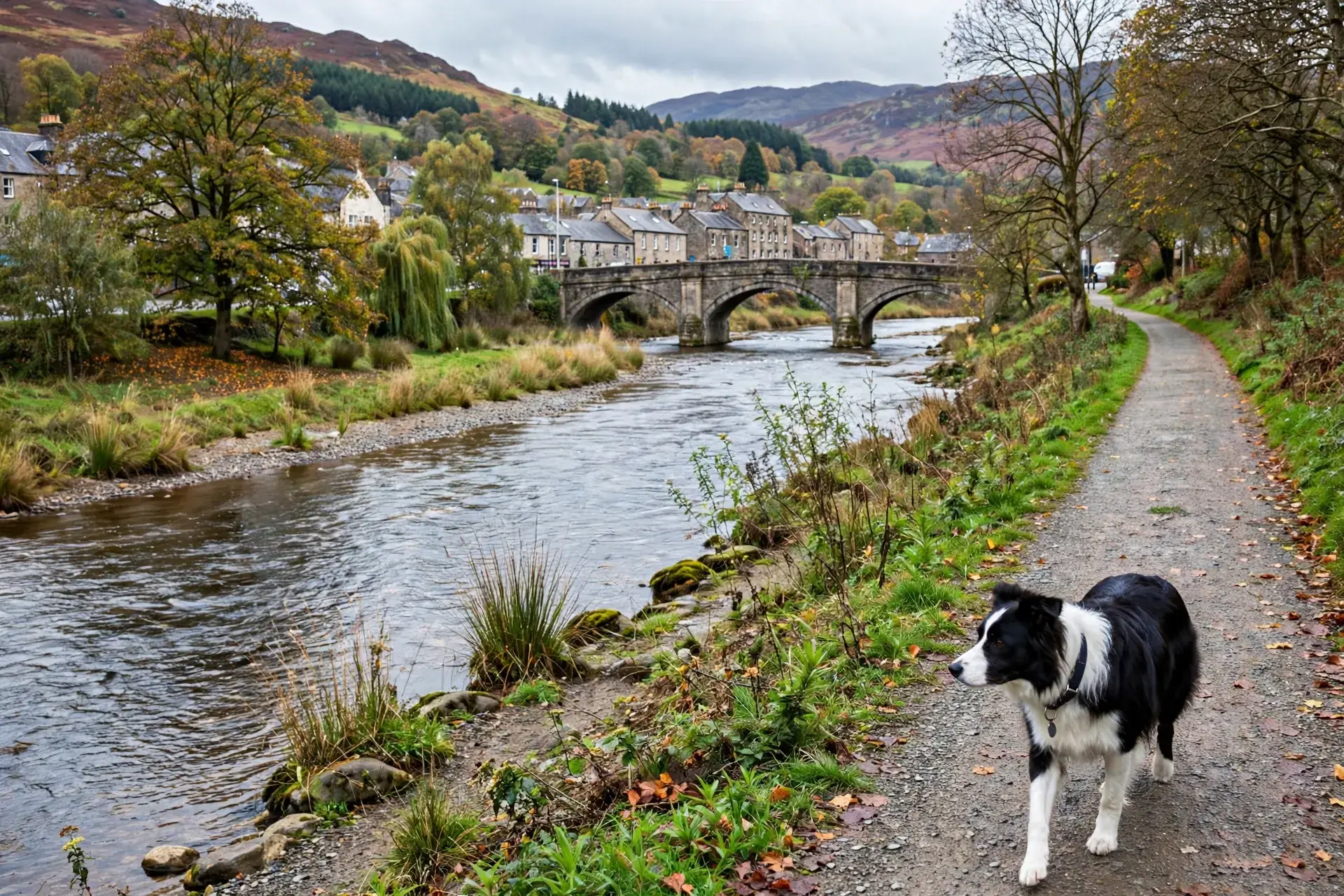
The river is the spine of this guide, and the riverside circuit is the walk to do first. It is not a single marked trail with a single distance; it is a flexible loop built from the paths on both banks of the Teviot, the footbridges that join them, and the green space of Wilton Lodge Park. The core loop, from the town centre through the park and back along the opposite bank, is roughly two to three miles depending on where you cross, and it takes most people between one and one and a half hours at a dog's pace, with stops. That is the honest figure: if you walk it in forty minutes, you have probably hurried past the best of it.
Wilton Lodge Park is the green heart of the walk. It sits beside the Teviot on the western side of the town, with lawns, mature trees, paths, a museum and gardens, and it is the place where Hawick comes to walk its dogs, push prams and sit by the water. The park paths are surfaced and mostly level, which makes them good for older dogs, puppies and owners who want a gentle start. Keep your dog on a lead in the park, particularly near the museum, the gardens and the children's areas, and pick up after your dog without exception. The park is also where you will meet most of the town's other dogs, so it is a good place to practise calm greetings and to learn what your dog does when another dog appears around a bend in the path. If your dog is reactive, walk the park early in the morning, when it is quieter, and use the wider paths where you can see ahead and step aside in good time.
From the park, the riverside path follows the Teviot upstream and downstream in both directions, and the choice of direction is the choice of walk. Downstream, towards the east, the path stays close to the town and the river, with bridges, weirs and mill buildings to look at; it is the more urban half of the circuit, good for a short walk and for dogs that like company. Upstream, towards the south-west, the path gradually leaves the town behind and the river feels wilder, with trees overhanging the water, quieter banks and fewer people; it is the better half for a dog that needs space and sniffing time. Either way, keep the dog on a lead on the narrow stretches, because the bank can be steep, the path can be close to the water, and a dog that jumps in after a duck or a stick can be in trouble quickly in a fast river. Do not let your dog swim in the Teviot unless you know the spot, the depth, the current and the exit point, and never let a dog swim below a weir or near a bridge pier.
The circuit works best as a loop rather than an out-and-back. Walk out on one bank and come back on the other, crossing by a footbridge or a town bridge at each end. That way the dog gets new smells in both directions, and you get two different views of the same river. Before you set off, check the map and agree on the crossing points, because the distance between bridges is what sets the length of the walk. A loop that uses the nearest bridges is short and easy; a loop that uses bridges further out is longer and quieter. Both are worth doing, on different days or at different times of day, and the town-centre bridges mean you can shorten the walk at almost any point by crossing back early if the dog tires or the weather turns.
Anglers use the Teviot, and the river has fishing rules that dog owners need to respect. Salmon and trout fishing is a serious local activity, and anglers have rights on particular stretches at particular times of year. Keep your dog away from anglers, their lines and their gear, do not let the dog splash or swim through a fished pool, and keep the lead short when you pass someone who is casting. The same courtesy applies to other river users: kayakers and canoeists appear on the Teviot when conditions suit, and a dog running loose on the bank can startle them at exactly the wrong moment. A short lead and a little attention solve all of this before it becomes a problem.
After rain, the riverside paths change. The Teviot rises quickly when rain falls on the hills above Hawick, and paths that were dry in the morning can be wet, muddy or partly flooded by the afternoon. Low-lying stretches near the river can hold standing water, and the bank can be slippery where grass meets mud. Wear shoes with grip, carry a towel for the dog, and be ready to turn back or to switch to the higher park paths if the river is up. The rule for this river is simple: if the water is brown, fast and close to the top of the bank, stay back, keep the dog on a lead, and do not try to cross a flooded path. There will be another day for the full circuit, and the park and the higher streets will still be there.
For a first visit, try this shape. Park in the town centre, walk down to the river, cross to Wilton Lodge Park, follow the riverside path upstream for about a mile, cross back by the next bridge, and return along the opposite bank to the town centre. That gives you a loop of roughly two and a half miles, with the park, the river, the bridges and the mill buildings all in one walk, and it leaves you in the town centre at the end, ready for a cafe. For a shorter version, stay in the park and the nearest riverside stretch, which gives you about a mile of easy, level walking. For a longer version, extend the upstream leg further before you cross back, adding another mile or two of quieter riverside path. All three versions use the same skills: a short lead, attention to the river level, and a willingness to turn back early if the dog or the weather says so.
Town centre streets with a dog
Hawick's town centre is built for walking, but it is a working town centre rather than a pedestrianised shopping centre, so it needs a dog owner's attention. The High Street runs through the middle of the town, with shops, cafes, banks and services on both sides, and traffic moves through it for much of the day. The pavements are generally wide enough for a dog on a short lead, but they narrow at corners, at shop doorways and at bus stops, and that is where most of the friction happens. Keep the dog on the inside, away from the road, and keep the lead short enough that the dog cannot step into the road or trip a passer-by. If your dog is nervous about traffic, walk the quieter side streets and the riverside paths instead, and use the High Street only for the specific shops you need.
A good town-centre loop starts at the High Street, drops down to the river, follows the water for a short stretch, and comes back up through a side street. That pattern — street, river, street — is the Hawick pattern, and it works because the river is never far away. The loop is about a mile, it is mostly level, and it gives the dog a mix of town smells and river air. It also gives you a practical way to do the errands that a dog trip always involves: a cash machine, a supermarket, a pharmacy, a pet shop if you need supplies, and a cafe for a break. Do the errands in one pass, keep the dog moving, and do not leave the dog tied up outside a shop for longer than a few minutes. A dog left alone on a busy High Street is a target for theft and a worry for the dog, and most shops will be happier if you ask whether the dog can come in with you rather than leaving it outside.
Shops in Hawick vary in their dog policy, and the only reliable way to know is to ask. Some independent shops welcome a well-behaved dog on a lead; larger stores and food shops generally do not allow dogs inside, except for assistance dogs. The polite approach is to look for a sign, ask at the door, and accept the answer without argument. If the dog cannot come in, one person waits outside with the dog while the other shops, or you shop in a quick, planned way and come back to the dog. What you should not do is bring a dog into a food shop or a crowded store and hope nobody notices; that is how dogs get a bad name in a town that is otherwise welcoming to them.
Street furniture matters more than visitors expect. Hawick has the usual town hazards for dogs: litter, dropped food, chewing gum on pavements, and glass near bins and takeaways. Watch the ground on the High Street, particularly after market days and at weekends, and teach the dog a reliable leave-it for dropped food. In winter, pavements and roads may be gritted, and salt on paws is uncomfortable; wipe the dog's paws after a town walk in cold weather, and check between the toes for grit and ice. In summer, pavements in direct sun can be hot enough to burn paws, so test the surface with the back of your hand before a long town walk at midday, and use the shaded riverside paths instead when the sun is strong.
The town centre is also where Hawick's history is easiest to read at street level. Look for the plaques, the old shopfronts, the market cross area, the war memorial and the buildings that still carry the names of long-gone mills and businesses. A slow walk with a dog is the right speed for this kind of looking, because the dog sets a pace that lets you notice details you would miss from a car. Keep the dog's needs first — water, shade, a toilet stop, a chance to sniff — and the history will take care of itself. A dog that is comfortable and settled makes a better walking companion than a dog that is being dragged past interesting buildings, and the town will still be there for a second look.
Market days and Saturdays bring more people, more noise and more dogs to the town centre. If your dog is calm in crowds, a Saturday morning in Hawick is a pleasant, sociable walk, with market stalls, buskers and the ordinary life of the town on display. If your dog is reactive or anxious, choose a weekday morning instead, when the streets are quieter and you can walk the High Street without constant encounters. Either way, plan your route so that you can step into a side street or down to the river if the High Street becomes too busy. A dog walk in a town centre should always have an escape route, and in Hawick the river provides one within a few minutes from almost anywhere in the centre.
Cafes, pubs and practical stops
Food and drink with a dog in Hawick follows the usual Borders pattern: some places welcome dogs warmly, some welcome them in a particular area, and some do not welcome them inside at all. The picture changes over time, as businesses change hands and policies change with them, so treat any list as a starting point rather than a promise, and check the official guidance before you travel or ask when you arrive. What does not change is the etiquette, and getting that right matters more than finding the one cafe that allows dogs in every room.
The best approach is to look for a cafe or pub with an outdoor area, a terrace or a quiet corner of the bar, and to ask before you sit down. A dog that can settle on a mat under the table, out of the walkway, is welcome almost everywhere that dogs are allowed at all. A dog that paces, barks, begs from other tables or tries to greet every stranger is not, even in a place that calls itself dog-friendly. Bring a mat or a blanket for the dog to lie on, bring water and a small chew or a stuffed toy to keep the dog occupied, and order in a way that lets you keep an eye on the dog rather than leaving the table for long stretches. If the room is busy, the dog is restless or the weather allows, sitting outside is often the calmer choice for everyone.
Pubs in Hawick are part of the town's social life, and several have a tradition of welcoming dogs in the bar area, particularly in the quieter hours. The bar is usually the dog-friendly part, while the dining room may be kept dog-free, and that distinction is worth respecting. Arrive at a quiet time for your first visit, ask the staff where dogs are welcome, and settle the dog before you order. Keep the lead short, keep the dog off the furniture unless you are explicitly invited to let them up, and do not feed the dog from the table or from other people's plates. If your dog barks at other dogs, sit away from the door, where new arrivals appear without warning, and be ready to take the dog outside for a short break if the room becomes too stimulating.
Practical stops matter as much as cafes. Hawick has supermarkets and local shops where you can buy dog food, water, treats and any supplies you forgot, and a pharmacy and other services that a longer stay may need. Plan a supply stop early in the visit rather than late, so that you are not hunting for dog food in the evening. If your dog needs a vet, find the nearest practice before you need it, save the number in your phone, and note the opening hours and the out-of-hours arrangement. Rural practices can be a drive away, and they may close early, so do not assume that help is five minutes away. The same planning applies to a dog wash or a groomer: check availability in advance if your dog will need one after muddy walks, rather than hoping for a walk-in appointment.
Water and toilets are the two small practicalities that shape a day out with a dog. Carry water and a collapsible bowl on every walk, even a short one, because Hawick's cafes may be closed when you need a drink and the river is not a safe substitute after rain. For the dog's toilet needs, use the park and the riverside verges where appropriate, always pick up, and carry more bags than you think you need. Public toilets for humans are limited in most towns, so plan your cafe stops around them, and do not rely on finding facilities on the longer hill routes outside the town. A little planning in the morning saves a lot of improvisation in the afternoon.
If you are staying overnight, ask your accommodation directly about its dog policy before you book, and get the answer in writing. Ask how many dogs are allowed, whether there is a charge, whether the dog can be left alone in the room, and where the nearest toilet walk is after dark. A guest house or self-catering cottage that welcomes dogs will usually have clear answers to all of those questions; a vague answer is a warning sign. For a wider view of how Hawick fits into a longer Borders trip, our guide to the Scottish Borders with a dog sets the town in its regional context, with the roads, the other towns and the countryside walks that connect them. Hawick works best as part of that wider picture, with a day in the town, a day on the river, and a day further afield.
Longer routes out of town toward the hills
Hawick sits in a valley, and the hills rise quickly in every direction. That geography is what makes the longer walks so rewarding and also what makes them serious. A walk that starts in the town centre can be on open moorland within an hour, with wide views, sheep, grouse moor and the sense of space that the Borders does so well. It can also be a walk with no shelter, no water, no phone signal in places, and a long way back if the weather turns or the dog tires. Treat the hill routes as proper countryside walks, with a map, water, food and a plan, not as an extension of the riverside circuit.
The gentlest longer routes follow the valleys out of Hawick rather than climbing straight up. The Teviot valley upstream, towards the south-west, offers a longer riverside walk that gradually becomes quieter and wilder, with the river on one side and fields and woodland on the other. The Slitrig valley, to the south-east, offers a similar valley walk with a different character, narrower and more enclosed, with the burn running through it. Both valleys reward a steady, out-and-back walk of three to five miles, and both need the same care around livestock, fences and river crossings. Keep the dog on a lead or on a long line through farmland, close to your side when you pass sheep or cattle, and do not let the dog chase or worry livestock under any circumstances. Farmers in the Borders take that seriously, and the law is on their side.
For a hill walk, the routes that climb out of the valley towards the surrounding tops need a clear plan and a fit dog. The ground is often trackless moor, with heather, bog and rough grass, and the weather can change in minutes. Wear boots with grip, carry a waterproof layer for yourself and a drying coat for the dog, and allow at least twice as long as you think the walk will take. A route of five or six miles on the hill can take three to four hours with a dog, once you allow for navigation, stops, water breaks and the slower pace that rough ground demands. Tell someone where you are going and when you expect to be back, particularly if you are walking alone, and carry a charged phone even though the signal may be patchy.
Livestock is the single most important safety issue on the longer routes. Sheep are everywhere on the Borders hills, often with lambs in spring, and cattle graze the valley fields in summer. A dog that chases sheep can cause serious harm, and a farmer is entitled to protect livestock. Keep the dog on a lead whenever livestock are in sight, even if the dog has never chased anything before, and keep the lead short when you pass through a field with cattle, particularly if calves are present. Do not walk between a cow and its calf, do not let the dog run ahead through a gate into a field you cannot see into, and close every gate behind you. If cattle show interest in the dog, let the dog off the lead so that it can run clear, and walk calmly and steadily away yourself; do not try to hold the dog and face the cattle at the same time. Check the official guidance before you travel for the current rules on dogs and livestock, because the details matter and they are enforced.
Other countryside rules apply just as much. Keep to paths where they exist, respect signs about lambing, shooting or forestry work, and do not let the dog disturb ground-nesting birds in spring and early summer. Grouse moor and farmland are working land, not a dog park, and the people who work there will judge dog owners by what they see. A dog under close control, on a lead near livestock and on a path through crops, is welcome; a dog running free through a field of sheep is not, however friendly it is at home. The same applies to deer: the Borders has deer in the woods and on the moors, and a dog that chases deer can run for miles and get lost. If your dog has a strong chase instinct, keep the lead on in woodland and on open moor, and use a long line rather than full freedom.
For a longer day out with a car, Hawick is a good starting point for the rest of the Borders. Melrose, with its abbey and the Eildon Hills, is a straightforward drive to the north-east, and our guide to Melrose with a dog covers the abbey, the hills and the rugby heritage of that town in detail. Kelso, Jedburgh, Selkirk and Galashiels are all within easy reach, each with its own rivers, parks and town walks, and the countryside between them is full of quieter lanes and forest tracks. The point is not to cram in every town in a single trip; it is to use Hawick as a base, to walk the town and the river properly, and then to choose one or two longer days out rather than rushing through them all. A dog that has had a good river walk in the morning will enjoy a gentle afternoon in a new town far more than a dog that has been driven from place to place all day.
When you plan a longer route, work backwards from the dog. How far can your dog comfortably walk, on what sort of ground, in what weather, and how will you get back if the dog tires halfway? An older dog, a puppy, a brachycephalic breed or a dog recovering from an injury needs a shorter, flatter route with plenty of water and shade, while a fit young collie or spaniel may be happy with a longer hill day. Build the route around the dog you have, not the dog you wish you had, and be ready to shorten it. Turning back early is not a failure; it is good dog ownership, and the hills will still be there next time.
Seasons and river conditions
Hawick changes with the seasons more than a first visit suggests, and the river is the reason. Spring brings the Teviot back to life after winter, with higher water, fresh growth on the banks, and lambs in the fields around the town. It is a beautiful time to walk, but it is also the time when the riverside paths are at their muddiest, when livestock need the most space, and when ground-nesting birds are at their most vulnerable. Keep the dog on a lead near lambs and through fields, stay on the paths, and carry a towel for muddy paws. Spring mornings can be cold, with frost on the park grass, so check the dog's paws and coat after a cold walk, and do not let a wet dog lie on cold ground for long.
Summer is the busiest season in Hawick, and the most rewarding for a dog that can handle warmth. The riverside paths are at their greenest, the park is full of people and dogs, and the long evenings make a late walk along the Teviot one of the best experiences in the Borders. Heat is the main risk. The town centre pavements can be hot at midday, the riverside paths can be humid under the trees, and a dog that runs hard in the heat can overheat quickly. Walk early in the morning or late in the evening, carry water and offer it often, and watch for the signs of heat stress: heavy panting, drooling, lethargy, vomiting or collapse. If you see them, move the dog to shade, offer cool water, wet the paws and belly, and seek veterinary help without delay. Never leave a dog in a parked car in warm weather, even for a few minutes, even with a window open. The inside of a car heats up far faster than most people realise.
Summer also brings the Common Riding, the festival week and the busiest weekends, when the town centre, the car parks and the riverside paths are all fuller than usual. Plan around that: arrive early, walk early, and expect to share the paths with more people, more dogs and more cyclists. Midges can be a nuisance on calm summer evenings near the river and in woodland, particularly after rain, and they bother dogs as well as people. A light walk in a breeze is usually fine; a still, damp evening by the water can be miserable. Insect repellent made for dogs may help, but check with your vet before using any product, and never use a human repellent on a dog without checking that it is safe.
Autumn is, for many dog owners, the best season in Hawick. The trees along the Teviot turn gold and red, the light is low and warm, the summer crowds have gone, and the air is cool enough for a long walk without the heat of summer. It is also the season when the river rises most often, as autumn rain falls on the hills, and when the paths can be slippery with wet leaves. Wear shoes with grip, keep the dog on a lead on the slippery bank, and be ready for a sudden shower. Autumn is also the season for fallen fruit, acorns and conkers, all of which can be harmful if a dog eats them in quantity, so watch what the dog picks up on the ground and teach a reliable drop-it for anything found on a walk. Fireworks around early November can unsettle dogs, so check whether local displays are planned, walk the dog early on firework nights, and keep the dog indoors and settled once the displays start.
Winter in Hawick is quiet, cold and often beautiful, with frost on the park, mist on the river and snow on the surrounding hills. It is a good season for a dog that likes the cold and a brisk walk, but it needs preparation. Short daylight hours mean that a walk that starts in the afternoon can end in the dark, so carry a torch and a reflective lead or a light for the dog, and plan to be back before dusk. Ice on the riverside paths and on the pavements is a real hazard, for the dog as well as for the owner, so use the gritted paths and the higher streets when the river paths are icy, and wipe the dog's paws after a walk on gritted surfaces. Snow on the hills can make the longer routes impassable, and the river can be high and fast after winter rain, so check conditions before you set off and be ready to switch to a short park walk if the weather turns.
Whatever the season, the river is the condition to check first. The Teviot's level, colour and speed tell you more about the day's walking than any forecast, and they change faster than the weather. A clear, low river means the riverside paths will be easy and the park will be at its best. A brown, high river means the low paths may be wet or flooded, the bank may be slippery, and the dog should stay on a lead well back from the water. After a storm, check for fallen branches, debris on the paths and damaged fences before you let the dog run, and do not cross a footbridge if the water is close to the deck or debris is piling up against it. The river gives Hawick its beauty and its walks; respecting it is part of walking here well.
Parking, transport and getting around
Hawick is a town to arrive in by car or by bus, and the way you arrive shapes the day. By car, the main approach is the A7, which runs through the town and connects Hawick to Carlisle to the south and to Galashiels and Edinburgh to the north. The A7 is a busy single-carriageway road in places, with lorries, buses and farm traffic, so allow more time than a navigation app suggests, particularly on a Friday afternoon or a summer weekend. The town centre car parks, around the High Street and the Common Haugh area, are the practical choice for a day visit: park once, walk to the river and the park, do the town on foot, and come back to the car at the end of the day rather than driving between stops that are only a few minutes apart on foot. Arrive early on market days and during the Common Riding week, when the car parks fill up, and check the official guidance before you travel for current charges, time limits and any changes to the car parks.
When you park, think about the dog first. On a warm day, do not leave the dog in the car while you walk into town, even for a short errand; take the dog with you or leave the dog at your accommodation. On a cold day, do not leave the dog in a cold car for long either. Park in the shade in summer, leave water in the car for the return journey, and keep a towel, a spare lead and a bag of treats in the car so that a muddy riverside walk does not become a problem on the way home. If you are staying overnight, ask your accommodation where to park and whether the car park is close to a toilet walk for the dog after dark; a long walk across a dark car park at midnight is nobody's idea of a good end to the day.
Hawick has no railway station, which surprises some visitors, and the nearest stations are at Galashiels, on the Borders Railway to Edinburgh, and at Carlisle, on the main line to the south. That matters for planning: if you arrive by train, you will need a bus, a taxi or a lift for the last part of the journey, and you should book that in advance rather than hoping for a taxi at the station. Buses serve Hawick on the A7 corridor, including the long-distance service between Edinburgh and Carlisle, and local services connect the town with the surrounding villages and the other Borders towns. Buses can be a good way to get to a walk and back again, but check the timetable before you travel, because rural bus services are less frequent than city services, and a missed bus in the Borders can mean a long wait. Dogs are generally allowed on buses at the driver's discretion, on a lead and on the floor, but check the official guidance before you travel for the current policy of the operator you plan to use.
Getting around Hawick itself is best done on foot, with the dog on a lead. The town centre, the river, the park and the mill buildings are all within a short walk of each other, and walking is how you see the town properly. For the longer valley and hill routes, a car is useful, because the starting points are spread out and the bus services do not reach them all. If you drive to a countryside walk, park considerately, in a proper parking place rather than on a verge or in front of a farm gate, and do not block access for farm vehicles. Leave the car tidy, take all rubbish with you, and do not leave valuables on display. A car parked thoughtfully at the start of a walk is part of being a welcome visitor in the countryside.
Cyclists use the riverside paths and the quieter roads around Hawick, and the paths are shared space. Keep the dog on a short lead when a cyclist approaches, move to the side of the path, and do not let a long lead stretch across the path where a cyclist could ride over it. The same care applies to runners, to other walkers and to horse riders on the bridleways outside the town. A little courtesy on a shared path goes a long way, and it is what keeps the riverside paths open and pleasant for everyone.
For visitors who want to combine Hawick with the wider Borders, the roads to the north and east lead to Galashiels, Melrose, Kelso and the Tweed, while the road to the south leads to the border country around Carlisle and the hills of the southern uplands. Each of those towns has its own dog-friendly walks, cafes and parks, and each is worth a day in its own right. The practical advice is to base yourself in Hawick, to walk the town and the river properly, and then to choose your days out rather than trying to see everything at once. A dog that has had a good night's sleep, a proper breakfast and a morning walk in the park will enjoy a new town far more than a dog that has been rushed from one car park to another all day.
Before you travel, make a simple checklist and run through it the night before. Water and a bowl, food and treats, bags, a spare lead, a towel, a drying coat in wet weather, the vet's number, the accommodation's dog policy in writing, the car park you plan to use, and the river level if rain is forecast. That list takes five minutes to check and saves most of the problems that spoil a dog trip. Hawick does not need a complicated plan; it needs a dog that is comfortable, an owner who has checked the basics, and a willingness to walk at the town's pace rather than your own. Do that, and the mills, the bridges and the river will do the rest.
Practical questions
Before you go
Can dogs go off lead on the riverside paths in Hawick?
Keep your dog on a lead on the built-up riverside paths, around Wilton Lodge Park, near roads and bridges, and anywhere livestock or other walkers are close. Use a long line rather than full off-lead freedom on narrow riverside stretches, and only let your dog off lead where you have a clear view, reliable recall and no livestock, anglers or cyclists nearby. Check the official guidance before you travel, as local rules and temporary notices can change.
Is Hawick a good base for a dog-friendly break in the Scottish Borders?
Yes, Hawick works well as a working-town base rather than a resort base. It has riverside walks from the town centre, a large park, places to eat and stock up, and road links to the rest of the Borders. It suits visitors who want a real town with history and everyday services, and who are happy to drive or take the bus to quieter countryside walks.
Are dogs welcome in Hawick cafes and pubs?
Some cafes and pubs in Hawick welcome dogs, often in a particular area, on the terrace or in the bar rather than the main dining room. Policies change, so check before you travel and ask on arrival. Bring a mat for your dog to settle on, keep the lead short indoors, and be ready to sit outside if the room is busy.
What should I do if the River Teviot is high after rain?
Stay well back from the water, keep your dog on a lead, and do not use flooded or undercut riverside paths. The Teviot can rise quickly after heavy rain in the surrounding hills, and fast, brown water is dangerous for dogs as well as people. Pick a higher park or woodland route instead, and check the official guidance before you travel for flood and river-level information.
Where can I park in Hawick with a dog?
Use the town-centre car parks around the High Street and the Common Haugh area, then walk to the river and the park rather than trying to park at every stop. Arrive early on market days and during Common Riding week, when the town is much busier. Check the official guidance before you travel for current charges, time limits and any changes to car parks.
Can I walk from Hawick to the surrounding hills with a dog?
Yes, but treat these as proper countryside walks, not town strolls. Routes out of Hawick climb quickly onto open moorland and farmland, so carry water, keep your dog under close control around sheep and cattle, and allow time to get back before dark. Shorter valley routes suit most dogs; longer hill routes suit fit dogs with owners who have a map and a plan.