This guide is independent and contains no paid placement. If affiliate links are added later, they will be clearly marked and will not change our editorial checks.
Start at the eastern end and walk west, following the sea until the land runs out at Pembrey. The Millennium Coastal Path is about 13 miles (21 km) of flat, surfaced, traffic-free path, and Llanelli Beach is dog-friendly all year round. Walk it in stages, carry water, keep dogs off the mudflats, and plan your way back before you set off.
Walk it as a line, not a loop
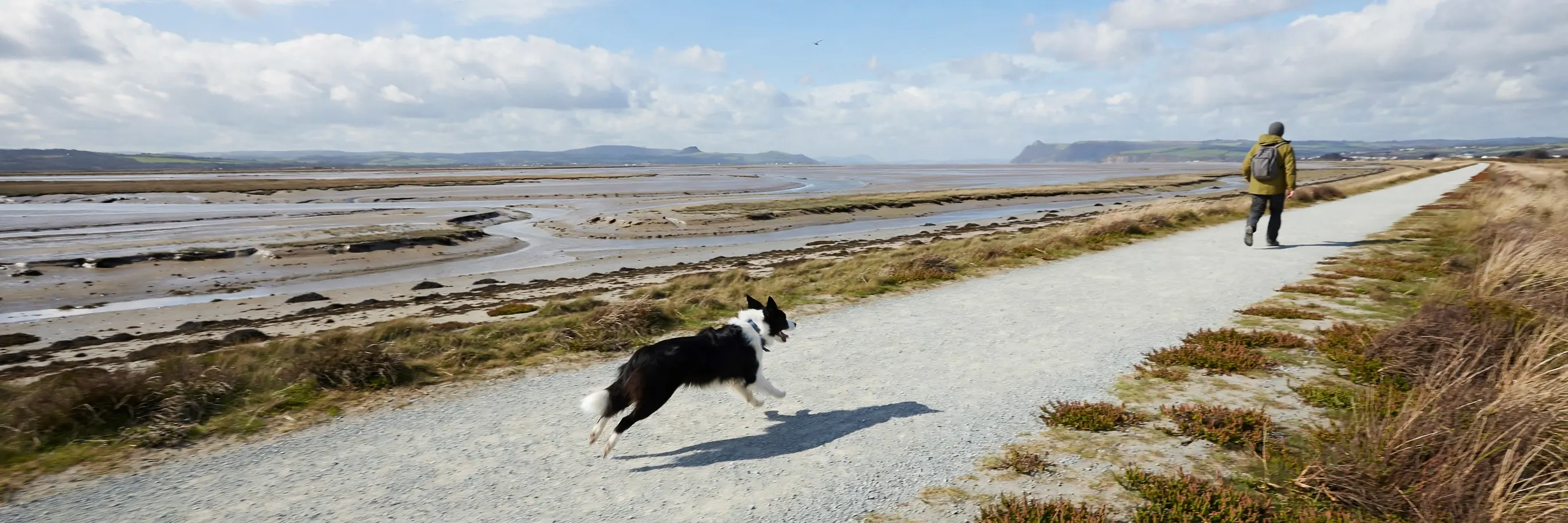
Most British coastal towns give you a circular walk: out along the cliff, back through the fields. Llanelli is different, and that difference is the whole point of visiting with a dog. Here the walk is a line. It starts on the Loughor estuary in the east, runs along the edge of the town, past a lake, a beach, a harbour and a nature reserve, and finishes at the great sweep of sand at Pembrey in the west. You walk in one direction, the sea stays on the same side, and the horizon keeps moving. The picture at the start of this guide is the walk itself: a wide flat path, a dog a few strides ahead, mudflats and distant hills under a big sky, and nothing between you and the far end of the coast except the next stage.
The line is the Millennium Coastal Path, a surfaced pedestrian and cycle route of about 13 miles (21 km) that runs from Bynea and Loughor in the east to Pembrey Country Park in the west. It forms part of the Wales Coast Path and of National Cycle Network route 4, and it runs through the Millennium Coastal Park, a stretch of reclaimed industrial land along the shore of Carmarthen Bay that was opened around the millennium. Before that, this shoreline was steelworks and tinplate works; today it is one of the flattest long walks in Wales, and that flatness is exactly what makes it so useful for dogs. There are no steep climbs to punish an older dog, no narrow cliff edges to worry a nervous one, and the surface is firm enough for a dog that struggles on rough ground. The trade-off is exposure: there is very little shelter, so wind, rain and sun all reach you, and there are long stretches with no water, no cafe and no easy exit. That is why this guide is organised the way it is — stage by stage, east to west, with the surface, the views, the water stops and the retreat points for each section spelled out before you commit to it.
Think of the path as six stages, and treat each stage as a complete walk in its own right. Stage one runs from Bynea past the Wetland Centre. Stage two passes Machynys and North Dock, where the town meets the water. Stage three is Sandy Water Park and Llanelli Beach, the busiest and most useful section. Stage four crosses Pwll and the Ashpits Pond nature reserve, the quietest stretch. Stage five arrives at Burry Port harbour and its lighthouse. Stage six finishes through Pembrey Country Park to Cefn Sidan, one of the longest beaches in Wales. A fit dog can cover two stages comfortably in a day; a small or older dog will be happy with one. Nobody needs to do all six at once, and the guide is written so you can pick any stage, walk it out and back, and still feel you have had the Llanelli experience.
Before the stages, a few facts that shape every decision on this walk. The path is shared with cyclists, including families and faster riders on the National Cycle Network, so dogs should be on a short lead on the path itself and only let off where it is clearly safe and permitted. The estuary beside the path is tidal, with wide mudflats at low water and a fast incoming tide, so the beach sections need tide times, not guesswork. Dogs are welcome on the path and on Llanelli Beach all year round according to the listings that cover this coast, but the Wetland Centre does not admit pet dogs, and Cefn Sidan has zoned summer restrictions, so the rules change from place to place along the same line. Check the official guidance before you travel for the current position at each beach and attraction, because local rules are reviewed and signs on the ground are the final word.
One more thing about the shape of the day. Because the walk is a line, the return journey is half the planning. Every stage in this guide ends with a retreat point: a car park, a bus stop on the coast road, a cafe where you can sit and decide, or simply the honest distance back the way you came. Do not start a stage without knowing which one you will use. The most common mistake on a linear path is to walk further than the dog can comfortably walk back, and on a flat, easy path it is a surprisingly easy mistake to make, because nothing hurts until the last mile. Walk the dog you have, not the dog you wish you had, and let the stages do the work of keeping the day honest.
Stage 1: Bynea to the Wetland Centre
The eastern end of the line begins quietly. Bynea sits on the Loughor estuary, where the river meets the sea and the view opens across the water towards the Gower Peninsula. This is the least built-up end of the path, and the best place to start if your dog is the kind that needs ten minutes of open space before it can settle. Park at Bynea, cross onto the path, and the town is behind you almost at once. The surface is flat and surfaced, the railway runs inland of the path, and the estuary is on your left as you walk west. On a clear morning the light here is the best on the whole route: low sun on the mudflats, wading birds picking along the waterline, and the long shape of Gower across the estuary.
The wildlife is the reason to keep your dog close on this stage, even though the path feels empty enough to let them run. The Loughor estuary is an internationally important site for birds, and the mudflats hold dunlin, redshank, oystercatcher, curlew and shelduck through the year. A dog chasing birds out onto the mud is not just a disturbance to wildlife; it is in danger itself, because the mud is soft and the tide comes in fast. Keep the dog on a lead through the estuary sections, let it sniff and watch, and save the off-lead running for the beach stages further west, where the ground is sand rather than mud. A long line gives a keen dog room to explore without giving it the freedom to reach the waterline.
The landmark of this stage is the WWT Llanelli Wetland Centre, which the path passes on its inland side. This is one of the great wetland reserves in Britain, with lakes, lagoons and scrapes that hold wildfowl through the winter and breeding birds in spring, and it is also home to a well-known collection of captive waterbirds, including flamingos. Pet dogs are not admitted to the centre, because it is a working wildlife reserve, and that matters for planning: do not arrive expecting to take the dog inside, and do not leave a dog in a car while you visit on a warm day. Instead, treat the centre as a boundary marker. Walk the path past it, look across the lagoons from the outside, and if you want to visit properly, come back without the dog or split the party, with one person staying on the path with the dog while the other goes in. The path itself gives you the estuary view for free, which is most of what the centre offers from the outside anyway.
Water and retreat points on this stage are thin, so come prepared. There is no reliable drinking water for dogs between Bynea and the built-up sections further west, and there is no cafe on this stretch. Carry at least a litre of water for the dog on a warm day, plus a collapsible bowl, and carry it from the start rather than hoping to find a tap. The retreat point is simple: turn around and walk back to Bynea, or keep going west towards North Dock, where facilities begin. The distance from Bynea to the Wetland Centre area is a comfortable out-and-back of a few miles on flat ground, which suits a morning walk before the day warms up. If your dog is small, older or new to long walks, this stage alone, walked gently and finished before midday, is a complete and satisfying day.
What to watch for on stage one: the railway line that runs beside the path, which can startle a noise-sensitive dog when a train passes; the wind, which comes straight off the estuary with nothing to break it; and the ground beside the path, which looks firm at the edges but softens into marsh and mud very quickly. Stay on the surfaced path, keep the lead short when a train passes, and give a nervous dog a few minutes to watch the first train from a distance before you walk on. Dogs that settle here will settle anywhere on this coast, because the rest of the route only gets busier and easier.
Stage 2: Machynys and North Dock
West of the Wetland Centre the path changes character. The open estuary gives way to the edge of the town, and the walk becomes a story about what Llanelli used to be and what it has become. Machynys is a modern development of houses and a golf course built on reclaimed land, and the path runs along its edge with the estuary still in view but the town now close on the inland side. The surface stays flat and surfaced, and the walking is easy, but the distractions multiply: golfers, dog walkers, cyclists and the occasional horsebox near the course. This is a good stage for a dog that needs to practise ignoring other people and dogs at a polite distance, because there is space to move aside and let others pass without leaving the path.
North Dock is the hinge of the whole route. Here the path crosses the water at the old docks, where the Discovery Centre stands, and the town, the beach and the path all meet. The Discovery Centre is the most useful building on the walk: it is a landmark you can navigate by, a meeting point if your party splits, and the place where facilities begin in earnest. The area around North Dock has car parking, toilets and places to sit, and it is the natural start point for visitors who want the beach and Sandy Water Park without walking the full eastern stages first. If you are arriving by car and your dog is only up for one stage, start here.
The walking on this stage is straightforward, but it is also where the shared-use nature of the path is most obvious. Cyclists use this section heavily, including commuters and families, and the path is wide enough for everyone only if dogs stay close. Keep the dog on a short lead, walk on the same side consistently so cyclists can predict where you will be, and teach a simple move-aside cue before you arrive if your dog tends to wander across the path. A dog that walks in a straight line on a short lead is a pleasure on a shared path; a dog on a long lead zig-zagging across the full width is a hazard to itself and to everyone else. This is also the stage where a reactive dog will meet the most other dogs, so if yours struggles with on-lead greetings, walk early in the morning, keep moving, and use the wide verges to create distance rather than stopping to chat.
Water and retreat points improve sharply at North Dock. This is the first reliable place to refill a dog bowl, find shade and sit down, and it is the point from which you can most easily bail out to the town. If the dog is flagging, stop here: you have walked a genuine stretch of the coast path, you have the estuary behind you and the beach ahead, and there is nothing to prove by pushing on. If the dog is fresh, this is also the point to decide whether to continue west to Sandy Water Park and the beach, which is the next stage, or to turn back east towards Bynea for a longer return leg. Either way, North Dock is the decision point, and the guide is written so that you make the decision here, with water and a bench, rather than a mile further on with neither.
Look out for the views as you cross North Dock. Behind you is the estuary and Gower; ahead is the beach and the open bay; to the side is the town that built its living on this water. The docks once shipped coal and tinplate from this shore, and the reclaimed land you are walking on was industrial ground within living memory. Dogs do not care about industrial history, but their owners often do, and the contrast is part of the walk: a working coast turned into a flat, open path where a dog can trot for miles without meeting a car.
Stage 3: Sandy Water Park and Llanelli Beach
This is the stage most people mean when they say they are going to Llanelli with a dog. Sandy Water Park is a lake and landscaped park built on the site of the old steelworks, with a loop walk of under two kilometres around the water, and Llanelli Beach is the sandy shore just beyond it, exposed at low tide on the northern shore of the Loughor estuary. Together they give a dog everything the earlier stages do not: water to drink, shade to rest in, sand to run on, and other dogs to meet. It is also the busiest stage, so arrive early on a sunny weekend if your dog prefers space, or arrive in the afternoon if your dog enjoys company.
Start at Sandy Water Park and walk the lake loop first. The loop is short, flat and surfaced, and it works as a warm-up: the dog can sniff, settle and get used to the day before the bigger beach walk. The lake holds swans and other waterbirds, so keep the dog on a lead around the water and do not let it swim in the lake, where the birds, the depth and the water quality are all against it. There are benches, grass and trees for shade, and the park is a good place to stop for a proper rest with a drink of water. The Discovery Centre is close by, and the area has the usual facilities of a town park rather than a wild coast: bins, paths, car parking and people. For a small or older dog, the lake loop plus a short visit to the beach is a complete day, and there is no need to push on to Burry Port at all.
Llanelli Beach itself is a sandy beach with groynes, set within the Millennium Coastal Park, and it is widely listed as dog-friendly all year round, with no seasonal ban. That is unusual on this coast, where several nearby beaches restrict dogs in summer, and it is the single most useful fact in this guide for anyone planning a summer visit. Treat it as the working assumption, not a guarantee: check the official guidance before you travel, read the signs at the access points, and be ready for local rules to change. At low tide the beach is wide and flat, with firm sand for running and shallow water at the edge, and the views run west along the coast towards Burry Port and across the estuary to Gower. At high tide the sand narrows and the groynes do the work of holding it in place, so time your visit for a falling tide if you want the biggest beach, and check tide times before you go.
Beach safety here is estuary safety. The sand looks inviting and it is, but the Loughor estuary has strong currents, soft mud in places and a fast incoming tide, and the beach is exposed to the wind. Keep the dog where you can see it, do not let it chase birds out towards the waterline, and do not let it drink seawater or eat anything it finds on the sand, including dead fish and bait. Bring fresh water and offer it often, because a dog that has been running on sand will drink seawater if nothing else is on offer, and seawater is a quick route to a sick dog. Bring a towel and a drying coat for the journey home, and check the dog's paws for sand and small cuts after the walk. If the dog swims, rinse it with fresh water afterwards if you can, and watch for the tiredness that comes after a beach run: a dog that has been sprinting on sand is often more tired than it looks, and the walk back to the car can be the hardest part of the day.
The retreat points on this stage are the best on the route. Sandy Water Park, the Discovery Centre and the beach car parks all give you a place to stop, sit and decide, and the town centre is a short walk inland if you need shops, a vet or a cafe. If you are walking the whole line, this is the natural lunch stop: rest the dog properly, refill the water, eat something yourself, and only then decide whether to continue west towards Pwll and Burry Port. A dog that rests here will walk the next stage well; a dog that is pushed through without a break will fade halfway to Burry Port, where there is much less to stop for.
Stage 4: Pwll, Ashpits Pond and the nature reserve
West of Llanelli Beach the path goes quiet again, and this is the stage for dogs that prefer space to company. The route passes Pwll, a village on the edge of the town, and runs beside Ashpits Pond and the Pwll Lagoon local nature reserve, a wetland rich in plants and birds. The surface stays flat and the path stays surfaced, but the feeling changes: fewer people, fewer buildings, more reeds and open water, and the estuary opening out again to the west. If the beach stage is the social heart of the walk, this is its contemplative middle, and it suits a dog that likes to sniff its way along a quiet path rather than sprint on sand.
The wildlife is the point of this stage, and it is also the reason for the lead. Ashpits Pond and Pwll Lagoon hold waterbirds through the year, and the reed beds shelter breeding birds in spring and summer. A dog crashing through the reeds is a disturbance and can also pick up ticks and cuts from the rough ground at the path edge. Keep the dog on the path, on a lead or a short long line, and let it watch the birds from a distance. This is also good training ground for a young dog: the distractions are real but distant, the path is wide enough to move aside, and there are long stretches where you can practise loose-lead walking without meeting anyone.
The walking itself is easy, but this is the stage where the lack of facilities matters most. There is no cafe, no shop and no reliable water between Llanelli Beach and Burry Port, and the distance is long enough that a dog without water will feel it on a warm day. Carry water from the beach stage, and carry more than you think you need, because there is nowhere to refill until the harbour. The shade is also thin: the path runs through open ground with the estuary on one side and the reserve on the other, and on a sunny day there is little cover. A light-coloured dog, a short-coated dog and a brachycephalic dog will all feel the sun here, so walk this stage in the morning or late afternoon in summer, carry a portable water bowl, and watch for heavy panting and slowing down, which are the early signs of heat stress.
The retreat point on this stage is the path itself: you can turn back to Llanelli Beach at any point, and the distance back is the same as the distance you have come, on flat ground. That is worth remembering, because the temptation on a quiet, easy path is to keep going until the dog is tired and then realise the way back is just as long. Set a turn-around time before you start — for most dogs, half the time you have available, minus a margin for the walk back — and stick to it. The other retreat is to keep going west to Burry Port, where the harbour, the lighthouse and the town give you everything this stage does not. The choice depends on the dog: a fresh dog that has rested at the beach will enjoy the push to Burry Port; a dog that is already warm or tired should turn back to the beach, where the water and shade are waiting.
One practical detail for this stage: the path crosses the railway line and runs close to it in places, and trains pass regularly. Most dogs get used to the sound quickly, but a dog that is frightened by trains should be kept on a short lead and given distance from the line where the path allows it. The path also passes a sewage works on the inland side in one section, which is not a place to let a dog drink from standing water. Keep the dog on the path, keep the water bowl filled from your own supply, and this quiet middle stage becomes one of the most relaxing walks on the whole coast.
Stage 5: Burry Port harbour and lighthouse
Burry Port arrives as a reward for the quiet miles. The path drops gently towards the harbour, the ground firms up, and suddenly there are boats, buildings and people again. The harbour is the prettiest on this stretch of coast: a small marina, a beach on either side, and a squat white lighthouse built in the 1830s standing at the harbour entrance. It is a natural stopping point, a place to sit with a dog and watch the boats, and the first town west of Llanelli where you can properly rest, eat and refill. If you have walked from Llanelli, you have earned this stop; if you have driven here and started the day at Burry Port, you have chosen the most charming start point on the whole line.
The harbour area has two beaches that welcome dogs all year round, according to the listings for this coast, and the sand here is whiter and cleaner than at Llanelli Beach, with clear water and views back along the coast. As always, check the official guidance before you travel and read the signs at the access points, because beach rules are set locally and can change. The harbour itself is a working place with boats, ropes and slipways, so keep the dog on a lead around the pontoons and the harbour wall, and do not let it swim in the harbour, where boats manoeuvre and the water is not a safe place for a dog. The beaches on either side are the place for running and paddling, and the harbour wall is the place for sitting and watching.
The lighthouse is worth a few minutes. Built in the 1830s, it is a short, sturdy tower that marks the harbour entrance, and the walk out to it gives you the best view of the stage: back east towards Llanelli and the estuary, and west towards Pembrey and the open bay. The ground around the lighthouse is exposed to the wind, so hold the lead firmly and do not let the dog scramble on the harbour wall or the rocks at its base. The yacht club beside the harbour is a reminder that this is a sailing town, and the cafe and facilities around the harbour are the first proper refreshment stop since Llanelli Beach. Use them: refill the water, let the dog rest in the shade, and take stock before the final stage.
The retreat points at Burry Port are excellent. There is car parking at the harbour, a bus stop on the coast road, cafes and shops, and the town is compact enough to walk around with a dog. This is the easiest place on the whole line to end a walk and get back to a car, which makes it a good finish point for a one-way walk from Llanelli. Park at Burry Port in the morning, take the bus east to Llanelli, and walk back west to your car — or walk east from Burry Port to Llanelli Beach and back, using the harbour as your base. Either way, Burry Port works as a hub, and the harbour is the place where the linear walk stops feeling like a commitment and starts feeling like a choice.
Burry Port is also where the character of the coast changes. East of here the path has been estuary, town and reclaimed land; west of here it becomes dunes, forest and open beach. The next stage leaves the harbour, crosses the dunes and enters Pembrey Country Park, and the walking becomes softer underfoot and wilder in feeling. A dog that has walked the estuary stages will notice the difference at once: the smell of pine, the sound of the sea rather than the estuary, and sand that runs for miles. Rest well at the harbour, because the last stage is the longest and the most rewarding.
Stage 6: Burry Port to Pembrey and Cefn Sidan
The final stage is the payoff for the whole line. From Burry Port the path leaves the harbour, follows the sea wall and the dunes, and enters Pembrey Country Park, a large park of woodland, grassland and beach that covers about 200 hectares. The surface changes here: the surfaced path gives way to sandy tracks and grass, the pine woods close in on the inland side, and the sea opens out to the south. The park is a destination in its own right, with a beach, a forest, a miniature railway and open spaces, and it is the place where a dog that has walked the estuary stages can finally run properly on sand. The distance from Burry Port to the park is only a couple of miles, but the feeling is of arriving somewhere completely different.
Cefn Sidan is the beach at the end of the line, and it is one of the longest beaches in Wales: around eight miles of golden sand, running west from Pembrey towards the Gwendraeth estuary. Dogs are welcome across most of the beach, with a small signposted dog-free zone to respect, and the scale of the sand means that even on a busy day there is room to find a quiet stretch. In summer, parts of the beach have zoned restrictions, so check the official guidance before you travel and follow the signs at the access points, which mark the dog areas clearly. Outside the summer season, the beach is as open as a beach gets: miles of firm sand, shallow water, dunes behind you and the open bay ahead.
The walking on Cefn Sidan is different from the path. Sand is hard work for a dog, especially soft sand near the dunes, and the distance is deceptive: a mile on sand feels like two miles on a surfaced path. Walk on the firm sand near the waterline where the going is easiest, keep the dog's running in short bursts rather than one long sprint, and watch for tiredness, especially in a young dog that does not know when to stop. Bring water, because there is none on the beach itself, and bring a towel and a brush for the sand that will get into every part of the dog and the car. The dunes behind the beach are a sensitive habitat and a good place for ticks, so keep the dog out of the deep dunes and stick to the paths and the open sand.
Pembrey Country Park itself is worth time beyond the beach. The forest paths are shaded and cool on a warm day, the grass areas are good for a calm on-lead walk, and the park has facilities, car parking and places to eat that make it the best-equipped finish point on the whole route. The park is also where the Wales Coast Path continues west towards Kidwelly, so if you have walked the whole line from Bynea and you still have energy, the coast goes on — but for most dogs, Cefn Sidan is the natural end. Walk out onto the sand, let the dog run, look back east along the coast you have just walked, and let the line end where the land runs out.
The retreat points on this final stage are the park car parks and the bus stops on the coast road back to Burry Port and Llanelli. If you walked here from Burry Port, the walk back is the same distance on flat ground, and the dunes and the sea wall make a pleasant return. If you walked the whole line from the east, this is the point to stop: take the bus back, arrange a lift, or drive the car round, but do not ask a tired dog to walk another eight miles back. The line is a journey, not a test, and the best ending is a dog asleep in the car with sand on its paws, having walked the coast from the estuary to the open bay.
For visitors planning a longer stay on this coast, the towns to the east and west of Llanelli make natural next steps. Our guide to Swansea with a dog covers the bay, the gardens and the road to Gower, which is the next big coastline east along the estuary, and our guide to Tenby with a dog covers the beaches and harbour town further west in Pembrokeshire. Both are day trips from Llanelli, and both are written for dogs that have already enjoyed a flat coastal path and want a change of scenery.
Llanelli town between walks
The path is the walk, but the town is where you eat, sleep and sort out the practicalities, and Llanelli town centre is a short walk inland from North Dock and Sandy Water Park. The centre is compact and flat, which suits a dog that has already walked, and it has the usual range of shops, cafes and takeaways. Dog-friendly cafes and pubs in the town vary from season to season and from one business to another, so check before you travel and ask at the door rather than assuming. The general pattern is the one you will find across Wales: dogs are welcome on outdoor terraces and in the more relaxed cafes, less often inside formal restaurants, and almost always on a lead and under the table rather than roaming free. Bring a mat for the dog to lie on, order at the bar or the counter where you can, and keep the visit short if the dog is tired from the path.
Parc Howard is the town's green escape, and it is worth a visit on a rest day or as a gentle evening walk after a day on the path. The park has gardens, lawns and mature trees, and it is the kind of place where a dog can walk calmly on a lead, sniff the flower beds from a polite distance and lie in the shade while you sit on a bench. It is not a substitute for the coast path, and it is not an off-lead exercise area, but it is a good change of pace, and it is close enough to the town centre to combine with shopping or a cafe visit. Swiss Valley Reservoir, a short drive north of the town, is another quiet option: a tree-lined reservoir walk that is popular with local dog walkers and gives a completely different landscape — woodland and still water — after days of estuary and sand.
Staying overnight with a dog in Llanelli means choosing between the town and the coast. Town accommodation puts you close to the eastern stages and the beach, and to shops and vets; coastal accommodation near Burry Port or Pembrey puts you close to the harbour and Cefn Sidan, and to the quieter western stages. Either way, ask the same questions you would ask anywhere: is the specific room dog-friendly, is there a pet fee and how much, is there a garden or a nearby toilet area, and where is the nearest place for a late-night walk? Our guide to dog-friendly holiday parks in Wales covers the booking checks that matter on this coast, including boundaries, livestock rules and realistic travel times, and it is worth reading before you book a park stay near Llanelli. If you are combining the coast with history, our guide to dog-friendly castles in Wales covers which castle grounds welcome dogs and how to plan a castle stop around a coastal walk.
The town also has a practical role that the path does not: it is where you find a vet, a pet shop and a supermarket. Save the number of a local vet before you travel, and know where the nearest out-of-hours service is, because the coast path is a long way from help if a dog eats something it should not or cuts a paw on the beach. A pet shop in the town can supply anything you forgot — a spare lead, a tick remover, a drying coat — and a supermarket can supply water, towels and the picnic for the next stage. Do this shopping before the walk, not after it, because a tired dog and a tired owner do not make good decisions in a supermarket aisle.
Tides, mudflats and estuary safety
Every safety rule on this walk comes back to the tide. The Loughor estuary is tidal, the mudflats are wide, and the tide comes in faster than it looks. The path itself is safe because it is set back from the water, but the beach and the shore are not places to improvise. Check tide times for Llanelli before every beach walk, and check them again if you change your plans during the day. Walk on a falling tide if you want the beach at its widest, and start heading back well before the tide turns, because the sand you walked out on can disappear under water while you are still a long way from the access point. If you are unsure, ask a local dog walker or check the official guidance before you travel, and do not rely on a tide table from another part of the coast.
Mud is the second danger, and it is less obvious than the tide. The mudflats beside the path look firm from a distance, but they are soft, deep and sticky, and a dog that runs out onto them can get stuck. The risk is not theoretical: estuary mud can hold a dog fast, and a dog that panics will sink further. Keep dogs on a lead near the mud, never throw a ball towards the waterline, and never let a dog chase birds out onto the flats. If a dog does get stuck, do not go in after it yourself — call for help and keep the dog calm from the path, because a person stuck in estuary mud is in far more danger than the dog. This is a rule to agree before the walk, not a decision to make in the moment.
Heat, cold and wind are the third set of risks, and they are all stronger on an exposed coastal path than they are inland. In summer, the path has almost no shade, the sun reflects off the water and the sand, and a dog can overheat on a walk that feels pleasant to a human. Walk early or late, carry water, offer it often, and watch for heavy panting, drooling, slowing down and a reluctance to keep walking, which are the early signs of heatstroke. In winter, the wind off the estuary cuts through a short-coated dog, and the rain on an exposed path soaks through quickly. Bring a waterproof coat for the dog if it is short-coated or older, and shorten the walk rather than pushing through a storm. In all seasons, the wind can carry a dog's scent and sound away, so a dog that normally recalls well may not hear you on a windy stretch — keep the lead on when the wind is strong, and use a long line rather than a free run.
Other hazards are smaller but worth naming. Adders are present in dune and heathland habitats in Wales, including around Pembrey, and a dog that sniffs in long grass or dunes can be bitten. Keep the dog on the path and out of deep vegetation in warm weather, and know the signs of a bite — sudden pain, swelling and distress — and where the nearest vet is. Ticks are common in the nature reserve and the dunes, so check the dog after every walk, especially around the ears, armpits and groin, and remove any tick promptly with a tick remover. Standing water on the path and in the reserve can carry bacteria, so do not let the dog drink from puddles or ponds; carry clean water instead. And on the shared path, the most likely accident is a collision with a cyclist, which is why the lead stays short and the dog stays on one side.
Parking, buses, water and vets
Parking is straightforward, and the choice of car park decides which stage you walk. For the eastern stages, park at Bynea or at North Dock, where there are car parks near the Discovery Centre. For the beach stage, park at Sandy Water Park or at the beach car parks, which put you on the sand within minutes. For the harbour stage, park at Burry Port harbour. For the final stage, park at Pembrey Country Park, which has large car parks and facilities. Car parks on this coast are generally pay-and-display, and charges and opening times change, so check the official guidance before you travel and bring coins or a card as a backup. Do not leave a dog in a car on a warm day, even with the windows open, and do not leave a dog in a car at all while you walk a stage — the car parks are for starting walks, not for holding dogs.
Buses run along the coast road between Llanelli, Burry Port and Pembrey, and they are the simplest way to turn a linear walk into a one-way trip. The usual pattern is to park at one end, take the bus to the other end, and walk back to the car, or to walk one way and take the bus back. Bus times are less frequent on Sundays and in winter, and dogs are generally allowed on local buses at the driver's discretion, on a lead and on the floor rather than on a seat, but this is not guaranteed. Check the official guidance before you travel for current times and dog rules, and have a backup plan — a taxi that accepts dogs, or a second car — if the bus does not come. Trains also serve Llanelli and Burry Port on the South Wales main line, and the path runs close to the railway in places, which makes a train-and-walk combination possible for visitors without a car.
Water is the practical detail that decides whether a stage goes well. The rule for this walk is simple: carry your own, and carry more than you think you need. The reliable refill points are the Discovery Centre at North Dock, the facilities at Sandy Water Park, the cafes at Burry Port harbour and the facilities at Pembrey Country Park. Every other stretch should be treated as a carry-your-own-water section, and the Pwll stage in particular has no refill at all. A litre per dog per stage is a reasonable minimum in cool weather, and twice that in warm weather, plus a bowl the dog will actually drink from. Some dogs will not drink from a collapsible bowl on a walk, so test the bowl at home first, and bring a familiar one if you need to. Offer water at every stop, not just when the dog asks, because dogs on a walk often forget to drink until they are already thirsty.
Food, first aid and vets are the last part of the practical picture. Carry a small first-aid kit for the dog: a tick remover, antiseptic wipes, a bandage, and the number of a vet saved in your phone. Save the number before you travel, and save the out-of-hours number too, because a cut paw on Cefn Sidan at six in the evening is not the time to start searching. Carry poo bags and use them — the path is a shared public space, and the bins at the car parks and facilities are there for a reason. Carry a lead and a spare lead, because a lead that breaks halfway to Burry Port is a walk-ending problem if you have no backup. And carry a towel, a drying coat and a blanket for the car, because a wet, sandy dog in a car is a miserable end to a good day, and a dry dog is a dog that will want to come back tomorrow.
Finally, a note on when to come. Spring and autumn are the best seasons for this walk: the path is quieter, the light is good, the birds are moving, and the temperatures suit dogs. Summer brings the widest beaches and the longest days, but also the most people, the most cyclists and the hottest sun on an exposed path, so walk early and choose the beach stages for the cooler parts of the day. Winter brings the wildest weather and the emptiest path, and it can be magnificent — a clear, cold day on the estuary with the birds and the big sky — but it also brings rain, wind and short days, so keep the stages short, check the forecast, and check the official guidance before you travel for any path closures after storms. Whatever the season, the line is the same: start in the east, walk west, follow the sea until the land runs out, and let the dog set the pace.
Practical questions
Before you go
Can dogs walk the whole Millennium Coastal Path at Llanelli?
Yes, in stages. The path is a flat, surfaced, traffic-free route of about 13 miles (21 km) from Bynea and Loughor in the east to Pembrey Country Park in the west, and dogs are welcome on the path itself. Few dogs need the whole distance in one day, so most visitors walk one or two of the sections in this guide and use a car or bus to return.
Is Llanelli Beach dog-friendly all year round?
Llanelli Beach is widely listed as dog-friendly all year round, with no seasonal ban. Beach rules can change, and nearby beaches such as Cefn Sidan at Pembrey have their own zoned restrictions in summer, so check the official guidance before you travel and read the signs at each access point.
Can dogs go into the WWT Llanelli Wetland Centre?
No, pet dogs are not admitted to the Wetland Centre itself, because it is a wildlife reserve with ground-nesting birds and captive collections. The Millennium Coastal Path passes its boundary, so you can walk the estuary section with your dog and save the centre for a dog-free visit, or leave one person with the dog outside while the other looks around.
Where can my dog drink and rest along the path?
Carry your own water and a bowl, because long stretches of the path have no drinking water for dogs. The reliable stops are the Discovery Centre at North Dock, Sandy Water Park, Burry Port harbour and Pembrey Country Park, where there are cafes, taps and shade. Treat every other stretch as a carry-your-own-water section.
Is the Millennium Coastal Path safe for dogs near the mudflats?
The path itself is safe: it is surfaced and set back from the estuary. The danger is the mudflats and the fast incoming tide beyond it. Keep dogs on a lead near the shore, never let them chase birds out onto the mud, and check tide times before any beach walk, because the Loughor estuary tide comes in quickly and soft mud can trap a dog.
How do I get back to my car after a one-way walk?
Plan the return before you set off. The simplest options are to walk out and back on the same section, to park at the far end and walk towards your start, or to use the local bus along the coast road between Llanelli, Burry Port and Pembrey. Check the official guidance before you travel for current bus times, as services are less frequent on Sundays.