This guide is independent and contains no paid placement. If affiliate links are added later, they will be clearly marked and will not change our editorial checks.
Marazion with a dog works best when you plan around the tide. At low tide, walk the cobbled causeway to St Michael's Mount with your dog on a lead and explore the wide sandy beach. At high tide, take the boat, walk the South West Coast Path, or enjoy the village and the marsh. Dogs are not allowed inside the castle or gardens, so plan the Mount as an outdoor visit, check the tide times the night before, and arrive early in summer when the village car parks fill up.
The tide sets the day
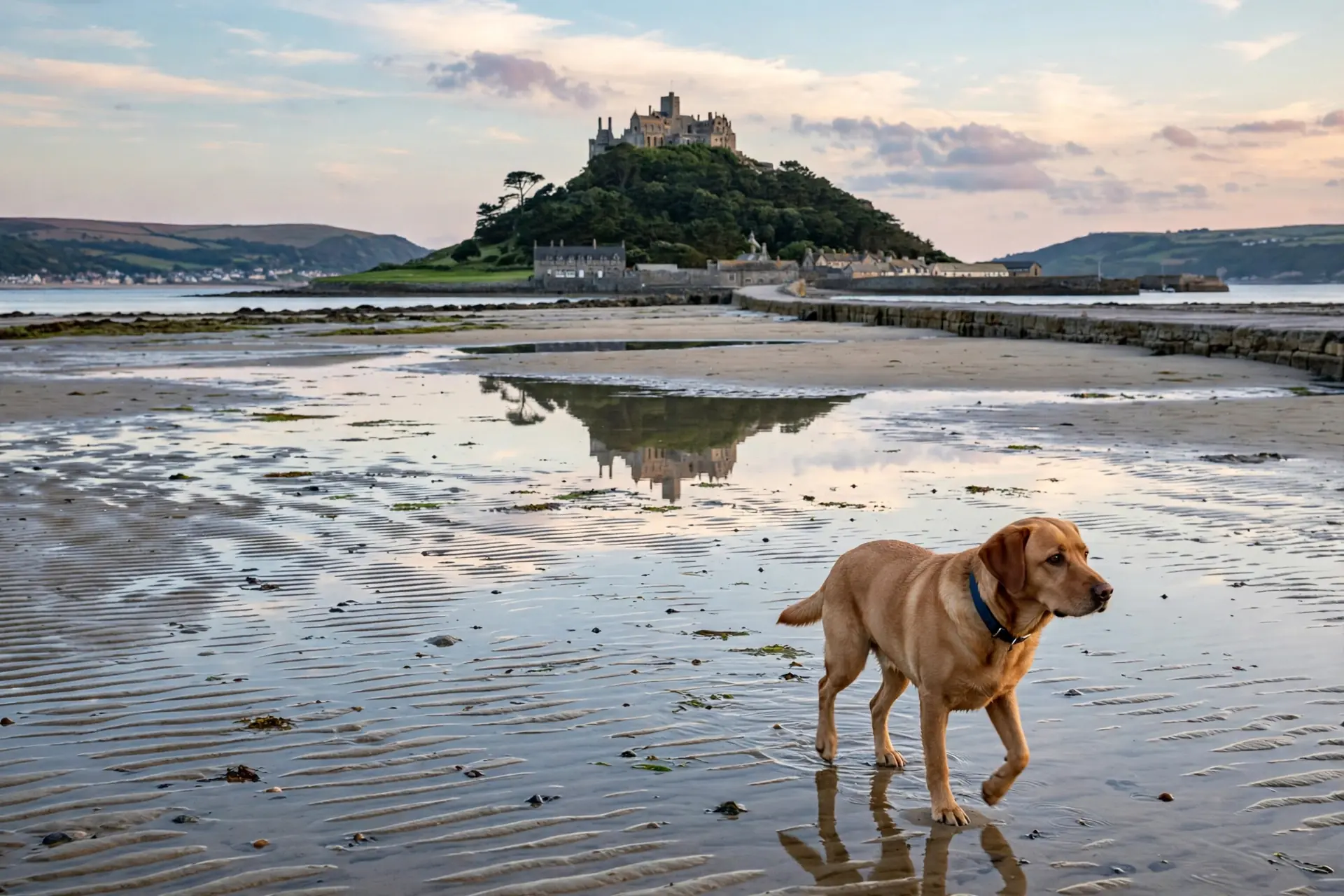
Nothing in Marazion is decided by a clock on the wall. The day here is decided by water: twice it pulls back across Mount's Bay and leaves a wide mirror of wet sand, and twice it returns and turns the castle offshore into an island again. Get the timing right and a dog can trot across half a kilometre of stone to a castle, run on a beach the size of a parish, and be back for lunch with sandy paws. Get it wrong and the same dog spends the afternoon staring at the same castle from behind a harbour wall, with the causeway somewhere under the sea. That is the whole trick of this town, and it is worth learning before the car doors open: check the day's causeway times, build the plan around them, and let everything else fit in the gaps.
The rhythm is not mysterious once you have seen it once. Roughly every six hours the water turns, so the pattern slides about an hour later each day, and a crossing that works at nine on Monday may not work until mid-afternoon on Tuesday. The Mount publishes its own causeway opening times, and those matter more than a generic tide table, because they mark the hours when the stones are genuinely safe to walk, not merely the moment the water is at its lowest. Aim for the middle of that window, arrive at the beach with time in hand, and be back on dry land with half an hour to spare rather than sprinting against the water. A dog has no idea what a tide table says, and a dog carried through rising water because its owner cut it fine is a dog that will spend the rest of the day sulking in the car.
Marazion sits on the northern edge of Mount's Bay, a few miles east of Penzance, with the A30 running close by and the railway never far away. It is a small place, not a resort: one main street running parallel to the shore, a church at one end, a harbour at the other, and out in the bay the tidal island that gives the town its reason to exist. For centuries this was the waiting place, the shore where pilgrims and traders gathered until the water dropped enough to cross, and the town still faces the island the way a station faces its trains. Every walk here is a walk with the castle in sight, and every plan here is a plan that starts by looking out to sea.
Low water and high water give you two different towns, and a good dog day uses both instead of fighting either. When the tide is out, the beach is enormous, the causeway is open, and the bay belongs to walkers, dogs, wading birds and children with buckets. The sand is firm in places and ridged in others, there is room for a proper run without crowding anyone, and the castle seems close enough to touch. When the tide is in, the beach narrows to a strip, the causeway vanishes, and the Mount stands alone in the water with boats moving around it. Then the town turns inward: the marsh behind the village, the coast path along the cliffs, the cafes filling up, the harbour wall becoming the best seat in Cornwall. Neither half is the consolation prize. The mistake is to plan one activity and discover the water has taken it away, so this guide follows the water: low tide first, with the causeway and the sand, then high tide, with the marsh, the village and the cliffs, and the practical details last.
Some plain talking before the detail. On a sunny summer day this beach, this causeway and these car parks are busy, most of all around the middle of the day when the tide is often at its friendliest. A dog that is reactive, nervous in crowds, or uneasy around children and other dogs will have a far better time at first light, when the sand is empty and the light is gold, or late in the afternoon when the day visitors have gone and the town belongs to the people staying over. The causeway stones are rounded, uneven and slick when wet, so older dogs, very small dogs and dogs with sore paws may be happier watching the crossing from the beach than making it. The sea here is a working bay, not a paddling pool: the water is cold, the currents around the island are real, and the weather on the south Cornish coast can turn in an hour, so pack a drying coat and a towel even on a morning that looks kind. Opening times, charges and rules all shift from season to season, and where this guide is unsure it says so rather than guessing.
Walking the causeway at low tide
The causeway is a low track of granite setts running from the beach out to St Michael's Mount, about half a kilometre of stone across the sand, and walking it with a dog is the reason most people come to Marazion. It is not a long walk, but it is a walk that punishes hurry. The stones are worn smooth by centuries of feet, the sea is still draining away on both sides when the crossing opens, and the smells along the way — rockpools, ribbons of weed, wet sand — will stop a dog every few steps. Ahead, the castle climbs out of the harbour walls and grows larger with every pace. Go at the dog's speed, not yours. The crossing is the day, not the way to the day.
Timing is the whole skill, and it is worth getting the numbers right. The causeway is walkable only for a window around low water, and the safe window is shorter than the time the stones are merely visible above the sea. The Mount's published opening times are the ones to trust, and the sensible pattern is to set out soon after the crossing opens, when the stones are at their driest and the crowds are still thin, and to be back on the mainland with at least half an hour in hand before the published closing time. The water does not return evenly: it quickens towards the end, and the stretch nearest the mainland can be under water while the island end still looks dry. Never try to race the tide home, never wade a flooded causeway, and never let a dog slip its lead and run ahead towards the island while you are still on the stones. If you are in doubt, ask the staff at the harbour or at the island entrance — they watch this water every day, and a tide table in a guidebook cannot tell you what today looks like.
The surface needs its own warning, because it is the part of the crossing dog owners most often underestimate. The setts are rounded and uneven, with gaps between them that can catch a small paw, and they turn slippery the moment they are wet. Dogs that are used to pavements and grass usually manage well enough on a short lead, but a dog with arthritis, a dog coming back from injury, a very small dog, or a dog that pulls hard will all find it difficult. A harness gives you far more control than a collar on this ground, and a short lead matters more here than almost anywhere in Cornwall, because the track is narrow, the walkers are close, and a dog that lunges sideways can drag its owner onto wet stone. Some owners carry small dogs for part of the way, which is plain good sense if the dog is struggling, and some older dogs are happier staying on the sand while their people cross — there is no shame in that, and a low-tide beach is a better place for an old dog than a slippery cobbled causeway. Afterwards, check the dog's paws for grit and small stones, and rinse them with fresh water if the dog has been paddling in the pools.
What you share the stones with is part of the experience. Families with children, walkers with cameras, people coming back from the island with bags and ice creams, and other dogs on leads all use the same narrow strip, and the manners are simple: keep to one side, keep the dog tight to your leg, and give way to people coming the other way. The lead stays on for the whole crossing, not for part of it, because a dog that dashes ahead can block the path, chase a gull across the sand, or slip on the stones at the edge. Keep the dog away from the gulls and waders feeding on the exposed shore beside the causeway — the birds are working, a charging dog is a problem for them, and a dog that runs far out onto soft ground as the water returns can find itself cut off. There is no fresh water on the causeway itself, so carry a bottle and a bowl, and remember that on a warm day the stones can be hot underfoot and the sun out in the open bay has no shade at all.
The crossing is also the best lesson in how a tidal island works. At low water the Mount is joined to the mainland and feels like a hill with a castle on it. At high water the same stones lie under several feet of sea, and the island is cut off until the next ebb. The harbour, the cottages and the castle all sit above the high-water mark, which is why people have lived there for so long, and the causeway is the thread that makes that life possible. Cross on foot at low water and come home by boat at high water, as many visitors do, and you will have seen the island in both of its states in one day — and your dog will have had a beach run, a causeway walk and a boat ride, which is a great deal of novelty for a single day, so keep the evening quiet and let the dog sleep. If the weather turns while you are over there, do not wait to see whether it clears: head back across the stones while they are still open, or take the boat, and confirm the day's boat and causeway times from the Mount's own notices before you rely on them.
St Michael's Mount with a dog: what is and is not possible
St Michael's Mount is a tidal island with a castle, a garden, a harbour and a small village, run as a historic property with its own rules for dogs, and the honest summary is that it is a superb outdoor visit with a dog and a poor indoor one. Plan around that split and the day works. A dog on a lead may cross the causeway and wander the harbour and village parts of the island, taking the lanes, sitting by the harbour buildings and enjoying the same views as everyone else. The castle and the gardens are closed to dogs, assistance dogs excepted, and the same goes for the indoor spaces and shops. So one person in your party stays outside with the dog while the other goes in, or the Mount becomes a place to walk around rather than a place to go inside — and for many dog owners that is the right call anyway, because the island's best pleasures are all under the sky.
The harbour and the little settlement around it are where the dog-friendly part of the visit lives. Cottages, a church and the climbing paths to the castle sit in a quiet, enclosed pocket above the water, and it suits a dog on a lead very well. The harbour wall is a fine place to sit and watch the boats, the water and the people coming and going, and on a calm day the harbour is one of the most sheltered spots in the whole bay. Keep the dog clipped on around the harbour edges, because the drop to the water is real and the walls are not fenced everywhere, and keep it close on the narrow lanes, where there is little room to step aside. The paths up towards the castle are steep and stepped, and they are no comfortable climb for every dog, so if yours is older or has stiff joints, stay down in the harbour and village and enjoy the view from there — the castle looks just as grand from the harbour as it does from the top, and the dog will be happier for it. Rules on the island can shift with the season and with events, so confirm the current dog rules from the Mount's own notices before you cross.
When part of your group wants to go inside the castle, treat it as a relay. One person goes in while the other waits outside with the dog, then you swap, or the castle waits for a day when the dog is not with you. It sounds like a compromise, and it is, but it is a workable one: a castle visit is not a long one for most people, the harbour is a pleasant place to wait, and the dog gets a rest after the causeway. Do not tie a dog up outside the castle entrance or anywhere else on the island, and do not leave a dog in a car back in Marazion while you cross — a dog tied up on a busy island is stressed, and a dog left in a car on a warm day is in danger. A single visitor with a dog has a simpler answer: enjoy the island from the outside, walk the harbour and the village, and keep the castle interior for a return trip without the dog. That is a better day than one spent worrying about a dog left alone.
The gardens deserve their own clear word, because they are the part of the Mount dog owners ask about most. They are planted on the steep slopes below the castle, they are a separate ticketed area with their own opening hours, and those hours are more limited than the castle's. Dogs are not admitted, assistance dogs excepted, and the garden paths are narrow, stepped and uneven, so they would suit few dogs even if dogs were allowed. The planting is at its best in spring and early summer, and on a visit without the dog the gardens are well worth the time. With the dog, enjoy them as a view from the harbour paths and leave it there — the staff are applying a rule that protects the planting and the other visitors, and it does not bend because a dog is well behaved.
The boat is the other half of the Mount's transport, and it matters to dog owners twice over: as the way onto the island when the causeway is under water, and as the way home when the water has turned. The boats run between Marazion and the island harbour while the tide is in, small open boats crossing a short stretch of water in a few minutes. Dogs can usually travel on them, but this is a small service with limited room, and whether a dog can board depends on the weather, the number of passengers and the crew's judgement that day, so ask before you join the queue and be ready to wait for the next boat if the one ahead is full. Keep the dog on its lead on board, sit where the crew direct you, and be ready to lift a small dog on and off, because the step from the quay to a moving boat can be awkward. Boat times and fares shift with the tide and the season, and in rough weather the boats may not run at all, leaving the island unreachable until the next low water — so never assume a boat will be there just because the causeway is closed. For the wider picture on how seasonal beach rules and local restrictions work, the UK beach rules guide is worth reading before any Cornish beach trip where the signs at the entrance do not tell the whole story.
Marazion beach and the bay at low water
At low water the sand at Marazion runs out in a pale, level sheet, hundreds of metres wide, with the castle standing offshore on one side and the curve of Mount's Bay opening towards Penzance and the Lizard on the other. The ground underfoot is soft and even, so a dog can run hard without climbing, and the water stays shallow a long way out, which is why families settle here and why the bay has become one of Britain's best-known windsurfing spots. Put together, that is nearly everything a dog could ask of a beach — room to sprint, shallows to paddle in, sand that does not hurt paws — provided the dog stays under control among the swimmers, the sailors and the families sharing it.
Low water turns the beach into a different place from the narrow strip it becomes at high water. The sand runs out for hundreds of metres, rockpools open up around the rocks at the edges, and the shore joins up with the causeway and the long flat beach running east and west. This is the time for a proper run: a ball to chase, shallows to paddle in, the tide line to sniff along, and other dogs to meet without the crowding that comes when the beach is narrow. It is also the time to stay alert, because a beach at low water can fool you into thinking you have more time than you do. The water returns faster than most people expect, and the channels that fill first can cut off a dog that has run a long way out. Keep the dog in sight and within calling distance, and start back towards the shore well before the water reaches you. Let a dog off the lead only where you can see a long way in every direction, where no other dogs or children are nearby for it to run towards, and where you are certain it will come back on first call. On a busy summer day that may mean a long line instead of no line at all, and that is fine — a long line gives a dog plenty of freedom without the risk.
The rules on the beach need the most careful wording in this guide, because Cornish beach rules are set locally, they change, and the signs at the beach are the final word. Marazion is generally welcoming to dogs and is one of the steadier year-round beaches on this stretch of coast, but seasonal limits can apply to particular areas, and local rules can shift from year to year. Always read the signs at the beach entrances before letting a dog off the lead, and check the current position before a summer visit, when restrictions are most likely to apply. The UK beach rules guide sets out how seasonal bans and public space protection orders work, how fines are applied, and how to check a beach before you go — the most useful background reading for any Cornish beach trip, because the rules are not the same from one beach to the next and the signs at the entrance do not always explain everything. In doubt, keep the lead on, keep away from the busiest part of the sand, and pick up after the dog — the people who enforce beach rules are far more reasonable with an owner who is visibly in control.
The water looks gentle and it mostly is, but the bay opens to the south-west and a windy day can build a surf that is stronger than it appears from the sand — most of all for a small dog, or one that is not a confident swimmer. Let a keen swimmer ease in through the shallows and wade deeper bit by bit, instead of throwing a ball into deep water and expecting the dog to follow it. Learn the signs of a dog that has had enough: panting that will not settle, a sudden wish to lie down in the shallows, a head shaken again and again. Seawater makes dogs sick when they drink it, so keep fresh water and a bowl within reach and offer it often — a dog that has been running on hot sand will drink whatever is nearest, and on a beach seawater is always nearest. Once the dog is out of the sea, rinse it with fresh water if you can, run a hand over its paws for cuts from shells and stones, and shake the sand out of its ears. Sea swimming can upset a dog's stomach, and anything eaten off the tide line — dead fish, seaweed, scraps — can keep a dog ill for days, so watch what the dog sniffs at the water's edge and train a solid leave-it for whatever it finds there.
Windsurfing and kitesurfing are a distinctive part of this beach, and they change how a dog owner should use the sand. Marazion is one of the best-known windsurfing spots in Britain, and on a windy day the shore is full of sails, boards and lines, with kites in the sky above the water. It is exciting to watch and a genuine hazard for a dog that runs into the wrong patch: kite lines are thin and hard to see, boards move fast, and a dog that chases a sail across the sand can cause an accident. Keep the dog well clear of the launching and landing areas, which are usually obvious from the concentration of kit, and keep the lead on when walking past them. The quieter stretches of beach, away from the watersports area, are the better place for a dog to run, and early in the morning, before the wind rises and the surfers arrive, the whole beach is often empty. A dog that is nervous around flapping sails or fast-moving boards will do better early, at the far end of the beach, or on a different day — a frightened dog will not enjoy the beach, however good the sand is.
Slow down for the rockpools, the seaweed and the tide line, because that is where a dog's nose wants to be. When the water drops, the rocks at the edges of the beach hold little pools full of crabs, anemones and tiny fish, and a sniffing dog can work along them for ages. Do not let the dog drink from those pools — the water in them goes stale — and do not let it eat seaweed, which can swell inside the stomach and block it. Dried seaweed is the worst of it, because it looks like something to chew and it is not. Barnacles and sharp shells slice paws open, so check the feet after any walk over rock, and keep a small first-aid kit in your pocket on a beach walk: a bandage and clean water for rinsing a cut. The tide line is a treasure chest of smells and a hazard for a stomach — dead fish, old bait, food wrappers and the rest of what the sea brings in — and a dog that helps itself to the tide line may be paying for it at the vet. Walk that stretch on a short lead, and make leave-it mean leave-it, and you will save yourselves a great deal of trouble.
High tide: marsh, village and views
When the water is in and the causeway is under the sea, Marazion does not close down — it changes its character, and the high-water half of the day is the part most visitors rush past. The beach narrows, the Mount becomes an island again, and the town turns its attention inland, to the marsh behind the village, to the church and the main street, and to the views across the bay from the higher ground. This is the time for a slower walk, a long lunch, and the kind of looking a dog is good at: sitting on a bench, watching the boats, and letting the day come to you rather than chasing it.
Marazion Marsh is the quiet surprise of a visit here, and it is the high-water walk most dog owners miss. The marsh lies just behind the village, between the beach and the main road, and it is a nature reserve managed for birds, with reedbeds, open water and paths running around its edges. It is one of the best places in west Cornwall to see water birds — herons, egrets, ducks, warblers and, in winter, larger numbers of wildfowl — and a dog on a lead is welcome on the paths, so long as the dog stays on the paths and does not go into the reeds or the water. This is a walk for a calm dog rather than an excitable one: the birds are the point, the paths are narrow, and a dog that lunges at every heron will not enjoy it and will disturb the wildlife. Go slowly, keep the dog close, and bring binoculars if you have them. The marsh is at its best in the early morning and late afternoon, when the light is low and the birds are most active, and it is a good wet-weather fallback too, because the paths are surfaced in places and the walk is short enough to fit between showers. Parts of the reserve can be shut for management work or for breeding birds, so confirm the current access arrangements from the reserve's own notices before you set out.
The village itself is small enough to explore on foot with a dog in under an hour, and it rewards a slow look rather than a quick pass through. The main street runs parallel to the beach, with the church at one end and the harbour at the other, and the houses along it mix old fishermen's cottages, Georgian fronts and newer buildings that have grown up around the visitor trade. There are shops selling beach goods, local crafts and Cornish food, and galleries and small studios that are worth a look if your dog can wait outside with one of your party. The church is worth a visit from the outside for its churchyard and its views, and the lanes behind the main street are quiet and green, with gardens and hedges that give a dog plenty to sniff. Keep the dog clipped on in the village, because the main street carries traffic and the pavements are narrow in places, and keep the dog on the pavement side at junctions. The village is not a place for a long off-lead run, but it is a pleasant place for a short on-lead wander, and it is the part of Marazion that feels most like a lived-in Cornish town rather than a visitor attraction.
High water is also the best time for the views, because the bay is at its fullest and the Mount is at its most dramatic, standing alone in the water with the boats moving around it. The finest viewpoints are from the beach at the western end of the village, from the harbour wall, and from the higher ground behind the town, where the whole sweep of Mount's Bay opens out towards Penzance, Newlyn and the Lizard. A dog that can sit and watch is a good companion for this kind of looking, and a bench with a view is a better destination for a dog than a forced march. Bring a coat for a short-coated dog, because the wind off the bay at high water can be cold even on a sunny day, and bring a towel for the car, because a dog that has been on the beach will be sandy and wet however careful you are. If the weather turns while you are out, the village cafes and pubs are a genuine shelter rather than a consolation prize, and they are covered in the eating section below.
One more high-water pleasure is worth naming, because it is the kind of thing that makes a Marazion day feel complete: watching the boats. While the causeway is covered, the boat service runs between Marazion and the island, and the harbour becomes a small working port, with boats coming and going, people queuing on the quay, and the water moving around the harbour walls. A dog that likes to watch the world go by will be happy here, and a dog that likes boats may want to get on one — which is why the boat section above matters. Even if you do not take the boat, sitting on the harbour wall with a dog and watching the island change with the water is a good way to spend half an hour, and it is the closest Marazion comes to a free attraction. Keep the dog clipped on on the harbour wall, keep it away from the edge, and do not let it drink from the harbour water, which is not clean. If you are planning to take the boat later in the day, look up the times early, because the boats are busiest in the middle of the day and the queues can be long on a sunny weekend.
The South West Coast Path east and west
Marazion has a second attraction that has nothing to do with the tide: the South West Coast Path passes through the village, and from the beach you can join it in either direction. West takes you to Penzance along the shore; east takes you over the cliffs towards Perranuthnoe and Praa Sands. The two directions feel like two different walks, and they suit two different dogs, so the choice matters more than it looks. The route is signed with the path's acorn waymarks, it is walked all year, and it packs the best of Cornish walking — sea views, cliff edges, fields, lanes, the odd steep climb — into a single morning.
The westward walk is the gentle one, and it is the right call for older dogs, for puppies, for dogs that have never walked a cliff, and for anyone who wants a walk they can abandon halfway without a fuss. From the village the path stays beside the shore and runs through Long Rock, staying level almost all the way, with the bay on one side and the railway and the main road never far on the other. At a comfortable pace with a dog it takes about an hour to reach Penzance, and at any point you can simply turn around, or pick up a bus from Long Rock or from Penzance itself. Penzance is a working harbour town rather than a resort, with places to eat and shops to browse, and it makes a good lunch stop — though it is busier than Marazion, so the pavements and the harbour need a short lead and a watchful eye. Walking home is the same ground in reverse, and the view changes completely, with the Mount growing larger on the way back. If you want a sense of how different Cornish walking can be from town to town, the Wadebridge guide follows a flat, traffic-free trail beside a river estuary — a world away from this shore path, though the two towns are only an hour's drive apart.
East is the wilder choice, and it belongs to fit dogs that like to climb, dogs that are steady on narrow ground, and walkers who want a full coastal day. The path rises out of Marazion, follows the cliffs and crosses fields, then drops to Perranuthnoe, a smaller and quieter beach than the one in town and a fine place for a dog to run and swim. Beyond Perranuthnoe the path carries on to Praa Sands, a long stretch of sand with its own car park and cafe, and from there on towards Porthleven and the Lizard. This direction needs a plan rather than a whim: the ground is steep in places, the edges are unfenced, and the next village is further than it looks on the map, so take water, take a lead and a long line, and be ready to turn back the moment the dog tires. Keep the dog clipped on near the drops and near the farm animals, because the fields here are grazed and a dog that chases sheep makes trouble for the farmer and for itself. Sections of the path can be closed after storms or landslips, so look up the current diversions from the coast path's own notices before you set out.
The edge is the thing to respect on this coast, and the rules are simple even if the views are distracting. A dog on a narrow cliff path should be clipped on and walking where you can see it, never running ahead around a bend you cannot see past. Never let a dog creep to the edge for a look, and never throw a ball or a stick anywhere near a drop — a dog chasing a toy does not stop to check what is beyond it. Stay clear of the base of cliffs too, where rock falls, and take care on steps and muddy ground after rain, when a slip is easy and the consequences are not. On a narrow stretch, put yourself between the dog and the drop and let the dog walk on the field side. Wind matters as well: a sudden gust on an exposed cliff can knock a small dog off balance, so on a blustery day keep the lead short and the dog close, and be ready to turn back rather than press on.
The fields are working farmland, and the animals in them are the other thing to take seriously. Sheep, cattle and horses graze close to the path in many places, and the law in England puts the duty squarely on the dog owner: a dog must be clipped on and under close control around livestock, and a dog that worries farm animals can be shot by the farmer. That is not a scare story; it is the position in law, and it is the reason this paragraph exists. Passing cattle, keep the lead short, keep moving at a steady pace, and do not let the dog bark or run at them. Passing sheep, keep the dog tight to your leg and walk straight on. If a cow comes at you and your dog, the advice that surprises people is to let the lead go — a dog held on a lead can be trampled when a cow charges, while a loose dog can run clear — but only if you are certain the dog will come back to you, and only on open ground where it has somewhere safe to run. Where another route avoids a field of livestock altogether, take it, and look up any temporary restrictions on the path before you set out.
A day on the path comes down to three things: distance, water and weather. Signal is patchy on the remoter stretches, so save an offline map before you leave and carry a paper one if you have it. There is no fresh water for dogs on the cliff tops, so carry more than feels necessary, and take food for the dog on anything longer than a couple of hours. Let someone know where you are heading and when you expect to be back, above all if you are walking alone, and read the forecast before you go — a sunny morning on the beach can turn into a windy, rainy afternoon on the cliffs, and the path is no place to be in a storm. The shape that works best is to walk one way, eat at the far end, and walk back or catch a bus home, which gives the dog a long walk without a forced march back on tired legs. And when the dog is tired, stop: a short wander on the flat beach beats a long cliff walk with a struggling dog, and the beach will still be there tomorrow.
Eating and browsing in the village
For a village of its size, Marazion feeds people well, and that is what turns a morning on the causeway into a whole day out. Dogs here are treated as ordinary customers rather than a problem to be managed: the terraces face the bay, the tables outside are the norm in summer, and plenty of places will take a dog indoors as well. You can cross to the island at low water, eat in the village at midday, and walk the sand again in the afternoon, without ever putting the dog back in the car. Plenty of Cornish towns cannot offer that, and it is worth noticing when one can.
The morning trade in the village is coffee, and the dogs in it have mostly just come off the beach. Cafes open onto pavement tables and terraces, many of them looking straight across the water to the castle, and the simplest seat is the one outside, where a wet dog can shake and nobody minds. A bowl of water by the door usually means a welcome, and when it is not clear, ask before sitting down — the staff would rather settle the question at the start than have a dog somewhere it should not be. Pick a corner table or one near the door, put the dog's own mat or blanket down so it has a place that is its own, and get the order in quickly so there is something to wait for. Run the dog first and the dog will sleep through lunch. Keep it in the car all morning and it will not, which is one more reason to plan the walk before the meal.
By lunchtime the pubs take over. Marazion's are old-fashioned Cornish locals, and a meal in one after a morning on the sand is one of the great pleasures of a Cornish dog day. A garden or a terrace is the easiest place to sit with a big dog, and when the weather is poor the bar is often where dogs are allowed while the dining room stays dog-free — and that split can change between lunch and dinner, so ask on arrival rather than assuming. Bring a blanket the dog knows, keep the lead short and under your chair instead of stretched across the floor, and choose food that does not come in a rush. A dog that settles quietly under a table gets asked back; a dog that barks at every passer-by does not. Policies change, above all in high season, so if a particular pub is the plan for dinner, look at its own listing or ring ahead. Ask the people behind the bar about the day's crossing and the local walks — they watch this tide every day, and they know the path and the beach rules from living with them.
Between meals, the village shops are worth a wander, and they matter most to anyone staying over. There are delis and farm shops with local produce, good bakeries, and food shops selling the kind of Cornish things that make better souvenirs than a fridge magnet — cheese, bread, pasties, fruit for a picnic on the sand. Some shops welcome a dog inside and some do not, so browsing properly is a two-person job: one to hold the lead and one to look. On your own, keep it brief, tie the dog where you can watch it and where it is safe, and never leave a dog tied outside a shop for long. The pavements are mostly wide enough for a dog and a pushchair to pass each other, but the main street carries traffic, above all in summer, so keep the dog on the pavement side and watch the junctions. Between what the village sells and the supermarket in Penzance a few miles away, a self-catering stay here wants for nothing.
Stay longer and the food becomes a reason in itself to base the break here rather than pass through. Walk to the shops, cook with local produce, eat out when the mood takes you, and do it all without touching the car. The village restaurants are worth booking ahead, most of all on Friday and Saturday nights in summer, and some of them accept dogs in certain areas — say so when you book, and be honest about how big the dog is and how it behaves, because a quiet spaniel and a large excitable dog are not the same proposition in a small dining room. Penzance, an easy shore walk away, has its own harbour restaurants and cafes, and an evening meal there after a day that began on the Marazion causeway is a fine way to end a Cornish Saturday. And on a day when the dog is not coping — barking, whining, pulling at everyone who passes — take the food away rather than forcing it. A takeaway eaten on a bench by the water, the dog asleep at your feet and the castle in front of you, is often the best lunch in the village.
Staying over, parking and getting there
The reason Marazion works as a base has little to do with the view and everything to do with how little driving it asks of you. Shops, cafes, pubs and places to eat all sit within a short walk of the beach, and Penzance, only a few miles away, has the supermarket, the vets, the pharmacy, the cash machines and the station. A self-catering break here can run for days with the car parked and forgotten: walk to the shops, cook dinner, take the dog along the beach in the evening, and repeat it the next morning. For a dog owner, that kind of ease counts for as much as any castle.
Before you book anything — hotel, bed and breakfast, cottage, apartment, holiday park, campsite or farm stay — ask the host the questions that decide whether the stay works, and ask them before you pay. Start with the garden: is it fenced all round, how high, and is there a gate a dog can nose open at six in the morning? Then the floors: hard floors dry out after a muddy beach walk, pale carpet does not. Then the stairs: a ground-floor bedroom spares an older dog a climb every night. Then the alone rule: can the dog be left in the place while you go out for dinner, and for how long, because that answer shapes your evenings. Then the money: is there a fee, is it charged once or per animal, and are there limits on size or breed? And check the dog is welcome in the exact room or cottage you are booking, not merely somewhere in the property. Get the answers in writing. A pet-friendly tick on a booking site is not a promise about your particular dog.
For most dog owners, a cottage or apartment of their own is the best shape for a stay here. It gives you a kitchen, a garden or a terrace, and the freedom to live on the dog's timetable instead of a hotel's. What matters is the practical detail: a washing machine for the pile of muddy towels a beach holiday creates, somewhere to dry a wet dog, and a spot close enough to the beach or the causeway that the walk starts at the front door. A cottage on the village edge with a direct path to the sand beats a prettier one that needs a drive to every walk. Holiday parks and campsites in the country around the village suit families well, but the same questions apply — how many dogs, what the fee is, whether the pitch or plot is enclosed, and what the rules are about leaving a dog alone. In a caravan or a lodge, look at the steps and the decking first, because a dog that finds steps hard will find them hard every time it needs to go out.
Hotels and bed and breakfasts in the village fit a shorter stay, and several of them take dogs, but the deal is tighter than in a cottage. The dog is usually welcome in the bedroom and not in the dining room, which means breakfast without the dog or breakfast in the room. Ask about the fee and any size limit, and ask where the morning walk goes — a hotel a minute from the sand is a different proposition from one on a busy road. Across several days, mix the walks: a causeway day, a beach day, a coast path day, then a town day, so the dog gets variety and so do you, and nobody grows bored of the same route. Each day brings a different kind of scenery, and none of it asks for more than a few miles in the car, which is the flexibility a trip with a dog needs.
Getting here is straightforward, and the choices are worth knowing before you leave home. By car, the A30 runs through Cornwall to Penzance and the village is well signposted from it. By train, Penzance and St Erth are the nearest stations: Penzance takes services from London, Bristol, Plymouth and Exeter, and St Erth sits a short drive inland on the same main line. Local buses cover the last few miles from either station, and so do taxis — check the current bus times before you travel, because they change with the season. Dogs travel on trains in Britain, usually free when they are on a lead or in a carrier and not taking up a seat, and they can usually travel on local buses as well, though the driver has the last word. If you are driving, leave extra time in summer, when the A30 and the roads around Penzance are busy and the village car parks fill early.
Parking is simple if you plan for it. Leave the car in the village, near the beach and the causeway, and the sand, the harbour and the coast path all start a few minutes from where you parked; there are smaller car parks around the village too, and on-street parking in some areas. The main car parks charge and set time limits, and both change, so confirm the current prices and maximum stays before you travel. Come early in summer, on sunny weekends and on bank holidays, when the village fills fast and the spaces nearest the beach are gone by mid-morning. For a causeway walk, be parked well before the crossing opens, so you are ready on the sand rather than circling for a space while the tide window runs down. And once the sun is on a parked car, never leave a dog in it, even for a few minutes — the temperature inside climbs fast enough to put a dog in danger, windows or no windows.
Put it together as a weekend and the shape looks like this. Arrive on Friday afternoon, park near the beach, and take a short evening stroll along the shore so the dog learns the smells of the place before dark. On Saturday morning, look up the tide times, cross the causeway to St Michael's Mount at low water, wander the harbour and village on the island, and come home by boat or on foot before the water turns. On Sunday, drive nowhere: a beach walk at low water in the morning, lunch in the village, and a short stretch of coast path towards Penzance or Perranuthnoe before the drive home. The dog gets a causeway day, a beach day and a coast path day in one weekend, and you get a different view each day while barely using the car. If the weather turns, swap the days: the beach is best on a calm dry morning, the marsh and the village are the best wet-weather choices in the area, and the cafes and shops are a genuine fallback rather than a consolation prize. Nothing here is far away, and nothing depends on a single plan working perfectly — which is the point of basing yourself in Marazion.
Vets, emergencies and what to pack
The part of a Marazion trip nobody wants to think about is the part that matters most when it goes wrong, so sort it out on arrival and then forget about it. The town is not remote: veterinary practices in Penzance sit only a few miles away, and emergency cover runs through the night and the weekend — though the practice that answers at midnight is often not the one open at midday. Put the nearest practice's number in your phone as soon as you arrive, next to your own vet's number and your insurance details. A dog on medication should travel with the medicine in its original box and a note of the dose and the timing, and the person hosting you should know where it is kept, in case something happens while you are out on the beach. Practice hours shift, so confirm the current hours before you need them rather than after.
What actually goes wrong on a trip like this is ordinary, and a pocket-sized kit covers most of it. Paws take the worst of it: shells and sharp stones on the sand, barnacles on the rocks, broken glass near the car parks — any of them can open a cut that bleeds onto the sand and leaves a dog limping. Carry clean water, a bandage, gauze and tweezers, and know the drill: rinse the cut, press a clean pad on it, wrap it snug enough to stay put and loose enough to let blood through. Seawater is the next trouble: a dog that drinks it will vomit and scour, and most recover with rest and fresh water, but a dog that stays lethargic, keeps vomiting, or cannot hold water down needs to be seen. Food from the tide line — seaweed, dead fish, scraps — can keep a dog ill for days, and a jellyfish sting, which the summer tides wash in, hurts and can need a vet. When in doubt, ring early: the call costs nothing, and the vet will say plainly whether the dog needs to come in.
Cornwall lies about heat. The coast feels cool until a sunny day arrives, and then the beach offers no shade at all, the causeway stones burn underfoot, and a dog that has been sprinting on the sand can overheat before you notice. The warnings to learn are drooling, panting that will not settle, a dog that drops into the nearest shade and will not move, or a dog that staggers. A dog in that state wants shade and cool water on its belly and paws, and a vet if it does not pick up quickly. In summer, walk the sand early or late, carry more water than feels necessary, and press the back of your hand to the ground: if the sand is too hot for your skin, it is too hot for paws. Pale noses and short coats burn, so a dog-safe sunscreen on exposed skin is worth packing for a long day out. And a parked car in the sun is an oven within minutes, windows or no windows — never leave a dog in one, and remember that British law lets a passer-by break in to free a dog in distress.
Think of the kit as three small piles, one for each place the day takes you. For the causeway: a short lead, a harness that fits, and a spare lead, because a wet and sandy lead can fail or chafe. For the beach: water and a collapsible bowl, a towel and a drying coat, because a dog off the sand is wet and gritty however careful you are. For the cliffs: a long line, poo bags with something to carry them in — the bins sit at the beach entrances and the car parks, not along the path — and a coat for a short-coated dog when the wind gets up. In the car, a blanket the dog knows. In the bag, the dog's normal food, any medicine, the vet's number and the insurance details. That is the whole list, and it fits in a day pack. What does not fit in the pack is patience: the water will not wait for you, the causeway will not stay open because you are late, and the days that work best here are the unhurried ones, shaped around the tide rather than against it.
Finally, learn the shape of the day, because Marazion runs on the water. Dawn is the quiet hour: the sand is empty, the causeway is at its calmest, and the only company is dog walkers, fishermen and birds. By mid-morning the day visitors arrive and the crossing fills, and at lunchtime the village is at its fullest, the cafes packed and the causeway busy in both directions. The evening is the reward: the light turns gold over the bay, the crowds thin, and the beach goes back to being a local walk. An early start, a long lunch and a slow evening walk will get you the best of the town with the least friction, and your dog will get its favourite walks at the hours it likes them best. The tide does the rest — opening the causeway, closing it again, twice a day, every day — and the best way to enjoy this place is to go with it.
Practical questions
Before you go
Can dogs walk the causeway to St Michael's Mount?
Yes. A dog on a lead can cross the cobbled causeway from Marazion to St Michael's Mount at low water, while the stones are clear of the sea. Keep the lead short, watch for slippery cobbles and for other walkers, and look up the day's published causeway times before you set out, because the safe window is shorter than the time the stones are merely visible. Plan to be back on the mainland with time to spare, and never try to race the water home.
Can dogs go inside St Michael's Mount castle and gardens?
No. The castle and the gardens are closed to dogs, assistance dogs excepted, and the same applies to the indoor spaces and shops. A dog on a lead is welcome on the causeway and in the harbour and village areas of the island, so the visit works best as a relay: one person goes inside while the other waits outside with the dog, then you swap. If you are on your own with the dog, enjoy the island from the outside and keep the castle interior for a return trip without the dog.
Is Marazion beach dog friendly all year?
Marazion beach is generally welcoming to dogs and is one of the steadier year-round beaches on this stretch of the Cornish coast. Seasonal limits can apply to particular areas, and local rules can change, so read the signs at the beach entrances before letting a dog off the lead, and check the current position before a summer visit. Keep the dog under control around swimmers, windsurfers and families, keep clear of the watersports launching areas, and pick up after your dog.
What happens if the tide comes in while we are on the causeway?
Once the water is over the cobbles, the causeway cannot be walked, and the island is cut off until the next low water. The usual way home is the boat service between the island and Marazion, which runs while the tide is in — but the boats do not run in all weathers, and times shift with the tide and the season. The safe answer is to leave the island well before the published causeway closing time, with half an hour in hand, rather than relying on a boat at the last minute.
Can dogs ride the boat to St Michael's Mount?
Dogs can usually travel on the small open boats between Marazion and St Michael's Mount, but this is a small service and the crew decide on the day, depending on the weather, the number of passengers and the room on board. Keep the dog on its lead, ask the crew before you join the queue, and be ready to lift a small dog on and off the boat. Look up the current boat times and dog rules from the Mount's own notices before you rely on them.
Where is the best place to park in Marazion with a dog?
The village car parks near the beach and the causeway are the best choice, because the sand, the harbour and the start of the coast path are all a few minutes away on foot. Come early in summer and on sunny weekends, when the village fills quickly and the spaces nearest the beach go first. Charges and time limits change, so confirm the current prices before you travel, and never leave a dog in a parked car once the sun is on it.