This guide is independent and contains no paid placement. If affiliate links are added later, they will be clearly marked and will not change our editorial checks.
Milford Haven rewards dog owners who treat it as a working port first and a seaside stop second. Walk the marina and waterfront on a short lead, save the open running for Sandy Haven and the coast path west of town, check tide times and beach signs before letting a dog off lead, and time your visit for early morning or early evening when the quayside is at its calmest.
The working harbour first
Stand on the Milford Haven waterfront on a clear morning and the town explains itself in one glance. A ship moves slowly up the waterway, a fishing boat works its way back towards the docks, gulls circle the masts in the marina, and a dog on a lead watches the water with the fixed attention that only moving boats seem to inspire. This is not a resort harbour dressed up for visitors. Milford Haven is a deep-water port on the Milford Haven Waterway in Pembrokeshire, south-west Wales, and the water in front of the town is a working stretch of sea, with commercial shipping, fishing, energy traffic and leisure boats sharing the same channel.
That working character is exactly what makes the town worth a dog trip, and it is also what sets the rules for one. The quaysides, slipways, lock gates and marina pontoons are places where vehicles reverse, ropes are handled, cranes and forklifts move, and boats come and go on the tide rather than on a visitor timetable. A dog that is fine on a quiet beach can still be startled by a reversing lorry, a rattling chain, a horn, or a sudden wash from a passing vessel. The sensible approach is to keep the dog close, keep the lead short near the water, and treat every fenced compound, pontoon gate and "no access" sign as a boundary that is there for a reason, not as a suggestion to test.
The town sits on the northern shore of the waterway, with the districts of Hakin and Hubberston to the west and Neyland across the water to the east. The Pembrokeshire Coast Path, the long-distance National Trail that runs for about 186 miles around the Pembrokeshire coast, passes through the area, and the Milford Haven Heritage Trails mark out shorter themed routes around the waterfront, covering the town's history as a harbour, its energy industry and its waterways. The combination matters for dog owners: the same walk can take you from a busy marina, past a working dock, and within a few minutes onto a grassy cliff path where the only traffic is a fishing boat far below.
Milford Haven was founded as a planned town in the late eighteenth century and grew around its harbour, with a naval and fishing history that still shapes the streets, the place names and the view from the waterfront. The large natural harbour, sheltered by the surrounding headlands, later attracted oil and gas terminals further down the waterway, and the town's economy has long mixed fishing, shipping, energy and, more recently, leisure boating and tourism. You do not need the full history to enjoy a walk here, but it helps to understand why the town feels different from a small fishing village: the scale of the water is bigger, the vessels are larger, and the waterfront is shared with people who are at work.
For a dog, that scale is part of the appeal. There is a lot to watch: boats arriving and leaving, ropes and fenders, harbour seals that sometimes appear in the waterway, and the steady movement of the tide. There is also a lot to smell, from fish boxes and bait to rope, salt and seaweed. The guide below follows the town the way a dog owner should meet it — in four parts, each starting with the port as it really is, and then explaining how to enjoy it with a dog: the marina district, the waterfront walks, town life, and the coast beyond the port. Two extra sections cover the two pleasures that need the most care: watching ships, and avoiding the busy times when the waterfront is at its most crowded.
Part one: the marina district
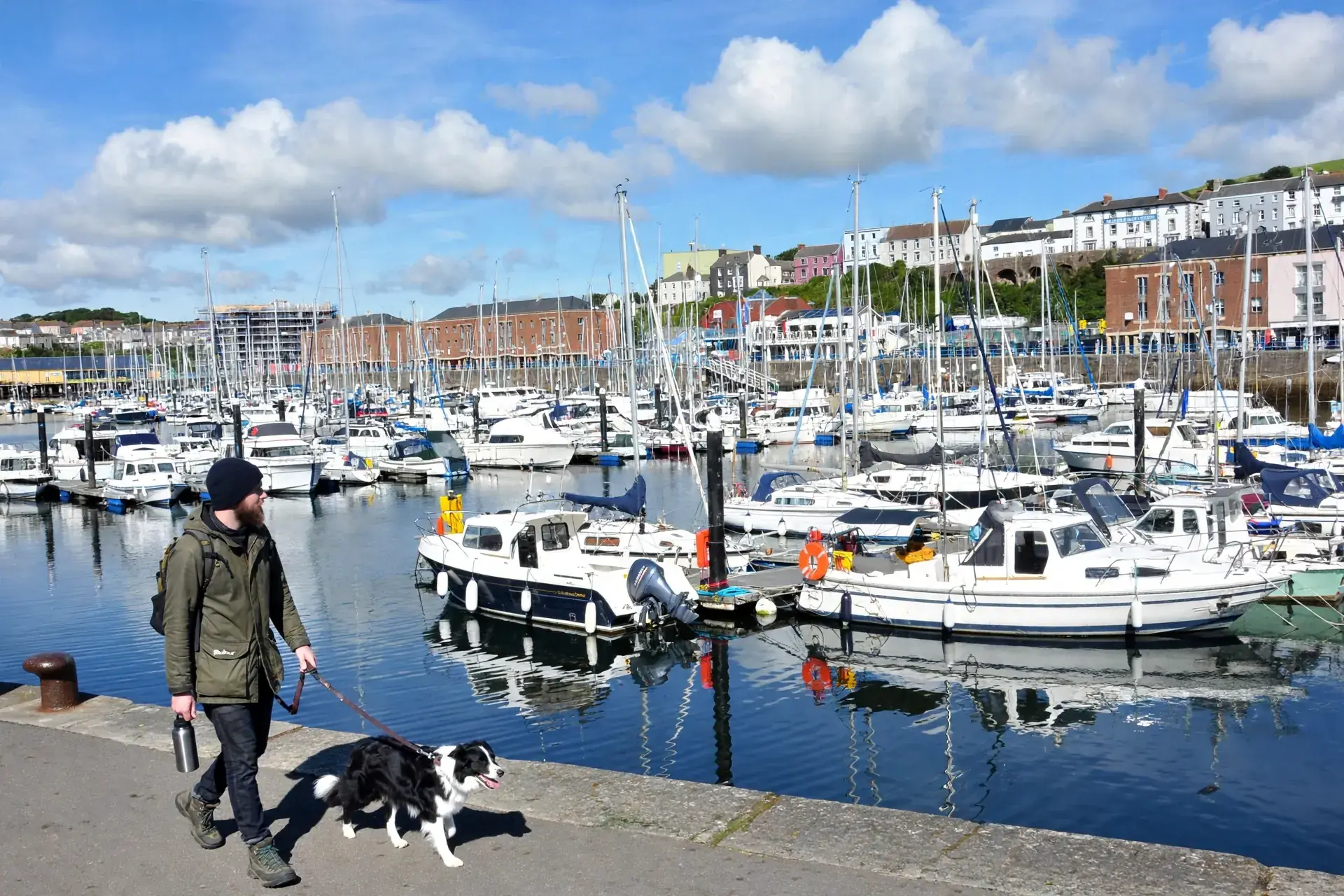
Milford Waterfront, the marina and leisure area at the heart of the town's quayside, is the natural starting point for a dog visit. This is where the working harbour and the visitor town meet most visibly: masts and moored boats on one side, cafes, restaurants, shops and open quayside space on the other, and the water itself always in view. The public waterfront paths here are paved and level, which makes them one of the easiest walks in the area for older dogs, dogs recovering from injury, and owners pushing a pushchair alongside a dog on a lead. The surface is kind to paws in dry weather, and the route is short enough to be a gentle first outing after a long drive.
Start by treating the marina as a place to look, not a place to roam freely. Dogs should stay on a lead throughout the waterfront and marina area, on the public paths rather than on the pontoons. The pontoons are working structures for berth holders: they move with the tide, they are narrow, they have cleats, ropes and gaps that can trap a paw, and a dog that slips or jumps from a pontoon into cold, deep water between boats is in real danger. Keep to the quayside, keep the lead short enough that the dog cannot reach the edge, and do not let the dog step onto a pontoon, climb onto a moored boat, or drink from the harbour water. The same caution applies to slipways and lock gates, where surfaces are wet, algae-slick and steeply sloped, and where boats and trailers are launched and recovered.
The marina is at its best as a slow, sniff-heavy walk rather than a march. Let the dog stop and watch the boats, the ropes and the water, and use the pauses to check the surroundings: where the nearest exit from the quayside is, where the traffic is moving, and where the next quiet stretch begins. Dogs that are nervous around noise will find the marina easier when there is little boat movement, so a first visit is better made early in the day or on a weekday than at a busy weekend changeover, when crews are loading, engines are running and trolleys are moving along the quayside. If the dog is already over-aroused by the time you reach the water, turn back towards the upper town or a quieter street rather than pushing on to the busiest part of the waterfront.
Facilities around Milford Waterfront include cafes and restaurants with outdoor seating, shops and the marina offices, and the area is a useful base for a short break: water for the dog, a place to sit, and toilets nearby. Dog policies inside individual cafes and restaurants vary, and they can change with the season, so check the official guidance before you travel and ask at the door rather than assuming a dog is welcome indoors. Outdoor seating is usually the safer bet, and a dog that can settle under a table on a mat is a much easier companion than one left tied up outside while the owner eats. Bring a water bowl and a mat of your own, because a borrowed bowl is not guaranteed and a familiar mat helps a dog settle in a busy place.
One practical habit pays for itself around any marina: carry poo bags and use them immediately. Quaysides, paved paths and grassy areas beside the water are shared by families, other dog owners, berth holders and people working on boats, and dog fouling left on a marina walk is both unpleasant and a fast way to make dog owners unwelcome. Bins are provided around the waterfront, but carry a spare bag and a small sealable pouch for the walk back to a bin. The same rule applies on the coast path and the beaches beyond the town, where there may be no bin at all for a long stretch.
The marina district also makes a good orientation point for the rest of the day. From here you can see the scale of the waterway, the direction of the tide, and the weather coming in from the west, and you can decide whether the dog is up for a coast path walk or would be happier with a short town loop and a beach visit by car. That decision, made honestly at the waterfront rather than halfway up a cliff path, is the difference between a good day and a tired dog being carried back to the car.
Part two: the waterfront walks
The walks that start from Milford Haven are the town's best feature for dog owners, because they change character so quickly. Within a short distance of the marina you can be on the Pembrokeshire Coast Path, on a woodland path, or on a quiet residential street with views across the water, and each of those suits a different dog and a different mood. The key is to choose the walk for the dog you have, not for the distance you would like to cover.
The most useful short walk is the waterfront and Hakin loop. From Milford Waterfront, follow the public paths west towards Hakin, the district on the western side of the town, and the shore at Gelliswick Bay. This is a small, sheltered bay close to the town, reached from the Hakin side, with limited roadside parking and a short walk down to the shore. It is a good place for a dog to paddle and sniff without the commitment of a long cliff walk, but it is also a place where the tide matters: the shore changes quickly as the water comes in, and a dog that is off lead near the water needs to be under reliable recall. Keep the lead on until you have checked the tide, the ground underfoot and the other dogs present, and remember that small coves often have no facilities and no easy escape route if the tide cuts around a headland.
For a longer walk, the Pembrokeshire Coast Path west from the town towards Dale is the classic route, and it is the one that most rewards a fit dog. The path runs from Sandy Haven, a tidal inlet west of Milford Haven, along grassy clifftops and red sandstone bays towards Dale, passing Great Castle Head, the grassy remains of an Iron Age hillfort on the headland. The published out-and-back route from Sandy Haven to Milford Haven is about 7.2 miles, and the shorter section from Sandy Haven to Great Castle Head is about 4 miles out and back, but neither figure should be treated as a target: walk as far as the dog is comfortable, then turn back, and treat the return leg as part of the distance, not an afterthought. The terrain is well trodden but uneven, with moderate climbs, stiles, gates and sections that can be muddy after rain, and the path runs close to cliff edges in places, so a lead is the right choice for most dogs, especially near livestock.
East of the town, the coast path continues towards Neyland and the upper reaches of the waterway, a different kind of walk altogether: more sheltered, more wooded in places, and with views across the water to the far shore rather than out to the open sea. This direction suits dogs that prefer shade and shelter to exposed clifftops, and it suits hot days, when the west-facing cliffs can be baking and the water below is a long way down. Whichever direction you choose, carry water for the dog, because there is no guarantee of a safe drinking source on the cliff path, and sea water is not a substitute: drinking it can make a dog ill, and salt water on a hot day is a particular risk.
Two local features deserve a specific warning. The first is the tidal crossing at Sandy Haven Pill, the inlet between Milford Haven and Dale, where the coast path route depends on the tide and can be impassable at high water. Check tide times before you set out, plan the crossing for low water, and do not attempt it if the water is already rising or the far bank is out of reach. The second is livestock: the coast path crosses farmland, and sheep and cattle are a normal part of the landscape around Milford Haven. Keep the dog on a lead near livestock, and use a short lead if the dog has a history of chasing. A dog that worries sheep can cause real harm and can put the owner in serious trouble, and the same caution applies to ground-nesting birds in spring and early summer.
Woodland offers a useful alternative when the coast path is too exposed or too busy. Goosepill Woods, the wooded area near the town, is a local favourite for dog walkers, with shaded paths that suit a hot day or a dog that finds open cliffs unsettling. Woodland walks have their own checks: keep the dog in sight on paths that cross, watch for adders in warm weather on sunny banks and clearings, and check the dog for ticks after any walk through long grass or bracken. The general rule for every walk around Milford Haven is the same: the prettiest route is not always the right one for the dog in front of you, and a shorter walk that ends with a settled dog is worth more than a longer one that ends with a limping one.
Heritage adds a gentler option for days when a long walk is not on the cards. The Milford Haven Heritage Trails are three short, waymarked routes around the waterfront, themed around the town's history as a harbour, its energy industry and its waterways. They are not dog-specific trails, but they are short, mostly level, and easy to follow with a dog on a lead, and they give a walk a shape and a stopping point rather than a vague wander. They are also a good wet-weather fallback: a short, purposeful loop with cafes and shelter nearby beats a long, exposed cliff walk in driving rain.
Part three: town life with a dog
Milford Haven the town is a working town rather than a holiday resort, and that is a useful thing to know before you arrive with a dog. The centre is compact, with shops, supermarkets, cafes, pubs and services within a short walk of the waterfront, and the streets climb gently away from the water towards the upper town. That climb matters for older dogs and for dogs with joint problems: a walk that looks short on a map can include a steady uphill stretch, and the return journey is downhill on hard pavements, which is harder on paws and joints than grass. Plan town walks as loops with rest stops, and use the car for the uphill leg if the dog is already tired.
Food and drink with a dog in Milford Haven follows the same pattern as in most Welsh towns: outdoor seating is the most reliable option, indoor dog policies vary from place to place, and a polite question at the door is worth more than an assumption. Some cafes and pubs around the waterfront welcome dogs indoors, others welcome them only outside, and policies can change between seasons or with a change of management, so check the official guidance before you travel and do not plan a meal around a single venue without a backup. A dog that can settle quietly under a table is welcome in far more places than one that barks, paces or begs, so a short settle-and-reward practice at home before the trip is time well spent. Bring the dog's own mat, a chew or a stuffed food toy for the wait, and water, and keep the lead short and tucked away so it does not trip staff or other customers.
Shopping with a dog is best kept short and practical. Supermarkets and most indoor shops do not admit dogs other than assistance dogs, so plan shopping as a separate errand, with one person staying outside with the dog, or do it before the dog's walk rather than after, when the dog is already tired and less able to wait patiently. Never leave a dog tied up outside a shop for longer than a few minutes, and never leave a dog in a car in warm weather, even with a window open: a parked car heats up far faster than most people expect, and a dog left inside can overheat in minutes. If you need to shop, choose a time when the dog can wait in the shade with a person, or leave the shopping for another day.
Stays in and around Milford Haven range from hotels and bed-and-breakfasts to self-catering cottages and holiday parks further out in Pembrokeshire. Dog policies vary widely: some places welcome dogs in all rooms, some only in selected rooms, some charge a per-dog fee, and some set a limit on the number or size of dogs. The questions that matter are the same ones that matter anywhere: is the specific room or unit dog-friendly, is there a fee and what does it cover, where is the nearest toilet walk after dark, is there a secure place for the dog to be left briefly, and what happens if the dog barks? Get the answers in writing with the booking, and check the boundary of any garden or patio on arrival, because a "secure" garden photographed from one angle may have a gap, a low wall or a gate that a determined dog can open. For a longer stay in Pembrokeshire, our guide to dog-friendly holiday parks in Wales covers the coast-versus-countryside choice, livestock rules and the booking checks that matter most.
The town is also a practical base for dog owners in a way that a small village is not. There are vets in the area, pet supplies in the town, and a choice of car parks and toilets, which makes it a good place to regroup after a coast walk: dry the dog, refill the water bottle, check paws for cuts or thorns, and decide whether the next outing is a beach, a woodland walk or simply a rest. Save the number of the nearest vet before you need it, and note the opening hours, because rural practices can close early and the nearest emergency vet may be a drive away. A basic first-aid kit for the dog — tick remover, saline for eyes, a bandage, and any regular medication — belongs in the car, not at home.
Noise is the town-life factor that catches some dogs out. Milford Haven is a port town, so the soundscape includes lorries, reversing alarms, boat engines, horns, gulls and, on some days, work at the docks and terminals further down the waterway. Most dogs settle quickly, but a noise-sensitive dog, a rescue that is still learning the world, or a puppy on its first big trip may find the waterfront overwhelming at first. Introduce the town gradually: a short, calm walk on a quiet street first, a pause at a distance from the busiest quayside, and a retreat to the car or the accommodation if the dog's body language says it has had enough. A dog that is allowed to retreat is a dog that will be braver next time; a dog that is pushed through fear learns that the waterfront is a place to dread.
Part four: the coast beyond the port
Step beyond Milford Haven and the port gives way to one of the finest stretches of coast in Wales, and that is the real reason many dog owners come here. The town is a gateway, not a destination in itself: to the west lies the Marloes Peninsula and the coast path towards Dale, Marloes and St Brides Bay; to the south, across the mouth of the waterway, lie Angle, West Angle Bay and Freshwater West; and to the north and east, the coast path runs towards Neyland, the Cleddau estuary and the wider Pembrokeshire coast. Each of these is a short drive from the town, and each gives the dog a very different day from the one it had on the marina.
Dale, the small village at the end of the peninsula west of Milford Haven, is the nearest coastal village and the most useful day trip. It has a sheltered, east-facing beach, a sailing club, a pub and a handful of places to eat, and it is the starting point for coast path walks in both directions. Dale Beach is dog-friendly on its southern section, but the northern part of the beach has a seasonal dog restriction from 1 May to 30 September, so read the signs at the beach entrance and keep the dog to the permitted area in summer. The village is small and can be busy on a sunny weekend, so arrive early, park considerately, and keep the dog on a lead through the village streets, where cars, boats on trailers and pedestrians share narrow lanes.
West Angle Bay, at the southern tip of the peninsula near Angle, is a different kind of beach: a sandy bay with a car park, toilets and a cafe nearby, and a coast path that runs east towards the mouth of the waterway and west towards Freshwater West. It is a good base for a longer coast walk, but the same cautions apply as everywhere on this coast: check the tide, keep the dog on a lead near the cliff edge, and watch for livestock on the farmland sections of the path. Freshwater West, the large, wild beach to the south, is a dramatic place for a dog to run, with a huge expanse of sand at low tide, but it is exposed, it has strong currents, and it can be windy even on a calm day in town, so it is a beach for a confident dog with reliable recall, not for a first off-lead experiment.
Further afield, the Pembrokeshire coast offers the contrast that makes a Milford Haven base work so well. Tenby, about an hour's drive to the east, is a walled seaside town with a harbour, pastel houses and a set of beaches that each have their own seasonal rules, and it is worth a day trip if you want a busier, more resort-like change of scene; our guide to Tenby with a dog sets out the beach bans beach by beach. St Davids, the small city to the north-west, offers a cathedral, a headland walk and Whitesands Bay, and the contrast with Milford Haven could hardly be sharper: one is a working port, the other a quiet cathedral city on an open headland; our guide to St Davids with a dog covers the cathedral rules, the bay and the boat trips. Between the two, the coast path and the beaches of the St Brides Bay area give a dog the open running that the marina cannot, and the drive between them is itself part of the holiday.
The coast beyond the port also brings the wildlife that makes Pembrokeshire special, and the responsibility that goes with it. Seals haul out on rocks and beaches around the coast, and a dog that chases a seal can injure the animal and itself; keep the dog on a lead and at a distance whenever seals are visible, and never let the dog approach a seal pup on a beach. Ground-nesting birds, including choughs on the cliff tops, are easily disturbed in spring, and the coast path passes through farmland where sheep, cattle and horses graze. The rule is simple and it never changes: if there is wildlife or livestock in view, the dog stays on a lead, and if the dog cannot be trusted near them, the dog stays on a lead anyway.
History is part of the coast here too. The headlands around Milford Haven are dotted with the remains of forts, hillforts and lookouts, from the Iron Age earthworks at Great Castle Head to the Victorian forts that guard the mouth of the waterway, and the castles of Pembrokeshire are a short drive away. If a castle day appeals, our guide to dog-friendly castles in Wales explains which sites welcome dogs, where leads are required and how castle zones differ. A castle visit with a dog is a different kind of day from a beach day, and it suits a dog that enjoys sniffing around old stone and grassy banks more than one that needs an hour of open running.
Watching ships with a dog
Watching ships is the pleasure that Milford Haven does better than almost any other town in Wales, and it is also the one that needs the most patience from a dog owner. The waterway is deep and sheltered, and large vessels move through it at all hours, from cargo ships and tankers to ferries, fishing boats, pilot boats and the occasional naval vessel. The best vantage points are the public waterfront at Milford Waterfront, the shore at Hakin, and the higher ground above the town, where the whole sweep of the waterway is visible and the dog has room to sit and watch without being close to the water's edge.
Choose a watching spot the way you would choose a picnic spot: with space, shade, a clear view, and a safe distance from the edge. A short lead and a mat give the dog a defined place to settle, and a chew or a scatter of treats on the mat gives the dog something to do while you watch the water. Dogs that are new to ships may be startled by a horn or by the wash of a large vessel, so start at a distance, let the dog hear the sounds from a place where it can move away, and do not hold the dog close to the edge while a ship passes. If the dog is barking at every boat, it is not enjoying the spectacle; move further back, shorten the session, or save the ship-watching for a quieter time of day.
Boat trips from Milford Haven are a separate question, and the honest answer is that it depends on the operator. Some harbour and wildlife trips welcome dogs on deck, while others do not allow them at all, and the rules can depend on the size of the boat, the length of the trip and the weather. Check the official guidance before you travel, ask the operator directly, and be realistic about the dog: a trip that involves engines, spray, a crowded deck, a steep gangway and an hour or more without a toilet break is a lot to ask of a nervous, elderly or seasick-prone dog. A dog that is happy on a boat at home may still be unsettled by a working harbour boat, and a dog that is unhappy on a boat will not enjoy the trip, however good the wildlife is. If in doubt, enjoy the ships from the shore, where the dog can watch, sniff and leave whenever it likes.
Seals and other wildlife are part of the ship-watching experience, and they deserve the same respect as the ships. Seals sometimes appear in the waterway, and dolphins and porpoises are seen off the Pembrokeshire coast, but a dog that barks at them or lunges towards the water will not improve the sighting for anyone. Keep the dog settled, keep the lead short, and let the wildlife come to you. The same applies to the gulls and other birds around the marina: a dog that chases gulls on a quayside is a hazard to itself, to other people and to the birds, and it is a fast way to be asked to leave.
Photographs are part of the fun, but keep them simple and safe. The best ship photographs from Milford Haven are taken from the public waterfront with the dog sitting beside you, not from a pontoon or a slipway, and not with the dog held up for a picture near the water's edge. Keep the lead in your hand, keep the dog on the landward side of the path, and do not ask the dog to pose on a wall, a bollard or a mooring post. A photograph of a dog watching a ship from a safe distance is a better memory than one taken in a risky spot.
Avoiding the busy times
The marina and waterfront are at their busiest on sunny weekends, during school holidays, on event days and at the times when boats are moving most: late morning and mid-afternoon, when crews arrive, boats are prepared, and cafes fill for lunch. Add a cruise or a large vessel movement, a market, or a waterfront event, and the quayside can change from a quiet walk to a crowded thoroughfare in the space of an hour. For a dog, the difference is not just the number of people: it is the noise, the trolleys, the reversing vehicles, the dogs on long leads crossing the path, and the smell of food from every cafe at once.
The simplest way to avoid the worst of it is to walk early or late. An early-morning walk, before the cafes open and while the marina is still quiet, gives the dog the waterfront almost to itself, with cool air, soft light and the first boats of the day moving on the water. An early-evening walk, after the day's boat traffic has eased and the lunch crowds have gone, is often just as calm, and the light over the waterway at that hour is some of the best in Pembrokeshire. Midday in high summer, by contrast, is the time to be somewhere else: a shaded woodland walk, a beach at low tide, or a quiet drive to a less crowded stretch of coast.
Weekdays are calmer than weekends, and term-time weekdays are calmer still. If your trip falls on a bank holiday or in the school summer holidays, plan the marina walk for the early morning and save the middle of the day for the coast path or a beach where there is room to spread out. If you arrive and find the waterfront already crowded, do not force the walk: turn back, drive to Hakin or to a quieter car park, or walk the upper town instead. A short, calm walk that the dog enjoys is worth more than a long, crowded one that leaves the dog stressed and the owner frustrated.
Busy times also change the practical details. Car parks at the waterfront fill early on sunny weekends, and the walk from an overflow car park to the marina can be along a busy road, so arrive early or park further out and walk in on a quieter route. Cafes with outdoor seating fill up, and a dog that has to wait in a queue or sit beside a crowded table is less likely to settle. Toilets, bins and water points are busier too, so carry your own water and poo bags rather than relying on finding them. And if the dog is reactive to other dogs, the busy waterfront is the wrong place to practise: choose a quieter time or a quieter route, and keep the lead short and the distance generous.
Finally, watch the weather as well as the calendar. Milford Haven is exposed to westerly weather, and a bright morning can turn to wind and rain by the afternoon, with the waterway choppy and the quayside wet and slippery. Check the forecast before you set out, and have a wet-weather plan: a short heritage trail loop, a drive to a sheltered beach, or a quiet afternoon at the accommodation with a chew and a rest. Dogs do not mind rain as much as owners do, but a wet, cold dog on an exposed cliff path is a different matter from a wet dog on a short town walk, and the wind on the waterway can be strong enough to make a small dog unsteady on its feet.
Beaches, tides and seasonal rules
Beaches are the part of a Milford Haven trip where the rules matter most, because they change from beach to beach and from season to season, and the sign at the entrance is the authority, not a guidebook or a memory from a previous visit. The beaches closest to the town are small and sheltered; the beaches a short drive away are larger, wilder and more exposed. Both kinds reward a dog owner who checks the tide and the signs before letting the dog off the lead.
Sandy Haven, the tidal inlet west of the town, is the most useful beach for a dog owner staying in Milford Haven. There are no restrictions on dogs, the sand appears at low tide, and the walk from the small car park to the shore is short. The same tidal character is the warning: the beach is mostly usable as a sand beach at low tide and can be rocky or shingle at high tide, and the crossing at Sandy Haven Pill is tide-dependent, so check tide times, arrive with the tide falling, and leave with time to spare. There are no facilities at Sandy Haven, so carry water, poo bags and a towel, and take everything away with you.
Gelliswick Beach, the small beach near Hakin, is a convenient local option for a short paddle and a sniff, with limited roadside parking and a short walk to the shore. It is a good choice for a dog that needs a brief outing rather than a long beach session, and for an owner who wants to stay close to the town. Dale Beach, a short drive west, is larger and better served, but it has the seasonal restriction described above: the northern part of the beach is closed to dogs from 1 May to 30 September, while the southern section remains open, so read the signs and keep the dog in the permitted area. Priory Bay and Watwick Bay, the quiet beaches near Dale, are reached on foot along the coast path and have no direct car park, which keeps them quiet but also means a longer walk in and out, with no facilities.
Further south, West Angle Bay and Freshwater West offer bigger, wilder beaches, but they also bring stronger currents, more wind and more exposure, and they are not places to let a dog swim without thinking. Dogs can get into difficulty in the sea just as people can, and the currents off the Pembrokeshire coast are strong, especially near headlands and at the mouth of the waterway. Let the dog paddle at the edge rather than swim out, keep the dog in sight, and call the dog back before it gets out of its depth. After any beach visit, rinse the dog with fresh water if you can, check the paws for cuts from shells or rocks, and check the ears for sand and water, especially in dogs with floppy ears.
Seasonal rules are not the only ones that change. Some beaches have lifeguards in summer, some have none at all, and the presence of a lifeguard does not make a beach safe for a dog to swim in. Some beaches have dog bans on part of the beach only, some have bans at certain times of day, and some have no restrictions at all, and the only reliable way to know is to read the sign at the entrance on the day. If a beach has a dog ban, respect it: the ban exists because the beach is busy with families, because there are nesting birds, or because the beach is a working slipway, and breaking it makes life harder for every dog owner who comes after you. Check the official guidance before you travel for the current rules at the beaches you plan to visit, because a rule that was true last summer may not be true this one.
Practical checklist
A Milford Haven trip with a dog is easy to pack for once you know the town: the list is the same as for any Pembrokeshire coast trip, with a few harbour-specific additions. Start with the basics: a lead and a spare, a harness that fits, poo bags and a sealable pouch, a water bottle and a collapsible bowl, a towel and a drying coat, a mat for cafes and for ship-watching, and the dog's regular food, measured out for the trip. Add a tick remover, a basic first-aid kit, any regular medication, and the number of the nearest vet saved in your phone. A long line is useful for beaches and open ground, but it is a hazard on a quayside, a cliff path or a busy street, so use a short lead in town and save the long line for open space where there is room to use it safely.
Parking is straightforward if you arrive early and use the signed car parks. Milford Waterfront and the town centre both have car parks, and there are smaller car parks and roadside parking at Hakin, Gelliswick, Sandy Haven and Dale, but the smaller ones fill quickly on a sunny weekend and some have time limits. Check the official guidance before you travel for current charges and time limits, park where you can unload the dog away from moving traffic, and never leave the dog in the car. On a hot day, the car is the most dangerous place in the whole trip, and the shade that was there when you parked may be gone by the time you return.
Safety around the water deserves its own paragraph, because it is the risk that is easiest to underestimate. The waterway is deep, cold and tidal, and the quayside edge is a hard drop into deep water. Keep the dog on a lead near the edge, do not let the dog jump or fall in, and know what you would do if it did: a dog in cold water can panic, tire quickly and struggle to find a way out, and an owner who jumps in after it is in danger too. If a dog falls in, call for help, throw a lifebuoy or a rope if one is available, and guide the dog to a slipway or steps rather than trying to lift it straight up a vertical quay wall. Teach the dog a reliable recall and a "leave it" before the trip, and practise both on a long line on a beach before you need them beside a harbour.
Weather and clothing are the last practical point, and they matter more in Milford Haven than in a sheltered inland town. The wind off the waterway can be strong, the rain can arrive quickly, and the temperature on an exposed cliff path can be several degrees colder than in the town. Pack a waterproof for yourself and a drying coat for the dog, and carry an extra layer even on a sunny morning. Footwear matters too: the quayside is paved and easy, but the coast path is uneven, muddy after rain and slippery on wet rock, so wear walking boots or sturdy shoes with grip, and check the dog's paws after every walk for cuts, thorns or salt irritation.
A calm half-day plan
If you have only half a day in Milford Haven with a dog, the plan below gives the town at its best without rushing the dog or the owner. Start early, before the waterfront gets busy, with a slow walk around Milford Waterfront and the marina, on a short lead, with pauses to watch the boats and the water. Let the dog sniff, let the dog watch, and do not try to cover a long distance: the point of the first hour is to let the dog settle into the sounds and smells of the port.
From the waterfront, walk west towards Hakin and Gelliswick Bay for a short shore visit, or drive to Sandy Haven for a low-tide beach walk, depending on the tide and the dog's energy. A beach visit at low tide, with room to run and paddle, is the reward after the on-lead discipline of the marina, and it is the part of the day the dog will remember. Keep the beach session short enough that the dog is still happy at the end of it, and leave while the dog is still keen rather than waiting until it is tired.
Finish with a late lunch or a drink at a waterfront cafe with outdoor seating, with the dog settled on its mat under the table, and a slow drive back through the town. If the dog still has energy, a short woodland walk at Goosepill Woods or a heritage trail loop is a gentle way to end the day; if the dog is tired, a rest at the accommodation is the right ending. The best Milford Haven day is not the longest one, and it is not the one that covers the most miles: it is the one where the dog comes home tired, dry, and happy to do it all again tomorrow.
For a longer stay, use Milford Haven as a base and vary the days: a marina and town day, a coast path day west towards Dale, a beach day at Sandy Haven or West Angle Bay, and a day trip to Tenby or St Davids for a change of scene. The town's position on the waterway makes it a practical base for the whole of south Pembrokeshire, and the dog will enjoy the variety far more than a repeat of the same walk every day. Keep one day in reserve for bad weather, and use it for a short town walk, a drive to a sheltered beach, or a rest day: a dog that is given a rest day is a dog that will enjoy the next walk all the more.
Practical questions
Before you go
Can dogs walk around Milford Haven marina?
Yes, dogs can walk the public waterfront paths around Milford Waterfront and the marina on a lead, but the pontoons and private berths are not dog-walking areas. Keep your dog on a short lead near the water edge, lock gates and moving boats, and do not let the dog step onto pontoons or climb on moored boats.
Which beaches near Milford Haven allow dogs all year?
Sandy Haven has no dog restrictions, and Gelliswick and several small coves west of the town are generally open to dogs, but Dale Beach has a seasonal restriction on part of the beach from 1 May to 30 September. Rules change, so read the signs at each beach entrance and check the official guidance before you travel.
Is the Pembrokeshire Coast Path near Milford Haven suitable for dogs?
Yes, for dogs that are fit and kept on a lead where the path runs beside cliffs or livestock. The stretch from Sandy Haven towards Dale passes Great Castle Head and red sandstone bays, but it has uneven ground, stiles and tidal crossings, so check tide times, carry water and turn back before the dog tires.
Can I take my dog on a boat trip from Milford Haven?
It depends on the operator and the trip, and most boat operators set their own dog rules, so check the official guidance before you travel. Some wildlife and harbour trips welcome dogs on deck, while others do not allow them at all, and a dog that is nervous around engines, spray or crowded decks is usually happier staying ashore.
When is the marina busiest, and when should I avoid it with a dog?
The waterfront is busiest on sunny weekends, school holidays and event days, especially late morning and mid-afternoon when boats are moving and cafes are full. For a calmer visit, walk early in the morning or in the early evening, avoid the busiest pontoon gates and quaysides at changeover times, and give a nervous dog a quieter route through Hakin or the upper town.
Where can I park with a dog in Milford Haven?
Use the signed car parks at Milford Waterfront and around the town centre, and check the official guidance before you travel for current charges and time limits. Arrive early on busy days, park where you can unload the dog away from moving traffic, and never leave a dog in a parked car in warm weather.