This guide is independent and contains no paid placement. If affiliate links are added later, they will be clearly marked and will not change our editorial checks.
Monmouth rewards a slow pace: walk the Wye in the morning, cross the Monnow Bridge into the old town for lunch, and save the longer valley walks for a second day. Keep your dog on a lead by the river, near roads and livestock, and check the official guidance before you travel for river conditions, path closures and venue rules.
Start on the river, not in the town
Monmouth is a town defined by two rivers. The River Wye sweeps past its eastern edge, wide and calm in dry weather and powerful after rain, while the smaller River Monnow joins it here after running down from the hills. The town sits in Monmouthshire, in south-east Wales, close to the English border, and that position shapes everything about a visit with a dog: the walks are riverside and wooded, the history is about crossing points and defences, and the pace is gentler than a city break. The best way to understand the place is to start on the riverbank, not in the car park.
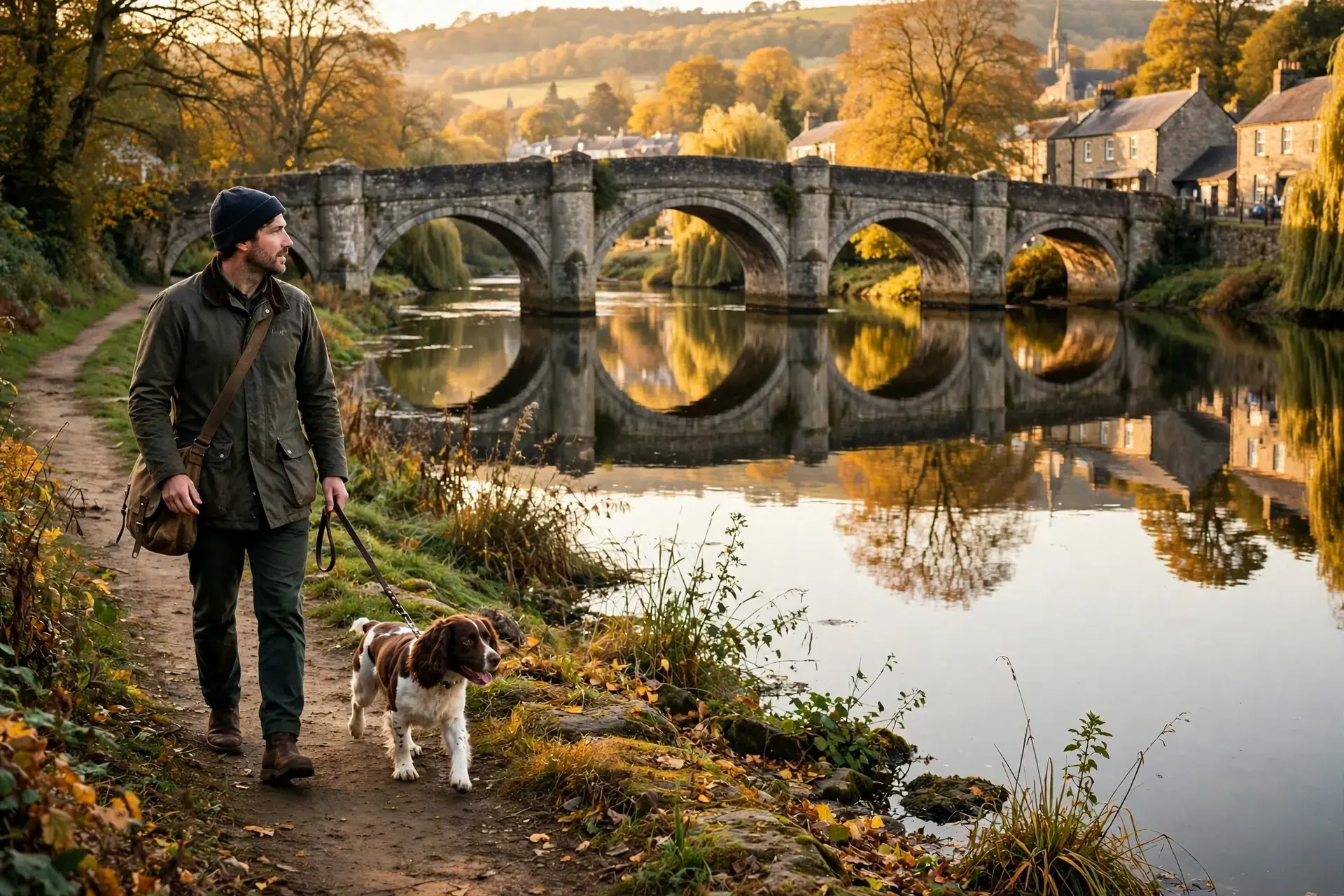
Begin with the riverside meadows and paths on the Wye side of town. Vauxhall Fields and Chippenham Mead are the open green spaces most visitors meet first, and they work well as a first walk because they let a dog stretch its legs, sniff, and settle before the narrower streets. On a dry morning the grass is firm and the views across the water to the wooded hills are wide; after rain the same ground can be soft and muddy, so pack a towel and a drying coat if the forecast is wet. Keep your dog on a lead where the path runs close to the bank, and use a long line only where you have a clear view ahead and no cyclists, anglers or other dogs are approaching.
The Wye is a working river as well as a scenic one. Anglers fish its banks, canoeists and kayakers paddle its length, and walkers follow the Wye Valley Walk through the town. That shared use is part of the charm, but it means a dog owner needs to stay alert. A dog that lunges at moving water, chases ducks, or rushes towards a canoe can create a problem in seconds. Teach, or at least practise, a reliable recall and a calm wait before you arrive, and reward your dog for ignoring the distractions that the river throws at it. If your dog is new to rivers, let it watch the water from a distance first, on a lead, before you walk close to the edge.
Morning is the best time for the river walk. The light is softer, the paths are quieter, and the dog can work through its first burst of energy before the town wakes up. Walk out along the bank, pause where the river bends, and turn back before your dog is tired rather than after. A riverside loop of forty to sixty minutes is enough for most dogs on a first day, especially if the walk includes sniffing time, a water break, and a few calm pauses. Bring drinking water even though a river is beside you: river water is not a reliable drinking source, and dogs that drink from it can pick up stomach upsets, particularly after heavy rain when run-off is high.
Watch the ground as well as the water. Riverside paths can hide broken glass near bridges, fishing hooks and line near popular angling spots, and slippery mud on the slope down to the water. Check your dog's paws after a riverside walk, especially in winter when the bank is wet and cold, and carry a small first-aid kit with a tick remover, because riverside grass and woodland edges are good tick habitat from spring through autumn. If you find a tick, remove it promptly and watch the bite site over the following days.
Cross the Monnow Bridge into the old town
From the Wye, follow the Monnow back towards the town centre and you reach Monmouth's most famous sight: the Monnow Bridge. It is the only remaining fortified river bridge in Britain with its gatehouse still standing on the bridge itself, a stone arch with a small towered gateway that once controlled who could enter the town. Today it carries pedestrians across the river into the old town, and crossing it with a dog is one of those small travel moments that stays with you: the stone underfoot, the river running below, and the market streets opening up on the other side.
Cross on a short lead. The bridge is narrow, the parapets are low by modern standards, and other walkers, including families with children and people with pushchairs, use the same crossing. Keep your dog close to your side, pass others patiently, and do not let your dog climb on the stonework or jump up at the parapet. The gatehouse itself is a place to pause and look, not a place to linger with a restless dog in a busy moment. If the bridge is crowded, wait a minute for a gap rather than squeezing through with a dog that is already over-excited.
On the far side, Agincourt Square opens out as the town's historic heart. The square takes its name from the Battle of Agincourt in 1415, and Henry V, who was born in Monmouth, is part of the town's story. The Shire Hall stands on the square, a handsome Georgian building that once served as the town's court and assembly rooms, and the square is ringed by shops, cafes and pubs. It is a good place for a dog to practise settling: find a bench, sit for ten minutes, let the dog watch the world go by, and reward calm behaviour. Dogs that can settle in a busy square can settle almost anywhere in town.
The old town rewards walking slowly. Monnow Street runs from the bridge towards the square, lined with a mix of Georgian and Victorian shopfronts, and the side streets hold older houses, a churchyard, and the kind of details that are easy to miss at driving speed. Look up as you walk: the rooflines, the plaques, and the variety of stone and brick tell the story of a market town that grew up around its river crossings. For a dog, the interest is closer to the ground: new smells at every corner, other dogs to greet or ignore, and the occasional dropped crumb outside a bakery. Keep the lead short on pavements, step aside for other pedestrians, and carry bags for the inevitable.
If your dog is nervous in towns, use the bridge crossing as a training exercise rather than a test. Walk towards it, pause before the narrow section, let the dog take in the sound of the river below, and cross when the dog is calm. Cross back the same way if you need to, and do not force a frightened dog across a bridge it is not ready for. A dog that has had a good river walk first will usually be calmer and more willing than one taken straight from the car into a busy street.
River levels, banks and water safety
The Wye looks gentle in summer, but it is a large river with a wide catchment, and its level can rise quickly after rain in the Welsh hills. That is the single most important safety fact for a dog owner in Monmouth. A bank that was dry and easy in the morning can be slippery, undercut or partly flooded by the afternoon, and a shallow edge that looked safe for paddling can become fast-moving water. Check the official guidance before you travel for river levels and flood warnings, and check again on the day if it has rained recently.
Never let a dog swim in the Wye near weirs, bridges, fast water or after heavy rain. The current below a weir can hold a strong swimmer under, and the water around bridge piers can swirl unpredictably. Even a confident swimming dog can tire quickly in cold, fast water, and a dog that panics can be very hard to rescue from a steep or muddy bank. If your dog loves water, choose a shallow, slow-moving edge where you can see the bottom, where the bank slopes gently, and where you can reach your dog easily. Keep the session short, keep the lead or long line attached until you are sure of the conditions, and dry your dog afterwards.
Water quality is another reason for caution. The Wye has faced well-publicised concerns about pollution in recent years, and conditions can vary along its length and after storms. That does not mean a dog can never paddle, but it does mean you should not treat the river as a clean swimming pool. Discourage your dog from drinking river water, rinse your dog with clean water after paddling, and watch for stomach upsets or skin irritation in the days after a swim. If your dog develops vomiting, diarrhoea or unusual lethargy after being in the river, contact a vet promptly and mention the river exposure.
Blue-green algae is a risk to be aware of in warm, still water in summer. It can appear as a green scum or paint-like film on the surface, and it is toxic to dogs. If you see it, keep your dog out of the water entirely, do not let your dog drink from it, and report it through the official channels if you can. Check the official guidance before you travel for any current algae or water-quality warnings, and teach yourself to recognise the signs before your trip rather than during it.
Flooding affects the walking routes as well as the water. Riverside paths and meadows in Monmouth can flood in winter and after prolonged rain, and a path that is passable in the morning can be closed by the afternoon. Do not walk a dog through flood water: it can hide deep holes, fast currents, debris and contaminated water, and it can be very cold. If a riverside path is flooded, use the higher streets instead and save the river walk for a drier day. The town itself is walkable without the riverbank, and a flooded path is a reason to change plans, not to push on.
Finally, think about your own safety as well as your dog's. Never enter fast or deep water to rescue a dog; call for help instead. Keep your phone charged and in a waterproof pocket on river walks, know where the nearest vet is before you set out, and tell someone your route if you are walking alone on a longer valley path. A dog on a lead is safer than a dog off lead near a river, and a dog owner who plans for the worst is the one most likely to enjoy the best of the Wye.
Market streets and old buildings
Monmouth's market-town character is best enjoyed on foot, at dog pace. The town has been a market centre for centuries, and the weekly market tradition, the independent shops, and the mix of old coaching inns and Georgian houses give it a different feel from the larger Welsh cities. For a practical comparison with a bigger city break, our guide to Cardiff with a dog shows how a river, a castle and a park change the shape of a day out; Monmouth is the smaller, slower version of that idea, and many dogs prefer it.
Start in Agincourt Square and work outwards along Monnow Street and the streets around it. The Shire Hall dominates the square, and its steps and facade are a reminder that this was once a place of courts, assemblies and public ceremony. The building's history includes the trial of the Chartists in 1840, a chapter that is commemorated in the town, and the square still hosts markets and events. Check the official guidance before you travel for market days and event dates, because a market day changes the town: more stalls, more people, more smells, and more reasons for a dog to stay on a short lead and close to you.
The shops along Monnow Street are a mix of independents and familiar names, with bookshops, delicatessens, cafes and outdoor shops among them. Some welcome dogs inside; others prefer dogs to wait outside or in the doorway. The rule is simple and polite: ask before you enter, read any sign on the door, and do not assume that because one shop welcomed your dog, the next one will. A dog that waits calmly outside a shop while you pop in for five minutes is a useful skill to practise at home before a town visit, and a travel mat helps a dog settle on a pavement without lying on cold stone.
Look for the older buildings as you walk. St Mary's Church, with its tall spire, stands close to the town centre, and its churchyard is a quieter pocket away from the main streets. The Nelson Garden, a small walled garden associated with Lord Nelson's visit to the town, is another calm spot, though access and rules can change, so check the official guidance before you travel before planning a visit with a dog. The Great Castle House, a grand house built on the site of Monmouth Castle, and the remains of the castle itself, are part of the town's layered history: a Norman castle, a birthplace of a king, and a market town that grew up in its shadow.
Monmouth Castle itself is largely ruined, and its remains are more a place to look and learn than a place for a long dog walk. That is worth knowing before you go, because castle-loving dog owners often want to combine a town visit with a castle visit. Our guide to dog-friendly castles in Wales explains which sites welcome dogs, where leads are required, and how castle zones differ, so you can plan a castle day that suits your dog rather than arriving with the wrong expectations. Monmouth works best as the town part of that plan: the history is in the streets, the bridge and the square, and the castle is a short stop within a longer walk.
Eating and drinking in town with a dog is usually straightforward if you plan ahead. Many pubs and cafes in Monmouth welcome dogs in at least part of their premises, often in a bar area or on a terrace, and a dog that can settle under a table is welcome almost anywhere that allows dogs at all. Call ahead or check the venue's own information before you set out, especially if you are visiting on a weekend or with a large dog, and bring a mat, a water bowl and a chew or a stuffed Kong to keep your dog occupied while you eat. If a venue is full or does not allow dogs inside, the terrace or a takeaway eaten on a bench by the river is a good fallback, and often a better one for a dog that finds indoor spaces stressful.
Boating and paddling on the Wye
The Wye is one of Britain's best-known canoeing rivers, and Monmouth is a natural stopping point on a paddling journey down the valley. For dog owners, the question is not whether the river is beautiful from a canoe, because it is, but whether taking a dog on the water is sensible for that particular dog on that particular day. The honest answer is that it depends on the dog, the boat, the water level, and the experience of the people in the boat, and it is a decision to make with a local operator rather than on the riverbank.
If you are considering a canoe or kayak trip with your dog, talk to a local hire company or guided-trip provider before you book. Ask whether dogs are allowed, what size of boat is suitable, whether a dog buoyancy aid is provided or required, and what happens if the dog becomes distressed or the boat capsizes. A calm, water-confident dog that will sit still in a boat is a very different passenger from a young dog that jumps at ducks or tries to climb out. Many operators will be honest about which dogs they can take, and their advice is worth more than any general guide. Check the official guidance before you travel for current river conditions and any restrictions on launching or landing.
For most visitors, the better option is to enjoy the river from the bank and leave the boating to the paddlers. Watch the canoes go by from a riverside bench, let your dog watch them too, and use the moment to practise calm observation. If your dog is reactive to boats or to people on the water, increase the distance, reward calm behaviour, and move on before the dog becomes fixated. A dog that can watch a canoe pass without lunging is a dog that will cope well with the rest of the Wye Valley.
Paddling without a dog is also worth considering if you are travelling as a pair: one person can paddle a short stretch while the other walks the dog along the bank, meeting at a bridge or a landing point. That way the dog still gets a walk, the paddler still gets the river, and nobody has to manage a restless dog in a boat. Plan the meeting point in advance, agree a time, and carry a phone, because river time and walking time do not always match.
Stand-up paddleboarding is another way people enjoy the Wye, but it is not a good first water activity for a dog. A paddleboard is less stable than a canoe, the dog has less space, and a fall into the river is more likely. If you see paddleboarders with dogs, they are usually experienced pairs who have practised in calm water many times. Do not copy them on your first visit. The river will still be there next year, and a dog that has learned to love the bank is a better paddling companion in the future than a dog that was frightened on its first outing.
Border walks: Offa's Dyke and the Wye Valley
Monmouth's border position is more than a line on a map; it is a walking opportunity. The Offa's Dyke Path, a long-distance National Trail that follows the historic earthwork along the England-Wales border, passes close to the town, and the Wye Valley Walk follows the river through the town and on through the wooded gorge downstream. Together they give a dog owner two very different kinds of walking from a single base: a ridge-and-border walk with views, and a river walk with shade, water and woodland.
The Offa's Dyke Path is a serious long-distance route, but you do not need to walk it end to end to enjoy it. Choose a short section near Monmouth, walk out for an hour, and return the same way, or arrange a linear walk with a lift at the other end. The path can be steep, exposed and uneven in places, and it crosses farmland where livestock may be present, so keep your dog on a lead through fields, close gates behind you, and check the official guidance before you travel for path conditions and any diversions. Good footwear matters more on this path than on the riverside meadow, and a dog that is fit for a flat town walk may still find a steep border ridge tiring.
The Wye Valley Walk is the gentler of the two for most dogs. It follows the river through woodland and meadows, with shade in summer and shelter from wind in winter, and it offers the kind of sniff-rich, varied walking that tires a dog out without exhausting it. The section downstream from Monmouth towards the Wye Valley gorge is particularly attractive, with wooded slopes and river views, but it can be muddy after rain and narrow in places where the path runs close to the water. Keep your dog on a lead where the path is narrow or the drop to the river is steep, and be ready to step aside for other walkers and for cyclists where the route is shared.
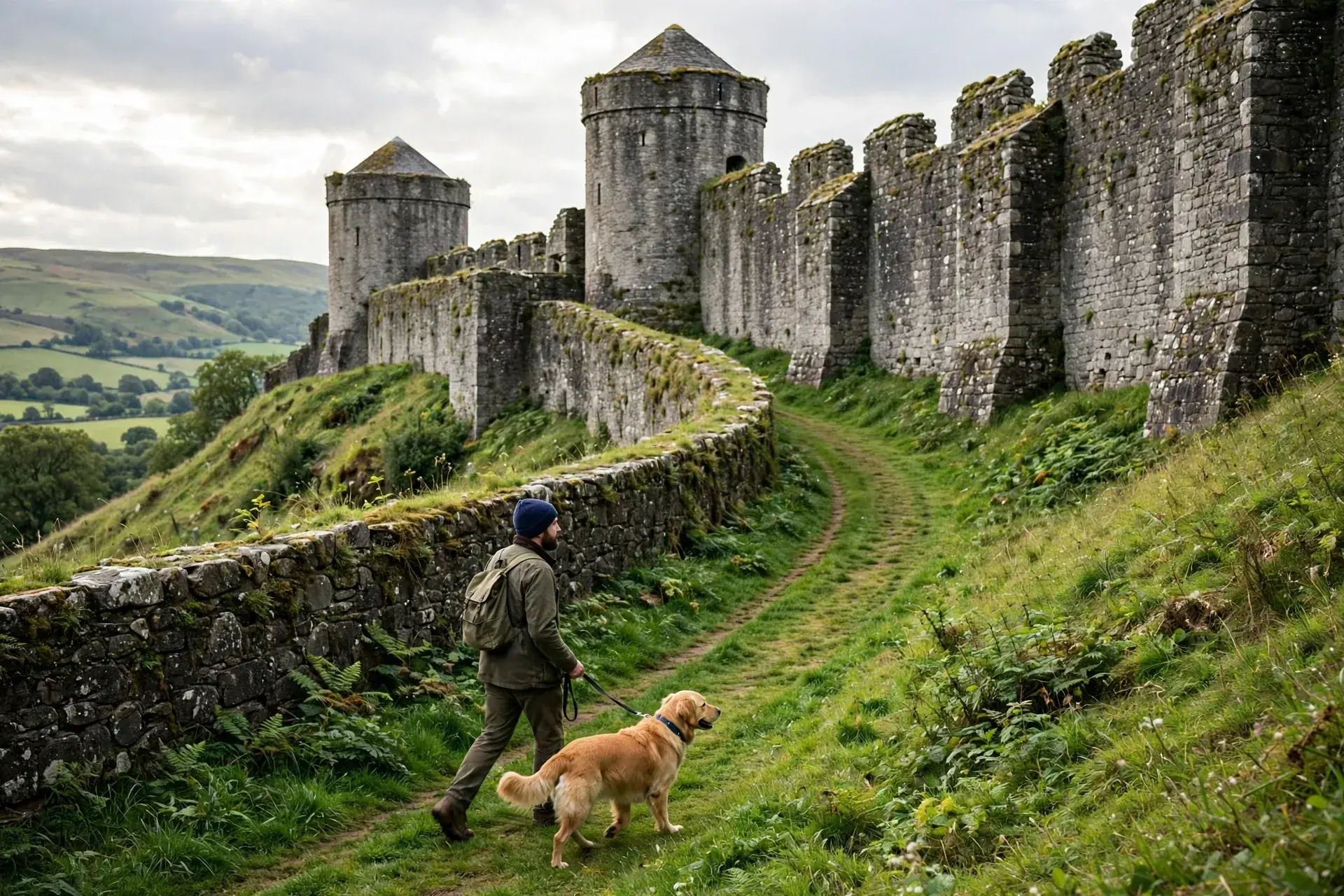
Livestock is a real consideration on both routes. Sheep and cattle graze the valley fields, and a dog that chases livestock can cause serious harm and can be in serious danger itself. Keep your dog on a lead in any field with livestock, and on a short lead if livestock are close to the path. If cattle block the path, do not try to push through with a dog; turn back or take a signed alternative. The law and the Countryside Code are clear on this point, and a responsible dog owner is one who respects them even when the dog is well behaved at home.
Longer walks need more planning. Carry water for the dog as well as for yourself, pack a snack, and know where the route rejoins a road or a village if you need to cut it short. A dog that is tired, hot or lame will not tell you in words, so watch for slowing down, lagging behind, or lying down on the path, and be ready to turn back. In summer, walk early or late to avoid the heat of the day, and check the ground temperature with your hand before a long stretch on a hard path. In winter, short daylight hours mean starting early and carrying a torch for the return leg.
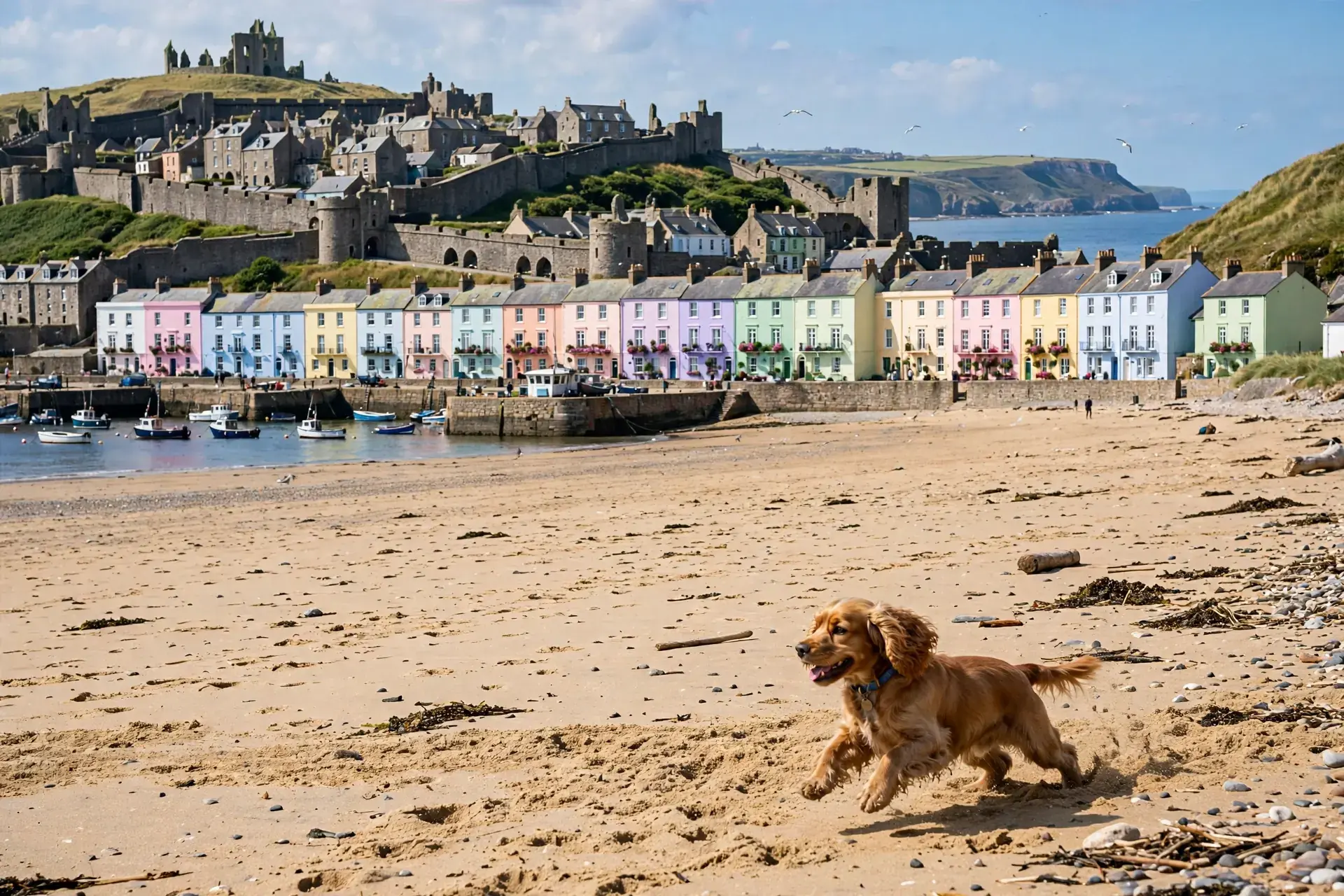
If you want to extend the trip beyond Monmouth, the Wye Valley and the Welsh coast both reward a longer stay. Our guide to Tenby with a dog covers a very different kind of Welsh town, with beaches, a harbour and town walls, and it makes a good contrast to Monmouth's river-and-border character. A week that pairs a few days in Monmouth with a few days on the coast gives a dog two kinds of walking and two kinds of town, without a long drive between them.
A slow two-day plan
Monmouth is at its best over two days, with one day for the river and one day for the town, and the two strands coming together in the evening. The plan below is deliberately slow: it leaves time for sniffing, settling, and sitting on a bench, and it can be shortened or stretched to fit your dog. If you only have one day, do the morning river walk and the afternoon old town, and save the longer valley walk for next time.
Day one is the river day. Start early with a riverside walk from the meadows along the Wye, keeping the dog on a lead near the bank and letting it sniff and settle. Return to your accommodation for breakfast and a rest, then take a second, shorter walk in the late morning, perhaps along the Monnow towards the bridge, so the dog sees the river from a different angle. In the afternoon, drive or walk to a quiet stretch of the Wye Valley Walk for a longer, shaded walk, and finish with a calm evening stroll around the meadows as the light fades. The aim is to let the dog learn the river gradually: first the meadow, then the bridge, then the wooded valley path.
Day two is the border-town day. Start with a short walk on the meadows to burn off the morning energy, then cross the Monnow Bridge on foot and spend the late morning in the old town: Agincourt Square, Monnow Street, the churchyard, and the shops that welcome dogs. Stop for lunch at a dog-friendly pub or cafe, with the dog settled under the table on its mat, and use the lunch stop as a rest rather than a rush. In the afternoon, choose a short section of the Offa's Dyke Path or a riverside loop, depending on your dog's energy and the weather, and finish with a final evening walk along the Wye.
Build in rest on both days. A dog that has walked for an hour in the morning does not need another hour immediately afterwards, and a dog that has spent a morning in a busy town needs a quiet afternoon. If you are staying in a cottage, a hotel or a campsite, let the dog sleep in its usual bed, keep feeding times close to home, and do not change the routine more than you have to. Dogs read consistency as safety, and a slow plan with regular rests is the fastest route to a dog that enjoys the second day as much as the first.
Weather should shape the plan, not ruin it. If rain is forecast, do the town in the morning and the river walk in a drier gap, or swap the two days round. If it is hot, walk early and late, use the shaded valley paths, and spend the middle of the day in a cool pub garden or back at your accommodation. If it is cold, pack a coat for a short-coated or older dog, and keep the walks shorter but more frequent. The best Monmouth plan is the one that fits the weather you actually get, not the weather you hoped for.
For a longer stay, Monmouth also works as a base for day trips. The Wye Valley, the Forest of Dean across the border in England, and the market towns of the Welsh Marches are all within an easy drive, and each offers a different kind of dog walk: forest tracks, river meadows, and hill paths. Keep day trips short, return to Monmouth for the evening walk, and let the town become familiar to your dog over a few days. A dog that knows where its bed is, where the river is, and where the best sniffing spots are will settle faster each evening.
Practical details: parking, food and seasons
Parking in Monmouth is straightforward if you use the town car parks and walk in, rather than trying to park on the narrow old streets. The main car parks are a short walk from the town centre and the river, and they are a better starting point for a dog walk than a street space, because you can load and unload the dog safely away from traffic. Check the official guidance before you travel for current charges, time limits, and any changes to parking arrangements, and in warm weather choose a shaded space and never leave a dog in a hot car, even for a few minutes.
Arriving by public transport is possible, though less flexible than driving with a dog. Trains and buses serve the area, and the town is walkable once you arrive, but carrying a dog, a bag, and supplies on public transport needs planning, especially for a larger dog. If you are travelling without a car, choose accommodation close to the town centre and the river, and plan your walks as loops from your door rather than as drives to distant trailheads. Check the official guidance before you travel for current transport rules for dogs, because they can vary by operator.
Food and drink with a dog in Monmouth is a matter of asking and planning, not of luck. The town has pubs, cafes and restaurants, and many welcome dogs in at least part of their premises, but policies change and a busy Saturday lunchtime is different from a quiet Tuesday morning. Ring ahead if you have your heart set on a particular place, bring a mat and a water bowl, and have a backup in mind. A takeaway eaten on a riverside bench is often the most relaxing option for a dog that finds indoor spaces noisy, and Monmouth's riverbank is a good place for it.
Seasons change the town in ways that matter for a dog. Spring brings lambs in the fields, nesting birds on the river, and ticks in the grass, so keep your dog on a lead near livestock and check for ticks after walks. Summer brings heat, blue-green algae risk in still water, and busy weekends, so walk early, carry water, and avoid the hottest part of the day. Autumn brings fallen leaves, muddy paths, and the Wye Valley in colour, which is a beautiful time for a dog walk if you pack a towel. Winter brings short days, cold water, and the risk of flooded riverside paths, so walk in daylight, keep the dog warm and dry, and check river levels before you set out.
Health and safety planning is simple but worth doing before you travel. Find the nearest vet to your accommodation and save the number in your phone, along with an out-of-hours emergency vet number. Pack your dog's usual food, any medication, a first-aid kit, poo bags, a towel, a drying coat, and a spare lead. If your dog is on medication, bring more than you need, and if your dog has a health condition that could be affected by heat, cold or exercise, talk to your vet before a long valley walk. A little preparation before you leave home saves a lot of worry on the riverbank.
Finally, leave Monmouth as you found it. Pick up after your dog everywhere, including on riverside paths and in meadows, and use the bins provided. Keep your dog on a lead where signs ask for it, close gates behind you, and do not let your dog disturb wildlife, livestock or anglers. The Wye Valley is a protected landscape, and the reason it stays beautiful is that visitors treat it with care. A dog owner who follows the Countryside Code, respects the river, and leaves no trace is the best ambassador for every dog owner who comes after.
Practical questions
Before you go
Can dogs walk along the River Wye in Monmouth?
Yes, on the riverside paths and meadows around the town, on a lead where other walkers, cyclists and livestock are nearby. Keep your dog close at unfenced banks, after rain, and near roads and bridges, and check the official guidance before you travel for any temporary closures or access changes.
Is Monnow Bridge suitable for dogs?
Yes, for a short on-lead crossing on foot. The bridge is narrow, with a historic gatehouse and stone parapets, so keep your dog on a short lead, pass other walkers patiently, and do not let your dog climb or jump on the stonework.
Can dogs swim in the River Wye at Monmouth?
Do not assume it is safe. The Wye is a powerful river with changing depth, current and water quality, especially after rain. Many owners keep dogs to paddling at shallow, slow edges only, and many avoid swimming altogether. Check the official guidance before you travel, and never let a dog swim near weirs, bridges or fast water.
Are dogs welcome in Monmouth town centre pubs and cafes?
Some are, and many welcome dogs in outdoor seating areas or specific indoor areas, but policies vary by venue and can change. Ask before you sit down, keep your dog settled under the table, and bring a mat and water bowl so the stop is comfortable for everyone.
Where is the best place to park in Monmouth with a dog?
Use the town car parks and walk in, rather than circling the narrow old streets. Check the official guidance before you travel for current charges, time limits and any changes, and choose a shaded spot in warm weather, never leaving a dog in a hot car.
Is Monmouth a good base for Wye Valley walks with a dog?
Yes. Monmouth sits where the Wye and the Monnow meet, close to the Wye Valley Walk and the Offa's Dyke Path, so it works well as a base for short riverside loops and longer valley walks. Plan each route in advance, carry water, and check the official guidance before you travel for path conditions and livestock.