This guide is independent and contains no paid placement. If affiliate links are added later, they will be clearly marked and will not change our editorial checks.
Travel with a Newfoundland works brilliantly when the car, the room and the walk are all sized for a dog that can weigh 55 to 70 kilograms. Measure everything, plan swimming and drying properly, keep walks steady rather than long, and book ground-floor space with a secure garden.
Start with the tape measure
Newfoundlands are among the largest dogs most British families will ever travel with. Adult males commonly stand 71 centimetres or more at the shoulder and weigh between 60 and 70 kilograms, while females are somewhat smaller at roughly 54 to 64 kilograms. Those numbers matter because almost every part of holiday planning in Britain is designed around a medium-sized dog: the boot of a hatchback, the staircase of a cottage, the pet fee band of a hotel and the turning circle of a pub garden. A Newfoundland does not squeeze into the gaps, so the honest approach is to measure the dog and measure the space, then compare the two figures before money changes hands.
Three measurements settle most arguments. First, the dog lying flat from nose to tail base, which decides crate and boot length. Second, the dog standing at the shoulder plus a few centimetres of head clearance, which decides crate height and whether a low car roof will force a crouch. Third, the dog's weight on a vet scale within the last few months, which decides harness ratings, ramp load limits and accommodation weight caps. Write the three figures on your phone before you start booking, because hosts and hire companies ask for them and guessing leads to a room that does not fit. Puppies complicate the picture further: a Newfoundland puppy grows fast, gains weight weekly and may outgrow a crate bought only a season earlier, so re-measure before every major trip in the first two years.
Size also changes how other people react to your dog. A Newfoundland looks imposing even when it is asleep, and that perception affects pub seating, train compartments and narrow pavements. A calm, well-trained giant that walks on a loose lead and settles on a mat is welcomed almost everywhere; the same dog pulling hard toward every stranger is a genuine safety concern on a crowded promenade. Training is therefore not a luxury extra for this breed but the core travel skill, and it is worth investing in lead manners, a solid settle and a reliable recall long before the holiday. If your dog is still learning, choose quieter destinations first and build up to busy seaside towns rather than starting with them.
The car is the first hotel room
For a Newfoundland, the car journey deserves as much planning as the destination. The Highway Code requires dogs to be suitably restrained so they cannot distract the driver or injure occupants in a crash, and a 65-kilogram unrestrained dog becomes a devastating projectile in even a moderate collision. That rule points to two realistic options: a crash-tested crate large enough for the dog to stand, turn and lie down, or a crash-tested harness rated for the dog's weight attached to a seatbelt point. Our guide to dog car harness vs crate choices explains how the two compare, but for a Newfoundland the crate often wins on space grounds alone, provided the vehicle can take one. Measure the boot aperture first, because a crate that fits the boot floor may still be impossible to load through a narrow tailgate opening.
Getting in and out is the next problem. A healthy adult Newfoundland can jump into a high SUV, but repeated jumping stresses joints, and an older or arthritic dog may not manage it at all. A sturdy ramp rated well above the dog's weight, with a non-slip surface and a gentle angle, transforms loading from a wrestling match into a routine. Practise at home on flat ground with treats before the trip, and keep the ramp in the car rather than in the roof box. Inside the car, a non-slip boot liner, a spill-proof water bowl for stops and a familiar blanket help the dog settle, and the air conditioning should be tested before a summer departure, since a thick-coated giant overheats faster than the driver expects.
Journey rhythm matters as much as equipment. Plan a stop every two hours at most, and choose service areas or lay-bys with grass away from traffic for toilet breaks. A Newfoundland drinks a lot, so carry several litres of water and offer small amounts at each stop rather than one huge drink at the end. On hot days, never leave the dog in a parked car, even briefly, and park in shade with windows and ventilation managed carefully. If the journey involves a ferry, check the operator's pet rules in advance: some crossings require dogs to stay in the vehicle, others provide kennels or pet lounges, and a giant dog may not fit a standard onboard kennel, so confirm dimensions before booking.
Water: the joy and the risk
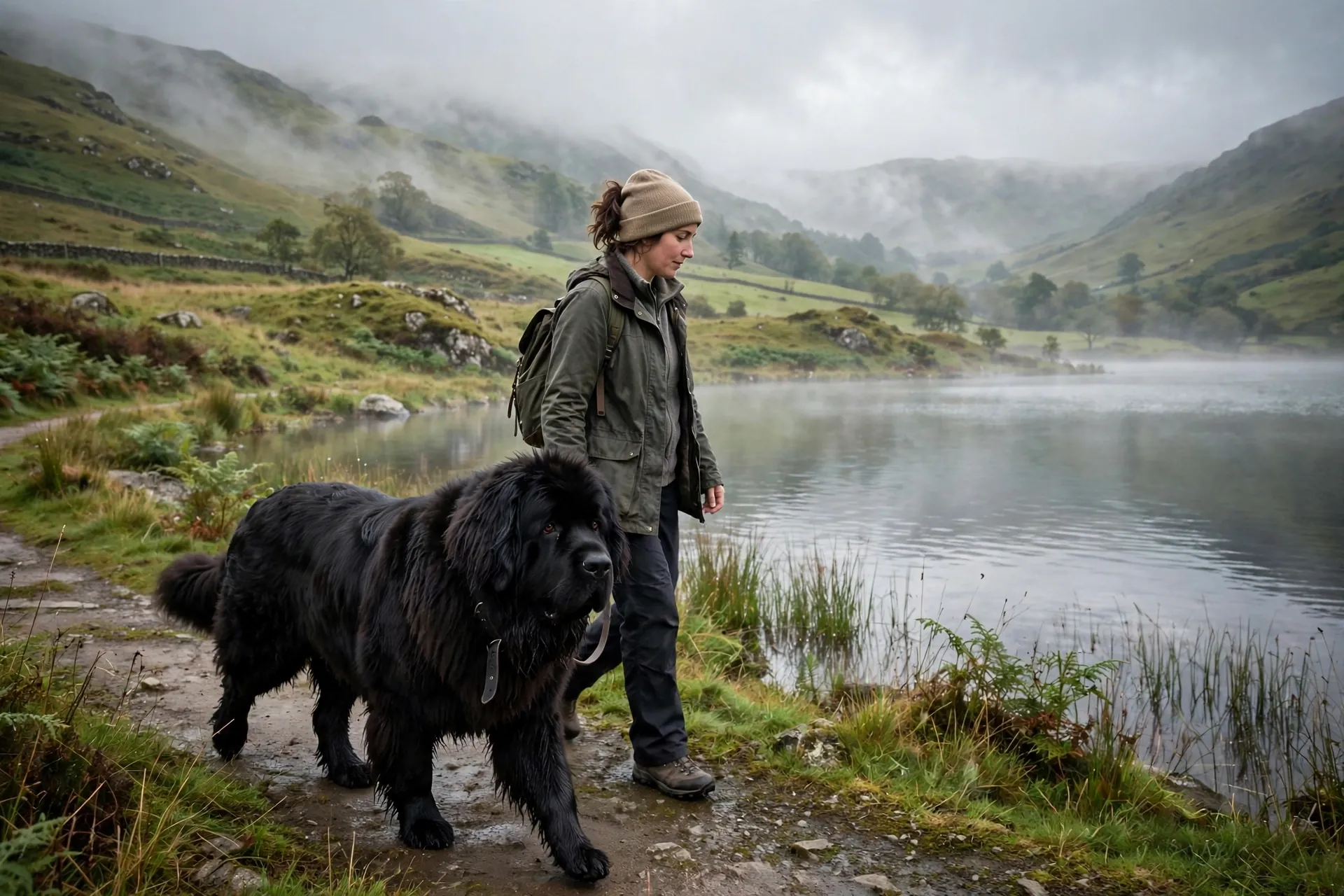
Newfoundlands were bred for work in and around water, with webbed feet, a water-resistant double coat and a powerful swimming stroke. Many of them love to swim, and a holiday near a lake, river or calm beach can be the highlight of their year. That instinct, however, is not a safety guarantee. Open water in Britain carries currents, cold temperatures, hidden underwater hazards, blue-green algae blooms in warm weather and, on the coast, tides that turn a gentle paddle into a strong pull within an hour. The sensible approach is to treat every new stretch of water as unknown: walk the bank first, check local warnings, watch how the water moves and start with a short paddle before any real swim.
A buoyancy aid is a wise purchase for a first swim in a new place, even for a confident swimmer. It adds visibility in murky water, gives the dog a handle for lifting out at a steep bank and supports a tired dog on the way back. Choose one rated for the dog's weight and chest measurement, and fit it at home in the garden before the trip so the dog associates it with fun rather than a strange new restraint. After swimming, rinse the coat with clean water where possible, dry the ears gently and check between the toes for cuts or debris. Dogs that swim repeatedly over a holiday can develop ear irritation or hot spots under a damp coat, so a thorough dry matters more than most owners realise. If the dog starts drinking large amounts of lake or sea water, stop the session: salt water causes vomiting and diarrhoea, and stagnant water can carry bacteria.
Beach rules add a seasonal layer. Many British beaches restrict dogs in summer, and the rules change by council and by date, so check the current position before travelling; our overview of UK beach dog rules, bans and fines explains how seasonal restrictions and fines work. Lakes and reservoirs have their own rules too, with some banning dogs from the water entirely to protect wildlife or drinking water supplies. Where swimming is allowed, keep the dog on a long line for the first visit if recall near water is unproven, and never throw a ball far into open water for a dog that will swim until exhausted. A tired Newfoundland is a heavy dog to rescue, so set a time limit and stick to it.
The coat is a holiday system
A Newfoundland coat is magnificent and, on holiday, a logistical project. The dense double coat sheds year-round, blows out heavily in spring and autumn, and holds water like a sponge after rain or swimming. Without a routine it mats quickly, especially behind the ears, in the armpits, around the collar line and at the feathering on the legs and tail. Mats pull painfully and trap damp against the skin, so the holiday routine should be short and daily rather than heroic once a week: a quick brush before the walk to remove loose hair, a towel and brush after the walk, and a proper grooming session every couple of days with a slicker brush and an undercoat rake. If you are unsure about grooming tools or technique, check the official guidance before you travel or ask your groomer for a holiday demonstration before departure.
Drying is where most Newfoundland holidays succeed or fail. A wet Newfoundland can carry litres of water into a cottage, and a damp coat left to dry slowly in a cold room develops a smell that no amount of air freshener fixes. Pack at least two large microfibre towels, a drying coat that the dog wears after towelling, and, if you have room, a high-velocity dryer. Dryers are loud, so introduce one at home first, and use it outdoors or in a bathroom rather than in a carpeted living room. At the accommodation, agree where the dog will be dried and where wet towels will go; hosts appreciate an owner who arrives with a plan, and a waterproof mat under the dog's bed protects floors and deposits alike.
Shedding on holiday is a fact to manage, not a problem to solve. A lint roller, a rubber grooming glove and a small handheld vacuum or brush for car seats keep the situation civilised. In rented accommodation, keep the dog off upholstered furniture unless the host explicitly allows it, and bring your own washable throws for any sofa the dog is allowed to use. If the dog sleeps in a crate or on its own bed, that bed goes everywhere with you, because a familiar-smelling bed is the fastest way to settle a giant dog in a strange room. Finally, remember that clipping a double coat short is not a shortcut: it damages the coat's insulation and regrowth, so discuss any coat decisions with a groomer or vet rather than improvising before a trip.
Joints, weight and sensible walks
Giant breeds pay a price for their size, and Newfoundlands are prone to hip and elbow dysplasia, cruciate ligament problems and arthritis in later life. Holiday walking should therefore be built around steady, low-impact movement rather than distance records. A typical healthy adult enjoys 45 to 60 minutes of walking a day, split into two sessions, with swimming counting as excellent low-impact exercise. Puppies need much less forced exercise: the old rule of five minutes per month of age, twice a day, is a rough guide rather than a prescription, so ask your vet for a figure tailored to your puppy before planning long walks. Older dogs may prefer two short strolls and a long sniff in the garden to one big outing.
Terrain choice matters as much as duration. Flat lakeside paths, forest tracks and firm beach sand suit a Newfoundland far better than steep, rocky scrambles or long flights of stone steps. Wet, slippery flagstones and steep wooden staircases are a genuine hazard for a heavy dog, so scout routes in advance and carry a plan B for bad weather. Avoid repetitive jumping in and out of cars, over stiles and onto high beds; a ramp or a step solves all three. If the dog starts lagging, lying down or showing stiffness after rest, cut the walk short without debate: pushing a giant dog onward risks an injury that ruins the whole holiday, while a short day costs nothing.
Weight control is the quiet hero of joint health. A Newfoundland that carries even a few extra kilograms loads its joints heavily on every step, and holiday treats, pub snacks and table scraps add up fast. Weigh food in advance, keep treats to a small daily allowance and skip the well-meaning extras from strangers where possible. If your dog takes joint supplements or pain medication, pack a spare supply in a separate bag, keep it in its original packaging and note the dose on your phone. Finding an emergency vet quickly is part of the same planning: save the details of the nearest practice before you arrive, as our guide to finding an emergency vet on holiday explains, because rural practices can be far away and close early.
Heat, drool and summer care
Newfoundlands and summer heat are a poor combination. A thick double coat, a large body mass and a brachycephalic-adjacent muzzle shape in some lines mean these dogs overheat faster than leaner breeds, and heatstroke in a giant dog is a veterinary emergency. On warm days, walk early in the morning and late in the evening, choose shaded woodland or water routes, and rest in the middle of the day. Carry water always, offer it frequently and watch for warning signs: heavy panting that does not settle, drooling thicker than usual, a bright red tongue, wobbliness or reluctance to move. If you see them, stop, move to shade, cool the dog gradually with wet towels on the belly and groin, and call a vet for advice rather than plunging the dog into ice-cold water.
Drool is part of the breed and part of the holiday. Newfoundlands drool after drinking, after eating, when excited and sometimes apparently for no reason at all. Pack a dedicated drool towel, keep one in the car and one by the door, and warn fellow diners in advance if the dog will be under a pub table. Most people find it charming once warned and far less charming when surprised. In restaurants, a mat under the water bowl contains most of the splash, and a quick wipe after drinking keeps floors safe for other guests. None of this is a reason to avoid eating out; it is simply the admission price of dining with a giant.
Summer also brings seasonal hazards that hit big coated dogs hard. Grass seeds lodge between toes and in ears after meadow walks, so check paws and ears after every summer outing. Ticks are common in long grass and woodland, so use a vet-recommended preventative and carry a tick remover. Midges and flies irritate ears and bellies, particularly in Scotland, so consider a light dog-safe repellent on veterinary advice. Finally, remember that a wet coat plus warm weather is a recipe for hot spots: dry thoroughly after swimming, check the skin under the coat daily and act on any sore, red or smelly patch promptly rather than hoping it resolves.
Booking a stay that fits a giant
The single most useful booking question for a Newfoundland owner is not "do you accept dogs?" but "do you accept a dog of 65 kilograms, and what are the conditions?" Weight limits of 25 or 30 kilograms are common in hotels and some cottages, and they are rarely advertised prominently. State the weight, the breed and the dog's temperament in the first message, and ask for the answer in writing. Follow up with the practical details: ground-floor access or a lift, the number of steps to the room, whether the garden is fully fenced and how high the fence is, whether the floor is hard or carpeted, and whether there is an extra cleaning charge for large dogs. A host who answers precisely is usually a host who has thought about dogs properly.
Room layout matters more than room size. A spacious room on the third floor with a narrow staircase is worse than a modest ground-floor room with a door straight to the garden. Ask where the dog will sleep, whether a crate fits beside the bed and whether the dog can be left briefly in the room while you eat. Many places prohibit leaving dogs unattended, so plan meals around dog-friendly dining or takeaway options. In cottages, check the garden gate latch: a Newfoundland can lean on a weak gate with considerable force, and a garden that looks enclosed may have a gap at the side return or a low wall the dog can step over. Walk the boundary on arrival before letting the dog off the lead, and photograph any pre-existing damage to floors or gardens for your own protection.
Costs deserve the same scrutiny. Pet fees range from nothing to £25 or more per night, and a week with a large dog can add hundreds of pounds. Ask for the all-in total, including any deep-clean charge, and check whether the fee is per dog or per stay. Cancellation terms matter too, because a giant dog's health can change plans quickly: a flexible booking that allows a date change is worth a small premium. If the perfect property refuses large dogs, do not argue or conceal the size; instead ask for a recommendation, since hosts in dog-heavy areas often know which neighbours accept giants, and honesty protects your deposit and your reputation.
Walks that suit a Newfoundland
The best Newfoundland walks share three qualities: flat or gently rolling ground, water to paddle in, and shade to rest in. Lakeland shore paths, canal towpaths, forest trails and quiet beaches on a cool day all qualify, while steep mountain ridges, long shingle beaches in hot sun and busy cliff paths with sheer drops do not. In the Lake District, level lakeside stretches around Derwentwater and Ullswater offer water, shade and cafés within a sensible distance; in the Yorkshire Dales, riverside paths and disused railway lines give flat, car-free walking. Wherever you go, build in a rest stop with water every twenty minutes or so, and carry a collapsible bowl rather than relying on streams, which may be fenced off or unsafe.
Lead rules deserve attention because a Newfoundland's strength turns a small lapse into a real incident. Around livestock, keep the dog on a lead without exception: a Newfoundland chasing sheep is dangerous for the sheep, the dog and the farmer's livelihood, and the legal consequences are serious. On beaches and in parks, check local orders, since many places require leads in certain months or areas. A long line gives the dog freedom to sniff while keeping control, and a harness with a front attachment helps with pulling. If recall is not reliable around other dogs, wildlife or water, keep the long line on and enjoy the walk anyway; a holiday is not the time to test training under maximum distraction.
Finally, plan the walk around the dog's day, not the sightseeing list. A Newfoundland that has had a good morning walk and a proper rest will settle happily under a pub table in the afternoon, while one dragged around attractions all day will be restless and hard to manage. Build the itinerary with the dog's needs first — morning walk, rest, short outing, evening walk — and the sightseeing fits around it surprisingly well. If the weather turns hot, wet or stormy, swap the big walk for a short sniffy loop and a training game indoors; the dog will not mind, and the holiday stays enjoyable for everyone.
Towns, pubs and public transport
Newfoundlands in towns need space and a plan for the moments when space runs out. Narrow pavements, crowded markets and busy high streets are stressful for a giant dog that cannot easily step aside, so walk early, use quieter side streets and cross the road rather than squeezing past a queue of people with prams and dogs. In pubs and cafés, ask for a corner table with room for the dog to lie flat, bring a mat for the dog to settle on and order water for the dog when you order for yourselves. Staff who see a settled giant on a mat tend to be generous with fuss and treats; staff who meet a loose, pulling giant in a doorway tend not to be.
Public transport with a Newfoundland is possible but requires research. Dogs travel on most trains in Britain, usually free and on the lead, but a giant dog needs floor space that a packed commuter train does not offer. Travel off-peak, choose a carriage with more floor room, and keep the dog on a lead under the seat or in the vestibule area where permitted. Buses vary by operator: some allow dogs at the driver's discretion, others restrict them, so check the official guidance before you travel rather than assuming. Taxis and private hire cars also vary, so book a large vehicle in advance and warn the company about the dog's size; a driver who arrives in a small hatchback for a 65-kilogram passenger is a wasted booking.
Attractions often require split visits with a Newfoundland, since many historic houses, gardens and museums admit dogs only in grounds or not at all. Plan who stays with the dog, where the dog will wait comfortably and what the dog does in the meantime. A shaded car is never an acceptable waiting room in warm weather, so a split visit needs a genuine alternative: one person visits while the other walks the dog, then swap. Gardens that admit dogs on leads are often the best compromise, giving the dog a walk and the humans a visit in the same outing. Check each attraction's current dog policy before travelling, because policies change and a wasted journey with a giant dog is a heavy disappointment.
The Newfoundland packing list
Packing for a Newfoundland is an exercise in volume: everything is bigger, heavier and needed in larger quantities. Start with the car kit: ramp, non-slip boot liner, crash-tested restraint, water container and bowl, drool towels and a spare lead. Then the grooming kit: slicker brush, undercoat rake, drying coat, microfibre towels and, if space allows, a high-velocity dryer. Then the health kit: medication with a spare supply, tick remover, paw balm, ear cleaner if your vet recommends it, and the vet practice details for both home and destination. Food deserves its own bag, weighed in advance into daily portions, because a giant breed's daily ration is large and local shops may not stock the usual brand or formula.
For the accommodation, pack the dog's own bed, a waterproof mat, washable throws, a non-slip feeding mat and a large water bowl. Bring more poo bags than you think necessary, in a large size, plus a sealed container for used bags on long walks. A long line, a standard lead, a harness and a collar with an ID tag cover most walking situations; the tag must by law show the owner's name and address, and a phone number is strongly advisable. Finally, pack a small comfort kit for settling: a familiar toy, a chew approved by your vet and a worn item of clothing can help a dog relax in a new room. With this kit packed, the holiday stops being a series of improvisations and becomes what it should be: a change of scenery for a dog that is already comfortable.
A Newfoundland holiday, done well, is genuinely joyful. The dog that lumbers into a lake with total delight, settles like a rug under a pub table and leans its enormous head against a stranger's knee is a wonderful travelling companion. The work is all in the preparation: measure the dog, measure the car, measure the room, plan the water and the drying, and keep the walks steady. Do that, and the size that complicates every booking becomes the very thing that makes the holiday memorable.
Practical questions
Before you go
Can a Newfoundland fit in an ordinary family car?
Many can, but only with a measured boot and a proper restraint. Measure the boot opening, floor length and height, then compare them with your dog's length lying down and standing height. Estate cars and large SUVs usually work; small hatchbacks rarely do. A crash-tested crate or harness rated for the dog's weight is essential, and check the official guidance before you travel if you are unsure about restraint rules.
Are Newfoundlands safe swimmers on holiday?
They are strong, water-loving swimmers, but no dog is risk-free in open water. Avoid fast currents, weirs, blue-green algae warnings and very cold water, and use a well-fitted buoyancy aid for a first swim in a new place. Dry the ears and coat afterwards, and watch for tiredness, because a big dog can tire without showing it clearly.
How do I manage a Newfoundland coat on a wet UK holiday?
Brush before and after walks, pack a high-velocity dryer or at least two large absorbent towels, and bring a drying coat. Check for mats behind the ears, in the armpits and around the tail after every wet walk. A muddy Newfoundland can soak a cottage floor in minutes, so agree a drying routine with your accommodation before you arrive.
Do Newfoundlands need shorter walks than smaller dogs?
Often yes, especially young, older or overweight dogs. A steady 45 to 60 minute walk with swimming or sniffing time suits many adults better than a long forced march. Giant breeds are prone to joint problems, so build distance gradually, avoid repetitive jumping and stair-heavy routes, and ask your vet about a sensible exercise level for your dog.
Will hotels and cottages accept a dog this big?
Many will, but weight and size limits vary widely, so declare the dog's weight honestly at booking. Ask about stair access, floor type, garden fencing height and any extra cleaning charge. Ground-floor rooms, level access and a secure garden matter far more for a Newfoundland than a stylish interior.
What should I pack specifically for a Newfoundland holiday?
Pack a ramp or low step if your dog struggles with the car, a non-slip mat, a large water bowl, extra towels, a slicker brush and undercoat rake, poo bags in a large size, joint-friendly bedding and any medication with a spare supply. Weigh the food in advance, because a giant breed eats a lot and holiday shops may not stock the usual brand.