This guide is independent and contains no paid placement. If affiliate links are added later, they will be clearly marked and will not change our editorial checks.
Newport, Pembrokeshire works best as a harbour-and-beach day shaped by the tide: start at the Parrog when the sand is out, walk the flat shore or a short coast path section, then climb back into town for a rest. Check the tide times before you leave, keep your dog on a lead near cliffs, boats and livestock, and confirm current beach rules for your dates.
Which Newport is this?
This guide is about Newport in Pembrokeshire, a small coastal town in north Pembrokeshire, Wales, where the River Nevern reaches the sea. It is not Newport in South Wales, the much larger city near Cardiff on the River Usk. The two places share a name and very little else: one is a quiet harbour town of a few thousand people with a sandy beach, a golf course and a stretch of the Pembrokeshire Coast Path; the other is a city with a railway station, a football club and a ring road. Confusing them is easy when booking, because a search for "Newport" alone will usually return the city first.
The practical difference shows up before you arrive. A sat nav set to the wrong Newport will send you roughly 270 miles in the wrong direction, and a hotel booked in the wrong one cannot be fixed by a short drive. When you book somewhere to stay, type the full name — Newport, Pembrokeshire — and check the postcode and the county on the confirmation. The Pembrokeshire town sits on the A487 between Fishguard and Cardigan, with St Davids to the south-west and Cardigan to the north-east. If your route takes you past the Severn Bridge and into a city centre, stop and re-check. If it takes you through the Preseli Hills and down towards the Nevern estuary, you are on the right road.
Once you are there, the town announces itself plainly. The main street runs down towards the Parrog, the small harbour quarter, and the beach opens out below the houses. The hills behind the town — Carningli, the rocky ridge that rises above Newport — give the place its backdrop, and the coast path climbs away in both directions. There is no mistaking it for a city. That small scale is the whole point of bringing a dog here: most of what matters is within a short walk, the beaches are the main event, and the day can be rearranged in minutes when the weather or the tide changes.
Parrog and Newport Sands: the paired beaches
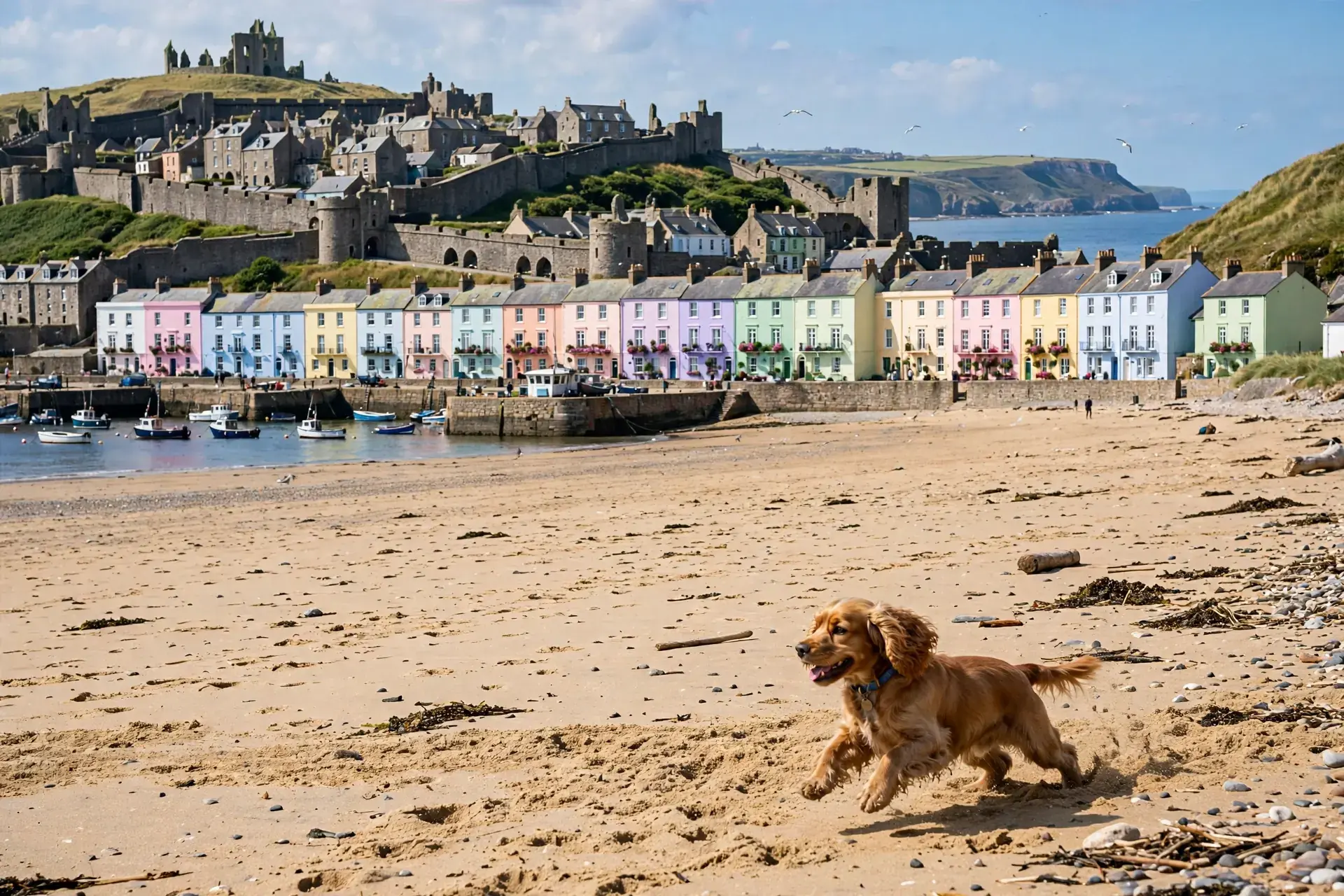
Newport gives a dog two beaches that behave like opposites, and the best days use both. The Parrog is the town beach, a curving stretch of sand tucked beside the harbour at the mouth of the River Nevern. Newport Sands, also known as Traeth Mawr, is the long, wide beach that runs north-east from the estuary towards the golf club and the dunes. The Parrog feels sheltered and close to everything; Newport Sands feels open, windy and made for long straight runs. Choosing between them is less about which is better and more about what your dog needs at that hour: a sheltered sniff and paddle, or a proper stretch of the legs.
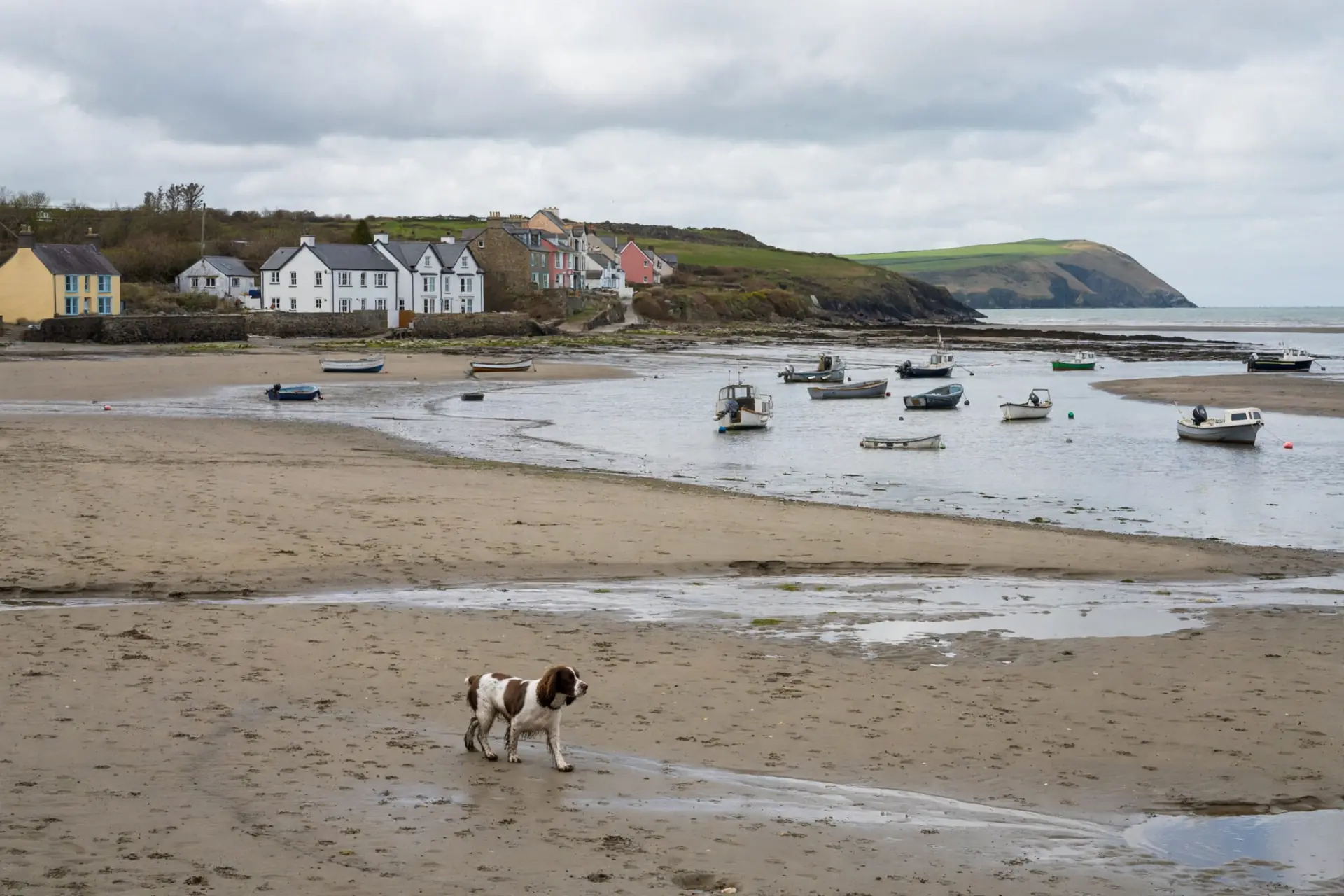
At the Parrog, the sand appears and disappears with the tide, and the shape of the beach changes with it. At low water there is a broad sweep of firm sand, rock pools along the edges and room for a dog to run in a wide arc without meeting a road. At high water the sea pushes right up towards the harbour wall and the sea defences, and the dry sand narrows to a strip. Dogs that love paddling will find shallow water at the river edge and along the shoreline, but the current where the Nevern meets the sea deserves respect: keep a dog that is not a strong swimmer on a long line near the channel, and do not let any dog chase a ball into deep or fast-moving water. The harbour boats, moored and hauled out according to the tide, add another reason to keep a lead handy — a dog that weaves between hulls, trailers and ropes is an accident waiting for a moment of inattention.
Newport Sands rewards a different kind of walk. The beach is long enough that a dog can run in a straight line for a satisfying distance, and at low tide the firm sand near the waterline is kind to paws and joints. The dunes and the golf course sit behind the beach, so the walk has a clear boundary on one side and the sea on the other, which makes it a good place for recall practice with a dog that is ready for more freedom. The exposure is the trade-off: there is almost no shelter from a south-westerly wind, and on a grey day the beach can feel much colder than the town ten minutes away. Bring a windproof layer for yourself and a drying coat for the dog, and plan the walk so the wind is at your back on the way home rather than in your face for the whole return.
Both beaches need the same basic kit. A long line gives a dog room to run without the risk of a free run into a nesting bird, a horse rider or another dog's picnic. A towel and a drying coat matter because a wet dog in a car will chill fast on the drive back over the Preselis. Fresh water is worth carrying even on a short walk: dogs that drink seawater vomit, and the nearest tap may be a walk away. Pick up after your dog on both beaches — the Parrog in particular is a shared space where families paddle, boats are launched and people sit on the sand, so a bag left behind is noticed immediately. Dog rules on beaches can change by season, so check the official guidance before you travel rather than relying on a sign remembered from a previous year.
The harbour, the Nevern and the tide
The Parrog harbour is small, working and tidal, and understanding that one sentence explains most of what a dog owner needs to know about Newport. Boats sit on the sand at low water and float at high water, and the harbour dries out between tides. That means the ground underfoot changes through the day: firm sand and muddy patches at low tide, water lapping the quay at high tide, and slippery weed and algae on steps and slipways in between. A dog that charges down a slipway after a ball can slide badly, and a dog that runs across drying mud can come back coated to the belly. Walk the harbour edge first on a lead, let the dog learn the surfaces, and only then decide how much freedom the moment allows.
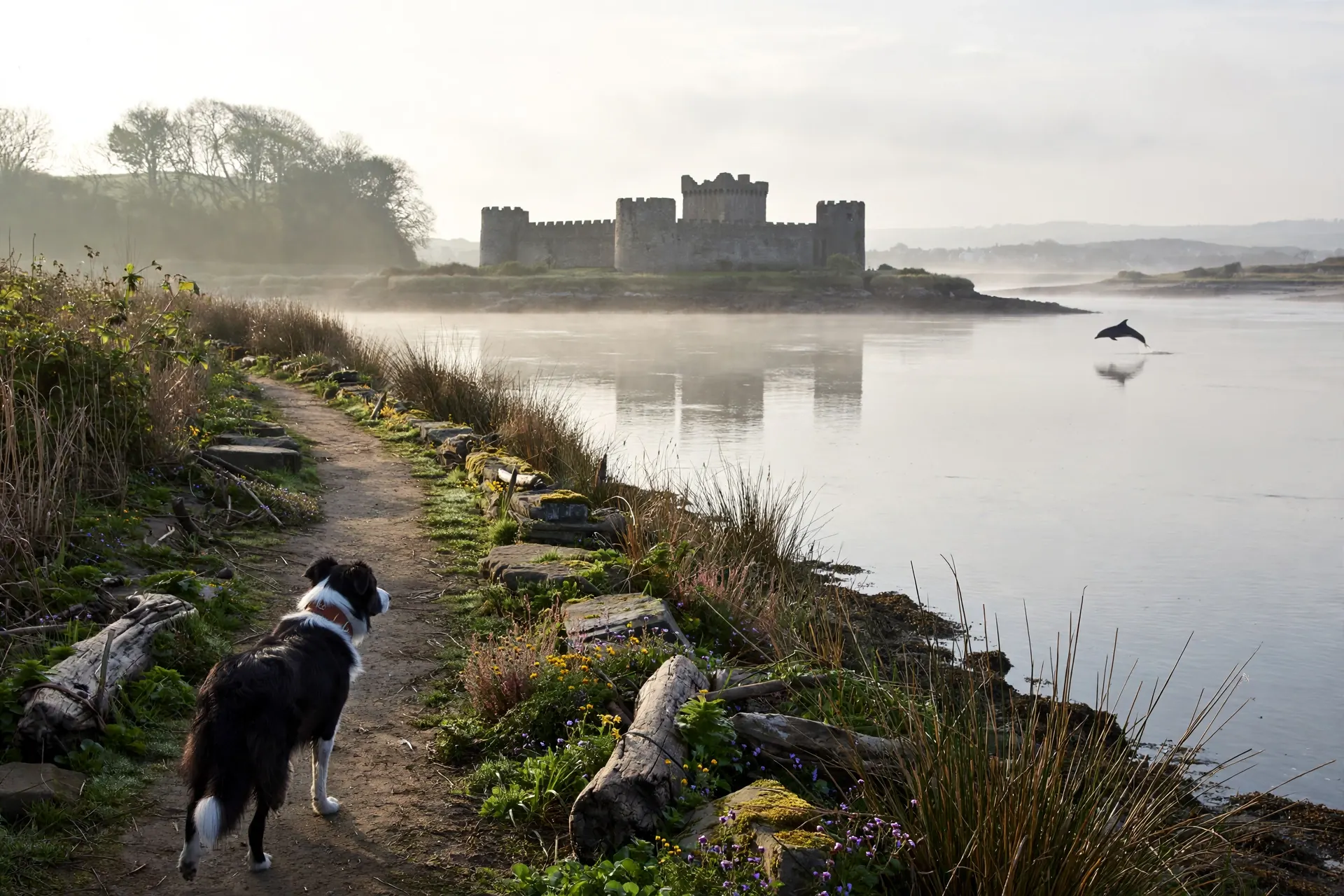
The River Nevern is the other half of the harbour picture. It flows down from the Preseli Hills, past the church of St Brynach at Nevern village, and out through the estuary at Newport. The river water is fresh where it meets the beach, and dogs will drink from it, paddle in it and chase sticks along it. That is fine in moderation, but a dog that swallows a lot of river or sea water can be sick later, so carry fresh water and offer it regularly instead of letting the dog drink its fill from the estuary. After heavy rain the river runs faster and browner, and the waterline carries driftwood and debris; on those days the harbour walk is better kept short and the beach walk kept to the firmer sand.
Tide times are the planning tool that matters most in Newport, more than any list of places to visit. A walk planned for low tide gives you the full Parrog, the rock pools and the long sand at Newport Sands; the same walk planned two hours either side of high tide gives you a narrow strip and a long climb instead. Check the tide times the night before and again in the morning, because a spring tide — the bigger tide around a new or full moon — covers more sand and arrives faster than a neap tide. A useful rule is to be off the lowest sand at least an hour before high water, and to allow extra time if your dog is slow, old or easily distracted by smells. If you are unsure, ask in a town shop or look at the tide table posted locally; the harbour is the kind of place where people will tell you plainly when the water is coming in.
There is also a safety habit worth building into every harbour visit: know your exit. On the Parrog, the exits are the slipway, the steps and the path back up towards the town; on Newport Sands, the exit is the path by the golf club or the coast path back towards the Parrog. Before you let a dog off the lead, look at where you would leave the beach if the tide turned or the weather closed in, and make sure the route does not involve scrambling over rocks with a dog on a lead. Dogs that are allowed to run far ahead on a beach with a rising tide can find themselves cut off from their owner by a channel of water that looks shallow from one side and is waist-deep from the other. A long line, a whistle recall and a habit of calling the dog back every few minutes solve most of that before it starts.
Coast Path sections from Newport
The Pembrokeshire Coast Path runs for 186 miles around the county, and the sections around Newport are some of its most varied: harbour, estuary, beach, headland and farmland in a single afternoon. From the Parrog, the path climbs out of the town in one direction towards Dinas Island and Fishguard, and in the other direction it crosses the Nevern estuary area and heads towards St Dogmaels and Poppit Sands. Both directions are hilly, and both reward a short out-and-back walk far more than an attempt to cover a long distance with a tired dog. Pick a section, walk it one way, and come back the way you came; the view changes completely on the return.
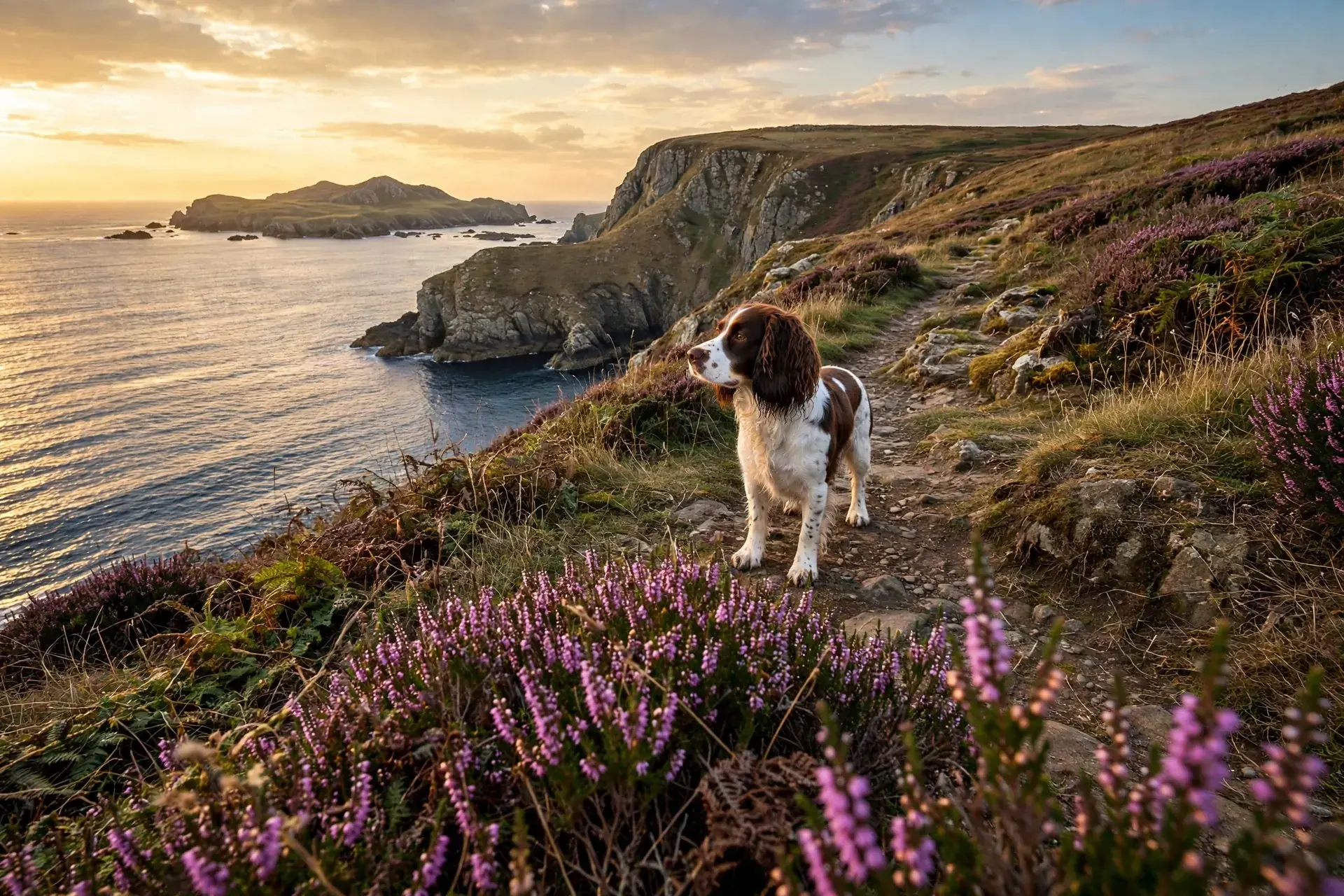
Towards Dinas Island, the path climbs steeply from the harbour and runs along the headland with wide views back over Newport and the Parrog. This is the dramatic direction: cliffs, gorse, open grass and the sea below. It is also the direction that needs the most care with a dog. Keep the dog on a short lead on the cliff sections, because the path runs close to unfenced edges in places, and the grass can hide a sudden drop. The climb is a genuine workout, with steps and uneven ground, so a dog with sore joints or a heart condition will find it hard going. The reward is the viewpoint at the top and the sense of space — on a clear day you can see the coast curving away in both directions and the hills of the Preselis inland.
Towards St Dogmaels, the path is gentler at first, crossing the low ground by the estuary and then rising towards the headlands above Newport Sands. This direction suits a longer, steadier walk, and it pairs well with a beach walk: coast path one way, sand the other, with the dog getting a change of surface underfoot. The estuary crossing needs attention, because the path and the tide meet here too — check the official guidance before you travel if you plan to cross low ground near the river, and do not attempt a crossing that is already under water. The farmland sections bring livestock, so a lead is essential even for a dog that is usually reliable; sheep and lambs are present for much of the year, and a dog that chases them can cause a serious problem in seconds.
Whatever section you choose, pack for the coast path as if the weather will change, because around Newport it often does. A waterproof for you, a drying coat for the dog, water for both of you, and a lead that you can shorten quickly are the essentials. A dog that is used to flat park walks will find the ups and downs tiring, so build in rest stops on the flat sections and watch for the signs of a dog that has had enough: lagging behind, lying down on the path, panting hard on a cool day, or refusing to climb. Turning back early is not a failed walk; it is the decision that lets you come back tomorrow. The coast path will still be there, and a dog that finishes the day sound and happy is worth more than a few extra miles.
The town: streets, shops and a pause
Newport town is compact enough that a dog walk can include it without turning into a shopping expedition. The main street climbs from the Parrog up into the town centre, where Market Street and the streets around it hold a butcher, a baker, a small supermarket, cafes, galleries and a handful of independent shops. The hill is the thing to notice: it is short but steep, and an older dog will feel it after a beach walk, while a young dog will pull up it at full speed if allowed. Walk the hill on a short lead, on the pavement, and give the dog a chance to sniff at the top rather than dragging it straight into the next thing.
The town centre is a good place for a dog to practise being calm in a busier place. Pavements are narrow in parts, cars park close to the kerb, and delivery vans use the same streets, so a dog that walks nicely on a loose lead will cope well and a dog that lunges at traffic will need management. The shops that welcome dogs are usually obvious from a water bowl by the door or a sign in the window, but the rule is to ask before taking a dog inside anywhere that sells food. A dog that waits outside with one person while the other buys lunch is a perfectly good arrangement, and it avoids the awkward moment of a dog knocking over a display in a small gallery.
St Mary's Church and the older buildings around the town centre give the walk a destination beyond the shops, and the lanes off the main street are quieter than the through road. The town has a long history — Newport was a Norman borough, and the castle mound and the old town layout are still visible if you know where to look — but for a dog owner the useful history is simpler: this is a town built around a harbour and a river crossing, and its streets still run downhill to the water. Following that slope is the easiest way to navigate: downhill takes you to the Parrog and the beach, uphill takes you back to the car parks and the road out of town.
Two small habits make the town part of the day work better. The first is to do the town walk before the beach, not after: a dog that has already run on the sand will be wet, sandy and tired, and neither of you will enjoy a slow browse of a gallery with a damp dog in tow. The second is to carry a towel even on a town-only loop, because a dog that finds a puddle, a ditch or a muddy verge will find it within five minutes of leaving the car. Newport is a town where the outdoors is never far away, and a dog that is ready for mud is a dog that can enjoy all of it.
Where dogs are welcome to rest
A dog that has walked the beach and the coast path needs a place to rest, and Newport's answer is its pubs, cafes and outdoor seating. The pubs and cafes around Market Street and down at the Parrog are the natural stopping points, and many of them welcome dogs in at least part of the building — usually the bar area or a terrace rather than the formal dining room. The rules change from place to place and from season to season, so the reliable approach is to look for a water bowl, read the sign by the door, and ask a member of staff before you settle in. A dog that lies quietly under a table will be welcomed back; a dog that barks at every arrival or begs at neighbouring tables will not, however friendly the policy.
The Parrog is the best place for a long outdoor rest, because the harbour seating and the beach are close together and a dog can lie on the sand while you sit with a drink. The town centre terraces are better on a windy day, when the buildings give shelter that the beach cannot. Either way, bring the dog's own mat or blanket: a cold stone floor or a damp wooden bench is no place for a tired dog to lie, and a familiar mat tells the dog that this is a rest stop, not another walk. A chew or a stuffed Kong can keep a restless dog settled while you eat, but choose something that will not scatter crumbs across a neighbour's table.
If you are staying overnight, the choice of accommodation matters more in Newport than in a larger town, because the options are smaller and the dog rules vary widely. Self-catering cottages and small guesthouses around the town and the Parrog are the most common choices, and the questions to ask are the same ones that matter anywhere: is the garden enclosed, how many dogs are allowed, is there a charge, and where is the nearest place for a late-night toilet walk? A cottage near the Parrog sounds ideal until you realise the garden is open to the harbour path; a cottage on the edge of town sounds dull until you realise it backs onto a quiet lane where the dog can stretch its legs at midnight. Ask for the details in writing, and check the cancellation terms before you pay, because Newport's smaller places can book out early in summer and a mistake is harder to fix at short notice.
For a longer stay, Newport works well as a base for the north Pembrokeshire coast, and the dogs that do best here are the ones that settle into a routine. A morning beach walk, a rest in the cottage, an afternoon coast path section and an evening stroll to the harbour is a pattern that suits most dogs, and it leaves the middle of the day free for the heat, the rain or a drive somewhere new. Our guide to Tenby with a dog covers a busier Pembrokeshire town further south if you want a contrast, and our guide to Cardigan with a dog covers the Teifi estuary town to the north-east. Both are easy day trips from Newport, but both are busier than Newport itself, so a dog that finds crowds hard may prefer to stay put.
Parking and arrival
Arrival is the part of a Newport day that most often goes wrong, and it is almost always a parking problem. The Parrog car park is the obvious choice for a beach and harbour day: it is close to the sand, the harbour and the coast path, and it fills early on sunny weekends, school holidays and bank holidays. The town centre car parks are the alternative, with a short walk down the hill to the Parrog — easy on the way down, noticeably steeper on the way back up with a tired, sandy dog. Arriving before ten in the morning solves most of this, and arriving after midday on a fine Saturday in August means circling, waiting or walking further than you planned.
Before you leave the car, do the small checks that save a long walk back. Make sure you have the lead, the long line, water, a bowl, poo bags, a towel and the drying coat, because the Parrog car park to the far end of Newport Sands is a long way to walk twice. Check the parking machine: charges, time limits and payment methods change, and a ticket bought for the wrong bay or the wrong length of stay is a common frustration. Keep the car cool and ventilated for the dog on the return journey, and never leave a dog in a parked car on a warm day, even for a few minutes — the temperature inside a car climbs far faster than most people expect, and a dog that has just exercised is already warm.
The drive into Newport deserves a mention too. The A487 from Fishguard and from Cardigan is a good road by rural Welsh standards, but it is narrow in places, with bends, tractors and walkers on the verges. The roads down to the Parrog are narrower still, and the turning space at the harbour is limited. Drive slowly, expect a dog walker or a cyclist around every bend, and do not rely on a sat nav to find the last stretch — the harbour roads are the kind that look simple on a map and confusing in person. If you are towing a caravan or driving a large motorhome, check your route and your parking options before you set off, because the Parrog car park is not designed for large vehicles and the town centre is tight.
One last arrival tip: use the first ten minutes in Newport to read the place, not to rush into it. Stand at the Parrog, look at the tide, look at the wind, and look at how busy the beach is. A dog that has just spent an hour in a car needs a calm toilet walk on a lead before it is asked to run, and a dog that is given that quiet start will settle into the day far better than one that is launched straight onto the sand. The harbour, the beach and the coast path are not going anywhere; the tide is the only clock that matters, and it is worth checking before you do anything else.
A tide-shaped day plan
The simplest good day in Newport follows the tide, and it can be built from three blocks: beach, path and town. Start with the tide times, and put the beach walk at low water. If low water falls in the morning, begin at the Parrog, let the dog run and paddle while the sand is wide, and then walk along to Newport Sands while the tide is still out. If low water falls in the afternoon, reverse the day: walk the town and a coast path section in the morning, rest over lunch, and take the beach when the sand is at its widest. Either way, the beach is the anchor, and everything else fits around it.
For the coast path block, choose one short section and walk it out and back. The Dinas Island direction gives the best views and the hardest climb; the St Dogmaels direction gives a longer, steadier walk with an estuary crossing to think about. Allow at least twice the time you think you need, because a dog will stop to sniff, a viewpoint will stop you, and the climb back will be slower than the climb out. Carry water for the dog even on a short section, because there is no reliable water source on the cliff path, and a dog that has run on the beach will already be thirsty before it starts climbing.
The town block fits best in the middle of the day, when the sun is high, the tide is in, or the wind is up on the beach. Walk the main street, find a cafe or pub that welcomes dogs, and give the dog a proper rest on its mat. This is also the time to buy anything you need for the rest of the day — water, snacks, an extra towel — because the town shops close earlier than visitors expect, especially out of season. A dog that rests properly in the middle of the day will have a second wind for an evening harbour stroll; a dog that is dragged from beach to path to town without a break will be flat by four o'clock and miserable by five.
Build in a margin for the things that go wrong. A dog that cuts a paw on a shell needs a first-aid kit and a calm walk back to the car, not a scramble. A dog that eats something on the beach needs water, a watchful eye and a vet's number saved in your phone before you need it — the nearest vet may be in Fishguard or Cardigan, a drive away, so save the number before you leave home. A sudden rain shower needs a waterproof and a drying coat, not a dash for shelter that leaves the dog soaked. And a tide that turns faster than expected needs a pre-agreed exit and a dog on a lead, not a debate on the sand. The day plan that works is the one with slack in it, because Newport rewards the visitor who has time to change their mind.
Seasons, weather and water
Newport changes with the seasons more than a first visit suggests. Summer brings the widest crowds, the warmest sand and the longest days, and it is also the season when beach dog rules are most likely to be restricted, so check the official guidance before you travel if you are visiting between May and September. The Parrog and Newport Sands are at their busiest on sunny weekends and during school holidays, when parking fills early and the beach has families, boats and other dogs in every direction. A dog that is nervous around children or reactive to other dogs will find summer hard; an early morning or late evening walk, when the beach is quieter, is a better choice than a midday visit.
Autumn is the season many dog owners prefer. The crowds thin, the light softens, and the coast path is at its best, with the gorse and the heather changing colour and the sea a deeper grey-green. The weather is less reliable — a bright morning can turn to rain by lunch — but a dog in a drying coat does not mind rain the way a person does, and the beaches are quiet enough for a proper run. Winter brings the same quiet with more wind and shorter days, and the harbour can be wild in a storm. A winter walk is a short, bracing loop rather than a long expedition, and the town's cafes and pubs matter more, because they are the warm place to dry off afterwards.
Spring is the season for care. Lambs are in the fields, ground-nesting birds are on the coast path and the dunes, and a dog that is allowed to run free can cause harm without meaning to. Keep the dog on a lead near livestock and nesting areas, and keep to the paths where signs ask you to. The adders that live on the coast path and in the dunes are also active in spring and summer, so keep a dog out of dense gorse and long grass where you cannot see the ground, and know the signs of an adder bite — swelling, pain and distress — and the route to the nearest vet. Our guide to dog-friendly beaches and the rules that govern them explains the seasonal restrictions, the Countryside Code and the practical checks that apply across the UK, and it is worth reading before a spring or summer visit.
Water is the last seasonal factor, and it is the one that catches people out. The sea at Newport is cold even in summer, and a dog that swims for a long time can chill quickly, especially a small, old or thin-coated dog. Limit swimming to short sessions, watch for shivering or a dog that will not come out of the water, and dry the dog thoroughly afterwards. Blue-green algae can appear in still freshwater after warm weather, so do not let a dog drink from or swim in stagnant pools or slow-moving water that looks green or scummy — check the official guidance before you travel if you are unsure. And after any beach or river walk, rinse the dog's paws and coat with fresh water, because salt, sand and estuary mud will irritate skin and paws if they are left to dry on.
Practical questions
Before you go
Is Parrog beach dog-friendly all year?
Parrog is generally a good dog beach, but seasonal rules can change, and the tide changes the usable sand quickly. Check the official guidance before you travel, confirm the current dog rules for your dates, and plan around the tide times for the day you visit.
Can dogs walk on Newport Sands?
Newport Sands, also called Traeth Mawr, is a wide, open beach north-east of the town, reached from the coast path and from the golf club area. It suits long, straight walks and recall practice, but it is exposed and the tide comes in fast across flat sand, so keep your dog in sight and check the tide times before you set off.
Is this the same Newport as the city in South Wales?
No. This guide is about Newport in Pembrokeshire, a small coastal town on the River Nevern in north Pembrokeshire, about 270 miles from Newport in South Wales. If you are booking somewhere to stay or setting a sat nav, make sure the address says Pembrokeshire, not South Wales.
Where do I park in Newport, Pembrokeshire with a dog?
The Parrog car park is the most convenient for the harbour and beach, and there is parking in and around the town centre near Market Street. Both fill on sunny weekends and bank holidays, so arrive early, carry change or a card for the machine, and expect a short walk on a lead from the town car parks to the shore.
How hard is the Pembrokeshire Coast Path from Newport?
The stretches around Newport are hilly and uneven, with climbs out of the harbour, steps, stiles and cliff-edge sections. A fit, lead-trained dog will enjoy a short out-and-back section, but an older or unfit dog is better on the flat Parrog and Newport Sands. Take water, keep your dog on a lead near cliffs and livestock, and turn back before either of you is tired.
What should I do if the tide cuts off my walk?
Do not try to wade around a headland or cross a flooding estuary channel. Stop, turn back along the route you came, and use the higher coast path or the road instead of the sand. Check the tide times before every beach walk, allow a generous margin, and keep your dog on a lead while you retreat so it cannot run ahead into rising water.