This guide is independent and contains no paid placement. Beach restrictions, lifeguard cover, parking charges and venue dog rules change, so where this guide flags a check, please confirm the latest official information before you travel.
Build Newquay around beaches that are open on your dates, not around a fixed list: Fistral, Watergate Bay and Mawgan Porth have commonly welcomed dogs year-round, while Towan, Great Western, Tolcarne, Lusty Glaze and Porth have typically carried seasonal restrictions — always check local signs and Cornwall Council's official list before relying on any list. Walk the harbour and headlands on a lead, use the coast path when the central beaches are closed, and treat Atlantic surf as a watching sport for most dogs, not a swimming pool.
Start with tide and season, not the town centre
Newquay looks simple on a map — a town on a headland, beaches tucked into every bay — and complicated on the ground, because almost everything a dog owner needs to know changes twice a day with the tide and once a year with the beach-rules calendar. At high water several of the town beaches shrink to a strip of sand under the cliffs or disappear against the sea wall. At low water they open out, join up in places, and reveal rock pools, caves and long walking sand that were not there at breakfast. A plan made without a tide table is therefore only ever half a plan.
Season matters just as much. In winter and the quieter shoulder months, Newquay is spacious, bracing and notably dog-welcoming: car parks have room, cafes have tables, and seasonal restrictions have lifted from most sand. In high summer the same town is one of Britain's busiest surf resorts, the central beaches carry their seasonal dog restrictions during the daytime, and pavements, car parks and beach access points fill early. Neither version is better in the abstract. The winter version suits a dog who loves empty sand and does not mind wind. The summer version suits a dog who is unbothered by crowds, boards and noise — provided the humans have chosen beaches that are actually open to dogs on that date.
So make two checks the fixed start to every Newquay day, before routes, cafes or sightseeing. First, the tide times and heights for the hours you intend to be on the sand, so you know whether a cove will be there, whether a headland route will be cut off, and when to turn back. Second, the current dog position for the specific beach you are heading to, from Cornwall Council's official list and then from the sign at the entrance when you arrive. Those two checks take minutes and prevent the three classic Newquay disappointments: arriving at a beach that is underwater, arriving at a beach that is closed to dogs, and walking out along sand that the returning tide is about to claim behind you.
The beaches, beach by beach: year-round and seasonal
Read this section as a compass, not a guarantee. Councils renew and vary their Public Spaces Protection Orders, private beaches set their own terms, and signs are replaced. You must check local signs and Cornwall Council's official lists before relying on any list — including this one — and if the sign at the beach differs from anything you have read online, the sign is the instruction to follow on the day. Our national guide to dog-friendly beaches in the UK and their rules explains how those orders, dates and fines work across the country.
The beaches most often listed as welcoming dogs all year are the ones to build a summer stay around. Fistral, the town's great west-facing surf beach, has commonly allowed dogs throughout the year. Just north of the town, Watergate Bay — a long, open stretch of sand reached by the coast road or coast path — and Mawgan Porth, the quieter valley beach beyond it, have also commonly welcomed dogs year-round. All three are big, Atlantic-facing beaches where space is the attraction: there is room to keep distance from other dogs, games and surf schools, and to walk for a long way at low tide without feeling crowded even in season. Year-round does not mean rule-free: expect lead requirements near access points and facilities, lifeguard zones to avoid in season, and local instructions that can be added for events, including major surf competitions at Fistral.
The central town beaches follow a different pattern. Towan, in the harbour's shelter and below the town centre, Great Western and Tolcarne along the bay to the east, and Lusty Glaze, the privately managed cove beyond Tolcarne, have typically carried seasonal dog restrictions during the main holiday period. Porth Beach, the long, flatter beach on the north-eastern edge of town by the Porth valley, has also typically been seasonal. The familiar Cornwall pattern for managed and Blue Flag beaches has been restrictions from 15 May to 30 September, often between 10am and 6pm, but that is a pattern, not a promise for any single beach or year: some coves restrict for a longer season, some for shorter hours, and a private beach can set different terms entirely. Check the official latest guidance before you go for the exact dates and hours that apply to your trip.
That split shapes a sensible Newquay strategy. If you are visiting between roughly mid-May and the end of September, do not base the holiday on a central beach outside your accommodation and assume the dog can use it at midday. Base beach days on Fistral, Watergate or Mawgan Porth, and enjoy the central beaches early, late, out of season, or from the promenade and headlands when restrictions are in force, exactly as the signs direct. Outside the seasonal window, the choice widens again and the town beaches become the easy, sheltered option they appear to be. Whipsiderry and the smaller, less managed coves between the main beaches add variety, but they are tide-dependent, often reached by steep steps, and their position should be checked locally rather than assumed — a cove with no lifeguard, no facilities and a cliff staircase is an adventure to choose deliberately, not a shortcut to stumble into.
One final beach habit will save embarrassment anywhere in Newquay: photograph the entrance sign when you arrive. It records the dates, hours, zone boundary and any lead rule for that beach, it settles disagreements in your own group about what was agreed, and it reminds you when you need to leave a time-limited beach. Boundaries matter here. On zoned beaches the restricted section may be only part of the sand, marked by posts, groynes or lifeguard flags, so walk to the marker rather than guessing from the steps.
Fistral: surf, space and spray
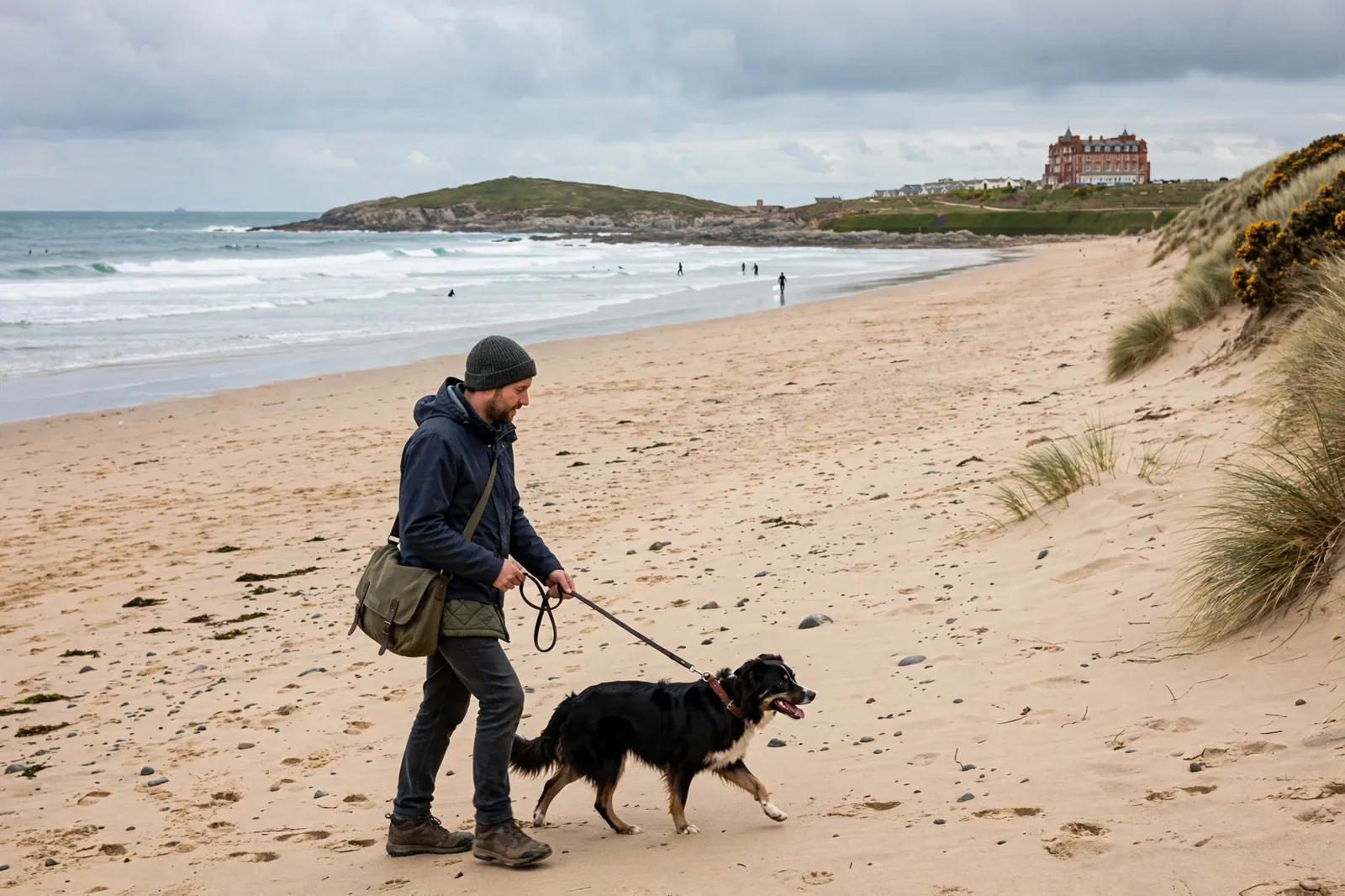
Fistral deserves its own section because for many dog owners it will be the beach of the holiday. It faces due west into the Atlantic, backed by headlands at both ends — Pentire to the south and Towan Headland to the north — with a broad sweep of sand at low tide, a promenade and surf centre behind the northern end, and surf in some form on most days of the year. It is home to surf schools, lifeguards in season and major surfing events, and it has the energy of a working surf beach rather than a quiet cove. Dogs who love open space, wind and watching the world tend to thrive here. Dogs who are frightened by kites, boards, flags and shouting surf lessons need a quieter corner and a gradual introduction.
Use Fistral intelligently and it is straightforward. Enter, read the signs, and walk away from the busiest northern access and surf-school concentration if your dog needs room; the beach is long enough at low tide to find space without walking far. Keep well clear of lifeguarded swim and surf zones, which are marked by flags and exist so that lifeguards can see swimmers and surfers without loose dogs crossing the water. Keep dogs out of the way of surf lessons on the sand, where beginners carry long boards at dog height and instructors need a clear teaching area. A lead or long line near the promenade, cafes and car parks, and reliable recall before any off-lead play, are the basics that keep a year-round welcome in good repair.
Swimming needs an honest assessment. Fistral is a surf beach, with rip currents, shorebreak and sets of waves that can knock a dog over and carry balls — and then dogs — further out than expected. Many dogs should not swim here at all, and none should swim in rough conditions, near surfers, or in lifeguarded zones. Our guide to dog swimming safety in the UK covers rips, cold water and when to keep a dog on the sand. The safer Fistral pleasures are paddling at the edge on a calm day under close supervision, long sand walks at low tide, and settling on a mat behind the windbreak to watch the surf — a spectator sport at which Newquay dogs become connoisseurs surprisingly quickly. Rinse salt and sand from coats and paws afterwards, offer fresh water often because dogs drink seawater when thirsty, and check ears and between toes after a beach day.
Events change Fistral's feel. On competition and festival days the northern end in particular can be crowded, loud and partially sectioned, with commentary, music and temporary structures. A dog who copes on an ordinary Tuesday may not cope on a finals Saturday. If an event coincides with your stay, walk Fistral early, use Watergate or the coast path for the main exercise, and return to Fistral for the spectacle only if your dog is genuinely relaxed in crowds — or watch from the headland paths, where there is space to step back.
Harbour, headlands and the old town side
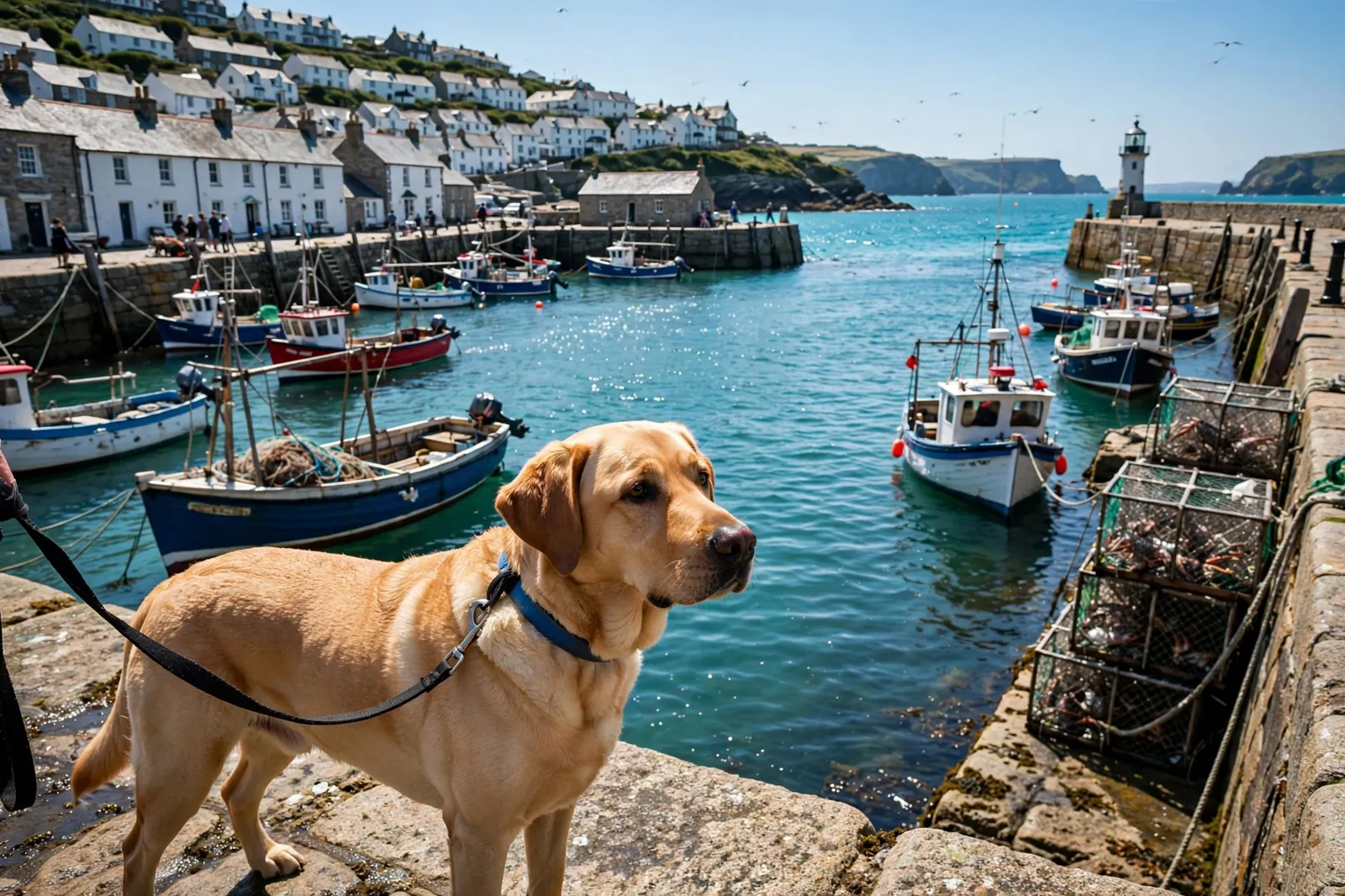
Between the surf beaches, Newquay has a second, older geography that is excellent dog walking in any season: the harbour, the headlands and the clifftop grass that links them. The harbour, tucked below the town and sheltered by Towan Headland, is a working harbour first and a viewpoint second. Dogs on short leads belong on the quays and public areas, out of working spaces, away from fishing gear, pots and boat decks, and well back from edges and ladders where the water is deep at every state of the tide. Harbour water is not for swimming, for dogs or people, and gulls here are bold and practised around food, so a pasty eaten on the quay wall needs guarding from above as well as from the dog beside you.
Towan Headland itself, with the distinctive Huer's Hut — the small white lookout historically associated with spotting pilchard shoals — gives the classic Newquay view back across Fistral and out to sea. The paths and grass around the headlands are made for a breezy lead walk and a bench stop, and they solve a practical problem: when a central beach is restricted or underwater, the headlands are still there. Keep dogs on leads near cliff edges without exception, give other walkers room on narrow paths, and treat high winds as a reason to choose a lower route. A dog pulling suddenly toward a gull at a cliff edge is not a theoretical risk on this coast.
The town side behind the harbour repays a slow lead walk early or late in the day. Newquay grew from a fishing port into a Victorian and then a surf resort, and the streets still show all three layers: harbour cottages, grander holiday-era buildings, and a modern centre of surf shops, cafes and nightlife venues. At dog pace, in the morning, it is a pleasant, interesting town to read. At peak summer lunchtime and late on a party night, the centre is crowded and noisy in a way many dogs would rather avoid. Time the town for the quiet hours, do any shopping with one person holding the dog outside food shops, and let the dog experience the centre as a short, successful outing rather than a long endurance test.
Coast path north and south: two different walks
The South West Coast Path runs straight through Newquay and offers a ready-made alternative on any day when beach rules, tides or crowds close the sand. North and east, the path climbs from the harbour side past Porth and on toward Watergate Bay and Mawgan Porth. This is the beach-hopping direction: headlands and coves at first, then longer views as the coast opens out, with the option of dropping to a year-round beach for the main run and climbing back to the path to continue. It is also the direction that links naturally with a wider Cornwall itinerary — compare the harbour-and-estuary rhythm in our Padstow with a dog guide, further up this same coast, where the Camel Trail plays the role the coast path plays here.
South and west, the path crosses the Gannel estuary area toward Pentire and on to Crantock. The Gannel is a tidal estuary and its crossings — bridges, causeways and seasonal arrangements — are strictly tide-dependent, so check the official latest guidance and local signs before you go and never improvise a crossing against a rising tide. Beyond it, Crantock's big dune-backed beach and the quieter lanes behind Pentire give Newquay's southern side a softer character that suits dogs who find the surf centre overstimulating. Pentire itself, the headland at Fistral's southern end, is excellent everyday dog ground: grass, paths and sea views without needing to commit to a long expedition.
Coast path discipline is the same in both directions and worth stating plainly. This is a cliff path, unfenced in many places, with livestock in some adjoining fields, nesting birds in season and seals resting in coves below. Dogs belong on a lead or a short long-line near edges, stock and wildlife, and extending leads should not be used on narrow cliff sections at all. Carry water for the dog — there are long stretches without supply — start the longer sections early in summer heat, and be willing to turn back at a chosen headland rather than pressing on to a named destination with a tiring dog. After storms, sections can be diverted or slippery; follow local diversion signs rather than the line on an old map.
Shorter path pieces serve daily life as well as grand days out. The harbour to Pentire circuit, the Porth headland loop, or an hour out-and-back toward Watergate and a bus or taxi return can be the main morning walk of a Newquay stay, leaving the beach for a shorter second outing when the tide and the rules suit. Dogs do not measure a holiday in miles. They measure it in interesting smells, comfortable rests and not being overwhelmed — and the coast path, used in pieces, delivers all three.
Living with a surf town: energy, nightlife and quiet corners
Newquay's character is the thing visitors either love immediately or need to plan around, and a dog feels that character more keenly than the humans do. This is Britain's best-known surf town: wetsuits drying over balconies, board hire on every other corner, beach bars, surf schools, and a summer nightlife scene that brings groups, music and late noise to the centre. For a sociable, bombproof dog it is stimulation in the best sense — new smells, friendly strangers, other dogs everywhere. For a nervous, reactive or elderly dog, the same streets in August can be a lot, and choosing where and when to walk matters more here than in a quieter resort.
The practical answer is geography plus timing, not avoidance. Stay and walk on the town's edges — Pentire, Porth, the headlands and the residential streets behind Fistral — and the surf-town energy becomes background rather than a gauntlet. Walk the centre early, when deliveries and dog walkers own the pavements, and late in the evening for a short circuit once the beach crowds have thinned but before the nightlife peaks. Give a dog who struggles with groups of shouting humans, skateboards or other dogs in narrow pavements a clear alternative: Newquay always has one within ten minutes, usually involving a headland and a sea view.
Surf culture also brings dog-friendly habits that help. Outdoor living is normal here, so water bowls outside cafes, sandy dogs on promenades and wetsuited owners with a dog tied — briefly, in sight, never in heat — outside a surf shop are part of the scenery. Board and bike hire, beach equipment and lessons are human activities, though: do not assume a dog can join a surf lesson, a coasteering session or a boat-based activity, and always confirm with the operator in advance. And if your trip coincides with a major surf festival or a bank-holiday weekend, book everything dog-related — stay, dog-welcoming tables, parking where bookable — earlier than you think necessary. Newquay's busiest weekends fill completely.
For a contrasting Cornish base, the art-and-harbour calm described in our St Ives with a dog guide shows how different two towns on the same coast can feel with the same dog. Many owners do both across separate trips and discover their dog has a firm preference. Neither is wrong; matching the town to the dog is the skill.
Eating and drinking with a dog
Newquay feeds dog owners well if they favour the formats the town does best: beach cafes, pubs with gardens and terraces, harbourside outdoor tables, and takeaway food eaten in the open air with a view. Fistral's beachside venues, the harbour area and the town centre all have places where a settled dog under a table is a familiar sight, and staff in a surf town are generally unruffled by sandy paws. Individual policies still vary — a small, packed restaurant may not take dogs inside while the pub next door welcomes them throughout — so check each venue's current position before you build an evening around it, and favour earlier sittings when a dog needs space to settle.
Beach and harbour picnics are the other half of the Newquay food story, and they need the usual Cornish defences. Gulls patrol every eating area and will take food from a hand, a bench or a bag left open beside a dog. Eat with food covered between bites, never leave a dog guarding food, clear every scrap, and do not feed gulls, however persuasive the audience becomes. Keep all human beach food — chocolate, grapes and raisins in trail mixes, cooked bones from barbecues, corn cobs and kebab skewers — securely away from dogs, and clear up barbecue remains rather than leaving them in sand where the next dog will find them. A surprising share of coastal vet emergencies begin as somebody else's picnic.
Carry the small eating-out kit that makes venues glad they said yes: a portable bowl and water, a lightweight mat so the dog is not lying on cold stone or hot tarmac for an hour, a chew for waits while food is ordered, and bags in every pocket. Keep leads short and out of walkways, dogs off seats, and feeding from the table to a minimum that is actually zero in smart places. If your dog cannot yet settle around food smells, music and passing dogs, choose the takeaway-and-headland option without apology. Fish and chips above Fistral as the surf comes in, with the dog asleep in the sea air after a long walk, is not a compromise in Newquay. For many regular visitors it is the point.
Stays, parking and arriving by train
Newquay offers every kind of stay, and the dog trade-offs are mainly about location. Hotels, guest houses and apartments near Fistral and the town centre put beaches and eating on the doorstep, with parking and nightlife noise as the costs to weigh. Self-catering houses and flats in Pentire, Porth and the residential areas behind the beaches give quieter nights, easier morning walks and often more floor space for a dog to dry off in. Holiday parks and campsites on the town's edges and along the coast toward Watergate and Mawgan Porth suit longer, beach-centred stays and dogs who settle better with a field outside the door than a corridor. None of these is automatically the dog-friendly choice; the right one is the one whose rules fit your dog.
Ask the booking questions precisely and get the answers in writing: how many dogs and of what size, the per-dog fee, whether dogs are welcome in bars and dining rooms or only in bedrooms and outdoor areas, whether a dog may be left alone and for how long, and what the first and last walk of the day actually looks like from the front door. In a surf town, add two specific checks: noise — is the room over or near a late bar, a venue terrace or a busy road — and sand management — is there an outside tap, a utility area or at least a tolerant entrance where a dog can be towelled before reaching carpets and bedding. Bring your own bedding, towels, a drying coat and a door mat routine, and the stay will start calmly in any property.
Parking needs a plan in season. Newquay's car parks near the centre, harbour and Fistral fill by mid-morning on fine summer days, and charges, time limits and payment methods change, so check the official latest guidance before you go and read operator signs when you arrive rather than relying on any guide's figures. Where your accommodation includes parking, treat it as gold and walk or use buses for the rest of the stay; moving a car between beach car parks in August is a poor use of a holiday. Repeat the rule that outranks convenience everywhere in this guide: never leave a dog alone in a parked car, in any weather that could warm the vehicle, for any errand however short.
Arriving without a car is entirely workable. Newquay has its own branch-line station, with trains connecting at Par on the main line through Cornwall, and dogs travel on trains under the usual national conditions, on leads and off seats. The station is a walk from the centre and the eastern beaches, so plan the last stretch with luggage and a dog honestly, especially in rain or heat. Local buses link the town with Watergate, Mawgan Porth, Padstow-side villages and other Cornish bases, and dogs are generally carried at the operator's discretion on a lead — confirm the current position before you rely on a particular service. However you arrive, save a local veterinary practice and its out-of-hours arrangement in your phone before you need it; coastal services are spread out and a surf-town weekend is a bad moment to start searching.
Sea safety, seasons and a working kit list
The Atlantic is the reason to come to Newquay and the thing to respect most carefully once you are here. Rip currents run at the surf beaches, waves that look playful can carry real power in the shorebreak, and rocky areas, harbour walls and the Gannel estuary each add their own hazards of slippery surfaces, deep water and fast-returning tides. Dogs should swim only in calm conditions, at suitable beaches, away from surfers, lifeguarded zones and harbour and estuary channels — and many dogs are happiest and safest as paddlers and spectators rather than swimmers at all. Keep dogs on leads near cliff edges in all weathers, keep them away from seals resting on sand or rocks, and follow any local wildlife signs around nesting birds on headlands and dunes.
Season choice is safety choice as well as crowd choice. Spring offers lengthening days, quieter beaches and the last weeks before seasonal restrictions begin — check the official latest guidance before you go for the year's exact start dates. Summer offers lifeguarded main beaches, the warmest sea and the full surf-town atmosphere, at the price of restrictions, heat and crowds; walk and exercise dogs early and late, carry water everywhere, and never let a dog overheat on hot sand or in a beach shelter with no airflow. Autumn is many dog owners' favourite Newquay: restrictions lift, the sea stays relatively warm, storms return drama to Fistral without summer numbers, and accommodation eases — with shorter days and changeable weather as the trade. Winter is empty, exhilarating and genuinely stormy; choose lower routes in high winds, keep well back from big surf and harbour edges in heavy seas, and expect some venues and services to run reduced hours.
Pack as for a working beach holiday rather than a town break: a lead you trust on cliffs plus a long line for safe open sand where it is permitted, a harness for scrambling paths, towels in quantity, a drying coat, fresh water and a bowl for every walk, poo bags in every coat and bag, and a basic check routine after each outing — paws for sand, shells and cuts between toes, coats rinsed of salt, ears dried after paddling. Watch for the seasonal extras Cornwall asks visitors to notice: adders in warm, quiet dune and path-edge grass in summer, jellyfish and weever fish on some beaches in season, and discarded hooks, line and barbecue debris around busy fishing and eating spots. None of this should put anyone off. It is the ordinary care that lets a dog enjoy one of Britain's great surf coasts safely, in the season that suits that dog best, on beaches that were open, checked and chosen rather than assumed.
Practical questions
Before you go
Which Newquay beaches allow dogs all year round?
Fistral Beach in Newquay itself, and Watergate Bay and Mawgan Porth just to the north, have commonly been listed as welcoming dogs all year round. That pattern can change when Cornwall Council renews or varies its orders, so check the council's official beach list and the sign at the beach entrance before you rely on any list, including this one, and follow the on-the-day sign if it differs.
When do seasonal dog restrictions apply in Newquay?
Seasonal restrictions in Newquay typically affect central beaches such as Towan, Great Western, Tolcarne, Lusty Glaze and Porth during the busiest months. Cornwall's Blue Flag pattern has been 15 May to 30 September, 10am to 6pm, but dates, hours and boundaries vary by beach and by year. Check Cornwall Council's official latest guidance before you go and follow the sign at each access point.
Can dogs go on Fistral Beach?
Fistral has commonly been a year-round dog beach, but check the official latest guidance and the entrance signs before you go. Keep dogs away from lifeguarded swim and surf zones and surf-school areas, keep them on a lead near car parks, cafes and busy access points, and do not let a dog chase boards, balls into the surf or other beach users. In rough surf, keep dogs out of the water entirely.
Are dogs allowed around Newquay harbour?
Dogs on leads can be walked around the harbour area, but it is a working harbour with boats, fishing gear, vehicles and deep water, so keep leads short, stay out of working areas and never let a dog swim in the harbour. Boat trips from the harbour set their own dog policies and are tide and weather dependent, so confirm with the operator before you book or turn up.
Where can I park and stay in Newquay with a dog?
Newquay has pay-and-display car parks near the town centre, Fistral and the harbour that fill quickly in summer, and a wide choice of hotels, cottages, holiday parks and campsites that accept dogs on different terms. Check current charges and time limits on operator signs when you arrive, confirm any dog fee, number limit and rule on leaving a dog alone before you book, and never leave a dog alone in a parked car.