This guide is independent and contains no paid placement. If affiliate links are added later, they will be clearly marked and will not change our editorial checks.
The Northumberland Coast Path runs 62 miles from Cresswell to Berwick-upon-Tweed, and it is the gentlest long-distance walk in England with a dog. Plan for four to five days, walk the beaches at low tide, keep dogs on leads through the dunes in nesting season, and book stays ahead in the small coastal villages. The castles, the beaches and the wide, empty sands make it a trail a dog will love.
Why this coast suits dogs so well
Northumberland has the wildest and emptiest coastline in England, and the Coast Path is the best way to walk it with a dog. At 62 miles from Cresswell to Berwick-upon-Tweed, it is one of the shortest of the long-distance trails, and it is also one of the flattest, with almost no climbing at all. The path follows the beaches, the dunes and the low cliffs of the Northumberland coast, passing through fishing villages, past ruined castles and across wide, sandy bays that are among the best in Britain for a dog to run on. For a walker with a dog, it is a generous trail: the distances are manageable, the ground is kind, and the scenery is superb from the first mile to the last.
The first thing to understand about this coast is how empty it is. Northumberland is the least densely populated county in England, and the coast reflects that: long stretches of beach with no one on them, villages that are quiet even in summer, and a sense of space that is rare on the English coast. A dog that needs room to run will find it here, and a dog that is nervous in crowds will find the quiet reassuring. The beaches are wide and sandy, with firm, clean sand that is easy on paws, and the dunes behind them are a haven for wildlife, with birds, butterflies and wildflowers in abundance. The castles, which give the coast its character, are mostly ruins, and they can be admired from the outside with a dog, without the ticket queues and the crowds of the more famous sites.
The trail is usually walked from south to north, from Cresswell to Berwick, so that the prevailing wind is behind you and the journey ends at the border town of Berwick-upon-Tweed, but it can be walked in either direction, and many walkers choose to walk it in sections, as day walks from a base in Alnwick, Bamburgh or Berwick. The total distance is around 62 miles, and most walkers take four to five days, with stages of 12 to 15 miles a day. The walking is flat and easy, with surfaced paths, beach walking and good surfaces underfoot, and the dog will find it comfortable, although the beach walking can be tiring on the legs, because the sand is soft in places and the distances are longer than they look.
This guide works through the trail section by section, from Cresswell to Berwick, then covers the questions that decide whether the walk succeeds: the castles and how to see them with a dog, the dunes and the wildlife, the villages and the pubs, and the planning of tides, transport and stays. The advice is written for walkers with a dog, but the trail is forgiving enough that a reasonably fit walker and a reasonably fit dog can manage it with good planning and a willingness to let the dog set the pace on the beaches.
Cresswell to Amble: dunes, drifts and a slow start
Cresswell, the start of the Northumberland Coast Path, is a small village with a wide, sandy beach, a nature reserve and a sense of quiet that sets the tone for the whole trail. The beach at Cresswell is one of the best on the coast for a dog to run on, with firm, clean sand and plenty of space, and the dunes behind it are a haven for wildlife. The village has a cafe and a car park, and it is a good place to start the trail, because the first day's walk is gentle and the scenery is immediately rewarding. The path leaves the village and follows the coast northwards, through the dunes and along the beach, to the small village of Lynemouth and on to Newbiggin-by-the-Sea.
Newbiggin is a former mining village with a long, sandy beach, a promenade and a maritime centre, and it is a good place to stop for lunch, with cafes that are relaxed about dogs. The beach at Newbiggin is wide and sandy, and it is a good place for a dog to run, although the seasonal rules apply, so check the current rules before you set out. The village has a particular character, with its history as a fishing and mining community, and the promenade is a pleasant walk with sea views. From Newbiggin, the trail follows the coast north to Ashington and on to the harbour town of Blyth, where the path crosses the river and continues to the dunes and beaches of the northern coast.
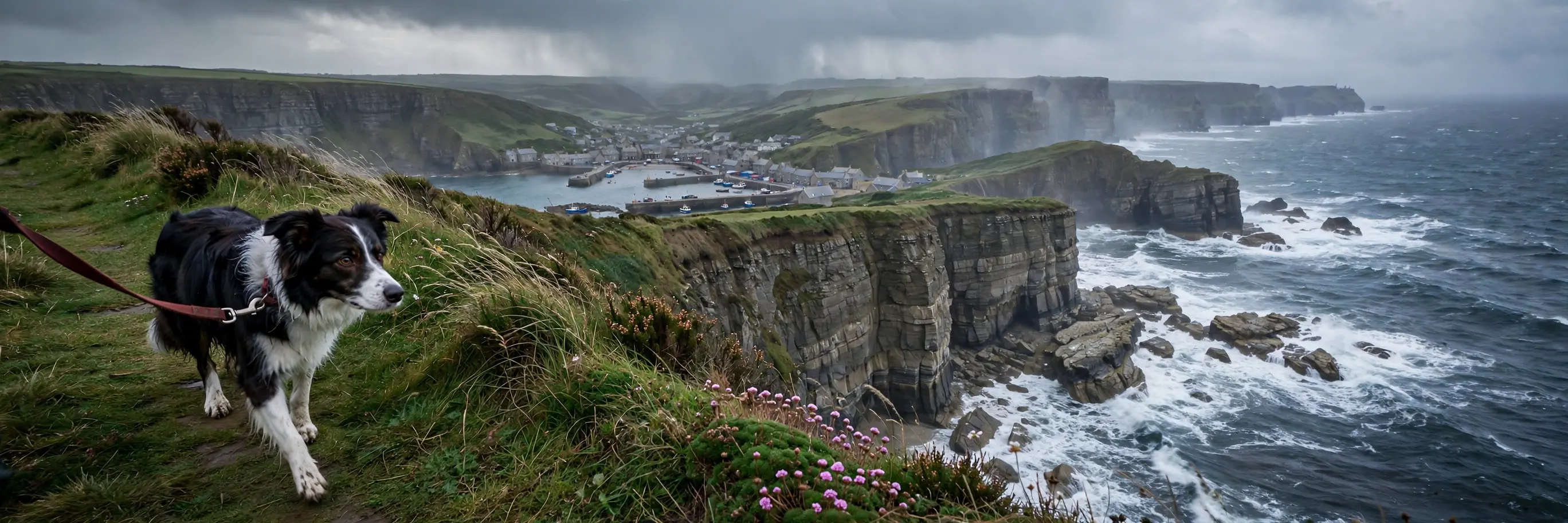
The walking on this first section is flat and easy, with surfaced paths, beach walking and good surfaces underfoot, but the beach walking can be tiring, because the sand is soft in places and the distances are longer than they look. A dog that runs on the beach for miles will need water and rest, so carry a bottle and a collapsible bowl, and stop regularly for the dog to drink and to rest in the shade. The dunes on this stretch are a sensitive habitat for ground-nesting birds in spring and summer, so keep the dog on the path and on the beach, and avoid the dune edges where birds may be nesting. The same caution applies to the cliff tops, where the drops are low but unfenced in places.
Amble, at the end of this section, is a harbour town with a working fishing fleet, a marina and a long, sandy beach, and it is a good place to stay for the night. The town has cafes, fish and chip shops and pubs that are relaxed about dogs, and the harbour area is busy with boats and vehicles, so keep the dog on a lead and be careful around the working quays. The beach at Amble is wide and sandy, and it is a good place for a dog to run in the evening, after the day's walk, with the sun setting over the sea and the harbour lights coming on. The town's position on the trail makes it a natural break point, and the accommodation is more plentiful here than in the smaller villages ahead.
Two river mouths: Coquet to Aln
The walk from Amble to Alnmouth is a walk between two rivers, and the rivers set the terms. The Coquet leaves the land at Warkworth in a wide, shallow estuary, and the Aln does the same at Alnmouth, and between them the coast is a long, empty beach with the dunes behind it. The birds know both estuaries well: oystercatchers and curlews feed on the mud at low tide, and the gulls follow the fishing boats out of Amble harbour in the morning. A dog that runs on this beach will run a long way, because there is nothing to stop it, and that is the pleasure and the risk of it: keep an eye on the tide, and call the dog back before it has run further than you want to walk.
Warkworth sits on the Coquet, and the village is worth an hour on the way through. The castle stands on a hill above the river, and the stone bridge crosses the water below it, and the whole place has the feel of a village that has been here a long time. The river paths are quiet, and the herons fish in the shallows, and the walk from the village to the river mouth is one of the prettiest on the coast. The castle does not allow dogs inside, apart from assistance dogs, so see it from the bridge and the riverside, where the view is free and the dog can come too.
Between the two rivers the walking is simple: sand, dunes and sky. The golf links run along the top of the dunes, and the dog must stay on the beach and the path, not on the fairways, where a golfer and a dog are a bad combination. The dunes themselves are out of bounds in the nesting season, when ground-nesting birds are on the ground, so the beach is the place for the dog, and the dunes are the place to look at, not to walk through. The sand is firm at low tide and soft at high tide, so walk it while the tide is falling, and turn back while there is still plenty of beach underfoot.
Alnmouth is the end of the day, and the Aln estuary is the reason to stop and look before you go in. At low tide the mud is full of waders, and the river runs out to sea in a channel that the dog should not be allowed to cross, because the current in the estuary is strong even when it looks calm. The village has places to stay and places to eat, and it is a good base for the walk to Craster the next day. Check the tide times before you set out in the morning, because the beaches are wide at low tide and the water comes back in fast, and a dog that has run a long way along the beach needs time to get back.
A morning on the sand to Craster
Set out early, while the tide is still going out, and walk the beach. The sand at Alnmouth is firm underfoot at low water, the dunes are on your right, the sea is on your left, and the only other footprints are the birds'. The estuary behind you is full of waders, the golf course is quiet, and the village is still asleep. This is the best hour of the day on this coast, and it is worth the early start, because by mid-morning the beach fills with walkers, and by high tide the sand is gone altogether.
The beach runs north for miles, and the walking is easy, but it is not a walk to do without thinking. The tide that is going out will come back in, and it comes back fast, so keep an eye on the water and turn for the dunes while there is still plenty of sand underfoot. The dog will run ahead, and it should, because this is the beach for running, but call it back before it gets too far, because a dog that has run half a mile along the beach is a dog that has a long way back. Carry water, because there is no shade and no shop, and the sun on the sand is stronger than it feels.
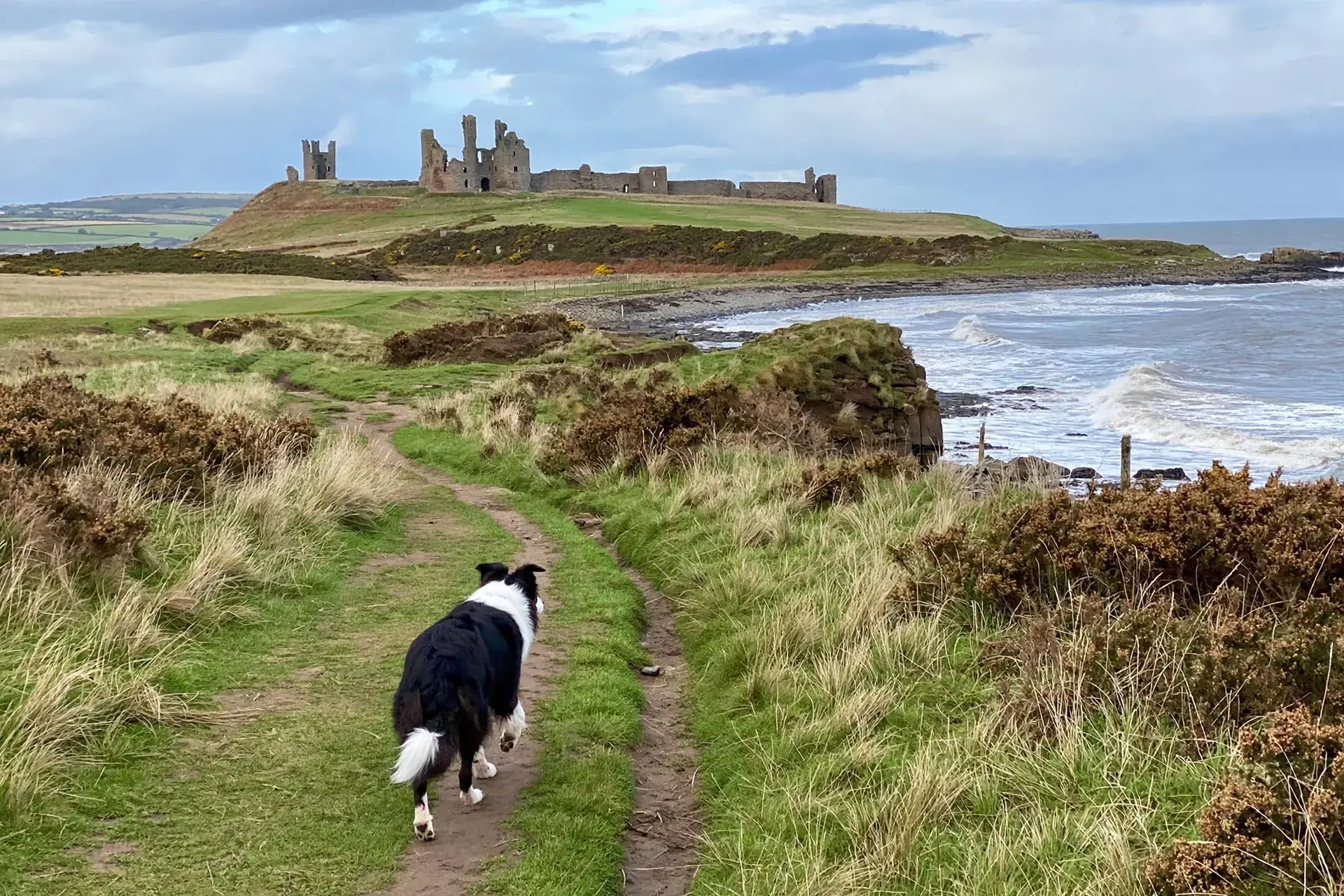
Boulmer is the halfway mark, and it is a village that time has left alone. The boats are pulled up on the beach, the houses face the sea, and there is nothing to buy and nowhere to sit, just the coast and the people who live on it. It is a good place to stop for water and a rest, and a reminder that this coast is a working place. North of Boulmer the path leaves the beach and follows the low cliffs and the dunes, with the sea on one side and the farmland on the other, and Dunstanburgh Castle appears gradually on the horizon, first as a smudge, then as towers, then as a ruin on a headland.
Craster is the end of the morning, and it is a village that rewards the walker. The harbour, the smokehouse, the pub and the stone cottages are all within a few minutes of each other, and the kippers are famous for a reason. The walk from Craster to the castle is the one everyone remembers, with the ruined towers on the headland and the sea beside the path, and it is a walk to take slowly, with the dog on a lead near the unfenced drops and the birds in the dunes given a wide berth in the nesting season.
Newton, Beadnell and the lime kilns
North of Craster the coast changes. The cliffs get lower, the beaches get wider, and the villages get smaller, until the coast feels as if it belongs to the birds and the sea more than to anyone else. Newton-by-the-Sea is the first village, a cluster of stone cottages around a small square, with a pub and a beach that is empty on a weekday and full of life on a summer weekend. The beach at Newton is a long, wide sweep of sand, and it is a good place for a dog to run, with the dunes behind it and the sea in front, and the views running north to Beadnell and Bamburgh.
Beadnell is the next village, and it has a particular history. The lime kilns on the harbour, great stone structures that once burned limestone for the farms inland, are a reminder that this coast was once an industrial place, with ships, quarries and kilns, and the harbour that is now full of pleasure boats was once full of working boats. The beach at Beadnell is wide and sandy, and it is a good place for a dog to run, with the bay curving round to the north and the castle at Bamburgh visible in the distance. The village has a cafe and a pub that welcome dogs, and the harbour area is a pleasant place to walk, with the boats and the sea.
The walking between the villages is flat and easy, with the dunes on one side and the sea on the other, and the path follows the beach where the tide allows and the dunes where it does not. The seabirds are everywhere: oystercatchers on the sand, curlews in the dunes, and gulls following the fishing boats. The Farne Islands, offshore, are home to puffins and seals, and on a clear day they are visible from the beach, a low, dark line on the horizon. The dog will enjoy the open ground and the sea air, but the lead stays on near the cliff edges and in the dunes in the nesting season.
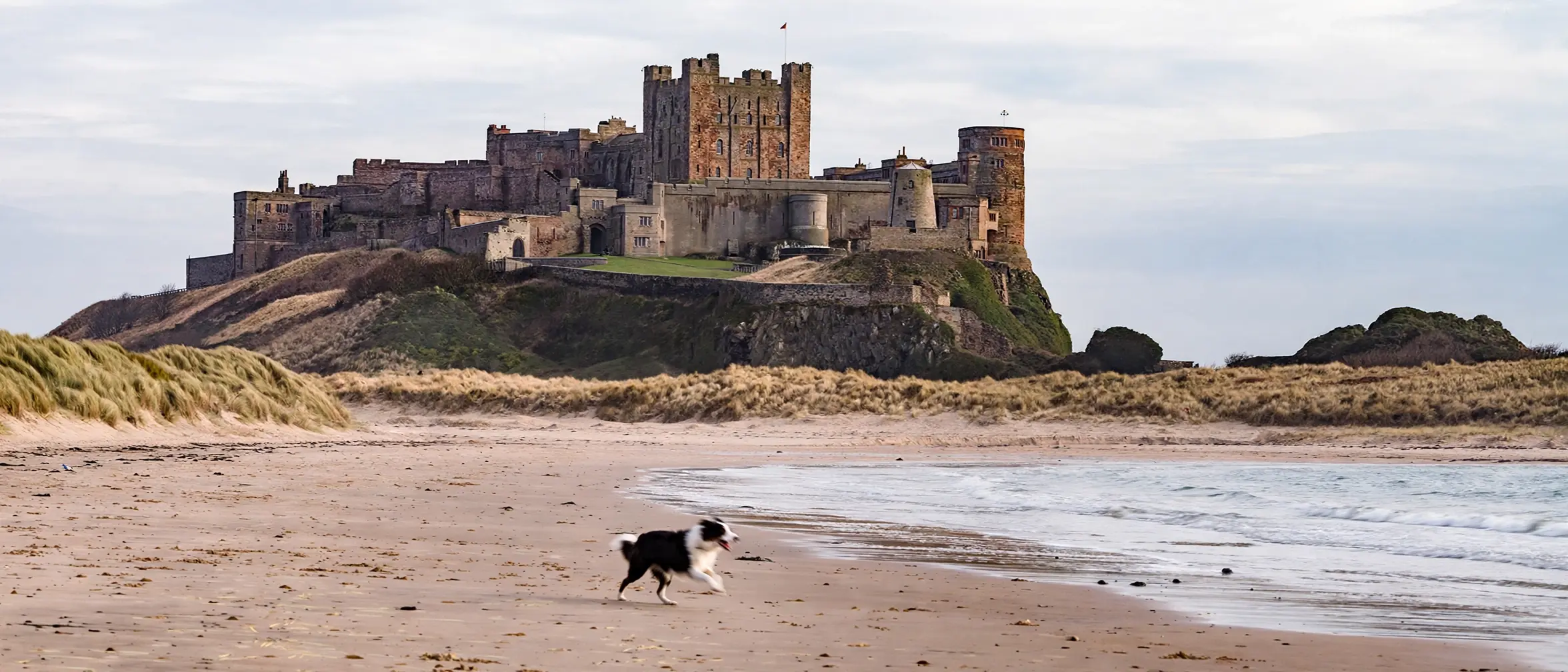
Bamburgh appears gradually, first as a castle on a hill, then as a village, then as a beach. The castle is a great fortress on a rocky outcrop, and it dominates the coast for miles, with the beach below it and the Farne Islands offshore. The beach at Bamburgh is one of the best on the coast for a dog to run, with firm, clean sand and plenty of space, and the views from the sand, with the castle on one side and the islands on the other, are superb. The village has cafes, pubs and shops that welcome dogs, and the castle is worth a visit, although the dog cannot go inside. It is a fitting end to a day that began in a fishing village and ends at a castle.
The northern shore to Berwick
Leave Bamburgh in the morning, with the castle behind you and the Farne Islands offshore, and walk north along the dunes to Seahouses. The islands are the reason many people come here: puffins in the summer, grey seals all year, and boat trips from the harbour that take you close to the colonies. The boats do not take dogs, apart from assistance dogs, so if you want to go out to the islands, plan for one person to stay ashore with the dog, and use the time for a walk on the beach at Seahouses, which is long and sandy and empty in the evening, when the boats are in and the town is quiet.
North of Seahouses the coast gets quieter, and the path follows the dunes and the low cliffs towards the Holy Island causeway. The walking is flat and easy, the sea is on one side and the farmland on the other, and the views run north to the island and the border. The causeway is the thing to plan for: it is under water at high tide, and the safe times are different every day. If you mean to visit the island, look at the board at the causeway the night before and again in the morning, and do not start across when the tide is coming in. The island is small, with a castle, a priory and a village, and the dog is welcome on the paths and the beaches, but not inside the castle or the priory.
Beyond the causeway the path returns to the coast and runs north to Berwick, through the dunes and along the beaches. The walking is flat, the ground is kind, and the dog will enjoy the open sand and the sea air, but the tide matters here, because the beaches are wide at low water and the water comes back in fast. Walk the sand while the tide is falling, and turn back while there is still plenty of beach underfoot. The water is cold, and a paddle is a better idea than a swim for most dogs, and the river mouths are best avoided altogether, because the current there is unpredictable.
Berwick-upon-Tweed, at the end of the path, is a town with walls, a quay, a beach and a station, and it is a satisfying place to finish a 62-mile walk. The walls are a great walk with a dog, with views across the Tweed and the sea, and the beach at Spittal, just south of the town, is a good place for a final run on the sand. The town has shops, cafes and pubs, and its position on the border makes it easy to get home. Our guide to Berwick-upon-Tweed with a dog covers the walls, the quay and the coast in detail, and it is a useful companion for the finish of the trail.
The castles, and how to see them with a dog
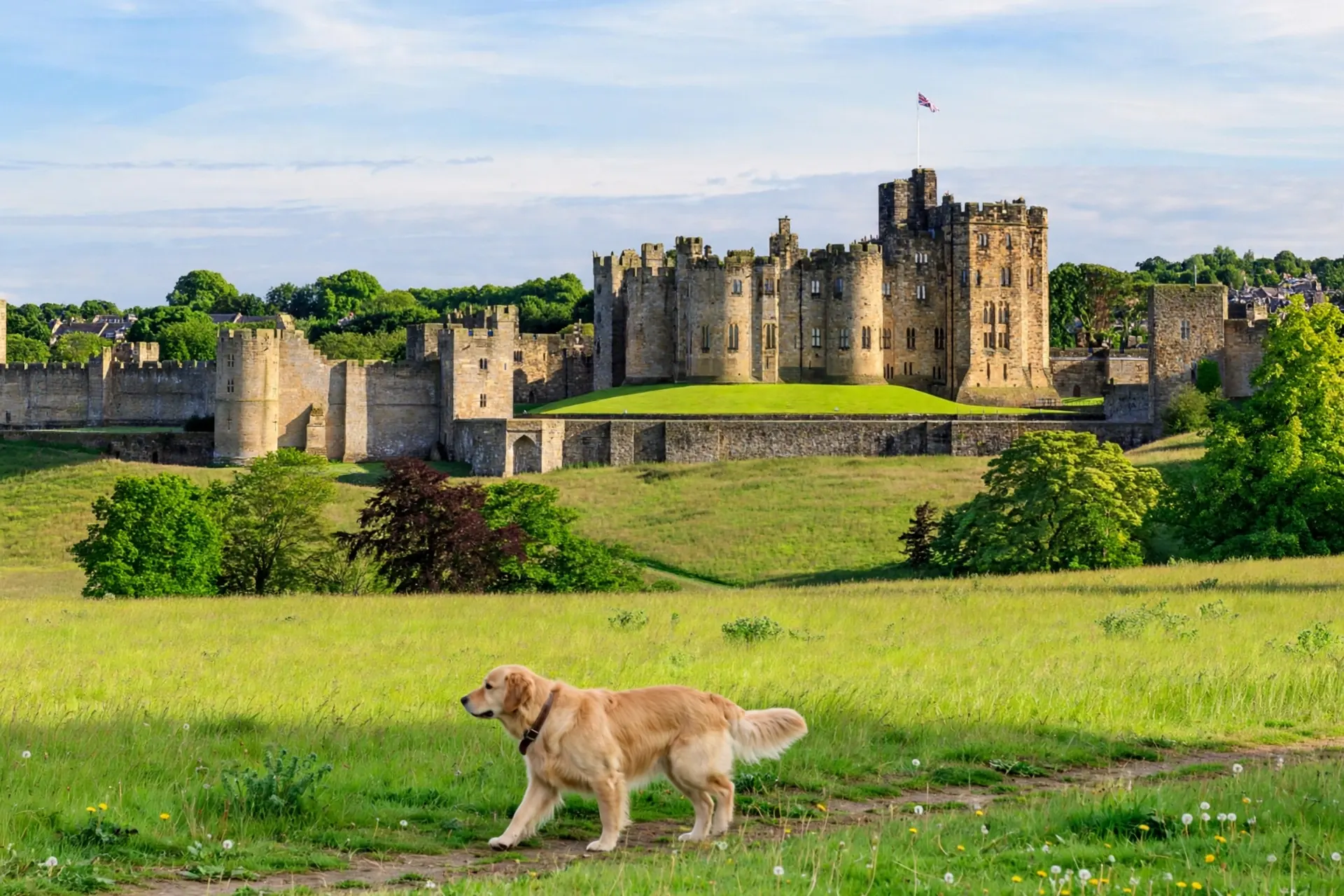
The castles are the thread that runs through the Northumberland Coast Path, and they give the trail its character. From Warkworth to Dunstanburgh, from Bamburgh to Lindisfarne, the castles stand on headlands and hills, ruined and romantic, and they are visible from the path for miles. Most of them are managed by English Heritage or the National Trust, and dogs are not allowed inside, apart from assistance dogs, but the castles can be admired from the outside with a dog, and the coastal paths that run past them give you the best views without the ticket queue. The trick is to plan the visit around the dog, not around the castle, and to enjoy the view from the path rather than the interior.
Warkworth Castle, the first castle on the trail, stands on a hill above the village, and the ruins are impressive, with a great keep and a curtain wall. The castle is worth a visit, but the dog will need to wait outside, so plan for one person to stay with the dog while the other visits the castle, or enjoy the view from the village and the riverside paths. Dunstanburgh Castle, the great ruined fortress on the headland between Craster and Embleton, is best seen from the coastal path, with the twin towers and the cliff edge, and the walk to it from Craster is one of the finest on the coast. Bamburgh Castle, the great fortress on the rocky outcrop above the beach, is the most famous castle on the trail, and it is worth a visit, although the dog will need to wait outside.
Lindisfarne Castle, on Holy Island, is a small castle on a rocky hill, and it is a beautiful place, although dogs are not allowed inside. The island itself is worth a visit, with the priory, the harbour and the village, and the dog is welcome on the outdoor paths and the beaches. The castles of Northumberland are not just tourist attractions, they are part of the landscape, and the best way to see them is from the path, with a dog at your side, the sea on one side and the castle ahead. The views are free, the walking is good, and the dog will enjoy the open ground and the sea air.
A practical note for the castles: check the opening times and the dog policy before you travel, because they can change with the season, and some castles are closed in winter or have restricted opening hours. The English Heritage and National Trust websites have the current information, and the local tourist information centres can advise on the best way to see the castles with a dog. If you want to visit a castle interior, plan for one person to stay outside with the dog, or leave the dog at your accommodation for a short time, if the accommodation allows it and the dog is settled.
Dunes, wildlife and the nesting season
The dunes of Northumberland are a sensitive and beautiful habitat, and they are one of the most important features of the Coast Path. The dunes run behind the beaches for miles, with marram grass, wildflowers and a wide range of birds, butterflies and other wildlife. They are also a fragile habitat, and a dog that runs through them can cause damage, especially in spring and summer, when ground-nesting birds are present. The rule is simple: keep the dog on the path and on the beach, and avoid the dune edges where birds may be nesting. The dunes are not a playground for dogs, they are a home for wildlife, and the walkers who respect them are the ones who are welcomed back.
The wildlife of the coast is superb, and the trail is a good place to see it. The Farne Islands, offshore from Seahouses and Bamburgh, are home to puffins, guillemots, razorbills and grey seals, and the boat trips to the islands are a popular attraction, although dogs are not allowed on the boats. The beaches and the dunes are home to a wide range of wading birds, including oystercatchers, curlews, redshanks and sanderlings, and the early morning is the best time to see them. The dunes are also home to butterflies, including the grayling and the dingy skipper, and to wildflowers, including the bloody cranesbill and the sea campion, which flower in the summer months.
The nesting season, from March to August, is the most sensitive time for the dunes and the beaches. Ground-nesting birds, including little terns, ringed plovers and oystercatchers, nest on the sand and in the dunes, and a dog that runs through the nesting areas can destroy a nest without the owner ever knowing. The restricted zones are signposted at the beach entrances, and the dog should be kept on a lead in these areas, even if the birds are not visible. The same caution applies to the seals on the Farne Islands and the beaches, which can be disturbed by a dog that approaches them. Keep the dog on a lead near seals, and do not let it chase them into the water.
The countryside code, which asks walkers to keep dogs under control and to respect livestock and wildlife, is not a suggestion on this trail. It is the way the trail works. Stick to the path, close gates behind you, keep the dog under control, and take all your litter home with you. The coast is a privilege, not a right, and the walkers who treat it with respect are the ones who are welcomed back. The dunes and the beaches are a joy, but they are a joy that needs care, and a walker who cares for them will enjoy them far more than a walker who does not.
What to eat, and where to sleep, on the coast
Food on this coast is simple, and it is good. Craster has kippers from the smokehouse, Seahouses has crab and fish from the harbour, Amble has fish and chips eaten on a bench with the sea in front of you, and Berwick has pubs that serve walkers' food in generous portions. The cafes in the villages are relaxed about dogs, with outdoor seating in the summer and a bowl of water that appears without being asked, and the pubs are the centre of village life, with a fire in the winter and a garden in the summer. A pub meal, a dog asleep under the table, and a map for tomorrow is a better end to a day than a long restaurant dinner, and it is cheaper too.
Sleeping on the coast is a matter of booking early, because the villages are small and the beds are few. Craster has a pub with rooms and a handful of bed and breakfasts. Seahouses has hotels and guest houses. Bamburgh has bed and breakfasts that fill up quickly in summer. Berwick has a station and a choice of hotels. Alnwick, a few miles inland, has the widest choice of all, and it is a good base for a rest day. Ring ahead, say the dog is coming, and ask whether there is a garden, whether the dog can come into the bar, and whether there is a charge. A host who answers easily has done this before, and a host who hesitates has not.
Self-catering is worth considering on this coast, because a cottage with a kitchen gives the dog its own space, a garden to use last thing at night, and a place to dry off after a wet walk. The cottages in the villages are often stone-built, with a fire, a kitchen and a garden, and they are a good base for a week, with day walks from the door. Hotels and bed and breakfasts are more convenient for a short stay, but always confirm the dog policy in writing before you book, including any charge, any size limit, and whether the dog can be left alone in the room, because that changes the evening completely.
Supplies are a matter of knowing where the shops are. Alnwick, Amble and Berwick have supermarkets where you can stock up, and the smaller villages have a shop with a limited range, or nothing at all. Buy more than you need for the next day, and ask the person behind the counter what lies ahead, because they will know which village has a shop and which one does not. Carry cash as well as cards, because some of the smaller places do not take cards, and the phone signal on the coast is unreliable. A dog that is fed little and often will walk better the next day than a dog that is fed once at night, so keep the food in the day pack.
Five days on the coast, day by day
Day one runs from Cresswell to Amble, about twelve miles of dunes and beach, and it is the gentlest day on the trail, a good way to settle into the walking. Day two runs from Amble to Craster, through Warkworth and Alnmouth, with the castle at Dunstanburgh ahead of you for the last few miles. Day three runs from Craster to Bamburgh, past Newton and Beadnell, and it is the day with the best beaches. Day four runs from Bamburgh to Berwick, through Seahouses and past the Holy Island causeway, and it is the longest day, so start early. A fifth day, if you take one, is best spent on Holy Island, or as a rest day in Bamburgh, where the beach and the castle are worth a slow morning.
The beds decide the stages, because the villages are small and the rooms are few. Craster has a pub with rooms. Seahouses has hotels. Bamburgh has bed and breakfasts that fill up quickly in summer. Berwick has a station and a choice of hotels. Alnwick, a few miles inland, has the widest choice of all, and it is a good base for a rest day. Book every night before you leave home, and say on the phone that a dog is coming, how big it is, and whether it will be left alone in the room. A host who knows is a host who is ready.
Berwick, at the finish, has trains to Edinburgh, Newcastle and London, and Cresswell, at the start, is reached by bus from Newcastle and Morpeth, so a car-free walk is possible. The Coast and Castles bus runs along the coast in the summer months, and it is the easiest way to get back to the start of a day's walk, but it is infrequent, so look at the timetable before you rely on it. Dogs are generally allowed on the buses and trains if they are well behaved, but the rules differ between operators, so check before you travel. If you drive, decide before you leave whether the car stays at the start or the finish.
Your bag can travel ahead of you. The firms that move walkers' bags from one night's stay to the next need the names of every stay and need to be booked before you leave home, and they need to know a dog is coming. If you would rather carry everything, pack light and restock in Alnwick, Amble and Berwick, rather than carrying five days of food from Cresswell. Either way, keep the dog's food, water and medicine in the day bag, where you can reach them during the day. A collapsible bowl weighs nothing, and a towel in the car is worth its weight after a beach walk.
Practical questions
Before you go
How many days for the Northumberland Coast Path with a dog?
Four to five days is the usual answer for the 62 miles. The trail is mostly flat, so the distance is the challenge, not the climbing, and fit walkers with fit dogs often manage four days, with stages of around fifteen miles. Slower walkers, and walkers with older dogs, should allow five and take a rest day in Bamburgh or Alnwick. The beach walking can be tiring on the legs, because the sand is soft in places, so the days are best walked slowly, with regular breaks.
Which beaches allow dogs on the Northumberland Coast Path?
Most of the beaches allow dogs, but the rules change from beach to beach and with the season, so confirm the current rules before you travel rather than relying on what worked last year. Some beaches have restrictions in the summer months, others are open all year, and the restricted zones are signposted at the entrance. Keep dogs on leads through the dunes in the nesting season, from March to August, to protect the ground-nesting birds, and clean up after your dog on every beach. For the latest position on any beach, check the official guidance before you travel.
How do I visit Holy Island from the Coast Path?
Holy Island is cut off twice a day: the road across the sands disappears under the incoming sea, so you can only cross inside the safe window printed for that date. Times shift daily, so look them up the evening before you go and confirm them once more over breakfast. Set off while the tide is still ebbing and give yourself a generous hour to reach the island; walking out as the water returns is dangerous because the channel fills quickly. When the window does not fit your route, spend another night on the mainland and try the following morning instead.
Is the Coast Path good for an older dog?
Yes, it is one of the best long-distance trails for an older dog, because the walking is mostly flat, with surfaced paths and soft sand underfoot, and there is almost no climbing. The distances are still long, at twelve to fifteen miles a day, so an older dog needs training and a rest day. Plan for five days, take a rest day in Bamburgh, and be ready to shorten a stage if the dog is struggling. The beach walking can be tiring, because the sand is soft, so walk the beaches at low tide when the sand is firm.
Where do I stay with a dog on the Coast Path?
Craster has a pub with rooms. Seahouses has hotels and guest houses. Bamburgh has bed and breakfasts that fill up quickly in summer. Berwick has hotels and a station. Alnwick, a few miles inland, has the widest choice of all. Book every night before you leave home, and say on the phone that a dog is coming, how big it is, and whether it will be left alone in the room. A host who knows is a host who is ready, and a host who finds out at the door may not have a room.
Can I walk the Coast Path without a car?
Yes. Berwick-upon-Tweed has a railway station, and Cresswell is reachable by bus from Newcastle and Morpeth. The Coast and Castles bus runs along the coast in the summer months, and it is the easiest way to get back to the start of a day's walk, but it is infrequent, so check the timetable before you rely on it. Dogs are generally allowed on buses and trains if they are well behaved, but look up the latest advice before you go, because the rules differ between operators.