This guide is independent and contains no paid placement. If affiliate links are added later, they will be clearly marked and will not change our editorial checks.
The Cleveland Way is a 109-mile National Trail in two halves: about 55 miles of cliff-top coast from Saltburn to Filey, and about 55 miles of inland moorland from Helmsley to Saltburn. The coast half demands cliff safety and a lead at all times; the moorland half demands navigation, water and weather sense. Walk either half on its own, or the whole trail in nine or ten days.
Two walks in one: coast first, then moor
The Cleveland Way is two trails stitched together, and understanding that is the key to walking it with a dog. The coastal half runs from Saltburn-by-the-Sea to Filey, about 55 miles of cliff-top path with the North Sea on one side and farmland on the other. The inland half runs from Helmsley to Saltburn, about 55 miles across the North York Moors, through heather, woodland and quiet valleys. The two halves could hardly be more different: one is a linear cliff walk where the main danger is the drop, the other is a rolling moorland crossing where the main dangers are weather, navigation and distance from help.
Most walkers start at Helmsley and finish at Filey, which means the moorland comes first and the coast is the reward. That order suits dogs well, because the moorland is the harder walking and the coast is the more distracting. A dog that has settled into the rhythm of the trail by the time it reaches the cliffs will be easier to manage on the narrow, exposed stretches than a dog that arrives fresh and over-excited. The alternative — starting at Filey and walking the coast first — is equally valid, and it has the advantage of putting the most dramatic scenery at the start, when energy is highest. Either way, do not try to treat the two halves as one kind of walking. They need different kit, different pacing and different safety habits.
Nine or ten days at 11 to 13 miles a day covers the 109 miles, and the two halves will not let you walk them at the same speed. The cliff path is the slower one: it rises and falls all day, the views stop you, and the steps down to each village take the pace out of your legs. The moorland half covers ground faster but forgives less — the moors are high, open and changeable, and a bright morning can turn wet and windy before lunch. Cliff falls and moorland diversions are both a regular feature of this trail, so check the official guidance before you travel rather than assuming the line on last year's map is still the line on the ground.
Cliff-top safety: the coast half with a dog
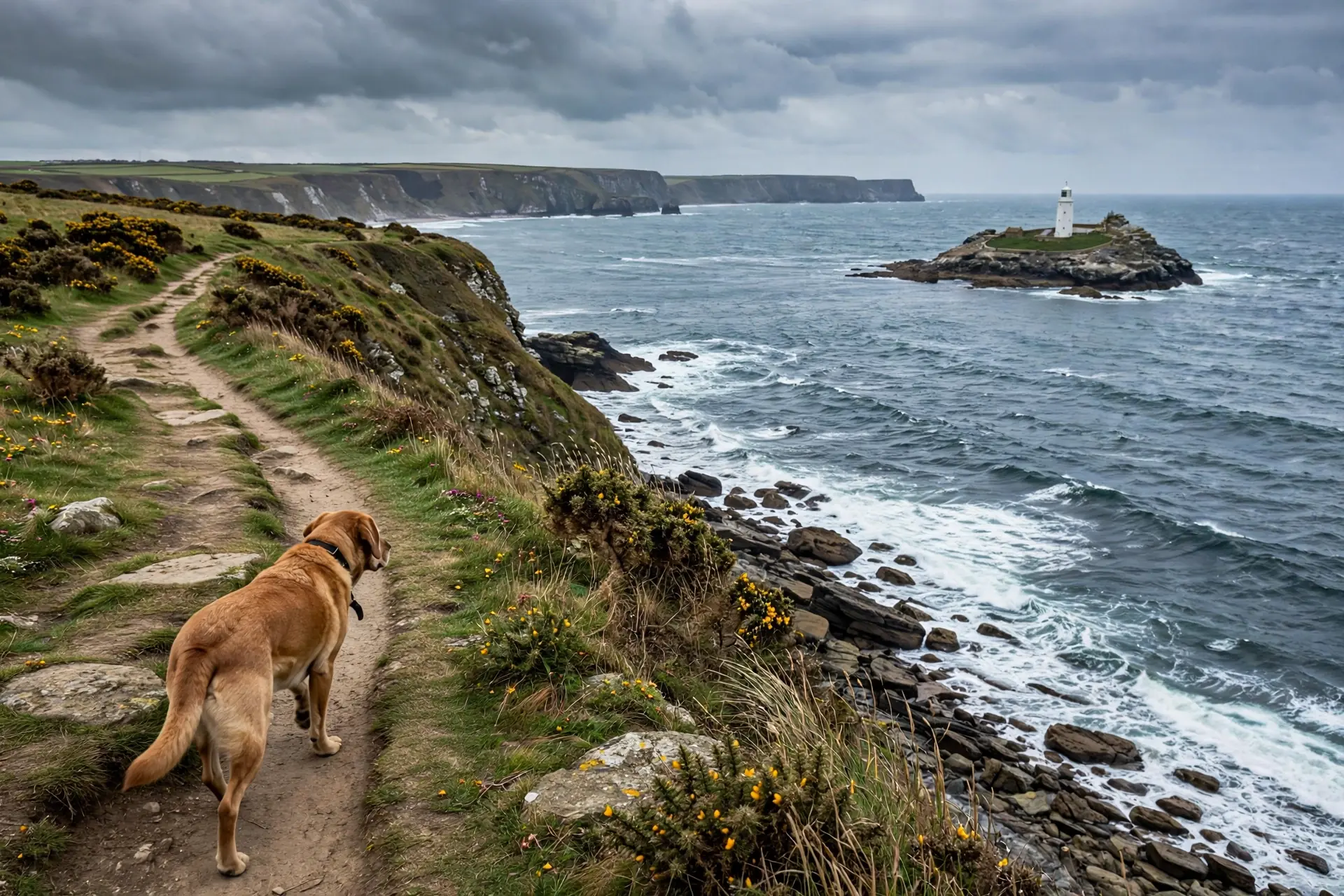
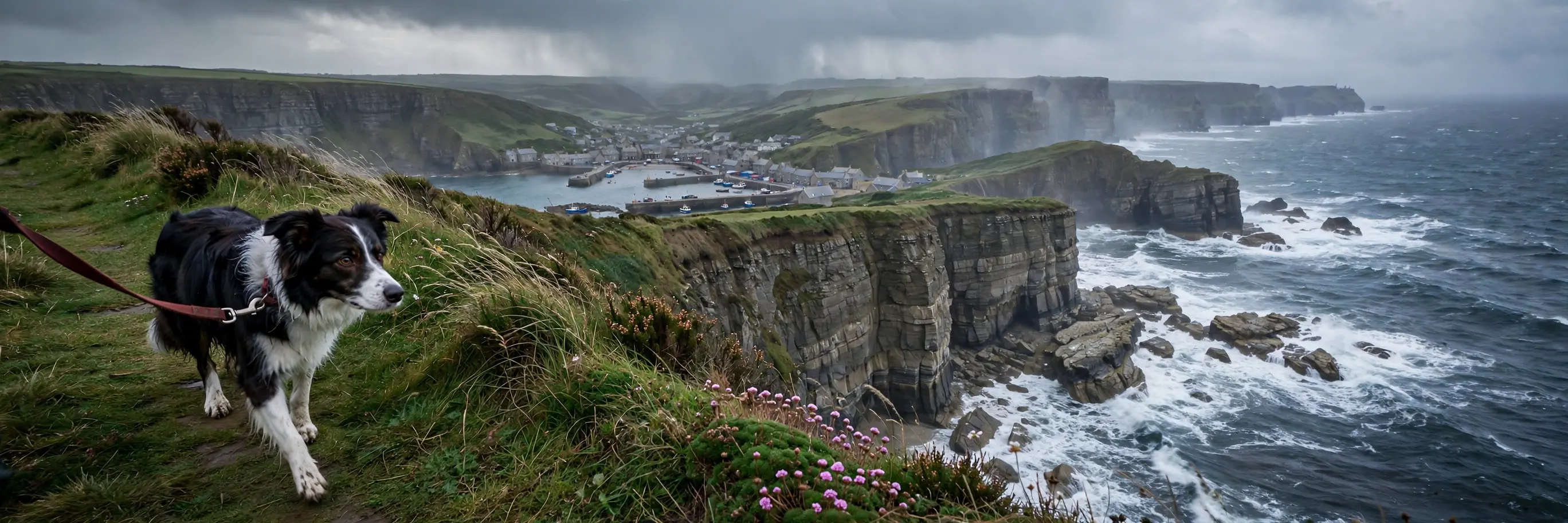
The coast half is a cliff walk first and a scenic walk second, and the dog rules follow from that. For about 55 miles the path runs along cliff tops that rise more than 150 metres above the sea, sometimes on a broad grassy strip and sometimes on a narrow track close to the edge, with gullies and steep steps breaking it up. On this ground the lead never comes off — not for a well-trained dog, not for a quiet stretch, not for a photograph. A dog that bolts after a rabbit, a seabird or another dog can reach the edge in seconds, and a fall from these cliffs is not something a dog comes back from. Keep the dog on the inland side of the path where there is room to choose, keep the lead short, and accept that the cliff walk is a lead walk: the views are just as good from behind a short lead as from the edge.
Cliff falls are a real and regular occurrence on the North Yorkshire coast. The cliffs are made of soft rock that crumbles, and sections of the path are moved inland when the edge becomes unstable. Follow the diversions, even when they look inconvenient, and never walk on a closed section. Keep your dog well away from the edge even where the path looks wide, because the grass at the cliff top can overhang an undercut that you cannot see. The same caution applies at the many steep descents to the beaches and villages: the steps are uneven, the handrails are not dog-proof, and a dog that pulls on the lead on a steep descent can pull you both off balance.
Seabirds add another layer of distraction. The cliffs between Staithes and Whitby are home to nesting seabirds in spring and summer, and the noise and movement can excite even a steady dog. Keep the lead short, keep the dog on the inland side of the path where possible, and do not let it approach the cliff edge to look at the birds. The views are superb from the path itself, and there is no need to get closer. If your dog is reactive to other dogs, be aware that the coast path is popular, and you will meet other walkers and their dogs regularly, often on narrow stretches with no room to pass comfortably. A short lead, a calm manner and a willingness to step aside will get you through.
The moorland half: heather, weather and open space
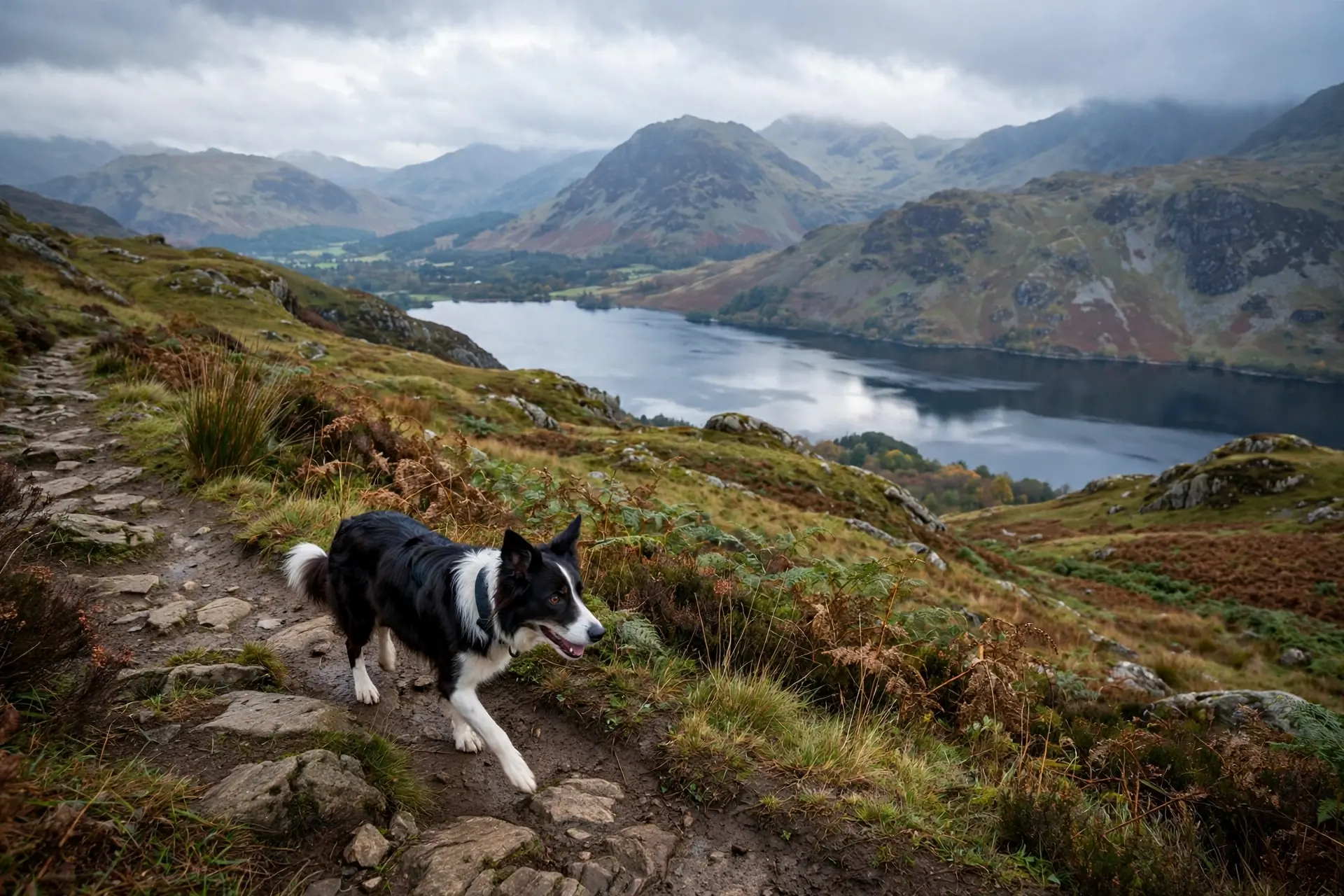
The moorland half of the Cleveland Way is a different kind of walking. From Helmsley, the trail climbs onto the North York Moors and crosses a landscape of heather, bracken, woodland and quiet valleys, passing through villages like Osmotherley, Kildale and Great Ayton. The walking is gentler than the coast, with fewer steep climbs, but the distances between villages are longer and the weather is more changeable. The moors are high and open, and the wind and rain can arrive fast. A dog that is comfortable in open country will love the space; a dog that needs shelter will need careful management.
Navigation is the main skill on the moorland half. The path is waymarked, but the moors are big and featureless in places, and fog can reduce visibility to a few metres. Carry a map and know how to use it, and do not rely on a phone signal that can be patchy on the high moor. The trail crosses several roads, and the road crossings need care, because the moorland roads are fast and drivers do not expect walkers. Keep your dog on a lead at every road crossing, and at every place where the path runs beside a road.
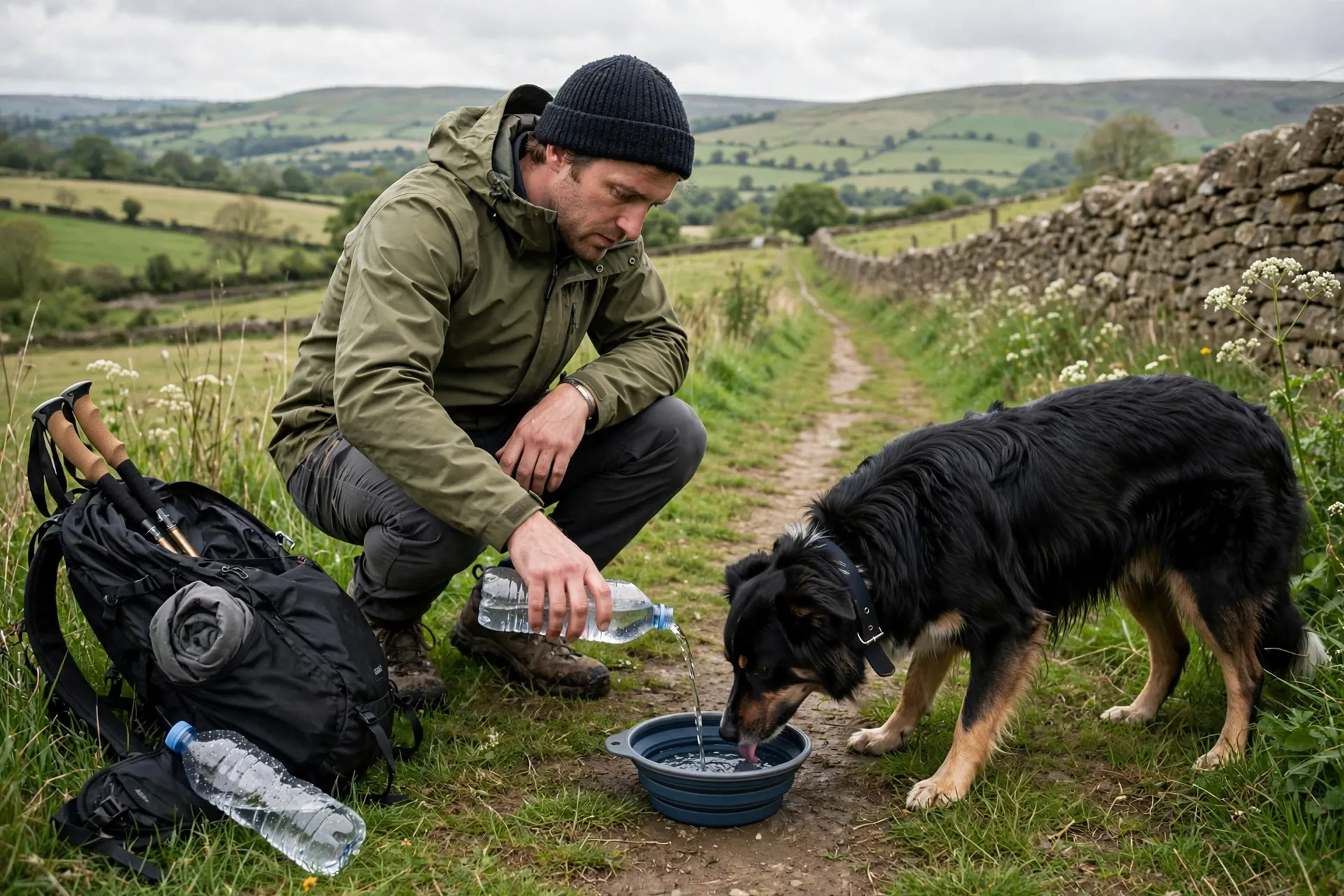
The moorland half is kinder about water than the coast, but only in the valleys. Streams and becks run through the low ground, and a village tap is never impossibly far — yet the high moor itself is dry, the valley streams can run low in a hot summer, and a day that stays on the tops can still leave a dog thirsty. Carry water and a bowl as a matter of habit, and treat the villages as refill points to plan for rather than chances to rely on. Food works the same way: the moorland pubs and small shops are real, but their hours are not guaranteed and the villages are far apart, so the day's lunch and the dog's ration travel in the pack. Our guide to dog hydration on long walks covers the water planning this trail needs, and our Coast to Coast guide covers the same moorland logistics in harder country.
Lead rules on the Cleveland Way: cliffs, livestock and birds
The lead rules on the Cleveland Way are not complicated, but they are strict, and they exist for good reasons. On the cliff-top path, the lead is on at all times. On the moorland, the lead is on around livestock, near ground-nesting birds in the breeding season, and at every road crossing. In the villages and on the beaches, the lead rules depend on the local by-laws and the season, and you should check the signs at each beach before letting a dog off. The practical effect is that a dog on the Cleveland Way spends a lot of time on a lead, and that is something to prepare for. A dog that is only ever walked off the lead at home will find the trail frustrating, and a walker that is only comfortable with an off-lead dog will find it tiring.
On the moors the lead is about the animals first. Sheep graze the open moor and the coastal farmland, cattle stand in the valley fields, and the rule is the one every British walker knows: a dog that worries livestock may be shot, and the farmer is acting within the law. The open ground is deceptive — the sheep look distant until the dog is already running — so the lead goes on before the field and stays on through the far gate, with the dog held close at every gate and stile. The birds set the same rule for a different reason: curlews and lapwings nest on the ground, and a dog off the path in the breeding season can destroy a nest in seconds. In the breeding season, roughly March to July, keep the dog on the path and clipped on wherever the signs ask.
Every beach on this coast makes its own rules, so there is no single answer to carry from one bay to the next. Some welcome dogs all year; others shut their main bathing sands to dogs for the summer, usually from May into September, while a quieter stretch of the same beach stays open. The signs at the top of the beach steps are the authority — read them before the dog goes off the lead, and follow them even when the beach looks empty. The reason is simple: a crowded summer beach and a loose dog do not mix, and the restrictions are what keep the beaches open to dogs at all. Around Whitby and Scarborough harbours the rule is stricter still, with dogs on leads and under close control among the boats, the crowds and the traffic.
Whitby, Scarborough and the coastal towns
The coastal towns are the highlights of the Cleveland Way, and they are also the places where a dog walk becomes a town visit. Whitby is the most famous, and for good reason: the harbour, the abbey ruins on the cliff, the narrow streets and the fish and chips are all worth the walk. Dogs are welcome on a lead around the harbour and in many of the pubs and cafes, but the town is busy, especially in summer, and a nervous dog will find the crowds hard work. Go early in the day, or visit in the shoulder season, and give the dog a break on the beach or the quieter streets above the harbour.
Scarborough is the largest town on the trail, and it offers the most in the way of accommodation, shops and transport. The South Bay is the busy beach, with seasonal dog restrictions, while the North Bay is quieter and more dog-friendly. Robin Hood's Bay is the prettiest village on the coast, a steep tumble of cottages down to a bay that is wonderful for dogs at low tide, when the rock pools and the sand stretch for miles. Staithes is a smaller, quieter version of the same idea, with a harbour, a beach and a pub. Saltburn-by-the-Sea, at the start of the coastal half, is a handsome Victorian town with a cliff lift, a pier and a long beach that dogs love.
Each town is a good place to end a day, because the accommodation is there, the food is there, and the transport links are there. Book ahead in summer, confirm the dog policy in writing, and check whether the beach you plan to visit has a seasonal restriction. A dog that has walked a cliff-top day needs a proper rest, not another hour in a crowded pub garden, so choose your evening stop with the dog in mind, not just the view.
Planning the Cleveland Way with a dog: days and stays
Nine or ten days covers the whole 109 miles, and the two halves split neatly for a first trip: Helmsley to Osmotherley for the moors, or Whitby to Robin Hood's Bay and on to Scarborough for the coast. Either gives you the real trail without a week's worth of planning, and either can be reached by train or bus at both ends, which is more than can be said for some of the inland stretches. Walk one half properly, learn how your dog copes with cliffs or moors, and the other half will still be there for the next trip.
Beds are the thing to sort first, because the coast towns fill up. Dog-friendly pubs, bed and breakfasts and small hotels cluster in Whitby, Robin Hood's Bay and Scarborough, and in summer the good ones go weeks ahead — book early, and get the dog terms in writing: the fee, how many dogs, and whether the dog is allowed in the bar or has to stay in the bedroom. Bag transfer runs the length of the Cleveland Way, and it is worth paying for: with a light day pack and an unloaded dog, the cliff steps and the moorland miles both feel shorter, and the dog finishes each day fresher. The same coastal logistics — bags, cliff safety, town stays — shape longer trails too, and our guide to the South West Coast Path with a dog works through them on a bigger scale.
Getting about is easy on the coast and thin on the moors. Trains call at Saltburn, Whitby, Scarborough and Filey, and buses link many of the coastal villages, though not often enough to build a day around. Out on the moors the buses all but disappear, and a lift or a taxi to the start is often the only option. Settle the way out for each day before you set off — the nearest station, bus stop or road — and keep it in mind, because a lame dog on the high moor is not a situation to solve by guessing.
Kit for cliffs and moors: what to carry
Two hazards decide the packing list: the drop and the weather. The cliff path is lead work all day, so the connection between you and the dog has to be solid — a harness that fits properly, not a collar a pulling dog can slip, with a short lead for the cliff edge and something longer for the open moor. A waterproof coat for the dog earns its place on wet, windy days, when wind chill on a wet coat is what makes a dog cold rather than the rain itself, and a towel plus a drying coat at the end of the day turns a wet dog into a comfortable one before bed.
Carry the water and the food even when the villages look close together. The coast has more taps than the moors, because the villages sit nearer the path, but the cliff-top path itself has almost none, and the high moor has long dry stretches of its own — so the bottle and the bowl and the dog's ration travel in the pack every day, whatever the map suggests. A first-aid kit with tick removers, paw balm and a bandage is worth its weight, and a phone with maps saved offline is essential on the moorland, where the signal fades and the fog can close in within minutes.
Footwear matters for the walker as much as for the dog. The cliff path is steep and uneven in places, and the moorland can be boggy after rain. Good boots with ankle support are worth their weight, and a walking pole helps on the steep descents to the beaches. For the dog, check paws at lunchtime, especially after the flinty moorland tracks and the rocky beach sections, and carry paw balm for sore pads. A dog with sore feet should not be walking another twelve miles tomorrow, so build in a rest day or a short day if you need to.
Seasons on the Cleveland Way: when to walk it
May and June or September and October are the months to choose. Late spring sets the moors flowering and the seabirds nesting on the cliffs, with mild air for long days; early autumn brings cooler walking, colour on the moors and quieter towns — and on many beaches the summer dog restrictions have lifted by then, so the sands open up again. The seasons on either side are the hard ones: summer crowds on the coast, and winter weather that can close the cliff path altogether.
Summer is the coast at its busiest and its most demanding for a dog. The cliff path is exposed to the sun, the towns are full, the main beaches are restricted, and a dog that overheats has a long way to walk to shade or water — so start at first light, carry more water than the day seems to need, and stop early rather than late. Winter turns the problem around: the moors take wind and rain, the cliff path grows slippery and dangerous in high winds, and a twelve-mile day has to fit into short daylight. A bright winter day on the moors is a fine walk, but the cliffs are not a place for storm weather, and after heavy rain the path itself can be closed. Check the official guidance before you travel, and never walk the cliffs in a storm.
Read two forecasts, not one: the coast and the moors can disagree completely, with sun on the tops and fog on the cliffs, or the other way round. Pack for both, and be ready to swap a cliff day for a moorland day — or to cut a day short — when the weather turns.
If you only walk one section: the best day walks
Whitby to Robin Hood's Bay is the day that shows you the coastal half: about seven miles of cliff-top path, seabirds overhead, a fishing village at the end and a bay that opens up for dogs at low tide. Start in Whitby, walk the cliffs south, and catch the bus back — the dog gets a real taste of cliff walking without a full day's miles. Read the tide times first: the bay is at its best when the tide is out, and at high tide the cliff path is the only way home.
For the moorland half, the out-and-back from Helmsley to Rievaulx Abbey is about eight miles from a market town onto the moors and down to one of England's great abbey ruins, with a steady climb that suits a dog that likes to work uphill and a lead walk among the ruins to finish. A longer coastal day runs from Saltburn to Staithes, roughly ten miles of cliff-top path with views across the North Sea and two dog-friendly villages — the quietest stretch of the coast path, and the one to choose for a dog that prefers space to crowds.
Keep the cliffs in mind and the trail looks after the rest: the lead on, the dog on the inland side, and time to stop and look. The best days here are the unhurried ones, walked at the dog's pace, with the coast on one side and the moors waiting for the next trip.
Practical questions
Before you go
Can dogs walk the whole Cleveland Way?
Yes — the whole 109-mile National Trail from Helmsley to Filey welcomes dogs, and most walkers take nine or ten days at 11 to 13 miles a day. The lead stays on at all times on the cliff-top path, and on the moorland it stays on around livestock, ground-nesting birds and at road crossings.
Is the cliff path safe for dogs?
Yes, if you treat the cliffs with respect, and no, if you don't. Keep the dog on a lead on the cliff-top path at all times, keep it well back from the edge, and follow every diversion around a cliff fall. Never walk a closed section, and stay off the cliffs in high winds or storms — check the official guidance before you travel.
Are dogs allowed on the beaches along the Cleveland Way?
It varies beach by beach. Some welcome dogs all year, while others bar dogs from their main bathing sands through the summer, usually May to September, with a quieter stretch nearby that stays open. Read the signs at the beach steps before letting your dog off, and keep the dog on a lead around Whitby and Scarborough harbours.
How long does the Cleveland Way take with a dog?
Most walkers take nine or ten days for the whole 109 miles, at 11 to 13 miles a day. The coastal half is the slower one, because the cliff path rises and falls all day and the views keep stopping you. Either half can also be walked on its own in four or five days, or as day walks using the coast's trains and buses.
What is the best time of year to walk the Cleveland Way with a dog?
May and June or September and October, as a rule. Late spring brings flowers to the moors and seabirds to the cliffs, while early autumn brings cooler walking, quieter towns and beaches free of their summer restrictions. Summer is crowded and hot on the cliffs, and winter brings wind, rain and short days.
Do I need to book dog-friendly accommodation in advance?
Yes — in summer above all. Rooms that take dogs in Whitby, Robin Hood's Bay and Scarborough and in the moorland villages go early, so book ahead, confirm the dog terms in writing, including the fee and how many dogs are allowed, and sort baggage transfer at the same time if you are walking the whole trail.
More northern trails in the same spirit: the Dales Way runs from Ilkley to Bowness through the Yorkshire Dales, and the Northumberland Coast Path follows the castle coast from Cresswell to Berwick — both are planned with dogs, stays and transport in mind.