This guide is independent and contains no paid placement. Opening hours, dog policies and charges change, so check the official guidance before you travel, especially for the abbey, museums and any place where dogs go indoors.
Start at Paisley Abbey and the White Cart Water, follow the riverside paths through the town centre, then head up to Gleniffer Braes Country Park for open hill walking. Paisley is compact, flat in the centre and around ten minutes from Glasgow Central by train, which makes it one of the simplest dog days out in Renfrewshire.
The abbey and the White Cart: where Paisley starts
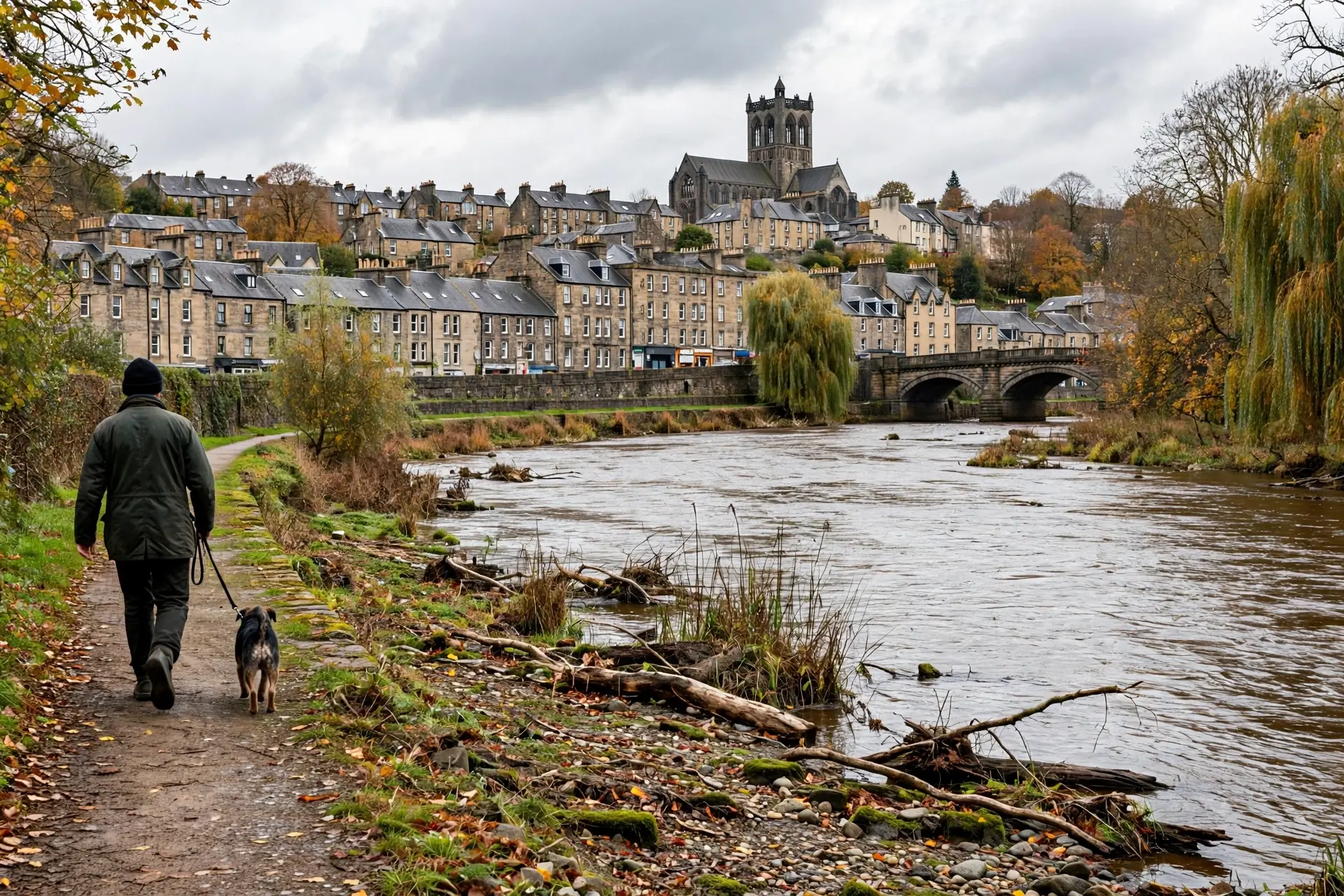
Every dog walk in Paisley makes more sense once you have stood on Abbey Close and looked at the town from the river. Paisley Abbey rises at the western end of the High Street, its tower visible above the rooftops from most of the town centre, and the White Cart Water bends around its grounds before flowing east under the town's bridges. The abbey dates back to the twelfth century, founded as a Cluniac priory and later raised to abbey status, and it remains the single most important building in Renfrewshire. For a dog owner, the important thing is not the architecture lesson but the geography: the abbey, the river and the open ground around them form the natural starting point for almost every route in this guide.
Begin on Abbey Close, the paved area in front of the abbey, where dogs on a lead can sit while you take in the west front and the tower. The ground here is level and mostly paved, which suits older dogs and puppies still learning to cope with town noise. From Abbey Close you can see the river below the bridge at Gauze Street, and the whole scene gives you a quick read on the day: how busy the town is, how high the river is running, and whether the wind is coming in from the west. If the abbey is open, one person can step inside while the other stays outside with the dog; dogs are not normally admitted inside, so treat the interior as a split visit and check the official guidance before you travel for current opening times and any special arrangements.
The ground around the abbey rewards a slow circuit rather than a quick photograph. Walk the dog around the abbey grounds and along the short stretch of riverbank beside it, keeping a lead on near the water and the road. Look for the stonework details on the abbey exterior, the graveyard and memorials on the surrounding ground, and the views back across the river towards the town centre. The abbey's place in Scottish history is considerable — it is linked to the Stewart family, to Robert the Bruce's daughter Marjorie, and to the long story of Paisley's textile trade — but you do not need the full history to enjoy the walk. What matters for the dog is that this is calm, open, largely traffic-free ground in the middle of a town, with grass to sniff, stone walls to investigate and shade on a warm day.
From the abbey, the town opens up in two directions, and both are worth knowing before you choose a route. Downstream, the river runs east through the town centre, past the Town Hall and the museum quarter towards the bridges at St James Street and beyond. Upstream, the White Cart Water comes in from the south-west, past the Seedhill area and the roads towards Elderslie and Johnstone. The downstream direction is the one most visitors take, because it leads straight into the shops, cafes and the riverside walk covered in the next section. The upstream direction is quieter and suits a dog that needs space before the town gets busy. Either way, keep the dog on a lead through Abbey Close and on the bridges: cyclists, pushchairs and other dogs all use the same narrow routes, and a loose dog on a riverside path can be in the water or on the road in seconds.
The White Cart Water walk
The White Cart Water is Paisley's best dog walk, not because it is wild — it is not — but because it is level, surfaced, close to everything and long enough to feel like a proper outing. The river rises in the hills south of Glasgow and flows through Paisley on its way to join the Clyde at Renfrew, and the stretch through the town centre is followed by paths on one bank or the other for much of its length. You can join the riverside at Abbey Close, at the bridges along Gauze Street and High Street, or further east near St James Street, and from any of these points a walk of twenty minutes or an hour is easy to shape.
The most useful central stretch runs east from the abbey, past the Town Hall and the riverside frontage towards the bridges at the eastern end of the town centre. The path here is mostly paved or firmly surfaced, which keeps paws clean in dry weather and makes the route workable for dogs that dislike mud. There are benches along the way, places where the dog can watch the ducks and swans, and regular steps and ramps back up to street level, so you are never committed to a long stretch with no exit. That matters with a nervous dog: if the town noise builds or another dog appears, you can leave the river in a few steps and cut back through a quiet side street.
Water safety deserves more attention here than on a country river walk, because the river in town is channelled, fast after rain and edged by stone walls in places. Keep dogs on a lead along the whole central stretch, and keep them well back from the bank where the wall drops straight to the water. Weirs and bridge arches create strong currents that are hard to judge from the bank, and a dog that jumps in after a duck can be swept downstream faster than you expect. After heavy rain, check the river level before you set out and choose the higher paths and the streets instead of the lowest riverside sections. In dry summer weather the river is calmer, but the same lead rule still applies near the weirs and the road bridges.
Wildlife is part of the pleasure and part of the discipline on this walk. Swans, mallards and gulls are regulars on the White Cart through Paisley, and herons fish the quieter stretches. A dog with a strong chase instinct needs a short lead and a watchful handler here, and any dog should be kept from harassing the birds, especially in spring when young birds are on the water. The river also attracts litter after high water, so watch for broken glass and discarded food near the bridges and the seating areas. Carry bags, use the bins provided along the riverside, and take the dog's water with you rather than letting them drink from the river in town.
Longer riverside walking is possible in both directions if you want more than the town-centre stretch. Heading south-west upstream takes you towards quieter water and the paths around the Seedhill and Ralston edges of town, where the river feels less urban and the dog gets more sniffing time between encounters. Heading east downstream follows the river towards its lower reaches and the flatter ground towards Renfrew, though the path becomes less continuous and you will need to use streets for parts of the route. Either extension is better treated as a second walk than as an attempt to cover everything in one outing: do the town-centre stretch properly, stop for lunch, and save the longer river walk for a return visit or for the morning of an overnight stay.
Gleniffer Braes: the hill above the town
If the river is Paisley's front room, Gleniffer Braes is its back garden — a large country park on the hills immediately south of the town, with open moorland, woodland, viewpoints and a network of paths that feel a world away from the High Street. The Braes rise above the southern edge of Paisley, and on a clear day the views run north across the town towards the Clyde and the hills beyond, and south across Renfrewshire farmland. For a dog, this is the place for the long, leg-stretching walk that the town centre cannot provide: open ground, long sightlines, woodland shade and the smells of moorland and forestry.
Getting there is straightforward but needs a small plan. The country park sits above the Gleniffer Road and the roads climbing out of Paisley's southern suburbs, and the signed car parks are the practical starting point for most visitors. Driving up takes only a few minutes from the town centre, and the car parks give you direct access to the path network without a long road walk. If you are on foot from the town, allow extra time for the climb and choose a route on pavements and quieter residential streets rather than the busiest roads. However you arrive, keep the dog on a lead in and around the car parks and on the first stretch of path, until you can see the ground ahead and judge how busy it is.
The path network in the Braes suits a wide range of dogs, but it is not a flat park loop. The main tracks are broad and well used, climbing steadily through woodland and out onto open moorland, with narrower footpaths branching off to viewpoints and through the trees. An older dog or a small breed will be happiest on the main tracks with a steady, unhurried pace and plenty of stops; a fit, young dog will want the longer loops and the open ground. The ground can be wet and boggy in places after rain, especially on the moorland sections, so waterproof footwear and a towel in the car are worth packing in every season. In summer, add sun protection for the dog's rest stops and carry more water than you think you need, because there is little shade on the open hill.
Control matters more on the Braes than in the town, even though the space feels empty. The park is shared by walkers, runners, cyclists and horse riders, and the open moorland is used by grazing animals in places, so a dog running out of sight can cause a real problem. Keep dogs under close control, use a lead near livestock, near other walkers and on any stretch where you cannot see what is ahead, and recall the dog before every blind corner or hill crest. The same rule applies around the viewpoints: the drops and slopes at the edges are not fenced, and a dog chasing a scent over a crest can end up a long way from the path. A long line gives an energetic dog freedom to explore while keeping you in control, and it is a better choice here than letting a dog range freely on a first visit.
Allow at least two hours for a proper Braes walk, including the climb, a viewpoint stop and the return. A short version — up to the first viewpoint and back — works as a morning leg-stretcher before lunch in town, while the longer loops reward a full half-day with a packed snack for the dog and a rest at the top. Check the weather before you go: the hill catches wind and rain that barely registers in the town centre, and mist can close in quickly on the open ground. In winter, the paths can be icy and the wind chill is real, so shorten the route and keep the dog moving. The reward for the climb is the view back over Paisley, with the abbey tower and the river valley laid out below, and a dog that has earned its lunch.
Paisley town centre: streets, squares and shortcuts
Paisley town centre is compact enough to walk end to end with a dog in fifteen minutes, and that small scale is one of its strengths. The main spine runs from Abbey Close along the High Street and Gauze Street, with the Town Hall, the museum quarter and the main shopping streets all within a few minutes of the river. The streets are largely flat, the pavements are generally wide, and there are pedestrianised and traffic-calmed stretches where a dog can walk without constant kerb discipline. That makes the town centre a good place for a dog that is still learning town manners, as well as for an older dog that needs a gentle outing rather than a hill climb.
Start your town-centre loop at the abbey and work east along the High Street, taking the riverside path where it runs alongside and the pavement where it does not. The High Street carries the town's main shops and services, and the side streets off it — including the lanes around the Town Hall and the streets leading down to the river — offer quieter alternatives when the main drag is busy. Cross Street and the streets around Paisley Gilmour Street station are useful for cutting north and south across the town without retracing your steps, and the area around the station gives you a natural turning point if you are heading back towards the car or the train. Keep the dog on a short lead on the High Street itself, where shop doorways, market stalls and other dogs create a lot of close encounters in a short distance.
Paisley's recent regeneration has changed the feel of the centre, and the buildings around the Town Hall and the museum are worth building into the walk. Paisley Museum, on the High Street, has been undergoing a major redevelopment, and the Town Hall beside it has been restored as a venue and civic building; check the official guidance before you travel for current opening dates and whether dogs are admitted, since policies for the interiors differ from the outdoor spaces. Even from outside, the museum and Town Hall frontages give the walk a destination and a place to pause, and the paved areas around them are good for a water stop and a rest in the shade. The town's textile heritage is visible in the street names and the grander stone buildings, and the famous Paisley pattern — the teardrop motif that took the town's name around the world — is a useful talking point when you stop for a photograph with the dog.
Shopping with a dog in Paisley works best as a short, purposeful exercise rather than a long browse. Many smaller shops will welcome a well-behaved dog, but policies vary from shop to shop, so ask at the door and be ready to wait outside with the dog if the answer is no. The indoor shopping areas, including the Paisley Centre, generally require dogs to stay outside or in the arms of their owner, so plan those stops as split visits or skip them in favour of the outdoor streets and the market stalls, where a dog on a lead is part of the normal scene. If you need supplies, the town centre has pet shops and supermarkets within easy reach of the main streets, and a quick stop for treats or water is easy to fit into the loop.
Toilets, water and rest stops are the practical details that make or break a town walk, and Paisley covers them reasonably well. Public toilets are available in the town centre, cafes will usually fill a dog bowl, and the riverside benches and the paved squares give you somewhere to sit without blocking a pavement. Carry your own water and a collapsible bowl as a backup, especially on a warm day, and plan a rest stop roughly halfway through the town loop — the area around the Town Hall and the riverside seating east of the abbey are the natural places. If your dog is reactive to other dogs, walk the town centre early in the morning or later in the afternoon, when the pavements are quieter and you have more room to create distance.
Barshaw Park and the town's green corners
Barshaw Park, on the north-eastern side of Paisley, is the town's most useful green space for a dog that wants grass, trees and a proper run without leaving town. The park sits between the Glasgow Road and the residential streets of the north-east, with open lawns, mature trees, paths and a pond, and it is large enough for a satisfying walk while remaining enclosed enough to feel manageable. It is the park Paisley dog owners use every day, which tells you most of what you need to know: it works in all weathers, it has room for a ball game, and it is close to the town centre and the station.
The layout of Barshaw Park suits a straightforward loop. Enter from one of the gates off Glasgow Road or the surrounding streets, follow the paths around the open lawns and the pond, and let the dog set the pace on the grassy areas. The pond attracts ducks and the occasional heron, so keep a lead on near the water and keep the dog out of the pond itself. The wooded corners and the paths under the mature trees give shade in summer and shelter in a shower, and the open lawns are the place for a game of fetch if your dog is reliable off lead and the park is not crowded. As in any shared park, check who else is around before you let the dog off: children's play areas, other dogs and picnickers all need space, and a lead is the right choice when the park is busy.
Beyond Barshaw, Paisley has a scatter of smaller green corners that are worth knowing about, because they let you break up a town walk without committing to a full park visit. The riverside greens along the White Cart Water, the small squares and planted areas around the Town Hall, and the green spaces in the residential streets south of the centre all give a dog a patch of grass and a change of surface. None of these is a destination in itself, but together they mean you are rarely more than a few minutes from somewhere the dog can sniff, rest and relieve itself without a pavement. For a puppy or an older dog, that network of small greens is often more useful than one big park, because it lets you build a walk out of short stretches with frequent stops.
Seasonal notes apply to Barshaw Park as they do to every Scottish park. In autumn the fallen leaves hide mud and the paths can be slippery, in winter the shaded paths freeze before the open lawns, and in spring the grass can be soft and wet after rain. The pond level rises after heavy rain, and the ground near it can be boggy, so keep to the paths in wet weeks. Litter and discarded food are more common near the play areas and the benches, so watch a scavenging dog closely there. The park is at its best early in the morning, when the light comes across the lawns and the dog walkers have the place largely to themselves, and again in the early evening when the commuter rush has passed.
If you are combining Barshaw Park with the rest of the day, it fits naturally into either end of the visit. Arriving by train at Paisley Gilmour Street, you can walk to the park in a few minutes for a first leg-stretch before heading into the town centre, or you can finish the day there with a final run before the train home. Drivers can park on the surrounding streets where signed, or use the town-centre car parks and walk across. Either way, treat Barshaw as the town's everyday dog park rather than a tourist attraction: it is the place to let the dog be a dog, after the abbey and the river have given you the sightseeing.
Cafes, pubs and a dog-friendly lunch
Lunch is the part of a Paisley dog day that needs the most advance thought, because the town's dog-friendly eating is concentrated in a handful of places and policies change. The good news is that Paisley has cafes and pubs in and around the town centre that welcome dogs, particularly in their outdoor seating areas and on terraces, and the riverside and the streets around the High Street give you somewhere to sit with a dog while you eat. The rule that saves the most disappointment is simple: decide where you want to eat before you are hungry, check the current dog policy on the day, and have a backup in mind.
The most reliable dog-friendly lunch in Paisley is the outdoor table. Cafes along the High Street, Gauze Street and the streets around the Town Hall put tables outside in good weather, and a dog on a lead under the table is a normal sight. Order at the counter where the cafe works that way, settle the dog with water and a chew, and keep the lead short so the dog is not blocking the pavement or greeting every passer-by. In cooler weather, some cafes and pubs allow dogs inside in a defined area, often near the door or in the bar rather than the main dining room; ask when you arrive, and accept the answer gracefully if the inside is not available. A dog that can settle under a table for twenty minutes will enjoy lunch anywhere; a dog that cannot will be happier with a takeaway eaten on a riverside bench.
Pubs deserve a special mention in Paisley, because the town has a strong pub tradition and several of its pubs are genuinely dog-friendly. The older pubs around the town centre and along the main streets often have a bar area where dogs are welcome, with water bowls and the occasional treat behind the bar. The etiquette is the same as in any dog-friendly pub: keep the dog on a lead, keep them off the furniture unless invited, clean up any mess immediately, and leave if the dog is barking or unsettled. Lunchtime is the easiest time to try a pub with a dog, when the room is calmer and the staff have time to show you the best spot; a busy Friday evening is the hardest, and an excitable dog will enjoy it least.
For a quick bite, the takeaway and bakery options around the High Street and the town centre work well with a dog. Pick up food, find a bench by the river or in one of the town's small squares, and eat with the dog beside you. This is also the best plan for a dog that does not settle indoors: you get the food you want, the dog gets the outdoors, and nobody has to negotiate a policy. Supermarkets and convenience stores in the centre sell sandwiches, water and dog treats, so a packed lunch assembled on the day is easy if you have not brought food from home. Whatever you choose, carry a small bag for rubbish and take it with you; the riverside and the parks stay pleasant because people leave them as they found them.
A few practical points round out the lunch plan. Ask for a bowl of water for the dog wherever you sit, and bring your own if you are eating outdoors away from a cafe. Do not feed the dog from the table in a pub or cafe, however hopeful the look, because it teaches begging and annoys the neighbouring tables. If you are travelling with two dogs, choose a table with space for both leads and avoid the narrowest pavement tables. And if the weather turns, have a wet-weather lunch plan ready: a takeaway eaten in the car, a covered outdoor area, or a pub with a confirmed indoor dog area. The worst lunch in Paisley is the one you try to improvise in the rain with a wet dog and no plan.
Staying over in Paisley
Paisley is an easy day trip from Glasgow, but staying overnight changes the trip in useful ways: you get the early-morning river walk before the town wakes, the evening walk up to the Braes in the long summer light, and a second day for the coast or the Clyde. The town's overnight options are modest in number compared with Glasgow, but they cover the main needs: town-centre hotels, guest houses and bed-and-breakfasts, and self-catering flats and houses in the surrounding streets. The key step, as everywhere, is to confirm the dog policy for the specific room or property before you pay, because a hotel that accepts dogs may only do so in certain room types or on certain floors.
When you compare places to stay, ask the same questions you would ask anywhere, but answer them against Paisley's geography. Where is the nearest place to walk the dog last thing at night and first thing in the morning? A town-centre hotel near the river or the High Street gives you a short, lit walk to the riverside paths; a guest house in the southern suburbs puts you closer to the Braes but further from the late-night streets. Is there somewhere to dry a wet dog, and is the room on the ground floor or reached by a lift? Is there a charge per dog per night, a maximum number of dogs, or a size limit? And where can the dog stay while you eat breakfast — in the room, in the car, or with you in a dog-friendly dining area? Get the answers in writing with the booking confirmation, and keep them with you on arrival.
Self-catering is often the best fit for a dog stay in Paisley, because it removes the two hardest hotel problems: leaving the dog alone in an unfamiliar room and finding somewhere the dog can eat with you. A flat or house with a small garden or yard, a hard floor by the door and a washing machine for muddy towels makes the stay much easier, and the residential streets around the town centre have a good supply of such properties. Check the garden boundaries before you book — a low wall or an open gate is not a secure garden for a terrier — and ask whether the property has a hose or an outside tap for muddy paws. If you are staying in a flat without a garden, plan the toilet walks in advance: the riverside paths and Barshaw Park are the practical options, and both need a few minutes' walk from most central addresses.
Overnight practicalities in Paisley are straightforward. The town centre has supermarkets and convenience stores for dog food and supplies, and the main streets have vets and pet shops within easy reach; save the number of the nearest vet practice and the nearest out-of-hours service before you need them, and check the official guidance before you travel for current details. If your dog is a barker, choose a quieter property away from the main roads and the station, and bring the dog's own bed and a familiar blanket so the new room smells like home. Keep the first evening routine close to normal: same feeding time, a last walk along the river, and a settled bedtime. A dog that sleeps well on the first night will enjoy the second day far more than one that spent the night listening to unfamiliar town noises.
One more reason to stay over is the range of day trips Paisley opens up. Glasgow with a dog is minutes away by train, with Kelvingrove, the Clyde and Pollok Park on offer, and the Clyde coast and the Ayrshire beaches are within easy driving distance for a second day. Our guide to Ayr with a dog covers the beach rules, the Esplanade and the Burns country at Alloway, which makes a natural pairing with a Paisley base. If you are planning a longer break, our guide to dog-friendly holiday parks in the UK helps you compare the parks and lodges that suit a multi-day stay, and our guide to dog-friendly beaches and their rules is worth reading before any coastal day, since seasonal restrictions change from beach to beach.
Getting here: trains from Glasgow and the airport
Paisley is one of the easiest towns in Scotland to reach with a dog, and the train is the best way to do it. Paisley Gilmour Street station sits on the High Street side of the town centre, a few minutes' walk from the abbey, the river and the main shops, and trains from Glasgow Central run frequently throughout the day. The journey usually takes around ten to fifteen minutes, which makes Paisley a genuine day trip rather than an expedition: you can leave Glasgow after breakfast, walk the river and the Braes, have lunch in town and be back in Glasgow for dinner, with the dog having had a full day out. Dogs travel free on most UK trains when kept on a lead and under control, but check the official guidance before you travel, as rules and peak-time crowding can change.
Paisley Gilmour Street is the station most visitors want, but it is worth knowing about the town's other stations. Paisley St James, on the western side of town, serves the lines towards the coast and is useful if you are staying or walking on that side of Paisley, while the Gilmour Street station is the one for the town centre, the abbey and the river. Both stations have step-free access in places and staffed help at busy times, but the layout and the lifts vary, so check the station information before you travel if you have a dog that struggles with stairs or a heavy bag. On the train itself, choose a seat near the door with space for the dog to lie down, keep the lead short in the aisle, and avoid the busiest commuter services if your dog is nervous in crowds.
Glasgow Airport is remarkably close to Paisley — it sits just to the north of the town, off the main road towards Renfrew — which matters if you are flying in with a dog or meeting someone at the airport. The airport is a short drive or taxi ride from the town centre, and the bus services between the airport and Paisley and Glasgow pass through the town. If you are arriving by air, confirm the dog policy of your taxi or transfer in advance, and give the dog time to stretch its legs on arrival before you head into the town centre. For drivers, Paisley is reached from the M8 motorway, with junctions serving the town from both the Glasgow and the Greenock directions, and the town-centre car parks are signed from the main approaches.
Parking in Paisley is manageable, but the details matter. The town centre has several public car parks within a short walk of the abbey and the river, including car parks around the town centre and near Paisley Gilmour Street station, plus on-street parking on surrounding streets where signed. Charges and time limits vary between car parks, and the busiest times are market days, event days at the Town Hall and the days when the museum quarter draws crowds, so allow extra time and read the signs on arrival. For Gleniffer Braes, use the signed country park car parks and keep dogs on a lead in and around them. Never leave a dog in a parked car on a warm day, even with a window open — the temperature inside a car climbs far faster than most people expect, and a shaded car park in Paisley is no exception.
Cycling and bus travel are also possible with a dog in Paisley, though both need more planning than the train. Local buses accept dogs at the driver's discretion on many services, but the rule is not guaranteed, so check with the operator before you rely on a bus with a dog. The town's cycle routes and the paths along the river give cyclists with a dog in a trailer or a well-trained running companion some options, but the town-centre streets are busy and the riverside paths are shared with pedestrians, so cycling with a dog on a lead is not recommended. For most visitors, the combination of train in and walking once there is the simplest and most reliable plan.
A one-day plan for Paisley
A good Paisley day with a dog follows the town's own shape: river in the morning, hill in the middle of the day, town centre and lunch in the afternoon, and a last riverside walk before the train home. Arrive at Paisley Gilmour Street by mid-morning and walk straight to the abbey, giving the dog ten minutes on Abbey Close to settle and sniff before you start the riverside walk. Follow the White Cart Water east through the town centre, taking the path where it runs beside the river and the pavement where it does not, and pause at the benches to watch the swans and to let the dog rest. This first hour is the gentlest part of the day, and it works for almost any dog.
By late morning, drive or walk up to Gleniffer Braes for the long walk. Choose a loop that matches your dog: the main tracks to the first viewpoint for an older dog or a first visit, or a longer moorland loop for a fit dog that needs the miles. Allow two hours including the climb and a rest at the top, carry water for the dog, and keep a lead on near livestock and on the shared paths. The view back over Paisley, with the abbey tower below and the Clyde valley beyond, is the reward for the climb, and the dog will have earned its lunch by the time you come down.
Lunch in the town centre is the natural next step. Pick a cafe or pub with outdoor seating, or a takeaway eaten on a riverside bench, and give the dog water, a chew and a proper rest while you eat. After lunch, take the town-centre loop at a slower pace: the High Street, the Town Hall and the museum quarter, the side streets and the shortcuts back to the river. This is the time for the photographs, the browse in the dog-friendly shops, and the short stops that a morning of walking does not allow. If the dog is tiring, shorten the loop and head for Barshaw Park instead, where the dog can have a final run on the grass before the journey home.
Finish the day the way you started it, on the river. A last short walk along the White Cart Water as the light softens is the best end to a Paisley day: the town is quieter, the dogs are calmer, and the abbey tower catches the evening light. Give the dog a final toilet stop, a drink of water and a few minutes to settle, then walk back to Paisley Gilmour Street for the train. If you are staying over, the evening walk is the same route at a slower pace, with dinner in town afterwards and the Braes or the coast saved for the second day. Either way, you will leave Paisley with a clear sense of the town: an abbey and a river at its heart, a hill above it, and a town centre small enough to enjoy properly in a single day.
Two adjustments make this plan work for different dogs. For a reactive dog, reverse the order: do the Braes first, when the hill is quietest, then the river and the town centre later when you can choose the quieter streets. For a puppy or a very old dog, drop the Braes entirely and build the day around the river, the abbey and Barshaw Park, with long rests between short walks. The plan is a framework, not a timetable, and the best Paisley day is the one that fits the dog you actually have.
Practical questions
Before you go
Can dogs go inside Paisley Abbey?
Dogs are not normally admitted inside the abbey itself, so plan on one person waiting outside with the dog while the other looks around, or admire the building and its grounds from outdoors. The riverside paths and Abbey Close around it are the dog-friendly part of the visit, and the abbey exterior, tower and riverside setting are free to enjoy from outside at any reasonable hour.
Is the White Cart Water walk in Paisley suitable for dogs?
Yes, the surfaced riverside paths through the town centre suit most dogs, with level ground, places to sit and frequent exits back to the streets. Keep dogs on a lead near the water, the weirs and the road bridges, and watch for swans and ducks, which are common on this stretch. After heavy rain the river can run fast and high, so check conditions and keep dogs well back from the bank edge.
Are dogs allowed off lead in Gleniffer Braes Country Park?
Dogs are welcome in Gleniffer Braes, but responsible control is expected throughout the park, and leads are the safe choice on shared paths, near grazing land, around other walkers and in the car park areas. The park is a large area of open moorland and woodland with uneven ground, so a lead also protects dogs that might chase wildlife or wander onto the road at the park edges.
Where can I park in Paisley with a dog?
Paisley town centre has several public car parks within a short walk of the abbey and the river, including car parks around the town centre and near Paisley Gilmour Street station, plus on-street parking on surrounding streets where signed. Check the signs and charges on arrival, as tariffs and time limits vary, and leave extra time on market days and event days. For Gleniffer Braes, use the signed country park car parks and keep dogs on a lead in and around them.
How long does it take to get from Glasgow to Paisley by train?
Trains from Glasgow Central to Paisley Gilmour Street usually take around 10 to 15 minutes, with frequent services throughout the day, making Paisley one of the easiest day trips from Glasgow with a dog. Dogs travel free on most UK trains when kept on a lead and under control, but check the official guidance before you travel, as rules and peak-time crowding can change.
Is Paisley a good base for a longer dog-friendly trip in Renfrewshire?
Yes, Paisley works well as a base: Glasgow is minutes away by train, Glasgow Airport is close by, and the Ayrshire coast and Clyde coast are within easy driving distance for beach days. Staying in Paisley gives you town-centre walks, the river and the Braes on your doorstep, with bigger days out in either direction when you want them.