This guide was put together independently. Nobody mentioned in it paid to be included, and any affiliate links added in future will be labelled clearly when they appear.
Perranporth hands a dog three things at once: a beach three miles long that stays open to dogs through the year, a cliff-top path south to St Agnes, and a dune system big enough to get properly lost in. Walk the sand on a falling tide, keep the lead on near the village on July and August days, and do the cliff walk in the morning while the wind is still deciding what to do.
A day in Perranporth, hour by hour
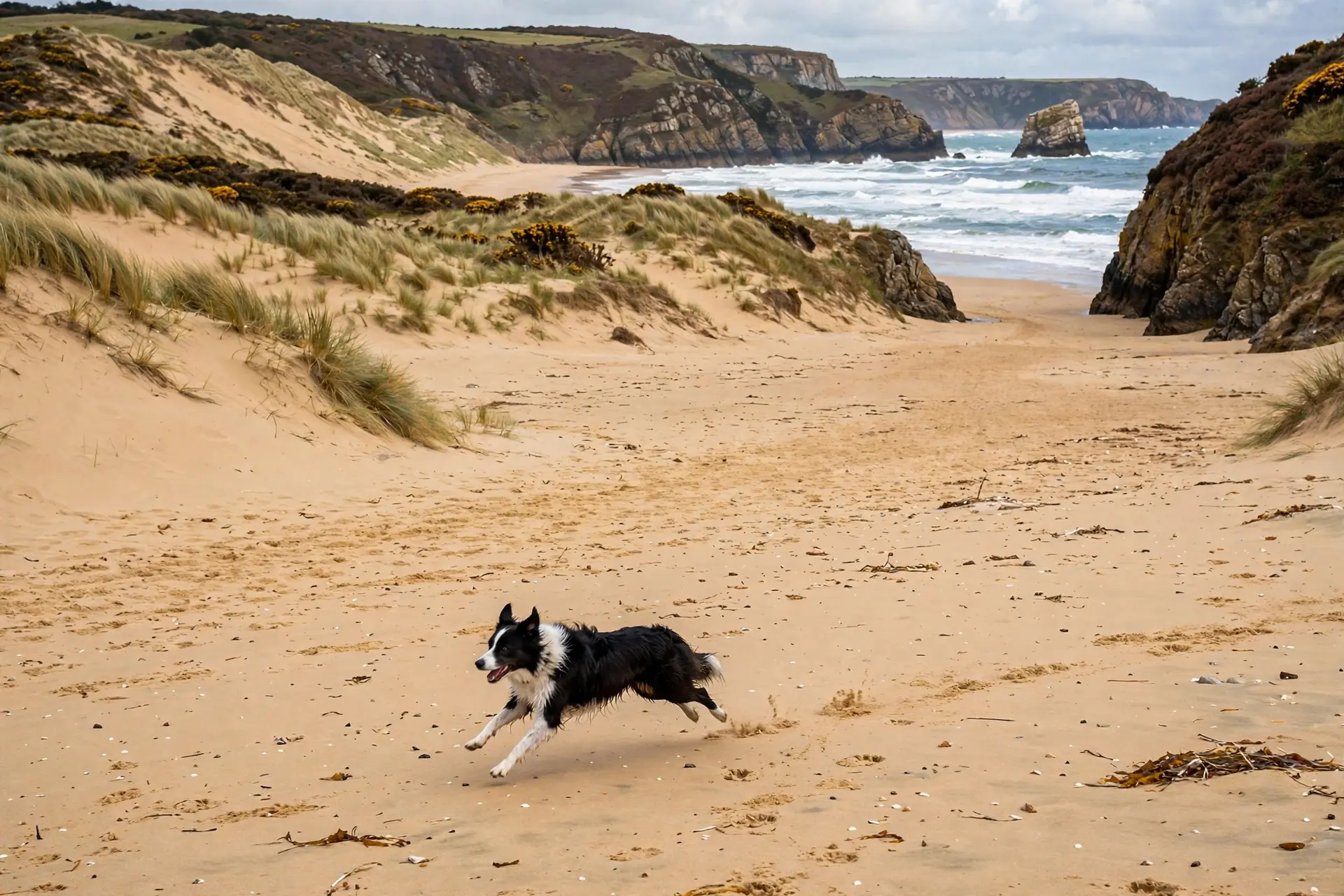
Stand on the sand at low water and the scale of the place does the talking. Three miles of pale, flat beach run away to the north until the dunes swallow the far end, the Atlantic comes in over it in long lines, and the surfers out by the break look like small marks on a very large page. A dog reads a beach like this at once: there is room to run in a straight line for a long time without meeting a wall, a person, or another dog, and a ball thrown with any enthusiasm takes a while to land and longer to fetch back. At the southern end Chapel Rock sits out on the sand, the cliffs begin, and the town lines up behind the promenade. At the northern end the ground rises into the dunes, pale folds of sand and marram grass that go on for miles. Nothing about the place is small, and a dog that has spent its life on pocket-sized beaches notices the difference within minutes.
Behind the sand sits a proper working seaside town, and the working part is what makes a day here easy. Surf hire, cafes, pubs, a bakery, a supermarket and places to sleep all sit within a few minutes of the beach steps, so the day never turns into a driving expedition. Walk the dog hard before lunch, eat properly, walk again in the afternoon, and finish on the sand in the evening, all without turning a key. That compactness is worth as much as the view: a grand beach loses its charm quickly if every visit to it means a car park hunt, a ticket machine and a timetable. Here the car can stay parked from arrival to departure, and the dog gets the benefit of that.
The order of the day matters more here than in most Cornish towns, because the tide and the wind both have opinions about when things should happen. Start on the beach, two or three hours before low water, when the sand is firm, wide and mostly empty. Move to the cliffs late in the morning, while the air is still cool and the light sits on the rock. Spend the afternoon in the dunes, when the town end of the beach is at its busiest and the sandy paths offer shade and quiet. Come back to the town for the evening, when the surfers drift in, the terraces fill, and the sun drops straight into the Atlantic. The practical material — roads, parking, sleeping, vets and kit — sits after the day itself, because it reads better as a checklist once you can picture the place.
Three honest warnings before the detail. First, this coast takes its weather straight off the Atlantic, so a calm morning inland can still be a gusty one on the sand, and sea mist can roll in during a summer afternoon and knock several degrees off the temperature in an hour. Second, the tide runs this beach: at high water the sand narrows to a strip, Chapel Rock turns into an island, and a walk that felt endless at low water becomes a scramble against the cliffs, so look at the tide times the night before and plan the long beach walk for the falling tide. Third, the dog rules are generous but not the same in every month: dogs can use the beach all year, yet on July and August days a lead is required on the main beach by the village, so read the boards at the beach steps on the morning itself. Where this guide is unsure of a detail, it says so instead of guessing.
Morning: the beach at low tide
Begin on the sand, and begin early. The beach runs for about three miles along this stretch of the north coast, and at low water it merges with the sand at Perran Sands into one long sweep. The sand is fine and pale, the slope is gentle, and the beach is backed by dunes to the north and by the town and the cliffs to the south. Two or three hours before low water is the sweet spot: the sand is firm enough for a proper run, the rock pools are exposed and full of things to sniff, there is space for a real game of fetch, and the sea is still a long way out, which leaves hours before the water returns.
Dogs can use this beach in every month of the year, which puts Perranporth ahead of many Cornish beaches that close their doors to dogs in summer. The single rule worth learning is the summer lead rule on the main beach by the village: during July and August, dogs stay on a lead on the stretch of sand nearest the town through the daytime. Printed sources disagree about the start of that window, some saying 9am and others 10am, with both ending around 5pm, and the rule covers the village end rather than the full three miles. Head north towards the dunes and off-lead running is usually fine even in high summer. The workable approach is to read the signs where you step onto the sand, keep the lead on near the town in July and August, and walk north when the dog needs to run free. Our guide to dog-friendly beaches in the UK explains how seasonal bans and public space protection orders work, and how to check a beach before you go.
Chapel Rock is the landmark every dog and child makes for first. It is a big outcrop on the sand near the southern end, and at low water a natural pool forms beside it, filling with seawater and warming in the sun through the day. When the tide comes in the rock becomes a small island, cut off by the water, so do not let a dog scramble onto it unless the tide is still on its way out and you have time in hand to get back. The rock carries the town's oldest story: St Piran, patron saint of Cornwall, is said to have built his first small chapel on it after washing ashore, and his name turns up everywhere here afterwards, from the dunes to the parish church.
Surfing fills the other half of the morning. Perranporth is one of Cornwall's best-known surf beaches, and on a good day the water is crowded with boards, from beginners on foam boards in the shallows to experienced surfers further out. RNLI lifeguards patrol through the summer — in 2026 the patrol ran daily from 1 April to 1 November, 10am to 6pm — and the swimming and surfing area is marked by red and yellow flags. Keep dogs clear of the flagged water, and do not let one chase surfers or swim out among the boards. A water-loving dog is happiest in the shallows at the edge of the flagged area, while a nervous dog does better further up the beach, where the sea arrives as a thin sheet instead of a breaking wave.
The Atlantic here is beautiful and unforgiving in the same breath, so the safety part of the morning deserves proper attention. The surf can be powerful even on a day that looks calm, and rip currents form along this coast, so never let a dog swim out of its depth and never throw a ball or a stick into breaking water. Dogs that drink seawater fall ill, so carry fresh water and a bowl, and watch for a dog that has swallowed too much: vomiting, diarrhoea and unusual tiredness all mean a call to the vet. Scan the sand for fishing hooks, broken glass and dead fish, which dogs will try to eat, and keep dogs away from the foot of the cliffs, where rockfalls happen without warning. Once the morning is done, rinse the dog with fresh water, check paws for cuts and ears for sand, and dry it properly before the next walk or the drive home.
The tide is the detail that catches visitors out. At high water the beach shrinks to a strip, the rock pools vanish, and the sand at the southern end disappears against the cliffs, so a walk that was easy at low water can turn into a scramble. Look up the tide times the night before, plan the long beach walk for the falling tide, and keep one eye on the water while the dog runs — a dog chasing a ball does not watch the tide, and the tide here comes in faster than it looks. Walking the full length towards Penhale, leave plenty of time to get back before the water cuts the route off, and if you are ever unsure, return along the dune paths instead of the sand.
Late morning: the coast path to St Agnes
With the beach run done, the cliff path is the natural second act. The South West Coast Path leaves Perranporth from the southern end of the sand, climbs Cliff Road past Droskyn Point, and follows the cliff tops south towards St Agnes, one of the classic short sections of the whole 630-mile trail. The walk is about 3.6 miles in one direction, and most people need two to two and a half hours to cover it with a dog, once sniffing stops, photographs and the climbs are counted in. It is a moderate walk rather than a gentle one: long stretches are level once you are up on the cliffs, but there are several steep pulls, including the climb out of Perranporth itself and the drops into the coves on the way.
Begin at Droskyn Point, where the Millennium Sundial stands on the headland above the beach. The sundial is set to Cornish time, which runs about twenty minutes different from Greenwich Mean Time, and from here you get the clearest view back over the whole beach — three miles of sand, the dunes, Chapel Rock, and the town behind the promenade in one sweep. It is the view that explains Perranporth at a glance, and it is worth five minutes before you set off. From Droskyn the path runs along the cliff edge to the south, Atlantic on the right and heathland and bracken on the left, and the walking stays straightforward provided the dog is kept on a lead near the edge.
The coast south of Perranporth is old mining country, and the path shows it at every turn. Cligga Head rises out of the sea as a rugged cliff, Hanover Cove sits below the path as a steep-sided inlet, and the valley at Trevellas Coombe drops down through ground that was worked for hundreds of years. The tall engine house chimneys that appear along this stretch belong to the mines around St Agnes, worked for tin and copper, and the Blue Hills Mine company ran much of this ground. The path drops into the valley, runs inland for a stretch, and then climbs again towards St Agnes, finishing with a steep, rocky track down past the old mine buildings to Trevaunance Cove, the small harbour beach at the foot of the village.
St Agnes makes a good destination, which matters: a walk that ends nowhere feels unfinished. The village has cafes and pubs, several of which welcome dogs, and Trevaunance Cove is a small sandy beach at the bottom of the village where a dog can paddle and rest before the return. If you would rather not walk back the same way, look at the bus times before you set out — buses link St Agnes and Perranporth, but services thin out outside the summer season and timetables change, so check the current times in advance. The other option is to walk back along the same path, which takes the same time but looks different in afternoon light, and which the dog will enjoy just as much the second time round.
Cliff walking with a dog comes down to a handful of habits worth stating plainly. Keep the dog on a lead beside cliff edges, on narrow stretches, and anywhere the path runs close to a drop, because a dog chasing a rabbit or a gull gives no thought to the edge. Keep it on a lead near livestock, and under close control around the mine ruins, where unfenced shafts and drops hide in the bracken. Watch for adders on warm days on the heath, above all in spring and summer — they bask on the path edges, and a curious dog is their most common victim. Carry water, because there is no reliable drinking water for dogs along the cliff tops, and carry more than you expect to need on a hot day. And look at the wind before you set out: this is an exposed coast, and a walk that feels pleasant in a light breeze can be hard work for a small dog in a strong onshore blow.
The path works in the other direction too, north-east from Perranporth towards Holywell Bay, and that is the better choice when you want a quieter walk or when the wind is coming from the south-west. The path runs through the dunes and along the coast towards Penhale Point, with views back down the whole length of the beach, and at low water much of the way can be walked along the sand instead. Holywell Bay itself is a wide sandy beach a few miles up the coast, welcoming to dogs and far quieter than Perranporth, and it makes a good target for a longer day. Allow a full day for the return walk, check the tide times, and remember that the dunes and the beach are the easier route at low water while the coast path is the safer one at high water.
Afternoon: Penhale dunes and St Piran's country
By early afternoon the beach is at its busiest, the car parks are full, and the sand near the town is crowded. That is the moment to turn north into the dunes, where Perranporth keeps its quiet half. Behind the northern end of the beach lies Penhale Dunes, the largest dune system in Cornwall at about 650 hectares, and the highest sand dunes in Britain, rising to around 90 metres above sea level. The dunes run for miles behind the beach, a landscape of pale sand, marram grass, scrub and sandy paths that feels entirely different from the beach below — quieter, warmer, sheltered from the wind, and full of places for a dog to sniff and explore.
The dunes are also St Piran's country, and the history is worth knowing before you walk in. St Piran, the fifth-century missionary and Cornwall's patron saint, is said to have washed up on this shore on a millstone after being banished from Ireland, and to have built his first chapel on Chapel Rock before raising his oratory in the dunes. The remains of St Piran's Oratory lie in the dunes above the beach, reached by sandy paths from Perran Sands, along with a modern cross and a three-holed cross that mark the holy ground. A circular walk of about 3.7 miles from Perran Sands visits the oratory, the crosses and the dune paths, and it is one of the most rewarding short walks in the area — sandy underfoot, mostly gentle, and full of the kind of detail that rewards a slow pace.
Walking in the dunes with a dog needs a little more care than the beach. The dunes are a fragile habitat, and ground-nesting birds use the area in spring and summer, so keep the dog under close control and on a lead wherever the signs ask for it. Parts of the dune system are Ministry of Defence training land, with restricted access in places, so follow the signs and stay on the marked paths rather than cutting across the open dunes. The sand is soft and deep in places, which is hard work for older dogs and for dogs with sore joints, so build the distance up gradually and carry water — there is none in the dunes, and the sun on pale sand is stronger than it looks. In summer, watch for adders in the grass and scrub, and check the dog's paws afterwards, because sand gets everywhere, including between the toes.
The dune paths also connect to the wider landscape, and that is where a longer afternoon walk opens up. From the dunes you can reach the coast path towards Holywell Bay, or walk back along the beach at low water, or follow the paths inland towards the village of Perranzabuloe and the church that carries St Piran's name. The Perran Sands holiday park sits at the northern end of the beach, and its paths and tracks give access to the dunes for visitors staying there as well as for day visitors. If you are staying for several days, a good pattern is to alternate: a beach morning, a cliff walk, a dune afternoon, and then a town evening, so that the dog gets a different kind of ground each day and nobody grows bored of the same walk.
One more thing about the dunes: they are the best wet-weather fallback in the area after the town itself. On a rainy day the beach is miserable, the cliff path is slippery and exposed, and the dunes offer shelter, sandy paths that drain quickly, and enough cover to keep a dog reasonably dry. The same holds on a very hot day, when the pale sand throws the sun back and the beach grows too hot for paws — the dune paths, with their scrub and grass, are cooler underfoot and offer shade. A dune walk is rarely the walk you plan first, but it is often the walk you are glad to have when the weather turns.
Evening: the town, dinner and the sunset
By late afternoon the surfers are coming in, the beach is emptying and the town is at its best. Perranporth in the evening is a relaxed place: people drift up from the beach with boards under their arms, the cafes switch from lunch to drinks, and the light over the Atlantic turns the whole beach gold. This is the hour to eat, and the town is well set up for it. Cafes, pubs and restaurants line the promenade and the main street, and many of them welcome dogs, above all on outdoor seating and terraces. The beach bar on the sand itself welcomes dogs, and sitting there with a dog at your feet as the sun goes down is one of the classic Perranporth evenings. Rules differ from place to place and can change with the season, so look at each venue's own listing or ring ahead before you go, and pick a table near the door with a mat from home for the dog to settle on.
A dog that has spent the day running on three miles of sand usually arrives at dinner tired and ready to sleep under a table, which is half the battle won. Feed it first, or bring a portion of its usual food to eat quietly below the table while you eat above it. A mat from home gives it a place of its own, a portable bowl and water cover the thirsty part of the evening, and a chew keeps a puppy occupied while the food arrives. Keep the lead tucked under your chair rather than stretched across the floor, where it trips waiters and children alike. When the dog is restless — barking at passers-by, whining, pulling towards every other table — the kindest move is to stop forcing it: take the food away, or eat outside on a bench above the beach, where the dog can settle in the open air and nobody minds a bit of sand.
The town itself is small enough to learn on foot with a dog, and an evening stroll is a good way to do it. The main street runs back from the promenade, with surf shops, gift shops, a bakery, a supermarket and the usual seaside mix, and the pavements are wide enough for a dog and a pushchair to pass each other. The beach is never more than a few minutes away, which means you can finish dinner, walk the dog along the promenade, and be back on the sand for the last light without any planning at all. In summer the town stays busy into the evening, with live music and events in some venues, so if your dog is sensitive to noise, pick a quieter spot away from the main promenade, or eat early and take the evening walk after the crowds have thinned.
Sunset is the last act of the day, and Perranporth does it well. The sun goes down over the Atlantic, straight out to sea from the beach, and on a clear evening the whole sky turns orange and pink over the water. The beach at sunset is one of the best dog walks of the day: the sand is empty, the tide is usually on its way out or in, and the dog can run in the last light while the surfers catch the final waves. Bring a torch or a headlamp for the walk back if you are staying late, because the beach is dark once the sun is gone, and the promenade lights do not reach far onto the sand. And remember that the evening beach is also when the temperature falls fast — a short-coated dog that was comfortable at noon may shiver by nine, so bring a dog coat for the walk back to the car or the cottage.
Getting there and getting around
Perranporth sits on the north Cornish coast between Newquay and St Agnes, and the road in runs down from the A30, the main route across Cornwall. From the A30 the B3285 drops towards the coast and brings you into town from the east, with the beach and the town centre signposted from the main road. The drive from Truro takes about half an hour in normal traffic, and from Newquay a little less, though summer traffic on the coast roads can add a good deal to both, above all on Saturday changeover days and bank holiday weekends. Allow extra time in July and August, and aim to arrive before ten in the morning if you want a choice of parking.
Public transport is possible but needs planning. The nearest railway stations are at Newquay and Truro, both a short drive or bus ride from Perranporth, and buses link the town with both, as well as with St Agnes, Holywell Bay and the surrounding villages. Routes and timetables change with the season, and Sunday services are thinner, so check the current times before you travel and save an offline timetable before you set out. Dogs can travel on most local buses, usually on the lower deck and on a lead, but the driver has the final say, and a large dog on a crowded summer bus can be refused — plan for the quieter services if you can, and have a backup plan ready.
Once you are in Perranporth, getting around without a car works perfectly well, because the town is compact and the beach, the dunes and the coast path all start within walking distance of the centre. The coast path to St Agnes is a walk, not a drive, and the dunes are reached on foot from the northern end of the beach. The places that need a car are the day trips: the beaches further up and down the coast, the inland towns, and the attractions on Bodmin Moor. If you want a flatter, easier trail day as a change from the cliffs, our guide to Wadebridge with a dog covers the Camel Trail, the River Camel estuary and the beaches at Polzeath and Daymer Bay, and it pairs naturally with this guide if you are staying in north Cornwall for several days.
One more thing worth knowing about getting around is the airfield. Perranporth Airfield sits just inland of the town, and light aircraft use it through the year, so do not be surprised to hear small planes overhead on the coast path, above all near the southern end of the beach. The airfield is a local landmark rather than a problem, but it is worth knowing about if your dog is sensitive to noise, because a low-flying plane is a sudden sound, and a dog that is startled on a cliff path needs a short lead and a calm handler.
Parking and the practical map
Parking in Perranporth rewards planning and punishes the lack of it. The beach and promenade car parks in the town centre put you straight onto the sand, and the Wheal Leisure car park a short walk away suits all-day parking. Charges apply in the main car parks and they shift with the season, so look up the current prices, time limits and payment methods before you travel. Arrive early on summer weekends, bank holidays and school holidays, when the car parks nearest the beach are full by mid-morning, and have a second choice in mind before you set out.
The shape of the town is simple once you have seen it once. The beach runs north to south along the western edge, with the promenade and the town centre at the southern end. The main street runs back from the promenade, with the shops, cafes and pubs along it. The dunes and the holiday park sit at the northern end of the beach, reached by walking along the sand or by the roads that run out to the north. The coast path leaves from the southern end, climbing up Cliff Road past Droskyn Point, and the B3285 out of town to the east heads back towards the A30. Learn that shape on the first morning and the rest of the stay takes care of itself.
A few practical points about the town map. There are public toilets near the beach and in the town centre, but they are not everywhere, so plan accordingly. Mobile signal is generally good in the town but patchy on the more remote stretches of the coast path and in the deeper dunes, so save an offline map before you set out on a long walk. There are shops in the town selling dog food, leads and beach supplies, and a supermarket for the weekly shop, so running out of food or forgetting a lead is not a disaster. And if you are visiting in winter, check that the places you want to visit are open — some cafes, pubs and attractions cut their hours outside the summer season, and the beach itself can be wild and empty after a storm.
On a warm afternoon the inside of a parked car above the beach heats up far faster than the sea breeze outside suggests, so the dog comes with you every time you lock up, even for a few minutes. The car parks near the sand offer little shade, and a windscreen shade helps the car but is no protection at all for an animal left inside. If you are parking for the day, pick shade where you can find it, and take the dog with you whenever you leave the vehicle.
Staying over with a dog
Sleeping here has one advantage that has nothing to do with the view: most places to stay sit within a short walk of the sand. Cottages and flats cluster around the promenade and the streets behind it, the big holiday park sits at the northern end of the beach by the dunes, and the campsites and farm stays lie a short drive inland. That closeness changes the shape of a stay — the morning walk starts at the front door, the dog can be dried off and fed without a car journey in between, and the evening stroll to the beach needs no planning at all. A base a few minutes from the sand is worth more here than a grander place ten miles away.
What you can sleep in covers the usual spread: hotels and bed and breakfasts in the town, self-catering cottages and flats, the holiday park at Perran Sands, and campsites and farm stays out towards the inland lanes. Dog-friendly places exist in each of those, but the small print is where a stay succeeds or fails, so it pays to ring the owner or the manager and pin things down before money changes hands. Find out which exact room or cottage the dog is allowed in, rather than the property as a whole, and how many dogs may come. Find out what the dog charge is, and whether it is charged once or per animal. Find out whether any size or breed rules apply. Ask about the outside space: is the garden properly enclosed, how high is the fence, and can a determined dog nose a gate open? Ask whether the dog may be left alone inside, and for how long, since that decides whether you can go out for dinner. And ask about the floor underfoot and the stairs: hard floors forgive a sandy, muddy dog far better than pale carpet, and a room at ground level suits an older dog better than one at the top of a staircase.
A cottage or flat of your own often works best here, because it hands you a kitchen, somewhere to dry sandy towels, and the freedom to come and go when the dog needs to rather than when a hotel timetable says so. The things worth hunting for are an enclosed garden for the last outing of the night, a washing machine for the towels, and a spot close enough to the beach or the dunes that the walk starts on foot. The holiday park at Perran Sands suits families well, but the same checks apply: how many dogs, what the charge is, how enclosed the outdoor space is, and what the rules say about leaving a dog alone in the unit. In a caravan or a lodge, look at the steps and the decking before you book — a dog that finds steps hard will find them hard every single time it needs to go out.
A hotel or bed and breakfast suits a shorter stay, and several in town take dogs, but the deal is tighter than in a cottage of your own. The dog will generally be welcome in your room and nowhere else, which means breakfast happens without it, or in your room if the place allows. Ask about charges and size limits, and ask where the first walk of the morning goes — a place a minute from the beach steps or the dune paths beats one on a busy road. Where you can, book direct and get the dog arrangements confirmed in writing; a pet-friendly filter on a booking site is not a promise about your particular animal.
A long weekend here falls into a natural rhythm. Arrive on Friday afternoon, park near the beach, and take a short stroll along the sand so the dog can learn the smells of the place before dark. On Saturday, start early, walk the beach on the falling tide, then take the cliff path towards St Agnes in the late morning and eat in town afterwards. On Sunday, spend the morning in the dunes around St Piran's Oratory, then walk the northern beach or drive up to Holywell Bay in the afternoon, and finish with a sunset walk on the sand. That gives the dog a beach day, a cliff day and a dune day, and a different kind of scenery each time, without ever driving more than a few miles. If the weather turns, swap the days around: the beach is best on a calm, dry morning, the dunes are the best wet-weather walk in the area, and the town's cafes and shops make a genuine fallback rather than a consolation prize.
Vets, emergencies and the wet-weather plan
There is a veterinary practice in Perranporth itself, with others in Truro and Newquay, and it is worth knowing where the nearest one sits before you need it. Put the number in your phone when you arrive, and find out the opening hours and the out-of-hours cover, since a small-town practice can close early and the nearest emergency cover may be in Truro or Newquay rather than here. If the dog takes regular medicine, pack more than the trip needs, and carry the vet's number and the insurance details on every walk, not only back at the cottage.
On this coast the likely emergencies are few and specific, and a little preparation covers most of them. A dog that swallows too much seawater will vomit, develop diarrhoea and grow lethargic — keep fresh water going in and ring the vet if it does not settle quickly. A hook in a paw or a mouth, or a cut from a rock, needs cleaning and checking by a vet rather than a do-it-yourself job. A jellyfish sting or an adder bite needs veterinary attention straight away, so do not wait to see whether it improves. And a dog that has chased a ball into the surf and been caught by a wave should be watched for secondary drowning: coughing, laboured breathing or unusual tiredness after a swim in the sea means a vet visit the same day. If a person or a dog is in trouble in the water, call 999 for the coastguard, and follow the RNLI's advice — never go into the water yourself to rescue a dog.
Heat is the risk people underestimate most. The beach here is wide, open and short of shade, and a dog running hard on a warm day can overheat quickly. Heavy panting, drooling, a sudden wish to lie down in the shade, and a tongue that turns very red or very pale are the signs to watch for. If they appear, stop, get the dog into shade, offer small amounts of cool water, wet the paws and the belly, and ring the vet. Prevention is easier: walk early or late on hot days, carry more water than you think you will need, use the dune paths for their shade, and test the sand with the back of your hand — too hot for your hand means too hot for paws.
Rain has a simple answer here, because Perranporth copes with wet weather better than most beach towns. Head for the dunes first: the sandy paths drain quickly and the scrub gives a dog enough cover to stay reasonably dry. The town comes second, with cafes, shops and the promenade giving you somewhere to be that is not the beach, and a short walk between showers is often all a dog asks for. Skip the cliff path in heavy rain and high wind — the cliffs are exposed and the paths turn slippery — and skip the beach in a storm, when the wind drives sand sideways and the waves reach the promenade. A drying coat, two towels and a waterproof mat for the car cover the rest, and a wet day here is still a good day for a dog: the sand is softer, the smells are stronger, and the beach is empty.
What to pack and the mistakes to avoid
What to pack comes down to three places: the sand, the cliffs, and the car. For the sand, a short lead and a long one, a harness that fits properly, and a spare lead in case one snaps or fills with grit. Water and a collapsible bowl matter everywhere here, since the beach, the dunes and the cliff tops offer a dog nothing to drink. A towel, a drying coat and a blanket for the car deal with the wet dog afterwards. Poo bags — more than you expect to need — plus something to carry them in, because the bins stand at the beach entrances and not along every mile of sand. A coat for a short-coated dog in wind or rain, sunscreen for a pale nose or a thin coat in summer, the dog's usual food and any medicine, the vet's number and the insurance details, and a torch for the walk back across the sand after sunset, when the beach goes dark fast.
First-time visitors tend to trip over the same handful of things, and each one is avoidable. The tide comes first: plan a walk for high water on a beach that stretches three miles at low water and shrinks to a strip at high water, and the walk ends in a scramble. Next is the summer lead rule near the village in July and August — it is real, and the boards at the beach entrance are the authority on it. Then the cliff path itself: 3.6 miles of cliff walking with steep climbs is a proper walk rather than a stroll, and a dog that is tired on the way out still has to walk all the way back. Then water: a dog that has run for an hour on sand needs a drink, and there is none to be had on the beach, in the dunes or on the cliff tops. And last, the car: this is a town where the dog can come along almost everywhere, so there is no reason to leave it locked in a hot car while you eat or shop.
The best days here are the unhurried ones. A long walk on the falling tide in the morning, a slow lunch, a dune walk in the afternoon, and the sun going down over the Atlantic — that is the whole plan, and it does not need improving. Let the day set its own pace, let the dog set the speed of the walk, and the souvenir will be a tired dog asleep in the car on the way home, sandy paws and all.
Practical questions
Before you go
Are dogs allowed on Perranporth beach all year round?
Yes. There is no season of the year when dogs are barred from Perranporth beach, which is a large part of why dog owners keep coming back. The one exception is the summer lead rule on the main beach by the village: through July and August, dogs stay on a lead on the stretch of sand nearest the town during the day. Read the boards where you step onto the sand, and check the current guidance before you travel, since the exact hours and the area covered can change from year to year.
When do dogs have to be on a lead at Perranporth?
On the main beach by the village, dogs stay on a lead through the daytime in July and August. Printed sources disagree about when that window starts, some saying 9am and others 10am, with both ending around 5pm, so take the daytime lead rule itself as the point and let the signs on the day settle the detail. Head north along the sand towards the dunes and dogs can usually run off the lead even in high summer. Check the current guidance before you travel.
How long is the coast path walk from Perranporth to St Agnes?
The South West Coast Path from Perranporth to St Agnes runs about 3.6 miles in one direction, and most walkers need two to two and a half hours to cover it with a dog. It is a moderate walk with several steep pulls, including the climb out of Perranporth past Droskyn Point and the drops into the coves along the way. Plan for a return walk of the same length, or look at the bus times before you set out if you would rather ride back.
Can dogs go into the dunes at Perranporth?
Yes. Dogs can walk the sandy paths through Penhale Dunes behind the beach, but keep them under close control. The dunes are a fragile habitat, parts of the system are Ministry of Defence training land with restricted access, and ground-nesting birds use the area in spring and summer. Keep your dog on a lead wherever the signs ask for it, stay on the marked paths, and check the current guidance before you travel.
Where can I park in Perranporth with a dog?
The beach and promenade car parks in the town centre put you straight onto the sand, and the Wheal Leisure car park a short walk away suits all-day parking. Charges apply in the main car parks and they shift with the season, so look up current prices and time limits before you travel. Arrive early on summer weekends and bank holidays, when the nearest car parks fill by mid-morning. On a warm day the inside of a parked car heats up fast, so the dog comes with you every time you lock up.
Can I take my dog into cafes and pubs in Perranporth?
Many cafes and pubs in Perranporth welcome dogs, above all on outdoor seating and terraces, and several allow dogs inside as well, including the beach bar on the sand itself. Rules differ from place to place and can change with the season, so look at each venue's own listing or ring ahead before you go. Pick a table near the door, settle the dog on a mat from home, and bring water and a portable bowl.