This guide is independent and contains no paid placement. Railway timetables, dog tickets and venue rules change, so where this guide flags a check, please confirm the latest official information before you travel.
Pickering is one of the strongest dog bases in North Yorkshire because its headline attraction genuinely takes dogs: well-behaved dogs travel on most standard North Yorkshire Moors Railway services on a short lead for a small dog ticket, and Pickering Castle welcomes dogs on leads across its outdoor ruins. Build the trip around one train ride and one moorland-edge walk, keep Monday market time short and early, and be strict about leads around sheep, grouse and ground-nesting birds.
A town built at a junction
Most dog-friendly towns ask you to choose between the town day and the country day. Pickering refuses that choice, because of where it sits. To the south lies the flatter Vale of Pickering, farmland and the road towards Malton and York. Through the middle runs Pickering Beck, a clear stream that threads under bridges and past the museum. To the north, the ground rises almost immediately into the North York Moors, and the railway that leaves the town's station climbs with it, through the wooded gorge of Newton Dale and out onto high heather moorland. A dog staying in Pickering can therefore do three quite different kinds of day without a long drive in between: a market town potter, a heritage train ride to a moorland station, and a proper upland walk.
That geography also explains Pickering's particular pressures. It is a gateway town. On a summer running day, visitors arrive for the first train, day trippers pause on the A170 between the coast and the interior, and walkers use the town as a supply stop before the moors. The Market Place can feel busy at midday while a street two minutes away is almost empty. Dogs who struggle with crowds do not need to avoid Pickering; they need a Pickering plan that uses the early morning and the edges — the beck, the castle hill, the quieter northern lanes — and treats the central pavement at peak hour as a short corridor to cross, not a place to linger.
There is a second, less obvious advantage. Because the railway carries dogs, a nervous or older dog is not limited to the radius of its own legs. A dog who can settle on a carriage floor can reach Goathland's moorland, Grosmont's river valley or even Whitby without a long car journey, and can walk a short, suitable stretch at the far end and ride back. That changes who a Pickering holiday works for: the elderly retriever who manages forty happy minutes but not four hours, the young dog who should not yet be doing long distances, and the owner who would rather watch Newton Dale unroll from a window than drive its lanes looking for somewhere to park.
The Moors Railway with a dog: rules first, romance second
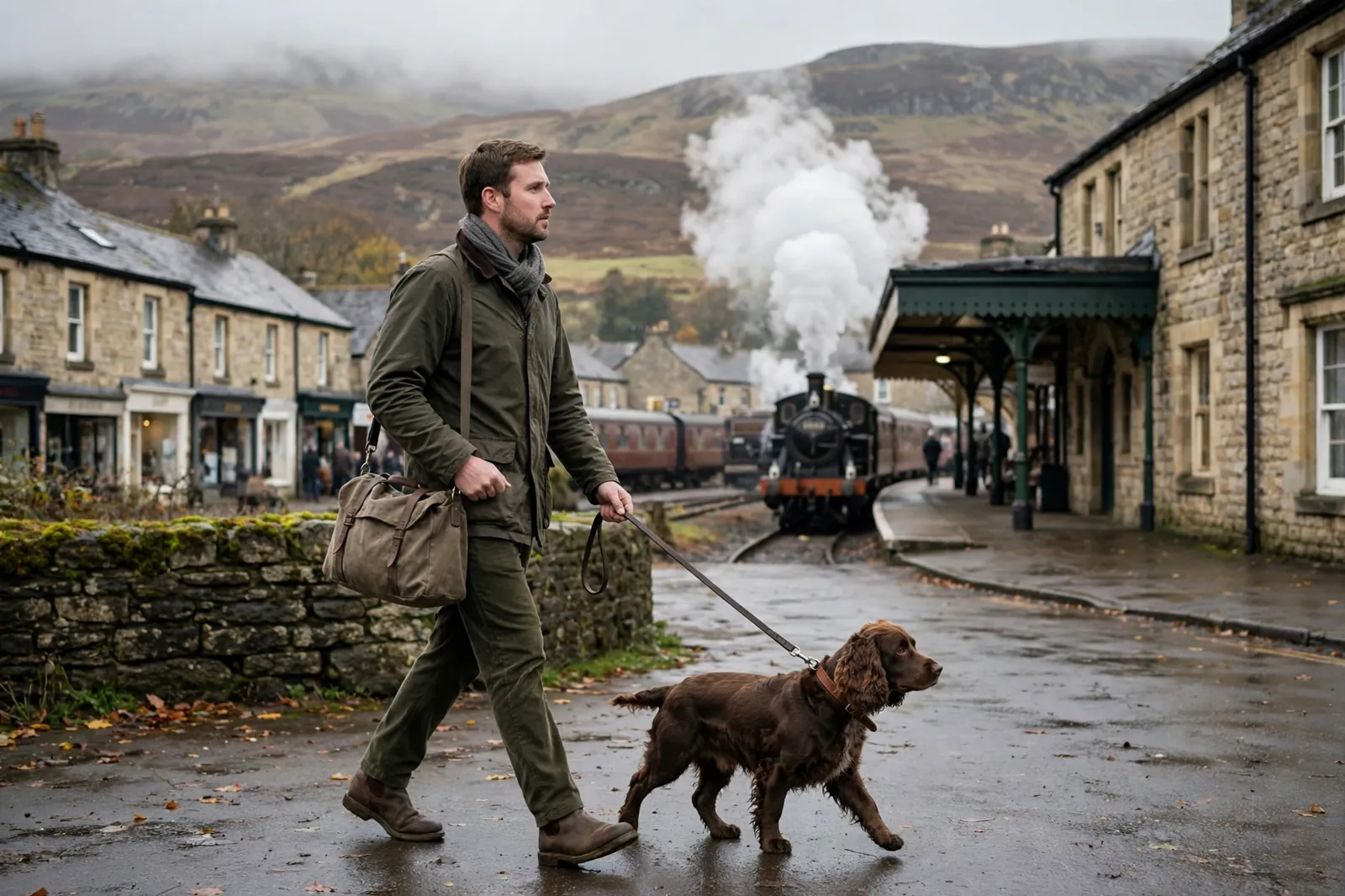
The North Yorkshire Moors Railway runs for about 24 miles from Pickering through Levisham and Newtondale Halt, over the moors to Goathland, down to Grosmont and on, on selected services, along the Esk Valley line to Whitby. It is a heritage line worked by steam and vintage diesel locomotives, and Pickering station — with its restored overall roof — is its southern terminus. It deserves every bit of its popularity. With a dog, however, a good day depends on understanding the rules before the whistle blows, because a heritage carriage is a confined, noisy, unfamiliar space and the railway is entitled to set conditions for using it.
The current shape of the dog policy, at the time of checking, is welcoming but specific. Well-behaved dogs are accepted on standard services for a dog ticket — listed at £3 for non-members, with members' dogs travelling free under the railway's published information. Dogs must stay on a short lead at all times and must not sit on the seats. Dogs other than assistance dogs are not permitted on dining trains, and some special-event services exclude them as well; the terms for a named Christmas service, for example, state plainly that dogs other than assistance dogs are not permitted on that train. First-class compartments have had their own restriction in published service information. Fares, membership terms and event rules all change, so check the official latest guidance before you go, and check it again for the exact train you intend to book rather than assuming that because dogs travel on one service they travel on all of them.
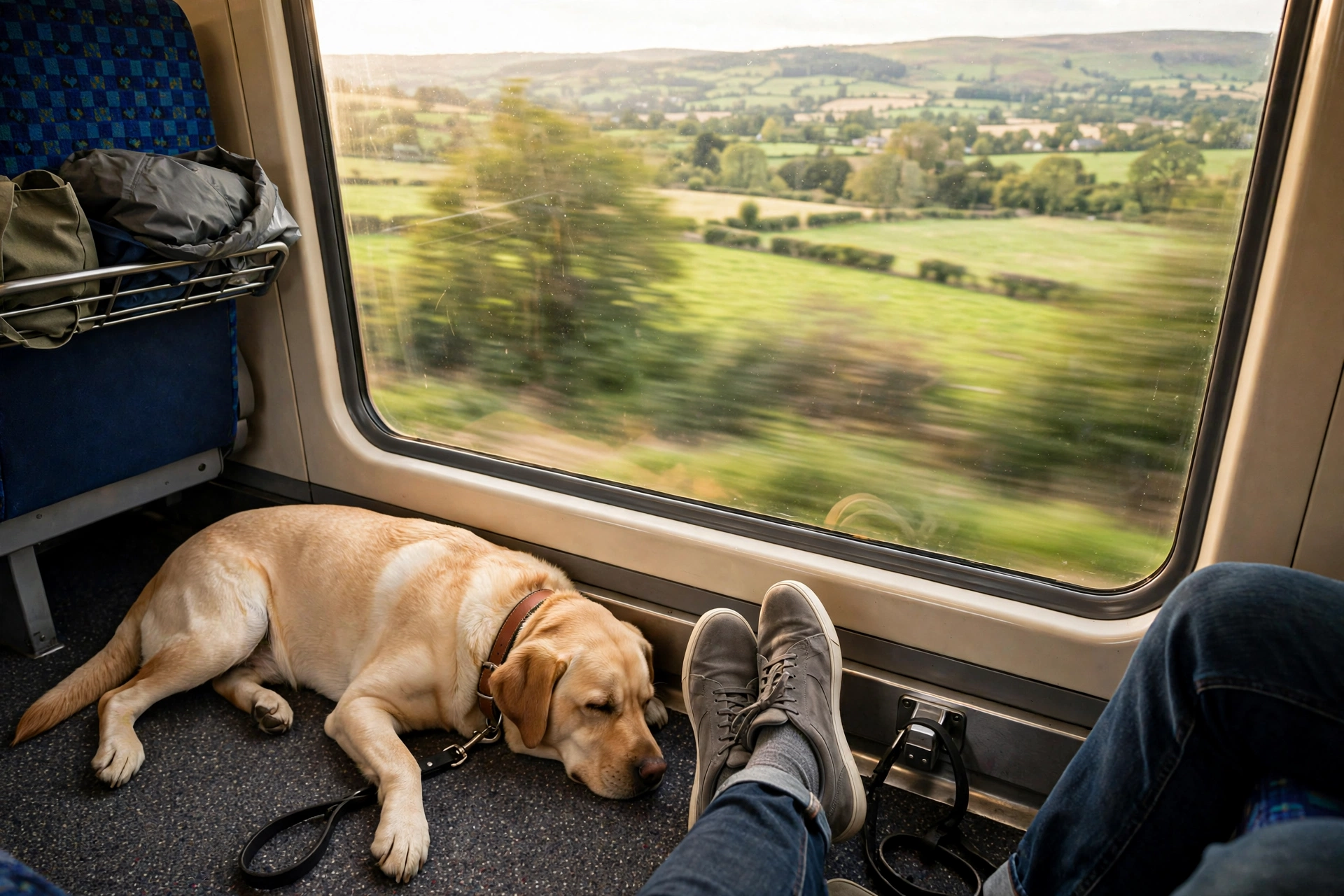
Settling a dog on board is a skill worth preparing. Arrive in good time so the dog has had a toilet stop and a few unhurried minutes on the platform, rather than being lifted from car to carriage in one exciting rush. Choose a position where the dog can lie on the floor out of the corridor and away from the door, ideally against your legs, on a familiar mat or blanket that signals settle. Bring water and a small bowl for longer journeys, because a full return to Whitby is a long outing, and a chew or lick mat for the first ten minutes if your dog uses one at home. Expect whistles, steam, sudden hissing, carriage jolts and applause-level excitement from small children at every station, and watch your dog rather than the view for the first stretch: a dog who is panting, whale-eyed and unable to settle is telling you to get off at the next station and rethink, which the line's intermediate stops make genuinely possible.
Platform discipline matters as much as carriage discipline. Heritage stations are working railways with moving locomotives, run-round manoeuvres and crowds surging towards the same carriage doors. Keep the lead short, keep the dog behind the platform markings and away from the edge, and never let a dog lunge towards a moving train or investigate a stationary locomotive's hot, oily underside. At smaller stations the exit may lead straight onto a lane or a level crossing. Our general guide to taking a dog on UK trains covers the transferable habits — floor settling, door positioning, muzzles where a route requires them and planning toilet breaks around stops — and they apply on a heritage line just as much as on the main line, with extra patience added for steam, crowds and nostalgia.
Choosing your train journey: short hop or the full line
Not every dog needs the full Pickering to Whitby run, and for many dogs the best railway day is a shorter one. A ride to Levisham gives a taste of Newton Dale, a quiet station in the valley and walking in wooded country, without committing the dog to hours on board. Newtondale Halt is a request-stop style halt deep in the valley, famously remote, used by walkers who know exactly which path they are taking from it; it is a lovely idea for a confident walking party and a poor improvisation for anyone without a map, because there is no village to fall back on when the plan turns out to be optimistic.
Goathland is the natural middle-distance choice. The station is known to many visitors from television and film, the village sits on open moorland a walk away from the station, and sheep graze remarkably close to everyday life there. That last fact is the management point: this is not a place for a dog to pour off a train and off a lead. Keep the lead on around the village greens and moor edges, give grazing sheep a wide berth, and treat any walk towards the Mallyan Spout waterfall or out across the moor as upland walking with stiles, uneven ground and weather that can turn above the valley while Pickering stays mild below.
The full run to Whitby is the grand day out, and it converts Pickering from a base into a starting point. If you take it, plan the Whitby end with the same honesty: the harbour is busy, fish and chips are dropped constantly at dog height, and the famous steps are no place for a dog who pulls. Our guide to Whitby with a dog sets out where the crowds thin, which parts work best on a lead and how to time the abbey headland, so read it before you commit to the return timetable. Whatever distance you choose, build the day around the last train back rather than the first train out, keep a margin for a missed connection at Grosmont where services join the Esk Valley line, and carry the timetable offline. A dog who has had a brilliant ride out and a two-hour wait on a cold platform because nobody checked the return board has a clear opinion about heritage railways, and it is not the one you wanted.
Seasonality shapes all of this. The railway's main running season does not cover every day of the year, special events rewrite both timetables and dog rules, and winter services are a different, smaller operation. Pickering as a town works in any season, but a trip sold to the family as a steam train holiday needs its dates checked against the railway's operating calendar first — and if no suitable dog-allowed service runs on your dates, say so early and rebuild the trip around Dalby, the beck and the moors rather than arriving to discover it at the ticket window.
Pickering Castle: the honest version
Here is the honesty this section promises. Pickering Castle is a dog-friendly castle — genuinely, on leads, across most of what there is to see — precisely because it is a ruin. This is not a furnished great house with rope barriers, delicate textiles and a one-way route through state rooms. It is a medieval motte-and-bailey castle developed in stone, managed by English Heritage, sitting on a hill at the northern edge of the town: curtain walls, towers, a chapel, the earthwork motte with steps to the top, and a large grassy interior where the shape of the fortress does the explaining. A dog on a lead fits that kind of site, and English Heritage lists well-behaved dogs on leads as welcome, with dog bowls provided at the entrance to the ticket office.
What a dog owner should not expect is a long indoor visit in bad weather, because there is very little indoors to visit. If it rains at Pickering Castle, you get wet while learning about medieval defence, which some families will find bracing and others will find like a short, expensive walk on a hill they could see from town. Nor is the ground easy throughout: access information describes gravel paths near the entrance giving way to grass and uneven terrain, flights of steps including a section into the moat area, and no lifts. A fit dog will enjoy the scents, the grass and the climb. A very old dog, a dog recovering from injury or a dog who dislikes steps and strange staircases may be happier with a partial visit — the lower grounds, the walls at ground level and the views — than with a determined assault on every tower.
Used well, the castle makes an excellent first or last hour of a Pickering day. It is close enough to the centre to walk up to, open enough that dogs are not threading through crowds in a corridor, and interesting enough that the humans are not merely exercising the dog under a historic pretext. Picnic benches on site suit a group who want to eat outdoors with the dog settled, and the climb gives a clear view north towards the moor edge that helps everyone understand the town's position. Opening is seasonal, hours vary across the year and the site can close in high winds or for events, so check the official latest guidance before you go. Do not leave the dog in the car as an alternative plan while others go in: if a member of the party does not want the castle, the beck and the town are a few minutes downhill and a far better swap.
One more honest comparison is useful. Visitors sometimes arrive expecting a second, larger castle day nearby, and the region obliges with places such as Helmsley, a short drive west, which also has a dog-friendly ruined castle tradition. That is a separate trip, not a walk from Pickering, and each site's current rules stand alone. Never transfer one castle's dog policy to another in your head; ruined, part-ruined and fully roofed heritage sites can sit ten miles apart and operate three different rules. Checking takes two minutes and prevents the worst sentence in dog travel, which is a surprised argument at a ticket desk with a dog already excited for a walk.
Market Place, Beck Isle and the church
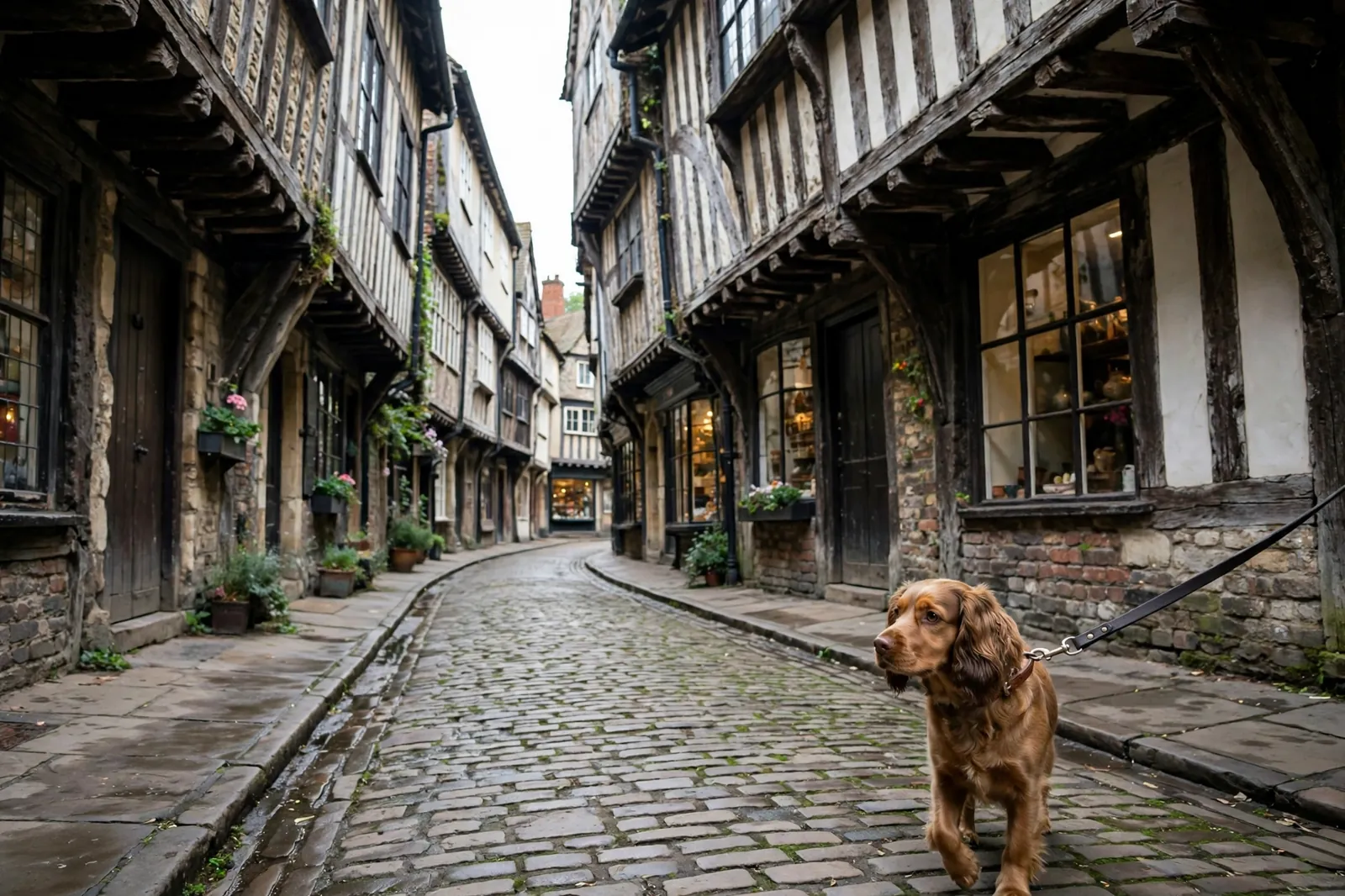
Pickering's centre is compact and legible: the Market Place climbing gently, shops and cafés along it, side streets such as Burgate and Birdgate leading away, the Memorial Hall, and the beck running below the main street's bustle. Monday is the traditional outdoor market day, when stalls take over space in and around the Market Place. With a dog, follow the universal market method: early, short lead, dog positioned on the quieter side of you, constant scanning for dropped food, and a low threshold for stepping out. Pickering helpfully offers one of the best step-outs in any market town, because within a few minutes you can be beside the beck, where the pace drops and a dog can decompress on grass while the shopping continues without them.
Beck Isle Museum, by the beck near the railway end of town, is the centre's surprise. It is a social history museum of recreated shops, trades and domestic rooms covering roughly two centuries of Ryedale life, run with heavy volunteer involvement — and it has welcomed well-behaved dogs on a lead, a policy that puts it ahead of most indoor museums for a dog-owning visitor. The same honesty as the castle applies, in reverse: dog friendly does not mean dog easy. Rooms are detailed and close, there are stairs, other visitors are near, and a big wet dog who shakes beside a recreated Victorian shop is a problem of physics, not policy. Take a calm, dry, settled dog, keep them tight to your leg, skip crowded demonstrations, and leave cheerfully if the dog is restless. The museum is seasonal, so check the official latest guidance before you go, including whether the dog welcome still applies on your date.
The parish church of St Peter and St Paul deserves a mention and a careful caveat. It is known well beyond the town for its medieval wall paintings, rediscovered in the nineteenth century after being covered for centuries, and it is one of the cultural reasons to linger in Pickering rather than treating it purely as a railway platform with shops. Whether a pet dog may go inside with you is exactly the sort of rule that varies by church, by service times and by event, and this guide will not invent one. Admire the exterior and the churchyard respectfully with the dog on a lead, and if you want to see the paintings, plan a split visit — one person inside, one with the dog in the town — unless the church's own current notices clearly welcome dogs at the time of your visit. That pattern, repeated at the castle and museum, is the quiet engine of a good Pickering trip: pairs and families who split and swap see more, and the dog never waits alone anywhere it should not.
Shopping itself needs little strategy beyond timing and doors. Independent shops in a working town will each have their own dog rule, often handwritten and entirely reasonable either way. Assume food shops are a no until invited, ask in one sentence, accept the answer in one second, and keep a list of the yeses for your return visit. Pickering rewards regulars, and a dog who is known to settle quietly will be remembered kindly by cafés in a way that a first-day whirlwind will not.
Walks from the town itself
For all the railway's pulling power, Pickering's everyday dog walking starts with water. Pickering Beck runs through the town and out into the countryside, and the paths beside it offer the short, repeatable walks that a holiday actually runs on: the first walk before breakfast, the ten minutes while dinner is booked, the last calm circuit before bed. Follow the beck and local footpaths at a gentle pace, keep dogs under close control near anglers and waterbirds, and be careful after rain, when banks are soft and a clear beck can rise and quicken. As with any stream, keep a dog who is desperate to swim out of stretches where signs, fishing or nesting birds say no, and never let a dog worry swans or moorhens with young in spring and summer.
The classic town circuit links the castle into a walk rather than treating it as a separate ticketed visit. Local circular routes head north from the centre through lanes and fields towards Newbridge, cross the railway with great care at designated crossings, come through woodland and return past the castle, with stiles, kissing gates, steps and at least one field that may hold cattle. That detail list is the point: this is a real country walk attached to a town, not a promenade. Check a current route description and map before you set off, identify the stile that a large or arthritic dog cannot manage while you can still turn back, and treat any unsignalled railway crossing as the most serious thirty seconds of the day — dog on a short lead, stop, look, listen, cross without stopping.
Longer ambitions lead north into Newton Dale itself, on footpaths that follow the valley the railway runs through. Walking the dale gives a different pleasure from riding it: kingfisher-fast glimpses of the beck, woodland that changes with the season, and the theatrical moment when a steam train passes through the landscape you are standing in. It also demands navigation, because valley paths branch, forestry and estate access changes, and distances back to town are easy to underestimate when the walking is pretty. Download the map, tell someone the plan, carry water for the dog even in a valley that looks wet, and remember that mobile signal cannot be relied on in the gorge. The railway and the walk combine well — ride one way, walk back a section — but only with the timetable and the dog's fitness both checked in advance, not as an improvisation at a remote halt.
In-town walking has its own small disciplines. The A170 passes through Pickering and can be busy with holiday and agricultural traffic, so choose crossing points carefully and keep leads short on narrow pavements, especially near the station when a train has just arrived and a crowd is moving as one. Evenings are the town's gift: day visitors leave, the Market Place calms, and a slow loop taking in the castle hill view, the beck and the lit streets gives a dog a proper final walk without leaving the pavements. In winter that loop, done in the middle of the afternoon instead, may be the day's main event, and there is no shame in building a winter Pickering day around a short walk, a long lunch and a train ride rather than a mileage target.
Moorland edge: heather, sheep, grouse and the law
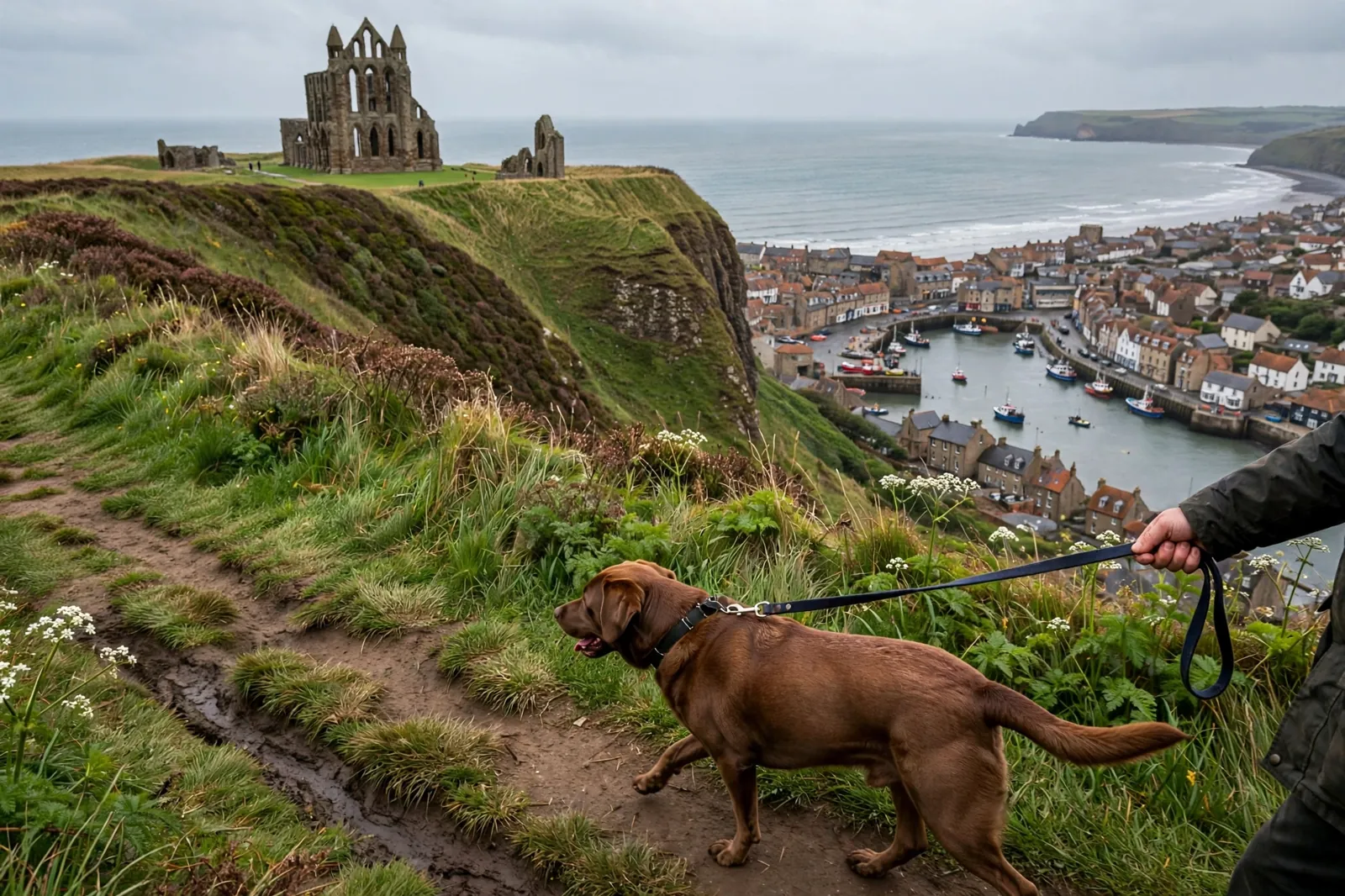
North of Pickering the land changes its rules. The North York Moors are a working upland landscape of heather moorland, managed in places for red grouse, grazed by hardy sheep, crossed by open-access land and home, from spring into summer, to ground-nesting birds whose chicks are almost invisible until a dog is on top of them. On open-access land, dogs must be kept on a short lead between 1 March and 31 July, and near livestock at all times, under the access rules — and many moorland routes carry local requests that are stricter still. Our guide to dogs on leads and the law in the UK explains the framework in full. On the moors, do not treat the lead as a technicality to negotiate. It is the price of admission, and keepers, farmers and other walkers will judge every dog owner by whether you pay it.
Sheep on these moors are not fenced into neat fields in the way lowland walkers expect. They range, they appear over brows and out of bracken, and a ewe with lambs in spring will run from a loose dog in a way that can injure both animals even without contact. If sheep move towards a path, stop, widen the distance and let them settle rather than pushing through the middle of a flock with a dog straining to look. Grouse add a second, camouflaged risk: a dog quartering through heather in nesting season disturbs birds you will never see, which is why staying on paths and keeping the lead short in heather is a conservation act, not just a legal one. Heather itself is hard walking for dogs off the path — woody stems, hidden holes and adders in warm weather — so the path is also the comfortable option, which is a rare and convenient alignment of ethics and ease.
Weather at the moor edge deserves a paragraph of respect. Pickering can be in soft valley cloud while the high moor above Goathland is in wind, horizontal rain or, on the best days, fierce sun with no shade for miles. Heather moorland offers a dog almost no water, so carry it, and almost no shelter, so shorten the walk rather than pressing on to a cairn because it is on the list. Ticks are present in bracken and rough grazing country, so check the dog thoroughly after every moorland walk, especially around ears, armpits and belly, and know how to remove one safely. In late summer the flowering heather is the moors' famous glory, purple to the horizon, and it is at exactly that popular moment that the disciplines above matter most, because visitor numbers peak while young birds are still vulnerable and sheep are still out. Beautiful and strict can coexist. In Pickering's uplands, they must.
Dalby Forest as the wet-day — and hot-day — escape
A short drive north-east of Pickering, Dalby Forest occupies a large area of woodland on the southern edge of the North York Moors, managed by Forestry England, with waymarked trails, a visitor centre, play areas, cycling routes and the deep shade that the open moor conspicuously lacks. For a dog party based in Pickering, Dalby solves two opposite problems. On a hot day, when the heather moor is exposed and airless, the forest offers shaded walking at a tolerable temperature. On a showery day, it offers surfaced trails and tree cover that turn a write-off into a decent outing, although nobody should pretend a forest in rain is dry — it is simply a better class of wet.
Dogs are a normal sight on Dalby's trails, but it is a busy, multi-use forest: mountain bikes travel fast and quietly on and across routes, there are children's play areas and picnic lawns where a lead and close control are plainly appropriate, and forestry operations close sections without consulting your holiday plans. Keep dogs under close control, use a lead around the visitor centre, car parks, play areas and other users, and check Forestry England's current information for trail closures, charges for parking and any seasonal restrictions before you set off — and check the official latest guidance before you go if a specific facility matters to your day. Choose trail length with the same out-and-back honesty as any railway path: forest distances feel short among trees until a tired dog is walking the last two miles on grit.
Dalby also makes a useful contrast day for a dog who found the train overstimulating. No whistles, no crowds surging at doors, no timetable — just steady walking at the dog's own pace, which is sometimes exactly the reset a holiday needs in the middle. Pair a morning in the forest with an afternoon off, back in Pickering, rather than stacking forest, castle and train into a single heroic itinerary. Dogs experience holidays as a sequence of demands, not as a highlights reel, and the owners who build in a genuinely quiet half day are the ones whose dogs are still enthusiastic on day four.
Pubs, cafés, stays and parking
Pickering eats well for a town of its size, with cafés around the Market Place, pubs in the centre and side streets, fish and chips, bakeries and the tea rooms that a railway town naturally grows. Dog policies are individual and change with ownership, season and how busy a room is, so this guide will not print a list of guaranteed welcomes that could be wrong by the time you read it. Use the method instead: prefer places with a garden, terrace or a clearly signed dog area, ask before you settle rather than after you have ordered, keep the dog on the floor and out of walkways, and treat a lunchtime rush as a reason to eat early or late. A town that serves walkers, cyclists and railway crowds generally understands muddy boots, but a quick paw towel at the door still buys goodwill, and our wider guidance on café etiquette in York with a dog applies just as well an hour north — settle the dog first, order second, and never let a lead become a tripwire across a serving route.
Stays follow the same pattern as the rest of Ryedale: inns and bed and breakfasts in the town, self-catering cottages in Pickering and in villages such as Thornton-le-Dale, Lockton and Levisham, holiday parks and campsites within a short drive. The label dog friendly needs unpacking every time. Confirm the number and size of dogs accepted, any charge per dog, whether dogs may go in bedrooms and on furniture, whether they may ever be left alone in the property — assume not unless explicitly agreed — and, crucially in this landscape, what the first and last walk of the day actually looks like from the front door. A cottage on the moor edge with a lane and a footpath opposite is worth more than a grander address whose only evening option is a busy main road with no verge. Ask about garden security in detail: stone walls and farm gates look absolute and often contain a terrier-sized argument, and a garden that opens towards grazing land should be treated as a lead-only space however it is described.
Getting there and parking are straightforward with one warning: Pickering is a through-route town, and traffic builds on the A170 and around the station on running days. Central pay-and-display car parks, including The Ropery and the Eastgate area, serve the town, and the railway has its own limited station parking that fills early when a popular service is due. Read current charges and limits on the operator signs when you arrive, because they change and no guide's figures, including this one's omissions, should be trusted over the sign in front of you. Arrive before the first popular train if parking near the station matters, or park in the town, walk the dog properly first and treat the stroll to the station as part of the settling routine described earlier. For rail arrivals on the main line, the nearest stations are some distance away, with Malton the usual railhead and a bus or taxi onward, so a car-free Pickering trip is possible but needs its connections planned in advance rather than assumed.
For supplies and emergencies, save the details of a local veterinary practice and its out-of-hours arrangement in your phone before a moorland or forest walk, not during one. Pickering has the shops a working town needs for forgotten leads, bags and food, but specialist items should travel with you. Carry, as a minimum, water and a bowl, a spare lead, bags, a towel, tick removal knowledge and a charged phone with maps downloaded. The moors, the dale and the forest all punish the assumption that signal will save a small problem from becoming a large one.
A two-day plan that actually works
Day one belongs to the railway, taken at the dog's pace. Start with a beck-side walk before the town fills, then a mid-morning standard service — not a dining train — to Goathland or, for a dog who has already proved they settle beautifully on board, on to Whitby with the return times checked twice. Keep the far-end walk modest, keep the lead on around moorland sheep, be back at the station early, and let the evening be a quiet Market Place loop and an early night. The mistake to avoid is adding the castle at full price in the last hour, when everyone is tired; Pickering Castle deserves its own fresh slot, and the dog's vote, if counted, will always be for the version with energy left.
Day two is the town and its edges. If it is a Monday, do the market early and briefly, step out to the beck, then give Beck Isle Museum a calm hour if its current opening and dog welcome fit your dog — splitting the party if they do not. Take the castle late in the morning, on a lead, with no expectation beyond walls, grass, steps and a very good view, and picnic or eat in town afterwards. Spend the afternoon in Dalby Forest's shade if the day is hot, or on a checked section of the Newbridge and castle circuit if the day is fine and the dog is fit, and stop while the walk is still enjoyable. Two days built like this cover everything Pickering is actually famous for, in the order that suits a dog, and leave the full Whitby run, a longer Newton Dale walk and Helmsley for a return visit — which, for a gateway town that gets the fundamentals this right, is very likely to happen.
Practical questions
Before you go
Can dogs ride the North Yorkshire Moors Railway from Pickering?
Yes, on most standard services. Well-behaved dogs are welcome on the North Yorkshire Moors Railway for a dog ticket, listed at £3 for non-members at the time of checking, as long as they stay on a short lead and off the seats. Dogs other than assistance dogs are not permitted on dining trains and on some special-event services, and rules for first-class compartments can differ, so check the official latest guidance before you go and before you book a specific train.
Can dogs go into Pickering Castle?
Well-behaved dogs on leads are welcome at Pickering Castle, which is a largely outdoor, ruined site managed by English Heritage, and dog bowls have been provided at the entrance to the ticket office. The ground is mostly grass and uneven, with gravel paths, slopes and steps up the motte and towers, so it suits a steady dog better than a very frail one. Opening is seasonal and hours vary, so check the official latest guidance before you go.
When is Pickering market day, and is it good with a dog?
Pickering's outdoor market is traditionally held on Mondays in and around the Market Place. A dog on a short lead can walk through with you, but go early before the pavements fill, keep your dog away from food stalls and dropped food, and step into a side street or down towards Pickering Beck whenever your dog needs space. Individual shops and cafés around the market set their own rules for dogs going indoors.
Can dogs go into Beck Isle Museum?
Beck Isle Museum has welcomed well-behaved dogs on a lead, which makes it unusual among indoor museums, but it is a seasonal, volunteer-run museum with narrow rooms, stairs and fragile displays. A calm dog who settles close may be fine, while a large, wet or restless dog will be hard work for everyone. Opening dates and dog arrangements can change, so check the official latest guidance before you go.
Where can I park in Pickering with a dog?
Pickering has pay-and-display car parks in and near the centre, including The Ropery and Eastgate areas, plus limited station parking for the railway that fills early on busy running days. Charges, limits and payment methods change, so read the operator signs when you arrive. Arrive early on Mondays and in the main railway season, and never leave a dog alone in a parked car, even for a short castle or museum visit.