This guide is independent and contains no paid placement. If affiliate links are added later, they will be clearly marked and will not change our editorial checks.
Cross the Old Bridge, walk the level paths of Ynysangharad War Memorial Park, then choose a direction on the Taff Trail: south to Treforest and Nantgarw for a gentle riverside stretch, or north towards Abercynon for a longer walk. The town centre, the park and the trail all sit within a few minutes of each other, so a dog can have a full morning out without a single car journey in between.
Start at the Old Bridge
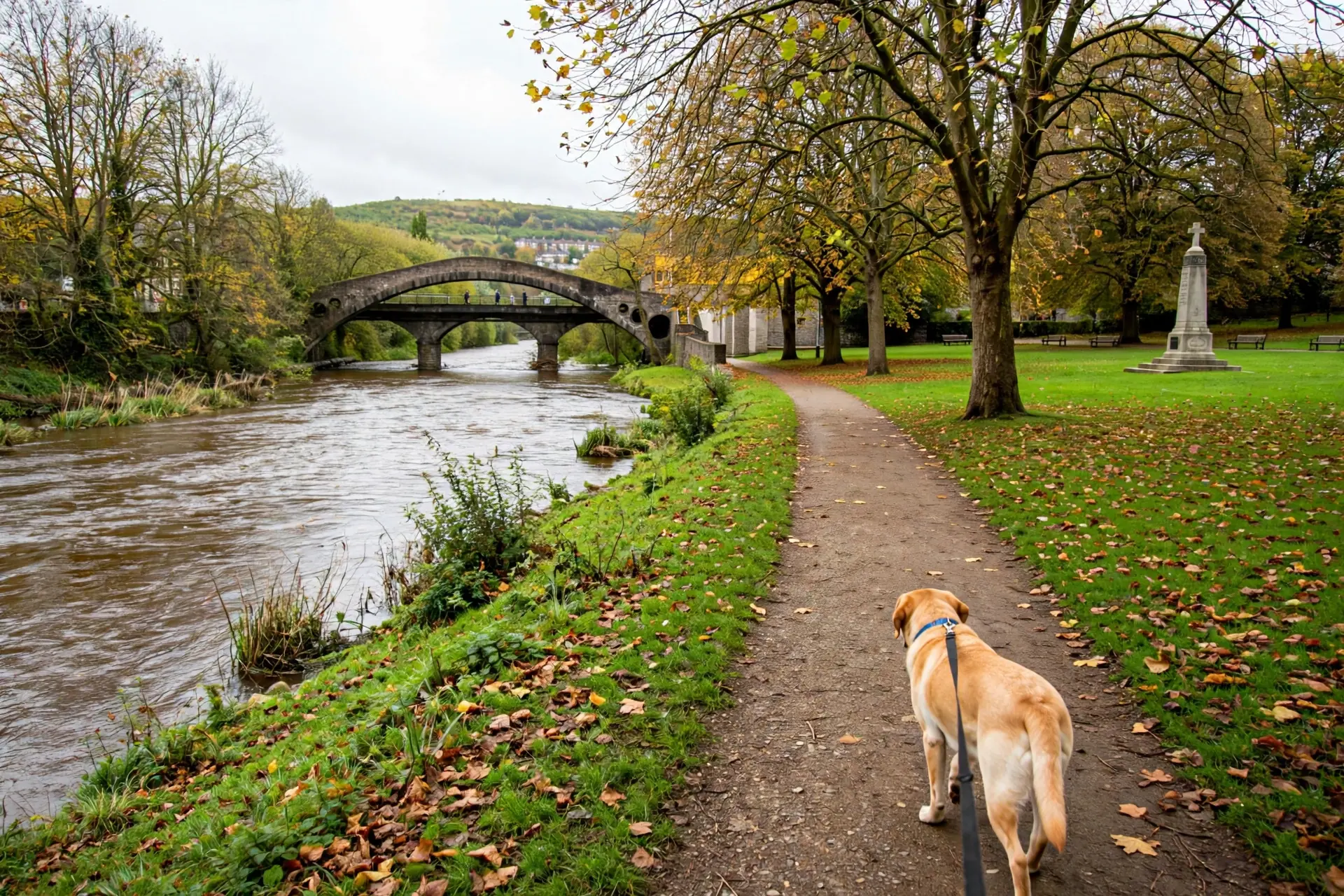
Pontypridd takes its name from a bridge over the River Taff, and the bridge still standing in the town centre is the place to begin. The Old Bridge, also known as the William Edwards Bridge or Pontypridd Bridge, was completed in 1756. It was the fourth bridge William Edwards built on this spot, after three earlier attempts failed, and its single stone arch spans 140 feet, or about 43 metres, across the river. When it opened it was the longest single-span bridge in Britain, and it is now Grade I listed and a scheduled ancient monument. The three circular holes pierced through the stonework at each end of the arch are the detail to look for: Edwards cut them to reduce the weight pressing on the arch, and they give the bridge its distinctive, almost lace-like outline against the sky.
Today the Old Bridge carries only foot traffic. The road bridge beside it, Victoria Bridge, built in 1857, takes the vehicles, so crossing with a dog means sharing the old span with walkers, not with cars. That makes it a calm introduction to the town, but it is worth treating the crossing itself with a little care. The arch rises steeply from both banks, the stone surface can be slick after rain, and the parapets are low by modern standards. Keep your dog on a short lead, walk at the dog's pace rather than pulling them up the slope, and pause at the top. From the crown of the arch the view runs north along the Taff towards the wooded slopes above the town and south towards the place where the River Rhondda joins the Taff just below the park. On a clear morning the light on the water and the dark green of the valley sides make this the best photograph of the day, and it costs nothing more than a slow climb.
Small dogs and older dogs sometimes hesitate on the steepest part of the arch, especially if the stone is wet or if other walkers are coming down towards them. Let them stop, let them sniff, and carry them if that is what they need; there is no rule that says a dog has to enjoy a historic bridge. Dogs that are nervous around heights are usually happier looking at the bridge from the riverbank in Ynysangharad Park, where the full curve of the arch is visible from level ground. Either way, the bridge works best as a short, unhurried stop at the start of the walk rather than as a route to rush across. Cross it once, look back at it from the park, and you have already understood the shape of the town: river below, park beside it, and the steep valley sides closing in on both sides.
Ynysangharad War Memorial Park
Immediately south of the Old Bridge, on the east bank of the Taff, lies Ynysangharad War Memorial Park, the green heart of Pontypridd and the easiest dog walk in the town. The park opened on August Bank Holiday Monday in 1923 as a war memorial park, laid out in Edwardian style on level ground beside the river, and it has held a Green Flag Award as one of the best-kept parks in the country. Its position is what makes it so useful for dog owners: it sits between the Old Bridge at its northern end and the town centre a few minutes to the south, so it works as a walk in its own right, as a link between the bridge and the shops, and as the place where the Taff Trail passes through the town.
The park is broad and mostly flat, with firm tarmac paths around the perimeter and across the middle, open grass for a game of fetch away from the formal areas, and long riverside stretches where a dog can watch the Taff sliding past. The paths are surfaced and level enough for a pushchair, a wheelchair or an older dog that struggles on rough ground, which is unusual for a Valleys town where so much walking climbs steeply out of the valley floor. A slow circuit of the park takes about twenty to thirty minutes at a dog's pace, and a faster lap with a ball and a few stops takes closer to forty-five. The cricket pitch, the football pitch, the tennis courts and the bowls lawns fill the middle of the park, so keep your dog on a lead near the marked sports areas and give matches and players a wide berth, especially on a Saturday when local games are in progress.
The southern part of the park holds the National Lido of Wales, Lido Ponty, a Grade II listed open-air pool with three heated outdoor pools, a splash pool and a visitor centre, and beside it a large themed play area. Dogs cannot go into the pools, and the play area is a place to keep a dog on a short lead and moving through rather than lingering, particularly on warm days when children are everywhere. The same applies to the war memorial garden and the memorial to Evan James and James James, the father and son who wrote the words and music of the Welsh national anthem, Hen Wlad Fy Nhadau. The memorial stands in the park as a quiet, formal space, and it is worth a pause and a photograph, with the dog settled beside you rather than investigating the planting. There is a cafe in the park, Cafe Lido, with a terrace overlooking the lido and the play area, and toilets including a Changing Places facility; check the official guidance before you travel for current opening times and for whether dogs are welcome on the terrace, as cafe rules change with the seasons.
For a dog, the park's best quality is its variety within a small area. A nervous dog can stick to the quiet perimeter path on the river side, away from the play area and the sports pitches. A sociable dog can meet other local dogs on the open grass, where there is room to pass at a comfortable distance. A dog that needs a toilet break before a train or a drive has grass and bins close to the park gates, and a dog that needs water after a long trail walk will find the river close by, although river water is not a substitute for a bottle of fresh water and a bowl. The park opens at 8.30am every day and closes between 5.45pm in winter and 8.45pm in the summer months, so an early walk is easy in every season, and the gates are the natural meeting point if you are walking with friends. Remember that the park is a memorial as well as a playground: pick up after your dog, use the bins, and keep dogs out of the flower beds and the memorial planting.
The Taff Trail south: Treforest and Nantgarw
The Taff Trail is the long-distance path that runs for 55 miles, about 88 kilometres, from Cardiff Bay to Brecon, following the River Taff through the city, the Valleys and the Brecon Beacons. Pontypridd sits roughly in the middle of the southern half, and the trail passes straight through Ynysangharad Park, so the town is one of the easiest places to join it for a short walk. Heading south from the park, the trail runs towards Treforest, Nantgarw and then on towards Taffs Well and Cardiff, and this is the gentler of the two directions from Pontypridd. The path is mostly flat, largely traffic-free and surfaced for much of the way, which suits a short out-and-back walk, a dog that is still building fitness, and anyone pushing a buggy alongside a dog.
From the park, follow the trail south past the southern end of the town and into Treforest, the village that sits just south-east of Pontypridd on the other side of the river. Treforest is home to a campus of the University of South Wales at Glyntaff, and the trail passes close to student housing, small shops and the Grogg Shop, a long-running shop selling the distinctive Welsh ceramic figures known as groggs. The walk from the park to Treforest takes about twenty to twenty-five minutes at a steady pace, and the path stays close to the river for much of it, with trees overhead and the sound of the water beside you. Cyclists use the same path, and it is part of National Cycle Network Route 8, so keep your dog on a lead or on a short line, keep to one side, and teach a reliable recall or a step-aside routine before you set off on a busy weekend.
Continue south from Treforest and the trail reaches Nantgarw, about 6.2 miles from the park on the signed walking route that ends back at Ynysangharad Park, and the village is worth the extra distance if your dog is fit. Nantgarw is known for the Nantgarw China Works and Museum, a small museum in the former pottery where fine porcelain was made in the early nineteenth century, and the trail passes the old china works before joining the riverside path again. The full walk from Pontypridd to Nantgarw and back is a solid half-day, roughly two and a half to three hours of walking with stops, so most dog owners will prefer to walk out for an hour and turn back at a point that suits the dog, rather than committing to the whole distance. There is no shame in a two-mile out-and-back: the river, the trees and the old railway and canal features along the way are the same whether you walk two miles or six.
The southbound trail is also the practical choice for a one-way walk. Catch a train from Pontypridd station south to Taffs Well or Cardiff, walk north back towards Pontypridd, and finish at the park with the river on your right and the Old Bridge ahead of you. Our guide to Cardiff with a dog covers the southern end of the same trail in detail, including Bute Park, the Taff Embankment and the Bay barrage walk, so a two-centre trip that pairs a Pontypridd morning with a Cardiff afternoon is easy to plan. Before you set off in either direction, check the official guidance before you travel for any temporary path closures, especially after heavy rain, when riverside sections can flood or become muddy, and after storms, when fallen branches can block the narrower stretches.
The Taff Trail north: Abercynon and beyond
Heading north from Pontypridd, the Taff Trail follows the river up the valley towards Abercynon, Quakers Yard, Aberfan and Merthyr Tydfil, and eventually on towards the Brecon Beacons. This is the longer, more open direction, and it suits a dog that needs a proper walk rather than a park circuit. From the northern end of Ynysangharad Park, the trail crosses a footbridge and follows the former Alexandra Docks and Railway line towards Rhydyfelin, passing Glyntaff Cemetery and then joining Cilfynydd Road for a short stretch before the path continues north. The surface changes along the way: surfaced riverside path gives way to old railway alignment, woodland track and stretches of loose stone, so a dog with sensitive paws or an owner with a buggy should treat the first mile as a trial and turn back if the ground does not suit.
Abercynon is the first useful turning point, roughly three to four miles north of Pontypridd depending on the exact route, and it has a railway station on the Merthyr line, which makes a one-way walk with a train back a realistic plan. From Abercynon the trail continues to Quakers Yard and then to Aberfan, a village whose name is known across Britain for the disaster of 1966, when a colliery spoil tip collapsed onto the village school. The memorial garden at Aberfan is a quiet, respectful place, and dogs should be kept on a lead and close by, with no playing or picnicking in the memorial area. Beyond Aberfan the trail climbs gently towards Merthyr Tydfil, passing the Cefn Coed Viaduct and the long, straight stretches of the old railway that give the northern Taff Trail its open, big-sky feeling.
For most visitors, the sensible northern walk is an out-and-back of one to two hours from Pontypridd, turning at Rhydyfelin or at the first comfortable point beyond it, rather than a full day to Merthyr. The valley narrows and the river runs faster here than it does south of the town, and the path can be exposed to wind and rain, so pack a waterproof layer for yourself and a drying coat for the dog, and carry water even on a cool day, because there are few shops once you leave the town. Cyclists are frequent on this stretch too, and the path is shared, so a long line is more useful than a flexi lead: it gives the dog room to sniff while letting you reel them in quickly when a cyclist calls out behind you. If you are planning the full trail to Brecon, treat Pontypridd as a rest and resupply stop rather than a starting point, and check the official guidance before you travel for the current state of the path north of Merthyr, where the climb to Torpantau and the moorland section demand proper hill kit.
Pontypridd Common and the Rocking Stone
West of the town centre, above the river, lies Pontypridd Common, a stretch of open common land that gives a completely different walk from the riverside paths below. The common is best known for the Rocking Stone, a large glacial boulder left behind by the ice age that sits on the hillside and can be rocked, gently, by hand. It is a well-known local landmark and a useful destination for a dog walk that needs height, open grass and a view back over the town, rather than another flat mile beside the river. The climb from the town centre to the common is steep in places, and the ground is uneven, so this is a walk for a fit dog and an owner who is happy with a hill, not for a puppy, an older dog with stiff joints, or a dog that is still recovering from an injury.
The circular walk that links the Old Bridge, Ynysangharad Park, Pontypridd Common and the Taff Trail is a popular local route, and it shows how the town's walks fit together. Starting at the Old Bridge, it crosses the town, climbs to the common and the Rocking Stone, then drops back to the Taff Trail and follows it south-east towards Glyntaff and Rhydyfelin before returning to the centre. The full circuit is a half-day walk with a substantial climb, and the section over the common and the higher ground towards Mynydd Meio, which rises to 322 metres, is exposed and can be muddy after rain. Dogs should be kept on a lead where the path crosses grazing land or runs close to livestock, and the usual countryside rules apply: close gates behind you, keep dogs under control around sheep, and pick up waste even on open ground.
If the full circuit is too much, the common still works as a short out-and-back from the town. Walk up, let the dog have a run on the open grass where it is safe and legal to do so, look back over the Taff valley, and walk down again. The view from the higher ground explains the geography of Pontypridd in a way that the riverside paths cannot: the town sits at the meeting point of three valleys, the Rhondda and the Cynon joining the Taff here, and the steep, wooded sides that close in on every side are the reason the town grew as a market and transport hub rather than spreading outwards. Take water for the dog, because there are no taps or cafes on the common, and check the weather before you climb, because the hilltop is the first place to catch wind and rain coming down the valley.
Taff Street, the Market Quarter and the museum
Pontypridd town centre is small enough to explore on foot with a dog, and the main shopping street, Taff Street, runs south from the river through the middle of the town. The street is lined with independent shops, cafes, charity shops and the usual high-street names, and the pavements are wide enough for a dog on a short lead, although they get busy on market days and on Saturdays, when the town fills with shoppers from the surrounding valleys. The Market Quarter, the covered market in the centre of town, has stood on its site since the early nineteenth century, with the present building dating from the 1870s, and it is still the best place in town to buy fresh fruit and vegetables, meat, bread and Welsh cakes. Dogs are not generally welcome inside the covered market hall itself, so plan the market as a human errand: one person shops while the other walks the dog around the park, or pop in alone for a quick browse and meet the dog outside.
Just a short walk from the Old Bridge, on the west bank of the Taff, stands Pontypridd Museum, housed in the former Tabernacle chapel. The museum tells the story of the town's industrial and political past, from the coal and iron industries to the chapels, the choirs and the sporting life of the Valleys, and it is a small, friendly museum that rewards half an hour. Dogs cannot go inside the museum building, so treat it the same way as the market: a short visit for the humans while the dog waits outside with a companion, or a stop to admire the chapel building from the street before moving on. Check the official guidance before you travel for opening days and times, as small museums often open limited hours and close on some weekdays.
The town centre also holds the two things every dog walk needs at the end: a place to sit and a place to buy supplies. Taff Street and the streets around the market have cafes and takeaways, and the larger supermarkets on the edge of the town are useful for stocking up on dog food, water and treats before a longer trail walk. The town is also the birthplace of Tom Jones, and the singer's name comes up in shop windows, in the park's visitor centre and in conversation with local people, which gives the centre a character that is distinctively Pontypridd rather than generically high street. Keep the town-centre walk short and purposeful if your dog is not comfortable in crowds: cross the bridge, walk the park, and use Taff Street for a coffee and a browse, rather than dragging a nervous dog through a busy Saturday market.
Barry Sidings Country Park
A short drive or a longer walk west of Pontypridd, between the town and Porth, lies Barry Sidings Country Park, a woodland and waterside park built on the site of old railway sidings. It is the nearest proper country park to Pontypridd, and it gives a dog a different kind of walk from the riverside paths in town: woodland trails, small streams and pools, open glades and a network of paths that link into the wider network of walks around the Rhondda. The park is a popular stop on the long linear walk from Porth to Taffs Well that passes through Pontypridd, and the Ramblers describe that route as suitable for dogs, with no stiles and no fields to cross, which is a useful sign for anyone planning a longer day.
Barry Sidings works well as a second walk on a two-day stay, or as the main walk if your dog prefers woodland to riverside. The paths are a mixture of surfaced track and woodland trail, and they can be muddy after rain, so boots for you and a towel for the dog are worth packing. There are toilets in the park, subject to opening hours, and a car park, but facilities are more limited than in Ynysangharad Park, so bring water, a bowl and a lead, and do not rely on buying anything on site. The streams and pools are attractive to dogs, but they can be deep in places and the banks can be slippery, so keep a dog that loves water on a lead until you can see how deep and fast the water is, and do not let a dog drink from still pools in warm weather.
The park also links to the wider industrial heritage of the area. The Rhondda Heritage Park at Trehafod, a short drive north-west of Pontypridd, tells the story of coal mining in the Rhondda, and the old railway lines that once carried coal down the valley are the same lines that now carry walkers and cyclists on the Taff Trail and the cycle network. If you are driving between Barry Sidings and Pontypridd, allow time for the narrow valley roads and for parking at both ends, and check the official guidance before you travel for the current opening times and any seasonal events, as country parks in the Valleys often host school-holiday activities that change the feel of a visit.
Eating and drinking with your dog
Pontypridd is a working Valleys town rather than a tourist resort, so dog-friendly eating and drinking here works differently from a seaside town with a row of dog-friendly cafes. The most reliable option is to eat outdoors: the terrace at the park cafe, the outdoor seating in the town centre, and the pub gardens in the warmer months are the places where a dog is most likely to be welcome, and a dog that can settle under a table for twenty minutes will do better than a dog that needs to be entertained. Bring a mat or a blanket for the dog to lie on, a bowl and water, and a chew or a stuffed Kong to keep them occupied while you eat; a dog that is comfortable and occupied is a dog that other customers will not notice.
The Bunch of Grapes on Ynysangharad Road, close to the park and the Old Bridge, is the pub most often named in walking guides as a good stop after a walk around Pontypridd, and it is described as dog-friendly, with a small outdoor seating area and a focus on cask and craft beers and gastropub food. Pub policies can change, and a pub that welcomes dogs in the bar on a quiet weekday may ask dogs to stay outside on a busy Saturday, so check the official guidance before you travel or ask at the door before you bring the dog in. The same rule applies to every cafe and pub in the town: ask first, watch for a water bowl by the door, and be ready to sit outside if the answer is no. A polite question at the door is always better than assuming a welcome and then having to leave with food half-eaten.
For a longer lunch, the Market Quarter is the place to buy food to eat in the park. A bag of Welsh cakes from the Welsh Cake Shop, a sandwich from one of the market stalls, and a coffee from a cafe on Taff Street make a simple picnic that can be eaten on a bench in Ynysangharad Park with the dog beside you, and that is often a better plan than trying to fit a large dog under a small cafe table. If the weather turns, take the food back to the car or to your accommodation and eat there, rather than trying to dry a wet dog in a crowded cafe. And if you are staying overnight, ask your accommodation whether dogs are welcome in the dining room or whether breakfast is served in a dog-friendly area; many small hotels and guesthouses in the Valleys will welcome a well-behaved dog at breakfast if you ask in advance, and many will not if you arrive unannounced.
Getting there, parking and trains
Pontypridd is easy to reach by car, train or bus, and the town centre is compact enough that a car is not needed once you arrive. By road, take the M4 to junction 32 and then the A470 north to Pontypridd; the A470 runs alongside the Taff for much of the way, and the town is about twenty minutes north of Cardiff by car in normal traffic. The A470 is a fast dual carriageway, so do not try to stop on it to admire the view, and follow the signs into the town centre rather than relying on a satnav postcode alone, as the one-way system around Taff Street and the river can send an unfamiliar driver in a circle.
For parking, the town-centre car parks within a few minutes' walk of Ynysangharad Park and the Old Bridge include Gas Road on Taff Street, Goods Yard, Sardis Road and Ty Pennant on Mill Street. Gas Road is a short-stay car park and Goods Yard is long-stay, while Sardis Road is long-stay with limited hours on Mondays to Saturdays, and Ty Pennant is close to the market. There is no parking inside Ynysangharad Park itself, so plan to park in the town and walk in. Charges, time limits and payment methods change, so check the signs on arrival and check the official guidance before you travel if you need a particular length of stay. Arrive early on a Saturday or a market day, when the town-centre car parks fill up, and remember that a dog left in a car is never a good plan: even on a cool Welsh day, a car heats up quickly, and a dog left alone in a car park is a dog that will bark, pant and worry.
By train, Pontypridd station stands at 121 Broadway, a few minutes' walk from the town centre and the park, and trains run south to Cardiff Central and Cardiff Queen Street in about twenty minutes, and north to Abercynon, Merthyr Tydfil, Treherbert and Aberdare. That makes the train a genuinely useful tool for a dog walk: walk north on the Taff Trail to Abercynon and catch the train back, or catch the train south to Taffs Well and walk north back to Pontypridd. Dogs are generally allowed on trains in Britain, usually free of charge, but check the operator's guidance before you travel, as the rules for dogs on trains, and for dogs on replacement buses, can change. Pontypridd bus station on Morgan Street serves the local Valleys routes, and the same advice applies: check the operator's rules for dogs on buses before you travel, and keep your dog on a short lead and under control at a busy station.
River, weather and trail safety
The River Taff is the reason Pontypridd exists, and it is also the main safety consideration for a dog walk in the town. The river runs fast after rain, the banks are steep in places, and the water is cold even in summer, so a dog that loves to swim needs to be kept on a lead near the river until you can see that the water is slow, shallow and safe. The best places to let a dog paddle are the shallow, slow stretches away from weirs, bridges and fast water, and even there a long line is safer than letting the dog off the lead entirely. After heavy rain the river rises quickly and the riverside paths can flood, so check the weather forecast and the river level before you set off, and turn back if the path is under water or if the river is running high and brown.
Welsh weather is changeable in every season, and the Valleys can be wet when Cardiff, only twenty minutes south, is dry. Pack a waterproof jacket for yourself, a drying coat or a towel for the dog, and a spare lead in case the first one gets soaked or muddy. In summer, the park and the riverside paths can be hot at midday, and the tarmac paths in Ynysangharad Park can be uncomfortable for paws, so walk early or late, carry water and a bowl, and test the path with the back of your hand before you set off. In winter, the stone of the Old Bridge and the shaded stretches of the Taff Trail can be icy, and the park closes earlier, so plan a shorter walk and finish in daylight.
Cyclists are the other regular hazard on the Taff Trail. The trail is a shared path, and cyclists can approach quickly and quietly from behind, especially on the downhill stretches south of the town. Keep your dog on a short lead or a long line that you can gather in quickly, keep to the left, and teach your dog to move to the side when you say so. The same applies to other dogs: the trail and the park are popular with local dog walkers, and not every dog wants to say hello, so ask before you let your dog approach another dog, and give reactive dogs space by stepping off the path and letting them pass. Finally, check for ticks after a woodland walk at Barry Sidings or on the higher ground above the town, and carry a tick remover and a small first-aid kit, including a bandage and a spare lead, on any walk longer than an hour.
A half-day plan that works
A good half-day in Pontypridd with a dog takes about three hours, including stops, and it follows the river from the bridge to the park and back. Start at the Old Bridge in the morning, when the light is best and the town is still quiet. Cross the bridge slowly, pause at the top for the view, and then cross back and walk south into Ynysangharad War Memorial Park. Do a full circuit of the park, stopping at the war memorial garden, the anthem memorial and the riverside path, and let the dog have a run on the open grass away from the sports pitches. Allow forty-five minutes to an hour for the park, including a coffee from the park cafe if it is open and dogs are welcome on the terrace.
From the southern end of the park, join the Taff Trail south towards Treforest. Walk for thirty to forty minutes, as far as your dog is comfortable, and then turn back the way you came. This gives the dog a proper riverside walk without committing to the full distance to Nantgarw, and it brings you back to the park and the town centre in time for lunch. Eat in the park if the weather is good, or at a pub with outdoor seating near Ynysangharad Road, and then walk up Taff Street for a browse around the Market Quarter, with one person shopping while the other stays with the dog outside. Finish the morning with a second, shorter crossing of the Old Bridge, this time looking at it from the riverbank in the park, where the full arch is visible.
For a full day, add one of the longer options in the afternoon. A fit dog can manage the climb to Pontypridd Common and the Rocking Stone, a second walk at Barry Sidings Country Park, or a longer stretch of the Taff Trail north towards Abercynon, with the train back to Pontypridd. A less energetic dog will be happier with a second, slower circuit of the park, a rest in the car or at your accommodation, and a gentle evening walk along the river as the light fades. Either way, the plan works because it is built around the river and the park, not around a timetable: if the dog is tired, cut the trail walk short; if the dog is still full of energy, keep going south. The town is small enough that you are never more than a few minutes from the car, the station or a bench, which is exactly what a dog walk should be.
Staying longer in the Valleys
Pontypridd works as a base for a longer stay in South Wales, but it is worth booking ahead. The town itself has fewer hotels, guesthouses and self-catering cottages than Cardiff, and the places that welcome dogs are fewer still, so a dog-friendly stay in Pontypridd needs to be booked well in advance, especially in summer and on weekends when the town hosts events. Check the exact dog rules for any accommodation before you pay: how many dogs are allowed, whether there is an extra charge, whether dogs can be left alone in the room, and whether there is a garden or a nearby toilet area for last thing at night. A place that welcomes dogs in principle but has no garden and a strict no-dogs-left-alone rule is a poor fit for a dog that needs a late-night toilet break.
From Pontypridd, the rest of South Wales opens up quickly. South on the train is Cardiff, where our guide to Cardiff with a dog covers Bute Park, the Bay and the castle rules, and a day in the city makes a good contrast with a day on the Valleys trails. North on the Taff Trail is the Brecon Beacons, and our guide to the Brecon Beacons with a dog covers the hills, the reservoirs and the longer walks that suit a fit dog. West is the coast, and the seasonal beach rules that decide where a dog can run in summer are covered in our guide to dog-friendly beaches in the UK, which is worth reading before you drive to the Gower or the Vale of Glamorgan. Pontypridd sits in the middle of all three, which is why it works as a base: river walks in the morning, a city or a coast in the afternoon, and a quiet park to come back to in the evening.
If you are staying for several days, vary the walks rather than repeating the same park circuit every morning. One day on the Taff Trail south, one day north towards Abercynon, one day at Barry Sidings, and one day on the common will give a dog four different kinds of walking without a long drive, and the variety will keep a clever dog interested. Pack for the Valleys as well as for the town: a towel and a drying coat for wet days, a spare lead, a tick remover, a water bottle and a bowl, and a first-aid kit for paws. And remember that the Valleys are a place where people talk to each other: ask a local dog walker where the path is muddy, where the river is safe, and where the best cafe is, and you will get better advice than any guidebook can give. Pontypridd is a town that rewards a slow walk and a conversation, and a dog is the best possible reason to have both.
Practical questions
Before you go
Can my dog cross the Old Bridge in Pontypridd?
Yes. The Old Bridge is now a footbridge, so you and your dog can cross it on foot. The arch is steep and the stone can be slippery when wet, so keep your dog on a short lead, walk at the dog's pace, and take care at the top where the view opens out over the river.
Is Ynysangharad War Memorial Park good for dogs?
Yes, it is the easiest dog walk in the town centre. The park has firm, level paths, open grass, riverside stretches and plenty of space for a relaxed circuit. Keep your dog on a lead around the lido, the play area, the sports pitches and the war memorial garden, and use the bins provided for waste.
Which direction on the Taff Trail is best from Pontypridd?
South towards Treforest and Nantgarw is the gentler choice, with a mostly flat riverside path that suits a short out-and-back walk. North towards Abercynon and Merthyr Tydfil is the longer, more open option, and it works best as a one-way walk with a train back, or as a shorter out-and-back from the park.
Can dogs go into Lido Ponty or Pontypridd Museum?
No. Dogs cannot go into the lido pools or the museum building. Dogs are welcome in the park around them, so one person can swim or visit the museum while the other walks the dog, and the pair can meet again on the park paths or at the cafe terrace. Check the official guidance before you travel, as opening times and rules can change.
Where should I park for a dog walk in Pontypridd?
The town-centre car parks within a few minutes' walk of Ynysangharad Park include Gas Road, Goods Yard, Sardis Road and Ty Pennant. Gas Road and Goods Yard are the most useful for a park and Old Bridge walk, while Sardis Road suits the southern end of the town. Check the signs on arrival for charges and time limits, as these can change.
Is Pontypridd a good base for a longer dog-friendly trip in South Wales?
Yes. Pontypridd sits on the Taff Trail between Cardiff and the Brecon Beacons, with trains south to Cardiff and north into the valleys, so it works well for a day or two of riverside walking followed by a city day in Cardiff or a hill day further north. Book dog-friendly accommodation in advance, as the town itself has far fewer places to stay than Cardiff.