This guide is independent and contains no paid placement. Venue dog policies, beach zones and reserve restrictions change, so please check the latest official signs and venue websites before you travel.
Dog friendly Rye in East Sussex works best as an early, layered day: old-town cobbles before the crowds, a long flat walk at Rye Harbour Nature Reserve, then Camber Sands only in the signed dog areas — with Winchelsea as the calm alternative when the beach is busy.
Start on the cobbles, early
Begin on the cobbles early in the morning, before the day-trippers arrive, and Rye feels like a different town. The lanes around the church are quiet enough for a nervous dog to take in new smells without weaving between groups, shop doorways are still closed and calm, and you can stop in the middle of a narrow street to look up at crooked chimneys without blocking anyone. By late morning on a sunny Saturday, those same lanes carry a steady flow of visitors, ice creams, pushchairs and other dogs in close quarters. Neither version is wrong, but they suit very different dogs — and the early version is almost always the kinder one.
An early start also solves practical problems. Parking spaces near the old town fill quickly, cafe tables outside are easier to claim with a dog that needs space, and the cobbles themselves are cooler and less slippery than they can be after rain has been polished by hundreds of shoes. Aim to be walking the old town by nine at the latest in summer, earlier if your dog struggles with heat or crowds. Keep this first wander short and sniff-led: twenty unhurried minutes around the hilltop streets will teach your dog the sounds and surfaces of the town far better than an hour of marching later in the day.
Use the quiet hour with intention. Let your dog toilet on a suitable verge before you enter the tightest lanes, because there are few green scraps in the centre and you should always carry bags and take waste to a bin. Practise settling outside a closed cafe doorway for a minute or two, so that later, when you stop for coffee in earnest, the routine is already familiar. Photograph the famous views now, while the light is soft and the streets are empty, rather than wrestling with a lead, a phone and a crowd at midday. Then, when the town begins to fill, you can leave the hill with a clear conscience and head for open space — which is where Rye really shines for dogs.
Mermaid Street and the old town
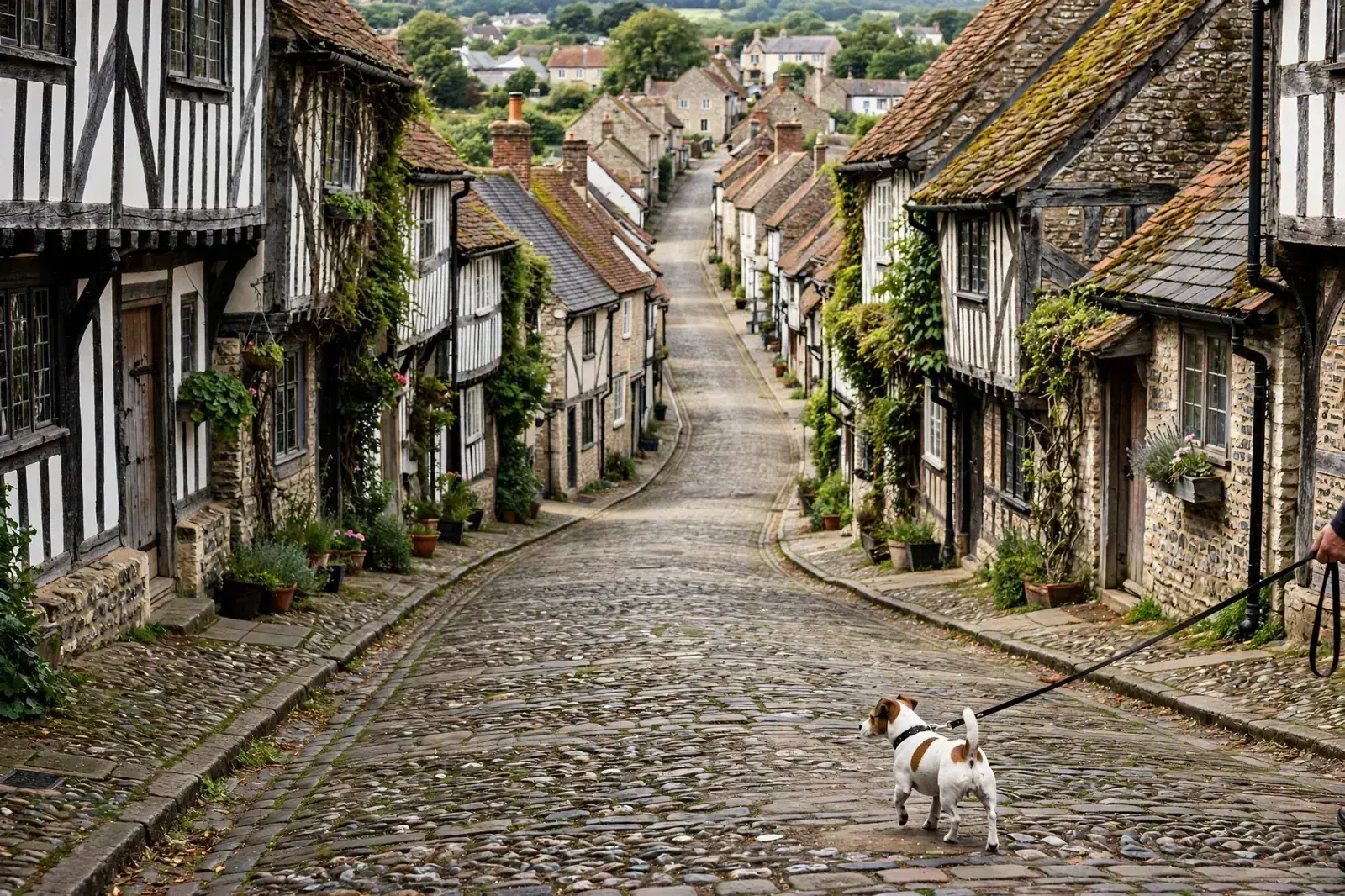
Mermaid Street is the postcard: a steep cobbled lane climbing between timber-framed and brick houses, with the historic Mermaid Inn partway up and cottage names that invite slow reading. It deserves its fame, but with a dog it needs a plan rather than a charge. The cobbles are rounded and uneven, the gradient is real, and there is no separate pavement — walkers, dogs and the occasional slow vehicle share the same stones. Keep your dog on a short, fixed lead on your uphill side, away from doorsteps and open gates, and be ready to step into a doorway to let groups pass. In wet weather the stones can be genuinely slick, so grippy footwear for you matters as much as steady paws for your dog.
Beyond Mermaid Street, the old town repays a loop rather than a checklist. Church Square, around St Mary’s Church, offers the widest views and a chance to orient yourself: marsh, river and sea in several directions, which explains why this small hill mattered for centuries. Watch Lane, West Street and the lanes near the Ypres Tower and Rye Castle Museum each have a different feel — quieter residential corners, small independent shops, and glimpses down to the harbour. Museum and attraction entry rules for dogs vary and change; some historic sites allow dogs only in grounds or not at all, so check the official website for the specific attraction on the day rather than assuming a dog can follow you inside. Many visitors with dogs enjoy the exteriors, the churchyard paths where dogs are permitted on a lead, and the simple pleasure of the streets themselves, and treat any indoor visit as a bonus that one person does while the other walks the dog.
Think carefully about which dogs will enjoy the old town at all. Confident, town-happy dogs usually love the smells, the attention and the frequent stops. Dogs that lunge at close passers-by, guard doorways or panic at sudden noises will find the narrow lanes stressful at busy times, however pretty they are. For those dogs, do the early loop, enjoy the views from the edges of the centre, and spend the bulk of the day at the harbour reserve instead. Puppies need extra care on cobbles: short bursts, no dragging up the steepest section, and plenty of pauses, because joints and confidence both develop better without a forced hill climb. Older dogs are covered in the questions below, but the short version is simple — choose gentler side streets, go slowly, and let the dog set the pace downhill especially, where cobbles test human knees and canine shoulders alike.
Shopping with a dog in Rye is a one-in, one-out affair in most cases. Independent shops are small, aisles are narrow, and even dog-welcoming businesses may prefer one dog at a time. Tie-up points outside are not a safe substitute: never leave a dog unattended outside a shop in a busy tourist town. If there are two adults, swap dog duty and give the waiting dog a calm spot in shade with water, away from the shop doorway. If you are alone, plan purchases for dog-welcoming shops only, or return without the dog another time. It is a small discipline that keeps the day relaxed and the dog safe.
Rye Harbour Nature Reserve: the big walk
If the old town is Rye’s face, Rye Harbour Nature Reserve is its lungs. South of the town, where the River Rother meets the sea, the reserve spreads across shingle, saltmarsh, lagoons and grazing marsh in a flat, open landscape that feels wonderfully empty after the lanes. For most dogs this is the best walk of the day: surfaced tracks suitable for steady mileage, big skies, sea air, and far fewer close encounters than in town — although you will meet other dog walkers, cyclists, birdwatchers and families, so normal courtesy applies throughout.
The non-negotiable condition is wildlife. The reserve is internationally important for birds, including ground-nesting species on the shingle and wintering wildfowl on the pools. Dogs must be kept under close control and, in signed sensitive areas and around the lagoons, on a lead and on the paths. Breeding-season fencing and temporary restrictions appear for good reason; a dog chasing birds can destroy a nest in seconds and cause real harm, quite apart from any penalty. Treat every sign as the current rule, keep off the vegetated shingle, and put the lead on early rather than after your dog has spotted something interesting. The Discovery Centre and reserve team publish updates and guidance — check their notices before you travel and again on arrival, as conditions change with the season and the tides.
Route choice is flexible. A short out-and-back on the main surfaced track from the harbour car park area suits older dogs and gives a taste of the landscape in under an hour. A longer loop taking in the sea defence, the river path and the hides can fill half a day with stops, but there is little shade and no shortcut once you are committed, so carry water for both of you and check the weather honestly: this is an exposed coast where wind can be as tiring as sun. Hides may have their own dog rules — many allow a quiet dog on a lead, some do not — so read the door sign and never force it. In winter, waterproofs and a dog coat for thin-coated breeds turn a bracing walk into a pleasure; in summer, do this walk early or late and keep the midday hours for shade in town or Winchelsea.
Getting between town and reserve is part of the plan. It is a straightforward drive or a longer walk along the river, and cycling is popular, but do not improvise a cross-marsh shortcut with a dog: stick to recognised paths, because tides, ditches and livestock make wandering genuinely risky here. If you are combining the reserve with Camber Sands on the same day, sequence matters — reserve first while you and the dog are fresh, beach later for a paddle and a run in the permitted area, works far better than the other way round, when a tired, sandy, salty dog must then behave impeccably around nesting birds.
Camber Sands, honestly: what the rules really mean
Camber Sands, a few miles east of Rye, is one of the great sandy beaches of the south coast — a rare, wide stretch of sand and dunes in a region of pebbles. It is also the part of a dog friendly Rye trip where honesty matters most, because the internet is full of confident, out-of-date claims. The truth is seasonal and zonal. During the main summer period, dogs are excluded from or restricted in the central, busiest sections of the beach, while signed areas at either end usually remain available for dogs. Outside the restriction season, access is generally much wider. The exact dates, zones and lead requirements are set locally and can change, so the signs at the car parks and access points on the day are the authority — read them before you unclip anything, and check the council information before you travel for the current season’s arrangement.
Our wider guide to dog-friendly beaches in the UK and their rules explains how these seasonal bans work nationally, and Camber is a textbook example of why they exist: at low tide on an August Saturday the central beach is dense with families, kites, games and picnics, and even a friendly off-lead dog will spoil someone’s afternoon and may be at risk itself. In the permitted zones, keep your dog close near the access paths, recall before it joins other groups, and be scrupulous about waste — bins can be a long walk from the far sand at low tide, so carry bags out with you. Dunes are a protected, fragile habitat and often subject to their own restrictions; keep to paths through them and never let a dog dig or chase wildlife there.
Tides shape a Camber visit as much as rules do. The sea retreats a long way, leaving a vast flat playground, then returns across that flat sand faster than many people expect. Check tide times before you go, know when the turn is, and keep an eye on channels filling behind you. Dogs that swim need extra thought: there are no lifeguarded dog areas, currents and cold water are real risks, and a dog exhausted by swimming in a choppy sea is in danger quickly. Most dogs are happiest paddling at the edge and racing on the firm sand — save serious swimming for calm conditions and a dog you know well, with a rinse and fresh water afterwards, because drinking seawater makes dogs ill. In high summer, also plan for heat, crowds in the car parks, and queues to leave; an early-morning or evening beach session, outside the restriction zones and the worst heat, is the version locals would choose.
If Camber sounds like more faff than fun on your dates, that is a perfectly good conclusion. Rye Harbour’s shingle shore and Winchelsea Beach nearby offer quieter coastal walking, albeit without the soft sand, and a dog that simply wants sea air, smells and a long lead walk will be just as happy. Choose the beach that fits the season and your dog, not the one with the loudest reputation.
Winchelsea: the quiet neighbour worth the detour
Two miles south-west of Rye, Winchelsea is the second of the area’s ancient hilltop towns and the perfect counterpoint to its busier neighbour. Planned on a grid in the thirteenth century, it has wide, quiet streets, a large central church with peaceful grounds, cellars hidden under apparently ordinary houses, and a general air of having nowhere to hurry to. For a dog that found Rye’s lanes stimulating, Winchelsea is decompression: fewer groups, wider pavements, grass verges for sniffs, and benches where a settle actually stays settled.
Build Winchelsea into the day in one of two ways. As a standalone afternoon, drive or take the bus over, wander the grid slowly, enjoy the views south to the sea and north back towards Rye, and drop down — by car or on foot on recognised paths — to Winchelsea Beach for a shingle walk along the sea wall. The beach here is quiet, exposed and much loved by local dog walkers; as always, check for any local signs, keep dogs clear of wildlife and livestock, and watch the tide and weather. Alternatively, walkers with fit dogs can link Rye and Winchelsea on footpaths across the marsh as part of a longer day, but map it properly in advance, allow generous time, and remember grazing animals, dykes and the absence of shade or water en route. This is not a route to improvise from a phone screenshot with a tired dog at dusk.
Refreshments in Winchelsea are smaller-scale than in Rye — a pub, small shops and seasonal options rather than a full high street — which is part of the charm but means you should not arrive hungry and assume. Check opening days and dog policies before you travel, carry your own water and snacks as backup, and treat anything open and welcoming as a bonus. Visitors comparing this coast with other Sussex stops may also enjoy our guide to Brighton with a dog, which shows the opposite end of the spectrum: a big, buzzing seaside city where planning around crowds matters even more.
Pubs, cafes and tea stops in Rye
Rye is well supplied with historic pubs, independent cafes and tea rooms, and dogs feature in many of them — but “dog friendly” in Rye, as everywhere, needs translating into specifics. In general terms, traditional pubs are the most reliable bet: bar areas, gardens and terraces commonly welcome dogs on a lead, often with water bowls and sometimes treats at the bar, while separate dining rooms may be dog-free. Cafes vary more: small interiors mean some welcome dogs only at outside tables, and a venue that happily hosted dogs last year may have changed hands or policy. The safe routine is always the same — ask at the door, accept the answer gracefully, keep the lead short and the dog tucked under your table or chair, and never let a dog beg at neighbouring tables, however many admirers it attracts.
Timing improves your odds everywhere. A pub lunch at noon on a wet Saturday compresses every dog owner in Rye into the same bar; the same lunch at half past eleven or two o’clock is spacious and calm. In summer, gardens are the obvious choice, but check for shade and a water source rather than assuming, and bring your own bowl so your dog is not waiting for staff to find one. In winter, the appeal of a fire-warmed bar is real, but so is the crush around it; choose a corner table where a wet dog can dry without steaming an entire room of strangers. Wherever you stop, a pre-stop toilet walk and a chew or lick mat for younger dogs buys everyone a peaceful drink.
For supplies and emergencies, Rye has the usual small-town provision — pet supplies are limited compared with a big town, so bring food, medication, bags and a spare lead with you rather than planning to buy locally. Note the location of the nearest veterinary practice before you need it, including its out-of-hours arrangement, and save the number in your phone. If you are exploring the wider region, our Kent dog-friendly guide covers the neighbouring county’s castles and coast, and makes a natural next day from a Rye base — the border is only a short drive east.
Staying over with a dog
Staying overnight transforms a Rye trip: you own the early mornings and evenings that day visitors miss, and the dog gets two quiet old-town walks for every busy midday. In general terms, the town and surrounding marsh villages offer dog-welcoming inns with rooms, small hotels, bed and breakfasts, self-catering cottages and nearby holiday parks and farm stays. Each type suits a different dog. Inns are sociable and easy for meals, but corridors and thin doors test light sleepers and barkers. Cottages give space, a kitchen for dog-food logistics and often a garden — check whether that garden is genuinely enclosed, because “garden” in a marsh village can mean an open yard beside a lane with livestock beyond. Bed and breakfasts are personal and often very dog-aware, but usually ask that dogs stay off beds and out of breakfast rooms, which needs an honest think about your dog’s habits.
Questions to ask before booking are the ones that decide the stay: how many dogs, what size, and at what fee per dog per night; which rooms are dog rooms and are they ground floor; can the dog join you for breakfast or dinner, and where exactly; is there a practical, lit toilet walk within two minutes of the door; and what is the rule on leaving a dog alone in the room — assume it is not allowed unless the host says otherwise in writing. Mention a reactive, elderly or very large dog at booking, not at check-in. Hosts in small towns talk to each other, and the owner who was warned and prepared will usually go out of their way for you.
Location deserves one special warning. Staying in the heart of the old town is romantic, but parking is limited, lanes are steep, and unloading a car with a dog on cobbles at dusk is nobody’s favourite task. Staying just below the hill or in Rye Harbour, Winchelsea or Camber trades a little atmosphere for level access, easier parking and a first walk straight from the door. For many dogs — especially older ones — that trade is the making of the trip. Wherever you base yourselves, our guide to Canterbury with a dog pairs well as the inland, cathedral-city contrast on a longer East Sussex and Kent tour.
A realistic one-day plan
Before nine: Arrive, park, and give the dog a proper toilet and sniff walk away from the tightest lanes. Walk the old-town loop slowly — Mermaid Street while it is quiet, Church Square for the views, a gentle descent through the side streets — and take your photographs now. Finish with coffee at an outside table if a cafe is open and welcoming, practising a calm settle while the town wakes up.
Late morning: Leave the hill before it peaks. Drive or walk to Rye Harbour Nature Reserve and walk the surfaced tracks at your dog’s pace, leads on in signed areas, with water breaks and time to simply stand in the big landscape. This is the main exercise of the day, so size it honestly: a fit dog might manage two hours with stops; an older dog may prefer forty minutes and a long sit by the river. Do not stack a second big walk immediately on top.
Lunchtime: Return to Rye or stop in the harbour area for a pub lunch, choosing bar, garden or terrace seating and arriving before or after the noon rush. Toilet walk first, dog under the table, and a genuine rest — for many dogs, an hour asleep under a pub table is what makes the afternoon possible.
Afternoon: Choose one, not both. Either head to Camber Sands, having checked the tide and the current dog zones, for sand, paddling and a run in the permitted area; or drive to Winchelsea for quiet streets, the church, views and a shingle walk at Winchelsea Beach. Trying to do Camber and Winchelsea properly in one afternoon, after a reserve walk in the morning, produces a tired dog and two rushed places.
Evening: If you are staying, repeat the old-town loop in the golden hour, when the day visitors have gone and the cobbles glow — many people find this the best walk of all. If you are heading home, leave before your dog is overtired, plan a final toilet stop, and expect summer traffic leaving Camber and Rye to be slow. A day that ends with a dog asleep in the car, rather than wired and overdone, is the day you planned correctly.
Parking, trains, tides and kit
Parking. Rye’s central car parks are modest in size and fill early on fine weekends and throughout the summer; arriving before ten makes a material difference, and having a backup car park in mind — including options below the hill and at Rye Harbour and Camber — saves a stressful circuit of full lanes with a hot dog in the car. Check payment methods, maximum stays and any height or size restrictions before you travel, and never leave a dog alone in a parked car in warm weather, even briefly. Camber’s car parks can queue at peak times; build that into a beach plan rather than discovering it with a desperate dog.
Trains. Rye station sits below the old town with services connecting along the coast and towards Ashford and London connections; it makes a car-free day feasible, with the reserve and Winchelsea reachable on foot or by local bus or taxi if you plan carefully. Dogs travel on trains under the usual national conditions — on a lead, off the seats, and considerate of other passengers — but check the operator’s latest rules and the timetable for your date, including engineering works, which affect this line on some weekends. The station-to-old-town walk is short but uphill, so factor the cobbles in at the end of a long day as well as the start.
Tides and weather. Two tide checks matter: Camber, where the returning tide crosses flat sand quickly, and the harbour and marsh paths, where high water and flooded sections can alter routes. Use an official tide table for the specific date, and treat onshore wind, heat and sudden coastal weather changes with respect — this coast can shift from picnic to waterproofs in an hour in any season. In hot weather, apply the standard rules with extra force on sand and shingle, which reflect heat: walk early and late, carry water, watch for hot surfaces under paws, and cut the plan rather than completing it.
Kit that earns its space. A short fixed lead for the lanes plus a longer lead for permitted open areas; plenty of poo bags and a bag to carry waste out of the reserve and off the beach; water and a portable bowl; a towel and, in winter, a drying coat for the car; treats or a chew for cafe settles; and a spare lead in the car. Add paw checks to your routine after shingle and cobbles, and rinse salt and sand off coats and feet after Camber. None of this is glamorous, and all of it is the difference between a dog-friendly trip in theory and one that actually works in Rye.
Practical questions
Before you go
Are dogs allowed on Camber Sands all year round?
No, not on every part of the beach all year. Camber Sands operates seasonal restrictions in the central, busiest zones during the main summer period, while other signed sections usually remain open to dogs on a lead or under close control. Signs at each access point show the current zones, and rules can change, so check the signs on arrival and the council website before you travel rather than relying on an old blog post.
Is Rye Harbour Nature Reserve dog friendly?
Yes, dogs are welcome on most paths at Rye Harbour Nature Reserve, but they must stay on a lead or on the paths in sensitive areas to protect ground-nesting birds and other wildlife. Some areas may be fenced or signed as no entry during the breeding season. Keep to surfaced tracks, take litter and waste home or to a bin, and check the reserve notices on arrival for any temporary restrictions.
Can dogs go inside pubs and cafes in Rye?
Many pubs and cafes in Rye welcome well-behaved dogs in the bar, garden or terrace, and some allow them in part of the indoor seating area, but policies vary by venue and can change with season or ownership. Dogs are rarely allowed in formal restaurant rooms. Always ask at the door before settling, keep your dog on a short lead under your table, and check the venue website for the latest rule before you travel.
Is Mermaid Street suitable for older dogs?
Mermaid Street is beautiful but steep and cobbled, with uneven stones that can be slippery when wet and hard work for arthritic dogs, tiny paws or dogs that pull. Older dogs often do better approaching the old town on gentler side streets, taking the hill slowly with regular pauses, and avoiding the steepest section in rain or frost. Choose a short flat lead, supportive footwear for yourself, and turn back if your dog looks unsure.
When is the best time to visit Rye with a dog?
Early mornings, weekdays outside school holidays and the shoulder seasons of spring and early autumn usually give the best balance of open businesses, quieter cobbled streets and easier beach access. Summer weekends bring the most crowds and the tightest beach restrictions at Camber. Whatever the season, start the old town early, plan the longest walk for the coolest part of the day, and check tide times, weather and venue opening hours before you set off.