This guide is independent and contains no paid placement. If affiliate links are added later, they will be clearly marked and will not change our editorial checks.
Shaftesbury sits on a greensand plateau some 200 metres above the Blackmore Vale, so the whole visit is shaped by one short, very steep lane: Gold Hill drops away from St Peter's Church at roughly one in four, and its cobbles punish stiff joints and small paws. Do the hill once, slowly, downhill, then climb back by Stoney Path or the St James lanes instead. The flat reward is Park Walk's terrace above the vale, and the long reward is the chalk grass of Fontmell Down, a ten-minute drive south on the A350 from the Spread Eagle Hill car park.
Gold Hill: the climb, done properly
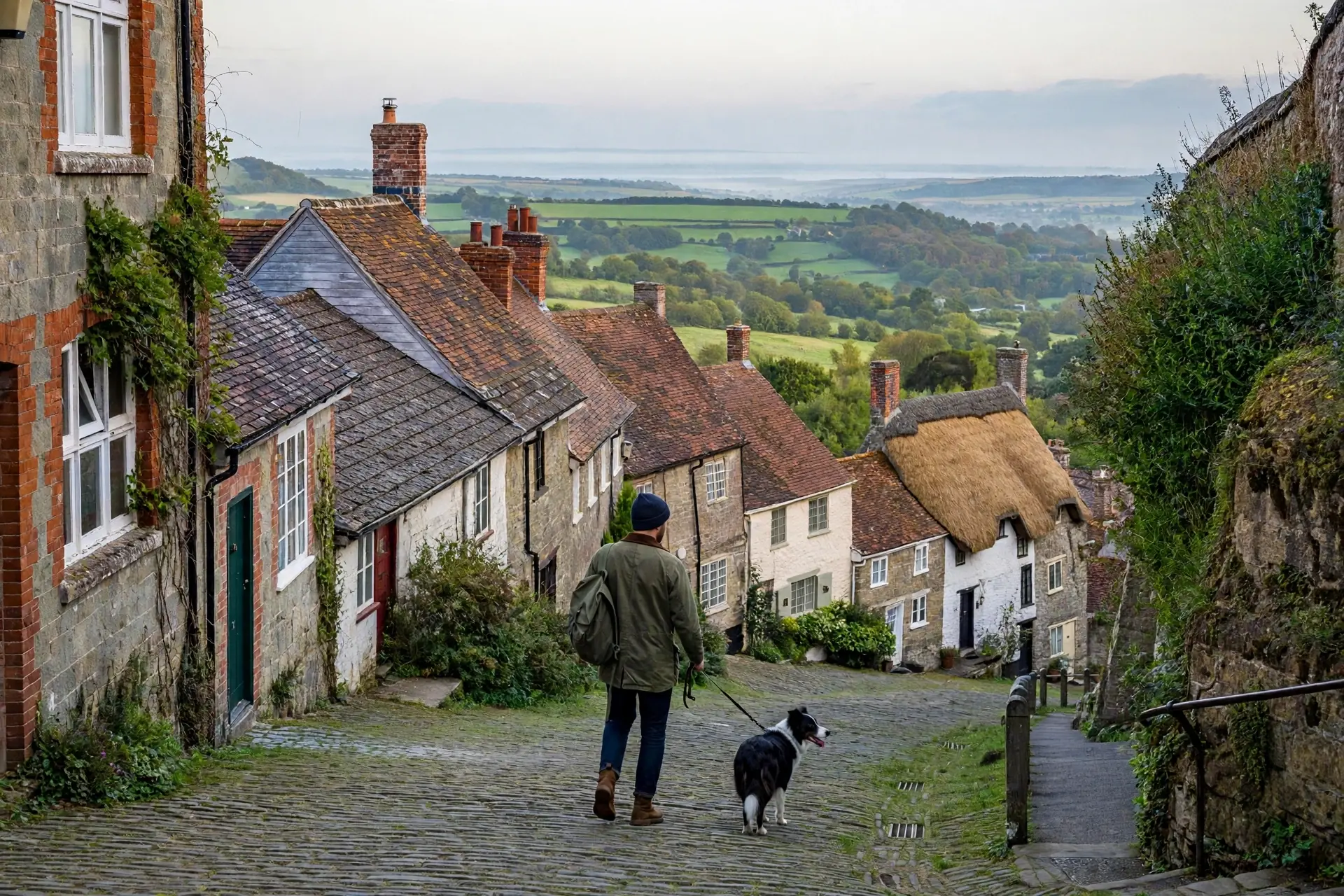
Gold Hill runs down from the top of Shaftesbury beside the buttressed precinct wall of the abbey, past stone cottages, to a view across the Blackmore Vale that opens up at the bottom of the lane. Ridley Scott filmed the 1973 Hovis "Boy on the Bike" advertisement here, and the street has been photographed ever since — which is exactly why it is awkward with a dog. The lane is narrow, the best viewpoint is in the middle of it, and on a bright weekend the people standing there with cameras leave no room for a dog on a lead to pass without being stepped on or stepped over.
The gradient is the practical problem, not the fame. The cobbled section runs at roughly one in four, and the stones are rounded, uneven and slick after rain. A fit adult dog can manage the descent if you keep the lead short, keep the dog against the abbey wall rather than the cottage side, and stop twice to let the dog's legs recover. A puppy, a dachshund-length dog, an arthritic spaniel or any dog that already hesitates on stairs should not be taken down at all: admire the lane from the top, beside St Peter's Church and the giant Hovis loaf, and let the photograph be the souvenir. Going up is worse than going down, because a dog that pulls on a one-in-four cobbled slope can lose its footing and slide backwards into the walker behind it.
Come before the coaches do. At eight in the morning Gold Hill belongs to the residents and a handful of early walkers; by eleven on a summer Saturday it is a queue of tripods. The Gold Hill Museum, in the old Priest's House beside St Peter's Church at the top, is the natural place to pause while the lane clears, though dogs stay outside it. If you do descend, do not climb back up the cobbles: turn left at the foot of the hill along St James, then take Stoney Path or the lanes through Tanyard Lane and Laundry Lane, which bring you back to Park Walk on tarmac and grass instead of stone. That loop takes about half an hour, gives you the famous view from below, and spares the dog a second battering.
Wet weather changes the decision entirely. Rain turns the Gold Hill cobbles into something closer to ice than stone, and frost does the same in winter, so on a wet or icy day skip the descent and spend the morning on Park Walk instead. The cottages along the hill are private homes, and the residents live with the crowds every day, so keep the dog off doorsteps and garden walls, carry bags, and do not let a dog stop and sniff in the middle of the lane while a line of photographers waits behind you. The hill will still be there on a dry day, when the stones grip and the vale is clear.
The abbey ruins and the town trail
King Alfred founded Shaftesbury Abbey in 888 as a Benedictine nunnery, and by the time Henry VIII dissolved it in 1539 it was the wealthiest religious house in England, holding the relics of Edward the Martyr and drawing pilgrims up the hill for six centuries. Almost nothing stands now: the site on Park Walk is low foundation walls, a walled herb garden and a small museum, entered through iron gates halfway along Park Walk, between the Oxfam bookshop and the Costa on the High Street. That modesty is what makes it work with a dog — there is no echoing nave to disturb, just grass paths, benches and the smell of the herb beds.
Dogs on a lead are welcome in the abbey garden, while only assistance dogs may enter the museum gallery itself, so plan the visit as a garden stop rather than an indoor one. One person can look at the Saxon stonework and the lead casket said to hold Edward the Martyr's bones while the other waits with the dog among the medieval herbs, then swap. The museum opens for the season around Easter and closes over winter, and admission was free for the 2026 season, so check the abbey's own opening dates before building a day around it — a February visit will find the gates shut and the garden out of reach.
From the abbey, the Shaftesbury Heritage Trail links twelve blue-plaqued sites in a short loop that never strays far from the High Street: the Town Hall on The Commons, the market cross, the old inns and the merchants' houses. The trail is mostly level once you are on the plateau, which is a relief after Gold Hill, but the pavements narrow sharply around the abbey and the Town Hall, so a long lead becomes a trip hazard for other walkers. Shorten it there, step into a doorway when a group passes, and let the dog sniff the walls rather than the shop thresholds.
Finish the trail at Castle Hill, the grassy earthwork at the town's northern edge, where a medieval fortified house once stood during the wars between King Stephen and Empress Matilda. Few visitors find it, which is the point: the benches look north across the Stour valley towards King Alfred's Tower on the Stourhead estate, and on a clear day Glastonbury Tor shows on the horizon. From Castle Hill, Pine Walk drops through beech and pine towards Love Lane and back to Park Walk, and the old yew trees of Bury Litton churchyard sit just off the path — a quieter, shadier circuit than the High Street, and the one to choose when the town centre is crowded.
Park Walk: the view over the vale
Park Walk is a Georgian promenade laid out in the 1760s along the western edge of the plateau, a level grass terrace with benches, a bandstand and the war memorial, looking south over the Blackmore Vale to Melbury Hill. It is the flattest useful ground in Shaftesbury, and that matters: after Gold Hill's one-in-four cobbles, a dog with tired legs can walk the whole terrace without a single step up or down. The view is the one the town is built for — the vale spread out below, the chalk ridge of Melbury Hill opposite, and on the clearest days Glastonbury Tor to the north-west.
February belongs to the snowdrops. The Millennium Snowdrop Collection is centred on Park Walk, and the terrace and the slopes below it are planted thickly enough that a short February walk here is worth the trip on its own — though the same slopes that hold the bulbs are steep and slippery when wet, so keep the dog on the terrace itself and off the planted banks. In summer the terrace fills with picnics, and a dog with a taste for other people's sandwiches needs to be settled on a mat with a chew rather than wandering between blankets. There is no shade on the terrace itself, so on a hot day the benches under the beech trees at the Pine Walk end are the only cool seats.
The terrace is also the top of the Stoney Path, the zigzag tarmac path that drops from Park Walk down to St James at the foot of the hill. It is steep, it has a handrail, and it is the gentlest way down from the plateau that is not a road — use it for the descent if Gold Hill's cobbles are too much, and climb back by it rather than by the cobbles. From the bottom, Tanyard Lane and Laundry Lane wind back through the oldest cottages in the town, past the church of St James, and the whole loop returns you to Park Walk in under half an hour without ever touching Gold Hill.
Evening is when Park Walk earns its reputation. The light drops over the vale, the day visitors leave, and the terrace empties to a few locals and their dogs. Bring a mat so the dog can lie on grass rather than the path, bring water — there is nothing to drink from up here — and stay for the sunset rather than rushing back to the car. On a windy winter day the same terrace is exposed and bitter, and a short-coated dog will feel it within minutes, so in January treat Park Walk as a five-minute viewpoint and do the real walk in the shelter of Duncliffe Wood instead.
Cranborne Chase: open downland walks
Cranborne Chase begins just east of Shaftesbury and runs for 379 square miles of chalk plateau, the sixth largest National Landscape in the country. The nearest piece of it is the ridge south of the town: Fontmell Down and Melbury Down, a 63-hectare nature reserve of ancient chalk grassland that the National Trust and Dorset Wildlife Trust look after between them. Start at the National Trust car park at the top of Spread Eagle Hill, on the A350 south of Shaftesbury at Compton Abbas, grid reference ST886187 — a small, level car park that puts you straight onto the down, with no lane-walking needed first.
The reserve is the reason to come in late spring. The south-facing slope holds nine species of orchid, the rare early gentian flowers in May, and 35 butterfly species work the short turf through the summer, while skylarks sing over the open grass from April into July. That wildlife sets the dog rules more precisely than any signpost: the skylarks nest on the ground, so from April to July keep the dog to the marked paths and out of the long grass; the orchids grow in the short turf the grazing animals keep down, so keep the dog off the flowered banks entirely. The National Trust asks for dogs under close control here, and on this open ground that means a lead whenever another walker, a grazing animal or a patch of long grass is in sight.
The grazing is the part to plan for. Fontmell Down is kept open by local organic grazing animals, and the mix changes through the year: sheep on the short turf, and cattle on the longer grass at Jerry's Hole, the third part of the reserve across the road, which is grazed later in the season. A dog that has never met cattle should not meet them first on an open down with no fence between them, so walk the marked 3-kilometre circular trail from the Spread Eagle Hill car park first, scan each field from its gate before entering, and turn back rather than threading between grazing animals with a dog that pulls. The cross dyke — a Bronze Age bank and ditch across the down — makes a natural landmark to aim for and a natural place to stop and check what is grazing ahead.
Melbury Beacon is the longer walk from the same car park: a 2.3-mile National Trust trail that climbs to the Iron Age hilltop at 263 metres, with a 360-degree view over the Blackmore Vale, the Vale of Wardour and Shaftesbury itself. The ground is chalk, so it drains well and stays walkable after rain, but the slopes are steep and the paths turn muddy and slippery in winter, and there is no fresh water anywhere on the down — carry a bottle and a bowl, and offer water before the dog starts panting rather than after. Brandis Down, across the B3081 with its own small quarry car park, is the quieter half of the reserve if the main car park is full, and Compton Abbas airfield, just across the road, is the landmark to navigate back by when the paths all start to look alike.
The High Street and the back streets
Shaftesbury's High Street runs along the plateau from The Commons, past the Town Hall, to the top of Gold Hill, and it is the town's whole shopping street in about five minutes of level walking. The pavements are wide enough for a dog to walk beside you rather than behind you, which is more than can be said for the lanes off it, and the shopfronts are independent — bookshops, galleries, a butcher, the Oxfam bookshop whose doorway marks the abbey entrance on Park Walk. Most shops will let a calm dog in if you ask at the door; none of them owes you entry, and a dog that barks at its own reflection in a gallery window should wait outside with one of you.
Thursday is the market day that matters. The charter market sets up on the High Street from 7:30 in the morning until four in the afternoon, with stalls for fresh meat, seasonal vegetables, plants and home-produced goods, and it is the one day the town centre feels busy before lunch. A dog does best here early, before the stalls are three deep, on a short lead, kept clear of the meat and vegetable stalls where food drops on the pavement. Saturday has no charter market of its own — check the town council's market page before planning a Saturday around stalls that may not be there — but the High Street shops, including the Harvest Hill produce shop at 44–46 High Street, are open and far quieter.
The back streets are where Shaftesbury stops performing. Behind the High Street, the lanes around the abbey and the market cross hold the town's oldest cottages, and the streets dropping towards St James and Enmore Green are steep, narrow and mostly free of traffic. The pavements shrink to a single dog's width in places, so this is short-lead territory, and the stone walls are low enough that a dog can see into gardens — keep them moving past the front doors. In February the snowdrops spill from Park Walk down the banks here, and in autumn the beech over Pine Walk turns the whole lane gold.
For food to take back to where you are staying, the Thursday market and the High Street shops cover a self-catered evening without a car: the market's meat and vegetable stalls, the produce shop at 44–46 High Street, and the delicatessens along the High Street. That matters most for a dog that will not settle in a pub — a takeaway eaten in your own space, with the dog on its own bed after a walk on Fontmell Down, is a better evening than an hour of a stressed dog under a pub table. Buy early on Thursday, because the market packs up at four and the best stalls sell out well before then.
Pubs and cafes with your dog
The Mitre, at 23 High Street, is the pub to aim for first. It is a traditional country pub with a tiered garden terrace that looks straight across to Melbury Hill, it allows dogs, and it has its own pub dog, Ginger, who greets four-legged visitors — which tells you more about the attitude inside than any policy page. The terrace is the place to sit: tiered, sunny, with room to tuck a dog under a table out of the foot traffic, and the Sunday roasts and the Mitre beef burger are the dishes the regulars order. Go early on a summer weekend, because the terrace fills and a dog that has to wait in a queue of standing drinkers is a dog that will start barking.
The Salt Cellar sits underneath the Town Hall at the top of Gold Hill, and it is the natural coffee stop at the end of the climb — or at the start, before you decide whether the cobbles are worth it. It is a cafe, not a pub, so the dog arrangement is a table outside with a view down the hill and across the vale, and the sensible move is to order a takeaway coffee, sit on the wall above Gold Hill with the dog settled beside you, and watch the photographers work. The other High Street cafes, including King Alfred's Kitchen, Turnbull's and Gusto, all serve cakes and sandwiches, but their indoor dog rules change with the season and the manager, so ask at the door rather than assuming a welcome that was there last summer.
The village pubs are worth the short drive when the town centre is crowded. Fontmell Magna, Melbury Abbas and Cann each sit within ten minutes of Shaftesbury, and their pubs have the bigger gardens and quieter rooms that suit a dog that has just come off the down. The Kings Arms at East Stour, a few miles west past Duncliffe Wood, is the classic end to a woodland walk — drive there, not walk, because the lanes between Stour Row and East Stour have no pavement at all. Wherever you go, book ahead on a summer weekend, say the dog is coming when you book, and choose the garden table over the bar: a dog that can lie in the sun at Fontmell Magna will settle, and a dog wedged between two bar stools on the High Street will not.
A reactive dog needs a different plan in Shaftesbury, because the town centre funnels every visitor through the same few streets. Skip the High Street at lunchtime on a Thursday market day and a summer Saturday entirely; instead, walk the dog first on the quiet side of Castle Hill or along Pine Walk, then eat late, after two o'clock, when the Mitre's terrace has emptied and the market stalls are packing up. A dog that barks at other dogs will meet a dozen of them between Bell Street car park and Gold Hill at midday, and no pub garden is worth that walk. Takeaway coffee from the Salt Cellar and a bench on Park Walk is a better lunch than a confrontation in a crowded bar.
Where to stay with a dog
The first decision is height, not price. A room on the plateau — on the High Street, The Commons or Bell Street — puts Gold Hill, Park Walk and the Thursday market within a flat five-minute walk, and the first and last toilet trips of the day are on level pavement. A cottage down in St James or Enmore Green, at the foot of the hill, is prettier and quieter, but every trip back means climbing the hill the dog has already climbed twice, and a stiff dog will feel that climb at ten o'clock at night. The Grosvenor Arms, on The Commons at the top of the High Street, is the obvious hilltop hotel to check first — confirm its current dog policy directly before booking, because hotel pet rules here change with the season.
The villages south of the town suit a different kind of stay. A cottage in Fontmell Magna, Melbury Abbas or Cann puts the dog on the edge of the Chase, with lanes and the Fontmell Down car park minutes away, but it also means a car for everything, including the Thursday market and the vet. A farm stay a few miles out, towards Motcombe or the Stour valley, is usually the calmest option of all: quiet lanes, space to walk from the door, and no hill to climb at bedtime. The trade-off is the drive back into Shaftesbury for every meal, so weigh a quiet night against a steep one honestly.
Ask about the garden before you ask about the price. On the plateau, a "garden" behind a High Street guest house is often a small paved yard with a low wall, and on the slopes below the town it may be a steep bank rather than a flat lawn — neither is a secure toilet area for a dog at midnight. Ask whether the garden is genuinely enclosed, how high the fence is, whether dogs are allowed in all rooms or only selected ones, and whether the dog can be left alone in the room: many places prohibit it, so plan as if the dog goes everywhere with you. Our guide to dog-friendly holiday parks in the UK explains how to compare pet fees and boundaries, and the same questions — fence height, charges per dog, rooms where dogs are allowed — apply to a Shaftesbury hotel or cottage just as they do to a holiday park.
Book early for summer weekends and school holidays, when the dog-friendly rooms on the plateau sell out first, and consider May, June, September and October instead: the town is quieter, the Thursday market is still running, and the pubs have space. In winter, ask about heating and drying space before you book, because a dog that has walked the muddy paths of Fontmell Down comes back filthy, and a cottage with no boot room and no outside tap means a muddy dog in a clean bedroom. The campsite on the A30 at Sherborne Causeway, two miles west of the town, is the budget option, with the same hilltop walks a short drive away and the same Thursday market to stock up at.
Steep streets, parking and arrival
Everything in Shaftesbury is either on the plateau or at the bottom of a hill, and the town's streets make that obvious within minutes. Bell Street car park, at the top of the town by the Town Hall, is the most convenient place to leave a car: a short flat walk to the High Street, Park Walk and Gold Hill. Coppice Street car park is the other hilltop option, and Angel Lane car park sits just off the High Street to the east. All three fill up on sunny weekends and on Thursday market mornings, so arrive before ten or be prepared to circle — and check Dorset Council's car park pages for the current charges and time limits before you travel, because the tariffs change and the machines are pay-and-display.
Parking lower down is a false economy with a stiff dog. Enmore Green and St James have on-street parking at the foot of the hill, but the walk back up to the plateau is the same climb Gold Hill demands, on roads with no pavement in places, and a tired dog at the end of a Fontmell Down walk should not be asked to climb it. If the hilltop car parks are full, wait for a space at Bell Street rather than parking below and climbing: the ten minutes spent waiting is kinder than the twenty minutes spent climbing. Leave water and a spare lead in the car, and give the dog a toilet break on the grass at Park Walk before a long drive home, not in the car park.
Shaftesbury has no railway station of its own. The nearest is Gillingham, just over five miles north in the vale, with direct South Western Railway trains to London Waterloo in just under two hours; Tisbury, seven miles to the east, is the other option. Either way the last leg is a taxi up the hill, so agree the fare and the dog before the train arrives, because there is no rank of waiting taxis at Gillingham on a quiet weekday. The local bus up from Gillingham exists but runs infrequently, and dogs travel at the driver's discretion, so do not build a day around it. A car is the practical choice here, because the best walks — Fontmell Down, Melbury Beacon, Duncliffe Wood — all start from small car parks with no bus service at all.
Driving the lanes needs the same care as walking them. The B3081 south to Fontmell Magna and the A350 to the Spread Eagle Hill car park are fast roads with high hedges, blind bends and few passing places, and the lanes to Melbury Abbas, Cann and Stour Row are single-track in places. Keep the dog secured in the car, never leave a dog in a parked car on a warm day — the hilltop car parks have almost no shade, and a car heats fast in summer — and drive the lanes slowly enough to stop for a horse, a tractor or a dog that has slipped its lead. Harvest brings tractors and grain lorries onto the B3081 in late summer, so expect to reverse to a passing place at least once.
Seasons: when Shaftesbury suits dogs best
February is the surprise season. The Millennium Snowdrop Collection turns Park Walk and the slopes below it white, the town is empty, and a short walk from Bell Street car park to the terrace and back is a proper day out for a dog that hates crowds. The abbey museum is closed in winter, the gates shut, so do not plan a February day around the garden — plan it around the snowdrops, the view, and a late lunch at the Mitre. The slopes are slippery after rain, so keep the dog on the terrace and the tarmac paths, and bring a coat for a short-haired dog: the wind across the plateau in February is colder than the temperature suggests.
Spring is the season the down comes alive, and the season to be most careful. From April to July the skylarks nest on the ground at Fontmell Down, and the lambs are in the fields of the Stour valley below the town, so the marked paths and a lead are not optional extras but the whole point of the walk. The orchids and the early gentian flower in May, the bluebells carpet Duncliffe Wood, and the town is still quiet before the summer visitors arrive. It is the best time to walk the Melbury Beacon trail, because the turf is dry, the butterflies are out, and the Spread Eagle Hill car park is not yet full by ten in the morning.
Summer is the hardest season for a dog in Shaftesbury, and the town does not hide it. Gold Hill's cobbles bake in the sun and burn paws by midday, the terrace at Park Walk has no shade, and the open down at Fontmell Down is exposed for the whole walk, with no water and no trees. Walk before nine or after six, use the beech shade on Pine Walk and the enclosed paths of Duncliffe Wood for the middle of the day, and carry water on every walk, including the short ones in town. The long evenings are the compensation: after dinner, when the coaches have gone and the High Street has emptied, Park Walk at sunset is the best hour in Shaftesbury, and the dog can have the terrace almost to itself.
Autumn is the quiet star. September and October bring low golden light over the vale, the crowds thin, the Thursday market keeps running, and the beech on Pine Walk and in Duncliffe Wood turns colour. The chalk paths stay dry long after the clay lanes of the vale have turned to mud, so Fontmell Down and Melbury Beacon are at their best, and the pubs have space again. Winter, after the abbey closes, is for the hardy: frost on Gold Hill is beautiful from the top and treacherous underfoot, the wind on Park Walk is biting, and the town's pubs are warm and empty. Whatever the month, the rule is the same — let the dog's legs and the weather decide the day, not the checklist.
Practical bits: vets, livestock and leads
Save a vet before you need one. Longmead Veterinary Practice, on Longmead just off the town centre, has served Shaftesbury for over sixty years and offers a 24-hour emergency service; Friars Moor Vets has a Shaftesbury branch at the Wincombe Business Centre, open weekdays. Both are within a few minutes' drive of Bell Street car park, so save the numbers in your phone before the first walk, not after an incident on the down. Out of hours, the nearest emergency cover is further away — check the current arrangements before you travel, and bring more medication than the trip needs, plus the prescription details, in case a replacement has to be arranged from a practice that has never seen your dog.
The livestock around Shaftesbury is specific, and the lead rules follow the animals rather than a general principle. On Fontmell Down and Melbury Down the grazers are sheep on the short turf and cattle on the longer grass at Jerry's Hole, and the cattle are at their most protective when calves are with them — give a group of cattle with calves a wide berth, and never walk a dog between a cow and her calf. In the Stour valley west of the town, around Stour Row and Duncliffe Wood, the fields hold cows with young calves in spring, and the footpaths cross those fields directly: if cattle block the path, turn back and take the lane instead, as the local farmers themselves advise. Under the law, a dog that worries livestock can be shot by the farmer, and the owner can be liable — and on the open down, where a dog can see sheep from half a mile away, recall is not a plan.
The other animals to know about are smaller. Adders bask on the warm chalk banks at Fontmell Down and Melbury Beacon in spring and summer, so keep the dog on the path and out of the bracken and long grass on hot days, and know the signs of a bite — sudden swelling, pain, distress — so you can get to Longmead quickly. Ticks live in the bracken and long grass on the down and in Duncliffe Wood, so check the dog after every walk, carry a tick remover, and check ears, armpits and groin, where ticks hide. After the cobbles of Gold Hill and the chalk flints of the down, check paws too: the stones cut pads, the chalk dries them, and a small cut picked up on Gold Hill will be worse after three miles on Fontmell Down.
Finally, think about the dog in front of you rather than the dog in the guidebook. A fit, confident dog will love the climb to Melbury Beacon and the open ground of the Chase; an older dog will be happier with Park Walk, Castle Hill and the flat loop through St James. A sociable dog will enjoy a Thursday market morning; a reactive dog will be happier on a weekday, on Pine Walk and the back streets, with lunch after two. If the trip stretches to the coast, the rules change again — our guide to dog-friendly beaches in the UK explains seasonal bans, lead orders and how to read the signs, which is worth reading before you drive south to Weymouth or Swanage rather than after you arrive.
Day trips from Shaftesbury
South is the coast. Weymouth is the nearer day out, with its long bay and the harbour, and our guide to Weymouth with a dog covers the beach rules, the Rodwell Trail and the harbour; Swanage with a dog covers the bay, the steam railway and the Purbeck coast a little further east. Both are easy drives from Shaftesbury, but both are beach days with seasonal bans, so read the rules before you set off, and plan the drive so the dog is not left in a hot car while you walk the Esplanade.
West is the woodland day. Duncliffe Wood, three miles west of Shaftesbury, is 93 hectares of ancient woodland managed by the Woodland Trust, with a free car park at its edge and paths that climb Duncliffe Hill to a trig point with views south over the Blackmore Vale. The wood is famous for its bluebells in spring, and the Hardy Way runs through its southern edge towards Stour Row, where the lanes are quiet and the fields hold the cattle described above. Finish at the Kings Arms in East Stour, a short drive on from Stour Row, and you have a woodland walk, a village and a pub lunch without ever touching a main road.
East is the National Trust day. Stourhead is a short drive over the Wiltshire border, and King Alfred's Tower on the estate is the landmark you can already see from Castle Hill on a clear day. The Bonham Wood walk behind the Temple of Apollo is a livestock-free circuit, which makes it the one Stourhead walk to choose if the dog has had enough of cattle on Fontmell Down, and the gardens and lake are a complete change from the open chalk. Salisbury, about half an hour east, is the city alternative: the cathedral close, the river paths and the parks are good with a dog on a lead, but it is a city, not a hilltop town, so arrive early, park on the edge and walk in.
North and nearer home, the Blackmore Vale itself is the quietest day of all. Gillingham, four miles down the hill, has its own market and the lanes around it; Hod Hill, the Iron Age fort above a bend in the River Stour, is a short circular walk from its own car park with ramparts to follow and views over the Dorset countryside. Plan any day trip the way you plan a Shaftesbury day: one main walk, one pub or cafe stop, and a realistic amount of driving. A dog that has been driven from place to place and left in the car between stops will not enjoy the fourth destination, however good it is — choose one, enjoy it properly, and end the day back on Park Walk, where the hill and the vale will still be there tomorrow.
Practical questions
Before you go
Is Gold Hill too steep for my dog?
It depends on the dog. The cobbled section runs at roughly one in four, so a fit adult dog can walk down slowly on a short lead, kept against the abbey wall, but puppies, very small dogs and arthritic dogs should stay at the top by St Peter's Church and skip the descent. Never climb back up the cobbles: return by Stoney Path or the St James lanes instead, and skip the hill entirely when the stones are wet or icy.
Can my dog go into the Shaftesbury Abbey garden?
Yes, dogs on a lead are welcome in the abbey garden on Park Walk, but only assistance dogs may enter the museum gallery itself. Enter through the iron gates halfway along Park Walk, between the Oxfam bookshop and the Costa, keep the dog on the grass paths and out of the herb beds, and check the abbey's opening dates first — the museum opens around Easter and closes over winter.
Where do I park for Fontmell Down and Melbury Beacon?
Use the National Trust car park at the top of Spread Eagle Hill, on the A350 south of Shaftesbury at Compton Abbas, grid reference ST886187. It is small and level, it puts you straight onto the down, and it is the start of both the 3-kilometre Fontmell Down circular trail and the 2.3-mile Melbury Beacon walk. If it is full, the small quarry car park at Brandis Down, across the B3081, is the fallback.
Which view is better with a dog, Park Walk or Castle Hill?
Park Walk is the easier of the two: a flat Georgian terrace with benches, looking south over the Blackmore Vale to Melbury Hill, and it suits a tired or older dog. Castle Hill, at the town's northern edge, is quieter and wilder, with views north to King Alfred's Tower and Glastonbury Tor, and it is reached by Pine Walk through beech and pine. If the dog has energy, do both — they are ten minutes apart on foot.
Can I take my dog to the Thursday market in Shaftesbury?
Yes, the charter market runs on the High Street on Thursdays from 7:30 in the morning until four in the afternoon, and dogs on a short lead are part of the crowd. Go early, before the stalls are three deep, keep the dog clear of the meat and vegetable stalls where food drops on the pavement, and note that Saturday has no charter market — check the town council's market page before planning a Saturday around stalls that may not be there.
What livestock will my dog meet around Shaftesbury?
Sheep graze the short turf of Fontmell Down and Melbury Down, and cattle graze the longer grass at Jerry's Hole, which is grazed later in the season; in the Stour valley around Stour Row, fields hold cows with young calves in spring. Keep the dog on a lead whenever grazing animals are in sight, never walk between a cow and her calf, and turn back rather than threading through a field of cattle — a dog that worries livestock can be shot by the farmer under the law.