Dog Trip Britain writes its own guides and takes no payment for the places named here. Anything marked as a tip to check before you travel is there because opening times, charges and dog rules in Sherborne do change, and the official source is the one to trust on the day.
Start on the abbey green at the top of Cheap Street, let the dog sniff the stone lanes around Abbey Close and Half Moon Street, then choose between two very different afternoons: the gravel path over the bridge into the grassy ruins of Sherborne Old Castle on Castleton Road, or the level paths through Pageant Gardens on Station Road down towards Purlieu Meadow and the River Yeo. Sherborne Castle's 42 acres of Capability Brown gardens take dogs on short leads from April to October, while the house itself stays assistance-dogs only. Thursday and Saturday mornings belong to the Pannier Market around the Conduit on the Parade, so a nervous dog does better on a weekday afternoon, and a reactive one does best of all on the wide grass of the Old Castle grounds or the quiet lanes out to Lillington.
The abbey and the old town on foot
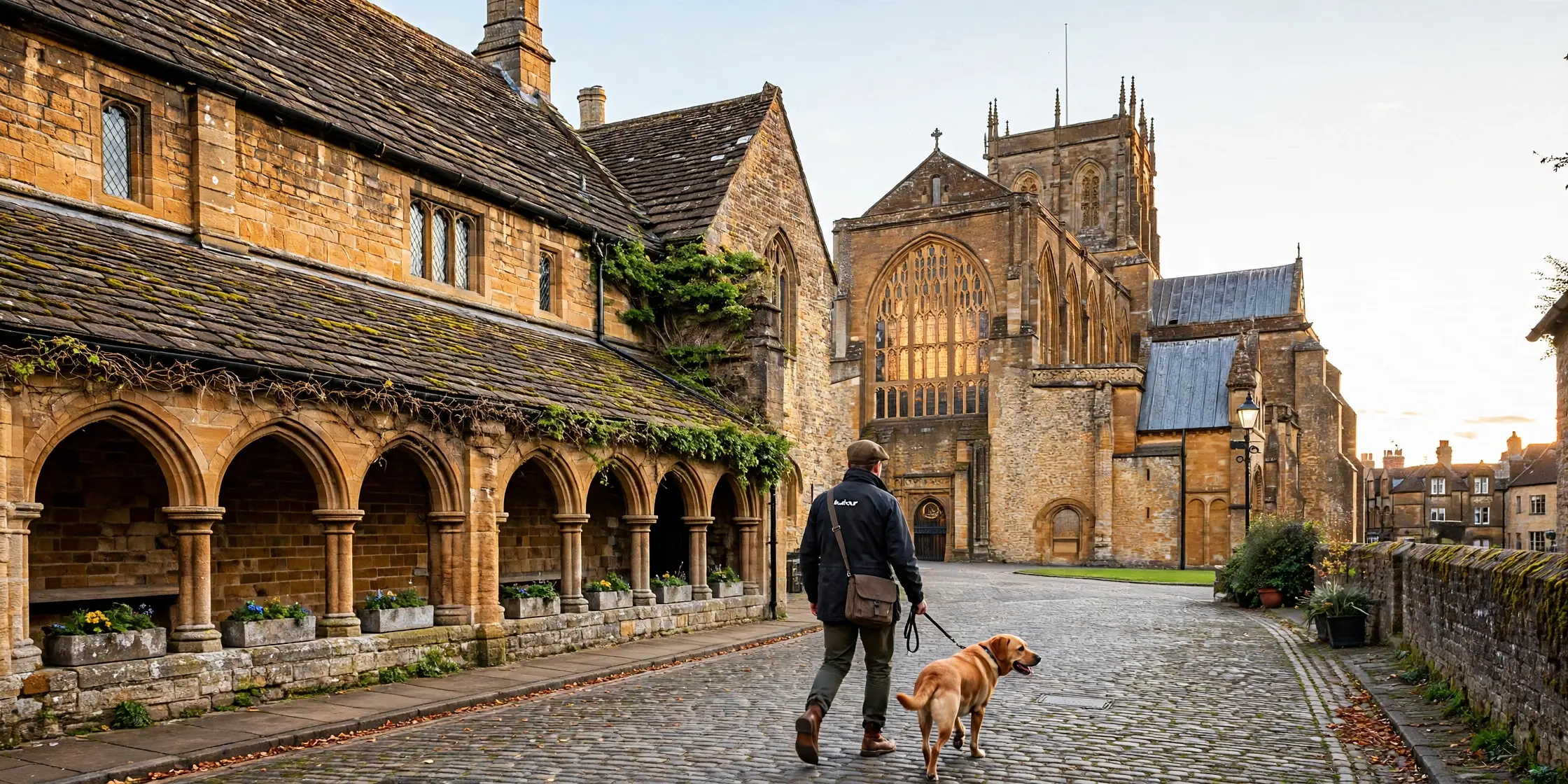
Sherborne Abbey, the Abbey Church of St Mary the Virgin, has stood on this spot since 705, and its fan-vaulted ceiling is the reason the building is sometimes called the Cathedral of Dorset. A dog will never see that ceiling, because only assistance dogs go inside, and that is fine: the abbey repays a visitor who stays outside, circling the green at Abbey Close to take in the west tower, the buttresses and the sheer length of Ham stone walling. Give the dog ten unhurried minutes on the green first. It is the one open lawn in the middle of town where a leaded dog can watch Sherborne wake up — delivery vans turning in Digby Road, choristers crossing to the school buildings, shoppers cutting across from Cheap Street — and a dog that has had that settling sniff will walk the rest of the old town far more calmly than one dragged straight down the main street.
From the abbey green, drop down Cheap Street, Sherborne's main shopping street, which falls gently from the abbey towards the Parade and the Conduit. The Conduit is the odd hexagonal stone structure at the foot of the street, once a lavatory in the abbey cloisters in the early 1500s and later moved here as a market house; it makes a natural landmark to aim for, and a natural place to pause while the dog watches the street from the edge of the pedestrianised stretch. Cheap Street is pedestrianised from noon to 4pm on weekdays and 11am to 4pm on Saturdays, so a midday walk here is a different experience from a morning one: no cars squeezing past, shop doors open, and room to step aside with the dog when a pushchair or a school group comes through. Before noon, keep to the building side and keep the lead short where the pavements narrow near the shopfronts.
The lanes off Cheap Street are where the town's age shows. Turn into Half Moon Street for St John's Almshouse, a medieval foundation with its own chapel and courtyard, and then loop back through Long Street and the little courts behind the abbey, where the stone cottages sit tight to the pavement and the doorways are low enough to make you duck. These back lanes are quieter than Cheap Street and cooler in summer, because the tall stone walls shade them for much of the day, but they are also narrower, so a long lead is a nuisance here: reel it in, let the dog walk on your inside, and be ready to tuck into a doorway when another dog comes the other way. The stonework rewards a slow eye — carved doorheads, mullioned windows, a date stone here and there — and a dog that is allowed to sniff each corner will happily spend forty minutes covering what a map calls two streets.
Time the abbey quarter around the school day if your dog is at all unsure of children. Sherborne School's buildings cluster around the abbey, and Abbey Close and the streets beside it fill with pupils in the morning and again in the mid-afternoon. A confident dog may enjoy the bustle; a nervous one will do better arriving after the morning rush, walking the green and Cheap Street while the town is quiet, and saving the castle or the lakes for the hour when the school gates open. If the dog does get wound up, the quickest reset is not a longer walk but a shorter one: cut down through the Paddock Garden on Newland, a small scented garden with sloping gravel paths and seating, where a leaded dog can decompress for ten minutes before you try the town centre again.
Two castles: old ruins and new gardens
Sherborne Old Castle sits at the end of Castleton Road, DT9 3SA, on the east side of town, and it is the freer and wilder of the two castles for a dog. English Heritage runs the site, entry is free, and dogs on leads are welcome across the grounds, including among the remains of the great tower, the chapels and the south-west gatehouse that survived the Civil War slighting. You reach the ruins along a long gravel path and over a wooden bridge, which is worth knowing in advance: the gravel is easy under paws, but the site beyond the bridge is mostly open grass with a sloped drop down into the moat, and there is no shelter at all when the wind comes across the valley. Bring a coat for the dog in winter, and in summer bring water, because there are no refreshments at the castle and the nearest tap is back in town.
The Old Castle car park takes a £3 donation paid by text, and the site is open daily from 10am to 4pm in winter, closing only on 24, 25 and 26 December. That winter opening is what makes the ruins the best cold-weather walk in Sherborne: the grass is short, the views run across the valley to the New Castle and its lake, and a dog on a lead has room to move without meeting the crowds that fill the town centre on a Saturday. In midsummer, look for Lady Betty's Pinks, the small pink flowers that grow in the walls, and keep the dog out of the planting. The ground softens after rain, so boots for you and a towel in the car for the dog are the difference between a good visit and a muddy drive home.
Sherborne Castle, the New Castle that Sir Walter Raleigh built in 1594 after giving up on modernising the old one, is a different kind of visit and needs a different plan. The house is still the home of the Wingfield Digby family and is only seen on a guided tour of about an hour, from May to September, and dogs are not allowed inside except for assistance dogs. The 42 acres of Capability Brown gardens are the dog part of the visit: dogs on short leads are welcome from April to October, gardens open 10.30am with last admission at 4pm in the main season, and the castle is closed on Mondays except bank holidays. Two waymarked walks cross the garden map — the Pleasure Grounds and Fossil House walk at about 2.1km, and the Thatched Hut and Ginkgo Lawn walk at about 1.6km — and both pass the cascade, the Folly, Earl Henry's Bridge and the boathouse pier, where the view back across the 50-acre lake to the Old Castle ruins is the best photograph in Sherborne.
Picnics are welcome in the Castle gardens, with tables in designated areas, and that is the practical reason to choose the New Castle on a warm day rather than the exposed Old Castle: the garden's champion trees — the famous ginkgo, cedar of Lebanon, Highclere holly and holly oak — give shade, the smooth gravel paths suit an older dog, and there are benches through the grounds for a rest. There is no swimming or paddling in the lake, no ball games, and the deer park is not open to visitors, so do not let the dog chase the waterfowl that gather on the lake all year. The single entrance gate is on New Road, DT9 5NR, next to the Castle Gardens garden centre; sat-nav routes that suggest another way in will not work. Check the castle's own visiting page before you set off, because the 2027 season dates were not yet published when this guide was checked, and the gardens close for winter.
Pageant Gardens and the lakes
Pageant Gardens sits on Station Road, DT9 3LP, directly opposite Sherborne station, and it is the first green space a rail traveller meets — which is exactly why it works as a dog's arrival walk. The gardens opened on 5 September 1906, paid for from the proceeds of the great Pageant of 1905 that celebrated 1,200 years since the founding of the town, and they are still formally laid out, with a bandstand refurbished in 1996 where Sherborne Town Band plays summer concerts. Dogs on leads are welcome, entry is free, and the level paths suit a dog that has just spent two hours on a train from London Waterloo. Let the dog work the edges of the lawns first, then settle on one of the benches while the bandstand and the flower beds do their work; a dog that arrives wound up from the journey will be a different animal after twenty minutes here.
The 2021 additions changed the gardens' character for dogs: four new water features, including stacked slate spheres, a spillway bowl and basin, three bubbling rocks and a main waterfall with a secret pond, plus wood carvings of a man, an owl and a squirrel. That means water to look at but not to drink from or paddle in, so keep the lead short around the waterfall and the pond, and keep the dog off the flower beds and out of the play area. In summer the trees and the moving water keep the gardens a degree or two cooler than Cheap Street, which makes this the sensible midday stop on a hot day; in winter the paths stay firm and the gardens drain better than the lakeside ground, so they are the reliable walk when the lower paths are flooded.
From Pageant Gardens, the walk south towards the Castle lake is the one to choose when the dog needs length without climbing. Cross towards Purlieu Meadow, the Castle Estate meadow on the bank of the River Yeo that the public have been granted the right to walk in, and follow the riverside ground towards the lake. The Yeo is a proper river here, not a stream, and the meadow is a favourite with local dog walkers for exactly that reason: flat grass, open sky, and water to watch from the bank. Keep the dog on a lead along the river in spring, when the swans and ducks are nesting, and do not let a dog swim in the Yeo where the banks are steep and the current runs fast after rain. The meadow also hosts festivals and public events, so check what is on before you go: a quiet Tuesday walk and a festival Saturday are two different outings for a dog.
The lake itself belongs to the Sherborne Castle estate, and the paths around its edge are best walked as part of a Castle gardens ticket in the open season, not as a free wander. Outside the gardens, the walk to choose is the loop from Pageant Gardens through Purlieu Meadow and back along the lanes to the south of town, which gives an hour of flat walking with the river on one side and the castle parkland on the other, and ends within a few minutes of the station. Ticks live in the long grass beside the Yeo in summer, so check the dog's ears, belly and armpits after the walk and carry a tick remover. In autumn the colours along the river are superb, and in winter the low ground floods in places, so if the meadow is under water, fall back to Pageant Gardens and the firm paths of the town instead of forcing a route through standing water.
The school quarter and the back streets
Sherborne School, founded in the 16th century, and Sherborne Girls, founded in 1899, shape the town's daily rhythm more than any other institution except the abbey. Their buildings cluster around Abbey Close and spill down into the streets beside it, and the boys' distinctive dress and the girls' uniforms are a familiar sight on the pavements. The school buildings and grounds are private and not open to visitors, so the dog part of the school quarter is the streets themselves: Abbey Close, the lanes beside the abbey, and the walk from the abbey down to the Terrace playing fields, where the open grass gives a dog room to breathe after the narrow lanes. At the start and end of the school day, keep the lead short and the dog on your inside, because the pavements fill fast and a dog at ankle height is easy for a hurrying pupil to trip over.
The Terrace playing fields, at the southern end of town near the Ramblers' walk start, are the unsung dog space in Sherborne. The North Dorset Ramblers start their Sherborne, Lillington and Longburton circular from the Terrace playing field car park, grid reference ST 64118 15641, and the fields themselves are where local owners bring dogs for a run before the lanes begin. The ground is open and the views run back over the town, but it is a playing field, not a dog park, so keep the dog under control, pick up, and move on to the lanes when the game is over. From the Terrace, the hollow way down towards the Castle is one of the prettiest short walks in town: a sunken lane with high banks, leading down to the road where the New Castle sits below you.
Behind the main streets, the lanes hold the town's quietest walking. The Weavers and the Old Yarn Mills on Westbury, the Britannia Inn on the same road, and the little courts off Long Street are the Sherborne that most day visitors never see, because the signposts point them to the abbey and Cheap Street instead. Westbury runs west out of town towards the railway and the River Yeo bridge, and the walk along it — past the Britannia Inn, over the bridge where the Dorchester and Sturminster Newton road crosses the line — is the way the 12km Yeovil Yompers permanent trail leaves Sherborne, and it suits a dog that likes to keep moving: pavements where they exist, verges where they do not, and a steady stream of new smells from the gardens and the workshops along the way.
The back streets are also where Sherborne's smaller shops hide, and the rule for taking a dog into them is simple: look for the sign at the door, ask if there is none, and be ready to leave the dog outside with a companion if the answer is no. The Jerram Gallery, close to the abbey, and the bookshops and antique shops tucked into the side streets are the kind of places where a calm dog that lies down quietly gets invited back, and a dog that pulls at the shelves does not. A good test is the doorway itself: if the dog cannot settle on the threshold for thirty seconds, the shop is not going to work, and the kindest thing is to walk on to Pageant Gardens instead. The town is a living place, not a museum, and the people who live in the almshouses and the cottages along Half Moon Street expect visitors to admire from the street and not to peer into windows or gardens.
Market day and independent shops
Sherborne's Pannier Market runs every Thursday and Saturday on the Parade, the small square beside the Conduit at the foot of Cheap Street, generally from 9am to 1pm, with food and drink, plants, vintage and second-hand stalls. Thursday is the dog day: the market is on, the stalls are full, but the streets are not packed, and there is room to work the dog around the edge of the Parade without being squeezed between the stalls. Saturday is the busy day, and a nervous dog will do better on a weekday, or on a Saturday afternoon after the stalls have packed up and Cheap Street has gone back to being a shopping street. The third Friday of the month brings the Dorset Farmers' Market to Cheap Street, also 9am to 1pm, with around 30 stalls of local produce, and the third Sunday brings The Sherborne Market, an artisan market that spreads across Cheap Street, Abbey Road, Half Moon Street and Digby Road with over 200 stalls on its biggest days.
On a Pannier Market morning, walk the dog in a loop that keeps the stalls on one side and an escape route on the other. Come down Cheap Street on the building side, cross the Parade at the Conduit end where the square is widest, and leave by Digby Road past the Digby Memorial Hall, where the monthly Vintage Market is held on the last Saturday of the month and the book fair runs on the third Saturday of February, May, August and November. That loop keeps the dog out of the tightest knot of stalls in the middle of the Parade, where the smell of hot food and the press of shoppers is at its worst for a dog that scavenges. Dropped food is a constant on market mornings, and a dog that hoovers the pavement needs a short lead and a watchful eye, or a muzzle if it is a determined food thief.
The first Saturday of the month adds the Monthly Market in the New Digby Hall next to the library on Hound Street, with up to 70 stalls of antiques, arts, crafts and food, and that is the market to choose if the dog is better indoors than out: the hall is a single roofed space with a clear floor plan, and the dog can be walked through it in five minutes and out again. The Country Market, on Thursday mornings in the Church Hall on Digby Road, is smaller still and quieter, and suits a dog that finds the Parade overwhelming. Whichever market you pick, ask the stallholder before letting the dog approach a stall, and do not let the dog nose through produce: the stallholders are generally friendly and many keep a water bowl out, but the produce is their living, and a wet nose in the cheese is not a sale.
For self-caterers staying in a cottage off Cheap Street, the market and the town's food shops change the shape of the day. Buy what you need on a Thursday morning, cook it at the cottage in the evening, and let the dog eat its own dinner on its own bed while you eat yours — that is the kindest option for a dog that cannot settle in a pub, and it is also the cheapest way to eat well in Sherborne. The town's delicatessens and the Sainsbury's on the edge of the centre fill the gaps between markets, and the shops that welcome dogs usually say so at the door. If you are staying in a cottage with a garden, ask whether the garden is genuinely enclosed before you let the dog out alone: a stone wall with a gap at the gate is not a fence, and a dog that slips out onto Cheap Street is a dog in traffic.
Pubs and cafes with your dog
The White Hart at 2 Cheap Street is the pub to aim for after a walk around the abbey, because it sits at the top of the shopping street and its bar-area tables take dogs. It is a historic Dorset freehouse serving local craft ales, West Country ciders and hearty pub fare, and the Sunday roasts come with the kind of Yorkshire pudding that regulars mention by name. Sit in the bar area rather than the main restaurant, ask on arrival where the dog is welcome that day, and bring a mat so the dog can settle under the table: the White Hart is popular, and a dog that has a place of its own will lie down while a dog with nowhere to go will pace. Book ahead on market Saturdays, when the pub fills from midday, and mention the dog when you book so the staff can put you where the dog will be comfortable.
The Half Moon on Half Moon Street is the other town-centre choice, and it doubles as a place to stay: a community pub and inn in the heart of Sherborne, with a beer garden, real ales, British classics such as Hunter's Chicken and steak pie, and 13 ensuite guest rooms a short walk from the abbey. Dogs are allowed, and the Half Moon's position on a quiet side street makes it easier than Cheap Street for a dog that finds the main drag too much. The beer garden is the place for a summer lunch, but it is also where other dogs gather, so if your dog is reactive, ask for a table at the edge of the garden or inside in the bar area, and time your visit for a weekday lunchtime rather than a Friday evening when the pub fills with locals and the pool table is in use.
For a dog that needs space, walk out to The Mermaid on Blackberry Lane, on the edge of town. It describes itself as a family and dog friendly pub, and the description fits: a huge beer garden where well-behaved dogs can stretch out, live music most weekends, a skittle alley and a pool room, and a menu that runs from a classic full English to Sunday carvery with four meats. The Mermaid is the pub to choose for a dog that has just done a long walk and needs to flop: the garden is big enough that a dog can lie down away from the tables, and the staff are used to dogs. Go on a weekday if the dog is nervous of live music, because the weekends are loud, and bring a chew to keep the dog occupied while the carvery is being served.
The cafes around the abbey green and the market are a mixed picture, and the rule is always to ask first rather than to assume. Some take dogs indoors with water bowls and treats by the door; others allow dogs only on a terrace or outside, and the answer can change with the season and with how busy the cafe is. A dog that barks at other dogs will be happier at a table on the Parade or in Pageant Gardens with a takeaway coffee than in a small cafe full of dogs, and a reactive dog's owner should say so when they arrive: the staff would rather seat you outside than have a barking match in the middle of lunch. Whatever you choose, walk the dog before you eat, not after: a dog that has had a good walk around the Old Castle or the lakes will lie down quietly under a table in the White Hart or the Half Moon, and a dog that has been cooped up all morning will not.
Longer walks: Lillington and Oborne
The walk from Sherborne to Lillington is the longer day out, and it should be planned as one: the Komoot loop is 15.1km with 210m of climbing, about four hours at a walking pace, and it runs through Folke village and past St Martin's Church in Lillington, a small picturesque hamlet just off the Macmillan Way. The Macmillan Way itself, a 290-mile coast-to-coast path from Boston to Abbotsbury, passes through Castleton and Sherborne on its way from North Cadbury to Yetminster, so the first miles out of town follow waymarked ground. Start from Culverhayes car park, DT9 3ED, and take the path through the middle of the car park towards the town centre and the abbey, then leave town by Westbury and the River Yeo bridge: that is the route the Yeovil Yompers permanent trail uses, and it gets the dog out of the traffic before the lanes begin.
Lillington itself is a valley village with a stream, a church and lanes that are perfect for a slow walk, but the walk there is not a gentle stroll: the route climbs out of the Yeo valley, crosses fields and tracks, and crosses the River Yeo again on a wooden footbridge before turning back towards town. Keep the dog on a lead on the roads, where the lanes are narrow with blind bends and tractors use them, and keep the dog under close control in the fields, where sheep and cattle graze for much of the year and the law requires dogs to be under close control around livestock. Carry water, because there are no shops or taps on the longer stretches, and carry a phone with a mapping app, because the paths are not always well marked and the field crossings can be confusing after a wet winter.
Oborne, to the north-east, is the shorter and more forgiving target, and the Sherborne Park and Oborne loop is 10.5km with 140m of climbing, about two hours and fifty minutes, with views of both the New Castle and the Capability Brown parkland. Oborne is a small village with quaint cottages and the remains of the 17th-century Old St Cuthbert Church, and the loop runs through the parkland rather than along the main roads, which makes it the better choice for a dog that is not yet fit enough for the Lillington loop. The highest point is 130m and the lowest 60m, so there is climbing, but it is gradual, and the paths are easily walkable. The same livestock rules apply: sheep in the fields, dogs on leads where stock is visible, and no relying on recall in open country where a dog can see sheep from a long way off.
For a bigger day, the Monarch's Way crosses the northern edge of Castleton on its route from Trent to Sandford Orcas, following the escape route of Charles II after the Battle of Worcester in 1651, and the Orange Way passes through Bradford Abbas to Sherborne and on through Goathill on its way to Wincanton. These are long-distance paths, not afternoon strolls, so use them as a way in and a way out: walk a section, then cut back to Sherborne on the lanes. A two-hour walk with plenty of sniffing and stops is better for most dogs than a four-hour march, and a walk that ends at the Half Moon or the White Hart is better than one that ends at a car park. Our guide to Axminster with a dog covers the East Devon lanes a short drive west, for a day when you want a change of scene without a long journey.
Where to stay with a dog
The Half Moon on Half Moon Street is the most straightforward dog stay in the town centre: 13 ensuite rooms above a community pub, a short walk from the abbey, with a beer garden for the last toilet trip of the evening and Cheap Street a minute away for the first walk of the morning. A pub room suits a short stay and a dog that is used to new places and to noise from below; it does not suit a dog that barks at every footstep on the stairs, or one that cannot settle without a garden. Ask when you book whether dogs are allowed in all rooms or only in selected ones, whether there is a charge per dog, and whether the dog can be left alone in the room: many places prohibit leaving dogs unattended, so plan as if you will take the dog everywhere, including breakfast.
A cottage in the town centre, around Cheap Street or the lanes off it, is the next option, and it changes the shape of the stay completely. A cottage with a garden gives the dog a secure toilet area at night and a place to decompress after a day in the town, but the garden is the question to ask about, not the bedroom: is it genuinely enclosed, how high is the fence, and is there a gap at the gate where a dog could slip out onto the street? A cottage on the edge of town, near the road to the Old Castle or the lanes to Lillington, is often the best compromise: quiet at night, close to the walks, and a short walk into the centre for the market and the pubs. A cottage in Castleton, the old district east of town by the River Yeo, puts you within a few minutes of the Old Castle on foot, but it means a walk back into town for every meal.
A stay in one of the villages around Sherborne — Lillington, Oborne, or the hamlets of Nether Coombe and Lower Clatcombe that sit inside the parish — puts the dog on the lanes from the front door, which is the calmest option for a dog that does not like town traffic. The trade-off is that you will need a car for everything: the market, the pubs, the station, and the vet if you need one. A farm stay a few miles out is often the quietest of all, with space to walk from the door and no traffic to worry about, but check the livestock situation before you book: a cottage in the middle of a sheep farm is not a good base for a dog that chases stock. Our guide to dog-friendly holiday parks in the UK explains how to compare pet fees and boundaries, and the same questions — fence height, dog charges, whether the dog can be left alone — apply to a cottage in Sherborne just as they do to a holiday park.
Book early for summer weekends and for school holidays, when the best dog-friendly rooms in Sherborne sell out, and think about the season when you choose. May, June, September and October are often the better months for a dog trip: the town is quieter, the Castle gardens are open, the weather is kind, and the pubs have space. In winter, the Old Castle stays open and free while the New Castle gardens close, so a winter stay should be planned around the town, Pageant Gardens and the Old Castle, not around the Castle lake. Check the heating and the drying space in any winter booking, and ask whether the garden gets muddy, which matters for a dog that needs a clean toilet area after dark on a wet night in January.
Parking and arriving by train
Culverhayes car park, DT9 3ED, is the car park to aim for on a long day with a dog. It is the biggest in town, with 267 spaces, 10 disabled bays, free public toilets, and charges from 8am to 6pm, with up to 10 hours for £6.30; it is a long-stay car park, so you can leave the car there for a full day of walking the Old Castle, the town and the lakes without watching the clock. The height barrier is locked between 6pm and 8am, with a 2.1m restriction, and the car park is open 24 hours. The walk from Culverhayes to the abbey is a few minutes through a tree-lined path, and the Yeovil Yompers trail starts here, so it is the natural base for a walking day. Pay by cash, card, phone or the JustPark app, location number 6307, and note the 10p convenience fee on JustPark payments.
For a short visit, Old Market Yard, DT9 3HR, is the better choice: 109 spaces, two motorcycle bays, free public toilets, electric vehicle charging, and short-stay charges that suit a stay of three hours or less. Digby Hall car park, DT9 3FE, has 46 spaces and is the closest to the abbey for a quick stop, while Newland North, DT9 4HA, has 54 spaces and suits a visit to the Paddock Garden and the shops at the southern end of town. Coldharbour, DT9 4HA, has 72 spaces and is a long-stay option with electric vehicle charging, and Acreman Street, DT9 3NX, has 45 spaces for an all-day town-centre visit. The railway station car park, DT9 3NB, has 67 spaces and charges for all day, weekend or seven days. Sainsbury's, DT9 3ND, has 193 spaces with a maximum stay of two hours, and charges apply.
Sherborne station is on the West of England Main Line, served by South Western Railway between London Waterloo and Exeter St Davids via Salisbury and Yeovil Junction, roughly hourly through most of the week, and the direct journey from London Waterloo takes about two hours and fifteen minutes. The station is about a ten-minute walk from the town centre, and Pageant Gardens sits directly opposite it on Station Road, so a rail traveller can let the dog out on grass within a minute of stepping off the train. Dogs travel free on most trains, usually on a lead and on the floor rather than on a seat, and the walk from the station to the abbey is mostly level along Digby Road or through the town centre. Avoid the busiest commuter trains with a large dog, and check the operator's policy before you travel.
If you arrive by train and want to walk the Old Castle, you can walk there from the town in about twenty minutes, following Castleton Road east out of Sherborne, and the walk is a pleasant one in itself. For the villages and the longer country lanes, a car is more practical, but the town centre, Pageant Gardens, Purlieu Meadow and the Old Castle are all reachable on foot from the station. The A30 runs through Sherborne between Shaftesbury and Yeovil, and the town is 10 miles south of the A303 at Wincanton, so a driver coming from London should allow around two hours. Never leave a dog in a parked car on a warm day, even with the windows open: the town-centre car parks have little shade, and a car heats up fast in summer. Leave the dog's water and a spare lead in the car, and make sure the dog has had a toilet break in Pageant Gardens or on the abbey green before you set off on a long walk.
Practical bits: vets, leads and livestock
Save the details of a vet in Sherborne and an out-of-hours vet in Yeovil before you travel, and keep the numbers in your phone. The town has veterinary practices of its own, and the nearest out-of-hours cover is usually in Sherborne itself or in Yeovil, six miles west on the A30, so check the current arrangements before you travel rather than assuming the practice you used last time still holds the out-of-hours rota. If your dog takes regular medication, bring more than you need, plus the prescription details, in case you need a replacement while you are away. A dog that has had a tick from the long grass beside the River Yeo, or a cut paw from the gravel path to the Old Castle, is a dog that needs a vet sooner rather than later, and the time to find the number is not when the dog is already bleeding.
Livestock is the main lead-rule issue around Sherborne, and it is not a theoretical one. Sheep and cattle graze the fields around the town, the Castle parkland and the lanes to Lillington and Oborne, and dogs must be under close control around livestock by law. Keep the dog on a lead whenever you can see stock, and do not rely on recall in open country where a dog can see sheep from a long way off: a dog that chases livestock can be shot by the farmer, and the owner can be liable, so this is not a rule to test. The same discipline applies on the paths near the Yeo and the Castle lake in spring, when swans and ducks are nesting and protective of their young, and in the Old Castle grounds, where the open grass tempts a dog to run and the birds nest in the walls.
Water and shade need planning on the longer walks out of Sherborne, because there is no fresh water on the lanes to Lillington and Oborne and little shade on the open ground between the villages. Carry a bottle and a collapsible bowl on every walk, and offer water regularly, especially in summer when the climb out of the Yeo valley is hot work for a dog. Walk early or late in summer and avoid the middle of the day on the exposed paths, and check paws after the gravel path to the Old Castle and the stony tracks on the Lillington loop. Carry a small first-aid kit with paw balm, a tick remover and saline for eyes, and check the dog for ticks after the long grass beside the Yeo and in the Castle parkland.
Finally, think about the dog you actually have, not the dog in the guidebook. A fit, confident dog will love the climb to the Old Castle and the 15km loop to Lillington; an older dog will prefer the level paths of Pageant Gardens, Purlieu Meadow and the Castle gardens, where the smooth gravel and the benches make a short walk a good one. A sociable dog will enjoy a Thursday Pannier Market morning on the Parade; a reactive dog will be happier on a weekday afternoon in the back streets off Cheap Street, or on the wide grass of the Old Castle grounds where there is room to keep distance from other dogs. Sherborne rewards owners who plan around the dog rather than around a checklist, and the best days here are the ones where the dog sets the pace. For the rules that apply to beaches on a day trip to the coast, our guide to dog-friendly beaches in the UK explains seasonal bans, lead orders and how to read the signs.
Day trips from Sherborne
South from Sherborne, Dorchester is about half an hour away, with the River Frome, Maiden Castle and the Hardy country, and Weymouth is a little further, with a long sandy bay and the harbour. Our guide to Honiton with a dog covers the lace town and the Otter Valley a short drive west, and Sidmouth with a dog covers the red cliffs and the beach a little further on. Both are easy day trips from Sherborne, and both pair well with a walk on the way home through the Blackmore Vale. If you go to the coast, remember that the beach rules are different from the town rules: check the seasonal bans and the lead orders before you let the dog off, and take water, because the coast is hotter and windier than Sherborne and the dog will drink more.
West, the East Devon towns of Axminster and Beer make a good day out, with the River Axe, the pebble beach and the chalk cliffs, and the drive from Sherborne takes you through the lanes of the Blackmore Vale and the Stour valley. North, Yeovil is six miles west on the A30, with markets, lanes and pubs that suit a slower day, and Crewkerne is a short drive beyond it. East, the Blackmore Vale runs towards Blandford Forum and the Stour valley, with villages, commons and country houses — though the houses themselves have their own rules about dogs, so check before you travel. Salisbury, 45 minutes away by train from Sherborne station, is the city day out: the cathedral, the close, and the riverside paths, with the same rule as Bath — arrive early, park on the edge and walk in.
For a bigger day out, the city of Bath is about an hour away by car, with its Georgian streets, the river and the parks. Bath is a city, not a town, and it is busier and less dog-friendly than Sherborne, but the parks and the riverside paths are good with a dog on a lead, and the city rewards a slow walk. If you go, arrive early, use the park and ride rather than driving into the centre, and plan a pub lunch rather than a restaurant. Exeter, an hour by train in the other direction, is the other city option, with the cathedral, the quayside and the riverside paths, and the train from Sherborne station makes it a car-free day out.
Plan day trips the same way you plan the Sherborne days: one main activity, a pub or cafe stop, and a realistic amount of driving. Dogs cope badly with a day of being driven from place to place and left in the car between stops, so choose one destination and enjoy it properly. Keep the car cool, stop for water and toilet breaks on the A30 or the A303, and end the day back at your base with a familiar walk — the abbey green, Pageant Gardens, or the short loop to Purlieu Meadow — rather than a new one. A week in Sherborne with a dog is best spent slowly, and the town will still be there tomorrow.
Practical questions
Before you go
Can dogs go into Sherborne Castle gardens, and what about the house itself?
Yes, dogs on short leads are welcome in the 42 acres of Sherborne Castle gardens, which are open from April to October with last admission at 4pm in the main season, and closed on Mondays except bank holidays. Dogs are not allowed inside the castle itself except for assistance dogs, and the house is only seen on a guided tour from May to September. Picnics are welcome in the gardens, there is no swimming or paddling in the 50-acre lake, and the single entrance gate is on New Road, DT9 5NR. Check the castle's own visiting page before you travel, as season dates can change.
Where do dogs go on a lead around Sherborne Abbey and the Conduit on Cheap Street?
Dogs on leads can walk the abbey green at Abbey Close and the streets around it, including Cheap Street down to the Conduit and the Parade, but only assistance dogs go inside the abbey itself. Cheap Street is pedestrianised from noon to 4pm on weekdays and 11am to 4pm on Saturdays, so a midday walk gives the dog room to move without traffic. Keep the lead short where the pavements narrow, keep the dog on the building side before noon, and use the Paddock Garden on Newland as a quiet reset if the school crowds around Abbey Close get too much.
Which Sherborne car park suits a long day with a dog, Culverhayes or Old Market Yard?
Culverhayes, DT9 3ED, suits a long day: 267 spaces, free public toilets, long-stay charges with up to 10 hours for £6.30, and a few minutes' walk to the abbey through a tree-lined path. Old Market Yard, DT9 3HR, suits a short visit of three hours or less, with 109 spaces, free public toilets and electric vehicle charging. Both charge from 8am to 6pm and take cash, card, phone or the JustPark app. Culverhayes has a 2.1m height barrier locked between 6pm and 8am, so a tall vehicle needs to leave before the barrier closes.
What is the best wet-weather plan with a dog in Sherborne?
Start in Pageant Gardens on Station Road, where the paths stay firm and drain better than the low ground by the River Yeo, then walk Cheap Street while it is pedestrianised from noon, when the shop awnings and the pub bar areas give shelter. The White Hart at 2 Cheap Street and the Half Moon on Half Moon Street both take dogs in their bar areas, so a wet afternoon can be a long lunch with a mat under the table. Save the Old Castle grounds, Purlieu Meadow and the Lillington lanes for a dry day, because the grass softens, the low ground floods, and the gravel path to the castle is miserable in driving rain with no shelter at the top.
Can I walk from Sherborne station to Pageant Gardens and the Old Castle without a car?
Yes. Pageant Gardens sits directly opposite Sherborne station on Station Road, so the dog is on grass within a minute of stepping off the train from London Waterloo or Exeter. From the gardens, the town centre and the abbey are about a ten-minute walk, and the Old Castle at the end of Castleton Road is about twenty minutes on foot from the town. The station car park, DT9 3NB, has 67 spaces if you do drive to the station, and the walk from the station to the abbey is mostly level along Digby Road or through the town centre.