This guide is independent and contains no paid placement. If affiliate links are added later, they will be clearly marked and will not change our editorial checks.
Shetland with a dog starts the night before landfall, on the overnight ferry from Aberdeen to Lerwick. Book a pet cabin if you can, or plan carefully around the kennels, give the dog a thorough walk and toilet break before boarding, and expect roughly twelve hours at sea. Once ashore, base yourself in or near Lerwick, walk cliffs and beaches on a lead near nesting birds, ponies and sheep, and treat weather and distance — sixty degrees north, closer to Norway than to Edinburgh — as the real itinerary. Official sources: Shetland.org and NorthLink Ferries (checked October 2026).
The crossing as a timeline: Aberdeen to Lerwick, hour by hour
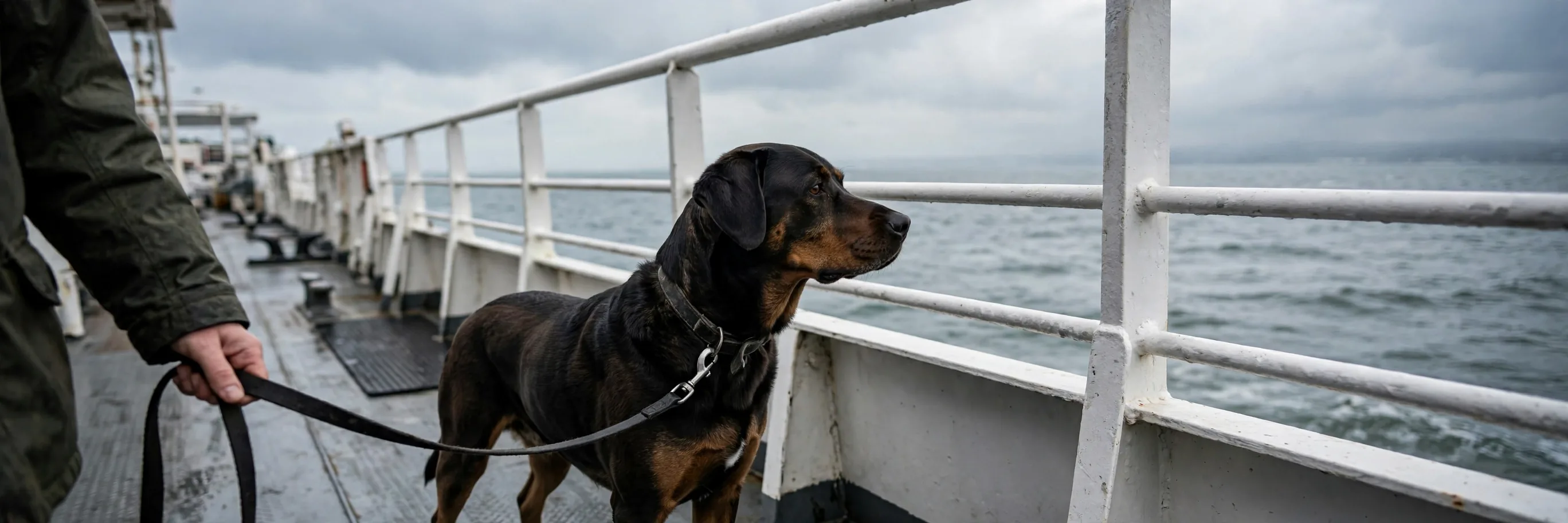
Most guides to Shetland begin at Lerwick. With a dog, the trip begins much earlier, and it helps to see the whole crossing as a timeline you can prepare for, stage by stage. Times below follow the usual pattern of the direct overnight sailing; exact departure, check-in and arrival times vary by date and by whether the ship calls at Kirkwall in Orkney on the way, so treat this as a shape to plan around and confirm your sailing's own times with the operator before you travel.
Afternoon, around four hours before sailing: give the dog its main walk of the day — a proper, unhurried hour, not a pavement circuit — followed by a normal meal fed earlier than usual, so digestion is well under way before the sea gets a vote. Pack the dog's overnight kit as hand luggage, not in the boot where you cannot reach it: lead and spare lead, water and a spill-proof bowl, a familiar blanket that smells of home, waste bags, any medication, and a chew or lick mat reserved for settling time. Check in with time to spare; ferry check-in closes well before departure and a dog that has waited calmly in a queue boards calmer than one rushed from car to gangway.
Early evening, boarding: take one last toilet opportunity in the designated area before boarding if one is provided, then settle the dog into its cabin, kennel or vehicle arrangement promptly, before exploring the ship yourself. The first hour matters: water offered, blanket down, a short period of you being boring and predictable nearby where the arrangements allow. Overnight: the North Sea does what it does; most dogs sleep through crossings their owners lie awake analysing. Follow the crew's instructions about any designated pet exercise or toilet areas and visiting times exactly — they differ between ships and sailings. Early morning, arrival: Shetland announces itself in pale northern light and gulls. Resist the dash for breakfast; the dog's first Lerwick walk — twenty unhurried minutes near the harbour or your accommodation — is the true end of the crossing, and everything else can wait until after it.
Pet cabins, kennels and car decks: where your dog sleeps
The single most consequential booking decision of a Shetland trip is where the dog spends the crossing, and it should be made when you book, not at the terminal. On sailings where they are offered, pet-friendly cabins let the dog stay with you overnight: a limited number, in high demand in summer, and by far the least stressful option for most dogs and owners. A dog that sleeps at the foot of your bunk wakes up as itself; the crossing becomes a strange hotel night rather than an endurance event. If a pet cabin matters to your trip, book the sailing around its availability, travel midweek or outside peak weeks if you can, and confirm the cabin's pet terms — numbers and sizes of dogs, charges, and where dogs may and may not go on board — directly with the operator, because these details change.
The kennel option suits many dogs perfectly well and should not be dramatised. Onboard kennels are typically a dedicated area where dogs rest in individual kennels with their own bedding, with set arrangements for owners to visit, water and exercise them during the crossing. Bring bedding from home, label everything, and time your visits to the published schedule rather than your anxiety; a dog visited every hour learns to expect upheaval hourly, while a dog visited calmly at the set times learns the night has a rhythm. Dogs that are crate-trained at home usually transfer that skill directly. Dogs that panic in confinement, guard kennel spaces aggressively, or are in season or unwell need a frank conversation with the operator — and possibly a different plan — before booking.
The third possibility, where the operator and sailing allow it, is the dog remaining in your vehicle on the car deck. Understand its terms clearly before choosing it: car decks are normally closed to passengers during the crossing, so this is a no-visits option for the entire night, in a space that will be noisy at loading and unloading and can be warm or cold depending on season and position. Some calm, car-happy dogs sleep the whole way through in their familiar boot; others do not, and you will not be there to know. Whichever option you choose, our dogs on UK ferries guide covers the wider ferry picture — operator rules, costs and what to pack — and repays a read before any long crossing. Whichever berth the dog gets, the golden rules hold: verified booking, familiar bedding, water, an emptied dog at boarding, and paperwork and microchip details up to date before you sail.
Lerwick first: settling in, supplies and harbour walks
Lerwick, Shetland's capital and main town, is the natural first base: the ferry terminal is here, along with the widest choice of places to stay, shops for food and dog supplies, cafés, a vet within reach, and the harbour-front streets where your trip will orient itself. Staying in or near town for at least the first nights gives a travel-tired dog a simple routine — the same morning and evening walks, the same feeding corner in your accommodation — while the islands' distances and weather reveal themselves gradually. Ask the usual dog questions when booking, with Shetland additions: is there an enclosed outdoor space, what happens with wet dogs and boots after cliff walks, and where exactly can the dog be walked last thing at night without an unlit road?
Give arrival day a deliberately small shape. A harbour and old-town wander on the lead — stone lanes, the market cross, views across to Bressay, the island that shelters Lerwick's harbour — lets the dog log the smells of a working port while you find the supermarket, the bakery and your bearings. The Knab and the coastal paths south of town offer a longer leg-stretch with sea views when energy returns, and Clickimin Loch and its broch add a flat, sociable circuit that local dog walkers use daily. None of this is filler: a dog that has decompressed properly on day one walks cliffs better on day three, and Shetland itineraries that start at full sprint usually pay for it by midweek.
Stocking up in Lerwick matters more than on a mainland trip, because beyond town the islands run on small shops, honesty boxes and seasonal openings. Fuel, dog food the dog actually eats, treats, waste bags and any pharmacy needs are Lerwick errands; rural Shetland will feed you splendidly at cafés and community halls in season, but it will not sell you a specific brand of kibble at nine in the evening. Check the latest official guidance before you travel for shop and attraction opening patterns in your travel month, and download maps and information while you have town signal — coverage thins quickly along the coasts where the best walking lives.
Cliff walks and headlands: Eshaness, Sumburgh and the west coast
Shetland walking is cliff walking first: around a hundred miles of Mainland coastline unfold into geos, stacks, arches and voes — the narrow sea inlets that cut deep into the land — and almost none of it is fenced for your convenience. That openness is the glory and the responsibility. Dogs belong on a lead on cliff sections as a matter of survival, not etiquette: edges are undercut, turf can give way, a rabbit or a sheep can pull a chasing dog over ground you cannot read from behind, and Atlantic wind gusts arrive without rehearsal. A short lead, a harness rather than a collar for security, and a human who treats every headland as guilty until proven innocent will bring everyone home.
In the far south, Sumburgh Head combines a famous lighthouse, waymarked paths and, in season, one of Britain's most accessible seabird spectacles, with puffins nesting in the grassy banks near the paths. It is a superb dog walk precisely because the infrastructure channels you: keep to paths, keep the dog on a short lead and close to heel near the colony, and let the birds own their ledges. In the north-west, the Eshaness cliffs deliver the wilder register — dramatic volcanic coastline, blowholes and stacks walked on open grass above serious drops, with grazing animals part of the scene. The walking is unforgettable and entirely unsuited to extendable leads, ball games, or dogs whose recall dissolves around livestock.
Between those bookends, the west coast and the central mainland offer quieter headlands, coastal sections around Scalloway and its castle, and island-hopping days to Bressay, just across the harbour from Lerwick by short ferry, where the walk out to Noss's neighbouring cliffs — viewed from Bressay's side — gives seabird drama without a boat landing. Build cliff days honestly: distances look trivial on the map and are not, because grass, peat and wind tax legs differently from pavement. Carry water for the dog on every cliff walk, since burns near paths may be brackish, seasonal or simply on the wrong side of a fence, and plan a turnaround time before you set off rather than negotiating with tired legs at the furthest point.
Seabirds, seals and nesting season: watching without disturbing
Shetland's wildlife is not a side attraction; for much of the year it is the main event, and the dog's job is to be its most boring spectator. The great colonies — puffins, guillemots, razorbills, fulmars, kittiwakes and, at the great gannetry on Noss and around Hermaness on Unst, tens of thousands of gannets — occupy the cliffs from spring into summer, and every bird on a ledge is spending energy it cannot spare on anything that looks like a predator. A dog under close control on a path is scenery; a dog lunging, barking or ranging through nesting turf is a threat that empties ledges and costs chicks. Keep leads short near colonies, stay on marked paths and viewpoints, never let a dog approach birds on the ground — burrow-nesting puffins and storm petrels, ground-nesting skuas, terns and waders are all vulnerable in ways a cliff face is not — and accept any seasonal diversions or closures as the price of the spectacle.
Bonxies — great skuas — deserve their own paragraph, because they enforce the rules personally. On their moorland breeding territories, notably around Hermaness, bonxies dive at intruders, dogs included, and a startled owner with a lunging dog on a long lead is an accident assembling itself. Walk these moors in season with the dog on a short lead at heel, keep moving steadily through territories rather than picnicking in them, and give Arctic skuas and nesting divers the same respect. Terns around beaches and piers dive with similar conviction. None of this should put you off; it should put you in the right frame of mind, which is that Shetland's birds were here first, are having a harder century than you are, and can be watched gloriously from exactly the spots the paths and hides provide.
Seals complete the etiquette exam. Grey and common seals haul out on Shetland's beaches, skerries and harbour edges all year, and a resting seal that drags itself to the sea because of your dog has burned reserves it needed — pups in season doubly so. Treat any seal on a shore as a full stop: lead on, wide berth, no approach for photographs, and leave by the way you came if the beach is narrow. Otters, which Shetland is famous for, are best watched for quietly at dawn and dusk along voe shores without a dog in tow at all; consider it the one wildlife hour of the trip where the dog holds the fort at your accommodation, repaid with the evening harbour walk afterwards. Trips combining Shetland with other Scottish islands will find the same rules serving them well — our Isle of Skye with a dog guide covers the Hebridean version of cliffs, colonies and lead discipline.
Ponies, sheep and crofting land: four-legged neighbours
The Shetland pony is the islands' emblem and its most underestimated hazard. Small, sturdy, famously hardy and often grazing on unfenced roadside and common land, ponies can be curious about dogs and are entirely capable of defending foals, food and personal space with hooves. Never let a dog approach, sniff at or attempt to play with ponies, however placid they look in photographs, and give mare-and-foal pairs a particularly wide berth in spring and summer. Keep the dog on a lead, position yourself between dog and pony where you pass on a path, do not feed ponies anything, and remember that a pony loose on a road is a driving hazard as well as a walking one — headlights and high beams at dusk on rural roads should assume small dark animals exactly where you least want them.
Sheep are the working reality beneath the postcard. Shetland's native sheep, in their range of natural colours, graze crofts, hills and coastal grass, and the islands' crofting pattern means livestock can appear almost anywhere: behind a peat bank, on a beach path, asleep in a sheltered geo. The law and the moral case agree — dogs must not worry livestock, and worrying includes chasing, not just biting. Keep the dog on a lead whenever sheep are in sight or likely, which in practice means most rural walking, and under the closest control everywhere else. If sheep bunch or run because of you, stop, increase distance and let them settle; if you meet lambs separated from ewes by your path, reroute rather than splitting them further. Gates, where they exist, get closed; much Shetland grazing is open, which makes your lead the only gate there is.
Respect crofting land as someone's workplace and larder. Stay off cultivated ground and hay meadows in growing season, keep to coastal and marked routes where they are provided, take all litter and dog waste away — waste left on grazing land is a genuine animal-health risk, not just an eyesore — and park with the croft in mind: gateways, passing places and track entrances are working access, not parking bays. Shetlanders are famously welcoming to walkers who behave as guests of a working landscape. The dog that walks quietly past ponies, ignores sheep on a short lead and leaves clean grass behind it will be welcomed back to these islands, and so will you.
Beaches, voes and day trips across Mainland and beyond
After cliffs and colonies, Shetland's beaches provide the release valve: pale shell-sand bays, long voe-side shores and tombolo walks that feel designed for a dog's happiness. St Ninian's Isle, reached across its famous curving sand tombolo from the south Mainland, is the signature walk — a double-sided beach causeway to a small island with a chapel site, glorious in calm weather and to be treated with respect when tides and weather combine, since the sand link is a natural feature, not a guaranteed bridge. West and north Mainland add quieter bays where you may share the sand with seals, oystercatchers and nobody else at all; apply the seal rules from the moment you arrive, scan the shore before the dog leaves the lead anywhere dogs may be off it, and check local signs, because a handful of beaches have seasonal arrangements around birds or livestock.
Day-trip structure matters in Shetland because distances deceive. The Mainland is long and thin: Lerwick to the north Mainland, to Sumburgh, or to the west coast are each substantial drives on roads that narrow, wind and reward slowness, with fuel and food stops to be planned rather than assumed. Build one anchor walk per outing, add a café or community hall in season, and stop trying to stack a second headline attraction an hour beyond it — the dog experiences the day as car, walk, car, walk, and Shetland days go better as car, long glorious walk, harbour potter, home. Inter-island ferries to Yell, Unst, Fetlar, Whalsay and Bressay open further worlds — Unst, Britain's northernmost island, with Hermaness and its gannets and skuas, is the great expedition — but each adds timetable discipline: check sailing times and dog arrangements for inter-island ferries before you travel, book vehicle spaces where the system allows, and never plan a last-ferry gamble with a tired dog as the stake.
Rainy and windy days are not lost days if you plan them as such. Lerwick's museum, small shops and cafés, Scalloway's castle and harbour, short voe-side walks between showers and the simple pleasure of watching weather cross a northern sea from a warm window all keep a trip balanced. Our Isle of Mull with a dog guide makes the same argument for the Hebrides — ferry-first planning, one anchor walk a day, wildlife watched at a distance — and the two island groups pair naturally in a longer Scottish summer. However you spend them, end Shetland days with the harbour ritual: a last lead walk as the light finally fades in summer, or under a huge dark sky in winter, with the dog entirely convinced this remote, windy, bird-loud place was chosen for it.
Weather, light and packing for four seasons in a day
Shetland weather is oceanic, which is a polite word for changeable at speed: sun, squall, rainbow and horizontal rain can all attend the same walk, and the wind is the constant that organises them. Dress and pack in layers with a genuinely waterproof outer for humans and a coat for small, old, thin-coated or low-slung dogs, whose bellies sit closer to wet grass and cold wind than any jacket advertisement admits. Waterproof boots you have already broken in beat new boots on peat. For the dog, add a drying towel and a spare lead to the car kit — a lead dropped in a bog or chewed in ferry-night nerves is a trip problem at sixty degrees north, where the nearest pet shop is a town away — plus enough of the dog's usual food for the whole trip, since island shops stock limited ranges and a mid-holiday diet change at the far end of a ferry crossing helps nobody.
Light is Shetland's seasonal superpower and its winter catch. Around midsummer the simmer dim — the near-daylight that lasts through the short night — means walks can start early or run late in luminous quiet, and a dog's body clock will happily adapt to evening cliff walks after the day visitors leave. In winter the equation inverts: a few hours of true daylight frame the walking day, reflective gear and lights for dog and human become essentials rather than accessories, and itineraries must be built backwards from sunset. Spring and autumn balance the two, with spring adding nesting season discipline and autumn adding the first storms, resting seals and a quieter, moodier coast that many Shetland devotees rate above summer.
Finish with the boring checklist that makes the glorious parts possible. Microchip details and phone number current; vaccination and any pet paperwork you need in order; insurance documents and your vet's number saved offline; the number of a Shetland vet noted before you need one; ferry bookings, pet arrangements and accommodation dog terms all confirmed in writing; maps downloaded; and a printed note of sailing times, because signal, batteries and plans all fail at the exact moment a ferry will not wait. Check the latest official guidance before you travel for ferry timetables, wildlife site access and any seasonal restrictions. Do all that, and Shetland with a dog becomes what it should be: not a logistical siege, but the far, bright edge of Britain, walked slowly, on a lead, in very good company.
Practical questions
Before you go
Can dogs travel in pet cabins on the Aberdeen to Lerwick ferry?
On sailings where pet cabins are offered, a limited number of cabins allow dogs to stay with their owners overnight, and they sell out early in peak season. Alternatives are the onboard kennels or, on some arrangements, remaining in your vehicle. Availability, charges and visiting rules change, so confirm the current pet cabin, kennel and exercise arrangements directly with the operator when you book.
How long is the ferry from Aberdeen to Lerwick with a dog?
The direct overnight sailing is typically around twelve hours, with longer timings when the route calls at Kirkwall in Orkney. Build your dog's evening routine around that length: a proper walk and toilet break before boarding, water and a familiar blanket for the night, and an unhurried first walk soon after arrival in Lerwick.
Do dogs need to be on a lead in Shetland?
Around livestock, ponies, nesting birds and on cliff edges, yes, without exception. Shetland is crofting land where sheep and ponies graze widely, sometimes on unfenced ground and near roads. Elsewhere keep your dog under close control, follow local signs, and use a lead whenever you are unsure what is over the next rise or fence line.
When is the best time to visit Shetland with a dog for seabirds?
Late spring and summer bring the great seabird colonies to the cliffs, including puffins, guillemots and gannets, along with the longest daylight. It is also nesting season, so dogs belong firmly on a lead near colonies and may need to watch from marked paths and viewpoints only. For quieter cliffs and empty beaches, early autumn is a strong alternative.
Can dogs go on Shetland beaches?
Many Shetland beaches welcome dogs, but rules vary by beach and season, and seals resting on sand or shingle change the plan completely: keep a wide distance, put the lead on and leave seals undisturbed. Check local signs on arrival, keep dogs away from any seal haul-outs and bird nesting areas, and carry out all waste even on remote shores.
Can my dog stay in the car overnight on the Aberdeen to Lerwick ferry?
Some passengers do keep their dog in the car overnight because the animal is less stressed in familiar surroundings, but it is a matter of personal choice and you must weigh it against the long crossing. The alternatives are a pet-friendly cabin or a pre-booked kennel, and only support dogs are allowed in the ship’s internal public areas, though you can walk your dog on the outer deck. Shetland’s official visitor site sets out the ferry options here: Shetland.org: moving to Shetland with pets (checked October 2026).
How do I book a NorthLink pet cabin or kennel?
Book early, because pet cabins are limited and sell out in peak season. Pets can travel in a pet-friendly cabin, in a kennel, or stay in your own car. Only assistance dogs may enter the ship's indoor public areas; pet dogs can be walked on the outer deck. A pet cabin carries a £15 surcharge per pet. Kennels must be booked in advance, come in two sizes, and visits during the sailing are limited. Bring your own pet bedding. Check-in at Aberdeen and Lerwick closes 90 minutes before departure. See NorthLink booking advice and NorthLink support for current charges and rules, and for another island ferry trip, see our Orkney dog guide.