This guide is independent and contains no paid placement. If affiliate links are added later, they will be clearly marked and will not change our editorial checks.
St Oswald's Way runs 97 miles from Heavenfield, near Hadrian's Wall, to Holy Island, and it is the most varied long-distance walk in Northumberland with a dog. Plan for six to seven days, expect a mix of inland valleys and coastal cliffs, keep dogs on leads near livestock and cliff edges, and book stays ahead in the small villages. The walking is never dull, the beaches are superb, and the finish across the sands to Lindisfarne is a proper reward.
Heavenfield: where the trail begins
St Oswald's Way begins in an unlikely place: a small chapel on a windswept hill near Hadrian's Wall, on the site of a battle fought in the seventh century. Heavenfield is where Oswald, a Northumbrian king, raised a cross before his victory over the Welsh king Cadwallon in 634, and the chapel that stands there now is a quiet, atmospheric building with views across the Tyne valley. It is not an obvious starting point for a long-distance walk, and it is not easy to reach, but that is part of its charm. The trail begins here because Oswald's story begins here, and the walk that follows traces his life and his kingdom from the Wall to the sea.
The first thing to know about Heavenfield is that it is remote. There is no village, no shop and no pub, just the chapel, a car park and the open hillside. Most walkers arrive by car or by taxi from Hexham or Corbridge, and the first day's walk takes them down into the Tyne valley and along the river to the small villages that line it. The walking on this first stretch is gentle, with field paths, farm tracks and quiet lanes, and the dog will find it easy underfoot. The views from Heavenfield are superb, with the Wall country spread out below and the Cheviots on the horizon, and the sense of starting a long walk in such a quiet, historic place is a good way to begin.
Oswald himself is worth knowing about, because his story shapes the whole trail. He was a king who brought Christianity to Northumbria, who founded the monastery at Lindisfarne, and who died in battle against the Mercians, and his body was carried to various places after his death, including Heavenfield itself. The trail is named for him because it connects the places associated with his life, from the battlefield where he raised his cross to the island where his monastery stood. A dog does not care about the seventh century, but a walker who knows the story will find the trail richer for it, and the places along the way, the chapels, the castles and the villages, all tell a part of it.
The practicalities of starting at Heavenfield are straightforward but need planning. There is no accommodation at the start, so most walkers stay in Hexham or Corbridge the night before and take a taxi to the chapel in the morning. The first day's walk is around twelve miles, ending at a village with a pub and a bed and breakfast, and the walking is easy enough that a dog that has travelled a long way will not be overtaxed. Carry water and food for the day, because there are no shops on the first stretch, and check the dog's paws at the end of the day, because the field paths can be rough underfoot after rain.
Wall country and the Tyne valley
The first section of St Oswald's Way, from Heavenfield through the Tyne valley, is the most inland part of the trail, and it is a gentle introduction to the walking ahead. The route follows the river Tyne through farmland and woodland, passing through small villages and past the Roman sites that make this part of Northumberland so rich in history. The walking is flat and easy, with surfaced paths, field tracks and quiet lanes, and the dog will find it comfortable underfoot. The river is a constant companion, with herons, kingfishers and the occasional otter, and the valley is green and sheltered, a contrast to the exposed coast that comes later.
The Roman history of this section is everywhere. Hadrian's Wall runs a few miles to the north, and the trail passes near the Roman town at Corbridge, the fort at Chesters and the other sites that line the Wall. The walking here is not a Roman history lesson, but the stones, the earthworks and the museums tell the story of a frontier that was guarded for three centuries, and the trail's position in the shadow of the Wall gives it a particular atmosphere. Dogs are welcome on the outdoor paths at the Roman sites, but not inside the museums or the visitor centres, apart from assistance dogs, so plan for one person to stay outside with the dog if you want to see the exhibitions.
Corbridge, the village at the heart of this section, is worth an evening. It is a stone-built village with a market square, a church, pubs and cafes, and a good range of accommodation, and it sits on the Tyne with the hills rising on both sides. The pubs are relaxed about dogs, the cafes have outdoor seating in the warmer months, and the village's position on the trail makes it a natural break point. The Roman town at Corbridge is a short walk from the village, and it is worth a visit in the morning before you leave, although the dog will need to wait outside the museum. Our guide to Corbridge with a dog covers the village, the river and the Roman walks in detail.
The livestock rules on this section are the same as on any farmland walk: keep the dog on a short lead through every field, even if the animals seem far away, and be especially careful in spring, when lambs are in the fields. The fields here are mostly pasture, with sheep and cattle, and the trail crosses them on marked paths, but the paths can be muddy after rain, and the stiles can be awkward for a dog, so check each one before you commit the dog to it. The river itself is a hazard as well: the Tyne is fast and deep in places, with steep banks, so keep the dog on a lead near the water and let it paddle only in the shallow margins.
Rothbury and the Coquet valley
The second section of the trail, from the Tyne valley north to Rothbury and the Coquet valley, is where the walking starts to feel more remote. The route climbs out of the Tyne valley and crosses the open moorland and farmland that lies between the two river valleys, and the landscape changes from the sheltered, wooded Tyne to the wide, open country of the Coquet. Rothbury, the market town at the heart of this section, sits on the Coquet with the hills rising on both sides, and it is a good place to rest, restock and enjoy a town that has welcomed walkers for generations. The town has shops, cafes, pubs and a good range of accommodation, and the pubs are walkers' pubs, with a fire in the colder months and a welcome for muddy boots and wet dogs.
The Coquet valley is one of the most beautiful river valleys in Northumberland, and the trail follows it for several miles, through woodland, past waterfalls and along the river bank. The walking here is varied, with woodland tracks, riverside paths and open moorland, and the dog will find something new to sniff around every corner. The river is shallow and clear in places, and a dog can paddle in the margins, but the current can be strong after rain, so keep the dog on a lead near the water and do not let it swim in the faster stretches. The valley is also home to a wide range of wildlife, including otters, kingfishers and dippers, and the early morning is the best time to see them.
The villages on this section are small and widely spaced, with limited facilities, so carry food and water for the day and do not rely on finding a shop. The accommodation is a mix of bed and breakfasts, small hotels and farmhouses, and it is limited, so book ahead, especially in the summer months. The hosts in this part of Northumberland are generous with walkers and their dogs, but they need to know in advance that a dog is coming, and they may have a limit on the number of dogs or a charge for the dog. Confirm the dog policy in writing when you book, and make sure the host knows the size and breed of your dog.
A practical note for this section: the moorland between the Tyne and the Coquet is open and exposed, and the weather can change quickly, so carry waterproofs even on a sunny morning. The path can be faint on the open ground, and the waymarks are widely spaced, so carry a map and compass and know how to use them. The dog should be kept on a lead on the moorland, because sheep graze the hills freely, and a dog that chases them can cause serious harm. Ground-nesting birds are also present in spring and early summer, so stick to the path and keep the dog close.
Over the hills to Alnwick
The stage from Rothbury to Alnwick takes the trail over the hills that separate the Coquet valley from the Aln valley, and it is one of the most rewarding days on the walk. The route climbs out of Rothbury and onto the open moorland, with views back down the Coquet valley and forward to the hills above Alnwick, and the walking is open, exposed and wonderfully empty. The path is good, with grass tracks and stony sections, and the dog will enjoy the freedom of the open ground, although the lead rules still apply, because sheep graze the moorland and the dog must be kept under control. The descent to Alnwick is long and steady, through farmland and woodland, and the town appears gradually as the hills open out.
Alnwick is the largest town on the trail, and it is a good place to take a rest day or at least a slow morning. The town has a castle, gardens, shops, cafes, pubs and a good range of accommodation, and it sits in the Aln valley with the hills rising on both sides. The castle is a famous landmark, and it is worth a visit, although dogs are not allowed inside the castle or the gardens, apart from assistance dogs, so plan for one person to stay outside with the dog. The town's market square, the old streets and the river walks are all worth exploring, and the pubs are relaxed about dogs, with outdoor seating in the warmer months and a fire in the colder months.
The walking around Alnwick is varied and interesting. The River Aln runs through the town, and the riverside paths are pleasant for a quiet walk, with the castle on one side and the parkland on the other. Hulne Park, the wooded estate to the north of the town, has trails through woodland and along the river, and it is a good place for a longer walk with the dog, although the park has its own rules about dogs, so check the signage on arrival. The town is also a good base for exploring the coast, which is only a few miles away, and the beaches at Alnmouth and Craster are within easy reach by car or by bus.
For walkers who want to know more about the town, our guide to Alnwick with a dog covers the castle rules, the river walks, the gardens and the pubs in detail. The guide is a useful companion for a rest day in Alnwick, and it will help you make the most of a town that is often passed through too quickly by walkers who are focused on the coast ahead.
Warkworth, Amble and the smell of the sea
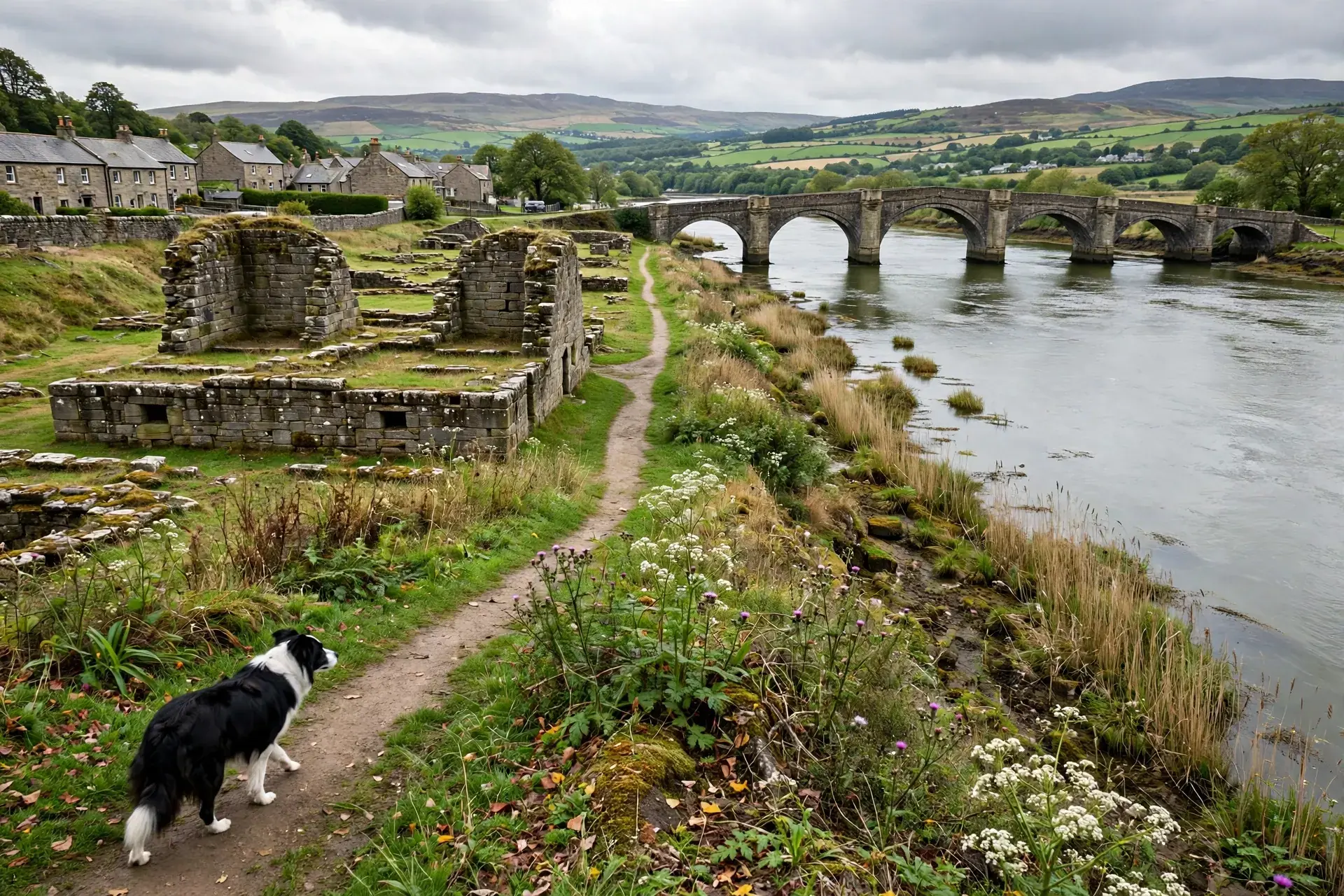
The first sign that the trail has reached the coast is not the sea, it is the smell: salt, fish, and the harbour at Amble, where the boats come in with the catch and the gulls follow them. Warkworth comes first, a stone village on the Coquet with a castle on its hill, a church, and streets that feel as if they have not changed in a hundred years. The castle is a ruin, and the dog cannot go inside, but the view from the village, with the keep on the hill and the river below, is worth the walk in itself. The river paths are quiet, the village is calm, and it is a good place to stop for an hour before the coast.
Amble is a different kind of place. It is a working harbour, with a marina, a fish quay, and boats that go out early and come back with the tide. The town has cafes, fish and chip shops, and pubs that are used to walkers, and the harbour area is busy, so the dog stays on a lead and close to your side. The beach at Amble is long and sandy, and it is a good place for a run in the evening, when the boats are in and the town is quiet. The sand is firm and clean, and the views run north along the coast to the headlands and the castles. Coquet Island, just offshore, is a bird reserve, and the terns and puffins that nest there are a reminder that this coast is a working landscape for wildlife as well as for people.
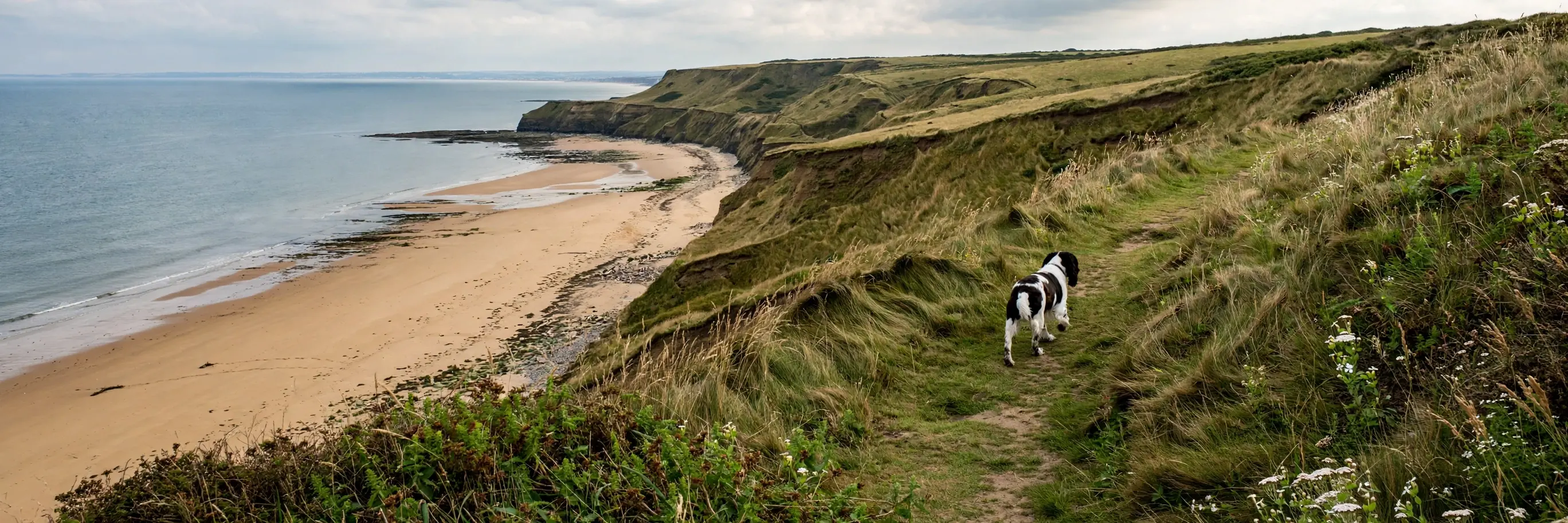
From Amble the path turns north along the coast, and the walking changes. The inland valleys are behind you, and the sea is on your left for the rest of the trail. The path follows the dunes and the low cliffs, with the beach below and the farmland inland, and the views are long and open. The walking is flat, the ground is kind, and the dog will enjoy the sea air and the open ground, but the cliffs are low and unfenced in places, so the lead stays on near the edge, and the wind can gust without warning. The dunes are a sensitive habitat, and a dog should not be allowed to run through them in the nesting season, so keep to the path and the beach.
Evenings on this part of the trail belong to the harbour towns. A fish supper eaten on a bench with the sea in front of you, a dog asleep at your feet, and a pub garden afterwards is a better end to a day than a long restaurant meal, and it is cheaper too. The pubs in Amble and the villages north of it are used to walkers, and they are used to dogs, and a dog that settles under the table with a biscuit is a dog that will sleep well and walk well the next day. Keep the evenings simple, keep the mornings slow, and the coast will do the rest.
Alnmouth, Boulmer and the road to Craster
Alnmouth is a village that faces the sea, and it shows. The houses are painted in soft colours, the golf course runs along the dunes, and the beach is a long, wide sweep of sand that is empty on a weekday morning and full of life on a summer weekend. The river Aln meets the sea here, and the estuary is a place for wading birds, with oystercatchers and curlews feeding on the mud at low tide. The village has cafes and pubs that welcome dogs, and the riverside paths are a pleasant walk, with the castle at Warkworth behind you and the dunes ahead. It is a good place to stop, to drink, and to let the dog run on the sand.
North of Alnmouth the coast gets quieter. The path follows the dunes and the low cliffs, passing the small fishing village of Boulmer, where the boats are pulled up on the beach and the houses face the sea. Boulmer is a working village, not a resort, and it has a particular charm: the smell of the sea, the sound of the gulls, and the sense that the coast here belongs to the people who live on it. There are no shops, no cafes, and no crowds, just the sea, the beach and the path. The walking is flat and easy, and the dog will enjoy the open ground, but the cliffs are unfenced in places, so the lead stays on near the edge.
Craster appears gradually, first as a smudge on the horizon, then as a harbour, a smokehouse and a pub, and then as a village of stone cottages with the sea at the end of every street. The kippers from the smokehouse are famous, and the pub is a walkers' pub, with a fire in the colder months and a garden in the summer. The coastal path from Craster to Dunstanburgh Castle is the walk that everyone remembers, with the ruined towers on the headland and the sea on one side, and the dog will love the open ground and the sea air. Keep the dog on a lead near the cliff edges, and be aware of the birds in the dunes in spring and summer.
The practicalities of this stretch are simple: carry water and food, because there are no shops between Alnmouth and Craster, and check the tide times, because the beaches are wide at low tide and the water comes back in fast. The sea is cold, the currents are strong, and swimming is only for dogs that are confident in the water. After the walk, rinse the sand and salt off the paws, and give the dog a towel and a drying coat, because a wet dog in a cold wind will chill quickly. The coast is a joy, but it is a joy that needs a little planning, and a walker who plans will enjoy it far more than one who does not.
Budle Bay, Ross Sands and the island ahead
The last miles of St Oswald's Way are walked on sand and mud, and they are the quietest miles on the trail. From Bamburgh the path leaves the castle behind and follows the coast north to Budle Bay, a wide, shallow inlet that is empty at low tide and full of wading birds: curlews, redshanks, oystercatchers, all feeding on the mud while the tide is out. The bay is a place to stop and watch, and the dog will enjoy the open ground, but the mud is soft and the birds are easily disturbed, so keep the dog on a lead and on the path, and do not let it chase the birds across the mudflats.
Beyond Budle Bay the coast opens out into Ross Sands, a long, empty beach that runs north towards Holy Island. Ross Sands is one of the wildest beaches in Northumberland, with no road, no car park and no facilities, just sand, dunes and the sea. The walking is flat and easy, and the dog can run for a mile or more without meeting another soul, but the tide matters here more than anywhere else on the trail, because the beach is wide at low tide and the water comes back in fast. Walk the beach on the falling tide, and start heading back while there is still plenty of sand underfoot, even if the dog is still full of energy.
Holy Island appears gradually, first as a low shape on the horizon, then as a castle on a hill, a priory, and a village. The causeway that connects it to the mainland is covered by the sea at high tide, and the safe crossing times change every day, so check them the night before, again in the morning, and confirm them at the causeway itself. The crossing is on foot, across the sands, following the line of the causeway and the wooden posts that mark the pilgrim route. It takes about an hour, and the views are superb: the island ahead, the sea on both sides, and the sense that you are walking somewhere that can only be reached when the tide allows.
On the island, the dog is welcome on the paths and the beaches, but not inside the castle, the priory or the visitor centre. The island is small, and it can be walked in a couple of hours, with the castle, the priory, the harbour and the village all within easy reach. The pubs and cafes are relaxed about dogs, and the island's atmosphere is quiet and contemplative, especially outside the summer crowds. Leave in good time for the return crossing, and do not linger if the tide is turning. The trail began at a chapel on a hill, and it ends on an island in the sea, and the journey between them is one that a dog will remember, even if it does not know why.
The beaches, one by one
Alnmouth first. The beach is a long, wide sweep of sand at the mouth of the Aln, with the dunes behind it and the golf course along the top, and it is a good place for a dog to run, because the sand is firm and the beach is empty on a weekday morning. The estuary is a place for wading birds, and the dog should stay on the sand and away from the channel, because the current in the river mouth is strong even when it looks calm. The village has cafes and pubs that welcome dogs, and the riverside paths are a pleasant walk when the tide is high and the beach is narrow.
Embleton Bay next, beyond Dunstanburgh, and it is one of the best beaches on the coast for a dog. The sand is wide and clean, the dunes are high, and the castle is visible from the beach, which makes it one of the most photogenic places in Northumberland. The beach is backed by dunes, and the dunes are a sensitive habitat in the nesting season, so the dog stays on the sand and off the dune edges, where ground-nesting birds may be present. The walk from Craster to Embleton Bay and on to the next village is flat and easy, and the dog will love the open sand and the sea.
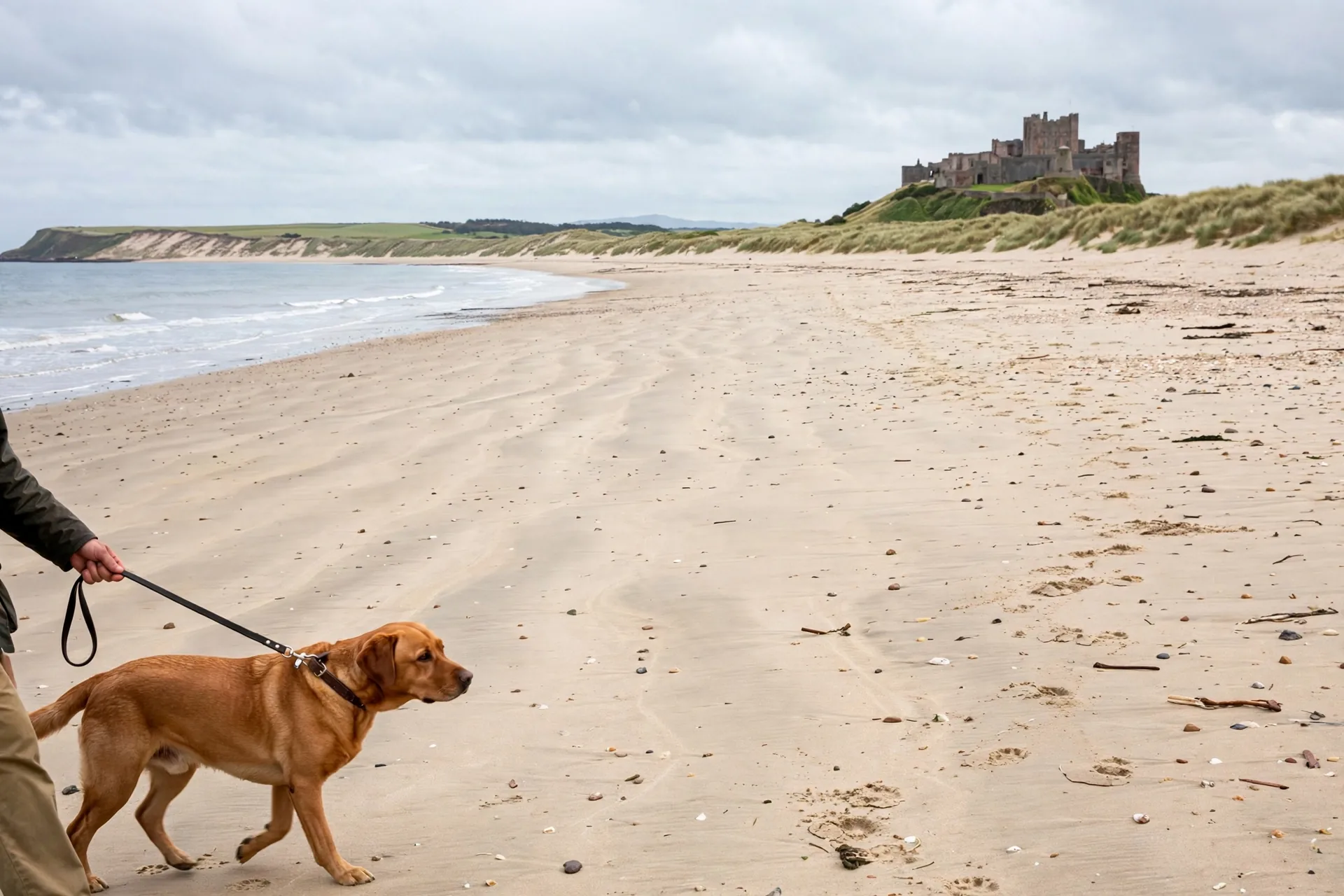
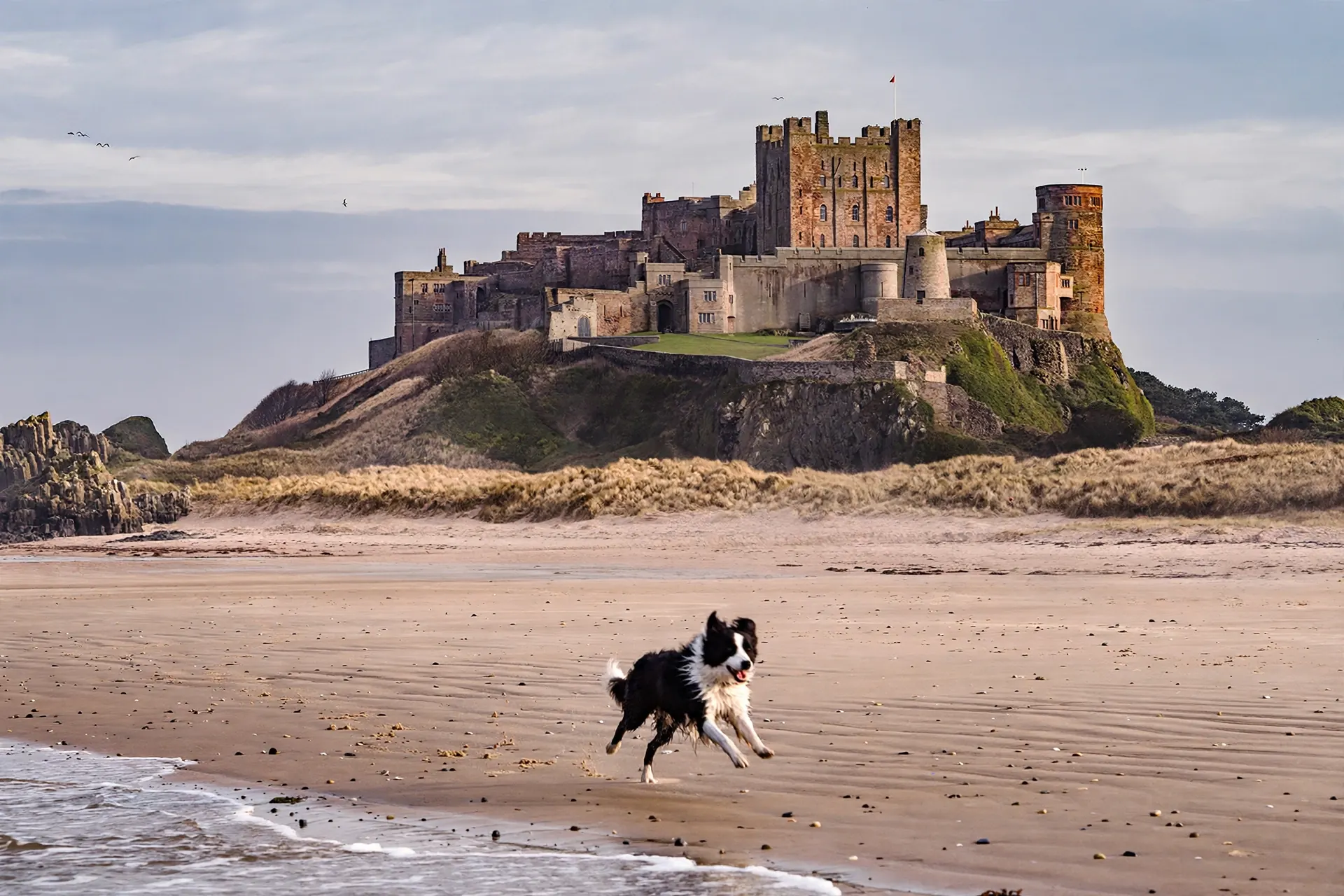
Bamburgh after that, and the beach below the castle is the most famous on the trail. The sand is firm and clean, the beach is wide, and the views run from the castle on one side to the Farne Islands offshore. Dogs are welcome, although the seasonal rules apply, so check the official guidance before you travel. The sea is cold, the currents are strong, and swimming is only for dogs that are confident in the water, in calm conditions, and well away from the harbour mouths. After the walk, rinse the sand and salt off the paws, and give the dog a towel and a drying coat, because a wet dog in a cold wind will chill quickly.
The causeway is the last piece of the beach story, and it is the one that needs the most respect. The causeway to Holy Island is under water at high tide, and the safe times change every day. Check the board at the causeway, check the tide times the night before, and check them again in the morning. Never start across when the tide is coming in, because the water rises fast and the causeway can be cut off in minutes. The refuge box is there for walkers who are caught out, and it is a miserable place to spend a tide. A safe crossing is worth more than a punctual one, and the island will still be there tomorrow.
The way back, and the beds along it
Work backwards from Berwick. The town has a station, hotels, and a choice of places to stay, and it is the easiest night on the trail to book. Bamburgh before it has a handful of bed and breakfasts that fill up early in summer. Alnwick has the widest choice, from hotels to self-catering cottages, and it is a good place for a rest day. Rothbury has pubs with rooms and bed and breakfasts. Corbridge and Hexham, at the start, have hotels and guest houses. That is the list, and the walk hangs off it. A stage ends where a bed is, and the days come out uneven, ten miles one day and eighteen the next, and that is how this trail works.
Ring the places on the list, and ask three things: is there a garden where the dog can be let out last thing at night, is the dog welcome in the bar or only in the room, and is there a charge. Say the dog's name and its size, and say whether it will be left alone. A host who answers easily has done this before. A host who hesitates has not, and you would rather find that out on the phone than at the door at six in the evening. The charge is normal, and it is worth paying without argument, because it is the price of a host who will welcome the next walker with a dog. Ask about the floor too, because a wet dog and a carpet are a bad combination.
The bag is the next question. A full pack for seven days is heavy, and the dog's food, water and first aid add to it, so many walkers pay a service to move the main bag from one night's stay to the next. The services that cover this trail need the names of every stay, and they need to be booked before you leave home, with the dog mentioned, because some of them have rules about dogs in their vehicles. If you carry everything yourself, pack light and restock in Hexham, Rothbury and Alnwick, rather than carrying a week's food from the start. Either way, the dog's food, water and medicine travel in the day pack.
The way back is the last thing to settle, and it is easy to forget until the last day. Heavenfield has no bus and no train, so most walkers take a taxi from Hexham or Corbridge to the chapel in the morning, and the driver will know the way. Holy Island has buses to Berwick, and Berwick has trains to Edinburgh, Newcastle and London, so the return is straightforward once you are off the island. If you drove to the start, work out how you get back to the car before you leave home, because a taxi from Berwick to Hexham is a long ride. Some walkers leave the car at Berwick and take the train to Hexham, which is the tidiest solution if the timetable works. Decide it now, not on the last morning.
A week of steady miles
The walkers who enjoy St Oswald's Way most are not the fastest, they are the ones who find a rhythm and keep it. The trail is 97 miles, and the days are long, but the walking is never brutal, and the secret is to walk at a pace that leaves something in reserve for tomorrow. Start slowly in the morning, when the legs are stiff and the dog is still waking up, and take the first break after an hour, not after two. Offer water at every stop, and offer the dog a snack, because a dog that is fed little and often will keep going longer than a dog that is fed once at night. Take a proper lunch break in the middle of the day, with the dog's food and a rest in the shade, and use the time to check the paws, the map and the weather ahead.
The dog's training should start six weeks before the trip, and it should be gradual. Add no more than a tenth to the daily distance each week, and include the things the trail will actually contain: hills, rough ground, wet grass, stiles, and the long, boring stretches where a dog has to keep walking when the interesting smells have run out. Check the paws after every training walk, and look for the early signs of trouble: a pad that is pinker than the others, a small crack, a reluctance to put weight on one foot. A paw that is sore on a training walk will be worse on the trail, and a dog that starts the trip with sore feet will not finish it happily. Paw balm helps, and so does a rest day, but the best cure is a training plan that never asks for too much too soon.
Alnwick is the natural place for a rest day, and it is worth taking one even if you feel fine. A day off the trail lets the dog's muscles recover, the paws harden, and the mind reset, and a short, gentle walk around the town keeps everything loose without adding miles. Use the day to wash the kit, dry the boots, treat any sore spots, and plan the coastal section to Bamburgh and Holy Island. The trail will still be there tomorrow, and a walker and a dog who have rested will walk the last miles far better than a pair who pushed through. Rest is not a failure on a long walk. It is part of the walk, and the dogs know it before the walkers do.
The last thing about rhythm is the evening. A long walk ends well when the dog has water, food, a dry bed and a quiet corner, and when the walker has a pub garden, a meal and a map for tomorrow. The pubs along this trail are used to walkers, and they are used to dogs, and a dog that settles under the table with a biscuit is a dog that will sleep well and walk well the next day. Keep the evenings simple, keep the mornings slow, and the miles will take care of themselves. The trail is not a race, and the walkers who treat it like one are the ones who miss the castles, the beaches and the dog trotting happily ahead.
Practical questions
Before you go
How many days does St Oswald's Way take with a dog?
Six to seven days is the usual answer for the 97 miles. Fit walkers with fit dogs often manage six, with stages of around sixteen miles. Slower walkers, and walkers with older dogs, should allow seven and take a rest day in Alnwick, which is the largest town on the route and a good place to stop. The trail is mostly gentle, so the distance is the challenge, not the climbing, and the days are best walked slowly, with regular breaks for water and food.
How do I cross to Holy Island at the end?
The causeway is under water at high tide, and the safe times are different every day. The board at the causeway shows them, and the council publishes them. Check both the night before and again in the morning, and start across on the falling tide, allowing about an hour for the walk. Never start when the tide is coming in, because the water rises fast. If the times do not work for your planned day, stay an extra night on the mainland and cross the next day.
Can dogs walk all of St Oswald's Way?
Yes, the whole route is open to dogs, with the lead on through farmland, near livestock and near cliff edges. Sheep and cattle graze much of the inland route, and a dog that chases livestock can be shot by the farmer, so the lead stays on wherever animals are visible. On the coast the dog should stay on a lead near the cliff tops, where the drops are unfenced, and in the dunes in the nesting season. On Holy Island the dog is welcome on the paths and beaches, but not inside the castle, priory or visitor centre.
Is this trail suitable for an older dog?
It suits older dogs better than most long-distance trails, because the walking is mostly flat, with surfaced paths and soft sand underfoot, and the climbs are steady rather than steep. The distances are still long, at fourteen to sixteen miles a day, so an older dog needs training and rest days. Plan for seven days, take a rest day in Alnwick, and be ready to shorten a stage if the dog is struggling. The coastal sections are the easiest for an older dog, because the ground is flat and the beaches are soft.
Where do I stay with a dog on St Oswald's Way?
Hexham and Corbridge have hotels and guest houses. Rothbury has pubs with rooms. Alnwick has the widest choice, from hotels to self-catering cottages. Bamburgh has bed and breakfasts that fill up early in summer. Berwick has hotels and a station. Book every night before you leave home, and say on the phone that a dog is coming, how big it is, and whether it will be left alone in the room. A host who knows is a host who is ready.
How do I get to the start at Heavenfield?
Heavenfield has no bus and no train, so most walkers take a taxi from Hexham or Corbridge to the chapel in the morning, and the driver will know the way. At the other end, Holy Island has buses to Berwick-upon-Tweed, where there is a railway station. Dogs are generally allowed on buses and trains if they are well behaved, but check the official guidance before you travel. If you drive to the start, work out how you get back to the car before you leave home.