This guide is independent and contains no paid placement. If affiliate links are added later, they will be clearly marked and will not change our editorial checks.
Book the ferry before anything else, base yourself in or near Tobermory, and plan one real walk a day — Aros Park or a beach — with the harbour front as the gentle bookend. The town is small, walkable and dog-tolerant, but it is still a working harbour on a Hebridean island, so lead rules, weather and ferry times shape every plan.
First look: a harbour town built for slow arrivals
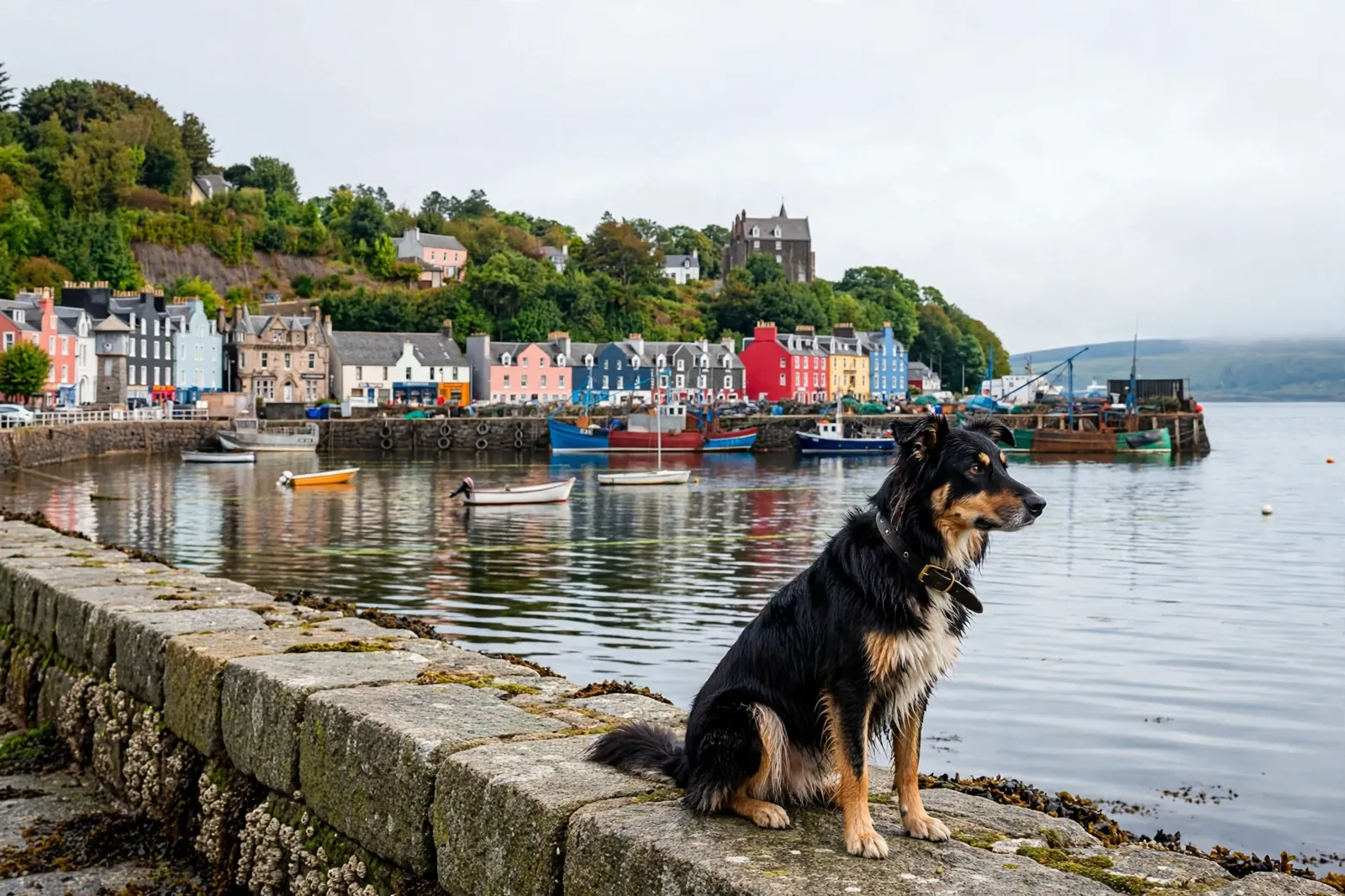
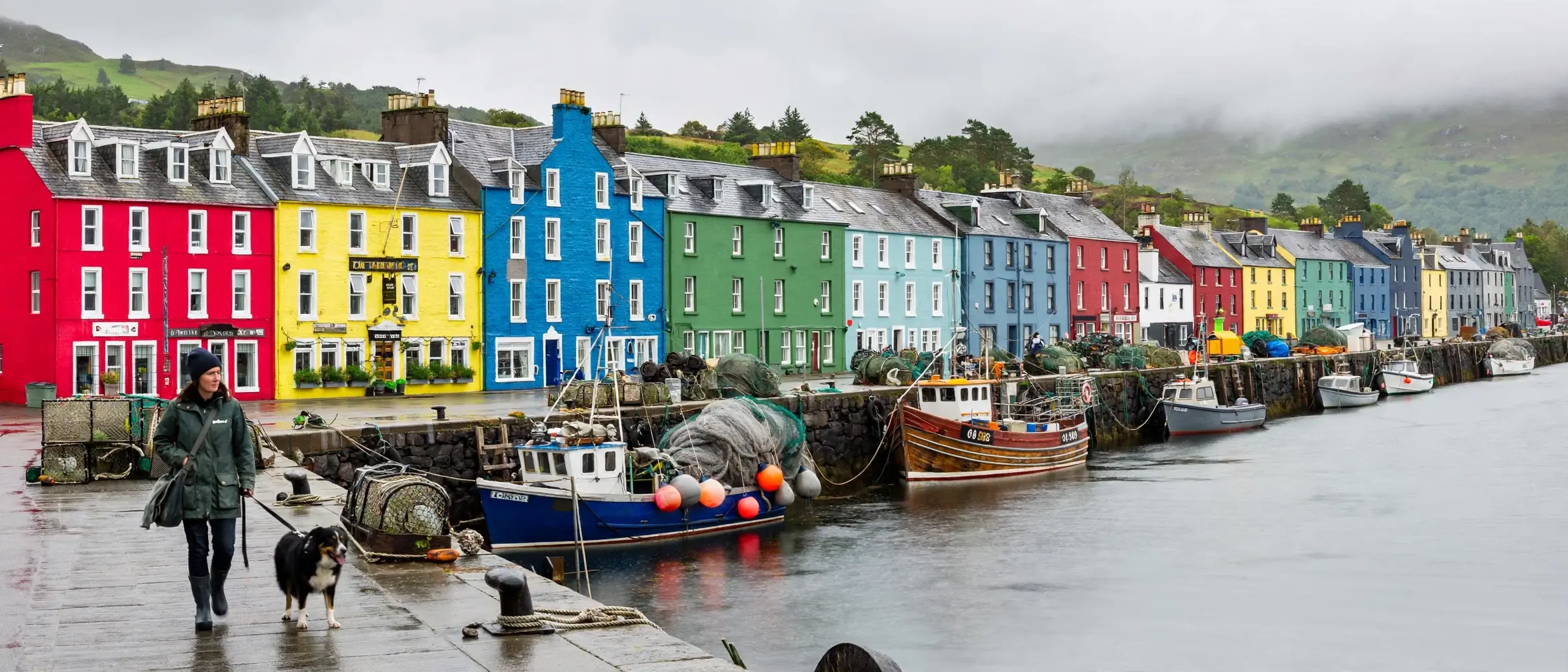
Tobermory is the capital of the Isle of Mull, and it announces itself before you have even parked. The harbour curves around a sheltered bay, and the houses along the quay are painted in the bright reds, yellows, blues and greens that have made the town one of the most photographed waterfronts in Scotland. For a dog, the first impression is simpler and better: salt air, gulls, fishing boats, rope and fish smells, and a flat harbourside pavement that is easy on paws after a long drive and a ferry crossing.
The town is small enough to cross on foot in minutes, which is exactly what makes it work as a dog base. There is no sprawling centre to navigate and no long trudge from a car park to the interesting part. You park, you walk to the water, and the day starts. That compactness matters more than it sounds when you are travelling with a dog that has just spent hours in a car and on a ferry: the first walk can happen within minutes of arrival, before the dog has had time to get restless or the humans have had time to get hungry and make a bad decision.
What Tobermory is not, and what it is worth knowing before you go, is a resort. It is a working harbour town on an island of roughly 3,000 people, with a distillery, a small museum, fishing boats that actually fish, and a ferry pier that still does a job. Shops and cafes are independent and often small, opening hours flex with the season, and the town can feel busy on a fine summer afternoon when several ferry arrivals coincide, then quiet again by evening. If your dog struggles with crowds, the fix is timing rather than avoidance: walk the harbour early, eat slightly off-peak, and save the middle of the day for the woods at Aros Park or a beach further out.
The other thing to understand early is that Tobermory rewards a slow itinerary. The town itself can be walked in an hour, but the reason to stay here rather than simply pass through is what sits around it: woodland trails, a waterfall, beaches within a short drive, and the whole of northern Mull within day-trip range. A good Tobermory trip with a dog is not a checklist of sights. It is a rhythm — harbour in the morning, a proper walk in the middle of the day, harbour again at dusk — and the town is built for exactly that loop.
Season shapes the experience more than in most mainland towns. In summer, Tobermory is at its liveliest, with the longest days, the most open businesses and the most visitors; in winter, it is quieter, some places close or shorten their hours, and the light goes early, but the harbour is arguably at its best, with low sun on the painted houses and very few people about. Spring and autumn sit in between, and for many dog owners they are the sweet spot: cooler walking weather, fewer crowds, and ferries that are easier to book than in July and August. Whenever you come, check the official guidance before you travel for ferry timetables, seasonal opening hours and any local restrictions, because island details change with the season and with the weather.
Getting there: the ferry is part of the trip
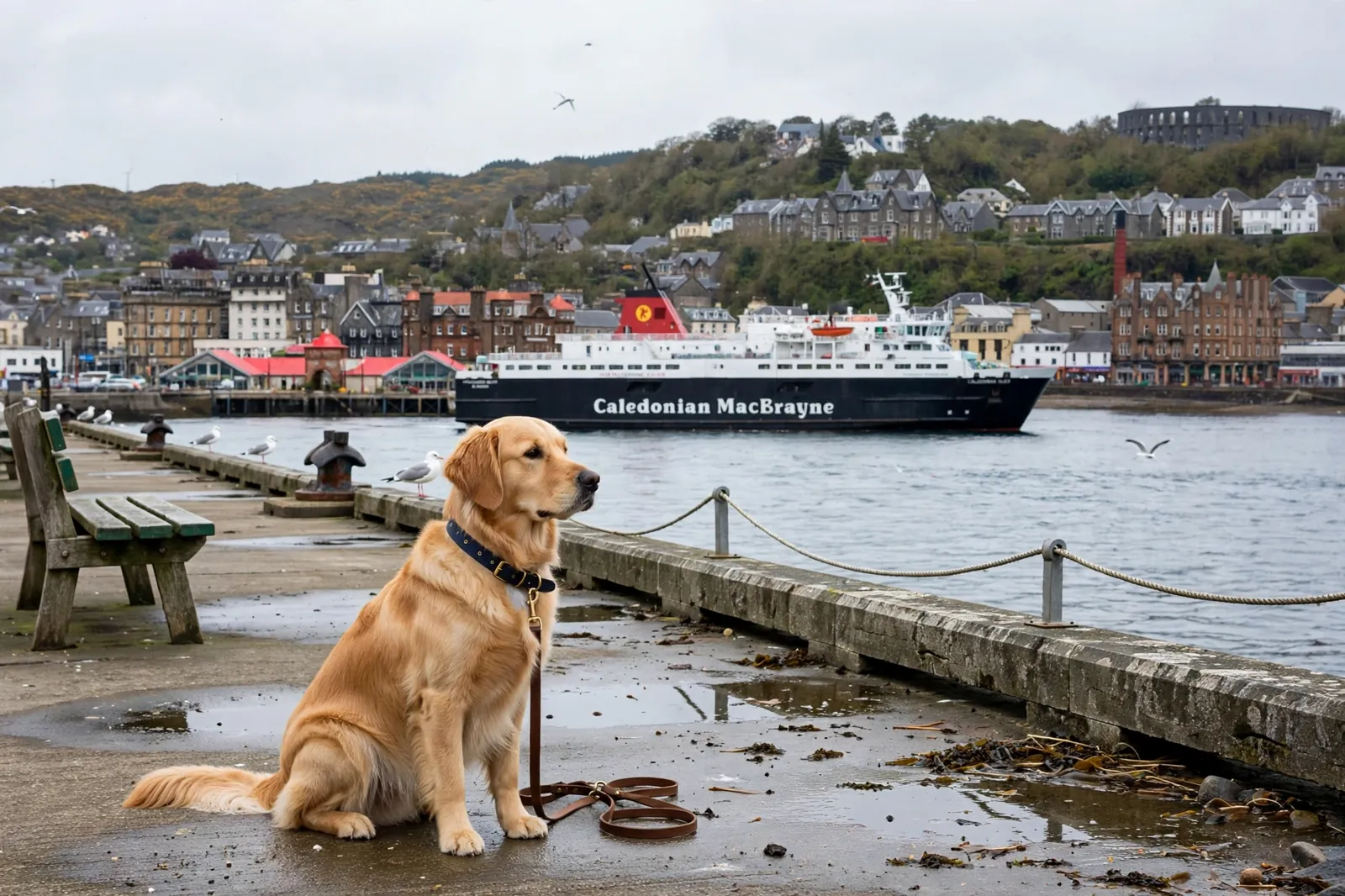
There is no bridge to Mull, and that single fact sets the tone of the whole holiday. Most visitors arrive by CalMac ferry from Oban to Craignure, a crossing of around 45 minutes, and then drive the roughly 20 miles north to Tobermory. The drive itself is part of the introduction: a single-track road in places, with passing places, sheep, and views that make the dog in the back seat entirely irrelevant to the humans in the front. Book the ferry as early as you can, especially if you are travelling with a vehicle in summer, because popular sailings sell out and the next available crossing may be hours later or the following day.
There is also a smaller CalMac crossing between Kilchoan on the Ardnamurchan peninsula and Tobermory itself, which suits travellers coming up the west coast of the mainland. It lands you directly in the town, which is a lovely arrival, but it is a smaller vessel with less capacity, so the same advice applies: book ahead and check the official guidance before you travel. Our wider guide to the island covers the choice between the two routes in more detail; see our Isle of Mull with a dog guide for the ferry-first planning that applies to the whole island.
Foot passengers have the easiest time with dogs. You can walk on, keep the dog on a lead, and enjoy the crossing on deck or in the passenger areas according to the vessel's rules. Dogs usually travel free on CalMac services, but do not assume the arrangement on your particular sailing: check the official guidance before you travel, and ask the crew where dogs are welcome once on board. Some vessels have a designated pet area, some expect dogs to stay on the outside decks, and some allow well-behaved dogs in parts of the passenger lounge. The rule that never changes is that your dog should be on a lead and under control from the moment you step onto the pier.
If you are travelling with a vehicle, the dog will normally stay in the car during the crossing, so prepare the car as if it were a short stay in itself. Park in the shade if you can, leave a window cracked for ventilation, make sure the dog has had water and a toilet break before boarding, and leave something familiar in the car, such as the dog's bed or a blanket that smells of home. The Oban to Craignure crossing is short enough that most dogs settle quickly, but a nervous dog benefits from a calm boarding routine: arrive early, walk the dog around the terminal area before you drive on, and keep your own manner unhurried. Our guide to dogs at UK ferry terminals covers the check-in and waiting routine that applies before you board.
Plan the arrival as carefully as the crossing. If you land at Craignure, the drive to Tobermory takes around 45 minutes to an hour depending on traffic and how often you stop at passing places. Give the dog a toilet break at Craignure before you set off, and resist the urge to rush: single-track roads reward patience, and pulling into a passing place to let a local driver through is part of the etiquette. If you land at Tobermory itself on the Kilchoan ferry, you are already there — walk the dog along the harbour front first, check in second, and let the holiday start the way it means to go on.
One more practical point: build slack into the journey home as well as the journey out. Ferries can be delayed or cancelled in bad weather, and a missed sailing can mean a night in Oban rather than a drive home. Keep a little extra dog food, medication and water in the car, know where the nearest vet is on the mainland as well as on Mull, and treat the ferry timetable as a plan rather than a promise. Island travel is forgiving if you leave room for it and stressful if you do not.
The harbour front, walked at a dog's pace
The harbour front is Tobermory's main street, its promenade and its living room, all in one short stretch of quay. The best way to walk it with a dog is slowly, on a lead, in both directions, with no destination in mind. Start at one end, follow the pavement past the painted houses, stop where the dog stops, and let the smells do the work. Dogs read a harbour the way humans read a newspaper: every rope, crate and puddle is a headline, and a ten-minute stroll can be as tiring as a much longer walk if you let the dog sniff properly.
Keep the lead short and the dog on the pavement side, away from the road and the water's edge. The quay is a working waterfront: vehicles reverse towards boats, mooring lines run across walkways, and the drop into the harbour is real. Small dogs should be kept well back from the edge, and no dog should be off lead here, however well behaved it is at home. The pavement is narrow in places, and on a busy afternoon you will be sharing it with other walkers, pushchairs and people carrying fish and chips, so a dog that lunges at food or other dogs needs a little management and a little space.
There are two directions worth knowing. Walking west from the centre takes you towards the quieter end of the bay, where the houses thin out and the water opens up towards the Sound of Mull; walking east takes you towards the pier and the ferry terminal, where there is more activity and more to watch. Neither is better than the other. The westward stretch suits a calm morning walk and a dog that likes to look at the water; the eastward stretch suits an evening wander when the fishing boats are coming in and the light is doing its best work on the painted facades.
Above the harbour, the town rises in a steep bank of houses, and a short climb up the lanes behind the waterfront gives a completely different view back across the bay. These lanes are quiet, residential and worth a wander, but they are steep, and the pavements are narrow, so take them at the dog's pace and avoid them in icy weather. An older dog or a dog with sore joints will be happier staying on the flat quay, and there is no shame in that: the flat walk is the good walk, and the view from the water's edge is the one the postcards use.
The harbour front is also where Tobermory's small museum and the distillery sit, and both are worth a look from the outside even if you do not go in. The distillery is one of the town's landmarks, and while tours and tastings are a humans-only activity, the building and its surroundings make a fine stopping point on a walk. Check the official guidance before you travel for current opening times and whether dogs are welcome in any part of a venue you plan to visit, because policies at individual attractions change and are not always published clearly.
Finally, treat the harbour as the dog's toilet plan as well as its walk. There are no vast grassy areas on the quay itself, so build the harbour stroll into a longer loop that includes a greener patch: the walk up towards Aros Park, or a drive to a beach, or simply the grassy edges on the way out of town. Carry bags, use the bins provided, and remember that a small town notices a careless dog owner quickly. Tobermory is generous to visiting dogs; the least we can do is leave the pavement exactly as we found it.
Aros Park: the woodland walk that earns the town
If the harbour front is Tobermory's sitting room, Aros Park is its garden — and it is the walk that turns a pleasant town break into a proper dog holiday. The park sits just south of the town, a short drive or a longer walk away, and it packs woodland trails, a waterfall, a loch-side stretch and views over the Sound of Mull into a compact area. For a dog that has spent the morning on a lead along a pavement, the change of surface, smell and sound is immediate: leaf litter underfoot, water somewhere below, and the kind of shade that makes a warm day bearable.
The trails vary, so choose according to the dog you have. The lower paths are gentler and suit older dogs, puppies and anyone who wants a straightforward out-and-back; the higher trails climb through the trees and reward the effort with views, but they involve steps, roots and uneven ground that are hard work for a stiff-legged dog. A good default is to take the lower loop first, see how the dog is moving, and only add the climb if the dog is clearly still keen. There is no prize for the longest route, and a dog that comes home tired but sound is worth more than a dog that comes home exhausted and lame.
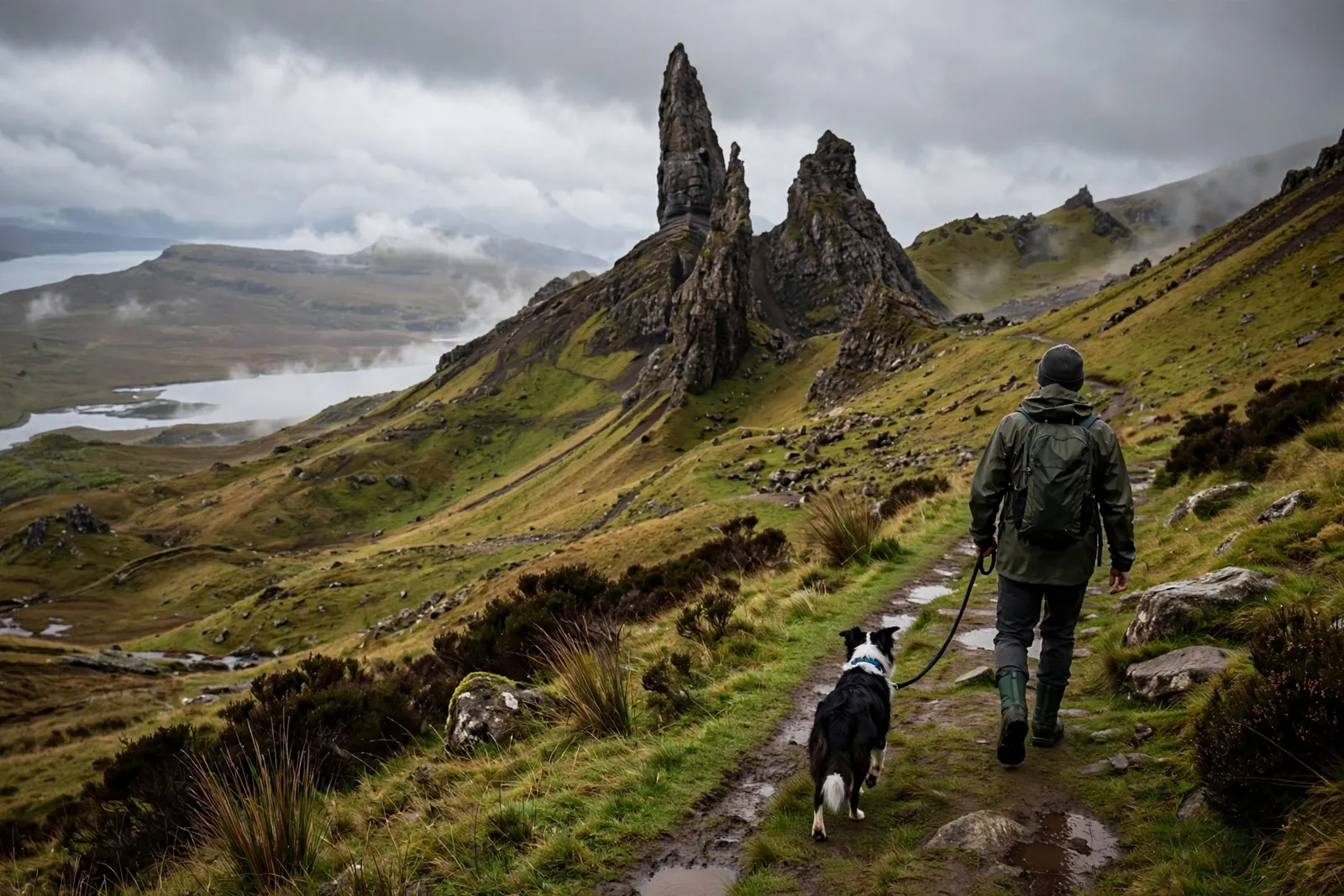
Water is the park's great joy and its main hazard, in equal measure. The waterfall and the burns that run through the woods are beautiful, and many dogs will want to paddle, drink and investigate. Let them, but watch the flow after heavy rain, when a cheerful burn becomes a fast, cold torrent, and keep a lead on any dog that would follow the water over a drop. The waterfall viewpoint itself deserves a lead and a steady hand: it is a place to stand, look and take a photograph, not a place for a dog to scramble. After rain, the paths are muddy and the wooden steps can be slippery, so a dog that pulls will pull you both into trouble; a harness with a handle and a short lead is the right kit here.
Time the visit well and you will have the woods largely to yourself. Early morning and late afternoon are the quietest, and the light through the trees at those hours is the best of the day. Midday in summer brings more walkers, more dogs and more midges, which is a combination worth planning around rather than enduring. If your dog is reactive, go early, keep the dog on a lead on the narrower paths, and use the wider tracks and open viewpoints as the places to let the dog relax and look around.
Pack for the woods as you would for any Scottish woodland walk: water for the dog, a collapsible bowl, a towel for the car, and a lead you do not mind getting muddy. There are no shops in the park, and the nearest facilities are back in town, so bring what you need and take everything home again. Check the official guidance before you travel for current access information and any seasonal restrictions, and if the ground is very wet or a storm has come through, consider the lower paths only or save the park for another day — fallen branches and flooded trails are not a dog walk, they are a rescue waiting to happen.
Beaches and water: where dogs can paddle and where they cannot
Tobermory itself is a harbour, not a beach town, so the sandy days require a short drive — and the drive is worth it. The best-known beach within easy reach is Calgary Bay, on the west coast of Mull, roughly 40 minutes by car from Tobermory. It is a wide, pale-sand bay with shallow water, dunes behind it and room for a dog to run properly, and it is the place most Tobermory visitors mean when they talk about a beach day. Go early or late in the day and you may have a long stretch of sand to yourselves; go at midday in high summer and it will be shared with families, picnics and other dogs, which is fine if your dog is sociable and a reason to choose another spot if it is not.
Closer to town, the shore is rockier and more intimate: small coves, shingle strands and flat rocks where a dog can paddle, sniff rock pools and watch the boats without the wide-open space of a big beach. These spots suit a short outing rather than a whole afternoon, and they suit a dog that likes water in small doses. Check the tide before you go, because a cove that is generous at low water can disappear at high water, and a dog that has scrambled down to the shore needs a way back up. Keep the lead on until you can see the whole stretch and know there is nothing — livestock, a nesting bird, a seal hauled out on the rocks — that your dog should not be chasing.
Seals are a genuine consideration on Mull. They haul out on rocks and beaches around the island, and a dog that charges at a seal is in danger from the animal, from the rocks and from the water. If you see seals, keep the dog on a lead, give the animals a wide berth, and move on. The same goes for livestock: sheep graze close to the shore in places, and the rule is simple and absolute — a dog that chases sheep is a dog that should not be off lead anywhere near them. Mull's farmers are patient with visitors, but sheep worrying is a criminal offence and a dead sheep is a ruined holiday for everyone involved.
Water safety deserves a paragraph of its own, because Hebridean water is cold even in August. A dog that swims happily in a warm lake at home can tire quickly in cold sea water, and currents around headlands and harbour mouths are stronger than they look. Let a keen swimmer paddle and splash in the shallows, keep a nervous swimmer on a long line, and never throw a ball into deep water or into a current. After a swim, dry the dog properly before the drive home: a wet dog in a cold car is a miserable dog, and a drying coat earns its place in the packing list on Mull more than almost anywhere else in Britain.
Seasonal restrictions are the last thing to check. Some beaches have dog restrictions during the summer months, and the rules are set locally, so the only reliable approach is to check the official guidance before you travel and to read the signs at the beach entrance when you arrive. If a beach is restricted, there is always another cove a few miles further on; Mull has no shortage of shoreline, and a restricted beach is an invitation to explore, not a reason to argue with a sign.
Eating and drinking with a dog in Tobermory
Tobermory's eating scene is small, independent and seasonal, and that is part of its charm — but it also means you should plan meals with the dog in mind rather than assuming you can walk in anywhere. Many of the town's cafes and pubs welcome dogs, often in a particular area, in the bar rather than the dining room, or on the terrace when the weather allows. Policies vary by venue and by season, and they can change without the website catching up, so the reliable method is to ask when you arrive, or to phone ahead if the dog is large, reactive or simply needs a bit of space.
The practical routine is the same one that works everywhere: arrive slightly off-peak, choose a table at the edge of the room or near the door, settle the dog on its mat under the table, and give it something to do. A stuffed chew or a long-lasting treat turns a forty-minute meal into a manageable wait for the dog, and a dog that is lying down chewing is a dog that is not staring at the next table's chips. Bring water and a bowl, or ask for one — many places will happily provide a bowl, but do not rely on it. Keep the lead short and attached to you, not to the furniture, so a sudden movement does not drag a chair across the floor.
Fish and chips by the harbour is the classic Tobermory meal, and it is also the most dog-friendly format of all: buy it, find a bench or a quiet stretch of quay, and eat it with the dog sitting beside you. The same applies to a takeaway sandwich or a coffee: the harbour front is the town's dining room, and a dog is entirely at home there. Just keep the food out of the dog's reach — chips are salty, fish batter is fatty, and a gull will take your lunch faster than a dog will, so eat with one eye on the sky.
Self-catering changes the equation entirely, and for many dog owners it is the best way to eat in Tobermory. A cottage or flat with a kitchen means the dog's routine stays intact, meals happen at home time, and nobody has to negotiate a restaurant with a tired dog at the end of a long walking day. If you are staying in a hotel or bed and breakfast, ask at booking whether dogs can be left briefly in the room while you eat, and what the rules are: some places allow it, some do not, and assuming the answer is yes is the fastest way to an awkward conversation with the owner. When in doubt, eat in shifts, take turns with the dog, or choose a takeaway and eat it together — the food tastes the same, and the dog stays settled.
One more note for the evening: Tobermory's pubs are social places, and a well-behaved dog is usually welcomed as part of the furniture. A dog that barks at strangers, guards the table or cannot settle is not having a good time and is not giving anyone else a good time either, so read the dog honestly. A short evening visit with a tired, settled dog is a pleasure; a long evening with a wired, anxious dog is a chore for everyone. The harbour walk afterwards, in the quiet of the evening, is often the best part of the day anyway.
Where to stay: what to ask before you book
Tobermory's accommodation is mostly small-scale: hotels, guest houses, self-catering cottages and flats, and a scattering of bed and breakfasts. There is no big resort and no sprawling holiday park, which means the dog policy is set by the individual owner rather than a head office — and that is good news, because it means a conversation can solve most problems. The mistake is to book on the strength of a "dog-friendly" filter and ask the questions afterwards. Ask first, book second.
Start with the questions that actually change the stay. How many dogs are allowed, and is there a charge per dog or per stay? Is there a size or breed condition? Can the dog be left alone in the room, and for how long? Is there an enclosed garden or a secure area, and how high is the fence? Where is the nearest place for a late-night toilet walk, and is it lit? These are the same questions that matter anywhere, but they matter more on an island, where the alternative accommodation may be a ferry ride away and a misunderstanding on arrival is much harder to fix.
Location within the town matters too. A place on the harbour front puts the morning walk on your doorstep and the evening stroll within minutes, but it also puts you closest to the noise of the pier, the gulls and the early-morning boats. A place up the hill is quieter and often has better views, but it adds a steep walk to every outing, which an older dog will feel by the third day. A place on the edge of town, towards Aros Park, is the quietest option of all and the closest to the woods — ideal for a reactive dog, less ideal if you want to pop out for coffee without the car. There is no wrong answer, only a wrong answer for your particular dog, so match the location to the dog rather than to the photographs.
Book early, and book the ferry before the accommodation if you possibly can. Tobermory is a small town with a limited number of beds, and the best dog-friendly places — the ones with enclosed gardens, ground-floor rooms and a genuinely welcoming attitude — are booked months ahead for the summer. In winter, the position reverses: there is more choice, prices are lower, and a last-minute booking is realistic, but some places close for the season, so check that your chosen stay is actually open on your dates rather than assuming it is.
Drying space is the feature that separates a good Tobermory stay from a bad one, and it is the question most people forget to ask. Mull is wet, the dog will get wet, and a cottage with a boot room, a tiled utility area or even just a covered porch is worth more than a sea view. Ask where you can dry the dog, where wet leads and coats can hang, and whether there is a washing machine for dog bedding. If the answer is vague, pack extra towels and a drying coat, and plan to dry the dog in the car with the heater on before you go inside — it is not elegant, but it works.
Finally, think about the car. Parking in Tobermory is limited, especially in summer, and some accommodation includes a space while some does not. If you have to park away from your stay, an older or nervous dog will have a longer walk to the car at the start and end of every day trip, which is a small friction that adds up over a week. Ask where you will park, how far it is from the front door, and whether you can unload the dog and the bags first. For the wider island picture, including the choice of base and the cost of a week, see our Isle of Mull with a dog guide, and if Oban is your gateway, our Oban with a dog guide covers the mainland side of the journey.
Rain, midges and weather: the contingency kit
Mull's weather is the island's personality, and it changes its mind several times a day. A morning of sunshine can turn into an afternoon of horizontal rain, and a forecast that promised a washout can clear by lunchtime. The dog does not mind the rain nearly as much as the humans do, but the humans have to drive, navigate and dry the dog afterwards, so the weather plan is really a humans plan with the dog's comfort built in.
The first rule is to dress for the walk you are going to have, not the walk you hope to have. Waterproofs for everyone, including a drying coat for the dog, a waterproof lead that does not get heavy and cold when wet, and a towel that lives in the car permanently. The second rule is to have a short walk and a long walk in mind every morning, and to choose between them based on the sky rather than the diary. Aros Park's lower trails work in most weather; the exposed headlands and the higher trails do not, and there is no shame in swapping a grand plan for a sheltered woodland loop. The dog will not know the difference, and will probably prefer the woods anyway.
Midges deserve their own warning, because they are the one Tobermory hazard that can genuinely ruin a still evening. From roughly June to August, especially at dawn and dusk, in sheltered, damp, windless spots, midges gather in clouds, and they bite humans far more than dogs — but a dog with a thin coat, a bare belly or sensitive ears will feel them too. The defences are simple: walk in a breeze or in the middle of the day, avoid still, damp hollows at dusk, carry repellent for yourself, and dry the dog off and get it indoors rather than lingering outside. A midge net for the human and a quick retreat to the cottage is a better plan than standing on a still evening hoping the midges will lose interest.
Wind is the other Hebridean constant, and it matters for ferry travel more than for walking. A windy day can mean a delayed or cancelled sailing, so check the ferry status before you drive to the pier, and never plan a same-day connection — a flight, a train, a non-refundable hotel — that depends on a ferry running exactly on time. Keep the car fuelled, keep the dog's food and medication in the car rather than in luggage that might be on the other side of a cancelled sailing, and treat a weather delay as part of the holiday rather than a disaster. The island will still be there tomorrow, and so will the painted houses.
When the weather really closes in, Tobermory still has things to do with a dog, just at a slower pace. A harbour stroll in the rain, with the dog in its coat and the humans in waterproofs, has its own bleak charm; a drive around the north of the island with the dog watching the weather from the back seat is a legitimate day out; and an afternoon in a dog-friendly cafe, with the dog asleep under the table and the rain on the window, is a holiday memory in its own right. The contingency kit is not really a list of things. It is a state of mind: expect the weather to change, carry the kit, and let the island set the pace.
Day trips from Tobermory: the north of Mull
Tobermory sits at the northern end of Mull, which makes it the natural base for the north of the island and a reasonable starting point for the whole of it. The single most important thing to know about driving on Mull is that the roads are often single-track, with passing places, and that a journey that looks short on the map can take twice as long as expected. Plan one destination a day, not three, and let the drive itself be part of the outing.
West from Tobermory, the road runs through Dervaig and on to Calgary Bay, the beach described earlier, and the drive is one of the prettiest on the island: moorland, standing stones, glimpses of the sea, and the kind of light that makes photographers stop the car at every passing place. Dervaig itself is a small village worth a stop, with a church, a tearoom in season, and a quieter pace than Tobermory. Keep the dog on a lead in the village, as everywhere with livestock nearby, and use the stop as a leg stretch rather than a destination in itself.
South from Tobermory, the road runs down the east coast of the island to Salen and Craignure, and on to the south of Mull for the determined. The drive to Craignure takes under an hour and is worth doing even if you have no ferry to catch: the road hugs the Sound of Mull, the views across to the mainland are superb, and there are places to stop, walk the dog and look at the water. If you continue further south, the island opens out into wilder country, with the road to Fionnphort and Iona at the far end — a long day from Tobermory, and one that should be attempted only if the dog is a good traveller and the weather is kind.
Loch Frisa, inland from Tobermory, is worth a mention for wildlife watchers: it is one of the places on Mull associated with white-tailed eagles, and the surrounding woodland and moorland make a fine walk. If you go looking for eagles, go quietly, keep the dog on a lead and under close control, and remember that the eagles are the reason for the lead rule, not an exception to it. Mull's wildlife is a privilege, not a playground, and the dogs that do best on the island are the ones whose owners treat every walk as a walk through someone else's home.
Two practical rules govern every day trip from Tobermory. First, fuel: fill up in Tobermory before you leave, because filling stations on Mull are few and far between, and the one you are counting on may be closed or out of fuel. Second, time: start back earlier than you think you need to, because a single-track road, a flock of sheep, a tractor and a wrong turn can each add twenty minutes, and they have a habit of arriving together. A day trip that ends with a calm harbour walk at dusk is a good day trip; a day trip that ends with a race against the dark is not.
Vets, supplies and the practical checklist
Before you travel, save the details of the veterinary practice on Mull and the nearest practice on the mainland, and keep the numbers in your phone rather than in a bag that might be in the car. Island practices are small, opening hours can be limited, and out-of-hours cover may involve a journey, so knowing the number in advance is worth more than any amount of packing. Check the official guidance before you travel for current practice details and opening times, because these change and are not always easy to find once you are on the island.
Supplies are the next thing to think about, because Tobermory's shops are small and their ranges are limited. Bring the dog's usual food for the whole trip, plus a day or two extra in case a ferry delay extends your stay; bring any medication with a margin for the same reason; and bring the dog's regular treats and chews, because the exact brand may not be on the shelf. The town has a supermarket and a handful of shops that cover the basics well, but a specialist diet, a particular medication or a favourite toy is a mainland purchase, not an island one.
The packing list for a Tobermory dog trip is short but specific. A drying coat and two towels. A waterproof lead and a spare lead. A harness with a handle for the slippery paths at Aros Park. A collapsible bowl and water for the car. Poo bags, more than you think you need. A torch or a light that clips to the dog's collar or harness, because winter afternoons go dark early and the harbour front is not brightly lit everywhere. A mat for cafes and pubs. A first-aid kit with the basics: tick remover, antiseptic wipes, bandage, and the number of your own vet. And a blanket that smells of home, for the car, the ferry and the accommodation.
Ticks are worth a specific mention. Mull has deer, sheep and long grass, and ticks are a real possibility from spring to autumn. Check the dog after every walk, especially around the ears, armpits and groin, carry a tick remover and know how to use it, and make sure the dog's tick prevention is up to date before you travel. If you find a tick, remove it promptly and watch the bite site for the next few days. Adders are present in Scotland, including on Mull, though encounters are rare; the practical advice is the same as anywhere in the Highlands: keep the dog on paths in warm weather, do not let it nose into rock piles or dense bracken, and know the signs of a bite so you can get to a vet quickly if it happens.
Finally, the paperwork. Make sure the dog's microchip details are up to date, carry the pet insurance details, and keep a photograph of the dog on your phone in case it gets lost. Mull is an island, but a lost dog on an island is still a lost dog, and a clear recent photograph and a working phone number on the collar tag are the two things that bring dogs home fastest. Tell your accommodation where you are walking each day, or at least leave a note of the plan, so that if something goes wrong, someone knows where to start looking. It is a small habit, and it costs nothing.
Tobermory with a dog is not a complicated trip. It is a ferry, a harbour, a woodland walk and a beach, repeated at island pace until the dog is tired and the humans are calm. Book the ferry early, keep the dog on a lead where the town and the wildlife ask for it, pack for rain, and let the painted houses do the rest. Mull has a way of slowing people down, and a dog is the best possible companion for that particular lesson.
Practical questions
Before you go
Do dogs need a ticket on the CalMac ferry to Mull?
Dogs usually travel free on CalMac crossings, whether you are a foot passenger or travelling with a vehicle, but rules and booking arrangements can change, so check the official guidance before you travel. On board, dogs are generally expected to stay in the vehicle, in a designated pet area, or on an outside deck on a lead, depending on the vessel, so confirm the arrangement for your sailing in advance.
Can dogs walk the Tobermory harbour front off lead?
No, keep your dog on a lead along the harbour front. The quay is a working waterfront with vehicles, boats, mooring lines and open water, and the pavements are narrow in places. The harbour is best enjoyed as a slow on-lead stroll with plenty of sniffing stops, not as an off-lead run.
Is Aros Park suitable for dogs?
Yes, Aros Park is one of the best dog walks near Tobermory, with woodland trails, a waterfall and views over the Sound of Mull. Keep your dog on a lead on the steeper paths and near the water, carry water in summer, and expect muddy sections after rain. Check the official guidance before you travel for current access and any seasonal restrictions.
Are there dog-friendly beaches near Tobermory?
The best-known sandy beach within an easy drive is Calgary Bay, on the west of Mull, which is popular with dogs outside the busiest summer hours. Smaller coves and rocky shores closer to Tobermory suit a paddle and a sniff, but always check for seasonal restrictions, livestock nearby and tidal conditions, and check the official guidance before you travel.
Can I take my dog into Tobermory's cafes and pubs?
Many of Tobermory's cafes and pubs welcome dogs, often in a specific area or on the terrace, but policies vary by venue and by season, and they can change. Ask before you sit down, keep your dog settled under the table on a lead, and bring a mat and a chew so the dog has a job while you eat.
What should I pack for a dog trip to Mull in winter?
Pack for wind, rain and short daylight: a drying coat, two towels, a waterproof lead, a torch or light for the dog, and extra food in case a ferry is delayed or cancelled. Book accommodation with a drying space, keep the vet's number saved, and build slack into every day, because winter sailings are more likely to be disrupted by weather.