This guide is independent and contains no paid placement. If affiliate links are added later, they will be clearly marked and will not change our editorial checks.
Totnes rewards a downhill plan. Start near the top of the town, browse the high street and the Friday market on the way down, pause at Totnes Castle if the current dog rules allow it, then finish beside the River Dart where the walking is flat and the dog can decompress. On any uncertain point, from castle dog rules to market hours, check the official guidance before you travel.
Walk the town downhill
Most Devon towns ask a visitor to choose between a pretty centre and an easy walk. Totnes asks for a different kind of choice, and it is one that matters more when a dog is involved: which direction to walk the hill. The town rises from the River Dart to a castle on higher ground, and its main shopping street follows that slope. Walked uphill, it is a steady climb with shop windows pulling attention in every direction and a dog pulling in several more. Walked downhill, the same street becomes a gentle, stop-start stroll. The dog can sniff, the humans can browse, and nobody arrives at the river out of breath.
That single decision shapes the whole visit, and it is why this guide is organised as a route rather than a list. A list encourages ticking off attractions in whatever order seems logical on a map. A route respects the ground under the dog's paws. Older dogs, small dogs, dogs recovering from an injury and dogs that simply lose enthusiasm after twenty minutes of uphill work all benefit from gravity doing part of the job. Even a fit young dog benefits, because a downhill start leaves energy in reserve for the riverside walk at the end, which is where most dogs actually want to spend their time.
Practically, the downhill plan means arranging transport so the climb is not repeated. If you arrive by car, consider parking arrangements that let you start high and finish low, or accept a short uphill return at a slow pace with a rest built in. If you arrive by train, Totnes station sits at a distance from the centre, so the walk into town needs its own allowance of time and water, especially in warm weather. The point is not to avoid every slope in Devon, which would be impossible, but to spend the dog's best energy on the parts that are enjoyable and to avoid spending it on a return climb made in a hurry because a parking ticket is about to expire.
The downhill plan also changes how the town feels. At the top, the streets are narrower and more residential in character, and the castle gives a clear reason to pause and look back over the roofs. Halfway down, the town becomes busier, with more shops, more people and more smells. At the bottom, the river opens out the view and the pace changes again. A dog experiences that sequence as a series of distinct environments rather than one long, undifferentiated high street. That variety is good for enrichment, provided the transitions are managed: a short pause, a drink, a chance to watch the world go by before moving into the next, busier stretch.
There is a second, less obvious benefit to walking downhill. It makes it easier to leave. A visit that ends at the river, with flat paths and open sky, gives a tired or overstimulated dog a calm ending. A visit that ends with a climb back to the car, through the busiest part of town, risks ending on a sour note, with a dog that is tired, hot or fed up and humans who are trying to hurry. Ending low and calm is a small piece of trip design, but it is the kind of detail that decides whether a dog remembers a town as a pleasant place or a tiring one.
Friday market, dog and all
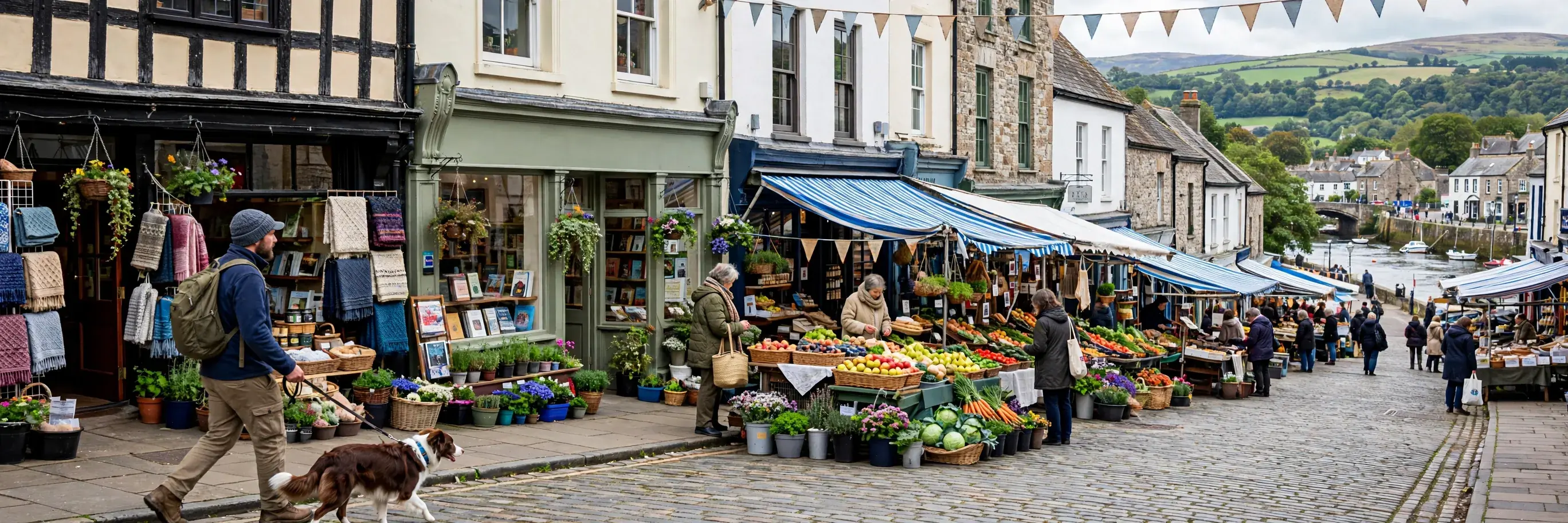
Totnes is known as an alternative, independent-minded market town, and Friday is the day when that character is most visible. Market stalls fill parts of the town centre, the high street gains extra colour and noise, and the usual mix of local shoppers, visitors and regulars becomes denser and livelier. For a human visitor, that is the attraction. For a dog, it is a test of crowds, food smells, dropped crumbs, other dogs on short leads and narrow gaps between stalls. Both things can be true at once, which is why Friday deserves its own section rather than a passing mention.
The first question is whether Friday is right for your particular dog. A sociable dog that enjoys people, tolerates being stepped around and settles quickly after a new smell will probably enjoy the buzz. A dog that is nervous in crowds, reactive to other dogs, protective of food or easily overwhelmed by noise may find the same market stressful, however well behaved it is at home. There is no virtue in proving a dog can cope with a market. A quieter weekday visit, when the same independent shops are open and the river walk is just as pleasant, is a better choice for that dog, and it still counts as a proper Totnes visit.
If Friday is the plan, timing matters more than enthusiasm. Markets build up through the morning, and the busiest period is usually the middle of the day, when shoppers, lunch seekers and stall browsers all arrive at once. An earlier start gives a dog more space between stalls, cooler air in summer and a better chance of a calm first pass. A later start, after the main lunch rush, can also work, but the dog should still be given a toilet walk and a drink before entering the busiest stretch, because a dog that needs the toilet is a dog that cannot settle. Check the official guidance before you travel for current market days and hours, since market schedules can change with the season and with local events.
Inside the market, the practical rules are simple and worth stating plainly. Keep the lead short, not because a long lead is rude in the abstract, but because a long lead in a market wraps around stall legs, other people's ankles and other dogs. Keep the dog on the side away from food stalls where possible, and do not let the dog help itself to dropped food, which may be hot, spiced or unsafe for dogs. Teach or reinforce a simple leave-it cue before the trip, and carry treats that are more interesting than whatever is on the ground. If the dog is small, be aware that crowds do not always see a dog at ankle height, and a bright harness or a clearly visible lead helps other people give space.
Shopping with a dog in a market also needs a system for the moments when one person wants to stop and look properly. The best system is unglamorous: take turns. One person holds the dog a few steps away from the stall, in a spot where the dog can sit and watch, while the other browses. Then swap. It is slower than browsing together, but it prevents the common market scene of a dog tied to a stall, a lead stretched across a walkway and two humans trying to have a conversation over a dog that is getting bored. If the dog shows signs of stress, such as yawning, lip licking, trying to pull away or freezing, treat that as information, not disobedience, and move to a quieter side street for a break.
What to buy is, of course, a matter of taste, and Totnes rewards slow browsing. Local food, crafts, plants, books and second-hand finds all appear in different weeks, and the mix changes with the season. From a dog owner's point of view, the most useful purchases are often the least glamorous: a bottle of water for the dog, a snack for the humans that does not need to be eaten while walking, and anything that can be carried without adding a swinging bag to a hand that also holds a lead. A small backpack, rather than a hand-held shopping bag, keeps one hand free for the dog and makes the downhill walk considerably easier.
Totnes Castle and the hilltop
Totnes Castle sits above the town on a grassy mound, a Norman motte-and-bailey castle with a stone keep and views over the rooftops to the River Dart and the Devon hills beyond. It is the town's most obvious landmark, and it is also the stop that needs the most careful checking before a dog visit. Historic sites change their dog rules by season, by event and by management decision, and a rule remembered from a previous visit may no longer apply. Check the official guidance before you travel, and plan the castle as a flexible stop: enjoyable if dogs are welcome in the areas you want to visit, easy to skip in favour of the hilltop streets and the river if they are not.
When dogs are welcome, a castle visit works best as a short, structured outing rather than a long, aimless wander. The mound and the keep involve steps and uneven ground, and the grass can be slippery after rain. An older dog or a dog with joint problems may prefer the lower, flatter ground around the site to the climb itself. A younger dog may enjoy the open grass and the new smells, but still needs a lead and a watchful eye around walls, drops and other visitors. In both cases, the visit should be timed so the dog is not already tired from a long uphill walk, which is another reason to think about where the castle fits in the downhill route rather than treating it as an afterthought.
The view is the real reward, and it is worth pausing for it even if the castle interior is not part of the plan. From the higher ground, the shape of Totnes becomes clear: the river below, the bridge, the curve of the valley and the patchwork of fields beyond. For a dog, the pause matters as much as the view. A few minutes sitting on grass, watching people pass at a distance, drinking water and doing nothing in particular is a useful reset before the busier shopping street. Dogs that are given these pauses tend to cope better with the next busy stretch than dogs that are marched from attraction to attraction without a break.
If the castle is not suitable for your dog on the day, Totnes still offers a hilltop experience without it. The streets near the top of the town are quieter, the buildings are interesting in their own right, and a slow walk down through them gives much of the same sense of place. Do not force a castle visit to justify the trip. A dog holiday is not improved by a photograph of a dog outside a gate it was not allowed to enter, and the river walk at the bottom of the town will matter more to most dogs than any historic interior.
Families with children and dogs should also think about splitting the castle stop. One adult can visit the keep while the other stays outside with the dog on the grass, then they can swap, provided the site rules and the queue allow it. This is not always practical, and it should not be assumed, but it is a useful fallback when a site welcomes dogs in its grounds but not inside a particular building. The key is to ask at the entrance, politely and specifically, rather than guessing from a sign or from what happened at a different castle on a different trip. For a wider sense of how the River Dart continues downstream, the guide to Dartmouth with a dog follows the same river to the coast, with embankment walks and ferry notes that pair naturally with a Totnes day.
The River Dart at the bottom
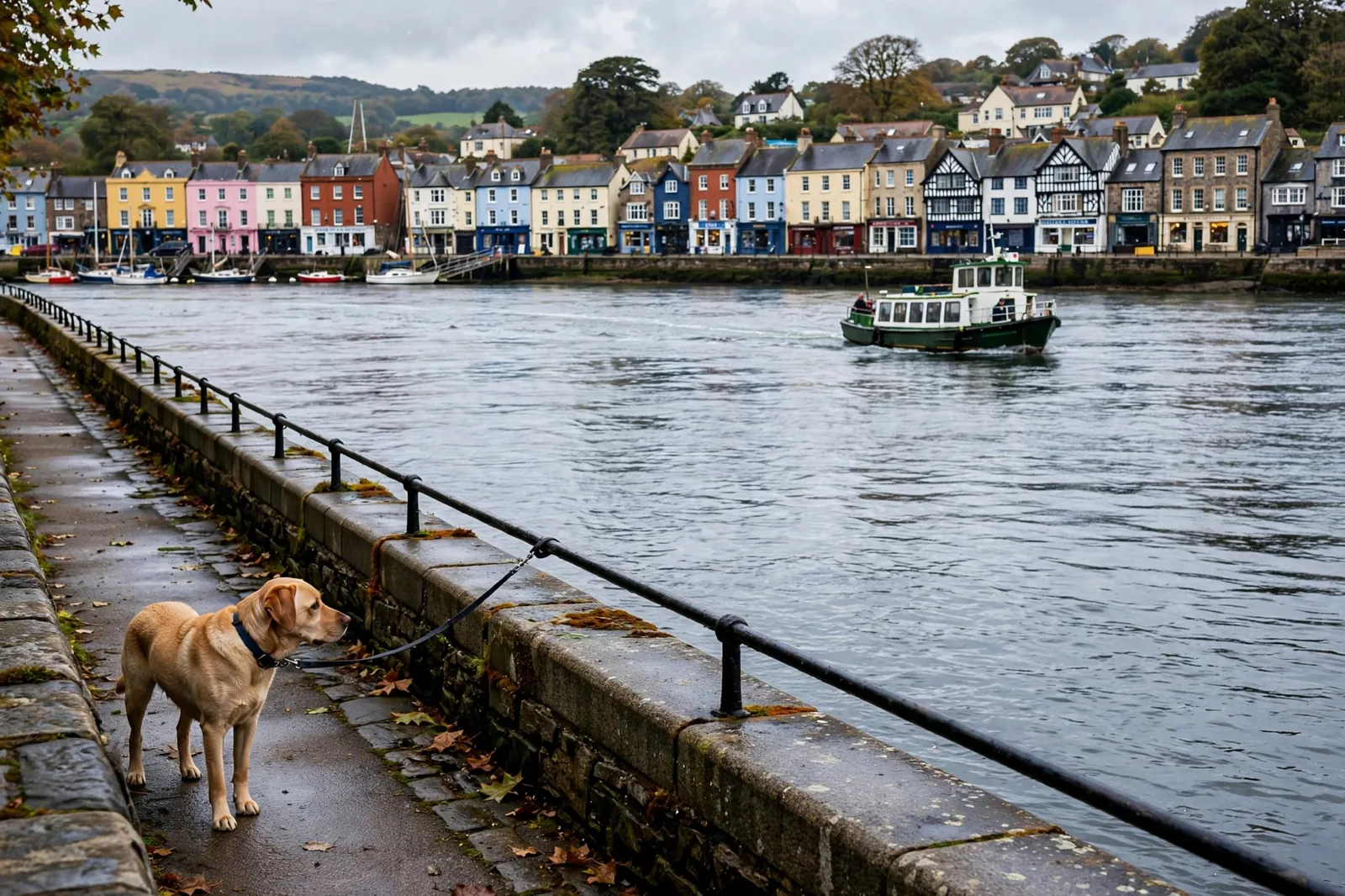
The River Dart is the reason Totnes feels different from an inland market town that happens to have a river. Here the river is tidal, wide and working, with boats, a quay area and a sense of movement that changes through the day. At high tide the water comes up close to the town; at low tide mud and banks appear and the river looks narrower and quieter. That tidal rhythm affects where a dog can walk, where a dog can paddle and how busy the riverside feels, so it is worth checking tide times as part of the day's planning rather than discovering them on arrival.
The riverside walk is the natural ending to the downhill route, and it should be treated as a reward, not a route to somewhere else. Flat paths, open views, ducks and boats to watch, and space for a dog to walk at its own pace all make it a good decompression walk. A decompression walk is not a training walk and it is not a march. It is a walk where the dog is allowed to sniff, stop, change direction within reason and generally process the busier parts of the day. A long lead, where it is safe and permitted, helps, because it gives the dog more choice without giving up control near water, cyclists or other walkers.
Water safety needs a clear-eyed paragraph, because the Dart looks inviting and is not a swimming pool. It is a tidal river with currents, deep sections, boat traffic and banks that can be slippery or muddy. Some dogs are strong, confident swimmers; others paddle happily in shallow edges and then panic in deeper water; others should not swim at all. The safe approach is to choose only a calm, shallow edge, only when the tide and current are clearly gentle, only where the dog can get out easily, and only if the dog is supervised at all times. Check the official guidance before you travel for any local restrictions, and if there is any doubt about depth, current or water quality, keep the dog on the bank. A riverside walk without swimming is still a good walk.
After swimming or paddling, even a brief one, think about the practical aftermath. A wet dog in a car, a cafe or a shop is a different proposition from a wet dog on a riverside path. Carry a towel and, in cooler weather, a drying coat, and give the dog a chance to shake off and walk dry before getting into a vehicle. Check ears and paws after a river outing, especially if the dog has been on muddy banks, and carry fresh water for drinking, because river water is not a substitute for clean drinking water. These are small habits, but they prevent the common end-of-day problem of a damp, muddy dog and humans who wish they had packed one more towel.
The river also connects Totnes to a wider Devon story. Downstream, the Dart flows through a wooded valley towards Dartmouth and the sea, and upstream it comes from Dartmoor. That geography explains why Totnes works as a base: a river town between moor and coast, with a railway and roads that make day trips possible without long drives every day. Visitors who want to follow the river to its mouth will find the Dartmouth guide useful, and visitors who want to go the other way, towards the moor, will find that the moor needs a different kind of preparation altogether, with livestock, open ground and weather that changes quickly.
Independent shops without the squeeze
Totnes has built its reputation on independent shops, and that reputation is part of the reason dog owners seek it out. Independent shops are often more flexible about dogs than large chains, because the person behind the counter can make a decision on the spot. That flexibility is real, but it is not a guarantee, and it varies from shop to shop, from day to day and from one dog to another. A well-behaved small dog may be welcomed everywhere; a large, excitable dog may be welcomed in some shops and politely asked to wait outside others. Neither outcome is a judgement on the dog or the shop. It is simply the reality of small, sometimes narrow, retail spaces.
The layout of Totnes shops matters for dogs. Many are in historic buildings with narrow doorways, tight turns between displays and low shelves at dog-nose height. A dog on a short lead, walking close to its owner, can navigate these spaces well. A dog on a long lead, a retractable lead or a lead held loosely while the owner browses with both hands cannot. The difference is not about training in the abstract; it is about the physical space. Before entering a small shop, shorten the lead, put a shopping bag in a backpack or over a shoulder, and decide in advance whether this is a quick look or a long browse. A quick look with a dog is fine. A long browse with a bored dog in a narrow aisle is not fair on the dog, the shopkeeper or other customers.
Food shops need extra care. A shop selling cheese, bread, chocolate or other open food will have hygiene rules that a bookshop or clothing shop does not, and a dog should not be allowed to sniff open produce, lick counters or beg from samples. If a food shop welcomes dogs, that welcome usually comes with an expectation that the dog stays on the floor, on a lead and away from the counter. Respecting that expectation keeps the welcome in place for the next dog owner. If a shop does not welcome dogs, accept it graciously and take turns outside, rather than arguing the point at the door.
There is also a shopping strategy that suits Totnes particularly well: browse first, buy later. Because the route is downhill, it is tempting to buy at every interesting shop and carry everything to the river. A better approach is to note what you want, enjoy the browsing, and buy on the way back up only what is genuinely wanted, or arrange to collect larger items later. This keeps hands free for the dog, keeps bags from swinging into displays and keeps the walk pleasant. It also gives a natural reason to pause in a cafe halfway down, which is often when the best decisions about purchases are made anyway.
For visitors who collect particular things, Totnes rewards patience. Second-hand books, vintage items, local crafts, natural health products, wholefoods and artisan goods all appear in different shops, and the mix changes as shops open, close and change hands. Rather than hunting for a specific item in a specific shop, which can lead to disappointment if that shop has changed, it is better to treat the town as a place to discover what is there on the day. That attitude suits a dog walk, too: the dog does not care about a shopping list, and the humans enjoy the town more when the list is a guide rather than a test.
Eating and drinking with a dog
Eating out with a dog in Totnes is usually straightforward, but it works best when it is planned around the dog's needs rather than fitted in as an afterthought. A dog that has already had a walk, a drink and a toilet break will settle under a table far more easily than a dog that is taken straight from a car into a busy cafe. A dog that is hungry, tired or overstimulated will struggle in any cafe, however dog-friendly the sign on the door claims it to be. The order of operations matters: walk first, then eat.
Outdoor seating is the easiest option in good weather, and Totnes has plenty of places where a dog can lie beside a table without blocking a walkway. The usual courtesies apply: keep the dog on the side away from passing people, do not let the lead stretch across a path, and bring a mat or blanket if the ground is cold or wet, so the dog has a defined place to settle. Indoors, the rules vary more. Some cafes and pubs welcome dogs throughout; others welcome dogs in one room but not another; others allow dogs only at certain times. Asking before sitting down, rather than after ordering, avoids the awkward moment of being asked to move with food already on the table.
Food for the dog deserves a short note, because market towns are full of tempting smells. A dog should not be fed scraps from a cafe table, however pleading the eyes, because rich, spiced or fatty food can cause stomach upsets that ruin the rest of the day and the drive home. Bring the dog's usual treats, and if a cafe offers a dog biscuit or a bowl of water, accept it as a bonus rather than a meal. Fresh water should always be available, and in warm weather it should be offered frequently, not just when the dog asks. A collapsible bowl weighs almost nothing and saves the embarrassment of trying to balance a dog's drink in a borrowed saucer.
Timing a meal is also a piece of dog management. Eating at the busiest lunch hour, in the busiest cafe, with a dog that is already tired from the market, is a recipe for restlessness. Eating slightly earlier or slightly later, in a quieter spot, often produces a calmer dog and a more relaxed meal. If the dog cannot settle, it is better to take food to go and eat it beside the river, where the dog can lie on grass and watch boats, than to persist with an indoor meal that is stressful for everyone. Totnes lends itself to this approach, because the river is never far from the centre and a takeaway eaten outdoors can feel like a proper part of the day rather than a compromise.
Evening meals need a separate decision. Some visitors stay in Totnes for dinner; others return to their accommodation. If dinner is planned in town, check dog rules in advance, because evening rules can differ from lunchtime rules, and a pub that welcomes dogs at midday may have a different policy in a busy evening. If the dog is staying at the accommodation, follow the accommodation's rules about leaving a dog alone, which are often stricter than owners expect. A dog that is left alone in an unfamiliar place, after a stimulating day, may bark or become anxious, and that is a problem for neighbours as well as for the dog.
Longer walks from Totnes
Totnes is a good starting point for longer walks, but the walks that work best are not simply longer versions of the town walk. They need different preparation, different expectations and, in some cases, a car or a bus to the starting point. The three directions that make most sense are along the river valley, towards Dartmoor and towards the South Devon coast. Each has a different character, and each suits a different kind of dog and a different kind of day.
River valley walks, including the paths towards Dartington, offer the gentlest extension of a Totnes day. They are generally flatter, greener and more sheltered than moorland walks, with shade in summer and a clear path to follow. They suit older dogs, dogs that prefer a steady pace and families who want a walk that can be shortened easily. The main cautions are mud after rain, cyclists sharing paths and livestock in some fields, so a lead should be carried even on a walk where the dog is mostly off lead. Check the official guidance before you travel for current path conditions and any seasonal restrictions.
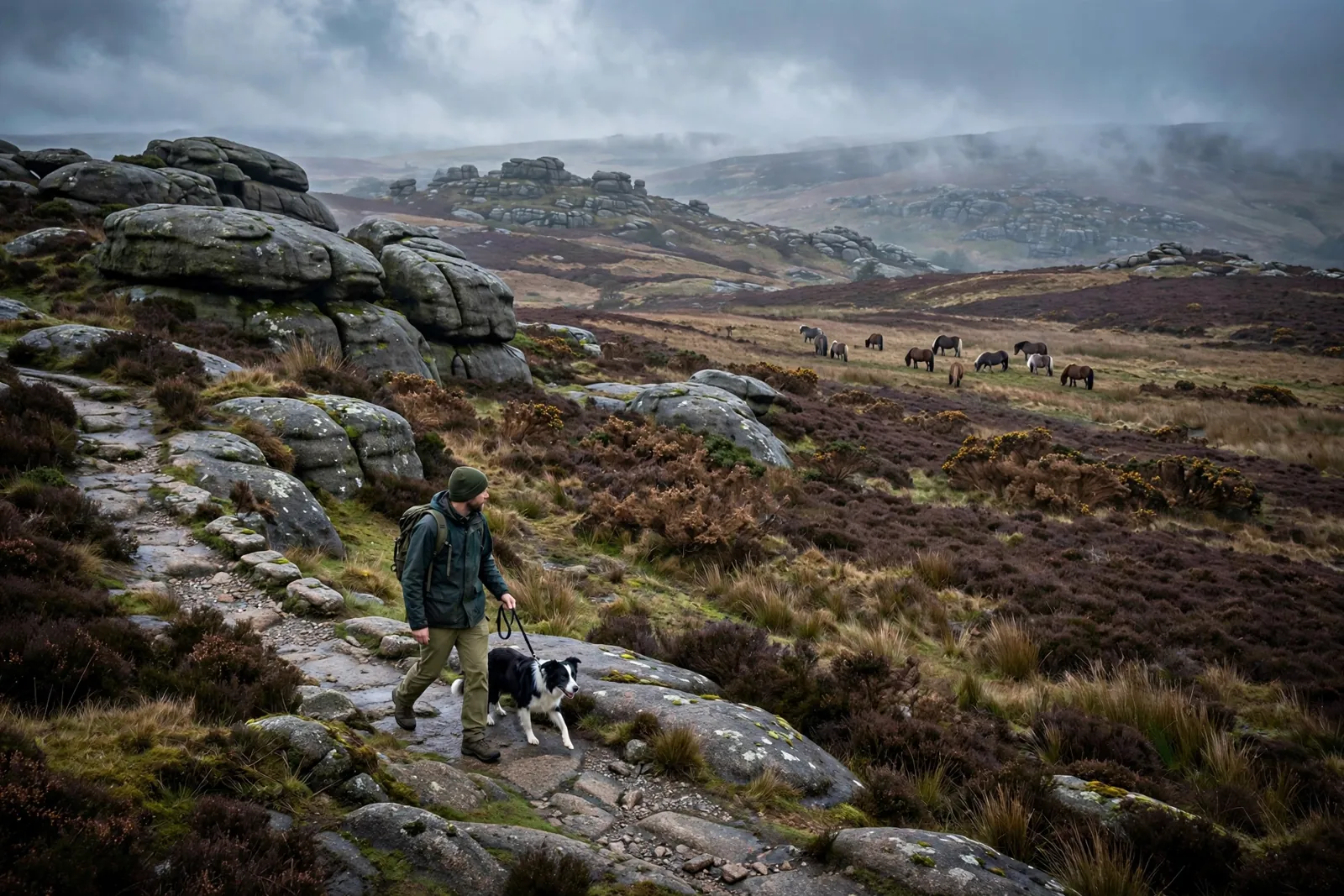
Dartmoor is a different proposition. The moor is open, exposed and beautiful, with wild ponies, sheep, cattle and ground-nesting birds in season, as well as military training areas with their own access rules. A Dartmoor walk with a dog needs a map, water, weather awareness and a clear understanding of when the dog must be on a lead. It is not a walk to improvise on a hot day without preparation. The guide to Dartmoor dog walks covers tors, ponies, livestock rules and river safety in detail, and it is worth reading before a first moorland outing rather than after a problem on the moor.
Coastal walks, towards Dartmouth, Torbay or the South Hams, add sea air, cliff paths and beach rules that change by season. Many South Devon beaches restrict dogs in summer months, while others welcome dogs all year, and the difference is not always obvious from a beach name alone. A coastal day from Totnes therefore needs a beach check before departure, a plan for shade and water, and an honest assessment of whether the dog can cope with cliff steps and exposed paths. The Dartmouth guide, already mentioned above, is a useful next step for the coastal direction, and the wider choice between the two counties is set out in Cornwall versus Devon with a dog, which compares beach rules, drive times and prices.
For a longer stay, the best pattern is usually one main walk a day, not two. A morning walk, a long lunch, a quiet afternoon and a short evening toilet walk suits most dogs better than a packed itinerary. Totnes supports that pattern well, because the town itself is an attraction on a rest day: a slow morning in the shops, a riverside sit and an early night are a legitimate holiday, not a wasted day. Dogs, like humans, need rest days, and a dog that is given one will enjoy the next long walk far more than a dog that is walked hard every day until it is exhausted.
Parking, trains and wet weather
Practical details decide whether a Totnes visit feels easy or fiddly, and they are worth sorting before the day rather than on arrival. Parking in Totnes is in car parks around the town rather than a single central facility, and the walk from a car park to the high street varies in length and steepness. Check the official guidance before you travel for current car park locations, charges and time limits, and choose a car park that fits the downhill plan rather than the first one encountered. A car park that saves five minutes of driving but adds a steep climb with a dog is not a saving.
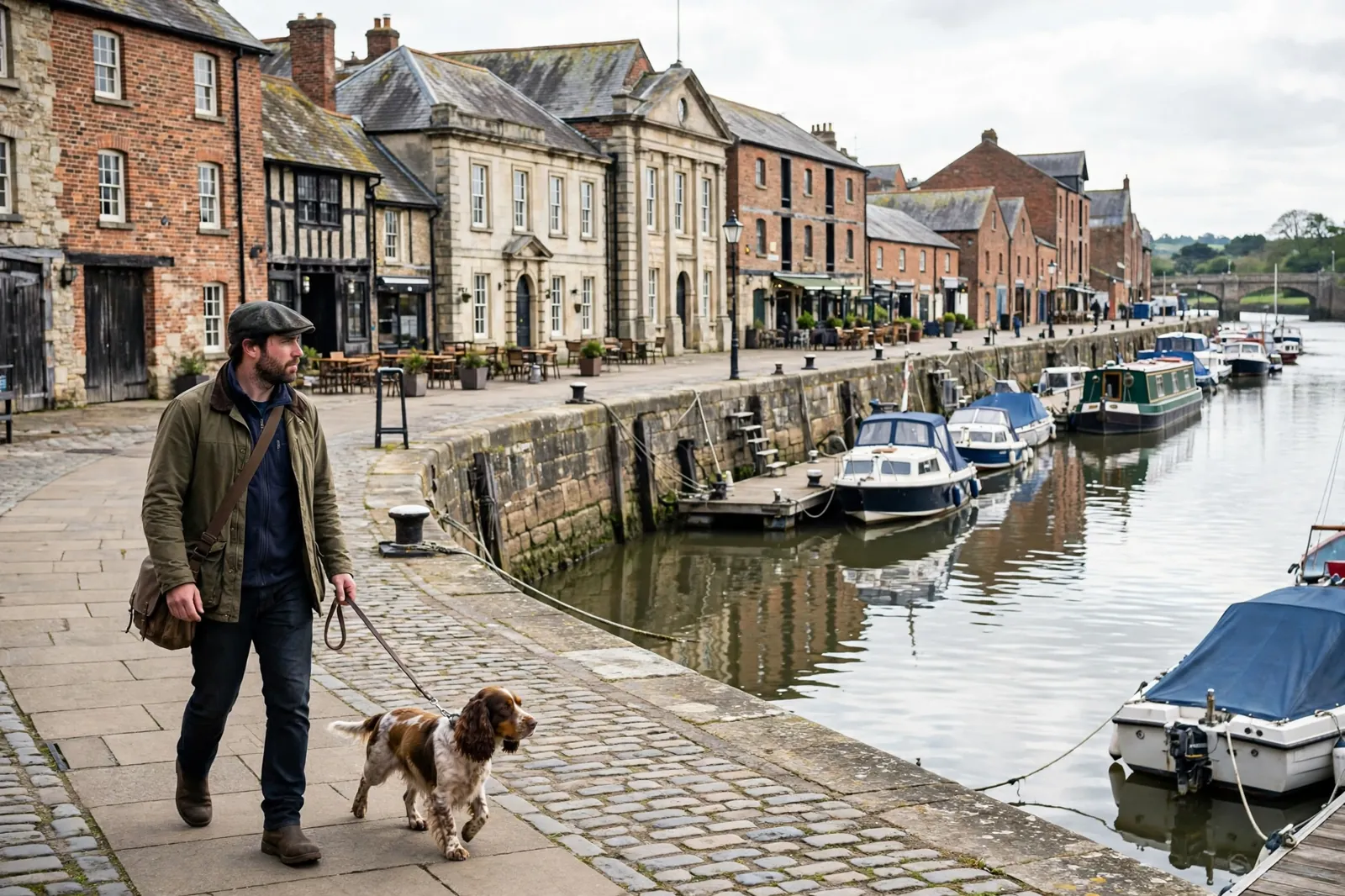
Arriving by train has its own rhythm. Totnes station is on the main line between Exeter and Plymouth, which makes it accessible without a car, but the station is not in the town centre, and the walk into town needs time, water and, in wet weather, waterproofs. For visitors without a car, that walk is part of the day and should be planned as such, not treated as a surprise. For visitors with a car, the train option is still useful to know about, because it offers a car-free day trip from Exeter or Plymouth that avoids parking altogether. The guide to Exeter with a dog covers Quayside walks and day trips that pair well with a Totnes visit by rail.
Wet weather in Totnes is not a reason to cancel, but it is a reason to change the plan. Rain makes the sloping streets slippery, market stalls more crowded under cover and riverside paths muddier. A wet-weather Totnes day should be shorter, slower and more cafe-based, with the castle and shops providing shelter and the river walk kept brief. Pack a dog coat if the dog feels the cold, a towel for the car, and a spare lead in case one gets soaked and muddy. Paws should be checked after wet walks, especially if the dog has been on gritted or salted surfaces in winter, and a quick paw wash at the end of the day prevents a muddy accommodation and sore pads.
Summer heat needs the opposite adjustment. A sloping town in direct sun, with dark pavements and little shade in places, can be hard on a dog's paws and body. Walk earlier in the day, carry water and offer it often, watch for excessive panting, and use shady side streets and the riverside for cooling breaks. Never leave a dog in a parked car, even for a short errand, and be aware that a car parked in sun heats up far faster than most people expect. If the dog is a brachycephalic breed, an older dog or a dog with a health condition, a hot Totnes day may be better spent mostly indoors or by the river in shade, with the market visited briefly in the cooler morning.
Finally, think about the small kit that makes a market town visit work. A short lead, a long lead for the riverside, a collapsible bowl, water, poo bags, a towel, a mat for cafes and a basic first-aid kit for paws cover almost every situation. A phone with the accommodation address, the nearest vet and tide times saved offline is useful, because mobile signal in historic buildings and river valleys is not always reliable. None of this kit is glamorous, but together it is the difference between a visit that feels prepared and a visit that feels improvised.
A slow half-day route
Putting the pieces together, a slow half-day in Totnes might look like this. Arrive in the morning and give the dog a toilet walk and a drink before the town centre. Start near the top of the town, with a pause near the castle area to look over the roofs and let the dog settle on grass. Walk downhill slowly, browsing the independent shops with a short lead, taking turns when a shop is small or crowded. If it is Friday, enter the market early, with a plan for where to pause and where to leave, and leave before the dog is tired rather than after.
Halfway down, stop for a drink and a snack, outdoors if the weather allows, indoors if the cafe welcomes dogs and the dog can settle. Give the dog water, a treat and a few minutes of doing nothing. Then continue downhill to the river, where the walk becomes flat and open. Let the dog sniff, watch boats and decompress on the riverside path. If paddling is safe and permitted, allow a brief paddle in a calm, shallow edge; if not, enjoy the bank. Finish with a short, calm walk back to the car or station, allowing extra time for the uphill return if that is unavoidable, and keeping the pace slow.
This route is deliberately undemanding. It does not try to cover every shop, every attraction and every walk in one visit, because a dog visit that tries to cover everything usually covers nothing well. It leaves room for a second visit, a longer walk on another day or a return to a favourite shop or cafe. Totnes rewards return visits, because the market mix changes, the river changes with the tide and the town feels different in different seasons. A first visit that ends calmly is more likely to become a second visit than a first visit that ends in exhaustion.
For visitors staying longer, the same half-day can be the first day of a longer Devon trip, with Dartmoor, Dartmouth and Exeter as separate day trips rather than additions to the same day. That separation matters, because each of those places deserves its own pace and preparation. A Totnes day that is also a Dartmoor day and a coastal day is not a Totnes day at all; it is a driving day with a dog in the back. Slow travel suits dogs, and Totnes, with its hill, its market and its river, is a good place to practise it.
Practical questions
Before you go
Are dogs allowed in Totnes Castle?
Dog rules at historic sites can change by season, event and management decision, so check the official guidance before you travel. If dogs are welcome only in the grounds or on a lead, plan the castle as a short outdoor stop rather than a long indoor visit, and keep a riverside walk as the backup.
Is Friday the best day to visit Totnes with a dog?
Friday suits visitors who enjoy a busy market, street food smells and a lively high street, but it is also the most crowded option. A dog that is calm in crowds will enjoy it; a nervous dog may prefer a quieter weekday, with the same shops and river walk and far fewer people to pass.
How steep is Totnes for a dog?
Totnes is built on a slope that runs down to the River Dart, so the main shopping street is noticeably steep in places. Walking downhill from the top of the town to the river is much easier than climbing back up, especially for older dogs, small dogs and dogs that tire quickly.
Can dogs go into the independent shops in Totnes?
Many independent shops welcome dogs, but there is no single town-wide rule. Look for a sign at the door, ask before entering with a large or excitable dog, keep the lead short in narrow aisles, and be ready to take turns outside if one person needs to browse a small shop alone.
Where can a dog swim or paddle near Totnes?
The River Dart is a working tidal river, not a fenced dog beach, so paddling needs care. Check the official guidance before you travel, watch the current and the tide, avoid fast or deep water, and choose a calm, shallow edge only when the conditions are clearly safe. If in doubt, keep paws on the bank and enjoy the riverside path instead.
Is Totnes a good base for a longer Devon dog holiday?
Yes, for travellers who prefer a small town to a resort. Totnes gives easy access to Dartmoor, the South Devon coast and the River Dart valley, while keeping evenings quiet. It suits a slow itinerary with one main outing a day, rather than a packed schedule of long drives.