This guide is independent and contains no paid placement. If affiliate links are added later, they will be clearly marked and will not change our editorial checks.
Wareham is a small Saxon walled town on the River Frome, and the best dog day here is a circuit of the grassy town walls, a stroll down to the Quay, and a pub lunch in the town centre — then a short drive into Purbeck for the coast. Keep the dog on a lead on the walls and by the river, walk early on market days, and use Wareham as a quiet, central base for Swanage, Corfe Castle and Studland.
A town built as a wall
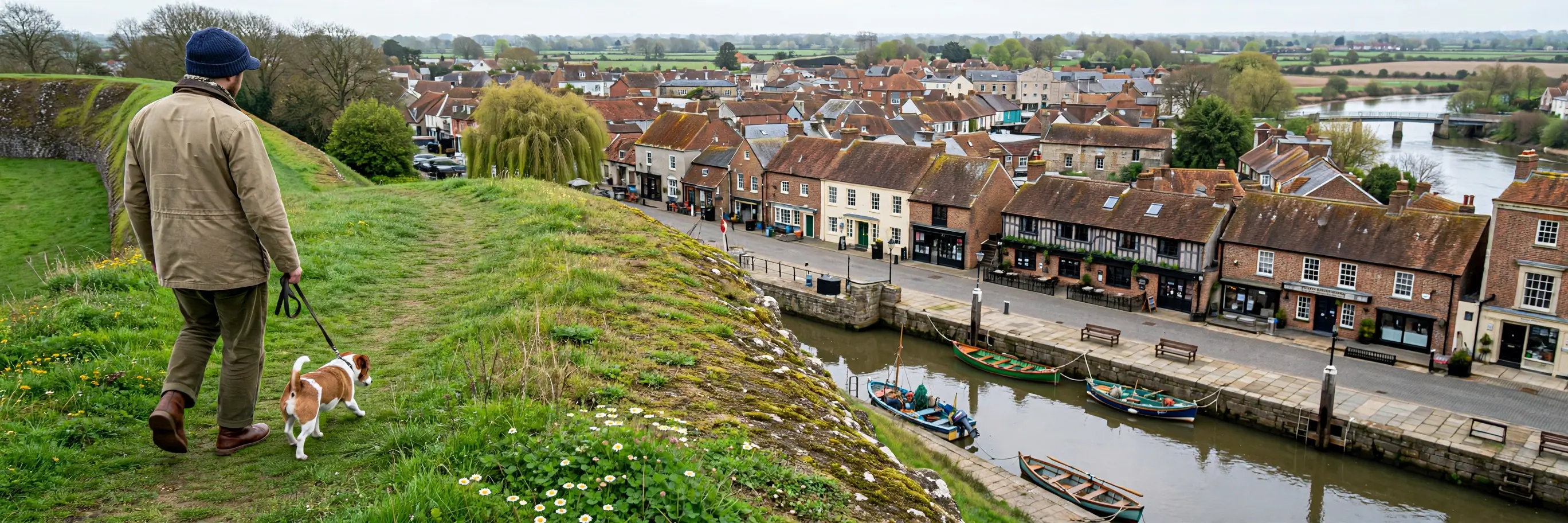
Wareham is unusual among English market towns because its shape is still the shape of its defences. The town was founded as a Saxon burh, a fortified settlement, and its earth walls — great grassy banks that run around three sides of the old town, with the River Frome guarding the fourth — still survive as a complete circuit. You can walk around the whole of the old town on top of them, looking down on the streets inside and out across the river and the water meadows beyond, and that walk is the best introduction to Wareham with a dog.
The walls are not stone battlements. They are broad, grassy banks, worn smooth by centuries of feet, and they feel more like a park than a fortress. That is what makes them so good for dogs: the ground is soft, the paths are wide, the views are open, and the circuit is long enough to tire a dog without being so long that an older dog cannot manage it. The walls are also a reminder of how old Wareham is. The town was important long before the Normans arrived, and its churches, its street plan and its position on the river all tell that story.
Wareham sits where the River Frome meets the head of Poole Harbour, and that position has shaped the town for centuries. The river brought trade, the harbour brought boats, and the walls brought safety. Today the town is quieter than its coastal neighbours, and that is its appeal. There are no crowds, no arcades, no seafront crush — just a market town with a river, a set of walls, a handful of pubs and a strong sense of itself. Dogs fit into Wareham because the town is built for walking, and because the walls give every visit a natural, satisfying loop. Our Dorset with a dog guide places Wareham among the county’s coast and countryside stops if your trip runs longer than a day.
Plan the day as a circuit rather than a list. Park near the Quay, walk up onto the walls, follow them around the town, come down to the river, walk through the town centre, and finish in a pub. The whole loop takes about two hours at a dog's pace, and it leaves you with a proper sense of the town rather than a handful of photographs.
Walking the walls circuit
The walls circuit is the classic Wareham walk, and it is best done slowly. Start at the Quay, where the river meets the town, and climb the steps or the slope up onto the walls. The path along the top is grassy and wide, with views on one side down into the town's gardens and streets, and on the other side out across the river, the water meadows and the Purbeck hills. The circuit takes about an hour at a dog's pace, and there are benches and gaps in the walls where you can stop and look.
Keep the dog on a lead on the walls. The banks are steep in places, the drops are real, and a dog that chases a squirrel or a rabbit could slip or fall. The paths are shared with other walkers, families and runners, so keep the lead short when the path is busy, and give way on the narrow sections. Pick up after your dog, because the walls are a much-loved local walk, and the grass is used by children and picnickers in summer.
The walls are at their best in the morning, when the light is low over the river and the town is quiet, and in the evening, when the sun sets over the water meadows. In spring the banks are green and the wildflowers are out; in autumn the trees along the river turn; in winter the walls can be muddy and slippery after rain, so wear shoes with grip and keep the dog on a lead. In summer the walls are exposed, so carry water and look for shade.
Look for the details as you walk: the churches that stand inside the walls, the old town houses with their gardens, the river glinting through the trees, and the way the walls turn at each corner of the town. Wareham's walls are not a museum piece; they are a living part of the town, used every day by local people walking their dogs, and that is what makes them special. A dog that has walked the walls has walked the history of the town.
The Quay and the River Frome
Wareham Quay is the town's waterfront, and it is a calm, pretty place for a dog walk. The Quay sits on the River Frome, with small boats moored along the bank, a riverside path, and views across the water to the meadows beyond. The walk from the Quay along the river takes about thirty minutes at a dog's pace, and it is flat, grassy and shaded in places, with swans, ducks and moorhens on the water and kingfishers in the reeds if you are lucky.
The Frome towpath rewards a slow pace and a long lead. Let the dog work the scent along the reeds beside the Quay, but keep a grip on the line: the bank shelves steeply into the river in places, and a swan or a moorhen bursting out of the reeds can send an excited dog straight into deep water. Give other walkers room at the narrow bends, where the path squeezes between gardens and the water, and carry spare bags — the litter bins along this stretch sit far apart, so anything you pick up travels with you back to the Quay.
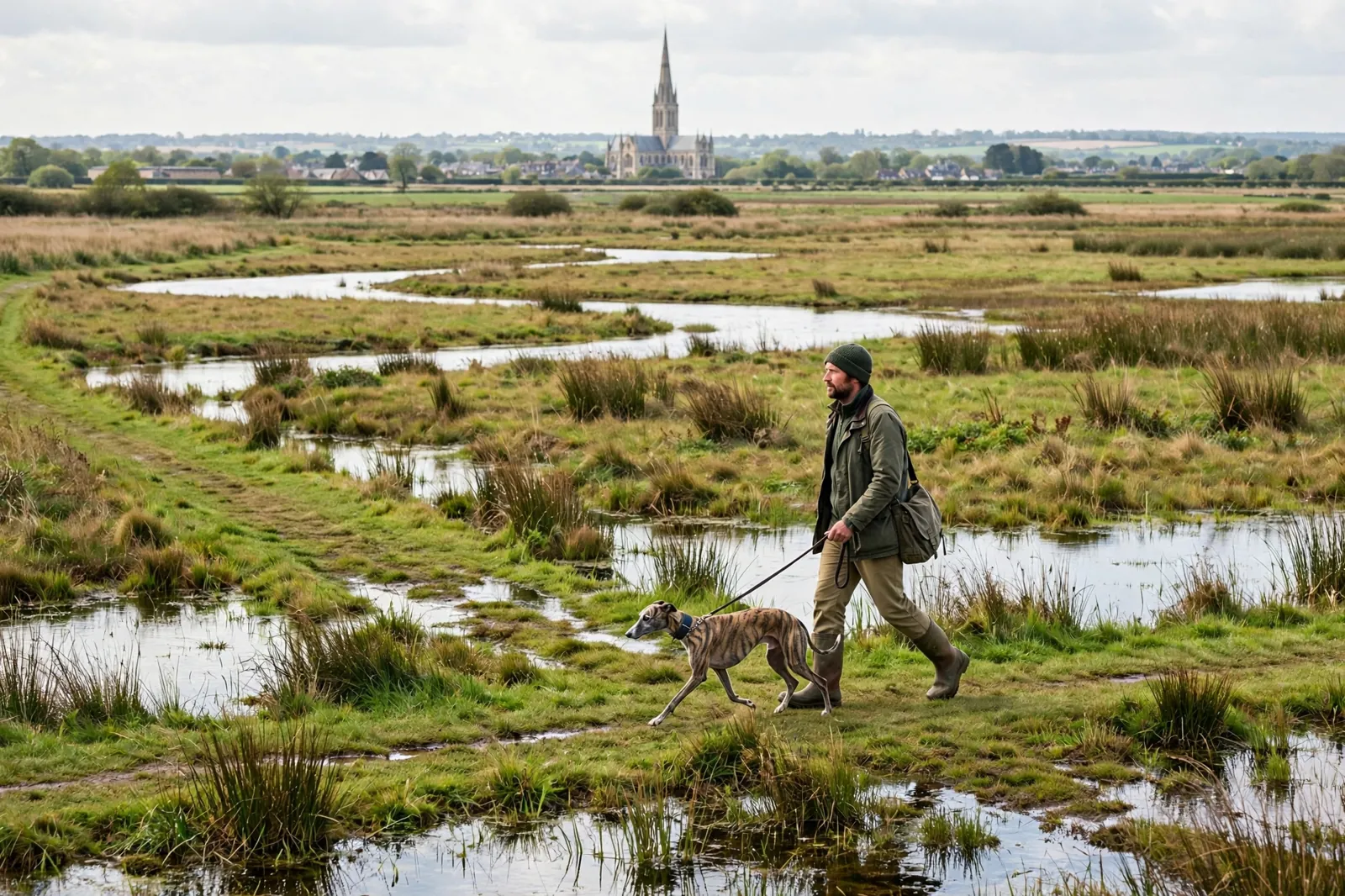
The Frome is a chalk stream, and its clear water is why so much wildlife gathers here. Kingfishers dart along the reed edges, otters pass through at dawn, and the water meadows between Wareham and the harbour hold wading birds through the year. Treat the banks as a nature reserve in all but name: keep the dog out of the reed beds, steer clear of anglers casting from the Quay steps, and do not let the dog paddle where the current quickens below the town bridge. If the river looks high or cloudy after rain, keep the dog on dry land and check the latest local water and path notices before your visit.
In the warmer months, boats leave the Quay for trips down the Frome towards Poole Harbour, and a few operators take a dog aboard — ask when you book, since space for dogs depends on the boat. A river trip is a restful way to see the water meadows from the water, with the walls rising behind you as you leave town. If you stay ashore, the Quay is a fine place to linger: find a bench, watch the boats rock on the tide, and let the dog settle after the walls circuit as the evening light comes down over the river.
The town centre and market
Wareham’s centre is small enough to cover on foot, and friendly. North Street and South Street hold the independent shops, cafes and pubs, with the market adding its stalls on market days, and the whole place has the feel of a town that knows its regulars. Look up at the shopfronts: Georgian facades stand beside older timber frames and Victorian fronts. The churches — St Mary’s, and St Martin-on-the-Walls, the Saxon church inside the walls — are worth admiring from outside, since dogs are not allowed in.
Wareham’s market fills North Street and the streets around the town centre with stalls, and it is worth timing a visit around it rather than steering clear. The stalls sell local food and crafts, and plenty of stallholders will make a fuss of a calm dog. But a market morning also means tight gaps between stalls, dropped food underfoot, and crowds pressing in from both sides, so shorten the lead, steer the dog away from food stalls, and duck down to the Quay or up onto the walls if the centre gets too much. Market days can shift with the season, so look up the current schedule with the town council or market organisers shortly before you travel.
Dog-friendly shops in Wareham tend to advertise it: a bowl of water by the door, a sticker in the window. Where there is no welcome sign, step inside first and ask — a question saves an awkward moment. A dog that has already done a circuit of the walls will settle by your feet while you browse; a dog that has waited in the car all morning will fidget and pull at the lead. Walk first, then shop, and keep the lead short inside so tails stay clear of displays.
An hour covers the centre: North Street down to the Quay, South Street back up, and a wander through the side streets between them, with benches along the way for a breather. For a nervous dog, come early, before the shops open and the market stalls are set up, when the streets belong to delivery vans and dog walkers. The town’s pubs and cafes are generally easy-going about dogs. Heading south for the day, you will find the coastal pubs and cafes in our Swanage with a dog guide.
Gateway to Purbeck
Wareham's greatest asset for a dog owner is its position. The town sits at the gateway to the Isle of Purbeck, the peninsula of coast, heathland and villages that runs south to Swanage and west to Lulworth, and almost every Purbeck destination is a short drive from Wareham. That makes Wareham a better base than the coast itself for many visitors: quieter, cheaper, and with a river and walls of its own, while the coast is only twenty minutes away.
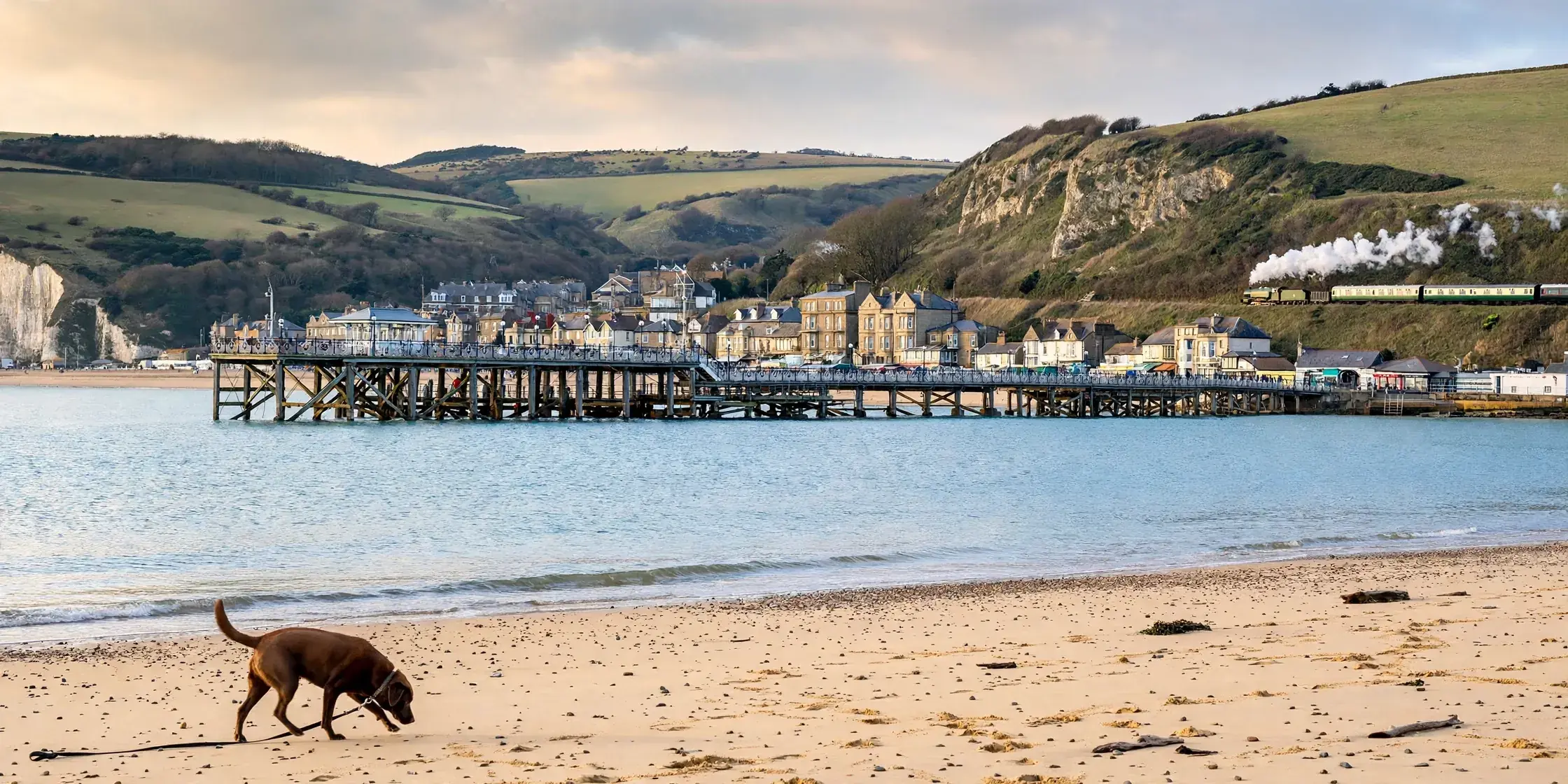
South from Wareham, the road climbs through the Purbeck hills to Corfe Castle, where a ruined castle stands over a village of stone cottages, and on to Swanage Bay, with its sandy beach, steam railway and cliff paths. Corfe makes an easy half day: the village lanes suit dogs, the castle ruins can be admired from the paths below, and the walks out of the village cross open downland with wide views. Dog rules at the castle and on the Swanage Railway change from time to time, so look up the latest visitor information from the castle and railway operators before you go.
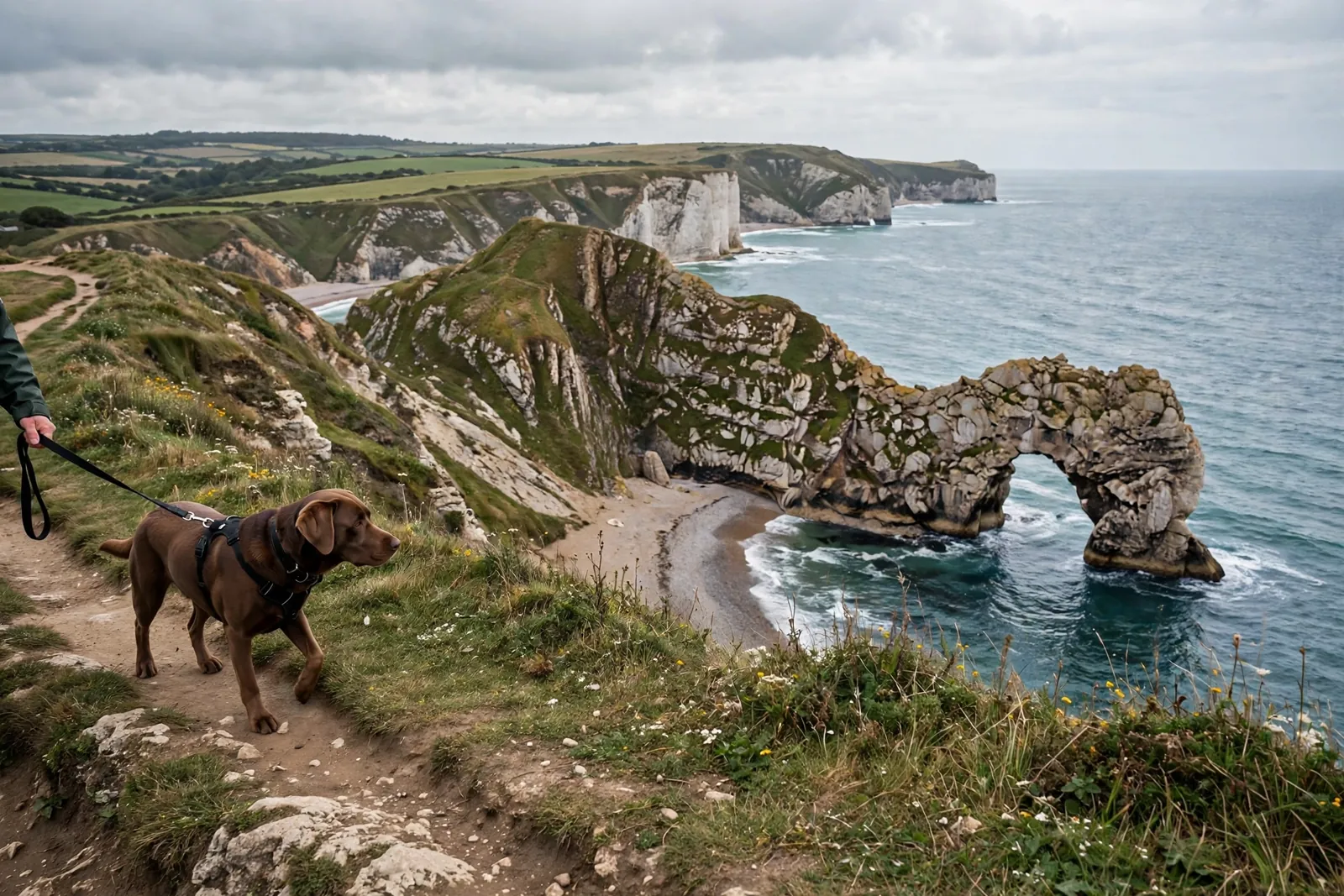
West from Wareham, the coast runs to Lulworth Cove and Durdle Door, two of the most photographed places on the Jurassic Coast, and to the village of Lulworth itself. The walks here are more demanding than the walls at Wareham — steep, exposed and crowded in summer — so walk early, carry water, and keep the dog leashed near the cliff edge. East from Wareham, the road runs to Studland Bay, with its long sandy beach, its heathland and its views across Poole Harbour to Sandbanks.
Closer to home, the Purbeck Way and the network of footpaths around Wareham offer walks that start from the town itself, with no driving at all. The paths run through heathland, woodland and water meadows, and they are at their best in spring and autumn, when the heath is in flower or the trees are turning. Check the route before you set out, carry a map or a charged phone, and watch for livestock, adders and ticks in the heathland in warm weather. Our Weymouth with a dog guide covers the coast further west if you want to extend the trip.
Pubs, cafes and the Quay
The pubs around North Street, South Street and the Quay are a natural end to a Wareham walk, and most keep a corner for dogs. Expect a dog to be settled in the bar, in the garden, or at a table outside, rather than in the dining room — and expect the answer to change with the season, the day, and who is on duty. Ask the staff as you arrive, take their spot, and settle the dog before you order. A pub that has had a good experience with your dog is a pub you can come back to.
A little preparation makes a pub stop easy. Bring a folding bowl, something to chew, and the blanket your dog sleeps on at home: familiar smells help a dog settle in a strange room. Stone and wooden floors, which Wareham’s older pubs have in abundance, are kind to muddy paws but treacherous under old legs, so a non-slip mat is worth carrying. Choose food you can manage one-handed, keep treats in your pocket instead of on the table, and remember that a dog which has learnt pubs mean scraps will spend the whole meal watching the floor.
Cafes along the High Street and around the Quay mostly welcome a dog at an outside table, and a few will take one indoors too. That welcome is never a promise: it shifts with the season, the staff, and how busy the room is, so ask each time. When the tables are full, grab a takeaway coffee and find a bench on the Quay or the walls — the view is better, and the dog has room to stretch out.
In a Wareham pub, good manners are simple. Keep the lead short and tucked under your chair, never stretched across a walkway. Never slip food from your plate to the dog — table scraps teach a dog to beg. Give the dog a toilet break outside before you sit down; a calm dog asleep under the table needs no praise.
Parking, buses and the railway
For a full day, the car parks by the Quay and in the town centre are the handiest: they put you a short stroll from the walls and the river. On Saturdays, when the market is on, and on fine summer weekends, get there before mid-morning: once the central bays are taken, the next options sit further out, and the walk back into town feels twice as long with a dog pulling at the lead. Charges and time limits are revised from time to time, so look up the current tariffs with the local council before you set off.
On a warm day, do not leave the dog waiting in a parked car, even for a few minutes with a window cracked open: the inside of a car heats far faster than the air outside, and spring and autumn sunshine can catch you out just as badly. If a shop will not take dogs, take turns at the door instead — Wareham’s centre is compact, so one person can wander the Quay or the walls with the dog while the other goes inside.
Rail passengers arrive at Wareham station from Bournemouth, Poole, Weymouth and London Waterloo, a short, flat walk from the town centre and the Quay, and dogs travel on the trains on a lead. Buses link the town with Poole and Bournemouth, and with Corfe Castle and Swanage, and most drivers will take a well-behaved dog, though that is always the driver’s call on the day. Rural buses run less often on Sundays and in winter, so look up the latest timetables with the train and bus operators before you travel.
The A31 and the A351 both lead into Wareham, and the town centre is clearly signed from each of them. The streets inside the walls are narrow, and some run one way, so follow the signs to the car parks instead of cutting through the centre: satnav sometimes picks the shortest line through quiet residential streets, where parked cars and tight corners make life harder with a dog in the back.
Seasons and the river
Each season gives Wareham a different mood, and each suits a different dog. Spring is the gentlest: the Frome runs high, the walls turn green, wildflowers line the banks, and the town is calm enough for a nervous dog to find its feet. March paths along the river can be churned to mud, so pack towels and a drying coat, and give the reed beds a wide berth while the birds are nesting.
Summer is the busiest season. Market mornings draw a crowd, the Quay fills with moored boats, and the pubs and cafes spill out onto the pavements. Get out early, before the heat and the crowds build, use the shaded Frome towpath or the trees of Wareham Forest for the middle of the day. Keep water for the dog in your bag wherever you go, watch for hot pavements in direct sun, and keep the dog in the shade whenever you stop. The Purbeck coast is at its busiest in summer, so treat Wareham as a quiet base and head for the coast first thing in the morning.
Autumn is the season many Wareham regulars love most. The light goes low and gold over the water meadows, the trees along the Frome turn, the heathland flushes purple, and the town slips back into its everyday pace once the summer visitors have gone. It is a fine time for a long circuit of the walls and a stretch of the Purbeck Way, finished with a slow pub lunch. Winter brings frost on the banks and mist hanging over the river, and the town goes quiet — but the towpaths turn very muddy, the Frome can run high after rain, so check the ground underfoot before you set out and keep the dog close beside you near the water.
The river is the main thing to respect through the year. After heavy rain the Frome rises fast, the low stretches of towpath flood, and the current strengthens enough to pull a swimming dog downstream. Be ready to turn back, keep the dog out of the water entirely after rain, and remember that cold, fast water is dangerous even for a strong swimmer. In summer the river runs clearer and slower, but test the water before the dog paddles and steer clear of still, warm side channels where algae gathers in hot weather.
Staying over with a dog
Overnight, Wareham offers inns in the town centre, bed and breakfasts on the town’s edge, and cottages with gardens in the villages around it — a modest choice, but a good one. Summer weekends and school holidays fill up fast, so reserve early, and settle the dog arrangements before you pay, in writing: how many dogs the host accepts, what they charge, whether the dog can stay alone in the room, and where to take it out last thing at night.
On arrival, check the place over before you unpack. Walk the garden and look for gaps under hedges, loose fence panels, and gates that do not latch — a dog that finds the gap on the first evening will find it again. Work out where the last walk of the night will go: the walls and the Quay both lie close to the centre, but the walls are dark and uneven after sunset, so carry a torch in winter. Pack the dog’s own bed and bowls, plus a blanket from home, so the first night in a strange room feels familiar.
For a week, a cottage of your own, with a garden to stretch out in and a kitchen to cook in, suits a dog best: mealtimes stay at the usual hour, and nobody minds if you come and go at odd times. Wareham’s shops cover the basics, and the bigger supermarkets are a few minutes’ drive away in Poole and Bournemouth. If you are weighing up stays elsewhere in Dorset, our Dorset with a dog guide sets out the choices from coast to countryside, while the holiday parks guide looks at the bigger sites elsewhere in the county.
Find out the cleaning charge and the deposit, and settle them before you book. Be straight about your dog: a host who knows a large, muddy spaniel is coming can offer the room with the hard floor and the garden with the secure fence, while a host hearing about the dog for the first time on the doorstep may not be so pleased. Comments from earlier guests who brought dogs tell you more than glossy photographs ever will, so read those before you choose. Wareham is a calm base, and a calm base lets a dog rest properly between days out.
Practical questions
Before you go
Can dogs walk on Wareham town walls?
Yes. The grassy circuit along the Saxon earth banks is open to dogs on leads, with town gardens on one side and the Frome water meadows on the other. Stay on the path, keep clear of the steep drops, and clear up after your dog — the walls are a daily walk for plenty of Wareham residents.
What is the best dog walk in Wareham?
Start with the walls circuit: a full loop of grassy banks with views over the town and the river. The Quay and the Frome towpath give a gentler alternative, and for a longer day, head out on the Purbeck Way towards Corfe Castle — the trailheads sit close to town, though it pays to look up path conditions before setting out.
Is Wareham a good base for exploring Purbeck with a dog?
Yes. Wareham sits at the gateway to Purbeck, so Studland, Lulworth, Corfe Castle, Swanage and the Jurassic Coast are within a short drive, while the town itself stays quieter and cheaper than the coast. Dog-friendly rooms in Wareham get booked up fast on summer weekends and in school holidays, so reserve ahead.
Which Wareham pubs and cafes welcome dogs?
Most of Wareham’s pubs and cafes keep a place for dogs, usually at a table in the bar, in the garden, or outside on the Quay. The welcome changes with the season and with who is working, so ask the staff when you arrive and settle the dog where they suggest.
Where should I park in Wareham for a dog walk?
Head for the car parks by the Quay and off the town centre streets, then walk into the centre and up onto the walls. On market days and summer weekends, get there early — the central bays fill fast — and on a warm day never leave the dog waiting in the car, even briefly.
When is the best time to visit Wareham with a dog?
Spring and autumn suit Wareham best: mild weather, quiet streets, and good walking on the walls and the Frome towpath. Summer is lively but crowded, so get out early. Winter is calm and atmospheric, though the towpaths turn muddy after rain.