This guide is independent and contains no paid placement. Venue dog policies change, sometimes by event or by season — check the latest official information before you travel.
Winchester works brilliantly with a dog if you build the day around the River Itchen water meadows, St Catherine's Hill and the first miles of the South Downs Way, and treat the cathedral as an outdoor precinct visit unless the latest rules clearly admit pet dogs inside. Come early, keep the lead short near livestock and waterbirds, and split indoor sightseeing between two adults.
Start at dawn on the water meadows
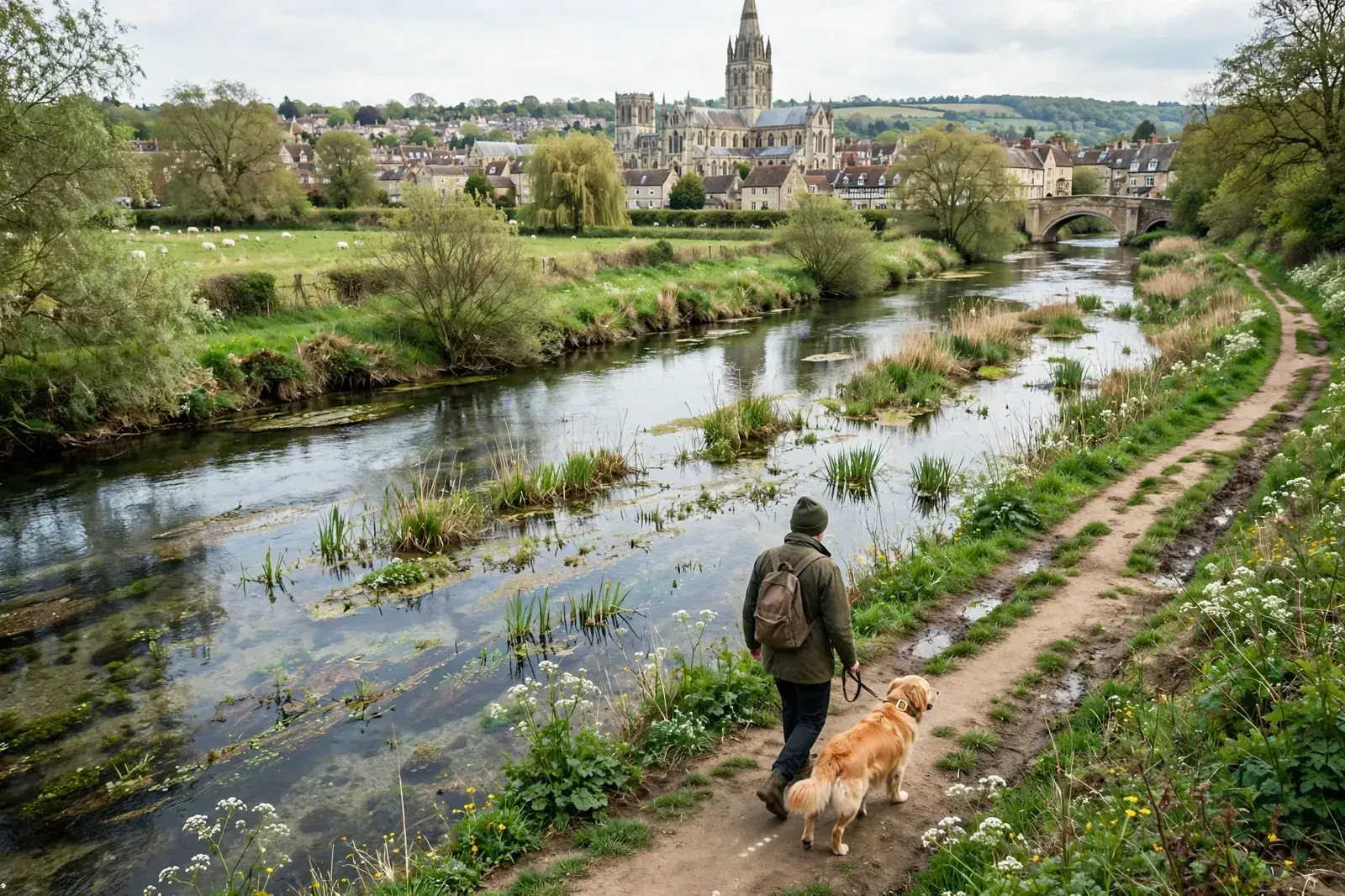
Begin before the city wakes. In the low ground south of the centre, mist often sits over flat meadows while the River Itchen runs cold and glass-clear beside the path, carrying the green tint of a chalk stream even on a grey morning. A dog on a lead at that hour gets the Winchester that day-trippers miss: herons standing motionless at the margins, the cathedral tower appearing and disappearing as the mist thins, and paths quiet enough that a nervous dog can settle into the walk instead of bracing for the next passer-by. That dawn start is not a poetic extra. It solves the city's main dog problem, which is timing. By late morning the riverside paths, the Close and the High Street all fill at once, and a walk that felt spacious at seven can feel like queueing by eleven.
Use the early hour deliberately. Give the dog a proper walk first — forty to sixty minutes at a sniffing pace along the meadows — before any sightseeing, shopping or café stop is attempted. A dog that has already explored, toileted and burned off arrival excitement will wait more patiently outside a shop, settle better under a café table and cope more calmly with the echoing, pigeon-rich environment around a cathedral. Owners who reverse the order, dragging an under-walked dog through the centre first and promising a run later, usually spend the whole morning managing pulling, whining and lunges at dropped food.
Dawn also changes what you need to carry. Meadows are dewy even in summer and flooded or boggy in patches through winter, so waterproof footwear matters more than the distance suggests. Bring a towel for paws before the dog gets back into a car or a holiday let, a spare lead in case the main one is dragged through mud, and water for the dog even on a river walk — a chalk stream is a habitat to protect, not a drinking bowl, and dogs should not be crashing in and out of its banks. Finally, check the light and the forecast together: the meadows have little shelter, and a beautiful still morning can turn into exposed, windy rain on St Catherine's Hill by lunchtime.
The cathedral, honestly: precinct yes, interior — check first
Winchester Cathedral is the reason most visitors come, and it is the part of a dog-friendly itinerary that needs the most honesty. A great tower, one of the longest medieval naves in Europe and a close full of historic buildings do not automatically add up to a dog-friendly attraction. Pet dogs and assistance dogs are not the same category, and cathedrals commonly welcome assistance dogs while restricting, limiting or refusing pet dogs inside — with rules that can also vary for services, concerts, school groups and special exhibitions. So the only responsible advice is this: do not build your day on taking a pet dog inside. Check the cathedral's official visitor information on the morning of your visit, look specifically for the pet-dog wording rather than a general welcome message, and be ready for the answer to be no.
That is not a reason to skip the area. The cathedral precinct and the Close are, for most dog owners, the enjoyable part anyway: open green space, gravel paths, benches and the sheer scale of the building from outside, all experienced at a dog's pace rather than in a hushed interior where a bored dog is a liability. Keep the lead short, keep the dog off flower beds and memorial areas, avoid doorways and service entrances, and move away promptly if a service, wedding or school visit is gathering. Dogs should never be tied to railings or left unattended outside the entrance while owners go in — it blocks access, stresses the dog and puts strangers in the position of managing someone else's pet.
If going inside matters to you, use the two-adult split that works at cathedral cities across Britain. One person visits the interior while the other does a slow circuit of the Close, the meadows path and a coffee stop, then you swap. Allow enough time for each half to feel unhurried — a rushed twenty minutes inside helps nobody — and agree a meeting point away from the busiest doorway. Solo travellers should treat the cathedral as an exterior visit and put their indoor time into dog-welcoming alternatives instead. Our Canterbury with a dog guide works through the same split-visit logic for another cathedral city, and the comparison is useful: in both cities, owners who plan for an outdoor cathedral experience have a calmer day than owners who arrive hoping an exception will be made.
While you are in the precinct, be honest about photography and behaviour too. A dog posed on steps or in doorways for photographs quickly becomes an obstruction, and extending leads across paths are trip hazards for elderly visitors. Keep photo stops brief, step well to one side, and never let a dog relieve itself against walls, gravestones or planted areas. Cathedral closes are shared, semi-quiet spaces — the standard to aim for is that other visitors barely register that a dog was there.
River Itchen and the water meadows: the walk that makes the trip
The Itchen is one of England's celebrated chalk streams: spring-fed, unusually clear and ecologically sensitive, home to wildlife that depends on clean, stable water. South and east of the city centre, its channels thread through flat water meadows traditionally associated with Winchester College and with the poet John Keats, who wrote about the season of mists after walking here in autumn. For a dog owner, the practical translation is simple — this is a lead walk, not a free-running and swimming walk. Banks may be soft, fenced or privately managed, waterbirds nest and feed at the margins, and livestock graze parts of the meadow system. A dog that plunges in, chases birds or barges through fences damages exactly the habitat that makes the walk special, and can also end up in difficulty in cold, fast or deep channels.
As a route, think in layers rather than a single fixed loop. The shortest layer is a gentle out-and-back from the city edge along surfaced or well-trodden riverside paths — suitable for older dogs, puppies building stamina and owners with limited time. The middle layer continues through the meadows towards the Hospital of St Cross area and back by a parallel path where the ground allows, giving roughly an hour to ninety minutes of flat walking. The longest layer adds the climb of St Catherine's Hill, covered in the next section, turning a riverside stroll into a half-day outing. Because meadow paths flood, do check recent weather: after sustained rain, sections can be under water or reduced to slick mud, and the sensible choice is a shorter surfaced section rather than wading a flooded path with a reluctant dog.
Wildlife etiquette deserves its own paragraph because the meadows reward it. Keep dogs close during bird breeding season and whenever swans, ducks or waders are near the path; a short lead is kinder than a shouted recall across open water. Watch for signs about grazing animals and obey closures or diversions without argument — meadow management, conservation work and flood defences all periodically change which paths are usable. Take every bag home or to a bin, including bags left supposedly to collect on the way back; in a landscape this wet, abandoned bags wash into watercourses. If your dog is a committed water-lover, plan a separate, more suitable swimming opportunity elsewhere in the trip rather than improvising here, and read our guidance on dog-friendly National Trust places for how other sensitive landscapes handle paw rules, leads and seasonal restrictions — the habits transfer directly.
One more practical point: shade and shelter are scarce on the meadows. In hot weather, walk early or late, shorten the route and carry water, because a flat open valley can be hotter than it looks with no breeze. In cold, still weather, the same valley holds frost and fog, and small or thin-coated dogs may need a coat for a slow, sniff-heavy pace. The meadows are a four-season walk, but never quite the same walk twice.
St Catherine's Hill: short climb, big view
Rising beside the meadows, St Catherine's Hill is Winchester's natural viewpoint — a chalk hill with a distinctive clump of trees, evidence of an Iron Age hillfort and a turf feature often called the Mizmaze near the top. For dogs, it offers what the valley cannot: a genuine climb, breezier air and a panorama back over the city, the cathedral and the Itchen valley. The ascent is short but properly steep in places, with chalk and grass surfaces that become slippery after rain and polished in frost. Trainers with worn soles are a common mistake; walking shoes or boots with grip make the descent far more controlled, especially with a dog that pulls downhill.
Manage the lead work carefully. Keep the dog close on the steeper sections and near the summit edges, and be ready for grazing animals — parts of the hill and surrounding reserves are managed with livestock at times, and signs at entrances give the current position. Where sheep or cattle are present, a lead is not optional, and giving stock a wide berth protects both them and your dog. At the top, allow time rather than treating the summit as a photo-and-go: dogs that have climbed at a sensible pace, had water and settled for ten minutes descend much more calmly than dogs turned straight around while still excited.
Fit the hill to the dog in front of you. Puppies should not be doing repeated steep descents while their joints develop, older dogs may manage the up but struggle with the down, and dogs recovering from injury are better kept to the flat meadow layer. On hot days the exposed chalk reflects heat and there is little shade, so the hill belongs to the cool ends of the day. In strong wind, smaller dogs can find the summit genuinely unsettling. None of this rules the hill out — it simply means the meadows-plus-hill combination should be chosen, not assumed, and a dog that only does the flat walk has still had an excellent Winchester morning.
The South Downs Way start and longer Winchester walks
Winchester is the western starting point of the South Downs Way, the long-distance trail that runs for around 100 miles to Eastbourne. For a visiting dog owner, the value is not in attempting distance — it is in the ready-made taster. Walk out from the city on the opening section, turn around at a pre-agreed point and walk back, and you get a truthful sample of chalk downland walking: open views, livestock in fields, gates and stiles to negotiate, and long stretches with no water tap, bin or shortcut. Set the turnaround by time, not ambition — forty-five minutes out means forty-five minutes back, with a tired dog slowing the return.
Preparation matters more on downland than on the meadow paths. Carry all the water both you and the dog will need, because chalk country is dry country and streams are not a reliable or appropriate supply. Keep the dog on a lead around livestock and on a short lead near roads and unfenced drops, and check paws after chalk and flint sections, which can be abrasive. Some field boundaries involve stiles that a large, elderly or anxious dog cannot manage; if you meet one you cannot cross safely, turning back is the correct decision, not a failure. Mobile signal can be patchy in dips, so download mapping before you leave and tell someone your turnaround time if you are walking alone.
If you want variety without committing to the trail, Winchester rewards a blended approach: a meadows morning, a hill climb on a second day, and a short South Downs Way out-and-back on a third. The Itchen Way, which follows the river valley over a much longer distance, offers another direction of travel in shorter local sections — again, treat it as out-and-back samples rather than a through-route unless you have transport arranged. What all these walks share is the need to check the latest official route information before you travel: diversions, flooding and land-management work change details, and a printed description from years ago should never override signs on the ground.
The city centre with a dog: compact, busy, manageable
Winchester's centre is compact and handsome — a long High Street, side lanes, independent shops, a market on certain days and historic landmarks including the Great Hall area and the famous statue of King Alfred. Compact is good news for short legs and bad news at peak hours, when pavements narrow, café chairs spill outwards and every dropped chip becomes a test of your dog's leave-it training. Walk the centre after the dog has already been exercised, use a short lead rather than an extending one, and position the dog on the inside, away from traffic and shop doorways. Market days add colour and smells in equal measure: stalls, food waste and crowds make them a training challenge, and a dog that is stressed by close crowds will enjoy the meadows far more than a forced circuit of the stalls.
Shops vary. Some independents welcome dogs, others are food premises or small spaces where dogs are not admitted, and chains set their own policies that can differ by branch. Never assume from a water bowl alone — a bowl outside sometimes belongs to one business while its neighbour is strictly no-dogs. Ask at the door, keep the visit brief and keep the dog away from stock, displays and other customers. If a shop says no, accept it gracefully and use the split-visit approach rather than tying the dog outside, where theft, escapes and confrontations with passing dogs are all real risks on a busy street.
Build rest into a centre visit. Dogs experience a shopping street as continuous stimulation — voices, smells, other dogs, pigeons, mobility scooters, children at face height — and even a confident dog benefits from a quiet ten minutes on a bench in a greener side space between bouts of pavement. Watch for the small signs of overload: lip-licking, yawning, pulling towards exits, sudden fixation on other dogs. Ending a centre visit twenty minutes early, while the dog is still coping, is what makes the next visit easier.
Eating and drinking with a dog in Winchester
In general terms, Winchester follows the pattern of most prosperous English cathedral cities: traditional pubs are the most reliably dog-welcoming places, usually in bar areas and gardens rather than formal dining rooms; cafés are mixed, with some offering dog seating inside, some terrace-only and some unable to admit dogs where food is prepared or space is tight; restaurants are the most variable and the most likely to be assistance-dogs-only in the evening. None of that is a promise about any individual venue. Policies change with refurbishments, new management and seasonal layouts, so check a venue's own latest information before you travel across town for it, and phone ahead for an evening booking rather than arriving with a hungry dog and no fallback.
Choose the setting your dog can actually handle. A pub garden on a quiet weekday afternoon is a very different test from a packed Friday-night bar. Ask for a table at the edge, away from the door, the bar queue and the route to the toilets, and bring a settle mat so the dog has a defined place rather than spreading across the walkway. Order water for the dog, keep the lead short and looped securely — never tied to a chair leg that a sudden lunge can drag — and feed the dog its own food or treats rather than a stream of rich pub scraps that may cause a miserable night. Our wider guide to dog-friendly restaurants in the UK covers the etiquette and the questions to ask when booking, and it applies just as well to a Winchester pub as to a city-centre bistro.
Have a wet-weather and a refused-entry plan. Terrace-only welcomes evaporate in horizontal rain, and a venue that took dogs last year may not this year. Carry a picnic fallback from city shops as a last resort, know where you can eat it without breaking local rules, and remember that a dog that has had its big walk first will also settle happily for an early night while two adults take turns eating out. That flexibility, unglamorous as it sounds, is the difference between a trip that bends and a trip that breaks.
Where to stay: choosing a Winchester base with a dog
Winchester offers the usual spread — city hotels, inns with rooms, bed and breakfasts, self-catering flats and houses, and rural stays in the villages and downland around the city. The dog-relevant differences are rarely in the star rating. They are in the ground-floor access, the flooring, the garden arrangements and the first walk of the morning. A beautiful first-floor room up a narrow staircase is a poor choice for an elderly dog; a smart hotel with a ten-minute drive to the first suitable toilet walk makes every late evening harder; a modest self-catering place two streets from the meadows path can outperform both.
Ask specific questions before booking. Is the dog allowed in the exact room or property type you are booking, and what is the per-dog or per-stay charge? Are dogs permitted in any dining or bar area, or will breakfast require a rota? Is there an enclosed outdoor space, or a shared garden where leads stay on? Where do the owners suggest for the last walk at night, and is that route lit? What is the rule on leaving a dog unattended — many properties prohibit it entirely, and planning as if they do avoids the most common Winchester accommodation argument. Get the answers in writing with the booking confirmation. For a broader checklist that applies to hotels anywhere in Britain, see our dog-friendly hotels UK guide and adapt its questions to Winchester's riverside layout.
Location strategy is simple here. Staying in or near the centre puts the meadows walk within reach on foot and removes daily parking costs, which suits a one- or two-night break built around walking. Staying just outside the city can buy you a garden, easier parking and quieter nights, at the cost of driving in and competing for city car parks — a fair trade for a reactive dog that needs decompression space. Either way, arrive in daylight if you can, walk the immediate area with the dog before unpacking, and establish the night-time toilet routine on the first evening rather than improvising it at midnight.
Parking, trains and getting around
Winchester is well connected by rail to London and the south coast, and arriving by train is genuinely workable with a dog: the station is a walkable distance from the centre for most owners, and a dog that arrives by train also arrives without an hour of car-park circling. Check the train operator's current pet rules before you travel — numbers of dogs, lead and muzzling expectations on board and any peak-time considerations — and allow extra time for lifts, stairs and busy platforms. A dog that has never used a station should not have its first attempt be a holiday departure with luggage in both hands.
Driving brings the familiar cathedral-city squeeze. Central car parks fill early on market days, event days and sunny weekends, charges add up over a full day, and height barriers or tight bays can matter for larger vehicles. Park-and-ride services on the edge of Winchester are worth considering, but check the current official details — including whether and how dogs are carried on the buses — before relying on them, because pet policies on local services vary and change. Whichever car park you choose, never leave a dog in a car while you sightsee: temperatures rise quickly even on mild days, and city sightseeing always takes longer than planned.
Within the city, walking is the default and the pleasure. Distances between the station, the High Street, the cathedral Close and the meadows are manageable for most dogs that are fit for the trip at all, provided you break them up with rests and water. Taxis and buses each set their own dog policies — assistance dogs have legal protections, pet dogs travel at the operator's or driver's discretion — so check before you depend on a ride back with a tired dog. The robust plan is always the same: assume you will walk back, and treat any ride as a bonus.
A one-day Winchester plan that respects the dog
Here is a shape that works for most dogs and most owners. Arrive early and go straight to the water meadows for the dawn walk described at the start of this guide — forty to sixty minutes, unhurried, finishing with water and a paw towel. Follow it with a dog-welcoming café or pub breakfast stop, chosen in advance, where the dog settles on a mat while the humans refuel. Late morning belongs to the cathedral precinct: an outdoor circuit of the Close at a relaxed pace, a split interior visit if two adults want one and the latest rules allow the waiting half to be comfortable, and no tying-up outside, ever.
Keep the middle of the day slow. Browse the High Street in one short, deliberate pass rather than an open-ended trawl, do any shopping in dog-welcoming shops only, and then leave the crowds. Lunch works best in a pub garden or quiet café at the edge of the centre, booked or checked ahead, with the dog already exercised enough to sleep through it. If energy remains after lunch, choose one — not both — of the bigger walks: the climb of St Catherine's Hill for the view, or a timed out-and-back on the South Downs Way for a taste of the Downs. Choosing one keeps the day spacious; attempting both turns a good day into an endurance event and usually produces a tired, fractious dog by evening.
Finish deliberately. A short evening stroll back to the meadows, in the cooler light, bookends the day and gives the dog a familiar, low-stimulation ending. Feed at the usual time, keep the last toilet walk short and close to where you are staying or parked, and leave before the dog is overtired rather than after. Owners who protect that ending — instead of squeezing in one more pub, one more street, one more photograph — are the ones whose dogs wake up willing to do it all again tomorrow. Winchester rewards that restraint more than most cities, because its best experiences were never the crowded ones. They were the river at dawn, the hill in clear air and a quiet green Close — all of which a well-planned dog gets to share.
Practical questions
Before you go
Can dogs go inside Winchester Cathedral?
Do not assume so. Cathedral admission rules for pet dogs change and assistance dogs are treated separately. Check the cathedral's official visitor information on the morning of your visit, and plan a split visit or an outdoor-only stop if pet dogs are not admitted that day.
Can dogs walk in the cathedral precinct and Close?
The open green spaces around the cathedral are the most dog-compatible part of a visit for most owners, usually on a short lead and away from services and events. Rules can change for services, school visits and special events, so follow signs on the day and check the latest venue guidance before you travel.
Where is the best short dog walk in Winchester?
The water meadows along the River Itchen below the city give the best short walk: flat, scenic and close to the centre, with the option to extend towards St Catherine's Hill. Keep dogs on a lead near livestock, waterbirds and narrow boardwalk sections, and check for flooding after heavy rain.
Can my dog swim in the River Itchen?
It is better not to plan on it. The Itchen is a protected chalk stream with sensitive wildlife, steep or soft banks in places, and strong local expectations to protect water quality. Keep dogs out of fenced or signed stretches, use only clearly accessible shallow edges where entry is permitted, and never let a dog chase waterbirds.
Where does the South Downs Way start in Winchester?
Winchester is the western trailhead of the South Downs Way, the long-distance route to Eastbourne. From the city centre you can walk an out-and-back first section with your dog as a taster, carrying water and keeping the dog on a lead around livestock, rather than attempting a long point-to-point day without a return plan.