This guide is independent and contains no paid placement. If affiliate links are added later, they will be clearly marked and will not change our editorial checks.
Around the winter solstice, plan the main walk for daylight, dress the dog to be seen from every angle, and keep a familiar short loop in reserve for dark, wet or icy days. A bright 30-minute walk with time to sniff beats a long walk that ends in darkness on an unfamiliar path.
The four o'clock walk
It is just after four in the afternoon in late December. The light has already gone thin and golden, the hedgerows throw long shadows across the lane, and the dog that slept through the working day is suddenly wide awake and ready. This is the walk that defines the whole season: the last proper outing before darkness, fitted into the narrow gap between the end of work and the end of daylight. Get it right and the evening settles. Get it wrong, and the walk drifts into darkness on a lane with no pavement, a phone battery running low and a dog that cannot be seen until a car's headlights catch it.
The pressure of that hour is what makes solstice walking different from ordinary winter walking. In November there is still a forgiving margin. By the week of the solstice, that margin has gone. A walk that took forty minutes in October still takes forty minutes, but the light available for it has shrunk by hours, and the dog does not understand why the familiar field is suddenly a dark place with different sounds. Dogs cope with this change far better when the routine changes with it, rather than when owners try to force a summer routine into a winter evening.
Start by moving the main walk earlier, not by making it longer in the dark. If the dog's best walk is usually after work, bring it forward to the lunch break, to a late-afternoon gap, or to a shorter daylight loop followed by indoor play in the evening. Many owners find that a split routine works better than one heroic walk: a proper sniffing walk in daylight, then a short, lit toilet loop after dark. The dog still gets exercise, scent and social contact, but the risky part of the day is no longer the main event. It also helps with house training and settling, because the dog is not arriving home over-excited and over-tired at the same time.
Think of the four o'clock walk as a deadline, not a start time. Work backwards from sunset, allow for the dog's pace rather than your own, and add time for mud, for a dog that stops to investigate every gatepost, and for the stretch of path that is always slower than expected after rain. If the maths does not work, change the route rather than the deadline. A familiar twenty-minute loop in daylight is worth more than a forty-minute adventure that finishes in the dark, because the dog knows the loop, you know where the puddles and the livestock gates are, and other road users can predict where you will be.
How short the days really get
The winter solstice, around 21 December in the northern hemisphere, is the shortest day of the year: the day with the least daylight between sunrise and sunset. After that date the days lengthen again, but only slowly at first, by a minute or two a day, so the practical effect is a run of several weeks in which daylight feels almost fixed at its minimum. For dog owners, the useful question is not the exact astronomical moment but the shape of the usable day around it.
In southern England, daylight around the solstice runs roughly from around 8am to around 4pm, giving about eight hours between sunrise and sunset. In central Scotland the window is closer to seven hours, and in the far north it can fall below six hours, with a long, dim twilight at either end rather than a clean switch from day to night. These are approximate figures that vary with latitude, local horizon and cloud cover, and they are not a substitute for checking the forecast for your own area on the day. A valley, a north-facing slope or a tall tree line can cut usable light further, while an open hilltop can hold a little more. The point is the same everywhere: there is no spare daylight to waste, and a walk planned for "after work" may already be a walk planned for darkness.
Twilight complicates the picture. Civil twilight, the period when there is still enough scattered light to see without artificial lighting, extends the usable window a little beyond sunrise and sunset, but it is also the period when visibility is at its worst for drivers. Light is fading, contrast is low, headlights are coming on, and a dark-coated dog on a dark path can be almost invisible even though a person can still see the path itself. That is why experienced winter walkers treat dusk as dark for planning purposes, even when they can still see. If a route needs headlights to be safe, it needs hi-vis gear too, and if it needs both, it is worth asking whether a different, lit route would serve the dog just as well.
Cloud and rain shrink the window further. A bright, frosty December day can feel generous, with low sun and long shadows that make a short walk feel like an occasion. A grey, drizzly day at the same date can feel dark by mid-afternoon, especially under trees or in a wooded valley. Do not plan from the calendar alone. Check the light, the cloud and the forecast together, and keep a daylight loop and a lit loop ready so that the weather on the day decides which one you use, rather than forcing a single plan to fit every kind of December afternoon.
Seasonal rules add another layer to check. Some beaches, nature reserves and farmland paths change their dog rules with the season, and winter can bring both freedoms, such as beaches where summer restrictions have lifted, and new restrictions, such as lambing-season guidance, shooting days or paths closed for ground-nesting birds or conservation work. If you are walking somewhere new, check the official guidance before you travel, including any local signs at the car park or gate, rather than assuming that a summer rule or a summer freedom still applies.
The visibility kit that actually works
Visibility gear fails in predictable ways. A single small flashing light clipped to a collar is easy to buy and easy to lose, and it tells a driver only that something small is moving. A reflective strip on a dark coat can disappear when the dog turns sideways. A hi-vis vest that fits in October may ride up over a thicker winter coat in December. The kit that works is layered, so that the dog can be seen from the front, from behind and from the side, and so that one failed battery or one slipped strap does not leave the dog invisible.
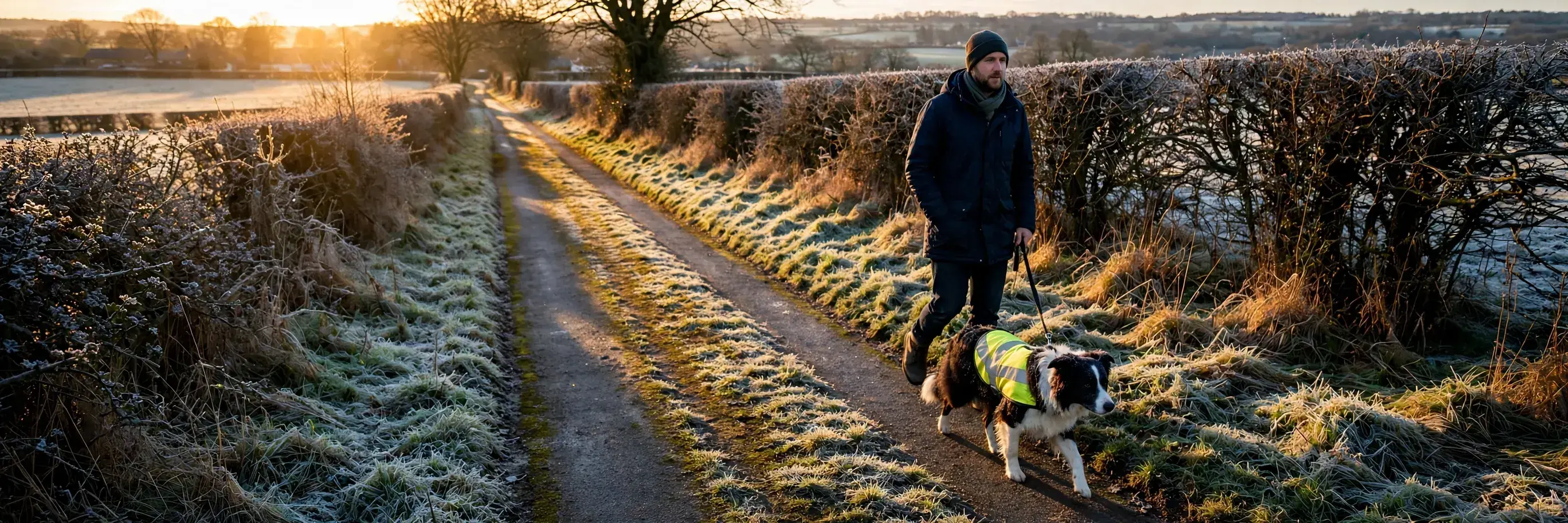
Start with a hi-vis vest or jacket in a fluorescent colour with reflective strips on both sides. Fluorescent yellow and orange are the most effective in low light, and the reflective material does the work when headlights hit it. Fit matters as much as colour: the vest should sit flat, stay clear of the legs, and allow the dog to move, toilet and lie down without bunching. Try it over the winter coat if the dog wears one, and check the fit again after a few walks, because straps stretch and coats compress. A vest that twists to one side is worse than no vest at all if it makes the owner assume the dog is visible when only one flank is covered.
Add a light, and think about where it sits. A collar light is visible from most angles but can be hidden by a thick ruff or a hood. A light clipped to the harness or vest, at the dog's highest point, is often easier for drivers to see, and a second light on the lead helps a driver judge where the owner is in relation to the dog. Steady lights are easier to track than flashing ones on a busy road, while flashing lights can be more noticeable on a dark trail. Whichever you choose, carry spare batteries or a charged spare light, and test the light before leaving the house, not halfway down an unlit lane. Cold weather drains batteries faster, so a light that lasted all autumn may fade sooner in January.
Do not forget the human half of the pair. A dog in full hi-vis next to an owner in a black coat and dark trousers is still a confusing shape in headlights. A reflective jacket, a head torch and a light-coloured hat or rucksack cover make the pair read as a walking group rather than a stray animal. A head torch has a second advantage: it lets you see the path, the dog's feet and any ice or cattle grid before you reach it, and it leaves your hands free for the lead. Keep the beam pointed down on shared paths so that you do not dazzle oncoming walkers, cyclists or horses.
Reflective leads and collars complete the kit at close range. They are most useful when a car is already near, or when the dog is off the lead in a lit area and you need to spot it quickly. They are not a substitute for a vest on a road, because they present such a small area, but they add a useful second layer on pavements, in car parks and on campsite paths. The same logic applies to the dog's normal gear: a bright lead is easier to find in a dark porch, and a light-coloured towel by the door is easier to reach with wet hands than a dark one.
Finally, check the kit the way a driver would. Stand the dog in the garden or on a quiet path at dusk, walk twenty metres away, and look back with a torch or a car's lights if it is safe to do so. What you see from dog height is not what a driver sees from a car seat. If the dog disappears when it turns sideways, add a side panel. If the light vanishes under a coat, move it higher. This two-minute check, done once when the clocks change and once when the winter coat comes out, prevents most of the surprises that happen on the first truly dark walk of the season.
Planning routes backwards from sunset
The most useful winter habit is planning backwards. Pick the time you must be home, or back at the car, subtract the walk, subtract a buffer, and that is your latest start time. If sunset is at 4pm and the loop takes forty minutes, a 3pm start leaves only twenty minutes of margin, and a dog that stops to roll in something unpleasant will eat that margin in one go. A 2.45pm start, or a shorter loop, turns the same walk from a race against the light into a relaxed outing.
Choose loops over out-and-back routes when light is short. A loop has no moment where you must decide whether to turn back, and it avoids the common trap of walking happily out in daylight and realising, halfway back, that the return leg is darker, muddier and slower. If you do use an out-and-back path, set a turn-back time before you start and keep to it, even if the dog is enjoying itself. Dogs do not keep time, and a dog that is having fun will always vote to carry on.
Familiarity is a safety feature in winter. A path you know well lets you predict the muddy corner, the stile, the gate that sticks, the field where sheep are kept and the stretch where cyclists come fast around a bend. An unfamiliar path in daylight is an adventure; the same path at dusk is a series of small risks that add up. Save new routes for bright weekends and for the lengthening days of late January and February, and keep the dark-week routes to the ones you could walk with your eyes half closed. This is also the season to learn which local paths are lit, which are surfaced and which drain well after rain, because those three qualities matter more in December than scenery.
Build in bail-out points. A good short-day route has at least one place where you can cut it short without retracing a long, dark stretch: a lane junction, a car park, a surfaced path back to the village. Mark these in your head on the first daylight walk of the season, and use them without guilt. Cutting a walk short because the light went or the rain set in is not a failure; it is the plan working. The dog will not keep a scorecard, and a short walk finished calmly is better preparation for tomorrow than a long walk finished in a hurry.
Practical details deserve the same backwards planning. Charge the phone and the head torch before the walk, not after. Tell someone where you are going if you walk alone in a remote area, and carry a charged phone even on a short loop. Keep the car keys, the lead and the hi-vis vest in the same place by the door so that the four o'clock walk does not lose ten minutes to searching. And if you drive to the walk, plan the parking too: a car park that is easy to leave in daylight can be awkward to reverse out of in darkness, especially if it is unlit and muddy. Arriving a little earlier is often the simplest safety upgrade available.
Dawn and dusk: the awkward hours
Dawn and dusk are the hours when most winter dog walks happen, and they are also the hours when the risks stack up. Drivers are commuting, with low sun in their eyes in the morning and fading light in the evening. Cyclists and runners are moving fast on shared paths and may be less visible themselves. Dogs are often at their most excited at these times, because dawn and dusk are when the world smells most interesting, with overnight scents still fresh and other animals active. Excitement plus poor visibility is a combination that needs a plan, not just good intentions.
On roads and lanes, the rule is simple: if there is no pavement, the dog stays on a lead, on the side away from traffic where possible, and the pair walks facing oncoming traffic on the right-hand side in Britain, so that the walker can see vehicles coming. This is old advice and it still matters, because a dog on a long lead across a lane is a hazard to itself, to the walker and to a driver who must swerve. Shorten the lead at bends, at junctions and wherever a hedge blocks the view, and never let the dog cross from one verge to the other without checking. A dog that is reliable off the lead in a field is not automatically reliable on a lane at dusk, when a pheasant, a cat or a sudden noise can override months of training.
Shared paths need a different kind of care. Announce yourself to cyclists and runners, keep the dog close on a short lead when you hear a bell or footsteps, and step to the side with the dog on the inside, away from the path edge near water or a drop. Horses deserve particular respect in low light: a dog that runs up behind a horse, or barks at its legs, can cause a serious accident, and a horse's rider may not see a small dark dog until it is too late. If you meet horses, put the dog on a lead, move well off the path, keep the dog still and quiet if you can, and wait until the horses have passed before carrying on.
Livestock is a winter issue as well as a spring one. Sheep, cattle and horses are out in many areas through the winter, and a dog that chases livestock can cause injury, abortion in ewes and serious legal consequences for the owner, even if the dog "only wanted to play". Around the solstice, when fields are dark early and fences are harder to see, keep the dog on a lead near livestock, even if the dog has been calm there in summer. If you are unsure whether livestock are in a field, check the official guidance before you travel and look for fresh signs at the gate, because grazing rotations change and a field that was empty last week may be occupied this week.
Wildlife adds its own dusk complications. Deer, foxes, badgers and rabbits are all more active at dawn and dusk, and a dog with a strong prey drive will find these hours far more exciting than a midday walk. That excitement is not a training failure; it is biology. Manage it by choosing fields with good visibility, by keeping a long line rather than full freedom where recall is unreliable, and by rewarding the dog for checking in with you before it reaches the end of its patience. A recall that works in a quiet garden may not work when a deer crosses the path at dusk, so do not test it for the first time in that situation.
Rain, fog, ice and snow: when to shorten or skip
Winter weather does not ask for a single rule. Rain, fog, ice, snow and wind each change a different part of the walk, and the right call depends on which one is in play, how the dog handles it, and what the ground is like underfoot. A decision framework helps more than a blanket rule, because a dog that loves snow may hate driving rain, and a dog that shrugs off rain may be frightened by thick fog.
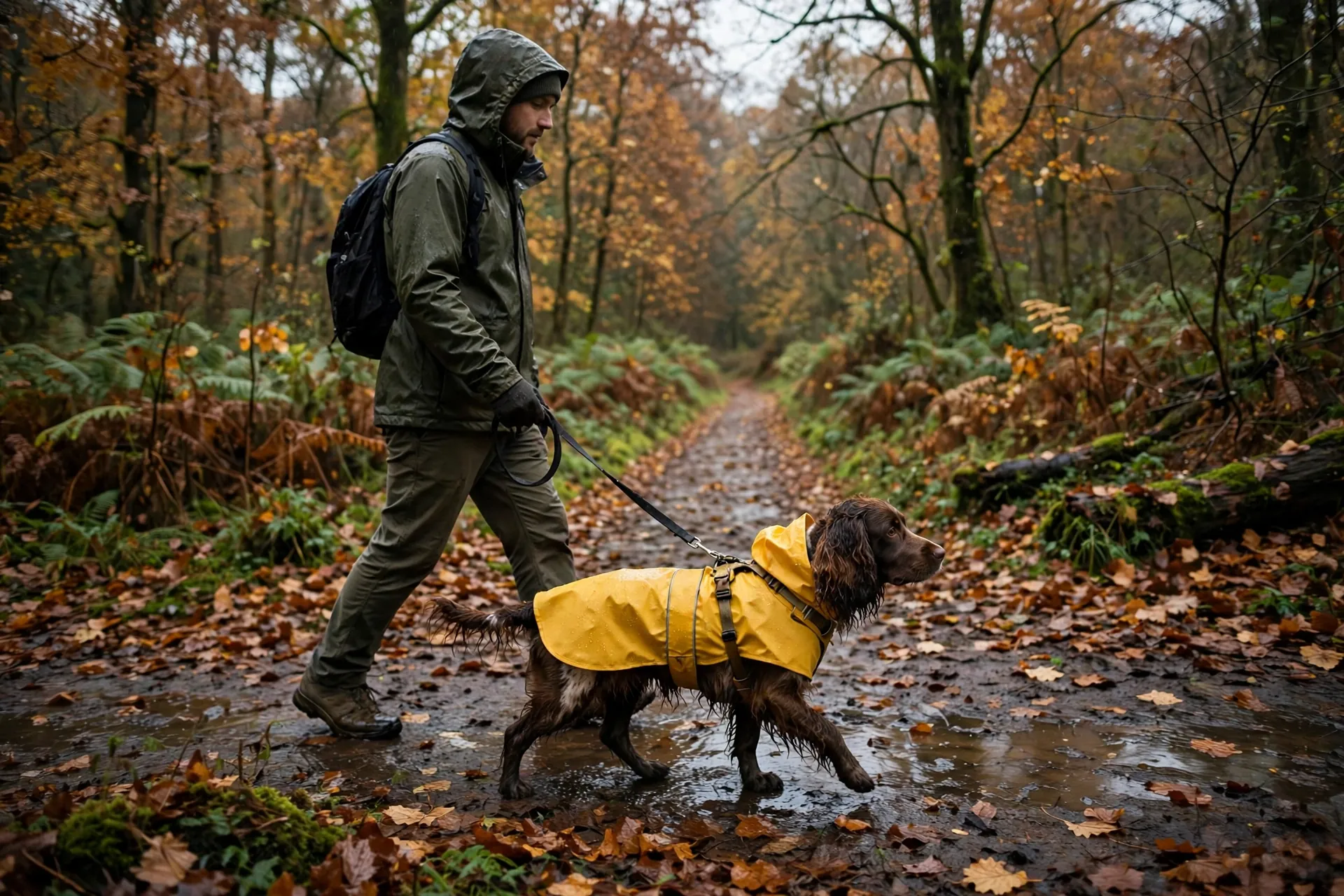
Rain is usually a reason to adapt, not to cancel. A steady drizzle on a surfaced path is fine for most dogs, provided the dog is dried properly afterwards and the walk does not end with a long, cold car journey in wet fur. Driving rain with a strong wind is different: it chills small, short-coated and older dogs quickly, it makes paths slippery, and it makes visibility poor for everyone. On those days, shorten the walk, choose a sheltered route through trees or along a hedged lane rather than an exposed hilltop, and consider a waterproof coat for the dog. A coat that keeps the chest and belly dry does more for warmth than a coat that only covers the back. For muddy conditions, our guide to dog boots for muddy walks explains when boots help and when a good drying routine matters more.
Fog deserves more caution than it usually gets. In light mist, a familiar, enclosed walk can still be enjoyable, with the dog on a lead and a light on. In thick fog, where you cannot see across a field or along a lane, the risks multiply: you cannot see traffic, other dogs, livestock or a cliff edge, and the dog cannot see you either, so recall becomes unreliable even for a well-trained dog. Fog also muffles sound, which makes it harder to hear a bicycle, a horse or a vehicle. On a thick-fog day, the sensible walk is a short, lit, enclosed loop close to home, or a garden and indoor session instead. If you do go out, keep the dog on a lead throughout, avoid water edges, quarries, cliffs and busy roads, and carry a torch even though it will not cut far through fog.
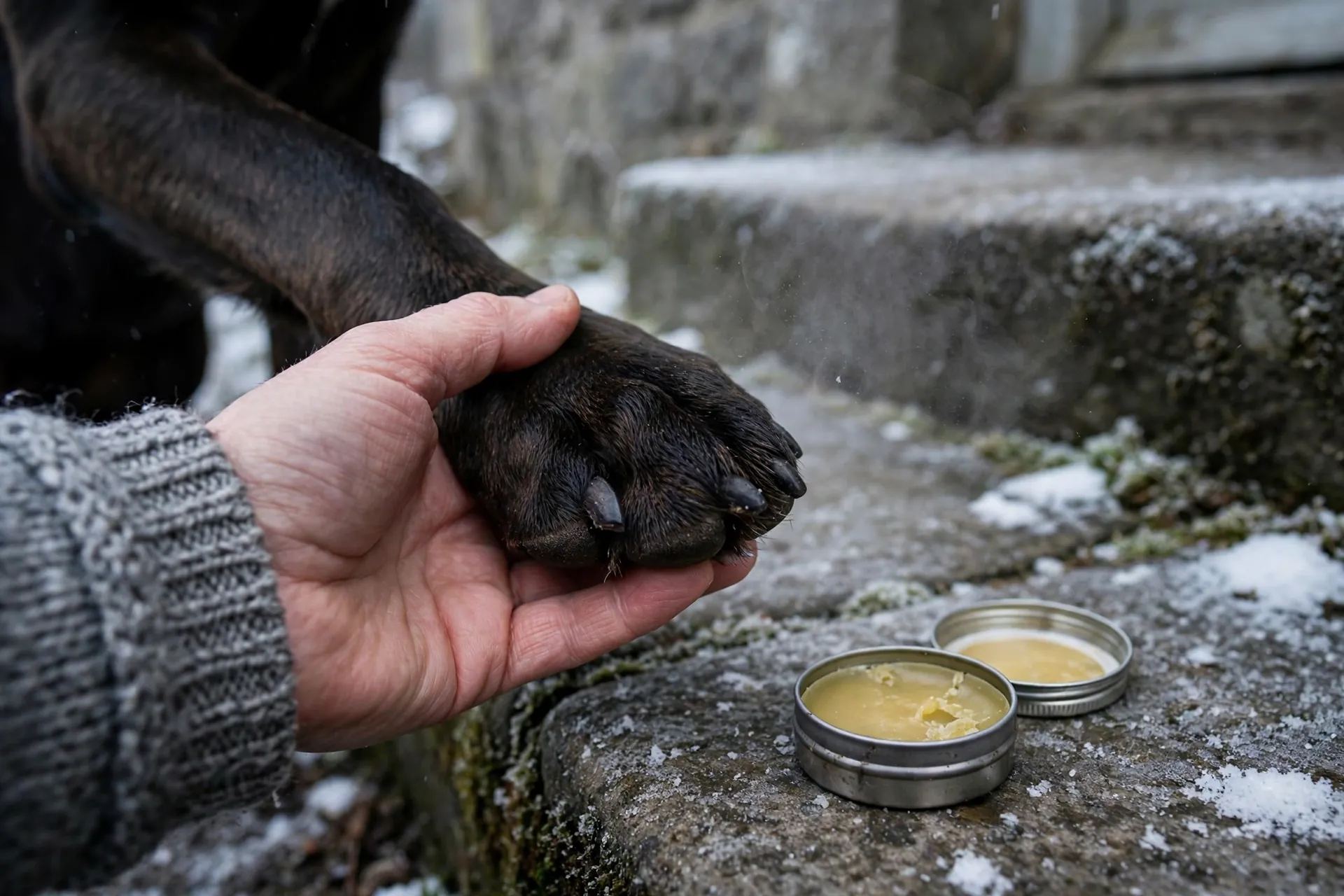
Ice is the weather that most often causes injury, to dogs and to owners alike. A thin, invisible layer on a pavement, a wooden bridge or a cattle grid can send either of you sprawling, and a dog that slips once may become nervous on that surface for weeks. Choose gritted pavements, grass verges or surfaced paths rather than untreated tarmac, walk slowly, keep the lead short so the dog cannot lunge, and avoid slopes and steps where possible. After the walk, wash paws in lukewarm water to remove grit salt, which can irritate pads and is harmful if licked, and check between the toes for small cuts and packed ice. Dogs that spend time on gritted roads regularly may benefit from paw protection, and our seasonal autumn dog holiday checklist covers the mud, light and drying routines that carry over into the darkest weeks.
Snow divides dogs sharply. Some breeds were made for it and will play for an hour without noticing the cold. Others, especially small, short-coated, very young or very old dogs, chill quickly and may need a coat, a shorter outing and a warm recovery. Snow also hides hazards: a frozen pond that looks like a field, a ditch under a drift, a sharp object under a thin covering. Keep dogs away from frozen water altogether, because ice thickness is impossible to judge from the bank and a dog that breaks through is in serious danger, as is anyone who tries to rescue it. After a snowy walk, check paws for ice balls between the toes, dry the dog thoroughly, and watch for limping that suggests a cut or a sore pad.
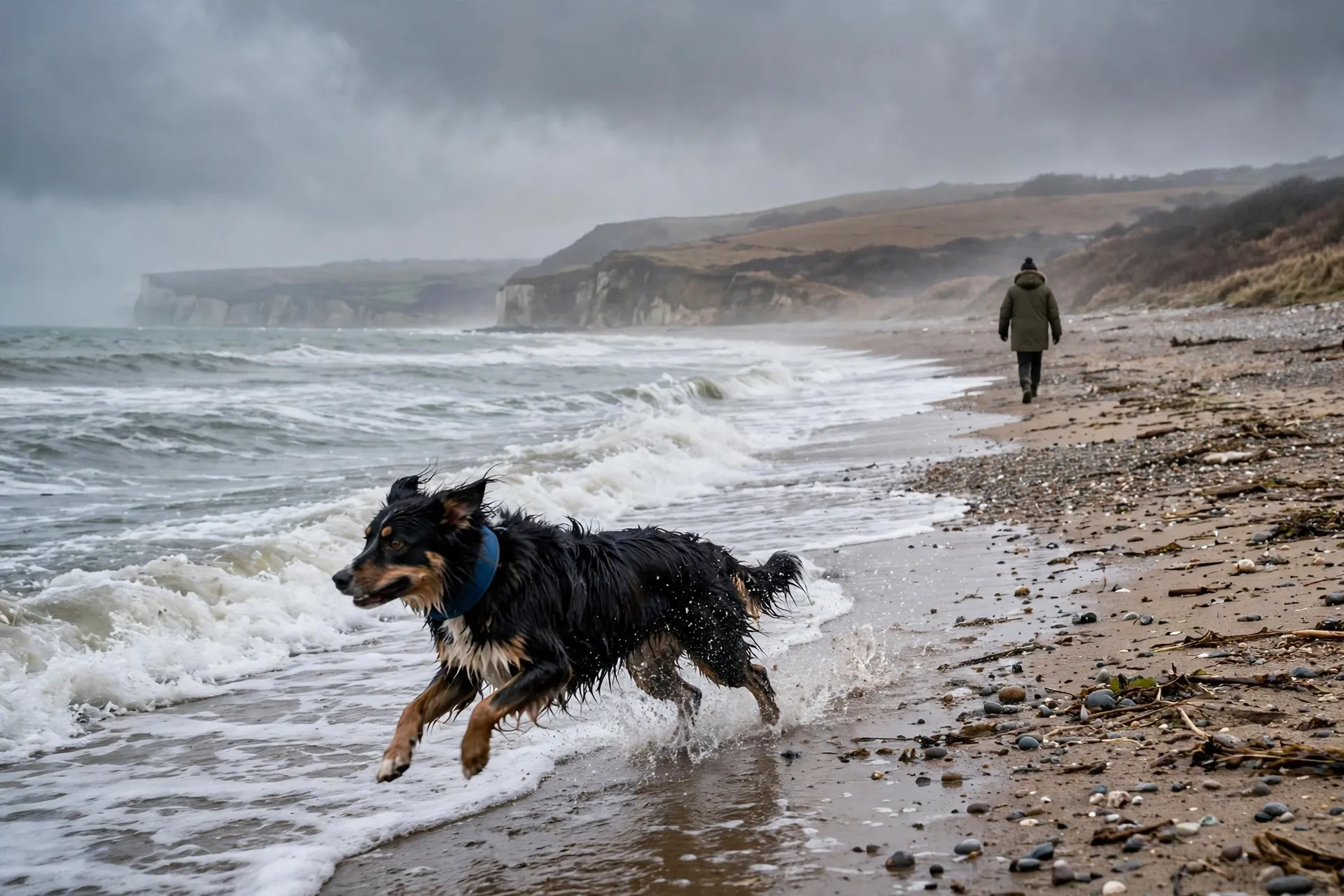
Wind is the forgotten hazard. A strong wind does not just chill a dog; it brings down branches, blows gates open, carries scents in confusing directions and makes a dog harder to hear and to control. On a very windy day, avoid woodland with dead branches overhead, avoid exposed coastal paths and cliff edges, and keep the dog on a lead near roads, because a sudden gust can push a dog, or a bin, or a branch, into the road. If a weather warning is in place for wind, treat it as a reason to stay local, and check the official guidance before you travel to a more exposed location.
Cold, coats, paws and older dogs
Not every dog needs a coat, and not every dog that needs one will admit it. Thick-coated breeds such as huskies and many collies are usually comfortable in British winter cold, provided they are dry and moving. Short-coated, lean, very small, very young, very old or unwell dogs lose heat faster and often benefit from a well-fitted coat that covers the chest and belly without restricting the legs. The test is behaviour, not breed alone: a dog that shivers, tucks its tail, lifts its paws repeatedly, slows down markedly or tries to turn for home is telling you it is cold, whatever the breed standard says. Believe the dog in front of you.
Coat fit matters more than coat price. A coat that rides up, rubs at the armpits or restricts the shoulders will make a dog move less freely and may cause sores on a long walk. Measure the dog's back length, chest and neck as the manufacturer directs, try the coat on over any harness, and watch the dog walk, trot and toilet in it before committing to a long outing. A coat that is waterproof is useful in rain, but a coat that traps damp fur underneath can chill a dog once it stops moving, so a quick towel-dry at the car or the door is still part of the routine. For drying after wet and muddy walks, a dog drying coat can be a practical second layer for the journey home, because it draws moisture out of the fur while the dog recovers.
Paws take a particular beating in winter. Wet mud softens pads, grit salt irritates them, ice balls form between toes, and repeated wetting and drying can crack the skin. A simple post-walk routine prevents most problems: rinse paws in lukewarm water, dry them gently, check between the toes and around the pads, and apply a paw balm if the pads look dry or cracked. Our guide to paw balm for winter dogs explains which ingredients protect pads and how boots and balm compare for different dogs. Trim the fur between the toes if it regularly packs with ice or mud, but do so carefully and only if you are confident, because nicking the skin between toes is easy and painful.
Older dogs need a winter plan of their own. Arthritis stiffens in cold and damp, so an older dog may need a longer, gentler warm-up, a shorter loop, a ramp or a lift into the car, and a warm, draught-free bed to recover on. Watch for stiffness after rest, reluctance on stairs or slopes, and a shorter stride on cold mornings, and talk to a vet if these signs are new or worsening, rather than assuming they are just age. A shorter walk that the dog enjoys is far better than a longer walk that leaves it stiff for two days, and a consistent daily routine usually suits an arthritic dog better than a weekend burst followed by days of rest.
Puppies and newly rehomed dogs are a special case in the dark weeks. A puppy's recall is still forming, its bladder control is limited, and its experience of traffic, livestock and other dogs is small, so dark walks should be short, positive and mostly on a lead, with plenty of rewards for checking in. Socialisation in winter still matters, but it should happen in daylight and in controlled settings, not on a dark lane with an unknown dog approaching. For a rescue dog settling into a new home around Christmas, the shortest days can be an advantage: a calm, predictable routine with short, successful walks builds confidence faster than ambitious outings that end in a fright.
Indoor exercise when the walk is short
The hardest part of the short-days season is not the dark walk but the long evening after it. A dog that has had only a short walk still has energy, curiosity and a need to use its nose, and if those needs are not met, the evening fills with barking, chewing, pacing or pestering. Indoor exercise is not a consolation prize for a missed walk; it is a different kind of work that can tire a dog more effectively than another lap of the same field, because it uses the brain as well as the body.
Scent work is the most efficient indoor top-up for most dogs. Hide treats in boxes, under cups, in rolled towels or in a snuffle mat, and let the dog search room by room. Start easy, with treats in plain sight, and build up to harder hides as the dog learns the game. Ten minutes of searching can tire a dog as much as a much longer walk, because sniffing is cognitively demanding. Scatter feeding, where the dog's meal is scattered across the floor or the garden rather than served in a bowl, turns an everyday event into a foraging session, and a lick mat or a stuffed, frozen food toy gives a calm, focused activity for the evening wind-down.
Training games double as exercise and as relationship building. Five minutes of practising a recall between two people, a settle on a mat, a gentle trick or a new cue is more valuable than a long, unfocused session, and it can be fitted into the gaps in an evening without any special equipment. Keep sessions short, end on a success, and reward generously, because a dog that enjoys training will offer focus willingly the next day. Avoid games that encourage jumping, frantic chasing or rough wrestling indoors, especially on slippery floors, because a dog that injures itself on a wet kitchen floor has lost more than it gained from the game.
Physical play indoors needs a little management. A hallway fetch with a soft toy, a gentle tug game with clear start and stop cues, and a controlled obstacle course made from cushions, boxes and a broom handle on the floor can all work, provided the space is safe, the floor is not slippery, and breakable objects are out of the way. Older dogs and puppies should have lower-impact versions: a slow treasure hunt rather than a chase, a short tug rather than a wrestling match. If the house is small, use the garden for a few minutes of play even in the dark, with a light on and the dog supervised, rather than trying to fit a high-energy game into a living room.
Enrichment is not only about tiring a dog out; it is about giving the dog choices. A dog that can choose between a chew, a sniffing game and a comfortable bed is calmer than a dog that is simply kept busy. Rotate toys rather than leaving all of them out at once, so that a toy that reappears after a few days feels new again. Provide a quiet, warm resting place away from draughts and from the main thoroughfare, because a dog that cannot rest properly will be harder to settle however much exercise it has had. And remember that a short walk plus a good indoor session is a complete day for many dogs, not a failed one.
A workable short-day routine
A routine that survives the solstice is one that can be done on a wet Tuesday as well as on a bright Saturday. It does not need to be elaborate. It needs a daylight walk, a short evening loop, a drying station by the door, and an indoor activity that the dog looks forward to. Once those four pieces are in place, the rest of the day can flex around work, weather and energy levels without the dog's welfare depending on a single heroic outing.
A practical weekday pattern looks like this. In the morning, a short toilet walk and breakfast, with a few minutes of sniffing or play if time allows. Around midday or in the early afternoon, the main walk: the longest daylight walk the day allows, on a familiar route, with hi-vis gear if light is fading. On return, paws washed, coat or vest removed, dog towelled or put in a drying coat, and a drink of water. In the evening, a short, lit toilet loop, dinner, and an indoor game or scent session. Before bed, a final brief toilet trip on a lit path. The exact times matter less than the order: daylight for the main walk, darkness only for short, lit loops, and recovery time built in after every wet or cold outing.
Weekends are the time to bank the longer walks that weekdays cannot provide. A bright Saturday can carry the week's exploratory walk, the beach visit, the woodland loop or the longer hill walk, provided the dog is fit for it and the weather allows. Do not try to make up a whole week of short walks in a single exhausting Saturday, because a dog that is unfit or stiff will pay for it on Sunday. Build length gradually, keep a rest day after a genuinely long walk, and use the weekend to check routes, test gear and practise recall in daylight, so that the weekday walks in the dark are as easy as possible.
Holiday weeks around Christmas and New Year need their own version of the routine. Guests, fireworks, new smells, disrupted feeding times and a house full of people can unsettle even a confident dog, and the shortest days leave little room to burn off that excitement outdoors. Keep the dog's core routine as stable as possible: same feeding times, same bed, same main walk if you can manage it, and a quiet retreat the dog can go to when the house gets busy. Fireworks are a particular issue in late December and early January, so check local displays, keep the dog indoors during likely display times, and talk to a vet in advance if the dog is noise-sensitive, rather than hoping a new product will work on the night. If you are travelling with the dog over the holidays, check the official guidance before you travel for any seasonal rules at your destination, and pack the hi-vis kit, the drying towels and the indoor enrichment as carefully as you pack the dog's food.
Finally, keep a simple end-of-day check for the darkest weeks. Did the dog get a daylight walk, or at least a good sniffing outing? Was it seen clearly on any dark stretch? Were its paws checked and dried? Did it have something interesting to do in the evening? If the answer to all four is yes, the day was a success, however short the walk was. The solstice passes, the days lengthen, and a dog that has had steady, safe, interesting days through the darkest weeks will come into spring fit, confident and ready for longer walks, without having had to endure a winter of rushed, dark, stressful outings to get there.
Practical questions
Before you go
Do dogs need a hi-vis vest, or is a light enough?
A light helps, but it does not replace a hi-vis vest on a dark road or lane. A light shows one point of movement, while a vest gives drivers a larger, recognisable dog shape from the side as well as from behind. Use both on any route that meets traffic, and add a reflective collar or lead for close-range visibility.
What time should the last walk finish around the winter solstice?
Plan to finish before full darkness unless the route is lit, familiar and traffic-free. In much of Britain that means starting the last walk in mid-afternoon and building in a 30-minute buffer for a slow dog, a muddy path or a wrong turn. A walk that ends in daylight is safer than a longer walk that ends in the dark.
Is it safe to walk a dog in fog or on icy paths?
Thick fog and sheet ice are both good reasons to shorten the walk or stay close to home. In fog, keep the dog on a lead, choose a route you know well and avoid roads, cliffs and water edges. On ice, pick gritted or grassy ground, walk slowly, keep the lead short and check paws afterwards for grit salt and small cuts.
How short can a walk be on the darkest days without harming my dog?
A short, sniff-rich walk of 20 to 30 minutes, plus indoor play and training, can be enough for many adult dogs on the worst days, especially if the dog also gets a longer walk at the weekend. The risk is not one short day, but a whole winter of short, rushed walks with no sniffing, no play and no variety. Keep the walk interesting even when it is brief.
Do I need different gear for a puppy or an older dog in winter?
Yes. Puppies chill faster, tire sooner and are still learning recall, so keep them on a lead in the dark and keep outings short and positive. Older dogs may need a warm coat, a ramp or a shorter loop, and extra care on slippery ground. For both, a warm, dry place to recover after the walk matters as much as the walk itself.