This guide is independent and contains no paid placement. If affiliate links are added later, they will be clearly marked and will not change our editorial checks.
Abergavenny works best as a market day: arrive early, browse the stalls while the town is still calm, take a riverside break at midday, then choose between a gentle valley walk or a Black Mountains climb in the afternoon. Keep your dog on a lead near livestock, carry water, and leave time for a quiet evening walk.
Morning: the market opens
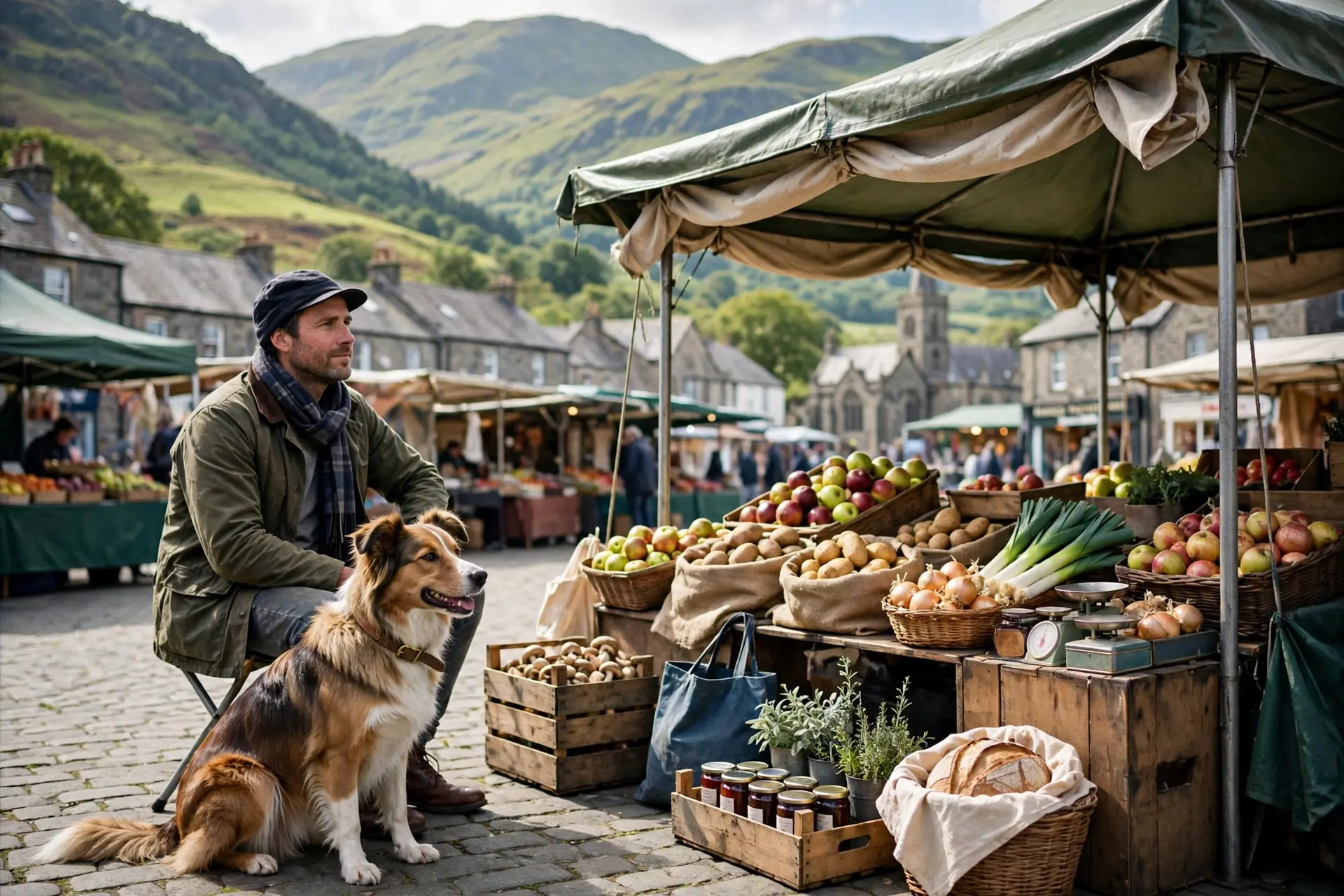
The market day starts before the crowds do. In the early morning, Abergavenny smells of fresh bread, coffee, cut flowers and damp stone, and the sound that carries across the town centre is not traffic but voices, stall shutters and the first customers greeting the traders they know by name. For a dog, this is the best hour of the day. The pavements are still wide enough to pass comfortably, the air is cool, and a short lead is enough to keep a curious nose out of a cheese stall while still letting the dog take in the new smells.
Plan to arrive early on a market day, and treat the first hour as a settling-in walk rather than a shopping trip. Walk the edge of the market first, let your dog sniff the corners, find a patch of quiet pavement and watch the town wake up. Dogs that are rushed straight into the busiest aisle often spend the rest of the morning over-aroused, while dogs that are given ten unhurried minutes at the edge usually settle much faster. If you are travelling with another person, take turns at the stalls that interest you most, so one person can always stay with the dog in a calmer spot.
Abergavenny Market Hall sits at the heart of the town, and the stalls around it change with the season: local meat, cheese, bread, vegetables, plants, crafts and cooked food. Market days are traditionally Tuesdays, Fridays and Saturdays, with a general market and a popular flea market on some days, but the exact pattern can change, so check the official guidance before you travel. The outdoor stalls are usually the easiest part of the market with a dog, because there is more space to step aside, more fresh air and a clearer exit. Indoor halls can be warm, noisy and crowded, with narrow gaps between stalls and food at nose height, so think carefully before taking a nervous, large or reactive dog inside.
Dog tip for the morning: keep the lead short in the market, carry poo bags where you can reach them without fumbling, and bring a small bottle of water and a collapsible bowl. Do not let your dog eat dropped food, and do not tie a lead to a stall or a chair and walk away. If your dog is small, be ready to pick them up for a short stretch through a crush, and if your dog is large, keep them close to your leg so their tail and back end do not sweep a display. A calm dog at a market is usually a dog that has already had a short toilet walk, so give them that chance before you start browsing.
Food is the great temptation of an Abergavenny morning, and it is worth deciding in advance what you will buy and what you will only look at. The town has built a strong reputation for food, helped by its long-running food festival, and the market is a good place to see why: Welsh cheese, local lamb and beef, artisan bread, honey, preserves and seasonal vegetables are all part of the same small circuit. Buying a little and carrying it in a rucksack is easier than juggling bags and a lead, and it leaves your hands free for the dog. If you plan to buy chilled food, bring a cool bag, especially on a warm day, and remember that a market bag swinging at dog height is an invitation to investigate.
Before you leave the market area, take a short loop around the neighbouring streets. The town centre is compact, with independent shops, cafes and bookshops within a few minutes of the market, and a slow wander gives your dog a change of surface and smell after the intensity of the stalls. Look for the church, the museum area and the quieter side streets, and use them as a decompression walk. By late morning, the market will be at its busiest, and that is the right moment to step away, find water and shade, and let the dog rest before lunch.
Midday: lunch and a riverside reset
By midday, the market is full, the sun is higher, and most dogs have had enough of crowds, noise and food smells. This is the point in the day to change the pace completely. Leave the town centre for the river. The River Usk runs close to Abergavenny, and its banks offer the flat, open, green space that a market-weary dog needs: room to walk at a natural pace, grass underfoot, water to look at and far fewer people pressing past.
Castle Meadows, the open ground below Abergavenny Castle, is the natural bridge between the town and the river. It is a useful midday stop because it is close enough to walk to from the market, yet it feels like a different place. The ground is open, the castle ruins stand above it, and the paths give you a choice between a short loop and a longer riverside stretch. Let your dog have a proper sniffing walk here rather than a forced march. Ten or fifteen minutes of unhurried sniffing on a long lead, where that is safe and allowed, often does more to settle a dog than a fast walk twice as long.
Dog tip for midday: offer water before your dog looks thirsty, especially on a warm or humid day, and find shade for a rest. A dog that pants heavily, seeks shade, slows down or lies flat on cool grass is telling you to stop. Do not expect a dog to settle under a cafe table in full sun after a busy morning, and do not leave a dog in a car while you eat lunch, even for a short time in warm weather. If you are eating out, choose a place with a shaded outdoor area and space for the dog to lie down, and bring a familiar mat or blanket so the dog knows where to settle.
Lunch in Abergavenny can be as simple or as elaborate as you like, and the dog-friendly choice is usually the simpler one. A cafe with outdoor seating, a pub garden or a takeaway eaten on a bench near the river all work well, because the dog can stay with you without navigating a crowded dining room. Ask staff where dogs are welcome before you sit down, and do not assume that a dog-friendly sign at the door means dogs are welcome everywhere inside. Some places welcome dogs in the bar area but not in the restaurant, some welcome dogs only outside, and policies can change, so check the official guidance before you travel if a particular meal matters to you.
Use the lunch break to check your timings for the afternoon. If the weather is turning hot, an afternoon mountain walk may need to become a shorter valley walk, and if rain is coming, a riverside path may become muddy and slippery. Look at the sky, feel the wind, and ask yourself honestly how your dog is doing. A dog that has settled well, drunk water and rested in the shade is ready for more. A dog that is still panting, restless or reluctant to walk is ready for a quiet afternoon instead. The market day works because it has a built-in rest in the middle, and the best use of that rest is to listen to the dog rather than to the plan.
If you are travelling with children, midday is also the moment to reset their energy. A riverside walk, a snack on a bench and a look at the castle from below give children something to do without asking the dog to cope with another hour of crowds. Keep children and dogs supervised around the river, because banks can be steep, slippery or unfenced, and keep dogs on a lead near the water unless you are sure of the spot and the rules. A calm midday hour makes the afternoon feel like a second, smaller day out rather than the tired end of a long one.
Afternoon: castle, streets and a second walk
After lunch, the town feels different. The market stalls are thinning, the light softens, and Abergavenny Castle becomes the natural focus for the afternoon. The castle stands above the town, with ruins, walls and open grass that invite a slow exploration rather than a hurried visit. Dogs are generally welcome in the castle grounds, which are managed as a public open space, but the museum inside has its own rules, so check the official guidance before you travel if you want to go indoors. The grounds themselves are the main attraction for a dog owner: a place to walk, sit and look out over the town and the hills beyond.
Walk up to the castle at a steady pace, and let your dog set the speed on the slope. The climb is short but noticeable, and older dogs, small dogs and dogs that are already tired from the morning will feel it. Once you are up there, the reward is space and a view. The Blorenge, the Sugar Loaf and the Black Mountains frame the town, and on a clear afternoon you can see how the valleys meet and why Abergavenny earned its name as the gateway to the Black Mountains. For a dog, the interest is simpler: grass, walls to sniff, other dogs at a distance and a breeze that carries smells from the whole valley.
Dog tip for the afternoon: keep your dog on a lead in the castle grounds, especially near edges, walls and other visitors, and do not let them scramble on ruins or walls. Take a short break on a bench, offer water again, and watch for tiredness. A dog that has walked all morning, rested at midday and then climbed to the castle may be ready for a shorter afternoon than you planned, and that is fine. A twenty-minute castle visit with a content dog is better than an hour with a dog that is pulling, panting and looking for the car.
From the castle, drop back into the town for a second, slower look at the streets you rushed past in the morning. The afternoon is a good time for the shops that do not suit a busy market crowd: a bookshop, a deli, a garden shop or a cafe for tea. Some shops welcome dogs inside, some prefer dogs to wait outside, and some have a water bowl by the door as a quiet invitation. Ask before you enter with a dog, keep the lead short inside, and do not let your dog browse the shelves at nose height. If a shop is small, crowded or full of breakable goods at tail height, it is kinder to take turns or to skip it.
If your dog still has energy, add a second riverside stretch in the afternoon. A walk along the Usk in the late afternoon light is one of the gentlest pleasures of an Abergavenny day: the river moves slowly, the meadows are quiet, and the town feels a long way away even though it is only a few minutes behind you. Keep the walk short and flat if the morning was long, and turn back before your dog tires. The aim is not to cover distance but to give the dog a calm, green end to the active part of the day.
For ideas about how castle visits work elsewhere in Wales, our guide to dog-friendly castles in Wales explains which sites welcome dogs, where leads are required and how castle zones differ. Abergavenny Castle is a smaller, more informal visit than many of the great Welsh castles, and that is part of its charm for a dog owner: there is less queuing, less formality and more open grass, but the same basic rules apply, with leads, respect for other visitors and care around old stonework.
Evening: a slow finish
Evening in Abergavenny is the reward for a well-paced day. As the market stalls close and the day visitors leave, the town quietens, the light turns gold on the hills, and the streets become easy to walk again. This is the time for a slow evening stroll rather than another attraction. Walk the town centre at your dog's pace, let them sniff the places they rushed past in the morning, and find a bench where you can sit and watch the town settle.
If you are staying for dinner, the evening is the best time to eat out with a dog in Abergavenny. Pubs and restaurants are calmer than at lunchtime, staff have more time to show you to a dog-friendly table, and a dog that has walked, rested and eaten is much more likely to settle under a table. Choose a place with outdoor seating if the evening is warm, or a quiet corner indoors if dogs are welcome there and the room is not crowded. Bring the familiar mat again, order simply, and be ready to take the dog outside for a short toilet break during a long meal.
Dog tip for the evening: plan the last toilet walk before dark, and know the route back to your car or your accommodation. Abergavenny is a safe, walkable town, but unfamiliar streets, unlit paths and tired dogs are a poor combination after dark. Keep the lead short on pavements, carry a torch or use your phone light on dark lanes, and make the last walk short, familiar and calm. A dog that settles well in the evening usually sleeps well, and a good night's sleep is the best preparation for a second day in the hills.
If you are driving home in the evening, give the dog a final drink and a toilet break before you set off, and make the car comfortable for the journey. A familiar blanket, a ventilated car and a calm departure matter more than a fast one. Do not rush the last ten minutes of the day to save ten minutes on the road. A market day that ends slowly is a market day your dog will remember as a good one, even if they cannot tell you so.
Evening is also the time to take stock. What worked? Did your dog prefer the river to the market, the castle to the shops, the quiet lanes to the busy stalls? The answers will shape your next visit, and they are worth remembering. Some dogs love a market day and thrive on the noise and smells. Others tolerate the market for an hour and love the river for three. Abergavenny suits both kinds of dog, because the town is small enough to change plan quickly and the countryside is close enough to escape to when the town gets too much.
A day that stays off the mountain
Not every Abergavenny day needs a mountain. Some dogs should not climb at all: older dogs with stiff joints, puppies whose bones are still growing, dogs recovering from injury or surgery, brachycephalic breeds that struggle in heat, and dogs that simply do not enjoy steep, exposed walking. A no-mountain day is not a lesser day. It is a different day, built around flat paths, shade, water and frequent rests, and Abergavenny is well suited to it.
Start with the river. The paths along the Usk and through Castle Meadows give a flat or gently sloping walk with plenty of places to stop, and you can make the walk as short or as long as you like by turning back at any point. A circular walk is not obligatory. An out-and-back walk along the river, with the same familiar path on the way home, is often easier for an older dog than a loop that keeps introducing new ground. Keep the pace slow, let the dog sniff, and sit on a bench halfway if the dog wants to rest.
After the river, explore the town at a walking pace. Abergavenny's streets are mostly level in the centre, with shops, cafes and the market within a short distance of each other. This matters for dogs that tire quickly, because you can sit down often, find shade easily and return to the car without a long climb. The castle grounds are still worth visiting on a no-mountain day, but take the gentlest route up, go slowly, and be ready to turn back if the slope is too much. The view from partway up is still a good view.
Dog tip for a no-mountain day: build the day around three short walks rather than one long one, with a rest between each. A morning river walk, a midday castle visit and an evening stroll give a dog variety without exhaustion, and each walk can be shortened or skipped if the dog is tired. Carry water on every walk, even a short one, and watch for heat on warm days, because flat riverside paths can be surprisingly warm in still, humid air.
Other no-mountain options include the lower valley lanes around the town, the quiet roads towards Llanfoist and the canal towpath. The Monmouthshire and Brecon Canal runs near Abergavenny, and its towpath offers a flat, linear walk with water on one side and hedges on the other. Canal paths suit dogs that like a steady, predictable route, but they also need care: the towpath can be narrow, cyclists use it, and the water is unfenced, so keep your dog on a lead and close to you when other users pass. Check the official guidance before you travel for the best access point and the current condition of the path.
A no-mountain day also leaves time for the things that a climbing day squeezes out: a long lunch, a second coffee, a browse in a bookshop, a sit in a pub garden. Dogs that are not natural hill walkers often enjoy these slower pleasures more than a summit, and their owners do too. The point of a dog-friendly break is not to tick off a peak but to spend a day that suits the dog in front of you, and Abergavenny gives you the room to do that without feeling that you have missed the main event.
A day that goes up
For fit, healthy dogs and owners who enjoy a climb, the Black Mountains are the reason to come to Abergavenny. The Sugar Loaf, the Blorenge and the long ridge walks beyond them offer some of the most rewarding dog walking in South Wales, with open moorland, wide views and a sense of space that a town walk cannot match. A mountain day needs more planning than a market day, and it should be planned as a separate day, not bolted onto a busy market morning.
The Sugar Loaf is the classic Abergavenny climb, a distinctive cone-shaped hill that rises to 596 metres and gives a panoramic view over the town, the Usk valley and the Black Mountains. The usual route from the town is a steady climb on paths and tracks, with a steeper final section near the summit. It is a half-day walk for most people, not a quick stroll, and it should not be attempted in poor weather, high wind or thick mist without proper preparation. The Blorenge, at 561 metres, offers a different kind of walk, with a gentler approach from the car park near the summit and wide, open views over the valleys. Both hills are grazed by sheep, and both need a lead, good footwear and a realistic sense of your dog's fitness.
Dog tip for a mountain day: keep your dog on a lead near livestock at all times, and be ready to keep the lead on for the whole walk if sheep are present. Sheep can appear suddenly over a rise or around a bend, and a dog that chases, even playfully, can cause serious harm and distress. Carry more water than you think you need, because there is no reliable drinking water on open moorland, and bring food for the dog as well as for yourself. A dog that has climbed for two hours needs calories and rest, not just a pat at the summit.
Start a mountain walk early, before the heat of the day, and check the weather forecast for the hills, not just for the town. Mountain weather changes quickly, and a sunny morning in Abergavenny can become wind, rain and low cloud on the ridge within an hour. Pack waterproofs for yourself and a drying coat or towel for the dog, wear boots with grip, and carry a map and a charged phone. Let someone know your route and your expected return time, especially if you are walking alone. These are standard hill-walking precautions, and they matter just as much with a dog as without one.
On the hill, watch your dog as carefully as you watch the path. A fit dog will usually tell you when they are tired by slowing down, lagging behind or seeking shade, and a dog that is panting heavily, limping or reluctant to continue should be turned back without argument. Paws need attention on rough, rocky ground: check for cuts, thorns and soreness at rest stops, and consider dog boots if your dog is not used to rocky paths. Puppies, older dogs and dogs with joint problems should not attempt a full mountain climb, and brachycephalic breeds should not climb in warm weather.
After the walk, give your dog time to recover. A mountain day is tiring, and a dog that has climbed, descended and walked on rough ground will need water, food, a comfortable place to lie down and a quiet evening. Do not plan a second long walk, a busy dinner or a long drive immediately after a mountain walk. Let the dog sleep, check their paws and coat for ticks and burrs, and dry them thoroughly if they are wet. The best mountain days end with a tired, content dog asleep at your feet, and that is a better souvenir than a summit photograph.
If you want to build a longer Welsh trip around Abergavenny, our guide to a dog-friendly road trip in North Wales shows how to link days together without rushing, and our Cardiff with a dog guide covers the capital as a contrasting city stop. Abergavenny works well as the quiet, green start to a Welsh trip, with the mountains on one side and the city within reach on the other, and a road trip that begins here feels unhurried from the first day.
Getting there and parking
Abergavenny sits in Monmouthshire, in south-east Wales, close to the border with England and within easy reach of the M4 and the A40 and A465 roads. The town is served by a railway station on the line between Newport and Hereford, with trains to Cardiff, Newport and the Marches, and by bus services from nearby towns. For most dog owners, the car is the simplest way to arrive, because it carries the dog, the water, the towels, the food and the spare lead without a struggle, and it gives you a base to return to during the day.
Parking is straightforward if you arrive early and much harder if you arrive late on a market day. The town has several public car parks within a short walk of the centre, including car parks near the market, the castle and the railway station, and there is on-street parking on some surrounding roads. Charges and time limits vary, so check the official guidance before you travel for the car park you plan to use. On a busy Saturday, the car parks near the market fill first, and a car park a few minutes further out is often a better choice than circling the centre with a dog in the car.
Dog tip for arrival: park, then walk the dog before you do anything else. A short toilet walk, a drink of water and a few minutes to sniff the new place will settle most dogs after a car journey, and it is much easier to do this in a quiet car park than in the middle of the market. Note where you parked, take a photograph of the car park sign if you need to, and plan the walking route back to the car so you are not searching for it with a tired dog at the end of the day.
If you arrive by train, check the train company's dog policy before you travel, and remember that dogs on trains in Britain usually travel free if they are well behaved and kept on a lead, but they should not occupy a seat. Abergavenny station is a short walk from the town centre, and the walk is mostly level, but the station area can be busy at peak times, so keep your dog close. If you arrive by bus, check the bus company's dog policy as well, because policies vary and some services only accept small dogs in carriers.
Traffic in Abergavenny is generally light outside market hours, but the town centre streets are narrow and can be busy with delivery vehicles in the morning. Keep your dog on a short lead on pavements, cross roads at marked crossings where possible, and be careful at junctions where drivers may not expect a dog at kerb height. The town is compact enough that you can walk almost everywhere once you have parked, and walking is almost always pleasanter than driving between stops that are only a few minutes apart.
Eating and drinking with a dog
Abergavenny's reputation as a food town is well earned, and it is one of the reasons the market day works so well. The town has cafes, pubs, delis and restaurants within a few minutes of each other, and many of them welcome dogs in at least part of their premises. The key is to match the place to the dog: a calm dog that settles under a table will enjoy a pub lunch, while a restless dog will be happier with a takeaway eaten on a bench or in a pub garden.
Cafes are usually the easiest option for breakfast and lunch. Look for outdoor seating, a water bowl by the door and staff who greet the dog as well as you. A cafe that welcomes dogs will usually make it clear, and a cafe that does not will usually say so politely at the door. Do not take a dog into a cafe that is clearly not dog-friendly and hope nobody notices, because it puts staff in an awkward position and unsettles the dog. If you are unsure, ask before you sit down, and be ready to take your business elsewhere if the answer is no.
Pubs are the classic Abergavenny evening option, and many welcome dogs in the bar area or the garden. A pub garden on a summer evening, with the hills in the background and a dog asleep under the table, is one of the best ends to a market day. Inside, the rules vary: some pubs welcome dogs throughout, some only in the bar, and some only in a specific area. Ask where dogs are welcome, keep the dog on a lead and under the table, and do not let them wander to other tables, beg for food or bark at other dogs.
Dog tip for eating out: feed your dog before you eat, or bring a chew or a stuffed Kong to keep them occupied while you eat. A dog that is hungry and bored under a table is much harder to settle than a dog that has already eaten and has something to do. Bring the familiar mat, keep treats in your pocket for quiet behaviour, and be ready to leave early if the dog becomes restless. A short, successful meal is better than a long, stressful one.
For a picnic, the market itself is the best supplier. Buy bread, cheese, fruit and a drink in the morning, and eat them on the riverside or in the castle grounds at midday. A picnic is often the most dog-friendly meal of all, because the dog can stay with you in open space, you can move if the dog needs to, and there is no need to negotiate indoor rules. Bring a blanket, a water bowl and poo bags, and take all your litter home with you. Picnics also suit dogs that are nervous indoors, dogs that bark at strangers in enclosed spaces and dogs that simply prefer grass to a dining room.
Staying overnight
Staying overnight turns a market day into a proper break, and Abergavenny has a good range of dog-friendly places to stay, from hotels and bed and breakfasts in the town to cottages, farm stays and holiday parks in the surrounding countryside. The right choice depends on your dog: a calm dog that settles in a new bedroom will be happy in a town hotel, while a dog that needs a garden, a quiet location and space to move will be happier in a cottage or a rural stay.
When you book, say clearly that you are bringing a dog, give the breed, size and number of dogs, and ask for the dog policy in writing. Ask whether dogs are allowed in the bedroom, whether they can be left alone in the room, whether there is a charge, whether there is a garden or a toilet area, and whether dogs are welcome in the dining room or only in the bar. A place that answers these questions clearly is usually a place that has thought about dogs properly. A place that answers vaguely may still be fine, but it is worth clarifying before you arrive.
Dog tip for staying over: bring the dog's own bed, blanket, food, bowls and a familiar toy, and set up the sleeping area as soon as you arrive. A dog that sleeps in its own bed, in a familiar spot, with a familiar smell, will settle much faster than a dog that is expected to sleep on a strange bed in a strange room. Keep the first evening quiet, take a short last walk before bed, and do not leave the dog alone in an unfamiliar room on the first night unless you are sure they will settle.
If you prefer a self-catering stay, the countryside around Abergavenny offers cottages and holiday parks with enclosed gardens, which can be a great advantage for dogs that need safe off-lead time. Our guide to dog-friendly holiday parks in Wales explains how to compare parks by coast access, livestock rules, secure boundaries and realistic travel time, and the same questions apply to a rural cottage near Abergavenny. Ask about the height and security of the garden fence, the presence of livestock nearby, the distance to the nearest walk and the rules about leaving a dog alone in the property.
Book early for market days, food festival weekends and summer Saturdays, because dog-friendly rooms in a small town sell quickly. If your first choice is full, look at the villages around Abergavenny, such as Llanfoist, Govilon and Crickhowell, which are a short drive away and offer quieter stays with easy access to the town and the hills. A stay a few miles outside the town can be calmer for a nervous dog, with less traffic, fewer people and a garden to wake up in, and the drive into Abergavenny for the market takes only a few minutes.
Seasons, weather and packing
Abergavenny is a year-round destination, but the market day changes with the seasons. Spring brings lambs in the fields, blossom in the town and longer, brighter days, but also muddy paths and changeable weather. Summer brings the food festival, busy market days and warm evenings, but also heat, crowds and the need for shade and water. Autumn brings colour on the hills, quieter streets and crisp walking weather, but also rain, wind and shorter days. Winter brings quiet markets, frosty mornings and a town that feels local again, but also cold, wet paths and early darkness.
The best time for a first visit with a dog is often late spring or early autumn, when the weather is mild, the crowds are smaller and the hills are at their most inviting. Summer market days are rewarding but busy, and they need an early start and a careful eye on heat. Winter visits suit dogs that like cool weather and quiet streets, but they need warm, waterproof clothing for the dog as well as for the owner, and a shorter, flatter walk if the ground is frozen or waterlogged.
Weather in the Black Mountains can be very different from weather in the town, even on the same day. A calm, sunny morning in Abergavenny can hide wind and cloud on the Sugar Loaf, and a light shower in the town can be heavy rain on the ridge. Check a mountain forecast before a hill walk, and check the official guidance before you travel for any route that crosses open moorland. If the forecast is uncertain, choose the valley walk instead. The river and the castle will still be there, and the mountain will still be there on your next visit.
Packing list for a market day: lead and spare lead, harness, poo bags, water bottle and collapsible bowl, a small towel, a drying coat or blanket for wet weather, a familiar mat for cafe stops, food and treats, a cool bag if you are buying chilled food, a torch for evening walks, and a first-aid kit with tick removers. For a mountain day, add a map, a charged phone, waterproofs, extra water and food for the dog, and a lead long enough for open ground where that is safe and allowed. For a winter visit, add a dog coat if your dog feels the cold, and a spare towel for muddy paws.
Finally, remember the basics that apply to every Welsh walk: keep dogs on a lead near livestock, close gates behind you, take litter and poo bags home with you, and respect other walkers, cyclists and horse riders on shared paths. The countryside around Abergavenny is a working landscape, with farms, sheep and local people going about their day, and a considerate dog owner is always welcome back. A market day that leaves no trace, causes no trouble and ends with a tired, happy dog is the best advertisement for dog-friendly travel in Wales.
Practical questions
Before you go
Is Abergavenny a good town for a day out with a dog?
Yes, for most dogs it is a strong choice. The town is compact and walkable, the market, castle grounds and riverside paths give a varied day without long drives, and the Black Mountains are close for a longer walk when the weather and your dog allow. The main limits are crowds on busy market days, livestock on open hillsides and the need to keep dogs on a lead in many places, so plan a calm route and a quiet break.
Can dogs go into Abergavenny Market Hall?
Rules can change, and indoor market halls often have different rules from the outdoor stalls, so check the official guidance before you travel. On a busy market day, many owners have a better time browsing the outdoor stalls with the dog and taking turns to look inside, rather than taking a nervous dog through a crowded hall.
Where can I walk my dog near Abergavenny without climbing a mountain?
The riverside paths along the River Usk, the castle grounds and the lower valley lanes give flat or gently sloping walks that suit older dogs, puppies and dogs that tire quickly. Castle Meadows and the riverside are good starting points, and a short out-and-back walk is often better than a long loop on a first visit.
Are dogs allowed off the lead in the Black Mountains near Abergavenny?
Not reliably, and not where livestock are present. Much of the open hill country around Abergavenny is grazed by sheep, and dogs should be on a lead near livestock at all times. Use a long line on open ground only where it is safe and livestock are not nearby, and check the official guidance before you travel for the route you have chosen.
What should I do if my dog is nervous in a busy market?
Arrive early before the biggest crowds, keep to the edges of the market rather than the middle of the busiest aisles, and build in a quiet break on a riverside path or in the castle grounds. A short lead, a familiar mat or blanket for a cafe stop, water and a calm exit route all help, and if your dog is still unsettled, leave the market early and let the walk be the main part of the day.
Where can I park in Abergavenny with a dog?
Use a town-centre or edge-of-town car park and walk in, rather than circling for a street space close to the market on a busy day. Arrive early on market days, note the car park name and the walking route back to the car, and never leave a dog in a parked car in warm weather. Check the official guidance before you travel for current charges and time limits.