This guide is independent and contains no paid placement. If affiliate links are added later, they will be clearly marked and will not change our editorial checks.
Start at the lough shore, walk the level river path to Antrim Castle Gardens, and finish the loop back along the Six Mile Water. Keep your dog on a lead everywhere around the water, never let them drink from the lough if algae is visible, and treat the free gardens as the calm centre of the day.
Antrim in one look: a town built around water
Antrim is a working town of about 25,500 people, sitting 22 miles north-west of Belfast where the Six Mile Water runs into Lough Neagh. It is the historic county town of County Antrim, and since 2015 it has sat inside the borough of Antrim and Newtownabbey. Most visitors pass through it on the way somewhere else, because Belfast International Airport lies only about four miles to the south, and the M2 runs straight past the town. That is exactly why it suits a dog trip: the useful things are close together, the walking is mostly level, and nobody expects you to rush.
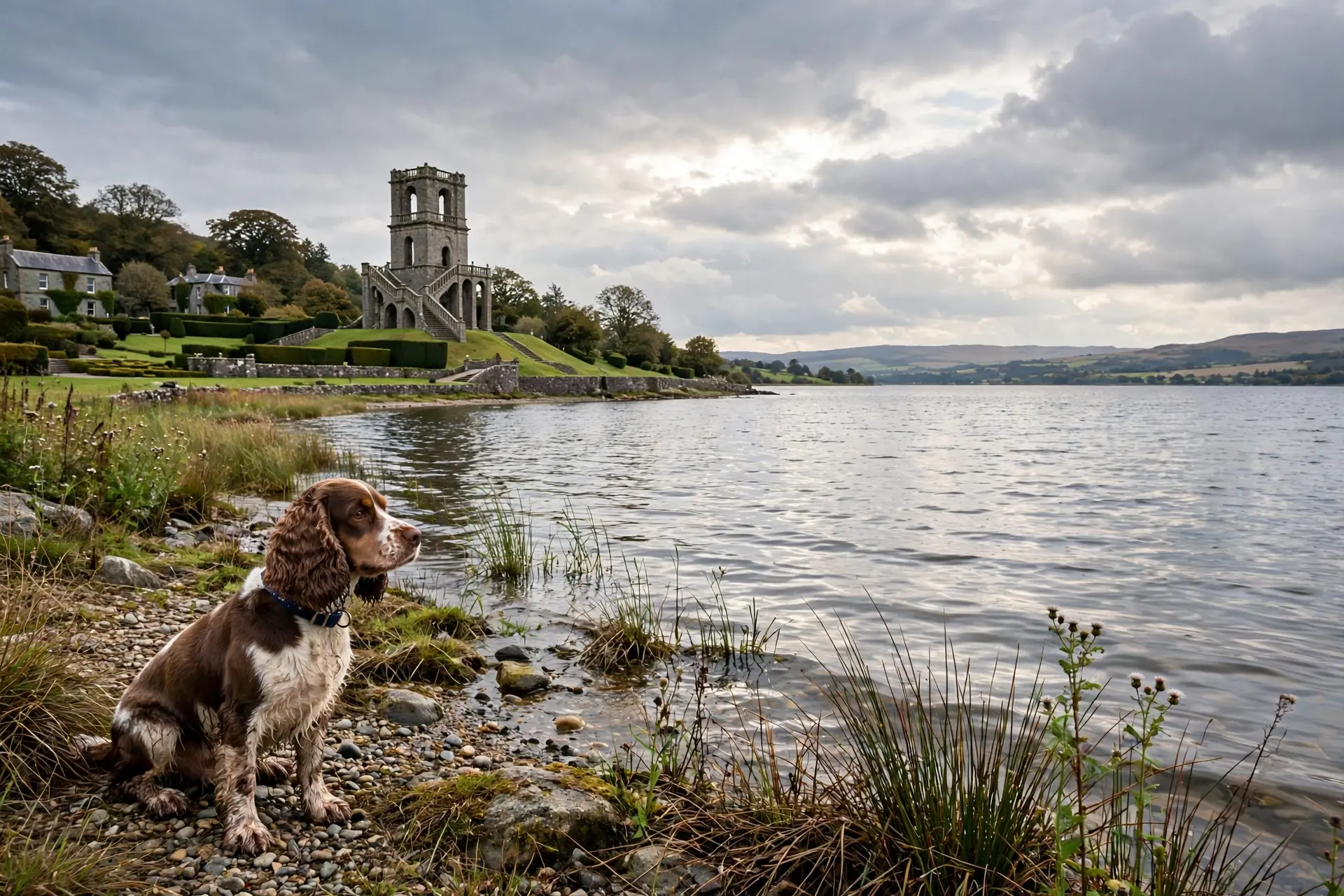
The geography does the planning for you. Three pieces of water shape every walk in town. Lough Neagh spreads to the south and west, so wide that from the shore it reads as an inland sea. The Six Mile Water cuts through the middle of town on its way to the lough. And Antrim Castle Gardens, laid out beside that river, hold the formal canals and ponds of a 17th-century water garden. A dog day in Antrim is really a triangle between those three: shore, river and garden, with the town centre tucked in between.
Lough Neagh itself deserves a moment of scale before you set off. At about 383 square kilometres it is the largest freshwater lake in the British Isles by surface area, with a shoreline of roughly 125 kilometres that touches five of the six counties of Northern Ireland. It is shallow for its size, averaging around 9 metres deep, which is why wind can whip up a surprising chop across open water and why the light changes so fast over it. The lough also supplies a large share of Northern Ireland's drinking water, which is one more reason to keep dogs out of it when the water is not clearly safe. You will not walk its whole shore in a day, and you do not need to: the Antrim stretch gives you the full effect in a single short walk.
What Antrim does not offer is also worth knowing before you arrive. This is not a resort town with a dog-friendly cafe on every corner, and it is not a beach destination. The shore is grass, reeds, stone and mud rather than sand, the town centre is compact and practical rather than pretty, and the best walks are the ones that follow water rather than the ones that chase views. If your dog is happy with long, flat, sniff-rich paths, open lawns and the smell of a river, Antrim will suit them far better than a steep coastal scramble would. If your dog needs off-lead running every day, you will need to plan that part of the trip deliberately, because the headline walks here are lead-on walks.
The rest of this guide works through the town in the order a dog would experience it: the lough shore first, then the woodland beside it, then the gardens, then the river loop that joins them, then the town itself, and finally the practical questions of getting there, staying over, eating, and using Antrim as a base. Read the water-safety section before you let your dog anywhere near the lough edge, because it changes how you handle the shore on every visit.
Antrim Lough Shore Park: the lake at its widest
Antrim Lough Shore Park sits at the end of Lough Road, about a mile south of the town centre, on the north-east shore of the lough. Entry is free, although parking charges may apply, so check the official guidance before you travel. The park is the obvious first stop because it gives you the lough in one glance: a broad sweep of open water to the horizon, a jetty, lawns, a nautical-themed play park, and the low, flat light that makes this shore feel much bigger than a town park has any right to feel.
The Gateway is the building to orient yourself by. It opened in December 2019 as part of a £2.3 million investment by Antrim and Newtownabbey Borough Council, and it houses an exhibition about Lough Neagh told through five themes: Legends, Life, Living, Lives and Links. Admission is free, and the building also serves as the base for Lough Neagh Rescue, the volunteer search and rescue service on the lough. Beside it stands the Protector of the Lough statue, which makes a useful meeting point if your group splits up. Accessible toilets and baby-changing facilities are available during the building's opening hours, which run from 8am to 8pm; check the official guidance before you travel in case those hours have changed.
For the dog, the park works best as a short, structured visit rather than a long free run. Keep the lead on from the car park. Walk the lawns first so your dog can settle and empty, then follow the shore path south towards Rea's Wood or north along the river side, depending on which direction is quieter. The shore itself is a mix of grass, reeds and a strip of sand and organic material, and it shelves gently, which is exactly why it looks inviting to a dog and exactly why you should not let them charge in. The water quality here has been a live issue, covered in detail in the water-safety section below, and the rule is simple: if you can see scum, discolouration or a warning sign, keep your dog on the lead and away from the water's edge.
The park's other features shape how long you will want to stay. The play park draws families, especially at weekends and in school holidays, so a dog that is nervous around running children will be happier on the quieter southern paths. A weekly parkrun uses the park, which means Saturday mornings bring a surge of runners along the paths; if your dog lunges at joggers, time your visit for later in the day. Boat trips run from the jetty in summer, and the Six Mile Water Caravan Park sits within the same lakeside complex, so the area can feel busy on a fine afternoon even though the water itself is enormous. Early morning is the sweet spot: the light is low across the lough, the paths are mostly empty, and the wind has usually not yet picked up.
One practical detail matters more than it sounds. The lough shore is exposed, and there is very little shelter once you leave the trees. On a still day that is a pleasure; on a windy day the wind comes straight across miles of open water and cuts through a wet dog fast. Bring a drying coat if your dog has been near the water, and do not plan a long shore walk as your last walk of the day in bad weather, because a cold, wet dog still has to ride home in the car. The Gateway building and the tree line by Rea's Wood are the two windbreaks worth remembering.
Rea's Wood and the southern shore
South of the main park lawns, the shore path runs into Rea's Wood, a stretch of wet woodland that changes the character of the walk completely. The open sky closes in, the path narrows between trees, and the lough appears in glimpses through the branches rather than as one wide view. For a dog this is the best sniffing ground in Antrim: damp leaf litter, reed edges, fallen branches and the constant traffic of birds moving between the wood and the water.
Rea's Wood is also a nature reserve, and that changes the etiquette. Keep your dog on a short lead here, stay on the marked path, and do not let them push into the reedbeds or the wet margins where birds nest and feed. The wood is one of the places where the lough's birdlife is most visible, and the path is shared with birdwatchers who will be standing still and quiet. A dog that barks at every heron will not enjoy this stretch, and neither will anyone else on it, so if your dog is reactive to birds, walk the open lawns instead and save the wood for a calmer day.
The ground underfoot deserves attention. After rain the woodland path can be soft and muddy, with puddles that linger because the land is low and wet. That is normal for a lough-side wood, and it is why the packing list at the end of this guide includes a towel and a boot liner rather than treating them as optional extras. In dry spells the path firms up and the walk becomes an easy, level loop that suits older dogs and puppies alike. Either way, the wood is not a place for off-lead running: the path is narrow, the undergrowth is dense, and a dog that disappears into it can come back wet, muddy and, in the worst case, having drunk from standing water.
Rea's Wood also carries a formal status worth knowing. It is a designated bathing water under Northern Ireland's bathing-water rules, and it has been rated Poor in recent years, including 2026. That rating is a water-quality classification, not a dog rule, but it tells you plainly that this is not a swimming shore. The same caution applies to the whole Antrim shore: admire the water from the path, let your dog sniff the air, and keep the drinking and paddling for somewhere you have checked first. Our guide to blue-green algae and dogs explains what to look for and what to do if a dog does get into suspect water.
Walked slowly, the park-to-wood stretch takes about 30 to 45 minutes each way from the car park, depending on how much your dog stops to investigate. It pairs naturally with the gardens walk described below: shore and wood in the morning, gardens and river in the afternoon, with a rest in between. That split matters, because it keeps each walk short enough for an older dog while still adding up to a full day out.
Antrim Castle Gardens: canals, a motte and a lost castle
Antrim Castle Gardens is the calm centre of the town, and the place most visitors remember best. The gardens sit on the banks of the Six Mile Water, just off High Street and Randalstown Road, and entry is free. Dogs are welcome, but they must stay on a lead at all times, and that rule is taken seriously here: the gardens are formal, planted and busy, with canals and ponds that a loose dog could fall into or disturb. Treat the lead as part of the visit, not as a restriction on it.
The history explains why the gardens look the way they do. Antrim Castle was built between 1613 and 1622, rebuilt in 1813, destroyed by fire in 1922, and its ruins were cleared away in the 1970s. What survives is the setting rather than the house: an Italianate stair tower, the Barbican gatehouse, and the gardens themselves, which are one of the few surviving genuine late 17th-century Anglo-Dutch water gardens in Ireland and Britain. A major restoration completed in 2010 brought the planting and water features back to something close to their original design, and the site now reads as a garden first and a ruin second.
Walk the garden in a slow loop and the features arrive in a sensible order. Start at Clotworthy House, the Jacobean revival stable and coach house built around 1843, which now works as the visitor centre, with exhibitions, a gallery and a cafe. From there the Lime Avenue runs north through the wilderness of trees, one of four parallel lines that organise the whole design. The two Long Canals are the centrepiece: the lower canal dates from the early 18th century, the upper canal was added in the 19th century, and a cascade runs between them. The Large Parterre, originally a 17th-century herb garden, was recreated in 1991, and the smaller parterre nearby shows the same geometric bedding at a smaller scale. The Yew Tree Pond and the Oval Pond sit within the tree canopy, and the Deerpark Bridge, built from basalt rubble more than 300 years ago, crosses the river at the edge of the grounds.
The oldest feature in the gardens is not a canal at all. The grassy motte near the eastern boundary is a 12th-century Anglo-Norman earthwork, built by the Earl of Ulster John de Courcy or one of his followers, and described as one of the finest in the country. Climb it for the view over the garden layout below; it is the best way to understand how the canals, avenues and parterres fit together, and it gives a dog a short, rewarding climb without any real gradient. Local legend says castle wardens once lit a warning fire on its summit when raiders approached, which is a good story to keep in mind while your dog sniffs the grass at the top.
There is also a lighter side to the gardens that suits a family visit. The Clockwork Garden, with trees that revolve to music, sits in the Victorian Pleasure Garden area, and there is a sensory garden designed for visitors with autism, dementia and other sensory needs. The gardens also include a dog area where dogs can run and play together, which is the one place in the gardens where off-lead time is part of the design rather than an exception. Use it as a reward at the end of the loop, not as the first stop, so your dog arrives calm rather than overexcited.
Opening hours are generous but not unlimited. The gardens are open year-round, generally from 9:30am to 5pm on Mondays, Wednesdays and Fridays, from 9:30am to 9:30pm on Tuesdays and Thursdays, and from 10am to 5pm on Saturdays and Sundays. Those hours can change for events and holidays, so check the official guidance before you travel. Parking at the gardens themselves is limited, and the Clotworthy House car park off Randalstown Road fills early on fine days; the town car parks are a short walk away and often a better bet. The paths are largely level and surfaced, which makes the gardens one of the easiest historic sites in Northern Ireland to walk with an older dog, a pushchair or a wheelchair.
The Six Mile Water loop: gardens to lough and back
The walk that ties Antrim together is the loop from the Castle Gardens to Lough Neagh and back along the Six Mile Water. It is about 3.6 miles (around 5.8 kilometres), generally rated easy, and most walkers complete it in one and a half to two hours including pauses. The route is a genuine loop, so you finish where you started, and it is almost entirely level, which is why it works for such a wide range of dogs.
Start at the Antrim Castle Gardens and Clotworthy House car park, just off Randalstown Road. Head south-west and cross the Six Mile Water, then keep right along the path that follows the river's winding banks for about 1.1 kilometres. This is the prettiest stretch of the whole loop: the river runs clear and fast beside the path, the trees close overhead, and the sound of the water covers a surprising amount of town noise. Keep your dog on a lead here. The bank is uneven in places, the river is close to the path, and anglers use the banks, so a dog that plunges in after a duck will cause a problem for everyone.
At the end of the riverside stretch, pass the playground and meet the road, then follow it to the right to reach the shores of Lough Neagh. The change of scale is sudden and worth pausing for: one minute you are in a shaded river valley, the next the whole width of the lough is in front of you. Walk south-east along the water's edge for about 1.9 kilometres, through the trees and past the park lawns. This is the section where the lead rule matters most, for the water-quality reasons set out below, and where the wind first hits you. If the day is blustery, shorten this stretch and cut back to the gardens sooner rather than pushing on into a headwind with a tired dog.
The return leg turns away from the water and crosses back over the Six Mile Water, following the road north to the gardens. The final stretch runs past the remaining castle buildings and Clotworthy House, then south along the edge of the gardens to the car park. That last part is the gentlest walking of the day, on surfaced paths with benches, and it is a good place to let a tired dog slow down rather than hurrying them back to the car.
A few practical notes make the loop easier. Go early on fine weekends, because the gardens car park fills and the riverside path is at its quietest before mid-morning. Carry water for the dog even though the route follows a river, because river water is not drinking water, and the lough water is not either. Wear shoes with grip rather than smooth soles, because the riverside path can be slippery after rain and the shore path can be muddy. And build in a rest: a dog that walks 3.6 miles without a break is a different dog from one that has had ten minutes on a bench halfway round. The loop is easy, but it is still a proper walk, and it deserves to be treated as one.
The Six Mile Water itself is worth a word. Its name is thought to come from a river crossing six Irish miles from Antrim, and it is one of the lough's main inflows, running into Lough Neagh close to the north end of the shore at the park. The river is also a reminder that Antrim's water is connected: what happens upstream in the river affects the lough, and the lough's condition affects the river mouth. That is why the same lead and no-drinking rules apply on both, and why a dog that is kept out of the water on this loop is a dog that stays safe.
Antrim town centre on foot with a dog
Antrim town centre is small enough to walk end to end in well under half an hour, and that compactness is a genuine advantage with a dog. The main axis is High Street, which runs from the Barbican gate of the Castle Gardens at one end towards the bus and rail station at the other. The Old Courthouse, also known as the Market House, stands at the head of High Street by the Barbican; built in 1726, it now houses the tourist information point and a theatre. It is a useful landmark for orienting yourself, and a good place to ask about current events, markets and any temporary path closures before you set off.
Walk High Street with a dog and the first thing you notice is that it is a working high street, not a visitor trail. There are supermarkets, takeaways, banks and everyday shops, and the pavements are wide enough for a dog on a short lead but not so wide that a reactive dog can always keep its distance. Keep the lead short through the busiest stretch, cross at the marked crossings, and use the quieter side streets if your dog is unsettled by traffic or by people stepping out of shop doorways. Castle Mall, the shopping centre one block back from High Street, is best treated as a human-only errand: go in without the dog, or skip it and keep the dog's walk outdoors.
The town centre's dog value is really in its position rather than its shops. From High Street you can reach the Castle Gardens through the Barbican in a few minutes, the Six Mile Water path in a few more, and the lough shore in about a mile. That means a town-centre base, whether a hotel, a guesthouse or a friend's house, gives you a proper walk without ever needing the car. It also means the evening toilet walk is easy: out of the door, down to the river path, and back, without crossing any fast road if you choose the route carefully.
For supplies, the town has what a dog trip needs without a special journey. The Junction retail park, about a mile north of the centre at the junction of the A26, has a large supermarket, and there are smaller shops on High Street itself. Pick up poo bags, drinking water and a spare towel before you head for the shore, because there is no shop at the lough park itself. If you are staying in the caravan park or in self-catering accommodation, do the food shop on arrival rather than after a long walk, when a tired dog is least keen on waiting in a car park.
One more town-centre detail is worth knowing. Antrim's railway station sits on Station Road, about a quarter of a mile north-east of the town centre, on the Belfast to Derry~Londonderry line. If you arrive by train, the walk from the station to the gardens is short and flat, and it passes through the town centre, so you can pick up supplies on the way. That makes Antrim one of the easier Northern Ireland towns to visit with a dog without a car, provided you are comfortable with the mile-long walk from the town to the lough shore, or happy to take a bus or taxi for that leg.
Getting to Antrim and parking without a scramble
By car, Antrim is straightforward. From Belfast, follow the M2 west for about 18 miles; the drive usually takes around half an hour depending on traffic. From the north, the A26 runs through the town towards Ballymena and Coleraine. Belfast International Airport is only about four miles south of the town, which makes Antrim a natural first or last stop on a Northern Ireland trip, though it also means the roads around the town can be busy at flight times. Allow extra time on Friday afternoons and Sunday evenings, when the M2 carries weekend traffic in both directions.
By public transport, the train is the simplest option. Trains run hourly from Belfast, taking about 40 minutes to Antrim, and continue to Ballymena, Coleraine, Castlerock and Derry~Londonderry; change at Coleraine for Portrush. The Goldliner bus 218 and 219 run every two hours from Belfast, taking around 30 to 35 minutes. Both are run by Translink, and timetables change, so check the official guidance before you travel. Dogs on public transport in Northern Ireland are generally carried at the operator's discretion, so check Translink's current rules before you travel, and carry a lead and a mat so your dog can settle at your feet.
Parking is where a little planning saves a lot of circling. The two car parks that matter are the Antrim Castle Gardens and Clotworthy House car park off Randalstown Road, and the car park at Antrim Lough Shore Park at the end of Lough Road, beside the Antrim Forum leisure centre. Both put you straight onto paths, so there is no long walk through traffic with a dog first. The gardens car park is limited and fills early on fine days; the lough shore car park is larger but also fills on summer weekends and during events. If both are full, use one of the town-centre car parks and walk in through the gardens, which is a pleasant start rather than a compromise.
For the drive itself, think about the dog before the destination. Antrim is an easy drive from Belfast, but a dog that has never travelled well will still arrive stressed, and a stressed dog on a busy lough shore is a poor combination. Build in a stop on the way if the journey is long, keep the car cool and ventilated, and never leave a dog in a parked car on a warm day, even for a few minutes. The lough shore car park has very little shade, and a car parked there in summer sun heats up fast. If you need to leave the dog in the car while you pop into the Gateway or a shop, take the dog with you or wait until you are somewhere shaded and cool.
Finally, remember that Antrim is a good place to arrive by one route and leave by another. If you came by train from Belfast, you can walk the gardens and the shore, then take a bus or taxi back to the station, or walk the mile from the lough shore to the station along the Dublin Road and Lough Road. If you came by car, the loop walk described above brings you back to the same car park, which is the simplest arrangement of all. Either way, decide the return leg before you set off, because the lough shore is a poor place to be working out transport with a tired dog at dusk.
Staying overnight: the caravan park and town bases
The most dog-shaped place to stay in Antrim is the one on the shore itself. Six Mile Water Caravan Park sits within the Lough Shore complex at the end of Lough Road, so you can walk from your pitch to the jetty, the Gateway and the river path without using the car at all. It has tourer hook-ups and tent pitches, and it has traditionally run as a seasonal site, open from spring into autumn; check the official guidance before you travel for current opening dates, prices and dog rules, because all three can change between seasons. Book ahead for summer weekends, and ask when you book whether dogs are welcome on your chosen pitch type and whether there is a charge per dog.
Staying on the shore changes the rhythm of the trip in a way that suits dogs. The first walk of the day can be a quiet loop around the park before anyone else is up, the middle of the day can be spent in the gardens or in town, and the last walk can be a short, familiar circuit as the light fades over the lough. That familiarity matters: a dog that has walked the same short loop three times in a day is far more settled than one that is driven to a new place for every walk. If you are staying in the caravan park, walk that evening loop on arrival, before dark, so the dog knows it before the first night.
If the caravan park does not suit you, Antrim town itself offers the usual mix of hotels, guesthouses and self-catering places, and Belfast is only half an hour away if you would rather base yourself in the city and drive in for the day. Whichever you choose, ask the dog questions before you pay, not after you arrive. The questions that matter in Antrim are specific: is there somewhere to dry a wet dog after a lough-side walk, is there a secure area for a last-night toilet trip, can the dog be left alone in the room for a short time while you eat, and is there a charge per dog per night? A place that answers those four questions clearly is a place that has thought about dogs; a place that answers with a general reassurance has not.
For self-catering stays, the practical checks are the same ones that matter anywhere, but they bite harder in Antrim because of the water. Check that the garden or yard is genuinely enclosed before you let the dog out unsupervised, because a gap in a fence beside a river or a lough is a bigger risk than the same gap beside a quiet street. Check the flooring, because a wet dog on a polished floor will slide, and check where the dog will sleep, because a dog that sleeps by the door will hear every passer-by on a town-centre street. Bring the dog's own bed and a familiar blanket even if the accommodation provides one; the smell of home settles a dog faster than any new bed will.
One caution applies to any stay near the lough. Midges and other biting insects can be a nuisance on still summer evenings beside standing water, and the lough shore is no exception. A dog that is sensitive to bites will be happier with a shorter evening walk and a quick return indoors, and you will be happier too. Pack insect repellent suitable for humans, keep the dog's coat clean and dry, and check for ticks after walks through long grass and woodland, especially around Rea's Wood. Our wider guide to dog-friendly beaches and the rules that govern them is useful background here too, because the same habits, lead control near water, checking local signs and cleaning up properly, apply on a lough shore just as they do on a beach.
Eating out and refuelling: the cafe, the picnic habit
Antrim is not a town where you plan a whole day around dog-friendly restaurants, and it is better to know that in advance than to discover it hungry. The reliable anchor is the cafe at Clotworthy House, inside the Castle Gardens, which serves teas, coffees, soft drinks, snacks and meals. It is the natural halfway point of a gardens walk: loop the canals and the parterre, climb the motte, then sit down with the dog beside you. Check the official guidance before you travel for current opening hours and whether dogs are welcome inside or on the outside seating, because cafe policies change and the answer determines whether you eat with the dog or take food away.
Beyond the gardens, the town centre has takeaways and cafes along High Street, and the practical approach is to treat them as takeaway stops rather than sit-down meals with the dog. Buy food, take it to a bench in the gardens or on the lough shore, and eat it there with the dog at your feet. That sounds like a compromise, but in Antrim it is often the better plan: the views from a bench by the Long Canal or on the lawns at the lough park beat the inside of a busy cafe, and a dog that can lie down and watch the water is a calmer dog than one wedged under a table.
If you do want a sit-down meal with the dog, ask before you sit, and ask precisely. The question is not whether a place is dog-friendly in general, but whether dogs are welcome inside, on a terrace, or only outside, whether there is a water bowl, and whether the dog can lie beside the table without blocking a walkway. A place that welcomes dogs on a terrace in summer may not welcome them inside in winter, and a place that welcomes one quiet dog may not welcome three. If the answer is no, take it gracefully and move on; Antrim is small, and a second option is rarely far away.
Picnics deserve a proper mention, because Antrim is a picnic town. The lawns at the lough shore, the benches in the Castle Gardens and the grassy banks beside the Six Mile Water are all good picnic spots, provided you follow the same rules as everywhere else: take everything home, keep food away from the dog's reach when it is not theirs, and do not feed the dog from the picnic if they have a sensitive stomach. Bring a sealable container for leftovers, because a dog that has smelled a picnic will remember exactly where it was, and a second visit to the same bench will be a negotiation. Water is the other picnic essential: bring a bottle and a collapsible bowl for the dog, because there is no guarantee of a dog-friendly tap where you stop.
For a longer stay, the supermarket at The Junction retail park, about a mile north of the centre, is the place to stock up on picnic supplies, dog food and the spare towel you will inevitably need. Buy the dog's food before you arrive if they are on a specific diet, because a small town supermarket may not carry the exact brand, and a change of diet halfway through a trip is a reliable way to ruin a walk. The same applies to any medication: bring it, keep it in the car or the accommodation, and know where the nearest vet is before you need one.
Day trips from Antrim: Randalstown, the lough circuit and Belfast
Antrim's real strength as a base is that the lough shore runs in both directions, and Belfast is half an hour away. A day trip from Antrim does not need to be ambitious to be worthwhile, and the best ones keep the dog's walking to a familiar pattern while changing the scenery. Three directions cover most of what visitors actually do: west to Randalstown and the forest, south around the lough, and east to Belfast.
West is the shortest hop. Randalstown is a small town a few miles from Antrim, and Randalstown Forest, beside it, offers woodland paths that contrast nicely with the open lough shore. The forest is also home to the World of Owls, and there are public bird hides on the lough shore nearby. Shane's Castle, about three miles west of Antrim on Castle Road, is another landmark in this direction, although access to the estate itself is limited, so check the official guidance before you travel rather than assuming you can walk the grounds with a dog. A morning in Randalstown Forest followed by an afternoon back in the Castle Gardens gives a dog two very different kinds of walking in one day, which is usually more tiring, in a good way, than a single long walk.
South around the lough is the longer circuit. The shore road runs through Crumlin and on towards Toome, at the northern end of the lough, and then around the western shore through Ballyronan and Ardboe towards Oxford Island on the southern shore. You will not cover the whole 125-kilometre shoreline in a day, and you should not try. Pick one stop, such as Toome for the eel fishery heritage or Oxford Island for its nature reserve and trails, drive there, walk, and drive back. Each stop has its own character, and each has its own rules about dogs, water and livestock, so check the official guidance before you travel for each one rather than assuming the Antrim rules carry over.
East is Belfast, and it is the obvious day trip for anyone staying more than a couple of nights. The city is about 22 miles away, roughly half an hour by car on the M2 or 40 minutes by train, and it offers everything Antrim does not: a larger choice of dog-friendly cafes, parks and walks, and a proper city day out. Our guide to Belfast with a dog covers the city in detail, including the parks, the riverside walks and the practicalities of a city visit with a dog. The useful way to combine the two is to treat Belfast as the busy day and Antrim as the recovery day: city in the morning, back to the lough shore for a quiet evening walk.
North is the longer ambition. From Antrim the north coast, including the Giant's Causeway and the Glens of Antrim, is reachable in a day, but it is a full day, not a half day, and it deserves its own plan rather than being squeezed in after a morning on the lough. If you do go north, leave early, plan the dog's walks around the coastal paths rather than the visitor centres, and come back to Antrim for the night rather than trying to fit the coast and the gardens into the same day. A dog that has had a long coastal walk and a long drive in one day will not thank you for a third walk in the dark.
Whatever direction you choose, the rule for day trips from Antrim is the same as the rule for the town itself: check the water before you let the dog near it, keep the lead on in shared spaces, and build in a rest. A day trip that ends with a calm dog asleep in the car on the way home is a successful day trip, and Antrim's level walks make that ending easy to achieve.
Water safety on Lough Neagh: algae, currents and the lead rule
This is the most important section in the guide, and it is the one to read before your dog goes anywhere near the water. Lough Neagh has suffered blue-green algae blooms since 2023, when the Agri-Food and Biosciences Institute reported that the algae had not been so abundant since the mid-1970s. The blooms can produce toxins that are harmful to people and especially dangerous to dogs, and dogs are at greater risk because they drink from the water, lick their coats after swimming, and swallow more water than a person would.
The advice from the Department of Agriculture, Environment and Rural Affairs, DAERA, has been consistent in outline: stay out of the water if you are in any doubt, keep dogs on leads near the shore, and follow any signs at the water's edge. In August 2025, DAERA advised against bathing at Rea's Wood because of high levels of blue-green algae, and the bathing water there has been rated Poor in recent years. Local reports have also recorded dogs becoming seriously ill after walks near the Antrim shore and along the Six Mile Water, and in 2023 the council erected signs warning of blue-green algae and of hemlock water dropwort, a toxic plant growing in the wooded area along Rea's Wood. That history is not a reason to avoid Antrim, but it is a reason to treat the water with respect every single time.
What should you actually look for? Blue-green algae often appears as a green scum, a paint-like slick, or a cloudy green discolouration on the surface, sometimes with a musty smell. It can collect at the water's edge, in sheltered bays, and around the mouth of the Six Mile Water, exactly where a dog is most likely to drink. If you see any of that, or if there are warning signs posted, keep your dog on a short lead, keep them well back from the water, and do not let them drink from the lough, the river or any standing water nearby. If the water looks clear, that does not guarantee it is safe either, so check the official guidance before you travel and follow the signs on the day.
The lough's size creates a second risk that is easy to underestimate. Lough Neagh is shallow, averaging around 9 metres, and wind can build up waves across miles of open water very quickly. A dog that swims out confidently on a calm morning can find itself fighting a chop on the way back, and the shore shelves so gently that there is no obvious deep edge to warn them. There is also a current where the Six Mile Water meets the lough, and the river itself runs fast after rain. Do not let your dog swim in the lough or the river, and do not throw a ball into the water for them to fetch. A ball in the water is an invitation to swim, and a swim in this lough is a risk you do not need to take.
If your dog does get into suspect water, act quickly. Rinse them with clean water as soon as you can, stop them licking their coat, and contact a vet immediately if they show vomiting, diarrhoea, drooling, disorientation, seizures or collapse. Do not wait to see whether it passes. Note where and when the dog entered the water, and tell the vet. The same applies if your dog eats any plant material from the riverbank: hemlock water dropwort and other waterside plants can be toxic, and a vet needs to know what the dog may have eaten. Keep the number of a local vet saved in your phone before you set out, and know the route to the nearest practice from the lough shore, not just from your accommodation.
The lead rule, repeated through this guide, is really a water-safety rule as much as a courtesy rule. A dog on a lead cannot run into the lough after a swan, cannot drink from a scummy edge while you are looking at the view, and cannot disappear into the reeds at Rea's Wood. A long line gives a dog freedom to sniff while keeping you in control near water, and it is the best compromise for the Antrim shore. Use a short lead in the gardens and on the busy paths, and a long line on the open lawns where the dog is well away from the water. That combination gives your dog a good day and keeps the water where it belongs: in the view, not in the dog.
Seasons in Antrim: when the town walks best
Antrim is open year-round, and the gardens and the lough shore do not close for winter, but the town feels different in each season, and the best season depends on your dog. Spring is the classic choice: the gardens come into flower, with late April and early May often cited as the best time for blooms, the paths are firming up after winter, and the lough shore is quiet before the summer crowds. A spring visit gives you the gardens at their best and the shore at its calmest, which is a hard combination to beat.
Summer brings the longest days and the busiest paths. The gardens stay open later on Tuesdays and Thursdays, the boat trips run from the jetty, and the caravan park is at its fullest. It is also the season when the water-quality question matters most, because warm, still weather favours algal blooms, and when the lough shore car park fills earliest. If you visit in summer, go early, carry extra water, and plan the main walk for the morning, leaving the afternoon for the shaded gardens or a rest. Never leave a dog in a car in summer, and remember that the lough shore has almost no shade, so a dog that has been walking in the sun needs a cool, shaded rest afterwards.
Autumn is the underrated season. The trees in the gardens and in Rea's Wood turn, the light over the lough goes low and golden in the late afternoon, and the paths empty out after the school holidays. The ground can be soft after rain, and the river can run high, so the muddy-path precautions in the packing list matter more, but an autumn walk along the Six Mile Water, with the leaves down and the river in full flow, is one of the best walks in the town. Fireworks around early November can unsettle noise-sensitive dogs, so check whether there are displays planned in the town or at the park before you book a stay over that period.
Winter is quiet, and quiet has its own value. The gardens are open, the shore is empty, and a dog that dislikes crowds will have the paths almost to itself. The trade-offs are short days, cold wind off the lough, and paths that can be icy or waterlogged. Walk in the middle of the day, keep the walk short, and dry the dog thoroughly afterwards, because a wet dog in a cold car is a miserable end to a winter walk. The Gateway building's opening hours, 8am to 8pm, give you a warm, indoor pause in the middle of a winter day, and the cafe at Clotworthy House gives you another. Use them.
Whatever the season, check the forecast the night before and again in the morning, because the lough makes its own weather. A forecast for Belfast can be wrong for Antrim if the wind is coming across the water, and a calm morning can turn into a blustery afternoon with very little warning. If the forecast is bad, the gardens are the better choice, because the trees give shelter and the paths are surfaced. If the forecast is good, the shore is the better choice, because the light and the space are the whole point. Let the weather choose the walk, and the day will work out.
A practical packing list for an Antrim break
Packing for Antrim is packing for water, wind and mud, and the list is short because the town is not remote. Start with the lead system: a short lead for the gardens and the town, and a long line for the open lawns at the lough shore. Bring a harness that fits well, because a dog that pulls towards the water needs a harness that holds, not a collar that slips. Add a spare lead, because a lead that breaks beside a lough is a problem you do not want to solve with a piece of string.
Water and food come next. Bring a bottle of clean drinking water and a collapsible bowl, and offer water regularly, because a dog that is thirsty is a dog that will drink from the lough. Bring the dog's own food and any medication, in the original packaging, and bring more than you think you need, because a small town supermarket may not stock the exact brand. Bring treats for recall and for settling the dog in a new place, and bring a chew or a lick mat for the evening, because a dog that has something to do in the accommodation is a dog that is not barking at the neighbours.
Drying and cleaning gear is the part most people underestimate. Bring two towels, one for the dog and one for the car, and a drying coat if your dog has one. Bring a boot liner or an old sheet for the car, because a wet dog from Rea's Wood will transfer mud to every surface it touches. Bring poo bags, more than you think you need, and a small sealable bag for used ones, because there is not always a bin exactly where you need it. Bring a tick remover and check the dog after woodland walks, especially around Rea's Wood.
For the humans, the list is just as practical. Wear shoes with grip, because the riverside path and the shore path are slippery when wet. Bring a waterproof jacket even on a fine day, because the lough wind can bring rain in from the west with little warning. Bring a phone charger, because you will use the phone for maps, for the vet's number and for photographs, and a flat phone on the lough shore is a nuisance. And bring a small first-aid kit for the dog, including saline for rinsing eyes and a note of the vet's number, because the nearest practice is a drive away, not a walk away.
Finally, pack the paperwork. Bring the dog's vaccination record if you are staying in the caravan park or in any accommodation that asks for it, and bring proof of insurance if you have it. Keep the booking confirmation, the accommodation's phone number and the vet's number in one place, on paper as well as on the phone, because a phone with a flat battery is no help in an emergency. With that list covered, Antrim is an easy trip: the town is small, the walks are level, and the only thing you really need to remember is the lead, the water bottle and the rule about the lough.
Practical questions
Before you go
Can dogs go off the lead at Antrim Lough Shore Park?
Treat the shore as a lead-on area. The park, the river path and the woodland beside the lough are shared with families, anglers, cyclists and wildlife, and council advice has repeatedly asked owners to keep dogs on leads around the shore. There is a dog area in Antrim Castle Gardens where dogs can run and play together, but on the open lough shore a lead is the safe default, and it also keeps your dog out of the water if algae is visible.
Is Antrim Castle Gardens free, and are dogs allowed?
Yes on both counts. Entry to the gardens is free, and dogs are welcome provided they stay on a lead at all times. The gardens are open year-round, with longer opening on Tuesdays and Thursdays, but hours can change for events, so check the official guidance before you travel.
Can my dog swim in Lough Neagh at Antrim?
Do not let your dog swim or drink from the lough unless current official advice says it is safe. Blue-green algae blooms have affected Lough Neagh since 2023, and the toxins they can produce are dangerous to dogs. If you see green scum, discoloured water or warning signs, keep your dog on the lead and well away from the water, and check the official guidance before you travel.
How long is the Antrim Castle Gardens to Lough Neagh walk?
The loop is about 3.6 miles (around 5.8 kilometres) and is generally rated easy, taking most walkers between one and a half and two hours including pauses. It leaves the gardens, follows the Six Mile Water to the lough shore, runs along the water's edge, and returns through the gardens. Allow extra time if your dog wants to sniff every metre of the riverbank.
Where can I park in Antrim with a dog?
The most useful starting points are the Antrim Castle Gardens and Clotworthy House car park off Randalstown Road, and the car park at Antrim Lough Shore Park at the end of Lough Road. Both put you straight onto paths, so there is no long walk through traffic with a dog first. Arrive early on fine weekends, as both fill up, and check the official guidance before you travel for current parking charges.
Is Antrim a good base for a longer dog-friendly break in Northern Ireland?
Yes, for a calm, low-key base. Antrim sits about 22 miles north-west of Belfast on the M2, with an hourly train to Belfast and on to Derry~Londonderry, and Belfast International Airport only about four miles south. From here you can reach Belfast, the lough shore villages, Randalstown Forest and the north coast within a day, then come back to level riverside walks each evening.