This guide is independent and contains no paid placement. If affiliate links are added later, they will be clearly marked and will not change our editorial checks.
Bideford works best as a slow, riverside base: cross the Long Bridge on a short lead, walk the flat Quay and the Tarka Trail along the estuary, watch the tide before any beach or mudflat walk, and use the town for pubs, shops and stays while the coast sits a short drive away.
The river and the long bridge
Everything in Bideford starts with the River Torridge. The river runs down from the high ground near the Cornish border, gathers speed through wooded valleys, and then slows and widens as it reaches the town, where the tide takes over and the water turns brackish and brown-green. Bideford sits on the west bank, just above the point where the estuary opens towards the Atlantic, and the town's whole shape follows the river: the Quay runs along the water, the streets climb away from it, and the Long Bridge carries the road across to the far bank at East-the-Water. For a dog, that shape is good news. The flat ground is all beside the river, the walks are level, and the water gives every outing a direction and a view.
The Long Bridge is the town's spine and its most famous landmark. It has 24 arches of different sizes, built in stone over several centuries on the site of a much older timber crossing, and it is now a Grade I listed structure. The arches are not even: the older, larger ones sit towards the middle of the river, where the water runs deepest, and the smaller ones step down towards the banks. Stand on the Quay at low tide and you can read that history in the stonework, with the piers rising out of the mud and the gulls perched along the parapet. Crossing the bridge on foot is the single most Bideford thing you can do with a dog, and it is worth doing at least once in each direction, because the view changes completely depending on which way you face. Looking downstream, the estuary opens out towards Appledore and the sea; looking upstream, the river narrows between wooded banks towards Great Torrington.
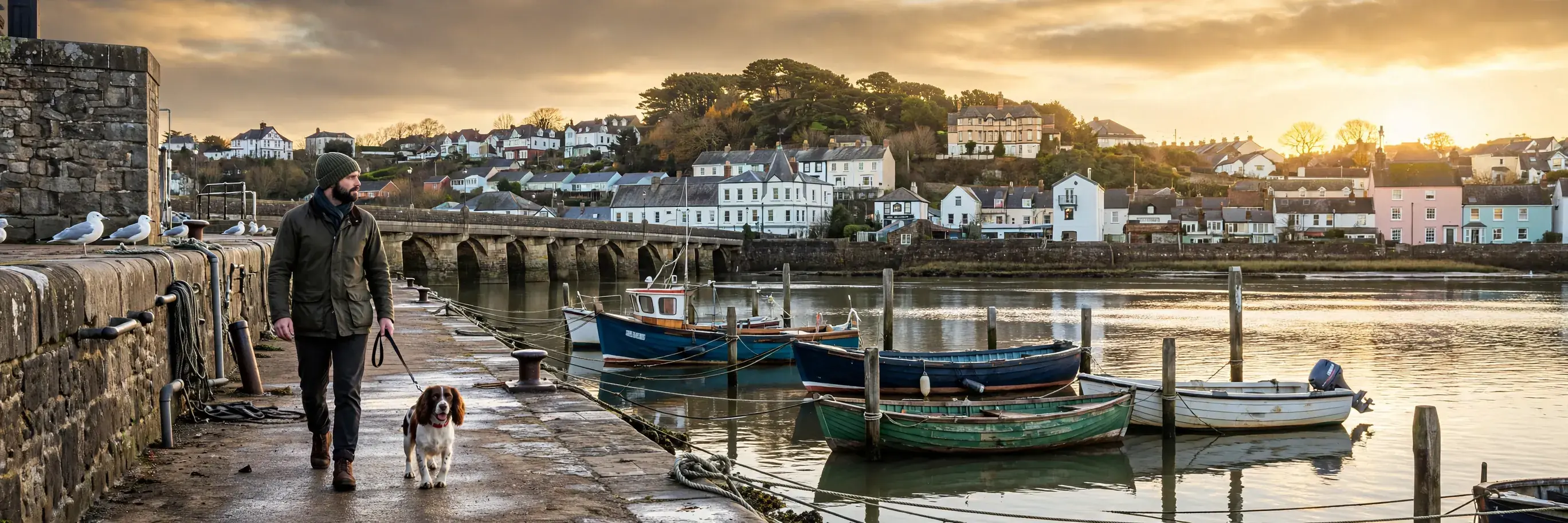
Crossing with a dog needs a little care. The bridge carries the main road through the town, so traffic is constant during the day, and the pavements are narrow in places, with the parapet low enough that a tall dog can see the water below. Keep your dog on a short lead on the side away from the road, walk at a steady pace, and do not stop in the middle to take photographs while traffic passes. Nervous dogs, and dogs that react to lorries or motorcycles, are better crossed early in the morning or in the evening, when the traffic thins and the light is softer. The far side is worth the effort: East-the-Water is quieter, the Tarka Trail runs along the far bank, and the walk back across the bridge at sunset, with the town's roofs and chimneys lit up behind you, is one of the best short walks in North Devon.
The bridge also sets the rhythm of a day in Bideford. Morning brings fishermen checking their boats, dog walkers doing the quay circuit, and delivery vans crossing to the far bank. Midday is busier, with shoppers and the market crowd. Evening belongs to the walkers again, when the tide is often high, the water sits close under the arches, and the gulls settle on the moored boats. If your dog is easily overstimulated, plan the bridge crossing for the quiet hours and use the Quay itself, which is wide and flat, for the busy part of the day. And if the weather turns, remember that the bridge is exposed: wind funnels along the estuary, rain arrives sideways, and a short-coated dog will appreciate a drying coat before you set out.
The Quay and Bideford's maritime past
The Quay is a long, wide, flat stretch of stone and tarmac running along the river, and it is the natural centre of any dog walk in Bideford. Fishing boats and small workboats are moored along its length, ropes and bollards line the edge, and the water rises and falls with the tide so that the same spot can look like a busy harbour at high water and a muddy creek at low water. Dogs love it here for the obvious reasons: the ground is level, the smells change with every tide, and there is always something to watch, from the gulls on the boats to the herons that stalk the mud at low tide. Keep your dog on a lead along the Quay, though, because the edge is unguarded in places, the stone steps down to the water are slippery, and a dog that jumps in at low tide lands in deep, soft mud rather than water.
Bideford's history as a port explains why the Quay is so long and so grand for a town of its size. In the sixteenth and seventeenth centuries, Bideford was one of the busiest ports in the west of England, sending ships across the Atlantic to Newfoundland for cod and to Virginia for tobacco. The tobacco trade made the town rich, and the wealth shows in the merchants' houses that still line the streets behind the Quay. Sir Richard Grenville, the Elizabethan sea captain, was born nearby and is closely associated with the town, and the statue of the writer Charles Kingsley stands on the Quay, a reminder that his novel Westward Ho! took its name and much of its spirit from this coast. Later the trade changed: timber, slate and clay came in and out, the big ocean-going ships stopped calling, and the Quay settled into the quieter working harbour it is today, with fishing boats, leisure craft and the occasional cargo vessel.
That working character is part of the Quay's charm for dog owners. It is not a polished marina or a theme-park waterfront; it is a place where people still work, mend nets, paint boats and load gear. The Burton Art Gallery and Museum stands on the Quay, and its exhibitions and shop are worth a look, though you should check the official guidance before you travel if you hope to take your dog inside, as policies for gallery spaces can change. The Quay also hosts markets and community events through the year, which can make it livelier and noisier than usual, so if your dog is wary of crowds, check what is on before you plan a Saturday visit.
For a practical daily routine, the Quay is hard to beat. Start with a circuit along the water and back, which takes about twenty to thirty minutes at a dog's pace, then extend the walk in either direction along the Tarka Trail. There are benches to sit on, bins for waste, and plenty of places to pause while your dog watches the boats. Watch out for the small hazards that come with any working harbour: coiled ropes that can tangle a lead, fish boxes and bait that smell irresistible to a dog, and discarded fishing line near the steps. A lead kept short, a pocket full of bags, and a quick check of the tide before you set out will cover most of it.
The Tarka Trail along the estuary
The Tarka Trail is the best reason to bring a dog to Bideford. It is a 180-mile figure-of-eight route inspired by Henry Williamson's novel Tarka the Otter, and its most popular stretch is the traffic-free section that follows the old railway line between Braunton and Meeth, passing straight through Bideford. The surface is flat and mostly tarmacked or firm gravel, the gradients are gentle because it was built for trains, and the route runs beside the estuary for long stretches, so the walking is easy and the views are constant. For dogs that cannot manage steep coastal paths, or owners who want a long walk without a long climb, it is the obvious choice.
From Bideford, the trail offers two very different directions. Downstream, towards Instow, the path hugs the estuary for roughly three miles, with the water on one side and fields and hedgerows on the other. At high tide the water sits close to the path and the wading birds are pushed up onto the marsh; at low tide the mudflats open out and herons, egrets and curlews work the channels. Instow itself is a small village with a sandy beach that appears at low tide, and it makes a natural turning point, with space for dogs to run on the sand and a chance to sit and watch the boats. Upstream, towards Great Torrington, the trail leaves the estuary and follows the river through woodland and farmland for about six miles, a quieter and shadier walk that suits hot days and dogs that prefer trees to open water. Both directions are out-and-back walks, so you can turn around whenever your dog has had enough, which makes the trail forgiving for older dogs and puppies alike.
Cyclists share the trail, and they are the main thing to manage. The path is wide, but bikes move fast and quietly, and a dog on a long lead across the path is a genuine hazard. Keep your dog on a short lead, walk on the left, and teach a reliable recall or a simple "close" cue before you go. If your dog chases bikes, hold the lead firmly and step to the side as they pass. Early mornings and weekday evenings are the quietest times, while sunny weekends bring the most cyclists and the most dogs, so pick your hour to match your dog's temperament.
Pack for the trail as you would for any long, exposed walk. Shade is limited along the estuary stretch, so carry water for your dog in summer, and remember that the wind off the water can be cold even on a sunny day. Bins are spaced out along the route rather than at every junction, so carry bags and be prepared to carry waste for a stretch. The trail is also a good place to watch wildlife with a dog that can stay calm: seals are sometimes seen in the estuary, kingfishers flash along the river upstream, and the mudflats are busy with birds in the autumn and winter. Keep your dog out of the water at the estuary's edge, where the mud is soft and the current is stronger than it looks, and save the swimming for a beach where the water is cleaner and the exit is easy.
The town centre and its historic streets
Behind the Quay, Bideford climbs uphill in a tangle of narrow streets that still follows the medieval layout of the town. High Street runs up from the river, Allhalland Street and Mill Street wind away from it, and the smaller lanes between them are lined with independent shops, cafes and the tall, narrow merchants' houses that the tobacco trade paid for. The walking here is very different from the Quay: the pavements are narrower, the streets are steeper, and the traffic is closer, so this is a place for a short lead, a steady pace and a dog that is comfortable with people, pushchairs and shop doorways. Older dogs and dogs with sore joints will find the climb from the Quay to the top of the town hard work, so plan the route in stages and use the Quay as the flat base to return to.
The Pannier Market is the centrepiece of the town centre. It is a Victorian covered market, built in the 1880s, with a high roof, iron columns and stalls selling local produce, crafts and household goods. The market gives a rainy day a dry destination, and the covered space is a useful place to shelter with a dog while you look around, though you should check the official guidance before you travel for current market days and the rules on dogs inside the market hall, as these can change. Around the market, the town's independent shops are one of its strengths: butchers, bakers, bookshops and gift shops line the streets, and many of them welcome dogs inside, often with a water bowl by the door and a biscuit on the counter. Ask before you walk in with a large or muddy dog, and keep the visit short if your dog is restless.
St Mary's Church stands above the town centre, and its churchyard is a quiet, green pocket that makes a good pause on a walk through the streets. The church tower is a landmark you can see from the Quay, and the churchyard's old gravestones and mature trees give it a calm, enclosed feeling that nervous dogs often prefer to the open quayside. Victoria Park, a short walk from the river, offers a more conventional green space, with lawns, paths and benches, and it is a good place for a lead walk and a sit-down before you head back to the car or your accommodation. Neither space is a dedicated dog park, so keep your dog on a lead, pick up after them, and treat both as shared public gardens rather than off-lead exercise areas.
The town centre rewards a slow wander rather than a route march. Look up at the merchants' houses, with their tall sash windows and slate roofs, and look down at the narrow lanes that drop back towards the river between the buildings. The best approach with a dog is to walk up one street and down another, so you see the town in a loop and finish back on the flat Quay. Avoid the busiest shopping hours if your dog finds crowds difficult, and remember that the streets are at their quietest early in the morning, when the shops are still shuttered and the only people about are dog walkers and delivery drivers.
Tides, mud and river safety
The Torridge is a tidal river at Bideford, and the tide shapes almost everything about a dog walk here. The difference between high and low water is several metres, and the change is fast: the water can come in across the mudflats quicker than a person can walk, and channels that look shallow at low tide can be deep and fast-flowing an hour later. Before any walk along the estuary, to Instow or out towards the beaches, check the tide times for the day and plan to be back on firm ground well before the water turns. A walk that is easy at low tide can become a wading exercise, or worse, if you misjudge the return.
The mud is the other hazard, and it deserves respect. The estuary mud is soft, deep and sticky, and a dog that runs onto it can sink to its belly in a few steps, especially near the channels and the edges of the salt marsh. Dogs that love mud will need to be kept on a lead near the water's edge, and any dog that does get into the mud should be washed off with clean water as soon as possible, because estuary mud can irritate skin and paws and is not something a dog should be licking off its coat. The stone steps down to the river from the Quay are slippery with weed and algae, and the quay edge itself is a hard drop at low tide, so keep dogs well back from the edge and never let a dog jump into the river from the Quay.
Swimming in the Torridge at Bideford is not a good idea for most dogs. The current is strong, the water is cold and murky, boat traffic moves through the channel, and the banks are steep and muddy, so a dog that jumps in may struggle to climb out again. The same goes for the smaller streams and drainage channels that run into the estuary: they look inviting on a hot day but can hide deep mud and sharp debris. If your dog needs a swim, save it for a beach where the water is clean, the slope is gentle and the exit is obvious, and always check the official guidance before you travel for current advice on water quality and seasonal restrictions.
Other river hazards are smaller but worth knowing about. Anglers fish from the Quay and the estuary banks, so keep dogs away from rods, hooks, bait and discarded line, all of which can injure a curious nose or paw. Gulls are bold around the Quay, especially near takeaway food, and a dog that chases them can run into the road or off the quay edge. In summer, check the water's edge for broken glass and sharp shells after busy weekends. A simple routine covers most of this: check the tides, keep the lead short near the water, carry fresh water and a towel, and wash your dog's paws after any walk that involves mud or estuary water.
Where to eat and drink with a dog
Bideford's eating and drinking is centred on the Quay and the streets just behind it, and dogs are part of the scene rather than an exception. The quay-side pubs have outdoor seating that looks out over the river and the moored boats, and many of them welcome dogs in the bar area as well as outside, with water bowls by the door and a relaxed attitude to a dog settling under a table. The pattern varies from place to place and can change with the season, so the practical rule is to ask before you sit down, especially at busy times, and to have a backup plan if the pub you wanted is full or does not take dogs that day. A takeaway eaten on a bench on the Quay is always an option, and it is often the simplest one with a restless dog.
A few habits make pub visits work better for everyone. Bring a mat or a blanket for your dog to lie on, so the dog has a defined place and is not sprawled across a walkway. Keep the lead short and the dog under the table rather than wandering between tables, and feed your dog before you go, so the smell of other people's food is less exciting. Water is usually offered, but carry your own bottle and bowl on hot days, because the quay-side seating is exposed to the sun and a dog can get warm quickly. If your dog barks at strangers or other dogs, choose a quiet table at the edge of the room or outside, and keep the visit short; a twenty-minute drink with a settled dog beats an hour with a stressed one.
Cafes in the town centre offer a different pace, with breakfast and lunch menus, cakes and coffee, and many of them welcome dogs in at least part of the seating area. The covered market and the streets around it have several small cafes that suit a mid-morning stop after a walk along the river, and a coffee and a cake while your dog rests is a good way to break up a day. As with the pubs, policies differ, so check the sign on the door or ask a member of staff rather than assuming. Fish and chips are a Bideford classic, and eating them on the Quay is part of the experience, but be careful with the gulls: they will snatch food from an unwatched hand, and a dog that lunges at a gull can pull you off balance near the quay edge. Keep food close, keep the dog's lead short, and do not share chips or batter with your dog.
If you are staying in self-catering accommodation, the town's shops make it easy to eat in as well. The butchers, bakers and grocers in the town centre cover most of what you need for a simple supper, and the market stalls add local produce when the market is running. For a picnic, the Quay has benches, Victoria Park has lawns, and the Tarka Trail has spots to sit beside the water, though you should take all litter home and keep your dog from begging from other picnickers. The point is that Bideford does not force you into a single way of eating: pub, cafe, takeaway and picnic all work, and the dog can be part of all of them if you plan the visit around the dog's needs rather than your own.
Where to stay with a dog
Bideford's accommodation is mostly small-scale: bed and breakfasts, guesthouses, self-catering cottages and a handful of small hotels, with holiday parks and campsites in the surrounding area around Westward Ho!, Northam and the villages inland. That small scale is an advantage for dog owners, because the places that take dogs tend to mean it, with a named pet policy, a clear fee and a host who has thought about muddy paws and early morning toilet walks. The trade-off is that the genuinely dog-friendly rooms and cottages are limited in number, and they book out early in the summer and at school-holiday weekends, so book well ahead if your dates are fixed.
When you compare places to stay, ask the questions that matter for your particular dog rather than accepting a general promise of dog-friendliness. Ask how many dogs are allowed and whether there is a charge per dog, per night or per stay, and get the total in writing. Ask whether the garden or outside space is enclosed, and how high the fence is, because a cottage with a walled garden is a different proposition from one with an open lawn beside a road. Ask whether dogs can be left alone in the room or cottage, and for how long, because many places prohibit it or allow it only if the dog is crated and quiet. Ask about the ground floor: a ground-floor room with a door straight outside suits an older dog or a puppy far better than a first-floor room reached by steep stairs.
Drying space is the detail that makes the biggest difference in North Devon. A wet dog after a walk on the estuary or a beach needs a place to dry that is not the bed, and a good dog-friendly stay will have an outdoor tap, a utility space, or at least a hard floor by the door where a wet dog can be towelled down. Bring your own drying coat and towels regardless, and ask the host where to dry the dog before you arrive, so you are not improvising in the dark on the first night. Also ask about the morning routine: where the nearest practical toilet walk is, whether there is a lit path for the last outing, and whether the front door is near a road, because a dog that bolts out of a cottage straight onto a lane is a risk you can avoid with a little planning.
Bideford's strength as a base is that it is quieter and less expensive than Barnstaple, with walks from the door rather than a drive to the start of every walk. The Quay circuit and the Tarka Trail give you a morning and an evening walk without moving the car, the town has shops and pubs within a short stroll, and the coast is a short drive when you want it. That suits a longer stay, where the dog settles into a routine and the town becomes familiar, better than a single night's stop. If you are comparing Bideford with Barnstaple, the choice is really between a working riverside town with flat walks and a larger market town with more shops and traffic: for most dogs, Bideford is the calmer of the two, and the calmer base usually makes for the better holiday.
Day trips: Bude, Barnstaple and beyond
Bideford sits in the middle of a useful patch of the South West, and a car opens up a string of day trips that all work with a dog. The closest and easiest is Barnstaple, about nine miles to the east along the A39 and the river valley. Barnstaple is the larger town, with a bigger Pannier Market, more shops, and the Tarka Trail running through it, and it makes a good half-day out for a change of scene, though it is busier and the traffic is heavier than in Bideford. Our Barnstaple with a dog guide covers its markets, riverside walks and dog-friendly stops in detail. If you go, take the Tarka Trail between the two towns for part of the way if you have the time, or drive in and park near the river, where the walking is flat and the cafes are used to dogs.
To the south-west, about thirty miles along the coast road, lies Bude, a small Cornish seaside town with two very different beaches, a canal with a flat towpath, and a breakwater walk that suits dogs that like open space and sea air. Bude is a full-day trip rather than a quick outing, and it rewards an early start, because the beaches fill up in summer and the parking near the seafront goes quickly. Our Bude with a dog guide explains how to choose between Summerleaze and Crooklets beaches, where the seasonal restrictions apply, and how to plan the canal walk and the coast path with a dog in mind. The drive itself is part of the day, with the coast road running through villages and farmland, so allow more time than the distance suggests and plan a stop for the dog along the way.
Closer to home, Appledore is the obvious short trip. The fishing village sits across the estuary where the Torridge meets the sea, and it can be reached by a short drive around the estuary or, in the summer months, by the passenger ferry that runs from Bideford Quay. Appledore's narrow streets, its quay and its slipways make a good hour's wander with a dog, and the village has pubs and cafes that are used to walkers coming off the ferry. Our Appledore with a dog guide covers the village in more detail, but check the official guidance before you travel for the ferry timetable and whether dogs are carried, as the service is seasonal and the rules can change. Westward Ho! and Northam Burrows are another short drive, with a long sandy beach, a pebble ridge and open grassland where dogs can run, though the beach has seasonal restrictions on part of its length, so check the signs at the entrance before letting your dog off the lead.
For a longer day out, the coast to the north-east offers Lynton and Lynmouth, twin villages joined by a water-powered cliff railway, with steep wooded valleys and the Valley of Rocks above the sea. It is a longer drive from Bideford, and the walking is much steeper than anything in the town, but it makes a memorable day for a fit dog and an owner who enjoys a climb. Our Lynton with a dog guide covers the cliff railway, the valley walks and the practicalities of steep paths and leads. Inland, Great Torrington is a quiet market town upstream on the Torridge, with the Tarka Trail running through it and commons to walk on, and it suits a gentle half-day when you want a change of scene without a long drive. However far you go, the rule is the same: Bideford is the base you come back to, and the day trip should leave enough time for an evening walk on the Quay, which is where the dog will want to be.
Seasons and wet weather
Bideford changes with the seasons more than a first visit in summer might suggest, and the best time to come with a dog depends on what your dog enjoys. Spring is one of the best seasons: the days lengthen, the Tarka Trail dries out, the estuary fills with wading birds on their way north, and the town is quiet before the summer crowds arrive. The air is still cold off the water in March and April, and the wind can be sharp on the Quay, so bring a coat for a short-coated dog and plan the longer walks for the middle of the day, when the sun has warmed the path.
Summer brings the crowds, the heat and the seasonal rules. The Quay and the town centre are at their busiest, the car parks fill early, and the beaches near Bideford have dog restrictions on parts of their length, so check the official guidance before you travel and read the signs at each beach before letting your dog off the lead. Heat is a real consideration: the Quay and the Tarka Trail have little shade, the stone paving radiates warmth, and a dog can overheat on a long estuary walk in the middle of the day. Walk early in the morning or late in the evening, carry water, test the paving with your own hand before you set out, and give your dog a shaded rest in the middle of the day. The river and the estuary can look inviting when it is hot, but the mud and the current make them a poor place for a dog to cool off, so plan the swimming for a beach instead.
Autumn is the season many regular visitors prefer. The crowds thin, the light on the estuary turns golden, the car parks empty, and the dog restrictions on the beaches lift, so the whole coast opens up again. The Tarka Trail is at its best in September and October, with firm ground, cool air and the hedgerows full of berries. The trade-off is the weather: autumn storms roll in off the Atlantic, the wind on the Quay can be fierce, and the trails turn muddy after rain, so pack a drying coat and a towel and be ready to shorten a walk if the weather turns. Winter is quieter still, with short days, mild temperatures and frequent rain, and the town takes on a working, local character that suits a slow break. The Quay in winter is windswept and beautiful, but the wind chill is real, and a small or older dog will feel it, so keep winter walks short and sheltered and save the long estuary walks for a calm, dry day.
Wet weather needs a plan, because North Devon gets plenty of rain and a dog that has been cooped up all day is nobody's idea of a holiday. The Pannier Market gives a dry, covered destination in the town centre, and a wander through the streets with stops in dog-friendly cafes and pubs can fill a wet morning. The Burton Art Gallery and Museum on the Quay is worth checking for its current dog policy, and a drive to Barnstaple opens up more indoor options, though you should check the official guidance before you travel for which of them welcome dogs. The practical kit matters as much as the destination: a drying coat, two towels, a paw-wash tub and a waterproof mat by the door turn a wet walk into a minor inconvenience rather than a soggy disaster. And remember that the trails drain slowly after heavy rain, so the Tarka Trail can stay puddled and muddy for a day or two, and the estuary paths can be slippery: choose the Quay and the town centre for the first walk after rain, and save the longer trail for the day after.
Practical planning: parking, vets and arrival
Parking in Bideford is straightforward if you arrive with a plan. The car parks beside the Quay and the Riverbank car park put you straight onto the flat quayside walk, which is the easiest start with a dog, and there is additional parking a short walk from the town centre. Charges apply in the main car parks, and the spaces fill up on summer weekends, market days and bank holidays, so arrive early or park a little further out and walk in along the Tarka Trail, which is a pleasant start to the day in itself. Check the signs at the car park for the current charges and time limits before you leave the car, and do not leave a dog in a parked car in warm weather, even for a few minutes, because a car heats up fast beside the river in summer sun.
Arrival is worth doing slowly. On your first day, start with the short Quay circuit, let your dog sniff the boats and the river, and give them water and a chance to settle before you attempt the bridge or a long stretch of the Tarka Trail. If you are staying overnight, unpack the dog's bed, bowls and food first, so the accommodation smells familiar before the dog is asked to rest in it. Find the nearest practical toilet walk for the evening, ideally a lit and familiar route that does not cross a busy road, and walk it once in daylight so the dog knows it before dark. If your dog is nervous in new places, keep the first evening quiet: a short walk, a familiar meal, and an early night will do more for the rest of the break than a rushed tour of the town.
For veterinary care, there are veterinary practices in Bideford itself, and larger practices in Barnstaple, so you are not far from help if your dog needs it. Save the number of the nearest practice and the nearest out-of-hours emergency vet before you travel, and note the opening hours, because rural practices can close early and the nearest emergency cover may be a drive away. Carry your dog's medication, a copy of their vaccination record if you have it, and a basic first-aid kit with tick removers and paw dressings, because the estuary and the coastal paths are tick country in the warmer months. Check your dog for ticks after walks through long grass and bracken, especially around the Burrows and the wooded stretches of the trail.
What you pack should match the place: a short lead for the Quay and the bridge, a long line for the beaches and the Burrows, a water bottle and a collapsible bowl, poo bags, a towel and a drying coat, and a paw-wash tub for the estuary mud. A torch is useful for the last walk of the day in winter, when the Quay is dark and the steps down to the river are hard to see. A mat for pub visits and a familiar blanket for the car will both get used more than you expect. And one last habit: keep your dog on a lead in the town, on the bridge and along the Quay, and save the off-lead running for the beaches and the open ground where it is allowed. Bideford rewards that kind of care with easy, level walks and a river that changes with every tide, and a dog that has walked the Quay in the morning and the trail in the afternoon will sleep well.
Planning the coast beyond Bideford? Our Bude with a dog guide covers beaches, the canal towpath and sea safety for a full day on the Cornish coast, and our Lynton with a dog guide covers the cliff railway, the Valley of Rocks and steep valley walks for a longer day out to the north-east.
Practical questions
Before you go
Can my dog walk across Bideford Long Bridge?
Yes, dogs can cross on the pavements, but keep your dog on a short lead on the side away from traffic. The bridge carries the main road through town, the pavements are narrow in places and traffic is close, so nervous dogs are better crossed quickly and calmly. The views over the estuary are worth the crossing, and the far bank gives you a quieter return along the Tarka Trail.
Is the Tarka Trail from Bideford suitable for dogs?
Yes, it is one of the easiest long walks in North Devon for dogs. The surface is flat and mostly surfaced, the route follows the old railway line along the estuary, and you can choose anything from a twenty-minute stretch to a full day. Keep your dog on a short lead because cyclists share the path, carry water as shade is limited, and pick up after your dog, as bins are spaced out along the route.
Which beaches near Bideford allow dogs?
Instow beach, reached along the Tarka Trail, is the closest sandy option, and Westward Ho! and Northam Burrows are a short drive away. Seasonal dog restrictions apply on parts of some beaches in the summer months, and the rules can change, so check the official guidance before you travel and look for the signs at each beach entrance before letting your dog off the lead.
Are dogs welcome in pubs and cafes on Bideford Quay?
Many of the quay-side pubs and cafes welcome dogs, usually in the bar area or on the outdoor seating, and water bowls are a common sight. Policies vary from place to place and can change with the season, so ask before you sit down, keep your dog on a lead under the table, and bring a mat for your dog to settle on. If a place is full or does not take dogs, a takeaway eaten on the quay is a good fallback.
Where is the best place to park in Bideford with a dog?
The car parks beside the Quay and the Riverbank car park put you straight onto the flat quayside walk, which is the easiest start with a dog. Charges apply and spaces fill up on summer weekends and market days, so arrive early or park a little further out and walk in along the Tarka Trail. Check the signs at the car park for current charges and time limits before you leave the car.
Is Bideford a good base for a dog-friendly holiday in North Devon?
Yes, especially if you prefer a quieter base than Barnstaple. The quay and the Tarka Trail give you flat walks straight from the town centre, beaches and villages are a short drive away, and the town has pubs, shops and places to stay that welcome dogs. It suits travellers who want a working riverside town rather than a resort, with day trips to Barnstaple, Bude and the coast within easy reach.