This guide is independent and contains no paid placement. If affiliate links are added later, they will be clearly marked and will not change our editorial checks.
Plan Blandford Forum around three anchors: the flat tarmac of the Rotary Way through Crown Meadow beside the Stour, the Thursday and Saturday stalls filling Market Place between the Corn Exchange and St Peter and St Paul, and the triple ramparts of Badbury Rings four miles north-east, where Portland sheep graze the chalk in autumn and winter and skylarks nest on the open grass from late February to August. A dog that tires easily can spend a whole day between Blandford Bridge, Mortain Bridge and the Crown Hotel on West Street without climbing anything; a fitter dog can add the Stour Valley Way north-east to Bryanston and Durweston, then come home along the North Dorset Trailway through Stourpaine.
A town rebuilt: the fire and the Georgian streets
On 4 June 1731 almost the whole of Blandford Forum burned, and the town that rose from the ashes was laid out in brick and stone under an Act of Parliament, finished by about 1760, to a plan drawn up by the Bastard brothers of Blandford. That is why Market Place, East Street, West Street and Salisbury Street still read as one coherent piece of eighteenth-century town planning rather than a jumble of centuries: long straight frontages, sash windows in regular bays, and a wide open square at the centre where a market had already been held since King John granted it in 1214. For a dog, the practical payoff is unglamorous and real — pavements broad enough for a lead and a sniffing dog side by side, level ground from one end of the centre to the other, and nowhere in the rebuilt core that demands a scramble.
Begin in Market Place itself, with the Corn Exchange — the Town Hall buildings — on one side and the tower of St Peter and St Paul rising over the roofs on another. The square works as a first fifteen minutes after the drive: let the dog work the edges, cross the open stone once in each direction, and sit on the building side while lorries and market vans use the road side. The churchyard behind St Peter and St Paul gives a quieter pocket of green when the square is full, but treat it as a lead-on pause among headstones, not a run, and leave it as clean as you found it. Blandford Town Museum, in its old coach house off the centre, tells the fire story in full, though its rooms are not a place for a dog; look at the street outside instead, where the rebuild is the exhibit.
From Market Place, East Street runs one way and West Street the other, and both repay a slow zigzag rather than a march. East Street holds the Ginger Viking deli-cafe-bar and the long shopfronts that face the church; West Street holds Conyers Home and Country Store, trading since 1886 and the town's oldest business, and the Crown Hotel at DT11 7AJ, a Hall and Woodhouse house whose bar keeps water bowls and dog treats. Salisbury Street and the side passages — Barnack Walk, the Georgian Passage, Greyhound Square — are where the smaller galleries and gift shops hide, and where a dog gets more room because the footfall thins. Keep to the building side on the narrow stretches, shorten the lead at the Damory Street lights, and let the dog choose the pace between shopfronts.
The rebuilding story also explains the town's edges. Cross Blandford Bridge south over the Stour and you are in Blandford St Mary, where Hall and Woodhouse has brewed since 1777 and the old maltings now hold the Brewery Tap; walk west along the river and the Georgian frontages give way to the meadows. The fire left Blandford with almost no medieval timber in its centre, so the history a dog walker meets is not a castle or a ruin but a street plan — wide, level, and deliberately regular — and the best way to read it is to walk the square, then East Street, then West Street, and notice how the same brick, the same window rhythm and the same rooflines repeat all the way round.
The River Stour and the water meadows
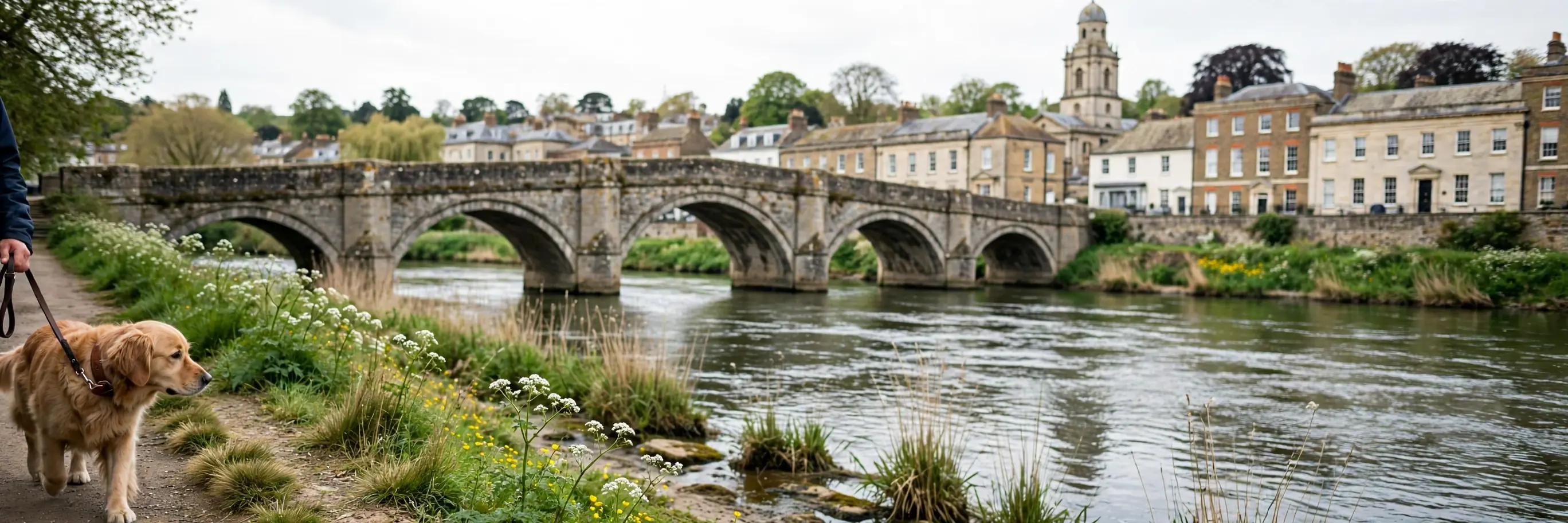
The Stour bends around Blandford in a wide loop, and the town's riverside walking sits inside that bend: Crown Meadow and the Stour Meadows on the town side of the water, the Rotary Way footpath running between them, and two footbridges named for Blandford's twin towns — the blue Mortain Bridge and the black Preetz Bridge — carrying walkers over the river without touching the road bridge. The surface is mostly tarmac, the gradient is flat, and the whole riverside circuit from Blandford Bridge measures about 1.6 miles, which is why it suits a first walk of the day, a stiff older dog, or a wet afternoon when the chalk downs would be a slog. Swans, ducks and moorhens work the slow water below the bridges, and in summer trout rise in the clear runs past the old mill.
A practical loop starts at the Crown Hotel car park on West Street: turn right out of the hotel, left into the car park, and cross Mortain Bridge over the original fording point of the Stour. Follow the path left around the meadows, with the Hall and Woodhouse brewery on your right and the water meadows running parallel to the river on your left, until you reach Preetz Bridge; the ruined arches of the old Somerset and Dorset Railway bridge stand on the far bank as you cross. From there the tarmac track bends back toward the town, passing the Langton Meadows entrance by the supermarket at Damory Street, and returns you to East Street and Market Place. Allow half an hour at a dawdling pace, an hour if the dog stops for every swan.
Longer water comes from the Stour Valley Way, the 64-mile waymarked path that follows the Stour from Stourhead to Christchurch and passes straight through Blandford. Heading north-east from Blandford Bridge, the Way runs past Crown Meadow and the Deer Park toward Bryanston — the school's parkland and chimneys on the left — then on to Durweston, where the river is crossed at Durweston Mill and the village church stands above the water. That stretch is the natural half-day: flat riverside grass and tarmac, waymarks to follow, and no climbing until you choose to leave the valley. There are no taps or shops once you leave the town, so fill a bottle and a collapsible bowl at the Crown or at a Market Place cafe before you set off.
Anglers fish the Stour for much of the year, and the banks below Blandford Bridge are their working ground, so give a rod a wide berth and keep the dog out of the swim where lines are in the water. The safest paddling is a shallow slow stretch away from the bridges and away from any angler, and even there the current after rain can be stronger than it looks; a dog that swims should be dried before the walk back through the town, and checked for ticks in the tall riverside grass in summer. In wet winters the meadows flood and the Rotary Way can be slippery underfoot, so treat a January loop as a boots-and-towel walk and save the dry tarmac for the dog's first outing of the day.
Market day and the Market Place
Blandford's outdoor market trades in Market Place on Thursdays and Saturdays, 8am to 3pm, throughout the year, with an indoor market in the Corn Exchange on Thursdays and a Farmers and Makers Market on the fourth Sunday of each month. Saturday has been market day here since 1214, and it still feels like it: the square fills with stalls selling fruit and vegetables, fresh fish, cake and cheese, plants, clothing and household goods, and the pitches spill toward East Street and West Street. Thursday is the same market at a lower volume, which is why it is the better day for a dog that startles at trolleys, flapping canvas and crowds pressing in from both sides.
Work the market as a loop rather than a plunge. Enter from the church side of Market Place, keep the dog on the building side of the stalls, and cross the square once with the stalls on your left so the dog is never trapped between a stall back and the road. Dropped food is the real hazard — fish trimmings, cake crumbs and fruit under the produce stalls — so a dog that scavenges needs a short lead and a watchful hand through the food rows, and a determined thief is better walked around the outside of the square than through its middle. Stallholders are used to dogs and several keep a bowl out, but ask before the dog approaches a pitch, and never let a nose go through produce that someone else is about to buy.
Between markets, the square's independent shops do the browsing. Conyers on West Street has sold to the town since 1886; the Ginger Viking on East Street pairs Dorset produce with a deli counter; the Grainstore Emporium on Shaftesbury Lane gathers antiques, retro and vintage pieces under one roof; and the bookshops, galleries and gift shops of Barnack Walk and the Georgian Passage reward a stop-and-sniff pace. A shop that takes dogs will usually say so on its door, and one that does not will say so too — take the sign at its word and move on, because the next doorway along the same Georgian frontage may be the one with the bowl. The Shambles, the covered stalls beside the Corn Exchange, give a roofed browse when rain is falling on the open square.
If the dog cannot settle in a crowded bar, buy for the room instead of the table. The Thursday and Saturday stalls, the Morrisons and Tesco food halls at the edge of the centre, and the delis on East Street and West Street all sell the makings of a meal to eat where the dog already has a bed — Dorset cheese and charcuterie from the market, bread from a town bakery, and Badger bottled beer from the Hall and Woodhouse visitor centre at the brewery to take away. That trade is also the kindest one on a Saturday: the dog eats nothing dropped, nobody queues with a restless animal at a till, and the walk back across Crown Meadow doubles as the evening toilet round.
Badbury Rings: the hillfort above the town
Four miles north-east of Blandford, off the B3082 toward Wimborne, Badbury Rings rises to 100 metres above sea level as three concentric ramparts of an Iron Age hillfort, ringed at the top by a beech avenue and open chalk grassland, and cared for by the National Trust as part of the Kingston Lacy estate. The full circuit of the ramparts and the beech avenue takes about two hours on foot, 3.8 miles from the Heron Drove car park, and the ground is grass, undulating and rough in places, with no toilets, no cafe and no tap at the site. It is the biggest walk in this guide and the most exposed: wind across the plateau, sun with no shade at midday, and a steady climb from the car park that an older dog will feel in the knees.
The animals on the hillfort are not decoration. The National Trust grazes rare-breed Portland sheep and Red Ruby Devon cattle from Kingston Lacy across the ramparts to keep the chalk grassland open for wild flowers, skylarks and corn buntings, moving them between three fenced compartments from September to February; between March and August there is no grazing, but that is the ground-nesting season, and the Trust asks for dogs on a lead from late February to August so skylarks are not chased off their nests. Dog mess matters here more than on a town pavement, because it can carry disease that damages cattle and sheep, so bag it and carry it to a bin or home — there are bins at the car park, not on the ramparts. Follow the compartment signs on the day; the grazing plan moves, and the sign at the gate is newer than any guide.
Walk the rings as a circuit, not a scramble. From Heron Drove car park, take the beech avenue toward Wimborne, turn left past Lodge Farm, and climb the grass track to the southern edge of High Wood before the ramparts open out ahead; keep to the paths, because the site is a scheduled ancient monument and a dog digging at a bank is doing real damage. Carry water for the dog and a bowl, because the plateau has none, and offer it at the car park, at the top, and again on the way down. Early morning and late afternoon give the best light on the ramparts and the fewest visitors; a summer midday is hot, bright and windless on the open grass, and a frosty winter morning is magnificent but bitter, with mud on the tracks and a wind that cuts through a short coat.
Pair Badbury Rings with the Kingston Lacy parkland rather than with a second hill. The estate's parkland paths take dogs on leads through fields and open countryside, and the house and gardens have their own rules, so check the Kingston Lacy page before assuming the dog can go beyond the parkland. A dog that is fit and steady around sheep and cattle will love the space; a dog that fixates on livestock, or that bolts at skylarks rising from the grass, will be happier on the flat Stour Meadows loop, and that is a fair trade — the hillfort will still be there on a quieter weekday, and the Trust's grazing signs will tell you which compartment is in use before you commit the dog to the climb.
Stour valley walks: villages and lanes
The walk that ties Blandford's valley together is the eight-mile Durweston and Stourpaine circuit, waymarked as walk W33 and starting from Station Court car park in the town, with a second start at Stourpaine Recreation Ground car park if you want to cut a mile off the Blandford leg. From Station Court the route follows the North Dorset Trailway — the dismantled Somerset and Dorset Railway line, now a shared walking, cycling and riding trail running fourteen miles from Sturminster Newton to Spetisbury — north-east through the cutting toward Durweston, then crosses the Stour at Durweston Mill and climbs the lanes above Stourpaine, where the White Horse Inn stands at DT11 8TA and the church of the Holy Trinity keeps the village green. Allow three and a half hours, expect stiles and gates, and expect mud after rain on the field sections.
North of Durweston the valley changes character. The Jubilee Trail leaves the Stour near the village and runs into Blandford Forest, where miles of forestry tracks give a shaded summer walk under trees, and the Wessex Ridgeway crosses the high ground toward Hod Hill, the Iron Age hillfort above Stourpaine whose ramparts once sheltered a village of around 250 houses. Hod Hill is a stiff climb from the valley floor and a different walk from the flat riverside — chalk grassland, butterflies in summer, and views back down the Stour to Blandford — so save it for a fit dog on a dry day and keep the dog close on the open grass, where skylarks nest in spring and summer. The lanes between Stourpaine and Shillingstone are narrow, hedged and blind at the bends, and tractors use them at harvest, so a lead stays on until the Trailway's wide ballast gives room again.
South of Blandford the valley runs the other way, toward Charlton Marshall and Spetisbury along the same Trailway, and the walking there is flatter, quieter and closer to the river. The Trailway's surface is the old railway ballast, wide enough for a dog, a cyclist and a horse to pass without a squeeze, and the villages along it — Charlton Marshall with its church and cottages, Spetisbury with its mill and riverside lanes — make natural turning points for a two-hour out-and-back. The Stour Valley Way continues south from Spetisbury toward Wimborne and the coast, but that is a longer day; from Blandford, the sensible version is an hour out along the Trailway, a drink at a village pub if the dog has settled, and an hour back on the same wide track.
For a gentler valley day, stay on the river itself. The Stour Valley Way between Blandford Bridge and Bryanston is flat, waymarked and close enough to the town that a tired dog can be back at the Crown Hotel within twenty minutes, and the Deer Park and Crown Meadow stretches give the dog grass to run on without leaving sight of the river. Our guide to Budleigh Salterton with a dog covers the coast a short drive away, for a day when you want pebbles and an estuary as well as the Stour. The valley's rule of thumb is simple: river and Trailway for easy days, Hod Hill and Blandford Forest for the days when the dog has energy to spend.
Pubs and cafes with your dog
The Crown Hotel on West Street is the town's anchor for a dog: a Hall and Woodhouse coaching inn at DT11 7AJ, with dog-friendly rooms on the first floor, a bar where dogs are greeted with water bowls and treats, Pawsecco and dog ice cream on the menu, and a restaurant that does not take dogs — so ask for the bar when you book, and say the dog is coming so staff can seat you where the animal can settle. The bar is the room that works: hard floor, space under the table, and staff who will move a table if another dog starts growling. Book ahead on summer weekends, and on Thursday and Saturday market days, when the town fills from mid-morning.
Across the river in Blandford St Mary, the Brewery Tap sits in the maltings of the old Hall and Woodhouse brewery at DT11 9LS, with free off-street parking, a garden, and a menu built around the brewery's own beers — the steak and Tanglefoot pie among them. It is listed as dog friendly, with treats and water ready for dogs, and it is the natural stop after a walk that starts at Mortain Bridge and follows the Rotary Way past the brewery: cross the river, eat in the old maltings, and walk the dog back across Preetz Bridge with the meal behind you. The brewery itself runs tours of the Victorian maltings and modern brewhouse; dogs do not go on the tour, so one of you stays with the dog at the Tap while the other goes round.
In the villages, the White Horse Inn at Stourpaine, DT11 8TA, is the pub the Durweston circuit is built around: an early eighteenth-century village inn at the end of the Trailway leg, with a garden and a bar that takes walkers and their dogs after the climb above the village. Six miles north in Winterborne Kingston, the Greyhound on North Street, DT11 9AZ, is a family-run free house with a wood-fired oven, a carvery and an award-winning garden, and it is listed as pet-friendly with free parking — a better lunch stop than a town-centre table for a dog that needs space and quiet after a valley walk. Both pubs are small enough that a phone call before you set off is worth more than any listing: say how many dogs, how big, and whether the animal can settle under a table.
Cafes cluster around Market Place and East Street, and the pattern there is door-by-door: the Ginger Viking on East Street, a deli-cafe-bar that won Observer Food Monthly's Best Place to Drink in 2022, is the most likely to have a dog under a table, but its policy can change with the season and the hour, so ask at the door rather than assuming. A cafe full of dogs is a hard room for a reactive animal, so take the terrace or the quieter weekday slot, bring a mat so the dog has a place that is theirs, and order a chew to keep the animal occupied while food arrives. A dog that has walked the Stour Meadows loop first will lie down; a dog that has been in the car all morning will not, whatever the cafe promises.
Where to stay with a dog
The Crown Hotel on West Street is the town-centre stay that is built for dogs rather than tolerant of them: dedicated dog-friendly rooms, some on the first floor, with the bar downstairs for breakfast and the river a five-minute walk away, and a charge that the hotel confirms when you book, so ask for the room, the fee and the floor in the same call. A Georgian coaching inn means stairs, corridors and a bar full of other people's dogs, so a dog that barks at strangers in a hallway will be happier in a cottage; a dog that settles quickly will love the routine of a morning walk to Mortain Bridge and an evening drink in the bar. Book the dog in by name when you book the room — the hotel's own page asks for prior acknowledgement, and a dog that arrives unannounced can be turned away.
Georgian terraces in the town centre give a different kind of stay. The rebuilt streets around Market Place, East Street and West Street hold holiday cottages in brick terraces with small walled yards or none at all, and the trade is clear: you step out of the front door onto the river walk, the market and the pubs, but the first and last toilet trips of the day are on a lead along a pavement to Crown Meadow, and there is no garden to let the dog out into at midnight. Ask the owner three things before you pay: whether the yard is genuinely enclosed and how high the wall or fence runs, whether the dog can be left alone in the cottage at all, and whether the charge is per dog or per stay. Our guide to dog-friendly holiday parks in the UK explains how to compare pet fees and boundaries, and the same questions apply to a Georgian terrace as to a park lodge.
Out of town, the choice splits between the Stour valley villages and the farms on the lanes toward Badbury Rings. A cottage in Durweston or Stourpaine puts the Trailway and the Stour Valley Way outside the front door, with a garden for the night-time toilet round and lanes for a first walk before breakfast, but every meal, shop and vet visit means a drive back into Blandford; a farm stay on the lanes toward the hillfort gives the same quiet plus open fields, and the same drive. Winterborne Kingston, six miles north, holds pub rooms at the Greyhound for a night that ends with a garden and a carvery. Whichever you choose, check the garden fence in person on arrival — a low dry-stone wall or a gap under a gate is the detail that decides whether the dog sleeps inside or spends the night testing boundaries.
Book early for summer weekends and school holidays, when the Crown's dog rooms and the valley cottages go first, and look instead at May, June, September and October, when the town is quieter, the pubs have space, and the Stour Meadows loop is at its best. In winter, ask about heating and drying space before you book: a dog that has walked a flooded Rotary Way needs a radiator and a towel, not a cold tiled floor, and a cottage garden that turns to mud in January needs a paved corner for the last trip out. A stay on the edge of town, near the river or the road to Badbury Rings, is often the best compromise — quiet at night, close to the walks, and a short walk into Market Place in the morning.
Parking and getting around
Dorset Council runs the town's car parks, and the ones to learn are Marsh and Ham off West Street, Church Lane by the church, Langton Road off East Street, and Station Court by the old station, with the Stour Meadows car park by the supermarket at the Damory Street end of the centre. Marsh and Ham is the long-stay choice: it sits behind the shops on the west side, a short walk from Market Place and from Mortain Bridge, and it is where the town's heritage walks start from the flood wall. Church Lane is the closest to the square and fills first on Thursdays and Saturdays; Langton Road is the quieter eastern option, a few minutes' walk from the Langton Meadows entrance to the riverside path. Charges and time limits change, so read the board at the machine or the Dorset Council car park page for the car park you are standing in, rather than trusting a remembered tariff.
On market days, arrive before the stalls finish setting up or park further out and walk in. The Stour Meadows car park by the supermarket is the overflow that works: it is a flat walk from there across the Langton Meadows footbridge and the Rotary Way into the centre, and the dog gets a riverside leg before the town rather than after it. The Crown Hotel has its own car park off West Street for guests and bar customers, and the Brewery Tap in Blandford St Mary has free off-street parking for lunch. Never leave a dog in a parked car on a warm day — the town car parks have little shade, and a car heats up fast even with a window cracked — and leave the dog's water and a spare lead in the boot before a long walk, so the return to the car is a drink and a rest, not a search.
Buses run from Market Place and from the Crown Hotel stop to Poole, Bournemouth, Salisbury and Shaftesbury, with Damory Coaches as the main operator, but services are infrequent, especially on Sundays, and a dog travels at the driver's discretion on most local buses. That makes the bus a fair option for a one-way trip into Poole with a small, calm dog that can sit on your lap or at your feet out of the aisle, and a poor option for a day built around Badbury Rings or Hod Hill, where no bus goes near the car park. If you do catch a bus, keep the lead short, sit where the dog is out of the way, and be ready to wait for the next one if the driver declines — a second bus an hour later is not a disaster if the dog has a pavement and a water bowl to wait with.
Driving the lanes needs more care than driving the town. The B3082 to Badbury Rings, the lanes to Durweston and Stourpaine, and the A350 and A354 round the town are all fast roads with narrow hedged lanes feeding off them, blind bends and passing places, and tractors at harvest. Keep the dog in a crate, behind a guard, or clipped to a seatbelt point — never loose in the boot with the tailgate open — and drive the Trailway villages slowly, because a dog walker stepping out of a hedge gap has nowhere to go. The National Trust car park at Badbury Rings, Heron Drove, is small and fills on sunny weekends, so go early or on a weekday; the same applies to Stourpaine Recreation Ground car park, which adds about a mile to the Durweston circuit if you start there.
Seasons: when Blandford suits dogs best
Spring is the river's season in Blandford. The water meadows green up, the hedgerows along the Stour Valley Way fill with birdsong, and the town is quiet before the summer visitors arrive — but it is also the season when the rules tighten: ground-nesting skylarks are on the open grass at Badbury Rings and Hod Hill from late February to August, and ewes with lambs are in the fields around Durweston and Stourpaine, so the lead stays on across the open ground and the dog stays on the path. The Rotary Way and Crown Meadow are the spring compromise: flat, close to the town, and full of the season without any of the risk, and a morning walk there before the market opens is the best hour of a spring day in Blandford.
Summer brings the market crowds and the heat, and the town's rhythm changes with them. Saturdays in Market Place are busy from 8am, the hillfort is exposed and hot at midday with no shade and no water, and the river is the place to be — walk the Stour Meadows loop early, before the stalls open, or late, after the square has emptied, and use the shade of the trees along the Rotary Way and the beech avenue at Badbury Rings rather than the open ramparts. Carry water on every walk, offer it at every bridge, and remember that the tarmac of the Rotary Way and the pavements of East Street can burn paws on a hot afternoon; test the surface with your own hand before the dog walks it. The long evenings are the reward: a proper walk after dinner, when the town has quietened and the river is cool.
Autumn is the quiet star of the year. The crowds thin after the school holidays, the beech avenue at Badbury Rings turns gold and copper, the light on the ramparts is low and long, and September and October are the best months for a dog trip to Blandford — kind weather, pubs with space, and walks at their best. The harvest brings tractors and grain lorries onto the lanes to Durweston and Stourpaine, so keep the dog on a lead on the roads and listen for engines at blind bends. The Portland sheep and Red Ruby Devon cattle return to the hillfort compartments in September, so read the grazing signs at Heron Drove car park before you let the dog off the lead anywhere on the rings.
Winter is the town's most underrated season. The pubs are warm, the town is quiet, Badbury Rings in frost is magnificent, and the Christmas market and lights in Market Place give a reason to visit in December — though the market is crowded and best tackled early with a confident dog, or skipped for a weekday walk instead. The paths are muddy and the wind is cold, so bring a coat for a dog that feels it and proper footwear for yourself, and expect the Stour Meadows to flood after heavy rain, when the Rotary Way needs boots and the dog needs a towel at the car. Whatever the season, Blandford rewards a slow pace and a dog that is allowed to set it: the river will still be there tomorrow, and so will the market.
Practical bits: vets, livestock and leads
Save a vet before you travel, not after you need one. Damory Vets runs its small-animal clinic from Damory Lodge on Edward Street in the town, with a 24/7 on-site emergency service for its own patients, and Friars Moor Vets sits just outside the town toward Sturminster Newton; for an emergency further afield, Vets Now in Wimborne is about nine miles away. Put the Edward Street number in your phone before you leave home, bring more medication than the trip needs plus the prescription details, and know that a dog that needs a replacement prescription in a strange town will be seen faster if you can name the drug, the dose and the prescribing practice.
Livestock is the main lead question around Blandford, and the answer changes with the place and the month. On Badbury Rings, Portland sheep and Red Ruby Devon cattle graze the ramparts in compartments from September to February, and the National Trust asks for dogs on a lead whenever livestock are present — pregnant ewes in particular can lose lambs if a dog chases them, and a loose dog can separate young animals from their mothers. On the Stour valley lanes around Durweston, Stourpaine and Charlton Marshall, sheep and cattle are in the fields for much of the year, and a dog that can see sheep from a long way off across open ground should be on a lead long before it reaches the fence. The Trust's own advice adds a nuance worth remembering: if cattle approach you, let the dog off the lead and call it back when it is safe, rather than being trapped between a curious herd and a lead.
Water and shade need planning on the hillfort and the open downland, because there is neither on Badbury Rings nor on Hod Hill. Carry a bottle and a collapsible bowl on every walk there, offer water at the car park, at the top and on the way down, and in summer walk early or late and avoid the middle of the day on the exposed grass. Check paws after the stony tracks of the Trailway and the rough grass of the ramparts, and carry a small kit with paw balm, a tick remover and saline for eyes — ticks are in the tall riverside grass in summer, and the Stour's banks are where a dog picks them up. On the river, keep the dog clear of nesting swans in spring: a swan guarding cygnets will come at a dog that gets too close to the water's edge, and the dog will lose that argument.
Finally, plan around the dog you actually have. A fit, confident dog will love the Badbury Rings circuit and the Hod Hill climb; an older dog will prefer the Rotary Way, Crown Meadow and the Crown Hotel bar. A sociable dog will enjoy a Thursday market; a reactive dog will be happier on a weekday on the North Dorset Trailway, where the wide ballast gives room to pass. For the rules that apply to beaches on a day trip to the coast, our guide to dog-friendly beaches in the UK explains seasonal bans, lead orders and how to read the signs. Blandford rewards owners who plan around the dog rather than around a list, and the best days here are the ones where the dog sets the pace.
Day trips from Blandford Forum
South to the coast, Poole is about thirteen miles away, half an hour by car, with the harbour, the quay and the beaches, and Weymouth is a little further, with a long sandy bay and the harbour. Our guide to Weymouth with a dog covers the beach rules, the Rodwell Trail and the harbour, and Exmouth with a dog covers the two miles of sand and the Exe Estuary a little further west. Both are easy day trips from a Blandford base, and both pair well with a walk on the way home — but choose one, not both, because a dog copes badly with a day of being driven from place to place and left in the car between stops.
West along the Stour valley, Sturminster Newton and Gillingham make a quieter day, with lanes, commons and pubs that suit a slower pace, and the North Dorset Trailway runs straight through Sturminster Newton if you want to walk a different stretch of the old railway. North, the lanes toward Shaftesbury climb to the hilltop town and Gold Hill, and the Cranborne Chase opens out beyond, with its own rules about livestock and access — read the signs at the car park before you let the dog off. East, the villages and heaths around Wareham make a good day out, with open ground, woodland and the river Piddle, and a shorter drive than the coast.
For a bigger day out, the country houses of the Stour valley are worth a look from the outside, though the houses and gardens themselves have their own rules about dogs. Kingston Lacy, near Wimborne, is the best known, with parkland, gardens and a house that is a highlight of the county; the parkland paths take dogs on leads, and the gardens are best enjoyed from the paths, so check the Kingston Lacy page before you go rather than assuming the dog can follow you inside. The parkland is the place for a dog walk after Badbury Rings, when the legs are tired and the animal wants shade and flat grass rather than another climb.
Plan day trips the same way you plan the Blandford days: one main activity, a pub or cafe stop, and a realistic amount of driving. Keep the car cool, stop for water and toilet breaks, and end the day back at your base with a familiar walk — the Rotary Way at dusk, or the Stour Meadows loop from Mortain Bridge — rather than a new one. A week in Blandford with a dog is best spent slowly, and the river will still be there tomorrow.
Practical questions
Before you go
Can dogs walk at Badbury Rings?
Yes. Badbury Rings is National Trust open-access downland, and dogs are welcome there on a lead. Portland sheep and Red Ruby Devon cattle graze the ramparts in compartments from September to February, and skylarks nest on the open grass from late February to August, so the lead stays on in both seasons. There is no water, shade or toilet at the site, so carry a bottle and a bowl, and read the grazing signs at Heron Drove car park before you set off.
Where is the best riverside walk in Blandford Forum?
The Rotary Way through Crown Meadow and the Stour Meadows, between Blandford Bridge, Mortain Bridge and Preetz Bridge. It is a flat, mostly tarmac loop of about 1.6 miles, close to Market Place and the Crown Hotel, and it suits older dogs and short morning walks. From Blandford Bridge the Stour Valley Way continues north-east past the Deer Park to Bryanston and Durweston for a longer day.
When is Blandford Forum market, and which day suits a dog?
The outdoor market trades in Market Place on Thursdays and Saturdays, 8am to 3pm, with an indoor market in the Corn Exchange on Thursdays and a Farmers and Makers Market on the fourth Sunday of each month. Thursday is the better day for a nervous dog, because the same stalls trade at a lower volume; Saturday is busier, and a dog that scavenges needs a short lead through the food rows, where dropped fish, cake and fruit are constant.
Where can I park in Blandford Forum with a dog?
Marsh and Ham off West Street is the long-stay choice, a short walk from Market Place and Mortain Bridge; Church Lane is closest to the square and fills first on market days; Langton Road is the quieter eastern option, near the Langton Meadows entrance to the riverside path; and the Stour Meadows car park by the supermarket works as overflow. Charges and time limits change, so read the board at the machine or the Dorset Council page for that car park before you leave the dog in the car.
Which pub should I choose in Blandford Forum with a dog?
Start with the Crown Hotel on West Street: its bar takes dogs, with water bowls, treats, Pawsecco and dog ice cream, while its restaurant does not, so ask for the bar when you book. Across the river in Blandford St Mary, the Brewery Tap in the old maltings has free off-street parking and a garden. In the villages, the White Horse Inn at Stourpaine suits the end of the Durweston circuit, and the Greyhound at Winterborne Kingston suits a dog that needs space and quiet. Confirm the dog policy on the day, because it can change.