This guide is independent and contains no paid placement. If affiliate links are added later, they will be clearly marked and will not change our editorial checks.
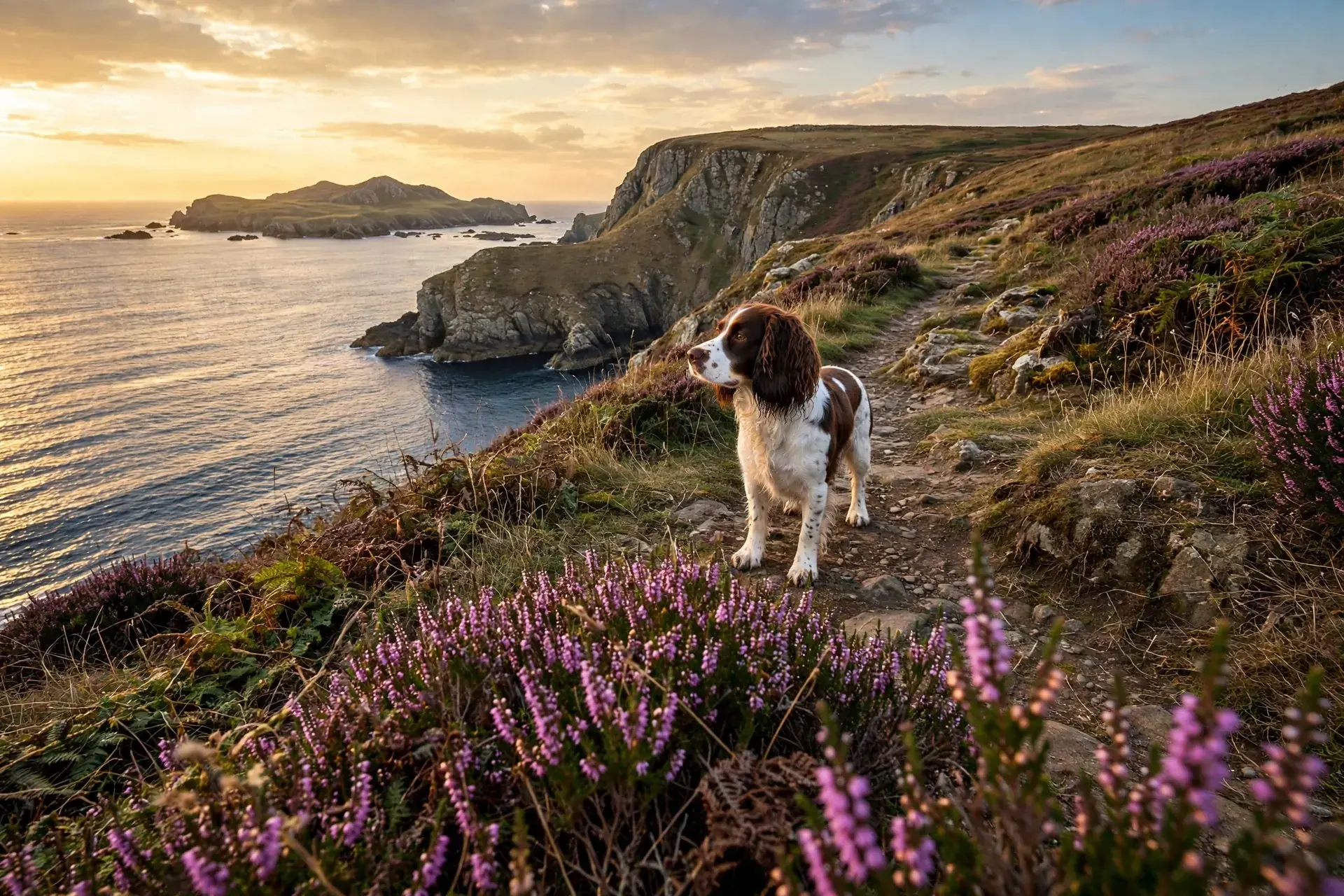
Brecon is one of the easiest gateways to the Bannau Brycheiniog (Brecon Beacons) with a dog: start on the flat Monmouthshire and Brecon Canal towpath, step up to a gentle cathedral and riverside circuit, and only then take on the open mountain. Pick the route that matches your dog today, carry water, keep a lead handy for livestock, and always have a retreat point in mind.
Three ways into the mountains
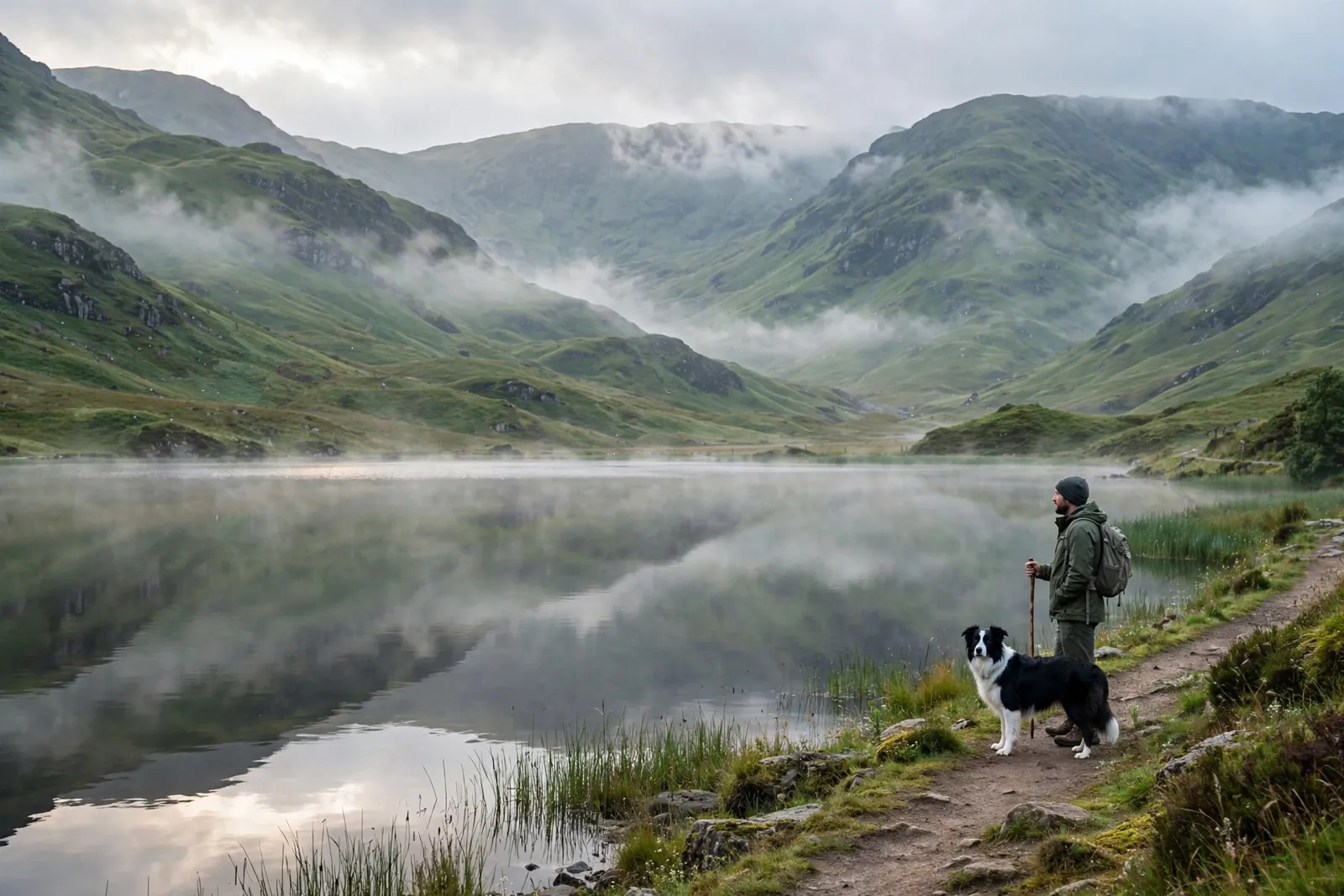
Stand at the southern end of Brecon town centre on a clear evening and the whole trip makes sense at once. The streets run out, the ground lifts, and the long green ridge of the Bannau Brycheiniog fills the horizon. The mountains are not a distant day trip from Brecon; they are the view at the end of the High Street, the backdrop to the canal basin, and the reason so many dog owners choose this small market town as their base. That closeness is Brecon's gift, and also its trap. Because the hills look near, it is tempting to walk straight out of town and up them. For many dogs, that is the wrong first move.
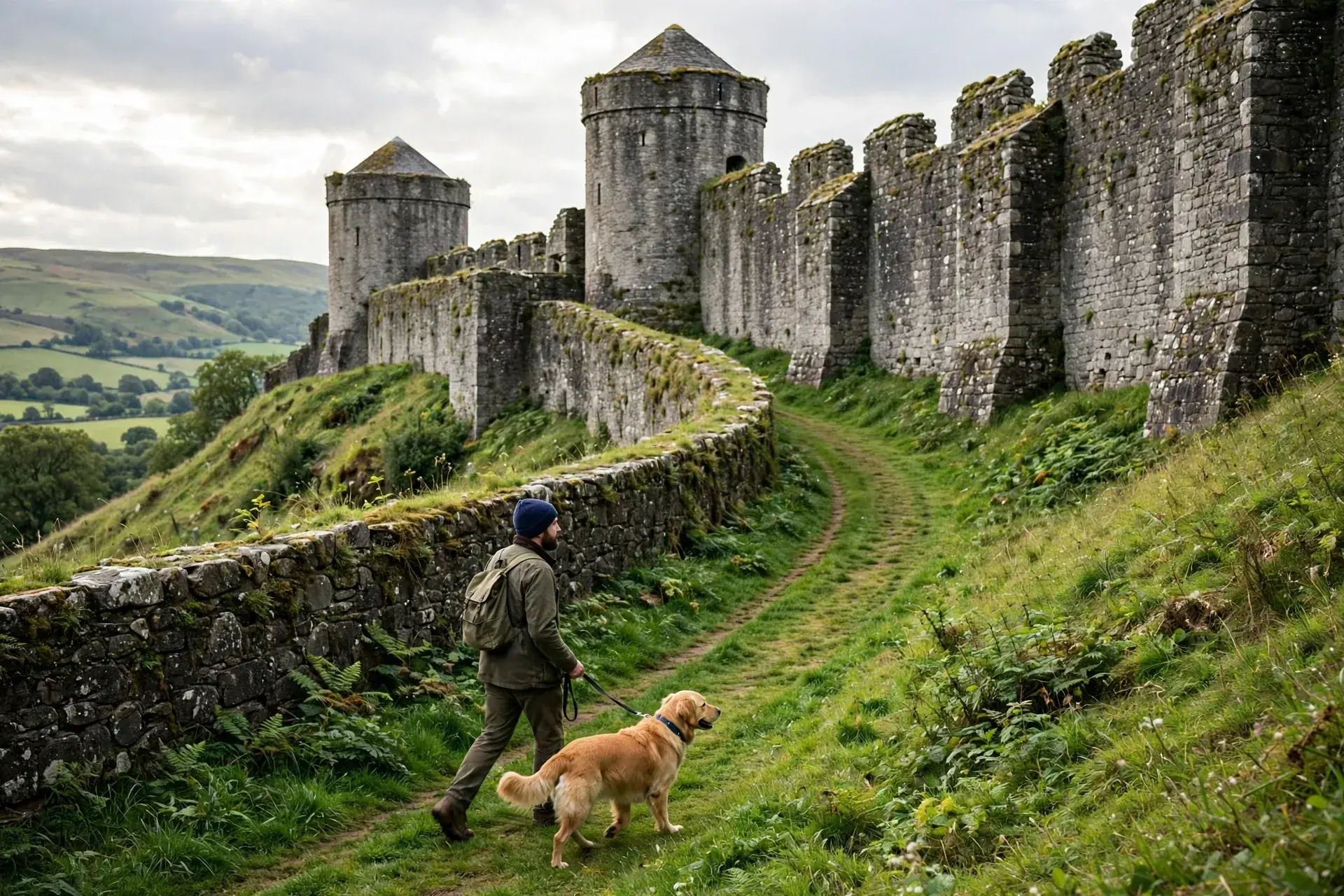
This guide is built around a simple idea: three ways into the mountains, in order of difficulty. Route one follows the Monmouthshire and Brecon Canal towpath, a flat, gentle introduction that suits almost every dog, including puppies building stamina, older dogs, and dogs recovering from injury. Route two stays in town, looping the cathedral, its green, and the riverside paths, and adds gentle slopes, steps, and town distractions without ever leaving civilisation. Route three leaves the town behind and climbs onto the open hill, where the walking is steep, the weather changes fast, and the dog needs to be fit, well trained, and comfortable around sheep. Each route is a complete day out on its own, and together they form a natural progression across a weekend or a longer stay.
Brecon itself is a compact market town in Powys, sitting where the rivers Usk and Honddu meet, at the northern edge of the Bannau Brycheiniog National Park. The town has a cathedral, a castle mound, a canal basin, independent shops, and a good spread of cafes and pubs. It is small enough to cross on foot in twenty minutes, which matters with a dog: you can park once, walk the town, and be on a towpath or a riverside trail without driving anywhere. The town is also a practical base for exploring further afield, including the waterfalls country to the south-west and the long ridge walks that run across the central Beacons.
The grading in this guide is deliberately honest. A flat towpath sounds easy, and it is, but it still has its hazards: canal water beside a narrow path, cyclists passing at speed, and moored boats with dogs of their own. A cathedral circuit sounds gentle, and it is, but the ground is uneven in places, the steps by the cathedral are steep, and town traffic needs a short lead. A mountain climb sounds dramatic, and it is, but the drama is mostly weather, gradient, and distance, and a dog that copes happily with two flat hours may struggle badly with one steep hour. The sections below treat each route separately, with its own notes on surfaces, livestock, water, and where to turn back, so you can judge each one on its own terms rather than on a single vague promise that Brecon is dog-friendly.
Before any route, run through the same short check. Is your dog fit for the distance and the gradient you have chosen? Do you have enough water for both of you, plus a bowl? Is your dog's recall reliable enough for the livestock you may meet, and is the lead in your hand, not in your bag, when you need it? Do you know where the nearest vet is, and have you checked the weather forecast for the hill, not just for the town? The town forecast and the mountain forecast are often different by several degrees and a whole category of wind. A warm, still morning in Brecon can become a cold, gusty afternoon on the ridge, and a dog that is comfortable at valley level can be chilled quickly on exposed ground. Check the official guidance before you travel for current path conditions, access rules, and any temporary closures.
One more thing to settle before you set out: Brecon is a working town in a farming landscape, not a theme park. Sheep graze the open hills, cattle graze the lower fields, and working dogs are part of daily life here. Most local walkers and farmers expect visiting dogs to be under close control, and the law expects it too. Keeping your dog on a lead near livestock is not a courtesy; it is the baseline. The routes in this guide are written with that expectation throughout, and the retreat points are there so you can change your mind gracefully rather than pushing on into a situation that does not suit your dog.
Route 1: the canal towpath, the flat way in
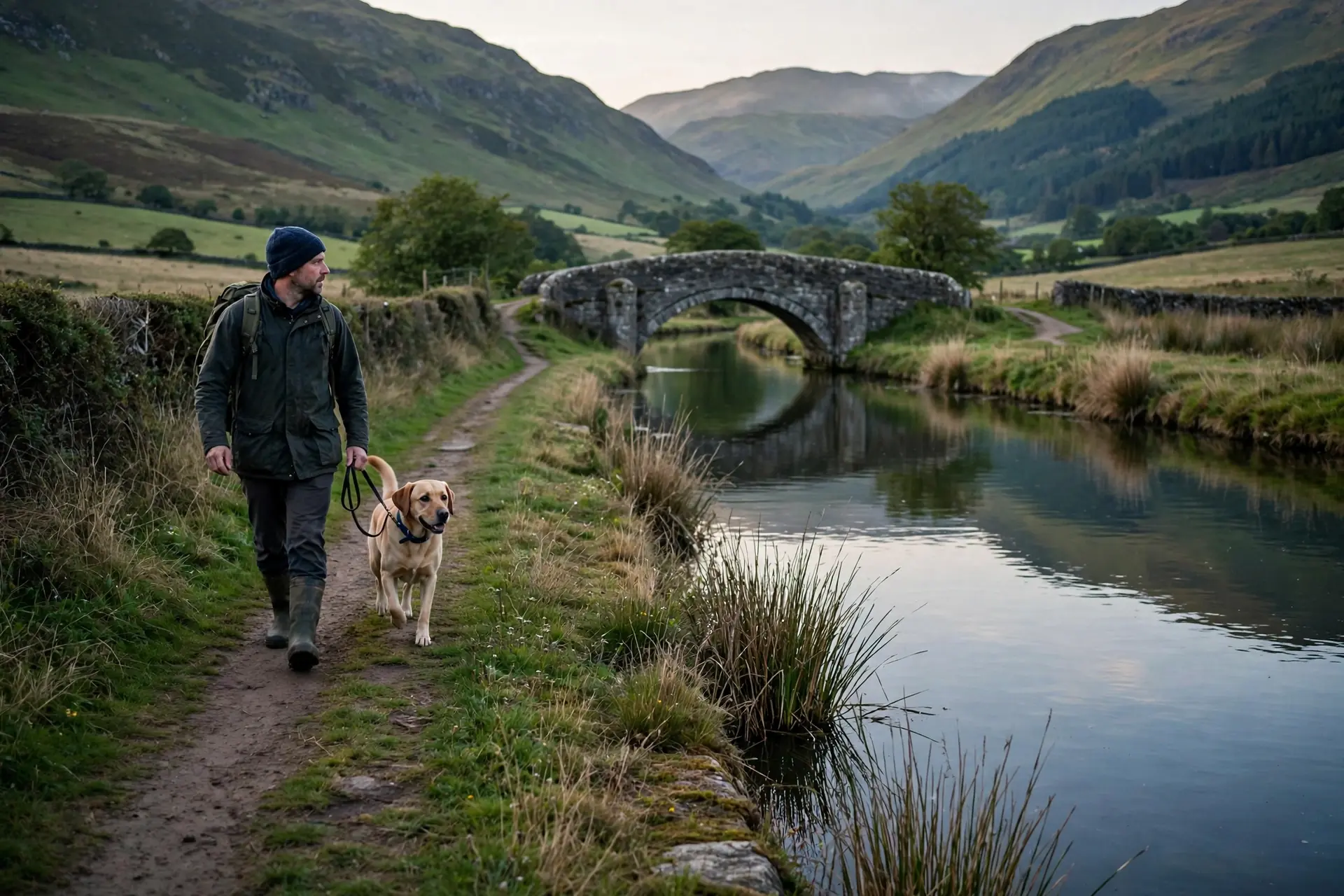
The Monmouthshire and Brecon Canal runs into Brecon from the south-east, ending at the canal basin just off the town centre. The towpath beside it is the gentlest walking in the area, and for many dogs it is the best walk in Brecon full stop. It is flat, it is mostly well surfaced, and it offers the one thing the mountain routes cannot: an easy, predictable distance that you can extend or shorten at any bridge. If your dog is young, old, stiff, nervous, or simply new to Welsh walking, start here, and let the canal set the pace for the whole trip.
The classic out-and-back begins at the Brecon basin. From the basin, the towpath heads south-east, leaving the town behind within a few minutes. The water sits on your left or your right depending on direction, the hedgerows close in, and the mountains open up ahead. The surface is generally a compacted path, though it can be muddy after rain and uneven where tree roots cross it. A dog on a short lead does well here, and a long line works on the wider, quieter stretches, but keep the line short at bridges, where the path narrows and sightlines disappear. Cyclists use the towpath too, and they often arrive silently from behind, so teach your dog to walk on the side away from the water and to step aside when you hear a bell or a voice.
Distance on the towpath is entirely your choice. A gentle there-and-back of an hour covers a few miles at a sniffing pace and suits most dogs, while a longer stretch rewards fitter dogs with changing views, locks, and aqueducts. The canal climbs through a series of locks as it leaves Brecon, and each lock is a natural stopping point: a place to offer water, check paws, and decide whether to continue or turn back. Bridges are the other natural markers. Each one is a landmark, a shade point, and a decision point, and on a first visit it helps to pick a bridge as your turnaround before you start, rather than deciding when the dog is already tired.
The towpath's surface deserves a careful look. Most of it is firm enough for paws, but after heavy rain the low sections hold puddles and the edges can be soft. In dry summer weather the path is dusty and the canal water looks tempting, but do not let your dog drink from the canal. Canal water can carry bacteria and, in warm weather, algal blooms, and it is not a substitute for the fresh water you carry. The same applies to swimming: the canal is deep in places, the banks are steep, and a dog that jumps in may struggle to climb out. Keep your dog out of the water, keep the lead on near the edge, and save swimming for a safe, shallow river spot you have checked first.
Livestock on the towpath itself is unlikely, but the fields beside the canal are working farmland. Sheep and cattle graze in fields that border the path, and the fence or hedge between them is not always dog-proof. A dog that fixates on livestock through a gap in the hedge needs a short lead and a firm recall before you reach that stretch. The other animals to watch for are the dogs on moored narrowboats. A boat dog behind a fence or on a deck can be a sudden, loud surprise for a dog walking the towpath, so keep your dog close as you pass moored boats, and do not let your dog approach a boat's deck or gangplank.
Water is the towpath's one real gap. There is canal water everywhere and drinking water almost nowhere, so carry a bottle and a collapsible bowl for the dog, and offer water at every lock rather than waiting for the dog to ask. In summer, the towpath can be warm despite the tree cover, and the lack of breeze beside the water can make it feel warmer still. A dog that pants heavily, seeks shade, or slows down is telling you to stop, offer water, and turn back. There is no prize for reaching the next bridge, and the canal will still be there tomorrow.
Retreat points on this route are simple and generous. Every bridge is an exit, and most bridges lead to a lane or a road that returns toward Brecon. The locks are also good places to stop, because they are obvious landmarks that are easy to describe if you need help or directions. If your dog tires, simply turn around: the towpath is the same distance back, it is flat, and there are no surprises waiting on the return leg. The only caution is the light. The towpath is shaded and darkens earlier than the open town, so plan to be back at the basin well before dusk, and carry a light in winter, when the afternoons are short.
For a first morning in Brecon, the canal is the perfect diagnostic walk. It tells you how your dog copes with a new place, how their paws handle a couple of miles, and how they react to cyclists, boats, and other dogs, all within easy reach of the car and a cafe. If the dog finishes the towpath bright and keen, you can step up to the cathedral circuit the same afternoon. If the dog finishes tired, you have learned something valuable without ever leaving flat ground, and you can plan the rest of the trip around the dog you actually have.
Route 2: cathedral, castle and riverside, the town way in
Route two stays in Brecon and treats the town itself as the walk. It suits dogs that enjoy people, smells, and changing scenery, and it suits owners who want a proper morning out without committing to a mountain. The loop centres on Brecon Cathedral, the castle mound, and the rivers Usk and Honddu, and it can be walked in an hour or stretched into a slow half day with cafe stops. It is also the best wet-weather option of the three routes, because you are never far from shelter, a pavement, or the car.
Begin at the cathedral, which stands on the northern edge of the town centre, above the river Honddu. The cathedral green is a wide, grassy space where dogs on leads are a normal sight, and it is one of the calmest open spaces in town. The grass is good for a sniff and a settle, the trees give shade in summer, and the views across the rooftops to the mountains are the same ones that open this guide. Walk the green slowly, let the dog read the ground, and use the time to judge how they are coping with a new town: the sounds, the people, the other dogs, and the occasional bell. Dogs are generally welcome in the cathedral grounds, which is the part of the visit most dogs will enjoy. Access inside the building can vary by service, event, and season, so check the official guidance before you travel, and plan your visit around the grounds if the interior is closed to dogs on the day. If you are hoping to step inside, it is worth checking the current rules in advance rather than arriving with a dog and a hope.
From the cathedral, drop down toward the rivers. The Honddu runs below the cathedral, and the Usk runs along the southern edge of the town, and the paths beside them are the quietest walking in central Brecon. The riverside paths are mostly level, but the surfaces vary: paved stretches, compacted earth, grass, and the occasional set of steps. After rain the riverside ground can be slippery, and the river itself is fast in places, so keep the dog on a lead near the water and do not let them scramble down steep banks. The rivers are beautiful and they are also real rivers, with currents, deep pools, and sudden drops. A dog that loves water will be tempted; a lead and a careful eye keep that temptation safe.
The castle mound is the third point of the loop. Brecon Castle itself is largely a ruin, and much of the site is now occupied by a hotel, so this is a place to walk past and look at rather than to explore freely. The mound and the surrounding ground still reward a slow circuit, with views over the town and the river, and the grassy slopes are good for a short, controlled run on a long line if the ground is dry and no other dogs are close. Keep the dog on a lead near the roads around the castle, because the streets here are narrow and the traffic, while slow, is constant. The castle area is also a good place to practise town manners: waiting at crossings, walking past other dogs without lunging, and settling while you read an information board or take a photograph.
Livestock is not a concern inside the town loop, but town distractions are. Brecon's streets are narrow, the pavements are sometimes narrow too, and a dog on a long lead can easily tangle with a pedestrian, a pushchair, or a shop doorway. Use a short lead through the town centre, keep the dog on the side away from the road, and cross at the obvious points rather than weaving between parked cars. Other dogs are the other town hazard: many local dogs walk these same streets, and not every meeting is friendly. A short lead, a wide berth at corners, and a willingness to cross the street to avoid a tense encounter will keep the loop calm.
Water on this route is easier than on the canal or the mountain. Cafes and pubs in the town centre will usually offer a bowl, and the town has shops where you can buy water if you run out. Even so, carry a bottle and a bowl, because a dog that is thirsty halfway around the loop should not have to wait for the next cafe. The rivers are not a drinking source: river water can carry bacteria and farm run-off, and it is not a safe substitute for fresh water. Offer water at the cathedral green and again at the riverside, and watch for the same signs of tiredness you would watch for anywhere: heavy panting, slowing down, and a reluctance to keep walking.
Retreat points on the town loop are everywhere, which is its greatest strength. You are never more than a few minutes from a pavement, a cafe, or your car, and every street is an exit. If the dog finds the town too busy, step onto the riverside path. If the riverside is too muddy, step back onto the pavement. If the whole loop is too much, cut across the town centre and be back at the car in ten minutes. This flexibility makes the cathedral circuit the right choice for a first afternoon, for a rainy day, for a dog that is still settling into the trip, or for an evening walk when the light is fading and you want to stay close to town.
For many visitors, the town loop is also the most rewarding route in its own right. It connects the cathedral, the castle, the rivers, and the market-town streets into a single walk that shows what Brecon is, rather than what lies beyond it. Take it slowly, stop at the river, sit on the cathedral green, and let the dog watch the town go by. A dog that has had a calm, interesting hour in town will sleep better, settle faster, and be in a better state for the mountain the next day than a dog that has been marched straight up a hill.
Route 3: up into the Beacons, the mountain way in
Route three is the reason many people come to Brecon, and it is the route that demands the most respect. From the town, the high ground of the central Beacons rises to the south, and the most famous summit, Pen y Fan, is the highest peak in southern Britain. The mountain routes from Brecon are long, steep, and exposed, and they are a different kind of walking from anything in the town or on the canal. This section describes the climb honestly, so you can decide whether it suits your dog, and if it does, how to do it well.
The first thing to understand is the gradient. The walk from valley level to the ridge climbs several hundred metres, and the steepest sections are genuinely steep, with rocky steps, loose scree, and uneven ground. A dog that is fit on flat paths may find the climb hard on its joints, its paws, and its stamina. Older dogs, very young dogs, dogs with arthritis, and dogs that are unfit or overweight should not attempt the full climb. A dog that has never done a mountain walk should build up with the canal and the town routes first, and only attempt the hill if it finishes those routes bright and keen. There is no shame in turning back, and there is no prize for reaching a summit with a lame or exhausted dog.
The second thing to understand is the surface. The lower slopes are grassy and relatively kind, but the higher ground is rocky, with stone steps, boulder fields, and exposed rock. Paws take a beating on this ground, especially in dry weather, when the stone is hard and sharp, and in wet weather, when it is slippery. Check your dog's paws at every stop, look for cuts, soreness, and limping, and consider paw protection if your dog is not used to rocky terrain. A dog that starts limping on the way up will be worse on the way down, and the descent is often harder on paws and joints than the ascent. If you see a limp, turn back immediately, however close the summit looks.
Livestock is a constant presence on the open hill. Sheep graze freely across the Beacons, often in large numbers, and they can appear suddenly from behind a rise or a crag. Ponies graze here too, and they are large, protective of their foals, and not to be approached. Keep your dog on a lead for the whole mountain walk, without exception. The open hill looks like a place for a dog to run free, and for a well-trained dog with perfect recall it can be, but the risk is not worth it: a dog that chases sheep can cause serious harm, can be shot by a farmer under the law, and can put its owner in a very difficult position. A lead on the mountain is not a restriction; it is the condition that makes the walk possible at all. Give grazing animals a wide berth, move slowly and calmly past them, and never let your dog approach a pony or a sheep, however friendly it looks.
Water is the mountain's biggest practical problem. There is no reliable drinking water on the high ground, and the streams on the lower slopes can be seasonal, muddy, or contaminated by livestock. Carry all the water you will need for the whole walk, for both of you, and carry more than you think you need. A good rule is at least a litre for the dog on a moderate day, and more in warm weather or on a long route, plus your own supply. Offer water little and often, at every stop, rather than waiting for the dog to become thirsty. A dog that stops drinking, pants heavily, or seeks shade on the hill is overheating or exhausted, and needs shade, water, and a decision to turn back.
Weather on the mountain is a separate discipline. The Beacons are notorious for fast changes: a clear morning can become cloud, wind, and rain within an hour, and the summit can be in cloud while the town below is sunny. Wind on the ridge is often strong enough to unbalance a small dog, and the wind chill can be severe even in summer. Check a mountain-specific forecast before you set out, not just the town forecast, and be prepared to change your plan. If the forecast shows strong wind, heavy rain, low cloud, or a risk of thunderstorms, do not go up. Thunderstorms on an exposed ridge are dangerous for people and dogs alike, and there is no shelter on the high ground. If the weather changes while you are on the hill, turn back at once: the mountain will still be there on a better day.
Retreat points on the mountain are fewer and more important than on the other routes. Before you start, agree on a turnaround point and a turnaround time, and stick to them. A good first target is a lower shoulder or a cairn part-way up, not the summit itself. If the dog tires, if the weather turns, if the path becomes too rocky, or if you meet livestock you cannot pass safely, turn back at once. The descent is long and the light fades quickly on the hill, so plan to be off the high ground well before dusk, and carry a head torch, a map, and a charged phone. Let someone know your route and your expected return time, and keep the dog on a lead for the whole descent, because tired dogs make mistakes on steep ground.
For a fit, experienced dog, the mountain is a superb walk. The views from the ridge are among the best in southern Britain, the air is clean, and the sense of space is something a dog feels as much as its owner. But the mountain rewards preparation and punishes optimism. Go early, go prepared, go with a lead on, and go with a plan to turn back. The best mountain day with a dog is not the day you reach the summit at all costs; it is the day you both come home sound, happy, and ready to go again.
Choosing the right route for your dog
The three routes are not a ladder you must climb. They are options, and the right choice is the one that fits the dog in front of you today, not the dog you wish you had. A young collie with boundless energy may still be wrong for the mountain if its recall fails around sheep. An older labrador may be perfect for the canal and the cathedral, and happier for never seeing the summit. A rescue dog that is nervous in town may love the quiet towpath and hate the cathedral green. Judge each dog on its own evidence, and let the first walk of the trip be a test, not a commitment.
Use a simple fitness check before you choose. Can your dog walk for two hours on flat ground without tiring, and recover quickly? Can it manage a steep hill of twenty minutes without panting hard or slowing? Are its paws sound after a rocky path, and does it cope with wind, rain, and cold? Is its recall reliable around sheep, other dogs, and cyclists? If the answer to any of these is no or not sure, choose the easier route and build up. A dog that finishes a walk keen and bright has had a good day; a dog that finishes lame, exhausted, or frightened has had a bad one, and the difference is usually the route choice, not the dog.
Age matters more than enthusiasm. Puppies under a year should not do long or steep walks, because their joints are still developing, and the canal towpath at a gentle pace is a far better choice than any climb. Older dogs may have arthritis, heart conditions, or reduced stamina that are not obvious at home but show quickly on a hill. Short-coated dogs chill faster on exposed ground, long-coated dogs overheat faster on a climb, and brachycephalic breeds such as pugs and bulldogs struggle with heat and exertion at altitude. If your dog has any health condition, ask your vet before attempting the mountain, and check the official guidance before you travel for current path conditions.
Combining routes across a stay is the best use of Brecon. A common pattern is the canal on the first morning, the cathedral circuit in the afternoon, and the mountain on the second day if the dog has coped well and the weather is kind. Another pattern is to alternate: a mountain day followed by a canal day, so the dog rests its paws and joints between climbs. A third pattern is to use the canal and the town as the daily walks and the mountain as a single highlight, with a rest day afterwards. Whatever pattern you choose, build in a rest day, or at least a rest morning, after any mountain walk. Dogs, like people, need recovery time after a hard climb, and a tired dog on a second hard day is a dog at risk of injury.
If you are travelling with more than one dog, choose for the weakest dog, not the strongest. Two dogs on leads on a steep, rocky path need more space, more control, and more water than one, and a disagreement between dogs on a narrow mountain path is a serious problem. Walk the dogs together on the canal first, see how they cope as a pair, and only take both up the hill if they are calm, controlled, and fit. If one dog cannot do the mountain, split the party: one person takes the fit dog up, the other takes the other dog on the canal. Nobody has a good day when a dog is pushed beyond its limits to keep up with a fitter companion.
Practical base: parking, water and vets
Brecon is a small town, and its car parks are close to everything you need. The town-centre car parks put you within a short walk of the canal basin, the cathedral, and the riverside paths, which means you can park once and walk all three routes from the same base. Arrive early on weekends and in school holidays, because the closest car parks fill quickly, and the later you arrive, the further you will have to walk with a dog that is already keen to get going. Check the official guidance before you travel for current charges, time limits, and any changes to parking arrangements. Never leave a dog in a parked car, even for a few minutes, and never on a warm day: cars heat up far faster than most people expect, and a dog in a hot car is in danger within minutes.
Water is the practical thread that runs through this whole guide, and it deserves a short checklist of its own. Carry a bottle and a bowl on every walk, including the town loop. Fill up before you leave the car, and refill at cafes, pubs, and shops whenever you get the chance. On the canal, offer water at every lock. On the mountain, carry all you need and offer it little and often. Do not rely on canal water, river water, or mountain streams, and do not let your dog drink from puddles beside farmland. If your dog will not drink from a collapsible bowl, bring its usual bowl from home, and if it will not drink on a walk at all, offer water flavoured with a little low-salt broth, or offer wet food as a way of getting fluid in.
Toilets and bins are the unglamorous part of any dog trip, and Brecon handles them well. The town centre has public toilets, and the canal and riverside paths have bins at intervals, but the mountain has neither. Carry more poo bags than you think you need, carry them out with you, and use the bins in town. On the mountain, double-bag and carry the waste down: leaving bags by the path, even with the intention of collecting them later, is littering, and it is one of the most common complaints about dog walkers in the national park. A small, sealable bag for used bags, kept in a rucksack pocket, makes this easy and keeps the smell contained.
Before you travel, save the details of the nearest vet. Brecon has veterinary practices in and around the town, and the nearest out-of-hours service may be further away, so look up the numbers before you need them and save them in your phone. Note the opening hours, and remember that rural practices can close early and may not be staffed at weekends. If your dog has a medical condition, bring its medication, its vet's number, and a note of its normal dose, and tell your accommodation where the nearest vet is. A dog that cuts a paw on the mountain, eats something it should not, or overheats on a climb needs help quickly, and the time to find a vet is before the walk, not during it.
Mobile signal is generally good in Brecon town and along the canal, but it can be patchy on the mountain, especially in the valleys between ridges. Download an offline map before you set out, carry a paper map as a backup, and do not rely on your phone alone for navigation. A charged phone, a head torch, and a map are the minimum for any mountain walk, and a portable charger is a sensible addition on a long day. Let someone know your route and your expected return time, especially if you are walking alone with the dog.
Eating and drinking with your dog
Brecon is a good town for eating out with a dog, because it is small, independent, and used to walkers. Many cafes and pubs welcome dogs, at least on a terrace or in a bar area, and a muddy pair of boots and a dog on a lead are a normal sight rather than an exception. Even so, dog policies change by season, by landlord, and by the time of day, and a place that welcomed dogs last summer may have changed its rules. Check the official guidance before you travel, and check with the individual venue before you sit down, especially if you want to eat inside rather than on a terrace.
Terraces are the easiest option. A dog can settle under a table outside, the air is fresh, and nobody minds a wet dog in the open air. In summer, a shaded terrace is ideal, but in winter or in rain, a terrace can be cold and exposed, and a short-coated dog will chill quickly. Bring a mat or a blanket for the dog to lie on, a drying coat for wet days, and a chew or a stuffed toy to keep it settled while you eat. A dog that is cold, wet, and bored will not settle, and a dog that will not settle will not be welcome for long. If the weather is bad, consider a takeaway instead: many cafes and food shops in Brecon offer takeaway, and a sandwich eaten on the cathedral green or beside the canal is often a better dog day than a long indoor meal.
Inside, the rules are stricter and more variable. Some pubs welcome dogs in the bar but not in the restaurant area, some welcome them everywhere, and some welcome them only at quiet times. Ask at the door, keep the dog on a short lead, settle it under the table, and keep it there. A dog that wanders between tables, begs from other diners, or barks at other dogs will not be invited back, and it makes life harder for the next dog owner who walks in. Order quickly, eat at a relaxed pace, and leave before the dog becomes restless. A short, calm meal is better than a long, tense one.
Food safety matters too. Pub floors are full of dropped food, and a dog that scavenges can pick up cooked bones, onions, chocolate, or alcohol, all of which are dangerous. Keep the dog's head away from the floor, bring its own treats, and do not feed it from your plate. If your dog has dietary restrictions or allergies, bring its own food and a bowl, and do not rely on the venue to provide them. Water is usually available on request, but carry your own bowl, because not every venue has one, and a dog that has just walked for two hours should not have to wait for a bowl to be found.
If you are planning a longer trip around Wales with your dog, Brecon makes a natural first stop before heading further afield. Our guide to dog-friendly castles in Wales covers the castle sites where dogs are welcome and where leads are required, which pairs well with a Brecon base. For a longer driving holiday, our dog-friendly road trip through North Wales sets out a route that works with a dog in the car, and our Cardiff with a dog guide covers the capital for the return journey south. Each of these is a separate trip in its own right, but together they show how Brecon fits into a wider Welsh dog holiday.
Staying overnight near Brecon
Brecon has a good range of places to stay with a dog, from hotels and bed and breakfasts in the town to cottages, farm stays, and campsites in the surrounding countryside. The town options are convenient: you can walk to the canal, the cathedral, and the rivers from your door, and you can eat out without driving. The countryside options are quieter and often have more outdoor space, but they usually need a car for every walk, and the lanes around them can be narrow and dark at night. Choose on the basis of your dog, not on the photograph: a nervous dog may be happier in a quiet cottage, while a sociable dog may be happier in a town hotel where there are people to watch.
Whatever you book, ask the dog questions before you pay. Is there a pet fee, and how much is it per dog per night? Is there a limit on the number or size of dogs? Are dogs allowed in the bedroom, and is there a place to dry a wet dog? Is the garden enclosed, and how high is the fence? Can the dog be left alone in the room, and if so, for how long and under what conditions? Is there a charge for damage, and what happens if the dog barks? Get the answers in writing, with the pet fee itemised, and keep the reply with your booking confirmation. A place that answers these questions clearly has usually thought about dogs properly; a place that answers vaguely has not.
Think about the room itself. A ground-floor room is easier for an older dog, a dog that needs frequent toilet trips, or a dog that struggles with stairs. A room near an exit is easier for night-time toilet trips, and a room away from the main corridor is quieter for a dog that reacts to footsteps. Ask for a room with hard flooring rather than carpet if your dog is muddy, and bring the dog's own bed, blanket, and bowls, so the room smells familiar. A familiar bed is the fastest way to settle a dog in a new place, and a dog that settles quickly will sleep better and walk better the next day.
Campsites and farm stays around Brecon offer a different kind of trip. They are often cheaper, they give the dog more space, and they put you closer to the countryside, but they also need more equipment: a secure lead system, a drying setup, and a plan for wet weather. Check whether the site has a dog exercise area, whether dogs must be on leads at all times, and whether there are livestock in the neighbouring fields. A campsite next to a sheep field is a poor choice for a dog with a strong chase instinct, however pretty the view. Check the official guidance before you travel for current site rules and any seasonal restrictions.
Book early for the best dog-friendly rooms, especially in summer and in school holidays. The dog-friendly rooms in Brecon are fewer than the rooms overall, and they are often the ground-floor rooms with garden access, which are the first to sell. If you are booking for a weekend, aim to book several weeks ahead, and if you are booking for a bank holiday, book months ahead. A last-minute booking may still be possible, but the choice will be narrower and the price higher, and you may end up in a room that does not suit the dog.
Seasons and weather
Brecon changes with the seasons, and the right route changes with it. Spring is one of the best times to visit with a dog: the canal banks are green, the town is quiet, and the mountain paths are firm after the winter. Lambing season, however, runs through spring, and the fields and hills are full of ewes and lambs. Keep the dog on a lead everywhere, give livestock a wide berth, and be extra careful on the mountain, where lambs can be hidden in the grass. Spring weather is also changeable, with warm sunshine one hour and cold rain the next, so pack a waterproof and a drying coat even on a bright morning.
Summer is the busiest season and the hottest. The canal towpath is shaded and pleasant, the cathedral green is a good place to sit, and the mountain is at its most accessible, but the heat is a real risk for dogs. Walk early in the morning or late in the evening, avoid the midday sun, carry extra water, and watch for signs of overheating: heavy panting, drooling, disorientation, or a reluctance to move. A dog that overheats needs shade, water, and cooling at once, and a car journey home in the heat can make it worse. The mountain in summer can be deceptively cool at the summit and hot on the climb, so dress for both, and remember that the rock on the high ground can burn paws on a hot day. Check the ground with your hand before you set the dog on it.
Autumn is, for many dog owners, the best season in Brecon. The crowds thin, the light is golden, the canal is quiet, and the mountain is crisp and clear. The ground, however, becomes wetter and more slippery as the season goes on, and the towpath and riverside paths can be muddy after rain. Leaves on stone steps are treacherous, and the days shorten quickly, so plan shorter walks and carry a light. Autumn is also the season for fungi and for fallen fruit, both of which can be poisonous to dogs, so keep the dog from eating anything it finds on the ground, and check the official guidance before you travel for current path conditions.
Winter in Brecon is quiet, cold, and beautiful, and it suits hardy dogs and prepared owners. The town is at its calmest, the canal can be frosty, and the mountain can be snow-covered, icy, or closed by weather. Do not attempt the mountain in snow or ice unless you have proper equipment, experience, and a dog that is used to those conditions. Ice on the towpath and the riverside steps is a hazard for dogs as well as people, and short-coated or older dogs chill quickly in cold wind. Pack a warm coat for the dog, keep walks shorter, and dry the dog thoroughly when you get back inside. A wet, cold dog that is left damp will chill, and a chilled dog is a dog at risk of illness.
Whatever the season, the mountain forecast is the one that matters for route three, and the town forecast is the one that matters for routes one and two. Check both, check them on the morning of the walk, and be ready to change your plan. The best dog days in Brecon are not the days with the best weather; they are the days when the route matches the dog, the weather, and the season, and when the owner is willing to turn back if any of those three changes.
Practical questions
Before you go
Can my dog walk the Brecon canal towpath off the lead?
It is safest to keep your dog on a lead on the towpath. The path is narrow in places, cyclists and other walkers pass closely, and the canal water is beside you the whole way. A short lead gives you control at bridges and moored boats, and a long line is a better choice than a free run on the open stretches.
Is Brecon Cathedral dog-friendly?
Dogs are generally welcome in the cathedral grounds and the surrounding green, which is the most useful part for most visitors. Access inside the building can vary by service, event and season, so check the official guidance before you travel and plan your visit around the grounds if the interior is closed to dogs on the day.
Can dogs climb Pen y Fan from Brecon?
Fit, experienced dogs can climb Pen y Fan, but it is a serious mountain walk, not a town stroll. The route is steep, exposed and long, with sheep and often strong wind, and there is no reliable drinking water on the high ground. Only attempt it with a fit dog, plenty of water, a lead, and a clear turnaround point agreed before you start.
Where can I park in Brecon with a dog?
Brecon has several town-centre car parks within a short walk of the canal basin, the cathedral and the river paths. Arrive early on busy weekends, as the closest car parks fill quickly. Never leave a dog in a parked car, even briefly, and check the official guidance before you travel for current charges and time limits.
Are there sheep on the walks around Brecon?
Yes, sheep graze widely on the open hills and on many of the fields around Brecon, and they can appear without warning near paths. Keep your dog on a lead wherever livestock may be present, give grazing animals a wide berth, and remember that a dog worrying livestock is a serious matter under the law.
What should I pack for a dog day in the Brecon Beacons?
Pack water and a bowl, a lead and a long line, poo bags, a towel, a drying coat in wet weather, paw protection for rough ground, food and any medication, and a first-aid kit. In summer add shade and extra water; in winter add a warm layer for short-coated or older dogs. Check the official guidance before you travel for current path conditions.