This guide is independent and contains no paid placement. If affiliate links are added later, they will be clearly marked and will not change our editorial checks.
Walk the commons, Jesus Green and the Cam towpath to Grantchester for daily exercise, admire the colleges from the Backs and public paths because pet dogs do not go inside college grounds, check each punt operator before planning a river trip with a dog, and watch for cattle on the commons and bikes everywhere.
Start on the meadows, among the cows
Cambridge is the rare famous city where a dog's day can begin with grazing cattle. The commons — Midsummer Common and Jesus Green along the river north of the centre, Stourbridge Common to the east, and the smaller greens threaded through the neighbourhoods — are working city pasture as much as parkland, and herds of Red Poll cattle graze several of them in season as they have for centuries. For a visiting dog this is both the charm and the first lesson of Cambridge: the green spaces are generous, central and genuinely rural in character, and they come with livestock rules. Keep dogs on a lead or under very close control anywhere cattle are grazing, give the herds a wide berth, and never let a dog approach calves or worry animals resting on the paths.
With that understood, the commons solve the dog owner's hardest city problem immediately. Jesus Green, a long tree-lined green between the river and the streets north of the centre, gives lead walks, open grass away from the grazing areas, and the Jesus Lock and river activity to watch. Midsummer Common, across the river, is the city's festival and fair ground at certain dates and a spacious everyday dog walk the rest of the year — check for event fencing during the Strawberry Fair and midsummer period, when parts close and crowds gather. Lammas Land and the Paradise nature area, on the Newnham side south west of the centre, add a quieter, wilder green with river swimming spots for humans and paddling edges that dogs love, subject to the same livestock and wildlife awareness.
Plan the Cambridge day around these spaces and the river that joins them, and the city's famous restrictions stop mattering much. A morning on the commons and towpath, a middle of the day viewing the colleges from the public paths of the Backs, an afternoon out to Grantchester or in the Botanic Garden's surrounding streets — Cambridge is flat, compact and made for walking, and a dog who can handle cattle calmly and bikes passing will find it close to ideal. The sections that follow take each piece in turn.
The Backs and the colleges: admiration from outside
The rule to absorb first is simple: Cambridge's colleges are private institutions, and pet dogs are not admitted to college grounds, courts, chapels or gardens. That includes the most famous views' interiors — King's College Chapel, the great courts of Trinity and St John's, the fellows' gardens — all of which belong on the human side of a split visit, with current visiting arrangements checked on the official site before you go, because term dates, graduations and events close even human access at times. Assistance dogs are a different matter, and our guide to assistance dog access rights in the UK explains that distinction in full.
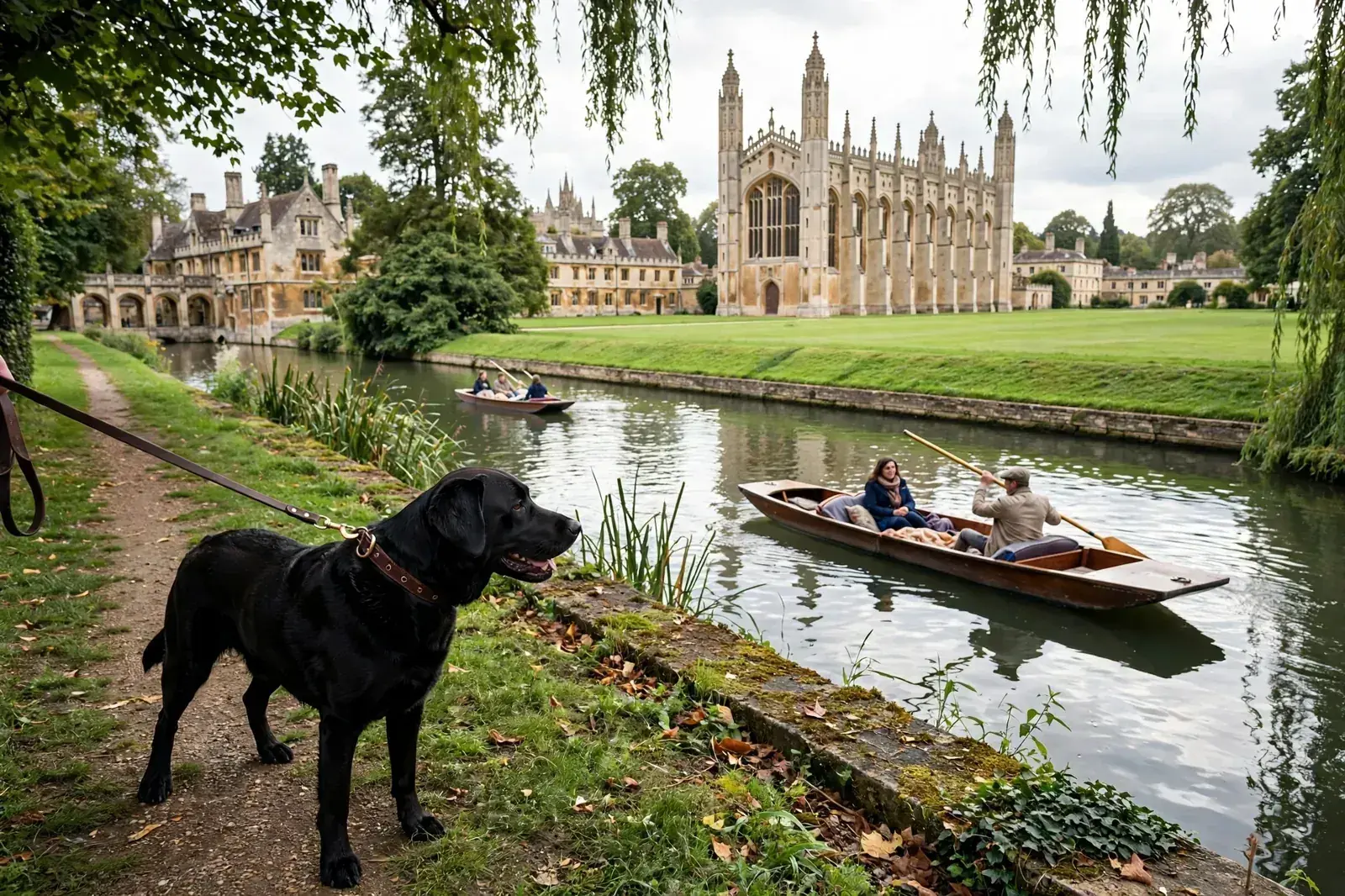
What saves Cambridge is that its most beloved view is public. The Backs — the riverside strip where the backs of the great colleges run down to the Cam — can be admired from Queen's Road, from the bridges, and above all from the river itself and its banks. Garrett Hostel Bridge and the paths by King's and Clare give the classic panorama: chapel, lawns, bridges and punts, all experienced with your dog beside you on public ground. Walk the route early for the quietest light and the fewest crowds, keep dogs on leads on the bridges and narrow path sections, and resist every inviting college gateway, however open it stands — an open gate is for members and ticketed visitors, not for dogs.
For the split visits themselves, the pattern from other university and cathedral cities applies: one person tours a college or the Fitzwilliam Museum — the university's great art museum, another interior to treat as assistance-only unless confirmed otherwise — while the other walks the dog on Jesus Green or along the towpath, then swap or save the second interior for another day. The University Botanic Garden follows garden rules of its own and pet dogs should be expected to stay outside; check the official site before you go. None of this diminishes the trip much. Cambridge's genius is outdoors — river, meadows, bridges and skyline — and the dog sees the best of it.
The River Cam towpath: the city's walking spine
The Cam is Cambridge's spine, and its towpath is the walk everything else hangs from. North and east from Jesus Lock, the path follows the river past Midsummer Common and Stourbridge Common toward Fen Ditton and the open fen-edge country beyond, passing houseboats, rowing activity and long skies. This is the direction for a bigger, quieter walk: the surface is generally good, the interest constant, and the return can be made by a different bank or a bus from the outer villages where services allow. Rowing is serious business on this reach — crews, coaches on bikes calling instructions, regatta days in season — so keep dogs close on the towpath where cycling coaches pass, and out of the water near boat activity.
South from the centre, the river changes character as it leaves the Backs: past the Mill Pond and the Laundress Green area, through the water meadows toward Grantchester, the path becomes the famous Grantchester Meadows walk, covered in the next section. Even the short version — centre to the meadows' edge and back — gives a dog a proper country walk without leaving the city behind, and it is the single most loved dog route in Cambridge for good reason: flat, scenic, spacious, and ending, if you continue, at a village made for lingering.
River sense applies throughout. The Cam is slow and benign-looking, but it is deep in places, its banks can be steep and muddy, and punts, kayaks and rowing boats fill the central reaches in summer. Dogs should swim only at the established, gentle access points on the meadows and commons reaches, away from boat traffic, and never among the punts at the Backs. Blue-green algae can appear in still water in warm weather across the region, so if the water looks scummy or signs warn of it, keep the dog out entirely. A towpath dog who is called back from the bank edge reliably is a dog who can enjoy the Cam safely for a whole holiday.
Grantchester: meadows, tea gardens and Rupert Brooke
The walk from Cambridge to Grantchester, about two miles along the river meadows, is the excursion to prioritise. The path crosses Byron's Pool's surroundings, skirts water meadows grazed in season — the livestock rules of the commons apply here too — and arrives at a village famous for its literary ghosts, its church clock, and the Orchard Tea Garden, where tea has been taken under the apple trees for well over a century. The Orchard's gardens have traditionally been a place where a well-behaved dog on a lead can sit with owners taking tea outside, but arrangements at any venue change, so check the official site before you go and confirm the current dog position before you set the walk's destination around it.
Grantchester repays a slow hour beyond the tea garden: the village streets, the church, the meadow paths continuing toward Trumpington, and the river at its most swimmy and picnic-friendly around the meadows on the Cambridge side. Families and dogs spread across the grass in summer, and the etiquette is the commons etiquette — space, leads near cattle, everything taken home. If two miles each way is too much for your dog, the walk works beautifully one-way with a bus or taxi back; verify dog carriage with the specific bus service or taxi firm in advance — our guide to dog-friendly taxis in the UK explains how to book so the dog is expected, not debated at the kerb.
Do Grantchester in the morning of a fine day if you can. The meadows are at their best before the afternoon crowds, the light on the river is kind, and you return to Cambridge with the sightseeing hours still ahead and a dog ready to rest through them. In winter the meadows can be wet and the path muddy in its field sections — boots for you, a towel for the dog, and a lead near any flooded edges where the river has spread. In every season it is the walk that makes Cambridge a dog holiday rather than a dog-tolerant city break.
Market Square, King's Parade and crowd craft
The historic centre — Market Square with its daily market, King's Parade facing the great gatehouses, the lanes of the old shopping quarter — is public street, and a dog on a lead can walk all of it. The craft is in the timing and the traffic. Cambridge is a cycling city on a continental scale, and bikes are the hazard visiting dog owners least expect: they are fast, quiet, numerous and legally present in places a visitor might assume are pedestrian-only. Keep the lead short on shared streets and crossings, position the dog on the side away from the cycle flow, and teach yourself to look for bikes as automatically as for cars. Most Cambridge dogs are bike-wise within a day; visiting dogs need their owners to be bike-wise for them.
King's Parade and the market area peak from late morning, in term-time weekends, graduation periods and through the summer visitor season. Go early, or treat the centre as a route to walk through purposefully rather than a place to browse slowly with a dog at ankle height. The market stalls are aromatic and low-slung, which makes them fascinating and hazardous in equal measure for a scavenging dog: short lead, attention forward, and no tying dogs outside food shops where they block narrow pavements. Side streets toward the Kettle's Yard area in the north, and the streets around Newnham and Mill Road in the south and east, give a calmer, more local Cambridge for the hours when the parade is full.
Wet weather moves Cambridge indoors, which for dogs means planning rather than improvising: a long towpath morning between showers in full waterproofs, a confirmed dog-welcoming pub for lunch, a split-visit museum in the afternoon. The city's churches, many of them historic and some welcoming to a lead dog outside service times, should always be treated as check-at-the-door visits, never assumptions. Build the day that way and even a rainy Cambridge weekend keeps both halves of the partnership content.
Where to stay with a dog in Cambridge
Choose the base by its nearest meadow or common and Cambridge becomes straightforward. The streets north of the centre around Jesus Green and Chesterton put the river and commons at the door and tend to be calmer in the evenings. Newnham, to the south west, is the Grantchester-side village within the city — Lammas Land and the meadows at hand, a quieter pace, and a slightly longer walk to the market square. The Mill Road area, east of the centre, offers an independent, local high street and good access to the eastern commons and the station. A very central address buys sightseeing convenience at the price of a longer walk to real grass at dawn, which is the walk your dog will judge the stay by.
Ask the standard dog questions with unusual precision here, because Cambridge's converted townhouses and college-adjacent properties have their quirks: which rooms accept dogs and up how many stairs, the fee and any size or number limits, dining arrangements, whether a dog may be left alone in the room, and — specific to this city — where the nearest cattle-free grass is if your dog is livestock-nervous, since several of the closest commons carry herds. Our national guide to dog-friendly hotels in the UK sets out the complete booking checklist that applies to hotels, guest houses and self-catering alike.
Book ahead for the dates that matter: graduation periods, May Week and the summer balls season, and the height of summer fill the well-located dog-welcoming rooms, and prices reflect a city whose visitor demand rarely sleeps. Self-catering in the residential streets often gives a dog the easiest stay of all — a door routine you control, hard floors, perhaps a small garden, which must be verified as genuinely enclosed, as Cambridge's garden walls and shared passages can surprise. Arrive with familiar bedding, a chew for the first evening and a towel by the door; fenland mud is fine, pale and remarkably persistent.
Riverside pubs, cafes and eating together
Cambridge eats with a dog most happily in its pubs and its green spaces. The riverside pubs along the Cam — in the centre around the Mill Pond, out at Fen Ditton on the eastern walk, and in Grantchester — are the classic dog venues of the city, with gardens running down to the water, bowls produced without fuss at the best of them, and a clientele in which dogs are simply expected. Independent cafes in Newnham, Mill Road and the Kettle's Yard streets are the daytime equivalent: confirm each venue's current policy before building a plan on it, aim for early or late sittings in the busy centre, and settle the dog under the table on a mat, out of the walkway, after a proper walk. Our UK dog-friendly cafes guide covers that etiquette in full.
The city's picnic game is exceptionally strong, and for many dogs it beats any restaurant. Market Square and Mill Road supply the provisions; Jesus Green, the Grantchester meadows, Lammas Land and the Backs-side public spaces supply the settings. Keep food high around the commons' opportunistic birds, clear every scrap, and keep the dog on a lead anywhere near the grazing herds — a picnic blanket is not a boundary a cow respects. In winter the balance flips to the fireside pub lunch after a towpath walk, where arriving before the rush gets the corner that suits a tired, slightly muddy dog.
Carry the small kit that smooths Cambridge outings: portable bowl and water for the longer towpath stretches, where taps are not guaranteed; a long-lasting chew for pub waits; and bags in every coat, in a city whose commons are shared with picnickers, sports and cattle alike. If your dog cannot settle indoors, lean on the takeaway-and-meadow pattern without regret — in a city with this much beautiful public grass, nobody is settling for second best.
Punts, bikes, parking and the seasons
Punting is Cambridge's signature pleasure, and its dog answer is: sometimes, by operator. The chauffeured and hire punts on the Backs reach are run by several companies and independent operators from the Mill Pond and Quayside areas, and their dog policies genuinely differ — some welcome a calm dog lying in the well of the punt, others do not take dogs at all. Ask the specific operator before you plan around it, check the official site before you go where policies are published, and judge your own dog honestly: an hour lying still in an open boat among close strangers, ducks and other punts is a big ask for an excitable dog, and a towpath walk along the same reach shows the same views with none of the stillness required. Dogs who do punt should be on a lead, settled in the boat's centre, and never swimming alongside.
Getting here and around is easiest without a car. Cambridge station, south east of the centre, connects to London in under an hour at best, and dogs travel under the usual national conditions covered in our guide to taking a dog on UK trains. If you drive, the park-and-ride sites around the city are the sane base — check the official site before you go for current arrangements — because central parking is scarce, expensive and guarded by a one-way system that punishes improvisation. Within the city, walk: it is flat, compact and almost entirely traversable on foot, with local buses generally carrying dogs at the driver's discretion for the longer hops.
Seasons reshape the details rather than the verdict. Spring brings the cattle back to the commons, the rowing season to the river and the gardens into blossom. Summer adds punts at full density, the Bumps rowing races and May Week's festivities in June — glorious, and the most crowded pavements of the year, so walk early. Autumn is the connoisseur's Cambridge: students returning, light softening, meadows emptying. Winter is quiet, fen winds are honest, and flooded meadows can close path sections after heavy rain, so check conditions locally and reroute along the streets without argument. Whenever you come, note the local veterinary practice near your stay, keep tick checks up after meadow and fen walks in season, and leave one afternoon unplanned — Cambridge's courts, commons and river reward the unhurried, two-legged and four-legged alike.
Practical questions
Before you go
Can dogs go into the Cambridge colleges?
No, pet dogs are not admitted to college grounds, courts, chapels or gardens, which are private. The famous views can be enjoyed with a dog from public ground: the Backs from Queen's Road and the bridges, and King's Parade facing the gatehouses. Travelling pairs split college and chapel visits while the other person walks the dog on the commons or towpath.
Can dogs go on punts in Cambridge?
Some punt operators welcome a calm dog on a lead in the boat, while others do not take dogs at all, so ask the specific operator before you plan a trip and check published policies before you go. A dog who cannot lie still for an hour among strangers and ducks will enjoy the towpath walk along the same stretch of river more.
Are dogs allowed on Cambridge's commons with the cows?
Yes, the commons and greens are public dog-walking ground, but cattle graze several of them in season. Keep dogs on a lead or under very close control near livestock, give herds a wide berth, and never let a dog approach calves. Follow any signs or temporary arrangements for events, especially on Midsummer Common in fair season.
Where can dogs go off lead in Cambridge?
Dogs with reliable recall can exercise off lead on the open commons and meadow areas away from grazing cattle, roads, sports and river traffic, including stretches of the Grantchester meadows and the larger commons. The central streets, the Backs paths, bridges and anywhere near livestock are lead territory. Always follow local signage on the day.
When is the best time to visit Cambridge with a dog?
Spring and autumn offer the best balance of mild weather, manageable crowds and good towpath conditions. Summer is lively with punts, rowing races and June's May Week crowds, so walk early. Winter is quiet and atmospheric, though flooded meadows can close some path sections after heavy rain, so check conditions before longer walks.