This guide is independent and contains no paid placement. If affiliate links are added later, they will be clearly marked and will not change our editorial checks.
Carmarthen rewards a slow, district-by-district walk: the old town for streets and markets, the riverside for a flat easy stroll, the castle hill for the view, and the woods east of town for a proper off-lead stretch. Come for a half day and you will see the best of it; stay overnight and the town becomes a calm base for the Botanic Garden, the Gwili Railway and the Pembrokeshire coast.
Walking the oldest streets in Wales
Carmarthen claims to be the oldest town in Wales, and the claim shapes the way you should walk it with a dog. This is not a resort built for visitors. It is a county town that has been a market, a river crossing and an administrative centre for centuries, and the layers are still visible in a single short walk: Roman foundations under the streets, a Norman castle on the hill, medieval lanes running down to the river, and a working market that still draws farmers and shoppers from across Carmarthenshire. Walking it with a dog turns the history into something practical. The town is compact enough that a fit dog can cover the old town, the riverside and the castle in one unhurried morning, and the streets are short enough that a tired or older dog can be carried back to the car or the station without a long trudge.
The first thing to understand is the shape of the place. Carmarthen sits on the tidal River Towy (Afon Tywi), about 11 miles from the sea, at what was once the lowest bridging point of the river. The castle stands on a high terrace roughly 20 metres above the water, looking down over the town and the bridge. The old town clusters below it, around Nott Square and the streets that run down towards the river, and the modern shopping streets spread out from there. Once you have that picture — castle above, market streets in the middle, river below — the whole town makes sense, and you can plan a dog walk that moves downhill in the morning and uphill only when the dog still has energy.
Legend adds a second layer. Carmarthen is traditionally linked to Merlin, the wizard of Arthurian legend, whose Welsh name Myrddin gives the town its Welsh name, Caerfyrddin. You will see the name everywhere — on signs, on pubs, on the local rugby and football clubs — and it gives the town a story that children and first-time visitors enjoy. The connection is legend rather than documented history, and the town does not pretend otherwise, but it is a useful way to remember the layout: Merlin's town is a town of stories told on street corners, and the best way to hear them is on foot, at dog-walking pace, with time to stop and look.
For the dog, Carmarthen is a town of contrasts that need managing. The centre is busy on market days, with crowds, stalls, delivery vans and the smells of a working food market. The riverside is open and calm, with wide skies and long views. The castle hill is steep, with steps, uneven stone and drops that need a lead and a steady hand. The woods east of town are quiet and green, with the kind of sniffing ground that tires a dog out properly. A good day in Carmarthen gives the dog a little of each, in the right order, with rest built in. This guide is organised the same way: by district, so you can pick the pieces that suit your dog and skip the ones that do not.
Before you set out, a word about the river. The Towy is tidal at Carmarthen, which means the water level, the speed of the current and the amount of exposed mud change through the day. The riverside path is a pleasant walk at any state of the tide, but the muddy banks are not a safe place for a dog to paddle, and the current is stronger than it looks when the tide is running. Keep your dog on a lead near the water, and do not let them drink from the river or chase birds on the mudflats. The same caution applies to the smaller River Gwili at Abergwili, just north of town. A dog that loves water will find safer places to swim on the coast, at beaches covered in our guide to Tenby with a dog, and the riverside here is best enjoyed as a walking route, not a swimming spot.
The old town: Nott Square and the market streets
Start in the old town, and start early if you can. Nott Square sits at the foot of the castle, and it is the natural meeting point of the town: the castle gatehouse on one side, the streets of the old town on the others, and the Guildhall nearby. In the morning the square is quiet, the pavements are wide enough for a dog to walk comfortably on a short lead, and you can stand and look up at the castle without a crowd pressing around you. This is the best place to get your bearings, because from here you can see the hill you will climb later and the streets you will walk first.
From Nott Square, the old town runs downhill towards the river along streets such as King Street and the lanes around the market. These are working streets, not a museum: independent shops, cafes, charity shops and the covered market sit side by side, and on market days the pavements fill with stalls and shoppers. For a dog, that means two things. First, the smells are extraordinary — a proper food market is one of the richest sniffing environments a town can offer, and a food-motivated dog will need a firm lead and a watchful eye around dropped food. Second, the pavements can get narrow where stalls and displays spill out, so a short lead and a dog that walks close to your heel will make the walk far easier than a long lead trailing behind you.
Carmarthen Market itself deserves a slow pass. The market hall is a large covered space in the centre of town, and it has been trading in one form or another for a very long time. Stalls sell local meat, fish, cheese, bread, fruit and vegetables, and the atmosphere is closer to a traditional Welsh market than to a modern food hall. Dogs are generally welcome in the outdoor market areas and in many of the surrounding streets, but indoor rules vary from stall to stall and from day to day, so check the official guidance before you travel if you are planning to take your dog inside the hall itself. A practical approach is to walk the market streets with the dog first, then take turns going inside if you want to browse the stalls properly, or to leave the dog with one person outside while the other shops. Either way, the dog still gets the walk, the smells and the atmosphere, and nobody has to rush.
The Guildhall, on Guildhall Square, is worth a look from the outside as you pass. It is one of the town's landmark civic buildings, and the square around it gives the dog a small open space to pause in. The streets around here — Lammas Street, King Street, Queen Street — are the town's main shopping streets, and they are all walkable on a lead. Keep the pace slow. Carmarthen's old town is at its best when you stop to look at the shopfronts, the plaques on the walls and the narrow lanes that run between the main streets. A dog that is allowed to sniff is a dog that is working, and a working dog is a tired dog by lunchtime, which is exactly what you want.
A few practical points for the old town. Pavements are generally in good repair, but some of the older lanes have uneven cobbles and raised kerbs, so watch a small dog's paws and an older dog's footing. Traffic is slow in the centre but constant, and delivery vehicles use the same streets as pedestrians, so keep your dog on the pavement side and away from the kerb. There are public toilets in the town centre, though opening hours vary, and cafes with outdoor seating are your best bet for a mid-walk rest — ask before you sit down, because dog policies differ from place to place. Carry water for the dog in warm weather, because the old town has little shade on a sunny day, and the climb to the castle is harder than it looks from below.
If your dog is nervous in crowds, time your old-town walk for a weekday morning, and avoid Saturday market hours, when the town is at its busiest. If your dog is sociable, the old town is a good place for gentle socialisation: most people in Carmarthen are used to dogs, shopkeepers often have a treat behind the counter, and a calm dog will be greeted warmly. Either way, the rule is the same — short lead, close control, and a route that lets you step into a quiet side street whenever the dog needs a break.
The riverside: the Towy quayside
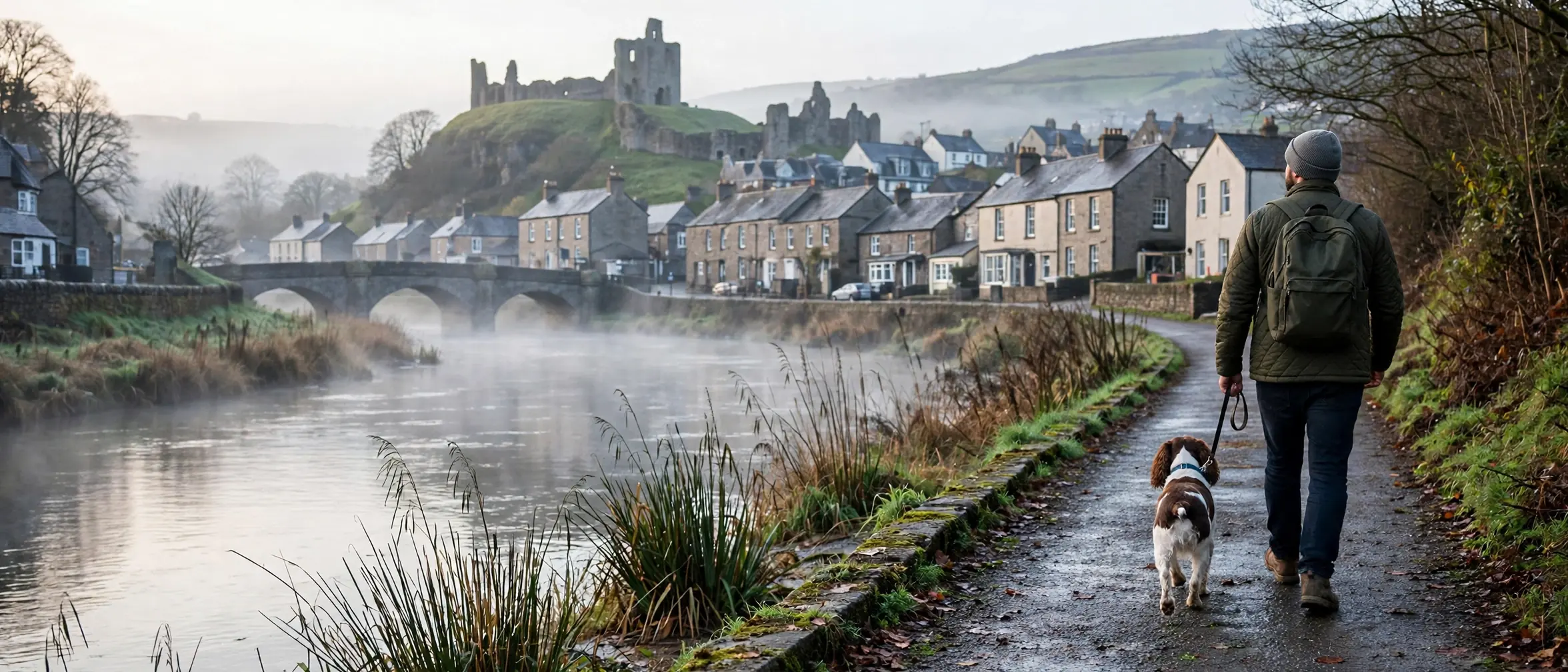
From the old town, walk down to the river. The quayside and the riverside paths along the Towy are the easiest and most forgiving dog walk in Carmarthen, and they are the part of the town that most visitors remember. The path is flat, the views are wide, and the dog can walk at a natural pace without the stop-start of shopfronts and crossings. On a clear morning the light on the water is beautiful, with the castle on the hill behind you and the river running out towards the estuary and the sea.
The riverside walk can be as short or as long as you like. A short loop from the town centre takes you along the quay, past the bridge and back through the streets — enough for a toilet walk and a breath of fresh air. A longer walk follows the river upstream or downstream, where the town thins out into fields, trees and open sky. The Wales Coast Path passes through Carmarthen, and the town is a natural stopping point on the longer route between the coast and the interior, so the riverside paths are well used and generally well maintained. Check the official guidance before you travel for the current state of any particular path, because riverside routes can be muddy after rain and sections can be closed for maintenance.
The river itself is worth watching with the dog. The Towy is famous for salmon and sea trout, and anglers work the river in season. Herons, egrets and wading birds are common on the mudflats at low tide, and the dog will almost certainly spot them before you do. Keep the dog on a lead here: the birds are protected, the mud is deep and sticky, and a dog that chases a heron into the tidal river is a dog in real trouble. A long line gives a calm dog more freedom on the open grassy stretches away from the water, but switch back to a short lead near the quay edge, the bridge and any road crossing.
Carmarthen Bridge, below the castle, marks what was historically the lowest bridging point of the Towy, about 11 miles from the sea. Crossing it on foot with a dog is straightforward — there is a pavement, and the traffic is slow — but hold the lead firmly, because the bridge is narrow and the view down to the water can excite a dog. On the far side, the walk continues into the quieter streets and lanes south of the river, which make a good return route if you want a circular walk rather than retracing your steps.
For dogs that need a proper run, the riverside is not the place. It is a walking route, not an exercise field, and the combination of water, birds, cyclists and other walkers means off-lead running is not appropriate. Save the running for the woods east of town, covered below, or for a beach day on the coast. What the riverside does offer is a calm, scenic, low-effort walk that suits almost every dog — puppies, older dogs, dogs recovering from injury, and dogs that simply prefer a gentle stroll to a hard run. It is also the best walk in Carmarthen in wet weather, because the surfaced path stays usable when the woodland tracks turn to mud.
Practical notes for the riverside: there is little shade on the open stretches, so carry water in summer; the path can be slippery with wet leaves in autumn; and the wind off the estuary can be cold even on a sunny day, so bring a coat for a short-coated dog. Bins for dog waste are provided along the main path, but carry spare bags anyway, because the bins at the far end of the walk are not always emptied as often as the ones near the town centre.
Castle hill: the high ground
The castle is the reason Carmarthen looks the way it does, and it is the one stop in town that no dog walk should skip. Carmarthen Castle (Castell Caerfyrddin) was first built in the early 1100s, probably by Walter, Sheriff of Gloucester, and rebuilt in stone during the 1190s. It was captured and destroyed several times in the centuries that followed, played a part in the wars between Welsh princes and English forces, was taken by Owain Glyndŵr in 1405, and later served as the county gaol from the late 18th century until 1922. The remains have been Grade I listed since 1954, and the site is now a free, open-access ruin in the middle of town.
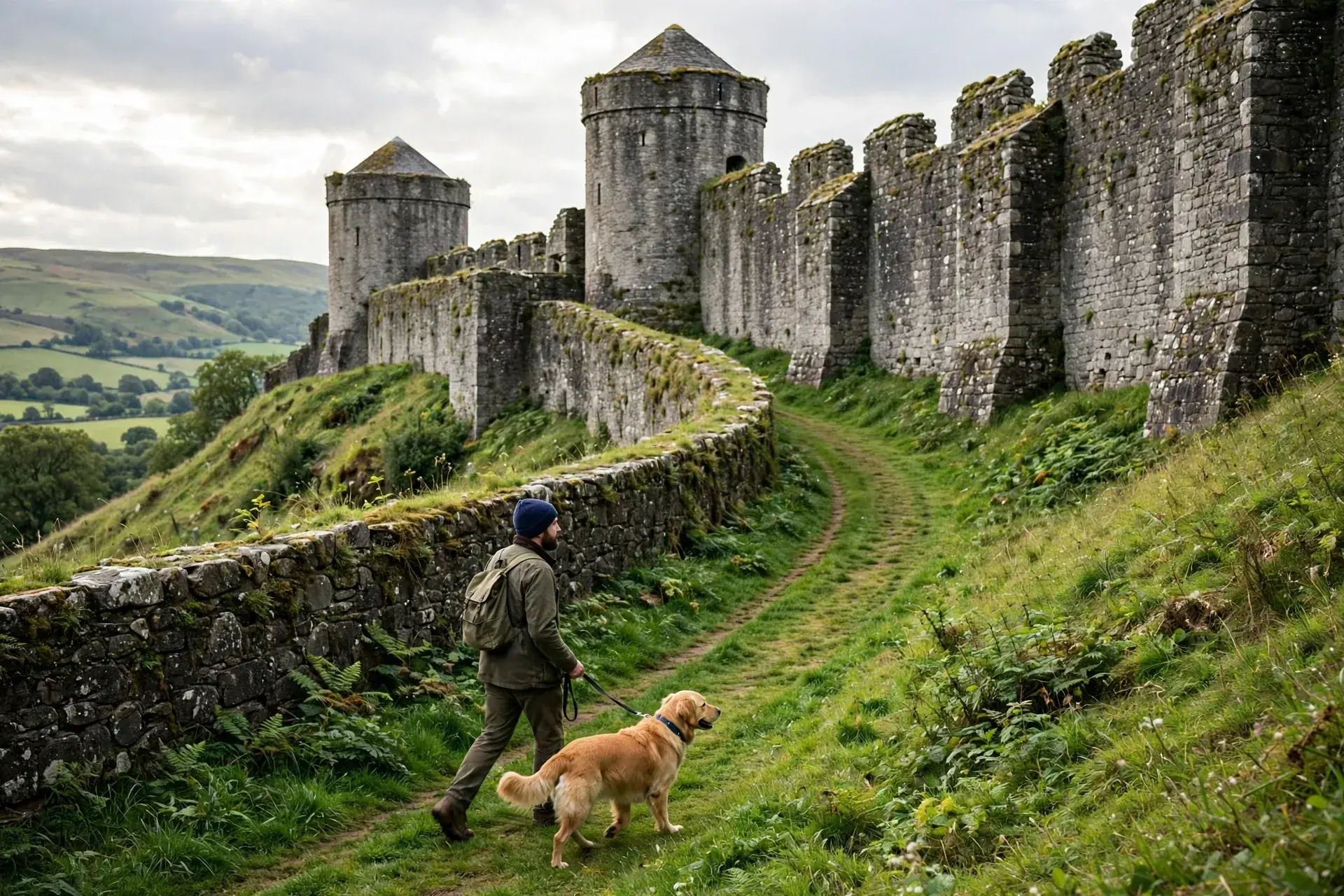
For a dog owner, the castle is a short, steep, rewarding climb. The entrance is through the surviving 13-metre-high gatehouse on Nott Square, or alternatively from the Old Castle Gaol entrance on Castle Hill. The ground inside is a mix of grass, stone and uneven surfaces, with a grassy area, benches and views over the town's rooftops and the river. Dogs on leads are welcome in the grounds, and the site is free to enter during daylight hours. The visitor centre, in the former gaol governor's office and Castle House, operates seasonally, so check the official guidance before you travel if you want to go inside or use the facilities there.
The view is the payoff. From the castle terrace you can see the whole shape of the town: the market streets below, the river curving away to the west, and the green hills of the Tywi Valley beyond. It is the best place in Carmarthen to understand the town's geography, and it is a good spot for a photograph with the dog — the stone walls and the rooftops make a better backdrop than any single street. Keep the dog on a short lead here. The castle stands on a high terrace above the river, there are drops and uneven edges, and the stone steps to the upper levels are steep and not suitable for every dog. Older dogs, small dogs and dogs with joint problems should stay on the flat grassy areas at ground level, where the walking is easy and the views are still excellent. For more on which Welsh castles welcome dogs and where leads are required, see our guide to dog-friendly castles in Wales.
The climb itself deserves respect. From the station or the riverside it is a steady uphill walk of ten to fifteen minutes, and the last stretch up Castle Hill is steep. A fit dog will take it in its stride, but a brachycephalic dog, an overweight dog or a dog that struggles in heat will find it hard on a warm day. Walk up slowly, stop in the shade, and carry water. The reward is that the walk back down is easy, and the dog will sleep well afterwards.
After the castle, the streets around Castle Hill and the old gaol are worth a slow wander. The area has a quieter, more residential feel than the shopping streets, and the stone walls, narrow lanes and glimpses of the river give it a character of its own. It is a good place to let the dog settle after the excitement of the climb, and a good route back down towards the riverside for the second half of the day.
The green edges: woods and parks
Carmarthen's green edges are where the town stops being a town and starts being countryside, and they are where most dogs will have their best time. The two places to know are Bishop's Park at Abergwili, just north of the town, and Green Castle Woods, east of the town on the far side of the river.
Bishop's Park is a quiet green space beside the River Tywi at Abergwili, a short drive or a longer walk north from the town centre. Dogs are welcome on leads, and there is plenty of space to stretch legs or enjoy a picnic under the trees. It pairs naturally with a ride on the Gwili Railway, which runs from Abergwili station nearby — the railway welcomes dogs on leads for a small fee, and the eight-mile round trip follows the River Gwili through farmland and wooded hillsides. Together, the park and the railway make a relaxed half day that suits dogs who enjoy new smells and gentle movement more than hard exercise. Check the official guidance before you travel for current railway times and dog fees, because the timetable is seasonal.
Green Castle Woods is the wilder option. The woods cover 50.5 hectares of three ancient woodlands, rich in wildlife and wildflowers, and the circular trail through them and along the River Towy is 3.1 kilometres long, taking an average of about 53 minutes. The route starts from the Green Castle Woods car park just off the B4312, follows paths through meadows that come alive with wildflowers in spring, and continues into beautiful woodland. Dogs are welcome and may be off-lead in some areas, though you should double-check the local rules before letting your dog off, and keep them on a lead where livestock may be present. The trail is generally considered moderately challenging, open year-round, and unlikely to be crowded — a proper countryside walk within a few minutes of the town centre.
For a dog, Green Castle Woods is the highlight of a Carmarthen visit: real woodland smells, uneven ground that works different muscles, and enough space to run without bothering anyone. For the owner, it is a reminder that Carmarthen is a market town in a farming county, not a suburb, and that the countryside starts at the edge of the streets. Wear proper walking shoes, because the paths can be muddy and slippery after rain, and carry a towel in the car for a muddy dog. In summer, check for ticks after a woodland walk, as you would anywhere in rural Wales, and in autumn watch for acorns and conkers, which are toxic to dogs if eaten in quantity.
Other green spaces in and around the town include the parks and playing fields that serve local residents, and the riverside meadows that open out as you walk away from the centre. These are useful for a quick toilet walk or a short game, but they are not destinations in themselves. The rule of thumb is simple: if you want a short, easy walk, stay on the riverside; if you want a proper walk, go to Green Castle Woods; if you want a gentle outing with a railway ride attached, go to Abergwili.
A half-day with your dog
If you have only half a day in Carmarthen, this is the route to take. It covers the old town, the castle and the riverside in one loop, takes about three to four hours at dog-walking pace including stops, and leaves the dog pleasantly tired rather than exhausted.
Start at Nott Square in the morning, when the square is quiet and the light is good. Walk the market streets downhill towards the river, giving the dog time to sniff the shopfronts and the market stalls. Allow about an hour for this stretch, including a pause for coffee at a cafe with outdoor seating. Then cross to the riverside and walk along the quay for half an hour, letting the dog settle into a steady walking rhythm after the stop-start of the streets.
From the riverside, walk back up through the town to the castle. Take the climb slowly, with a stop halfway for water. Spend half an hour in the castle grounds: walk the flat grassy areas, look at the view, and let the dog rest in the shade. Then walk back down to Nott Square and finish with a late lunch at a dog-friendly cafe or pub, or a picnic on the riverside if the weather is kind.
This loop works because it alternates effort and rest. The old town is mentally tiring for the dog, full of smells and people. The riverside is physically easy and calming. The castle climb is physically hard but short, and the castle grounds are a rest. The lunch at the end is the reward for both of you. If the dog is still full of energy at the end, add a short drive to Green Castle Woods for a woodland loop. If the dog is tired, head for the car or the station — the town has given you its best in half a day, and there is no need to push further.
A few variations are worth knowing. With a puppy, shorten the route: skip the castle climb and spend the saved time on the riverside, where the walking is flat and the puppy can rest often. With a reactive dog, reverse the route: start on the riverside when it is quiet, climb to the castle before the crowds arrive, and walk the old town last, when you can duck into a side street if you need space. With a dog that loves people, add time in the old town and subtract time on the riverside — the dog will get more from the market streets than from an empty path. The town is small enough that all of these variations are easy to improvise on the day, which is part of its charm.
Staying overnight
Carmarthen works well as an overnight base, and it works differently from a coastal resort. The town is a working county town, so it stays open and practical all year: shops, supermarkets, cafes and restaurants do not close for the winter, the railway station connects to Swansea and the west Wales coast, and there are vets in town if you need one. That makes it a good choice for a shoulder-season or winter break, when coastal towns can feel shut down, and for travellers who want a town base with countryside walks rather than a beach-only holiday.
When you book somewhere to stay, ask the questions that matter for a dog. Is there a secure garden or a safe place for a last toilet walk? Is the dog allowed in the bedroom, or only in certain rooms? Is there a charge per dog, and does it apply per night or per stay? Is there somewhere to dry a wet dog, and somewhere to wash muddy paws? Is the accommodation near a road, and is the road busy at night? Carmarthen's town-centre accommodation is convenient for the old town and the riverside, but it can be noisy on a Friday or Saturday night, and a noise-sensitive dog may sleep better in a quieter property on the edge of town. Accommodation on the outskirts, towards Abergwili or the villages east of town, is quieter and closer to the woods, but you will need a car or a taxi for the evening.
For an overnight stay, think about the evening routine. After a day of walking, most dogs want a short last walk, a familiar bed and a quiet room. The riverside is a good last walk in summer, when the evenings are long, but it can be dark and exposed in winter — in that case, a short loop around the town-centre streets is safer and easier. Feed the dog at the usual time, keep the bed in the same place as at home, and bring a familiar blanket or toy. A dog that sleeps well on the first night will walk well on the second day, and a dog that is unsettled by a strange room will be grumpy and reactive the next morning.
If you are staying for two nights, the second day is for the wider area. The National Botanic Garden of Wales, about a 20-minute drive away, welcomes dogs on Mondays, Fridays and the first full weekend of each month, with 568 acres of gardens, meadows and lakeside paths to explore on a lead. The Gwili Railway at Abergwili runs an eight-mile round trip that dogs can join for a small fee. And the coast is within easy reach: the sandy beaches of the Gower and Pembrokeshire are both drivable in under an hour, and our guides to Swansea with a dog and Tenby with a dog cover the beach rules, parking and walks in detail. If you would rather stay in the countryside than in town, our guide to dog-friendly holiday parks in Wales covers the booking checks that matter for a longer stay.
One more overnight consideration: Carmarthen is a market town, and market days bring early-morning noise — delivery vans, stallholders setting up, and shoppers arriving before the shops open. If your dog is a light sleeper or a barker, ask your accommodation how close it is to the market streets, and consider earplugs for yourself and a familiar bed in a quiet corner for the dog. It is a small detail, but it is the difference between a good night and a 6am wake-up call.
Day trips from Carmarthen
Carmarthen's greatest strength as a base is its position. It sits at the meeting point of the Tywi Valley, the west Wales coast and the roads into Pembrokeshire, so a surprising number of dog-friendly days out are within an hour's drive. Here are the ones that pair best with a Carmarthen stay.
The National Botanic Garden of Wales is the closest big day out, about 20 minutes from town near Llanarthney. It is 568 acres of gardens, meadows, lakes and woodland, and dogs are welcome on Mondays, Fridays and the first full weekend of each month. Dogs must stay on leads, and they are not allowed in the Great Glasshouse, Tropical House, Bird of Prey Centre or play areas, but the majority of the gardens are open to them, and the lakeside paths and meadows make a lovely long walk. The garden also has a cafe and shop where dogs are permitted, according to local listings. Plan around the dog days — turning up on a Tuesday with a dog and being turned away is a miserable start to the day — and check the official guidance before you travel, because dates and rules can change. Paxton's Tower, a hilltop folly above the Tywi Valley near the garden, is a good add-on: dogs are welcome in the open areas around the tower, and the views are panoramic.
The Gwili Railway at Abergwili is the gentlest day out of all. The preserved line runs an eight-mile round trip from Abergwili, just north of Carmarthen, following the River Gwili through farmland and wooded hillsides. Dogs on leads are welcome for a small fee, and the on-site museum and tea room make it a proper half day rather than just a train ride. It suits older dogs and dogs that enjoy watching the world go by, and it is a good wet-weather option, because the carriage is dry even when the countryside is not. Combine it with a walk in Bishop's Park, the quiet green space beside the River Tywi at Abergwili, and you have a relaxed day that asks very little of the dog.
Dinefwr Park and Castle, near Llandeilo, is about half an hour from Carmarthen and is one of the finest parkland walks in south Wales. Dogs on leads are welcome in the grounds, and there are plenty of trails to follow, including a pond walk and a woodland walk. Dogs are welcome on the ground floor of the house and in the cafe, but not in the ancient deer park or on the boardwalk, and not in Newton House except for assistance dogs. The parkland is open and beautiful, with wide views across the Tywi Valley, and it suits dogs that enjoy a long, steady walk with plenty of open ground.
For the coast, head south and west. Llansteffan, at the mouth of the Tywi estuary, has a castle, a beach and long views across the water to the Gower, and the walk from Carmarthen to Llansteffan along the Wales Coast Path is a full day for a fit dog and a fit owner. Tenby, about an hour away, is the classic Pembrokeshire seaside town, with beaches, a harbour and a walled old town — but check the seasonal beach rules carefully, because summer dog bans apply on the main beaches, as covered in our guide to Tenby with a dog. St Davids, the smallest city in Britain, is further west and makes a longer day, with a cathedral, a wild coast path and Whitesands Bay. For a shorter coastal trip, the beaches around Kidwelly and Pembrey Country Park are closer, with long sandy stretches where dogs can run properly.
When you plan a day trip, think about the dog's energy budget. A day at the Botanic Garden is a long, slow walk with lots of stopping; a day on the Gwili Railway is mostly sitting; a day on the coast is a hard run on sand. Do not stack two hard days together. Alternate a busy day with a quiet one in town, and the dog will stay happy all week. And always carry water, a bowl, a lead, a long line, spare bags and a towel in the car — the Carmarthenshire countryside is generous, but it is not always convenient.
Eating and drinking with your dog
Carmarthen is a market town, and market towns eat well. The town has cafes, pubs and restaurants across the centre, and many of them welcome dogs, at least outside. The pattern is familiar from other Welsh towns: dogs are commonly welcome on terraces and in pub gardens, sometimes welcome in the bar area of a pub, and rarely welcome in a formal restaurant dining room. Policies change from place to place and from season to season, so ask before you sit down, and do not assume that a dog-friendly terrace in summer means a dog-friendly interior in winter.
Bailey's Dog Cafe in Carmarthen town is worth knowing about, because it is a pet-first cafe — a place designed around dogs rather than a place that tolerates them. It is a good stop for a coffee and a rest, and a good place to meet other dog owners and pick up local tips. Beyond that, the cafes around the market and Nott Square are your best bet for a mid-walk stop: look for outdoor seating, a water bowl by the door, and a menu that does not mind a dog lying quietly under the table. If you are eating inside, choose a pub with a bar area rather than a restaurant with a dining room, and sit near the door so the dog can settle without being stepped over.
A few habits make eating out with a dog easier in Carmarthen. Bring a mat or blanket for the dog to lie on, so the dog has a defined place and is not sprawled across a walkway. Bring a chew or a stuffed Kong to keep a young dog occupied while you eat. Order food that arrives quickly, and keep the meal short — a dog that has already walked for two hours will settle happily for forty minutes, but a dog that is asked to lie still for two hours in a busy pub will get restless. And if the dog is having a bad day, take the food away instead. Carmarthen's market sells excellent picnic food, and a picnic on the riverside or in Bishop's Park is often a better lunch than a restaurant meal with a stressed dog.
For self-catering visitors, the market and the supermarkets in town make it easy to cook for yourselves, and a holiday cottage or a dog-friendly holiday park with a kitchen gives you more control over the dog's routine than a hotel room. If you are staying in town, ask your accommodation whether there is a fridge for the dog's food, and whether there is somewhere to store raw food safely. Small details like these are what separate a smooth stay from a fiddly one.
Practical details: parking, trains and seasons
Getting to Carmarthen is straightforward. The town is on the main line from Swansea to west Wales, and Carmarthen station is about a ten-minute walk from the castle and the town centre, mostly uphill on the way back. Trains run to Swansea, Cardiff and London in one direction and to Milford Haven, Fishguard and Pembroke Dock in the other, so the town works well as a car-free base if you are happy to use buses and taxis for the wider area. Dogs travel on trains in the UK without a ticket, and a well-behaved dog on a lead is welcome on most services, though you should keep the dog off the seats and out of the aisle during busy times.
If you drive, there are car parks in and around the town centre, including long-stay options for a full day out. Parking near the castle is limited, so do not plan to park at the top of Castle Hill — park in the town centre and walk up. On market days, the town-centre car parks fill early, so arrive before 10am or park on the edge of town and walk in. Check the official guidance before you travel for current parking charges and any changes to car park layouts, because charges and opening hours are reviewed regularly.
Seasons change the town more than you might expect. Spring is the best time for the woods, when the wildflowers are out and the paths are drying. Summer brings the longest days, the busiest market, and the warmest riverside walks — but also the heat on the castle climb and the summer dog bans on the coastal beaches, so plan beach days around the rules. Autumn is quiet and beautiful, with the woodland colours at their best and the town at its calmest, though the riverside path can be slippery with wet leaves. Winter is the town's quietest season, and the most practical: the shops and cafes stay open, the castle grounds are still free to enter, and the riverside walk is still pleasant on a dry day, though you will need a coat for the dog and a towel for the mud.
Vets, pet shops and supplies are all available in town, which is one of the advantages of a county-town base over a remote cottage. Save the number of a local vet before you need it, and know where the nearest out-of-hours service is, because rural practices can be a drive away in the evening. Carry a basic first-aid kit for the dog — tick remover, antiseptic wipes, a bandage, and any medication the dog takes — and check the dog's paws after woodland and riverside walks, where thorns, sharp stones and broken glass can cause cuts.
A final practical note: Carmarthen is a bilingual town, and you will see Welsh on signs, menus and place names everywhere. The Welsh name for the town is Caerfyrddin, and the river is the Afon Tywi. You do not need to speak Welsh to visit, and everyone you meet will speak English, but learning a word or two — bore da for good morning, diolch for thank you — is always appreciated. Dogs, of course, do not care about language, and a friendly greeting in either tongue will do.
Before you travel, a short checklist: check the official guidance before you travel for the castle visitor centre, the Botanic Garden dog days, the Gwili Railway timetable and any beach restrictions on your planned day trips; pack water, a bowl, a lead and a long line, spare bags, a towel, a coat for the dog, and a first-aid kit; save a local vet's number; and plan your route by district, so the dog gets a mix of streets, river, hill and woods rather than a single long march. Carmarthen rewards that kind of planning, because it is a town of districts, and each district has something different to offer a dog.
Practical questions
Before you go
Is Carmarthen Castle dog-friendly?
Yes, in the usual sense: dogs on leads are welcome in the castle grounds, which are free to enter during daylight hours. The site is a ruin on a steep spur above the river, so keep your dog on a lead, watch the drops and uneven ground, and check the official guidance before you travel for any change to access or to the seasonal visitor centre.
Where is the best dog walk in Carmarthen?
For most dogs, the riverside path along the River Towy is the best all-round walk: flat, scenic and easy to join from the town centre. For a longer, quieter walk, Green Castle Woods offers a 3.1-kilometre circular route through ancient woodland beside the river, about 53 minutes on average.
Can dogs go to the National Botanic Garden of Wales?
Yes, but only on dog days: every Monday and Friday, plus the first full weekend of each month. Dogs must stay on leads and are not allowed in the Great Glasshouse, Tropical House, Bird of Prey Centre or play areas. Check the official guidance before you travel, because dates and rules can change.
Are dogs allowed on the Gwili Railway?
Yes, dogs on leads are welcome on the Gwili Railway for a small fee, and the line runs an eight-mile round trip from Abergwili, just north of Carmarthen, following the River Gwili through farmland and wooded hillsides. Book ahead in busy periods and check the official guidance before you travel.
Is Carmarthen a good base for a dog-friendly holiday in Wales?
Yes. Carmarthen is a working county town rather than a resort, so it stays open and practical all year: a railway station, supermarkets, vets and places to stay, with the Pembrokeshire coast, the National Botanic Garden of Wales and the Gwili Railway all within easy reach. It suits travellers who want a town base with countryside walks rather than a beach-only break.