This guide is independent and contains no paid placement. If affiliate links are added later, they will be clearly marked and will not change our editorial checks.
The Dales Way is about 78 miles from Ilkley to Bowness-on-Windermere. With a dog, allow six to eight days, keep the dog on a lead through the sheep and cattle fields of Wharfedale, Dentdale and the Lune valley, use the bridges rather than the stepping stones when the Wharfe is high, and book dog-friendly rooms in Ilkley, Burnsall, Grassington, Kettlewell, Dent, Sedbergh and Bowness well ahead.
The route at a glance
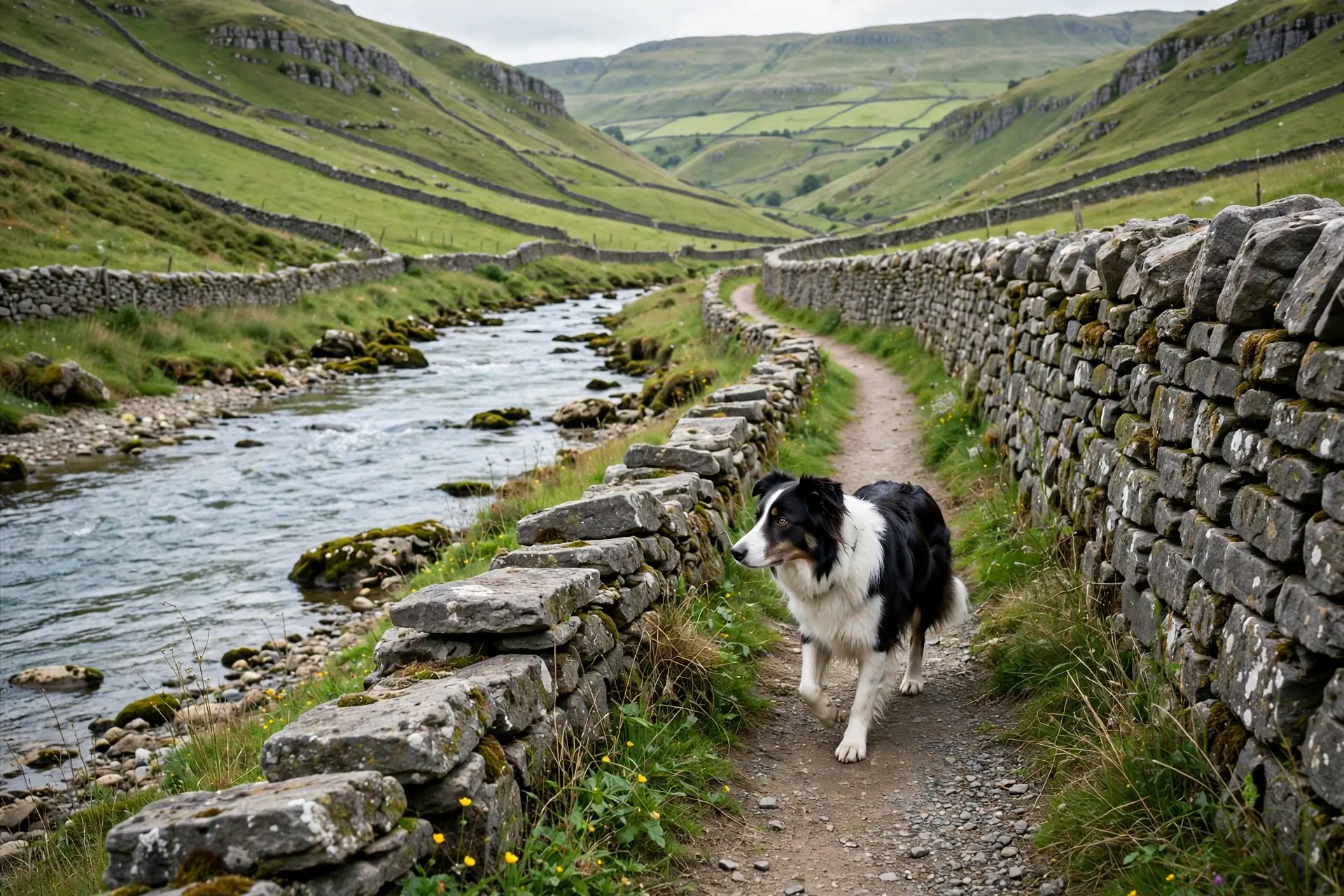
The Dales Way starts at the Old Bridge over the River Wharfe in Ilkley, West Yorkshire, and finishes at Bowness-on-Windermere in Cumbria, on the shore of England's largest lake. Between those two points it follows three river valleys in turn: the Wharfe through Wharfedale, the Dee through Dentdale, and the Lune from Sedbergh towards the Lake District. The total distance is about 78 miles, or roughly 126 kilometres, and the waymarking is the familiar Dales Way acorn-and-arrow disc, with the route also marked on Ordnance Survey maps as a long-distance path. For a dog, the character of the walk matters more than the mileage. This is a valley trail, not a ridge trail: long stretches run on riverside paths, field edges, farm tracks and quiet lanes, with only one sustained stretch of high, open ground, between Buckden and Dent, where the path climbs away from the Wharfe and crosses the watershed into Dentdale.
That valley character is what makes the Dales Way one of the more realistic long-distance walks to attempt with a dog, and also what sets its particular problems. The riverside sections are gentle on paws and legs, with grass, gravel and packed earth underfoot, but the same riverside meadows flood after heavy rain, the field paths turn to deep mud in winter, and the Wharfe itself can rise fast enough to cover the stepping stones at Bolton Abbey and Burnsall. The dry-stone walls that define Wharfedale are crossed by stiles of every design the Dales can offer: stone step stiles, ladder stiles, squeeze stiles and kissing gates, some of them awkward for a large dog and some of them a genuine squeeze for a barrel-chested one. Villages come at useful intervals — Bolton Abbey, Burnsall, Grassington, Kettlewell, Buckden, Hubberholme, Dent, Sedbergh, Burneside and Staveley — but the gaps between them are real, and on the high ground between Buckden and Dent there is no shop, no pub and no water tap for miles.
Most walkers split the route into six or seven walking days, and the plan in this guide uses seven, with a shorter first day out of Ilkley and a rest option at Grassington or Dent. A fit, experienced dog that already walks ten miles comfortably can manage the seven-day version; a dog that has never walked further than a daily park loop should not be asked to do it in six. The Dales Way Association publishes the route in stages and keeps notes on diversions, and its guidance is the place to check before you travel for the current state of the path, because stiles are replaced, fields are re-fenced and riverside sections are diverted after flooding. Carry the relevant Ordnance Survey maps or a downloaded offline map, because phone signal drops out in the upper Wharfe valley and in Dentdale, and the waymarks, while generally good, are not continuous through every field.
Before the first mile, it helps to know what kind of walk this is for a dog. There is almost no beach, no cliff edge and no long moorland crossing of the sort that defines the Coast to Coast or the Cleveland Way, and that is the point: the Dales Way trades drama for steadiness, trading a single hard day for a week of river walking, village pubs and dry-stone walls. The trade-off is livestock. Sheep graze nearly every field in Wharfedale and Dentdale, cattle — including cows with calves in spring and early summer — stand in the riverside meadows, and the path passes through farmyards where dogs, tractors and loose hens share the same yard. A dog that cannot walk calmly past sheep on a lead, or that cannot be lifted over a stile, will find this route harder than its gentle reputation suggests.
Ilkley to Burnsall, via Bolton Abbey
Day one runs from Ilkley to Burnsall, about 12 miles, and it is the busiest day of the whole walk — which is useful, because it teaches you and your dog the rhythm of the route while help is still close at hand. Leave Ilkley by the Old Bridge, cross the Wharfe, and follow the riverside path upstream past the stepping stones at Ilkley and the Dales Way's first meadows. The path here is wide, flat and well used by local dog walkers, so an excitable dog will meet other dogs within the first mile; keep the lead short through the riverside stretch and let the dog settle into the pace before the crowds thin out. Ilkley itself is worth a slow start: the town has dog-friendly cafes on The Grove, a riverside park where dogs can paddle at the edge of the Wharfe, and the moor above the town for a short warm-up walk if you arrive the day before, as described in the Ilkley with a dog guide. Fill water bottles here, because the first reliable shop after Ilkley is at Bolton Abbey village, and the riverside taps are not guaranteed.
From Ilkley the path follows the Wharfe upstream through Addingham and on to Bolton Abbey, passing the broad meadows where the river loops under the road bridge and the path alternates between riverside grass and farm tracks. The fields between Addingham and Bolton Abbey hold sheep for most of the year, and the stiles here are the first test of the trip: stone step stiles with a dog gate beside some, and narrow ladder stiles beside others. Lift a small dog over rather than letting it scramble, and check the landing on the far side before you send a big dog over, because the ground is often churned mud where cattle have stood. The village of Bolton Abbey, with its post office shop, tea rooms and the Devonshire Arms, is the natural lunch stop, roughly halfway to Burnsall, and dogs are welcome outside at most of the village spots and inside some of the pubs — ask at the door rather than assuming, and keep the dog on a lead on the terrace because the road through the village carries coaches and cars all day.
Beyond Bolton Abbey the route reaches its best-known landmark, the stepping stones across the Wharfe below the ruined priory. In low summer water the stones are a straightforward hop for a confident dog, but the stones are uneven, wet and widely spaced, and the river runs fast between them. A dog that slips will be swept downstream before you can reach it, so judge the crossing by the water, not by the photograph: if the stones are barely above the surface, if the river is brown after rain, or if your dog hesitates at the first stone, turn back to the aqueduct bridge a short way upstream and cross there. The priory ruins themselves are managed by the Bolton Abbey estate, and dogs on leads are welcome in the grounds, though not inside the priory church. The riverside path from the priory to Burnsall is one of the prettiest stretches of the whole route, running through riverside woods and open meadow where the Wharfe bends under limestone scars, but it is also narrow in places, with tree roots across the path and a steep bank down to the water — keep a reactive dog close here, because other walkers appear suddenly around the bends.
Burnsall is a small village green village, and the Dales Way arrives at it by the five-arched stone bridge over the Wharfe. The village has a pub, the Red Lion, with a riverside garden, a tea room in summer, and the wide village green where dogs can rest on the grass after the day's walk. The stepping stones at Burnsall, just downstream of the bridge, are a popular paddling spot, and in summer the river here is shallow enough for a dog to wade and cool off — but check the current first, and keep the dog out of the deeper channel on the far side. Burnsall is also the first overnight stop where booking ahead matters: the village has limited dog-friendly rooms, and walkers who arrive without a booking in summer often have to walk on to Grassington, another three miles up the Wharfe, which is a long end to a first day. The Burnsall with a dog guide covers the village's riverside walks, parking and pubs in more detail, and it is worth reading before you decide whether to stop here or push on.
Burnsall to Kettlewell, via Grassington
Day two runs from Burnsall to Kettlewell, about 11 miles, and it is the day the Dales Way starts to feel like a Dales walk rather than a riverside stroll. The path leaves Burnsall along the Wharfe, crosses the meadows below Thorpe, and climbs gently towards Grassington, the largest village on the upper Wharfe and the route's first proper resupply point. The riverside meadows between Burnsall and Grassington are grazed by cattle in summer, and the path crosses them on field-edge tracks that can be deep in mud after rain; the stiles here are mostly stone step stiles with a dog gap, but one or two have no gap at all, so be ready to lift. Grassington itself sits above the river, and the climb into the village from the Wharfe is short but steep on a cobbled lane — a good place to shorten the lead and let an older dog take it slowly. In Grassington there is a Co-op, a pharmacy, cafes, pubs and a good choice of dog-friendly bed and breakfasts, and it is the last place to buy dog food, blister supplies and a spare lead until Sedbergh, three days away, so stock up here even if your pack feels full.
From Grassington the Dales Way follows the Wharfe upstream through Linton, where the village green and the church sit above a bend in the river, and on through the limestone country towards Kettlewell. This stretch is the most photogenic part of Wharfedale for many walkers: dry-stone walls run in long lines across the valley floor, limestone pavements appear on the slopes above the river, and the path passes through the riverside meadows where curlews call in spring and the grass is thick with wildflowers in June. It is also, in spring, the most sensitive stretch for wildlife. Curlews, lapwings and oystercatchers nest on the ground in the riverside fields, and a dog running loose through the meadows can destroy a nest in seconds, so keep the dog on a lead through the nesting season even where the path looks empty. The river here is shallow and clear, with gravel banks where a dog can drink and paddle, but the banks are undercut in places — watch a dog that likes to jump in, because the far bank can be a vertical drop of a metre or more.
Kettlewell is a compact village of stone cottages gathered around a beck, with two pubs, a village shop and a youth hostel, and it makes a comfortable overnight stop after the Grassington climb. The village green is small, and the beck that runs through the village is a good place for a dog to cool its paws, but the water is fast after rain and the banks are stone-lined, so keep a small dog on a lead near the beck. Kettlewell is also the point where the Dales Way leaves the gentle riverside walking behind: tomorrow the path climbs out of Wharfedale altogether, and the village is the last chance to check the weather forecast, charge a phone and confirm the next night's booking in Dent, because the high ground ahead has patchy signal and no facilities. If your dog is already stiff after two days, Kettlewell is a sensible place to take a rest day — the village has short circular walks along the Wharfe and up the beck that let a tired dog move without adding miles, and the pubs welcome dogs inside by the fire.
Kettlewell to Dent, over the high ground
Day three, from Kettlewell to Dent, is the hardest day of the Dales Way with a dog, and the one to plan most carefully. The distance is about 13 miles, but the miles are not the difficulty — the climb is. The path leaves Kettlewell up the valley of the beck, climbs past Buckden and Hubberholme, and then rises steadily onto the open moor and fell between Wharfedale and Dentdale, crossing the watershed at a height where the wind, the rain and the lack of shelter are all real. On a fine day this is a magnificent walk, with views across the Dales and a sense of space that the riverside days do not offer; on a wet, windy day it is a long, exposed trudge with a dog that cannot be carried, and the decision to go or to wait should be made the evening before, in Kettlewell, with the forecast in hand. If the forecast is bad, take the lower alternative via the road through Buckden and Hubberholme and wait out the worst of it — the Dales Way will still be there tomorrow, and a dog that is cold and miserable on the fell is not a dog that will enjoy the rest of the week.
Buckden, about four miles from Kettlewell, is the last village before the high ground, with a pub, a small shop and a place to fill water bottles and check the weather. The village sits where the Wharfe is still a young river, narrow and fast, and the path crosses it on a packhorse bridge before climbing towards Hubberholme, a hamlet of a church, a pub and a handful of cottages at the head of the valley. Hubberholme is worth a stop even if you do not stay: the George Inn welcomes walkers and dogs, the churchyard is a quiet place to rest, and the river here is shallow enough for a dog to paddle. Beyond Hubberholme the path climbs out of the valley on a rough track, past the last farms and onto the open fell, where the waymarks become cairns and posts rather than stiles, and the ground underfoot changes from grass to peat, heather and bog. This is the stretch where a dog's paws take the most punishment: the peat is soft and wet, the heather is rough on a short-coated dog, and the boggy sections can be knee-deep in places after rain, so check paws at every stop and carry a towel to dry them.
The descent into Dentdale is long and steep, dropping from the fell down a rough track past the scattered farms of Cowgill and into the village of Dent itself. The track is loose stone and grass, with stone steps in places, and a dog that is tired from the climb will be tempted to run down it — keep the lead short, because the track crosses a road at the bottom and the farms along it keep dogs of their own. Dent is a village of cobbled streets and stone cottages, with a pub, a small shop, a tea room and a good choice of dog-friendly accommodation, and it is one of the most rewarding overnight stops on the whole route. The village sits in a deep, sheltered valley, and the evening walk along the River Dee, which runs through the village, is a gentle end to the hardest day. Dentdale is also the valley where the Dales Way changes rivers: the Dee is narrower and faster than the Wharfe, and its banks are steeper, so keep a dog on a lead near the water here, especially after rain when the river rises quickly and the stepping stones across it disappear.
Dent to Sedbergh
Day four runs from Dent to Sedbergh, about 10 miles, and after the high ground of the previous day it feels like a recovery walk — which is exactly what most dogs need by now. The path leaves Dent along the River Dee, following the valley floor through meadows and past the old railway line that once served the village, and the walking is gentle, with grass underfoot and dry-stone walls on either side. The Dee here is a small, fast river, and the path crosses it several times on footbridges and fords; the fords are shallow in summer and a dog can paddle across them, but after rain they run deep and fast, so use the footbridges when the water is brown or the current is strong. The fields along the Dee hold sheep and cattle, and the path passes through farmyards where the farmer's dogs may be loose — keep your dog on a lead through every yard, and do not let it chase the hens or the farm cats, however tempting they look.
The middle of the day brings the climb out of Dentdale towards Sedbergh, and it is the second sustained climb of the route. The path rises from the valley floor on a farm track, past the scattered farms above Dent, and onto the open fell where the views open out across the Howgill Fells and the Lune valley. The climb is steady rather than steep, but it is exposed, and on a hot day there is no shade and no water for a long stretch — carry more water than you think you need, and offer the dog a drink at every stop, because the next reliable water is the beck at the top of the climb. The descent into Sedbergh is on a rough track that drops through fields and past the town's outlying farms, and the first sight of Sedbergh's church tower is a welcome one after the open fell. Sedbergh is a small market town with a bookshop, a Co-op, cafes, pubs and a good choice of dog-friendly accommodation, and it is the first town since Grassington where you can properly resupply. The town's main street is narrow and busy with cars, so keep the dog on a short lead through the centre, and use the riverside path along the Rawthey for the evening walk instead.
Sedbergh is also the town where the Dales Way changes character for the last time. The Howgill Fells rise to the north, the Lune valley opens to the south, and the route from here onwards is a mix of riverside walking and low farmland, with the Lake District fells appearing on the horizon as the path approaches Bowness. If your dog is tired, Sedbergh is a good place for a rest day: the town has short circular walks along the Rawthey and the Lune, the cafes welcome dogs, and the bookshops are a pleasant way to spend a wet afternoon. The town's accommodation books up in summer, especially the dog-friendly rooms, so confirm your booking before you leave Dent, and ask about the dog's arrangements — some Sedbergh guesthouses welcome dogs in the bar but not in the bedrooms, and some charge a per-night fee that is worth knowing before you arrive.
Sedbergh to Bowness-on-Windermere
The final stretch of the Dales Way, from Sedbergh to Bowness-on-Windermere, is about 17 miles, and most walkers split it into two days, stopping overnight at Burneside or Staveley. The first of those days runs from Sedbergh to Burneside, about 10 miles, following the River Lune downstream through a broad, open valley. The Lune is a bigger river than the Dee, wide and slow in summer, and the path follows its banks on field-edge tracks and farm lanes, passing through the villages of Kirkby Lonsdale's outlying farms and the hamlet of Beck Foot. The walking is gentle, but the fields along the Lune are grazed by cattle, including large herds of dairy cows, and the path crosses several fields where the cattle stand on the path itself — give them a wide berth, keep the dog on a short lead, and if a cow with a calf blocks the path, wait for it to move or walk around the edge of the field rather than pushing through. The Lune valley is also the most exposed stretch of the route for wind, and on a wet day the rain drives across the open fields with nothing to stop it, so pack a waterproof coat for the dog if it is short-coated or thin-skinned.
Burneside is a village on the River Kent, with a pub and a small shop, and it makes a practical overnight stop before the final day. The village sits just north of Kendal, and the path from Burneside to Bowness runs through the Kent valley and then climbs over the low ridge towards Windermere, passing through Staveley, a village with a pub, a shop and a good bakery, and then on through the woods and fields above the lake. The final day is about 7 miles, and it is the most varied day of the whole walk: the path leaves the Kent valley, climbs through woodland where the ground is soft with leaf litter, and then drops down to the shore of Windermere at Bowness, where the lake stretches away to the north and the steamers leave from the pier. The woods above Windermere are home to red squirrels, and a dog that chases squirrels will need a firm lead here — the trees are close to the path, and a dog that bolts after a squirrel can be tangled in the undergrowth before you can stop it.
Bowness-on-Windermere is a busy tourist town, and the finish of the Dales Way is marked by the lake shore, where the path meets the water and the walk ends. The town has dog-friendly cafes, pubs and accommodation, and the lake shore is a good place for a dog to paddle after a week of walking — but the shore is busy with boats, ducks and other dogs, so keep the lead on until you find a quiet spot. The steamers that run on Windermere accept dogs, and a short cruise is a pleasant way to finish the walk, but check the current rules with the operator before you board, because the dog policy varies by boat and by season. From Bowness, the walk back to the start is by public transport: the bus or the short walk to Windermere station, and then the train to Oxenholme and on towards Leeds and Ilkley, as covered in the transport section below. The Dales Way ends at the water, and the best way to mark it is a quiet evening by the lake, with a tired dog asleep at your feet and the week's miles behind you.
Dogs, livestock and leads on the Dales Way
Livestock is the single most important dog issue on the Dales Way, and it is present on almost every day of the walk. The valleys of the Wharfe, the Dee and the Lune are working farmland, and the fields the path crosses are grazed by sheep, lambs, cattle and, in places, horses. The legal position is clear: a dog must be kept under close control in a field with livestock, and on a lead if the livestock is sheep or lambs, or if the dog is likely to chase. In practice, that means a short lead through every field with animals in it, and a lead on through farmyards, lambing fields and any field where you cannot see the far side. The Dales Way crosses fields where the sheep are out of sight behind a wall until you are in the middle of the field, so keep the lead on until you can see that the field is empty — and even then, keep it on if the grass is long enough to hide lambs.
Lambing season, roughly from March to May, is the most sensitive time on the route, and the most dangerous for a dog that chases. Ewes with young lambs are protective and unpredictable, and a dog that runs at a lamb can be kicked, trampled or chased by the ewe — and a farmer who finds a dog worrying sheep is legally entitled to shoot it. The fields between Burnsall and Grassington, and the riverside meadows along the Dee, are heavily used for lambing, and the path passes close to lambing sheds and pens where the ewes are at their most defensive. Walk quietly through these fields, keep the dog on a short lead and close to your leg, and do not stop to take photographs in the middle of a lambing field. If a ewe approaches the dog aggressively, pick the dog up if it is small enough, or walk steadily away without running — running triggers a chase response in both sheep and cattle, and a dog that runs will be followed.
Cattle need a different approach. The Dales Way crosses fields of dairy cows along the Lune and beef cattle in Wharfedale, and cows with calves are the most dangerous animals on the route. A cow that feels its calf is threatened will charge, and a dog on a long lead is a liability in that situation because the cow will chase the dog and the dog will run back to you, bringing the cow with it. If cattle block the path, give them a wide berth, walk around the edge of the field, and if a cow approaches, let the dog off the lead so it can run away from you and the cow — a dog that can run free is safer than a dog tied to you when a cow charges. This is the one situation on the Dales Way where letting go of the lead is the right call, and it is worth rehearsing the decision before you meet it: if the cattle are calm and distant, keep the lead on and walk steadily; if they are agitated, close, or moving towards you, let the dog go and walk calmly away yourself.
Stiles and gates are the other daily challenge. The Dales Way uses every kind of stile the Yorkshire Dales can offer, and many of them were built for people, not dogs. Stone step stiles, where the wall is crossed by a flight of stone steps, are usually manageable for a medium or large dog that can jump, but the steps are uneven and the landing is often muddy, so lift a small dog over and check the landing before you send a big dog across. Ladder stiles, where the wall is crossed by a wooden ladder, are harder: a dog cannot climb a ladder, so you will need to lift it over, and a large dog may need two people or a boost from below. Squeeze stiles, where the wall has a narrow gap, are the hardest of all for a broad-chested dog — measure your dog against the gap before you try, and if the dog does not fit, look for a gate nearby, because many squeeze stiles have a field gate a few metres away that the farmer uses. Kissing gates are the easiest, and the Dales Way has been improved with kissing gates on many stretches, but they are not universal, and the gates are often stiff, rusted or blocked by mud — carry a short lead so the dog does not slip through the gate while you are wrestling it open.
Ground-nesting birds are a seasonal concern on the high ground between Buckden and Dent, and in the riverside meadows between Burnsall and Grassington. Curlews, lapwings, oystercatchers and skylarks nest on the ground from March to July, and a dog running loose through the nesting areas can destroy a nest in seconds. The Dales Way crosses open moorland where the nests are invisible in the heather, and the birds will dive-bomb a dog that comes near — if you see a curlew or lapwing calling loudly and flying in circles above you, you are near a nest, so call the dog back, put it on a lead, and move steadily through the area without stopping. The same rule applies in the riverside meadows: if the grass is long and the birds are calling, keep the dog on the path and on a lead, and do not let it run through the meadow to the river.
River crossings, stepping stones and drinking water
The Dales Way follows rivers for most of its length, and the crossings are a recurring feature of the walk. The Wharfe is crossed on bridges at Ilkley, Addingham, Bolton Abbey, Burnsall, Grassington, Kettlewell and Buckden, and on stepping stones at Ilkley, Bolton Abbey and Burnsall. The stepping stones are the most photographed feature of the route, and also the most underestimated: the stones at Bolton Abbey are wide and flat in low water, but they are slippery with algae, uneven in height, and spaced widely enough that a small dog has to jump between them. A dog that slips will be carried downstream by a current that looks gentle from the bank but is strong between the stones, and the river below the stones is deep enough to swim in. The rule for stepping stones is simple: cross them only in low, clear water, only if your dog is confident and sure-footed, and only if you can see the whole crossing from the bank. If the water is high, brown, or covering the tops of the stones, use the bridge — at Bolton Abbey the aqueduct bridge is a short walk upstream, and at Burnsall the road bridge is a few metres from the stones.
The Dee and the Lune are crossed on footbridges and fords rather than stepping stones, and the fords need the same judgement. The fords on the Dee between Dent and Sedbergh are shallow in summer, with a gravel bed that a dog can walk across, but after rain they run deep and fast, and the bed is slippery with algae. If the water is above the dog's belly, or if the current is strong enough to push the dog sideways, use the footbridge instead — there is almost always a footbridge near a ford on the Dales Way, and the extra few minutes are worth it. The Lune is a bigger river, and its fords are fewer, but the path crosses it on bridges at Kirkby Lonsdale's outlying farms and at Burneside, where the river is wide and the current is strong. Never let a dog swim in the Lune or the Wharfe after heavy rain, and never let it drink from the river below a farm or a village without checking the water first — the rivers are generally clean, but they carry farm run-off, and a dog that drinks from a stagnant pool in a field is at risk of blue-green algae in summer. If you are unsure, carry water from the last village tap and offer it to the dog at every stop.
Drinking water for the dog is a planning issue on the high ground and in the Lune valley, where the gaps between villages are longest. The riverside days are easy: the Wharfe, the Dee and the Lune are all accessible from the path, and a dog can drink from them at most points — but the water should be running and clear, not still and green, and the dog should not drink from the river immediately below a farmyard or a sewage outfall. On the high ground between Buckden and Dent there is no reliable water for several miles, and the becks that cross the path are small and can run dry in summer, so carry at least a litre of water for the dog on that day, and offer it at every stop. In hot weather, carry more: a dog walking ten miles in the sun needs far more water than a dog walking the same distance in the cool, and the Dales Way has long stretches with no shade. A collapsible bowl weighs almost nothing and is worth carrying, because a dog that cannot drink from a bottle will dehydrate quickly on a hot day. If your dog will not drink from a bowl, teach it before the walk, or carry a water bottle with a built-in bowl.
Mud and wet feet are a daily reality on the Dales Way, especially in winter and after rain. The field paths in Wharfedale and Dentdale are churned by cattle, the riverside paths flood, and the peat on the high ground is wet for most of the year. A dog's paws will be wet and muddy at the end of every day, and the paws need checking at every stop: look for cuts from sharp stones, thorns from the hedgerows, and mud packed between the toes, which can cause soreness and limping. Carry a small towel to dry the paws at the end of the day, and a tube of paw balm for cracked pads — the limestone pavements above Grassington and the rough tracks on the fell are hard on pads, and a dog that has never walked on rough ground will need time to toughen up. If the dog starts limping, stop and check the paw immediately, and do not push on in the hope that it will improve — a sore paw on day two becomes a lame dog on day four, and a lame dog cannot finish the walk.
Where dogs sleep along the route
Dog-friendly accommodation on the Dales Way is concentrated in the villages, and the pattern is consistent: pubs with rooms, bed and breakfasts and cottages welcome dogs, but the number of dog-friendly rooms in each village is small, and they book out early in summer. Ilkley has the widest choice, from hotels to guesthouses, and most of them welcome dogs — but confirm the dog is accepted in the specific room, and ask about the charge, because some Ilkley hotels charge a per-night fee and some have a limit of one dog per room. Burnsall has a pub with rooms and a handful of cottages, and the pub is the natural overnight stop — book it well ahead, because the village has no other accommodation and walkers who arrive without a booking often have to walk on to Grassington. Grassington has the best choice on the upper Wharfe, with bed and breakfasts, a hotel and cottages, and most of them welcome dogs, but the dog-friendly rooms are the first to sell out on summer weekends, so book as soon as you know your dates.
Kettlewell has two pubs with rooms, a youth hostel and cottages, and the village is small enough that the pubs know the Dales Way walkers by sight — but the rooms are few, and the pubs fill up on Friday and Saturday nights in summer. Buckden has a pub with rooms and a small number of cottages, and Hubberholme has the George Inn, which welcomes walkers and dogs, but the inn has only a handful of rooms and they are booked months ahead in summer. Dent has a good choice of dog-friendly bed and breakfasts, a pub with rooms and cottages, and the village is one of the most welcoming overnight stops on the route — but even Dent books out in August, so confirm your booking before you leave Kettlewell. Sedbergh has hotels, guesthouses and cottages, and most of them welcome dogs, but the town's accommodation is used by walkers on several long-distance routes, so the dog-friendly rooms are in demand. Bowness-on-Windermere has the widest choice of all, from hotels to guesthouses, and most of them welcome dogs, but the town is busy and expensive in summer, and the dog-friendly rooms are often the cheapest and the first to sell.
Camping with a dog is possible on the Dales Way, but the campsites are fewer than the pubs and bed and breakfasts, and they are concentrated at Grassington, Kettlewell, Dent and Sedbergh. The campsites welcome dogs on leads, but the pitches are often in fields with sheep nearby, and the dog will need to be kept on a lead at all times on the site. Wild camping is not permitted on the Dales Way, and the high ground between Buckden and Dent is not a place to camp with a dog — the ground is wet, the wind is strong, and the nearest help is miles away. If you plan to camp, book the sites in advance, and check the dog rules: some sites charge a per-night fee for dogs, some limit the number of dogs per pitch, and some do not allow dogs in the shower block or the shop. A dog that barks at night will not be welcome on a campsite, so a camping trip is best suited to a dog that settles quickly and sleeps through the night.
When you book, ask the same questions every time: is the dog accepted in the specific room or pitch, what is the charge, how many dogs are allowed, can the dog be left briefly in the room while you eat, and is there a secure garden or field where the dog can be let off the lead in the evening. The answers vary widely, and the variation matters: some pubs welcome dogs in the bar but not in the bedrooms, some guesthouses welcome dogs in the bedrooms but not in the breakfast room, and some cottages charge a per-dog fee that can add up over a week. Get the answers in writing, keep the confirmation with your booking, and confirm the booking again a few days before you arrive — a dog-friendly room that has been given to another walker because the booking was not confirmed is a miserable discovery at the end of a long day. If you are walking in a group, book a cottage rather than separate rooms, because a cottage gives the dog a garden to run in and a kitchen to feed it in, and the per-night cost is often lower than two pub rooms.
Getting there, getting back, and baggage
Getting to the start of the Dales Way is straightforward: Ilkley has a railway station with trains from Leeds and Bradford, and the station is a short walk from the Old Bridge where the route starts. Dogs travel free on most trains in Britain, and a dog on a lead is welcome on the train to Ilkley — but the trains are busy on summer weekends, so travel early or late to avoid the crowds, and keep the dog on the floor rather than on the seat. If you are driving to Ilkley, the town has car parks, but long-stay parking for a week is expensive and the car parks are not secure, so most walkers arrive by train and leave the car at home. If you must drive, ask your first night's accommodation in Ilkley whether you can leave the car there for the week — some guesthouses will agree for a fee, and some will not, so ask before you book.
Getting back from Bowness-on-Windermere is a little more complicated, because the route ends at the lake and the nearest railway station is at Windermere, a short walk or bus ride from Bowness. From Windermere, trains run to Oxenholme, on the West Coast Main Line, and from Oxenholme you can travel south to Lancaster and Preston, or east towards Leeds and Ilkley — but the journey involves at least two changes, and the total time from Bowness to Ilkley is around four hours, so allow a full day for the return and book the trains in advance if you want a seat. Dogs travel free on the trains, but the trains from Oxenholme can be busy, and a dog on a lead in a crowded carriage is not comfortable — travel outside the peak hours if you can, and keep the dog on the floor by your feet. The buses from Bowness to Windermere and Kendal accept dogs at the driver's discretion, and the DalesBus services that run in summer connect the Dales villages with the towns — but the bus timetables change seasonally, and the services are infrequent, so check the official guidance before you travel and do not rely on a bus that runs only twice a day.
Baggage transfer is the service that makes the Dales Way manageable with a dog, because it means the dog carries nothing and you carry only a day pack with water, food and a waterproof. Several companies offer baggage transfer along the Dales Way, collecting your bag from your accommodation in the morning and delivering it to your next night's stop by the afternoon, and most of them also move walkers on some routes. Book the transfer when you book the accommodation, confirm the collection and delivery times, and label every bag clearly — a bag that is not collected because it was not labelled is a bag you will have to carry. The cost is usually charged per bag per day, and the total for a week is worth budgeting for, but the difference it makes to a dog's enjoyment of the walk is considerable: a dog that walks unladen is a dog that walks further and recovers faster, and a walker who is not carrying a heavy pack is a walker who can concentrate on the dog rather than on the weight on their back.
If you are walking the Dales Way in a group, consider leaving a car at Bowness and travelling to Ilkley by public transport at the start, so the car is waiting for you at the finish. The car parks at Bowness are expensive for a week, but the long-stay car park at Windermere is cheaper, and the bus from Windermere to Bowness runs regularly in summer. Alternatively, use a taxi from Bowness to Windermere station — the taxis accept dogs, but book in advance and confirm the dog is welcome, because some taxi drivers will not take a wet, muddy dog after a week of walking. Whatever you choose, plan the return journey before you start the walk, because the last thing you want after seven days of walking is to discover that the train you need does not run on a Sunday, or that the bus from Bowness has already left.
Pacing the walk for your dog
The Dales Way is 78 miles, and the pace you set will decide whether your dog finishes the walk happily or limps into Bowness on the last day. A fit, adult dog that already walks ten miles a day can manage the seven-day plan in this guide, but a dog that has never walked more than five miles in a day should not be asked to walk ten miles on the first day out of Ilkley — build up the distance gradually, with a shorter first day and a rest day at Grassington or Dent, and let the dog's condition decide the pace rather than the guidebook's stages. The Dales Way is not a race, and the villages are close enough together that you can shorten any day by stopping early: if the dog is tired at Burnsall, stop there rather than pushing on to Grassington; if the dog is stiff at Kettlewell, take a rest day and walk the short circular route along the Wharfe instead.
Older dogs need a different plan. A dog of ten years or more, or a dog with arthritis, hip problems or a heart condition, should not be asked to walk 78 miles in a week — but it can still enjoy the Dales Way in shorter sections, walking the riverside days from Ilkley to Grassington and then travelling home, or walking the gentler Lune valley from Sedbergh to Bowness. The high ground between Buckden and Dent is the hardest day for an older dog, with its long climb, rough ground and lack of shelter, and an older dog is better off skipping that day and travelling by road from Kettlewell to Dent, rejoining the route in the valley. Small dogs need a different consideration: a short-legged dog covers the same distance with many more steps, and the stiles and stone steps that a large dog jumps easily are a genuine obstacle for a small dog — lift it over every stile, carry it across the stepping stones, and be ready to carry it for a short stretch if it tires. A dog that is carried for part of the day is not a dog that has failed the walk; it is a dog that has been looked after.
Feeding and rest are as important as mileage. A dog walking ten miles a day needs more food than a dog at home, and the extra food should be added gradually, starting a few days before the walk, so the dog's stomach is used to it. Feed the dog in the evening, after the day's walking, rather than in the morning before you set out — a dog that has just eaten and then walks ten miles is at risk of bloat, especially a deep-chested breed. Carry the dog's normal food with you, because the shops along the route stock a limited range, and a change of food in the middle of a week of walking is a recipe for an upset stomach. Rest the dog at every stop: offer water, check paws, let the dog lie down in the shade, and do not rush on after five minutes. The Dales Way has plenty of places to rest — the village greens at Burnsall and Grassington, the riverside meadows along the Wharfe, the churchyard at Hubberholme — and a dog that rests properly at each stop will walk further and recover faster than a dog that is pushed from village to village without a break.
Weather is the final factor in pacing. The Dales Way is a valley walk, but the valleys funnel the wind and the rain, and a wet, windy day in Wharfedale is a hard day for a dog, especially a short-coated or thin-skinned one. In hot weather, walk early in the morning and rest in the middle of the day, when the sun is strongest and the riverside paths offer little shade — the Wharfe is a good place to cool a dog off, but the water is cold even in summer, and a dog that is overheated should be cooled gradually, not plunged into cold water. In cold weather, carry a coat for the dog, especially if it is short-coated, elderly or thin, and check for signs of cold at every stop: shivering, reluctance to walk, and a tucked tail are all signs that the dog needs to warm up. If the weather turns bad on the high ground, turn back or wait it out in the village — the Dales Way will still be there tomorrow, and a dog that is cold, wet and miserable is not a dog that will enjoy the rest of the week. Check the official guidance before you travel for the latest advice on walking the route in different seasons, and be ready to change your plan if the forecast changes.
Practical questions
Before you go
How long is the Dales Way, and how many days should I allow with a dog?
The Dales Way runs about 78 miles from Ilkley to Bowness-on-Windermere. Most walkers with a dog take six to eight days, walking roughly 10 to 14 miles a day, with a shorter first day out of Ilkley and a rest or short day around Grassington or Dent. Build in a spare day for bad weather on the high ground between Buckden and Dent, and check the official guidance before you travel if you are walking in lambing season.
Does my dog have to stay on a lead on the Dales Way?
On much of the route, yes. The Dales Way crosses working farmland along the Wharfe, Dee and Lune valleys, with sheep, lambs and cattle in most fields, and dogs must be kept on a lead near livestock by law. There are also ground-nesting birds on the open moor and fell between Buckden and Dent. Use a short lead through fields and villages, and only let your dog off where you can see clearly that there is no livestock and the landowner allows it.
Can my dog cross the stepping stones at Bolton Abbey and Burnsall?
Many dogs manage the Bolton Abbey stepping stones when the River Wharfe is low, but the stones are slippery and uneven, and after rain the river can rise quickly and cover them. The stepping stones at Burnsall are similar. If your dog is small, nervous or unsteady, or the water is high, use the bridges instead: the aqueduct bridge near Bolton Abbey and the road bridge at Burnsall. Never force a dog across fast water.
Where can I stay with a dog along the Dales Way?
Dog-friendly pubs with rooms, bed and breakfasts, cottages and campsites are found at Ilkley, Burnsall, Grassington, Kettlewell, Buckden, Dent, Sedbergh and Bowness-on-Windermere, with fewer choices at Hubberholme and Cowgill. Book every night in advance, confirm the dog is accepted in the specific room, and ask about charges, the number of dogs allowed and whether the dog can be left briefly in the room.
How do I get back from Bowness-on-Windermere to Ilkley with a dog?
Take the bus or train from Windermere station, a short walk from Bowness, to Oxenholme and then by train towards Leeds and Ilkley, or use a Dales Way baggage transfer company that also moves walkers on some routes. Check the official guidance before you travel for current timetables, as rural bus services change seasonally and dogs travel at the driver's discretion on most buses.
Is the Dales Way suitable for an older or small dog?
The Dales Way is gentler than most long-distance trails because it follows river valleys rather than ridge tops, but it is still 78 miles of stiles, stone steps, muddy field paths and rough tracks, with a long climb out of Dentdale towards Sedbergh. Older or small dogs do best on a shorter plan of eight or nine days with rest days at Grassington and Dent, and some walkers use baggage transfer so the dog carries nothing.