This guide is independent and contains no paid placement. Farm rules change between seasons, so always confirm entry, dog and picking rules with the farm itself before you travel.
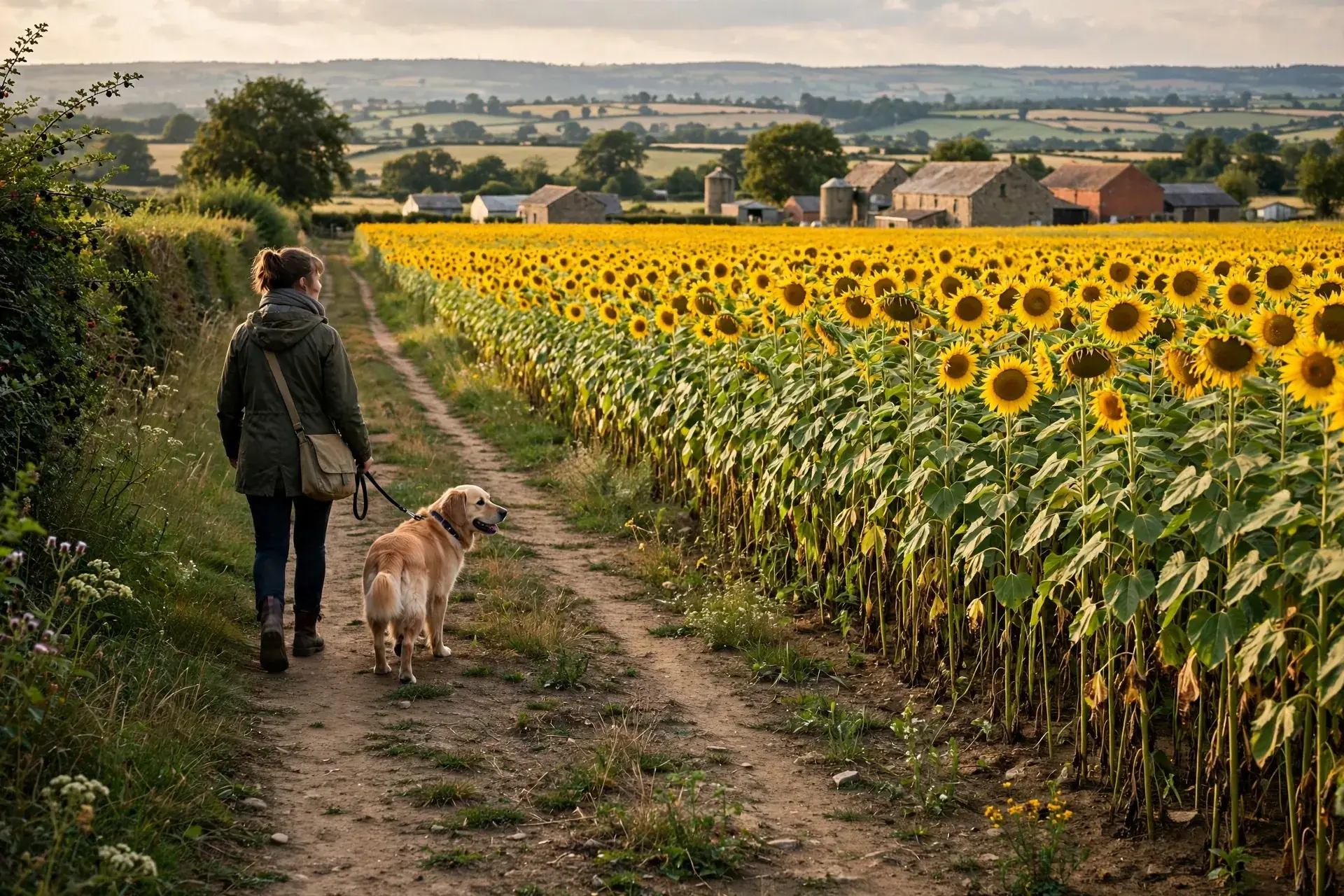
Choose a farm that explicitly welcomes dogs, book the ticket type that covers your dog if one is required, keep the dog on a lead on marked paths, carry water and shade in mind, and treat every stem as stock. The visit works best when the dog's comfort comes before the photograph.
Think farm first, photo second
A sunflower field in late summer looks like a backdrop, but for the farm it is a crop, a workplace and a short, intense trading season. The plants are usually grown for seed, oil or cut stems, and the weeks when they are tall, yellow and photogenic are also the weeks when the farm is busiest, most exposed to weather damage and most dependent on visitors behaving well. That single fact explains almost every rule you will meet at the gate: why dogs must stay on paths, why some areas are roped off, why picking is charged by the stem, and why staff may close a field early after heavy rain. When you plan from the farm's point of view, the visit becomes simpler, because you stop expecting park facilities and start looking for farm facilities: a car park field, a ticket kiosk, a farm shop, a toilet block, a water tap, and a clearly marked route.
The difference matters for dogs in particular. A woodland walk usually offers shade, a soft floor, varied smells and room to move off the path. A sunflower field offers the opposite: full sun, a narrow track, tall plants that block sight lines, and a strong smell of pollen, soil and, on warm days, bees. Dogs cannot see other dogs coming until they are close, children may run between rows, and a dog that pulls toward a stem can flatten several plants in seconds. None of that makes the visit unsuitable. It makes it a visit that needs a lead, a plan for heat, and a realistic sense of how long your dog will enjoy standing in the sun. For many dogs, forty minutes in a field, followed by shade, water and a quieter walk nearby, is a far better day than two hours of posing.
Start by reading the farm as a business. Look for its opening dates, last entry time, ticket conditions, dog policy in writing, and any statement about picking, parking and refunds in bad weather. If the farm sells tickets online, the booking page is usually more reliable than a social media post, because ticket terms are updated when conditions change. If the policy says dogs are welcome on leads in designated areas, take that wording literally: designated areas are the limit, not a hint. If it says no dogs, do not try to negotiate at the gate with a dog in the car on a hot day. That situation is avoidable, and it is unfair on staff, on other visitors and on the dog. A farm that says no may still have a farm shop, cafe or walking route nearby where dogs are welcome, and that can be a better plan than a refused entry.
Also consider what kind of sunflower visit you want. Some farms run a simple pick-your-own field with a mown path and a stall. Others run a full summer attraction with a maize maze, play areas, food stalls and timed entry. The first suits a calm dog and a short visit. The second can suit a sociable dog that copes with crowds, noise and food smells, but it can overwhelm a nervous dog. Ask yourself, before booking, whether your dog enjoys busy places or merely tolerates them. A dog that settles in a busy cafe may still struggle in a narrow field path where other dogs pass within a metre. Conversely, a dog that dislikes crowds may love a quiet weekday morning in a small pick-your-own field. The farm's scale, not just its dog policy, is part of the decision.
Finally, keep expectations honest about the landscape. Sunflowers in Britain are typically at their best for a limited window in late summer, and the exact dates move with sowing time, variety, rainfall and temperature. A field can look spectacular one weekend and be past its best, lodged by wind or harvested the next. Farms often post bloom updates, and it is worth checking them the day before you travel. If the update says the field is going over, or that rain has made paths difficult, believe it. Arriving with a flexible plan, and a nearby shaded walk as a backup, protects the day far better than insisting on a photograph in a field that is no longer in good condition.
Entry fees and picking rules
Entry fees for sunflower fields vary widely, and the variation is usually explained by what the farm provides. A small pick-your-own field may charge a modest entry fee, or no entry fee at all, and make its money from stems. A larger attraction may charge per person, with separate charges for parking, picking and activities. Some farms use timed tickets to control numbers on busy weekends, and some require advance booking while others accept walk-ups. The safest approach is to price the whole visit before you leave home: entry for every adult and child in your party, parking, any dog charge, and the number of stems you realistically want to take home. That total, not the headline entry price, is the cost to compare.
Ask four questions when you read the ticket page. First, does the dog need a ticket, or is the dog included free with a human ticket? Second, does the ticket cover one field or the whole site, and does it allow re-entry if you leave for shade or lunch? Third, what does picking cost, and how is it counted: per stem, per bunch, or by size? Fourth, what happens in bad weather: is the ticket transferable, refundable, or valid on another day? Keep the answers in the booking confirmation, because a screenshot of the policy on the day you booked is useful if staff on the gate describe a different rule. Farms are entitled to change conditions, but a written confirmation makes any discussion calmer and shorter.
Picking rules deserve the same attention, because they protect both the crop and your dog. In most pick-your-own sunflower fields, you pick only where staff direct you, you cut with the tools provided or approved, and you pay for every stem you cut, including stems cut by accident. Some farms restrict picking to certain rows so that the display rows stay intact for other visitors and for photographs. Others allow picking throughout the field but ask visitors to leave the largest display heads alone. Cutting a stem is not reversible, and a field that has been heavily picked early in the day looks very different by afternoon. Teach children the rule before you enter, and keep secateurs or scissors out of a dog's reach, in a closed bag or pocket, rather than loose in a hand while you hold a lead.
For dogs, the picking rule is simple: the dog does not pick, chew, pull or carry a sunflower. Stems are thick and fibrous, heads are heavy, and fallen petals and leaves on the path are not a free snack. If your dog grabs a fallen leaf, remove it calmly and move on. If your dog eats a larger amount of plant material, or shows vomiting, drooling, lethargy or diarrhoea afterwards, contact a vet promptly and check the official guidance before you travel about which plants and quantities are a concern. Do not assume that because a plant is sold for cutting it is safe for a dog to eat. The same caution applies to any farm shop flowers, seeds or dried heads you buy: keep them out of reach in the car and at home until you know they are stored safely.
Payment and queueing also affect the dog. Entry queues in full sun are hard on dogs, especially flat-faced breeds, older dogs and dogs with thick coats. If the farm offers advance tickets, use them. Arrive at the start of your timed slot rather than early, so you are not standing in a queue with a dog that is already warm. Keep the dog in shade while one person buys tickets if the kiosk is in the open, and avoid leaving a dog alone in a car in warm weather, even with a window open. Car interiors heat quickly, and a sunflower visit is never a reason to take that risk. If only one adult is travelling with a dog, choose a farm with online tickets and a short, shaded entry route, and plan the first stop to be water and shade rather than the far end of the field.
Finally, respect the farm's commercial boundaries. Do not pick stems outside the picking area to avoid a charge, do not break a stem to test its length, and do not move rope, signs or barriers for a better photograph. Staff notice this behaviour quickly, and it is one reason some farms tighten dog rules the following season. A good visit leaves the farm willing to welcome dogs again. That is a practical outcome, not just good manners: the more farms that have calm, well-managed dog visits, the more choices dog owners have next summer. For a broader sense of how working farms set visitor rules, our guide to dog-friendly farm parks explains lead rules, livestock distances and visitor etiquette in a similar setting.
Heat, shade and water in an open field
Heat is the main welfare issue in a sunflower field. There is little natural shade among tall annual plants, the ground can radiate heat, and the air between rows can feel still on a windless day. Dogs cool themselves mainly by panting, and panting becomes less effective when the air is hot, humid or still. Add excitement, pulling on the lead, and a dark coat, and a dog can overheat faster than its owner expects. The risk is higher for brachycephalic breeds such as bulldogs, pugs and French bulldogs, for older dogs, for overweight dogs, and for dogs with heart or breathing conditions. If your dog falls into any of those groups, choose a cool, cloudy day or an early slot, and keep the visit short. If in doubt, check the official guidance before you travel and ask your vet about safe heat limits for your dog.
Plan water as a system, not as a single bottle. Carry more water than you think you need, in a bottle for people and a separate supply for the dog, plus a collapsible bowl that the dog already knows how to use. Offer water little and often, rather than waiting until the dog is panting hard, and offer it in shade wherever possible. Some farms provide a tap, a dog bowl station or a farm shop where you can refill, but do not rely on that until you have confirmed it. A farm tap may be for washing hands or filling buckets, and it may not be in the field itself. If you cannot confirm a refill point, carry enough for the whole visit plus the journey home. Our guide to dog hydration on long walks explains water by weight, temperature and drinking rhythm in more detail, and the same principles apply on a short, hot field visit.
Shade needs to be planned in the same way. Look at the farm map before you go and identify where shade actually exists: a tree line at the field edge, a barn wall, a cafe canopy, a parked car in shade, or a hedgerow on the return path. Sunflowers themselves do not provide useful shade for a dog at ground level, because their leaves are high and the rows are narrow. A light-coloured cooling mat, a damp towel, or a pop-up shade can help during a rest, but none of these replaces moving out of the sun. Build rests into the visit: walk a short section, return to shade, offer water, let the dog settle, and only then continue. If the dog is seeking shade, lying flat, panting heavily, drooling, or slowing down, that is the end of the field part of the visit, not a cue to push on for one more photograph.
Timing is the simplest heat control you have. Early morning visits usually offer cooler air, softer light and fewer people. Late afternoon can also work, but check when the farm closes and whether the field is still in full sun at that hour, because west-facing fields stay hot late. Midday in a heatwave is the wrong time for most dogs in an open field, however good the light looks. The United Kingdom does not need extreme temperatures for a dog to overheat in a still, sunny field, and a forecast of warm, humid weather should change your plan even if the absolute temperature looks modest. If the forecast changes on the morning of the visit, be willing to postpone. A ticket that can be moved to another day is worth more than a fixed ticket on a dangerously hot day.
Sun protection is a second, smaller issue. Dogs with pale, thin or sparsely haired coats, pink noses, light ears and recently clipped areas can sunburn, particularly on the nose, ear tips and belly. Pet-specific sunscreen, shade and limiting time in direct sun are the usual controls, and human sunscreen should not be used unless a vet advises it. Our guide to dog sun protection covers which coats are at risk and how to choose a product safely. In a sunflower field, the practical point is simple: do not leave a pale-coated dog standing in full sun while you take photographs for twenty minutes. Rotate the dog into shade, keep sessions short, and check the nose and ears afterwards for redness.
Watch for heat illness and know what to do. Heavy panting that does not settle in shade, drooling, wobbliness, vomiting, glazed eyes or collapse are emergencies. Move the dog to shade, offer small amounts of cool water, wet the coat with cool, not icy, water, and contact a vet immediately. Do not cover the dog with a wet towel and leave it, because that can trap heat. Do not force large amounts of water, and do not drive a long distance to a vet without calling first if the dog is collapsing. Before any summer farm visit, save the number of a vet near the farm, not just your home vet, because a local practice can advise faster and may be open when your own practice is closed. That one saved number is the difference between a calm response and a panicked search in a field with poor signal.
Bees, crop protection and boundaries
Bees belong in a sunflower field. Sunflowers depend on pollinators, and a healthy field in bloom will attract honeybees, bumblebees and other insects, especially on warm, still mornings when flowers are fully open. For most dogs, bees are background noise. For a dog that chases, snaps or paws at insects, they are a real risk. A sting to the mouth, tongue or throat can cause swelling that affects breathing, and a sting inside the mouth is more serious than a sting on a paw. Dogs that have reacted badly to stings before need extra care: a shorter visit, a very short lead, and a clear plan for getting to a vet quickly. If your dog is known to chase bees, a sunflower field in peak bloom may not be the right outing, however attractive it looks.
Keep the lead short and the dog's head away from flower heads. Sunflower heads face outward at roughly dog-head height in some varieties, and a curious nose can meet a bee at close range. Walk in the centre of the marked path rather than brushing along the plants, and do not let the dog push its head into a head to sniff or bite it. If a bee lands on the dog, move calmly away rather than swatting at the insect near the dog's face, because sudden movements often trigger snapping. If the dog is stung, watch for swelling, pawing at the face, vomiting, weakness or difficulty breathing. A single sting on a leg that causes mild local swelling still deserves a call to a vet for advice, and multiple stings, mouth swelling or breathing difficulty need urgent veterinary care. Do not give human antihistamines unless a vet has advised the product and dose for your dog in advance.
Crop protection goes beyond bees. Sunflower fields are often treated with approved plant protection products during the growing season, and the timing, product and re-entry interval are matters for the farm, not for guesswork by visitors. You should not let a dog eat leaves, lick wet foliage, drink from field puddles, or roll in recently treated rows. If you see spraying equipment, warning signs, or staff working in protective clothing, stay on the marked visitor route and follow staff directions immediately. After rain, wash paws and lower legs before the dog licks them clean in the car, and check the official guidance before you travel if you are concerned about a specific product or exposure. The same rule applies to fertiliser granules, irrigation equipment and any chemical store: they are farm equipment, not part of the visitor attraction.
Boundaries are part of crop protection too. Ropes, fences, signs and mown paths are not decorations; they mark where visitors may walk and where the crop must be left alone. Stepping between rows compacts soil, snaps stems, creates a path that other visitors follow, and can damage irrigation lines or young plants at the field edge. It also puts a dog in a position where it cannot be seen by other visitors, staff or vehicles, and where it may encounter wildlife, ground-nesting birds or farm machinery. Stay on the path even if the photograph would be better two rows in. The best photographs in a sunflower field are usually taken from the path anyway, because the path gives a clear line, a sense of scale and a safe distance for the dog.
Livestock and neighbouring fields deserve the same respect. Sunflower fields are often part of a mixed farm, with sheep, cattle or horses in adjacent fields, or with a public footpath crossing nearby land. Keep the dog on a lead near livestock, even if the dog is normally reliable, because a sunflower field is a high-arousal environment and a sudden movement can trigger a chase. Do not let the dog bark at animals through a fence for entertainment, and do not feed livestock from the path. If a footpath crosses a field with livestock, follow the farm's directions and the countryside code for your area, and check the official guidance before you travel about dogs and livestock in that location. Our guide to dog lead law explains where leads are legally required and why farm land is treated differently from a public park.
Finally, think about what the dog leaves behind. Pick up after your dog promptly, using bags you carry yourself, and use the farm's bins or take bags home if bins are full or absent. Do not leave bags on a fence, in a ditch or at the field edge, and do not bury waste in the crop. Dog waste in a food or seed crop is a hygiene issue for the farm, and it is one of the fastest ways for a farm to decide that dogs are more trouble than they are worth. The same applies to water bowls left in the field, treat wrappers and any other litter. A clean visit is a repeatable visit.
Rain, mud and field paths
Sunflower fields are summer attractions, but British summer rain can change them in an afternoon. Field paths are often grass, mown earth or compacted soil rather than surfaced tracks, and after rain they become soft, slippery and deeply muddy, especially at the field entrance, at gates, and wherever visitors stop for photographs. Heavy foot traffic in the same narrow line makes the problem worse, because the path is churned into a channel that holds water. A dog that copes well with a dry path may struggle on the same path after a downpour, and a small dog may be wading rather than walking in the worst sections.
Before you travel, check the farm's weather and path updates, not just the general forecast. A farm that posts that paths are muddy, that wellies are advised, or that part of the field is closed is giving you useful information, not discouraging you. If the update says the field is waterlogged, believe it and postpone if you can. If you decide to go, dress for mud: waterproof footwear with grip, old trousers, and a change of shoes for the car. For the dog, consider a lightweight waterproof coat if the dog tolerates one, and a harness that is easy to clean, rather than a long, absorbent lead that drags in mud. Avoid extendable leads in a muddy field, because a dog that runs to the end of the line on slippery ground is hard to stop and may pull you off balance.
On the path, slow down and choose the firmest line that stays within the marked route. Do not cut across crop rows to find drier ground, and do not step onto the verge to overtake a group if that means trampling plants or slipping into a ditch. If the dog is struggling, shorten the visit rather than forcing the full route. A dog with mud caked between its toes may be uncomfortable even if it keeps walking, so stop in a firm area, clear the paws gently, and check for cuts, thorns or small stones. Long-coated dogs pick up mud quickly on the belly, legs and tail, and that mud will transfer to the car, the farm shop and anyone who strokes the dog afterwards. A quick towel at the field edge is not enough after a really muddy visit; plan for a proper clean at home or at a dog wash if one is available nearby.
Mud also changes the car journey. Pack a boot liner, old towels, a spare lead and a bag for muddy items, and put a towel on the seat if the dog travels inside the car. Do not let a muddy dog jump into a clean boot without protection, because the clean-up will take longer than the visit. At home, rinse paws with lukewarm water, check between the toes and under the tail, and dry the coat thoroughly, especially in long-coated or thick-coated breeds where damp fur can hide skin irritation. If the dog has a cut, a thorn or persistent lameness after a muddy walk, contact a vet rather than assuming it will settle. The same care applies to your own footwear: clean mud off boots before the next visit, because soil-borne material can travel between farms.
Wet weather also affects the plants and the photographs. Wet sunflower heads are heavier and may droop, petals stick together, and colours look duller in flat light. That is normal, and it does not mean the field is not worth visiting. A wet field can be quieter, greener and more atmospheric than a crowded sunny one, provided you are dressed for it and the dog is comfortable. The key is to match the visit to the conditions: a short, muddy visit with a clean-up plan is a good day out, while a long visit in unsuitable footwear, with a dog that hates mud and no towels in the car, is a miserable one. Pack for the field you will actually walk, not the field in the photograph.
Leads, other visitors and farm staff
Leads are not optional in most sunflower fields, even for dogs with excellent recall. The reasons are practical: narrow paths, close passing, children, food stalls, farm vehicles and a valuable crop all make off-lead running unsafe. A short, fixed lead gives you control when another dog appears around a tall row, when a child runs past with an ice cream, or when a tractor moves on a farm track. A long line can work in an open area, but in a sunflower field it tangles in stems, trips other visitors and gives a dog enough range to reach a flower head. Choose a lead length that keeps the dog beside you on a path, and keep a spare lead in the car in case one breaks or becomes too muddy to hold safely.
Passing other visitors well is a skill worth practising before a busy weekend. Step to the side of the path where the ground allows, shorten the lead, and keep the dog on the side away from the other party. Do not let the dog greet every other dog, because not every dog wants to greet, and a narrow path leaves no escape route for a nervous dog. If another dog is off lead and approaches yours, stay calm, keep your lead loose enough that your dog does not feel trapped, and move away steadily. If your dog is reactive, choose a quiet weekday, arrive early, and consider whether a sunflower field with narrow paths is the right choice at all. There is no shame in choosing a wider, quieter walk for a reactive dog; the sunflower visit can wait for a calmer day or a different farm layout.
Children, food and photographs create their own etiquette. Children may want to stroke a dog, offer it food, or run up to it suddenly. It is reasonable to say no politely, and to move your dog away if a child is becoming over-excited. Food stalls, picnics and dropped ice cream are strong distractions, and a dog that lunges for food can knock a child or spill hot drinks. Keep the dog close near food areas, do not let it beg from other visitors, and clean up any food your dog drops or steals. Photographers also need consideration: do not block the path for a long posed session, and do not ask another visitor to hold your dog while you step into the crop. If you want a photograph with the dog, take it from the path, keep the session short, and let others pass.
Farm staff are working, not just hosting. They may be driving vehicles, moving stock, repairing fences or managing queues, and they may need to close a path or move visitors quickly. Follow their directions without argument, even if it cuts your visit short. If staff ask you to keep a dog on a particular side, to leave a row, or to move away from machinery, that direction is for safety, not a judgement on your dog. Thank staff when they help, and report problems such as a broken fence, a sick-looking plant area, or a dog that is off lead and causing trouble, rather than trying to resolve it yourself. A calm report helps the farm manage the day for everyone.
Finally, remember that a sunflower field is a shared, temporary space. The farm has opened a working crop to the public for a few weeks, and that generosity depends on visitors behaving as guests. Dogs that are calm, clean, on lead and under control make it easy for farms to keep welcoming dogs. Dogs that bark continuously, chase bees, trample rows or foul paths make it harder. The standard is not perfection; it is consideration. If your dog is having a bad day, cut the visit short and return to the car. A short, calm visit is always better than a long, stressful one that ends with an incident.
Timing the bloom and the crowd
Sunflower bloom in Britain is not a fixed date. It depends on when the seed was sown, which variety was planted, how much rain fell, and how warm the summer has been. Some farms sow in stages so that different fields peak in different weeks, which extends the season and spreads visitors. Others have a single, spectacular peak that lasts only a week or two before heads begin to droop and petals fall. The farm's own bloom updates, usually posted on its website or social channels, are the best guide. Look for recent photographs dated within the last few days, rather than promotional photographs from a previous year, and check whether the update mentions full bloom, peak, going over, or harvested.
Weekdays are usually quieter than weekends, and early slots are usually quieter than midday slots. If you have a choice, a weekday morning gives a dog more space, cooler air and a calmer path. School holidays, bank holiday weekends and the first sunny weekend after a bloom announcement are the busiest times, and timed tickets may sell out. If you must visit at a busy time, accept that the visit will be shorter and more managed: queues at entry, a one-way route, limited stopping points, and less room for a nervous dog to pass others comfortably. Book the earliest slot you can manage, and plan a quieter walk afterwards so the dog's day is not only the crowded field.
Light matters for photographs, but it should not override welfare. Early morning and late afternoon light is softer and more flattering, and it is also cooler. Midday light is harsh, shadows are short, and heat is at its highest. If you are visiting mainly for photographs, a morning visit gives you both better light and a happier dog. If you are visiting mainly for picking, check which rows are open for picking that day, because picking rows may be different from display rows, and the best picking may be in the morning before the most popular stems are taken. Either way, set a time limit for the field itself. An hour in a field is a long time for many dogs; two hours in full sun is rarely kind.
Combine the sunflower visit with a nearby dog-friendly walk or cafe, rather than making the field the whole day. A shaded woodland edge, a riverside path, a farm shop with outdoor seating, or a quiet village green can turn a short field visit into a full, balanced day. Check that the second location also welcomes dogs, and that the journey between locations does not leave the dog in a hot car. For ideas about staying on a working farm rather than just visiting for a day, our guide to dog-friendly farm stays explains what to expect from cottages, barns and farm routines. A farm stay can make a sunflower visit easier, because you can visit early, return for shade and rest, and visit again later without a long drive.
Finally, have a backup plan for a closed or past-peak field. Farms close fields for weather, harvesting, or safety, sometimes at short notice. If you arrive and the field is closed, do not argue at the gate and do not enter a closed field from another direction. Use your backup walk, visit the farm shop if dogs are welcome there, or move to a nearby attraction. A backup plan is not pessimism; it is the practical way to enjoy a seasonal attraction whose dates and conditions change quickly. Check the official guidance before you travel about any local access restrictions that might affect your backup route, especially if it crosses farmland.
Photographs without trampling the crop
Good sunflower photographs with a dog do not require stepping into the crop. The strongest images usually come from the path, where the rows create leading lines, the dog is at a natural scale against tall plants, and the light falls across the field rather than behind the subject. Sit or crouch at the dog's level, keep the lead out of the frame by holding it low or asking another person to hold it just out of shot, and take a few frames quickly rather than posing for a long session. Dogs tire of posing, especially in heat, and a relaxed dog looks better in a photograph than a dog that is being held in place.
Use the field's structure. A path curving into the distance, a gap in the rows, a single tall stem at the edge, or a farm building in the background all give a photograph depth. Avoid placing the dog directly against a bright sky, because the camera will expose for the sky and darken the dog, and avoid shooting into full sun unless you want a silhouette. Early morning light from the side, or late afternoon light behind the photographer, usually flatters both dog and flowers. If you are using a phone, tap to focus on the dog's eyes, lock the exposure if your phone allows it, and take several frames so you can choose the one where the dog's ears and expression look natural.
Respect other photographers and visitors. Do not block a path for a long session, do not set up a tripod across the route, and do not ask other visitors to wait while you rearrange a dog that does not want to sit. If a spot is popular, take your photograph quickly and move on. If another visitor is taking a photograph, wait behind them or pass quietly rather than walking through their frame with a dog. Drones are a separate issue: many farms prohibit drones over crops, livestock and visitors, and national rules also restrict where drones can fly. Do not fly a drone over a sunflower field unless the farm has given explicit permission and you have checked the official guidance before you travel.
Think about the dog's comfort in every photograph. A dog that is panting, squinting, or trying to move into shade is telling you the session should end. Do not dress a dog in a costume, flower crown or accessory that it has not worn comfortably before, and do not place flowers on or near the dog's face for a photograph, because petals, pollen and insects can irritate eyes and noses. If you want a flower in the photograph, hold a picked stem yourself, at a safe distance from the dog, and keep the session short. The best souvenir is a photograph of a dog enjoying a day out, not a photograph of a dog enduring one.
What to pack for a field visit
Packing for a sunflower field is different from packing for a woodland walk, because shade, water and mud all need to be covered in a short visit. Start with the dog's basics: a short fixed lead, a well-fitting harness or collar with identification, poo bags, water and a bowl, and any medication the dog needs. Add towels, a drying coat if the dog uses one, and a boot liner for the car. If the forecast is warm, add a cooling mat or damp towel for rests, and pet sunscreen if your vet has recommended it for your dog. If the forecast is wet, add a waterproof coat for the dog if it tolerates one, and extra towels.
For people, pack sun protection, water, a hat and footwear with grip. Sunflower fields are open, and there may be no shade at the ticket queue, the picking area or the photograph spots. A small backpack is better than a handbag, because it leaves your hands free for the lead and for carrying stems. Bring a bag for picked stems that protects them in the car, and a separate bag for muddy items. If you are picking, bring the farm's approved cutting tool if required, or check whether tools are provided. Do not bring secateurs in a pocket where they can catch on a lead or injure a dog that jumps up.
Check the car before you leave. Make sure the dog has ventilation, water for the journey, and a shaded parking plan if you will leave the car while you buy tickets. Never leave a dog alone in a car in warm weather. If you are travelling with another adult, plan who stays with the dog while the other person queues, buys tickets or visits the shop. If you are travelling alone with a dog, choose a farm with online tickets and a simple entry, and keep the dog with you throughout. A little planning at home prevents a difficult choice at the gate.
Finally, pack a small first-aid kit for the dog: a clean cloth, saline for rinsing eyes or minor wounds, tweezers for thorns, and the vet's number saved in your phone. Add a torch if you are visiting late in the day, because field paths are not lit, and a phone charger if you rely on the phone for tickets, maps and vet numbers. None of this is excessive for a short visit; it is the kit that turns a minor problem, such as a thorn in a paw or a muddy coat, into a brief pause rather than a ruined day.
After the visit: paws, coat and car
After a sunflower visit, check the dog before you drive home. Look at the paws for mud, thorns, cuts or swelling between the toes, check the ears for seeds or insects, and brush loose petals and pollen from the coat. Offer water in shade, and let the dog settle for a few minutes before the car journey. If the dog was stung, watch for swelling over the next hour, even if it seemed fine at first. If the dog ate plant material, note how much and when, and watch for vomiting or diarrhoea on the way home. A calm check at the car park is easier than a check in a moving car.
At home, wash paws and lower legs if the field was muddy or dusty, dry the coat thoroughly, and check again for ticks, thorns and skin redness. Sunflower fields can harbour ticks in grassy margins, and a post-walk tick check is good practice after any rural visit in summer. Remove ticks promptly with a tick remover, and contact a vet if the tick head remains, if the area becomes inflamed, or if the dog becomes unwell in the following days. Wash any towels, coats and bowls used on the visit, and store picked sunflowers out of the dog's reach, because stems and heads can be chewed if left at dog height.
Review the visit honestly. Did the dog enjoy the field, or merely tolerate it? Was the path too narrow, the crowd too dense, or the heat too much? Would a different farm, a different time, or a shorter visit work better next time? Seasonal attractions are worth repeating only if the dog enjoyed them, and there are many other summer walks in Britain that may suit your dog better. Use the visit as information, not as an obligation to return every year. The best dog-friendly summer is built from outings the dog actually likes, not from a checklist of photogenic places.
Practical questions
Before you go
Are dogs allowed in sunflower fields in the UK?
It depends on the farm. Some sunflower fields welcome dogs on leads on marked paths, while others do not allow dogs at all, or allow them only on certain days. Always check the farm's own rules before you travel, because a field is a working crop, not a public park.
Do sunflower fields charge an entry fee for dogs?
Many do not charge a separate dog fee, but most charge an entry fee per person, and some charge for parking or for picked stems. Read the booking page carefully so you know whether the dog fee, if any, is included, and whether tickets must be booked in advance.
Can my dog pick or chew a sunflower?
No. Sunflowers are the farm's crop and income, and stems, heads and seeds are not dog toys. Keep your dog on the path, stop chewing promptly, and check the official guidance before you travel if your dog eats a large amount of plant material.
Are bees a problem for dogs in sunflower fields?
Bees are part of a working sunflower field, especially on warm, still days when flowers are open. Keep your dog on a short lead, avoid letting it snap at insects, and know where the nearest vet is in case of a sting, particularly if your dog has reacted badly before.
What should I do if the field is muddy after rain?
Slow down, stay on the firmest marked route, and expect a muddy dog at the end. Pack towels, a drying coat and a boot liner, check paw pads afterwards, and do not cut across unmarked crop rows to find a drier line, because that damages plants and soil.
When is the best time to visit a sunflower field with a dog?
Early morning or late afternoon is usually kindest: temperatures are lower, light is softer for photographs, and the field is often quieter. Bloom dates vary by farm and weather, so check the farm's opening dates and bloom updates before you set off.