This guide is independent and contains no paid placement. Store layouts and local decisions change, so check the specific store before you travel — if in doubt, the official latest guidance and staff on the day take priority.
No inside, yes outside. In most UK Starbucks stores pet dogs are not allowed inside — assistance dogs are — but many stores welcome dogs in outdoor seating, and a drive-thru or takeaway works everywhere. The Puppuccino is a US item, not a standard UK menu item, so do not plan a UK visit around it.
The 10-second door test
Most confusion about dogs in Starbucks happens in the ten seconds between spotting the green sign and reaching the counter. Someone ahead of you seems to have a spaniel by the sofas. A social media post shows a puppy in a city-centre branch. A friend swears their local store does not mind. All three can be true without changing the rule you should plan around, because what you are seeing is local discretion, an outdoor area photographed from an angle that hides the doorway, or a working assistance dog doing a job that is not obvious at a glance.
So start every visit with a door test instead of an assumption. First, look for signage on or beside the entrance: a dogs welcome notice, an assistance dogs only notice, or no notice at all each tells you something different. Second, look at the floor plan through the glass. If every seat is indoors, around food preparation and a narrow counter queue, treat the store as indoors-only for a pet dog. If there is a distinct terrace, a row of pavement tables or a bench area separated from the counter, that outside space is your realistic option. Third, if you have already arrived with the dog and nobody is free to ask, step back outside with the dog rather than drifting into the queue to ask. It is a small courtesy that staff remember, and it avoids the awkward moment of being asked to leave while holding a lead in a crowded line.
This guide works through each part of that test in detail: why the inside rule exists, how outdoor seating really works in practice, the workarounds that never require an argument at the counter, what to know about the Puppuccino before you ask for one, and how to check a single named store before a journey depends on it. None of it requires specialist knowledge. It requires planning for the stricter answer and enjoying the coffee more when a particular terrace turns out to be generous.
Inside: assistance dogs only in most stores
For pet dogs, the working rule in the UK is simple: do not expect to be allowed inside a Starbucks. Most stores welcome assistance dogs only indoors. That position is common across large food and drink chains, because the indoor space is a food preparation and serving environment, seating is close together, and staff have to manage allergies, hygiene, trip hazards in the queue and other customers who may be nervous around dogs. Whether or not you agree with the balance a chain strikes, the staff member on shift did not write the policy and cannot always bend it, even for a very small, very calm dog in a carrier.
Owners are sometimes confused by exceptions. A rural store with a large lobby, a licensed store inside another business, a store in a transport hub and a standalone high street branch can all feel different, and an individual team may have allowed a pet dog inside on a quiet afternoon. Treat any exception as exactly that — a favour on that day, in that store — rather than evidence of a chain-wide welcome. If you return to the same branch at a busy Saturday lunchtime with a different team on duty, you may get a different, perfectly polite answer. Building a regular routine on an exception is how people end up disappointed and, occasionally, arguing in a doorway with a wet dog and a cooling drink.
Size, breed and behaviour do not override the indoor rule for pets. A handbag-sized dog is still a pet dog, a dog in a buggy is still taking up indoor space, and a dog that has passed a training class is still not an assistance dog in law. The distinction that matters is function, not manners: an assistance dog is trained to perform tasks that mitigate its handler's disability. Our guide to assistance dog rights in the UK explains that distinction and what handlers can expect, and it is worth reading before you comment on a dog you see working indoors, because many assistance dogs do not look like the traditional image and their handlers do not owe strangers an explanation.
There is also a practical reason to accept the indoor rule gracefully. Coffee shops are full of dropped cake, spilled milk, hot drinks carried at dog height and toddlers moving unpredictably at exactly lead length. Even a friendly dog can be put in an unfair position indoors: crowded, warm, surrounded by food smells and unable to move away. A dog settled outside on a mat, with space and fresh air, is usually having the better experience, whatever the weather app promised. The goal of a coffee stop with a dog is a relaxed break for both of you, not a test of how much stimulation your dog can tolerate for the sake of a sofa seat.
The terrace is where pet dogs fit
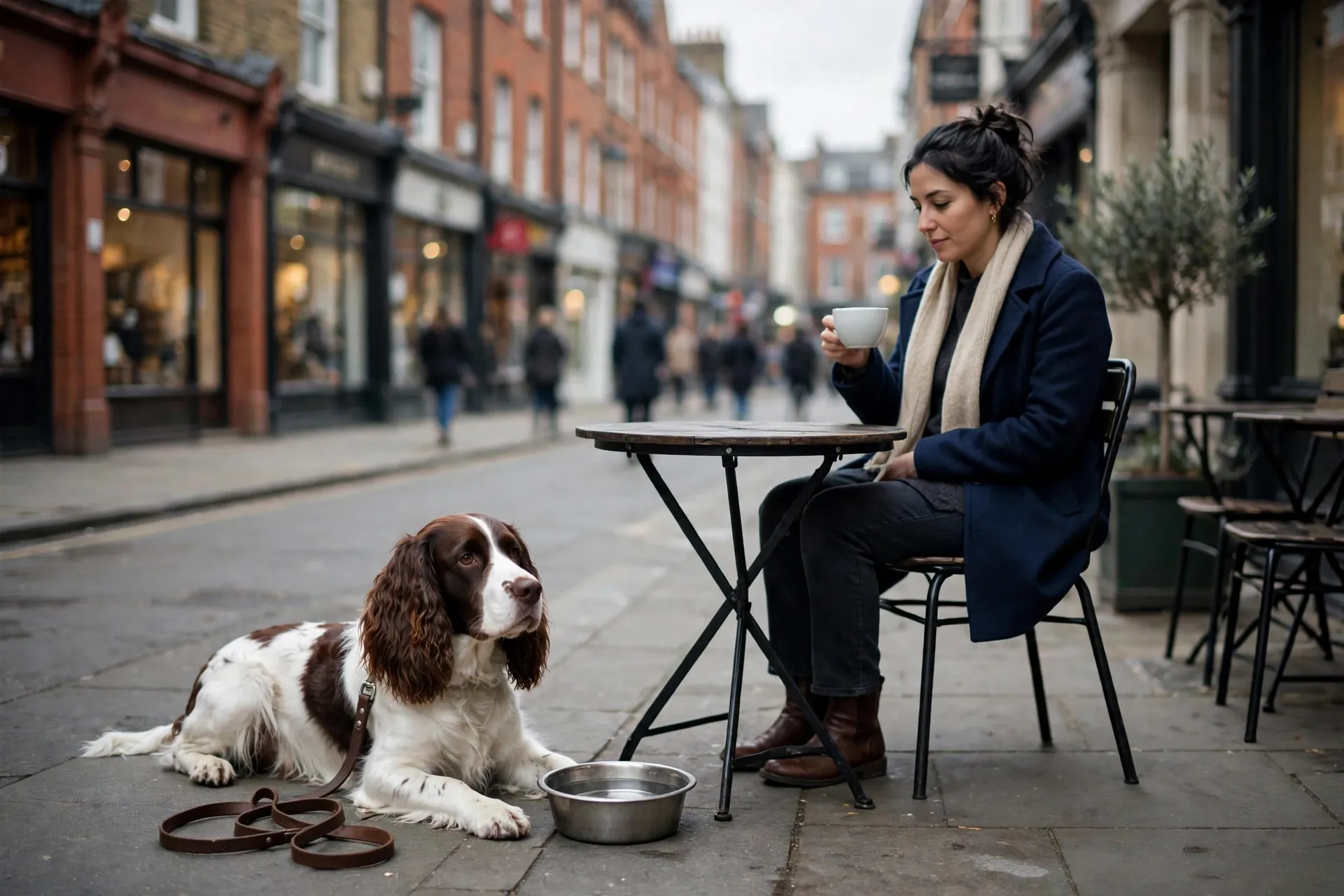
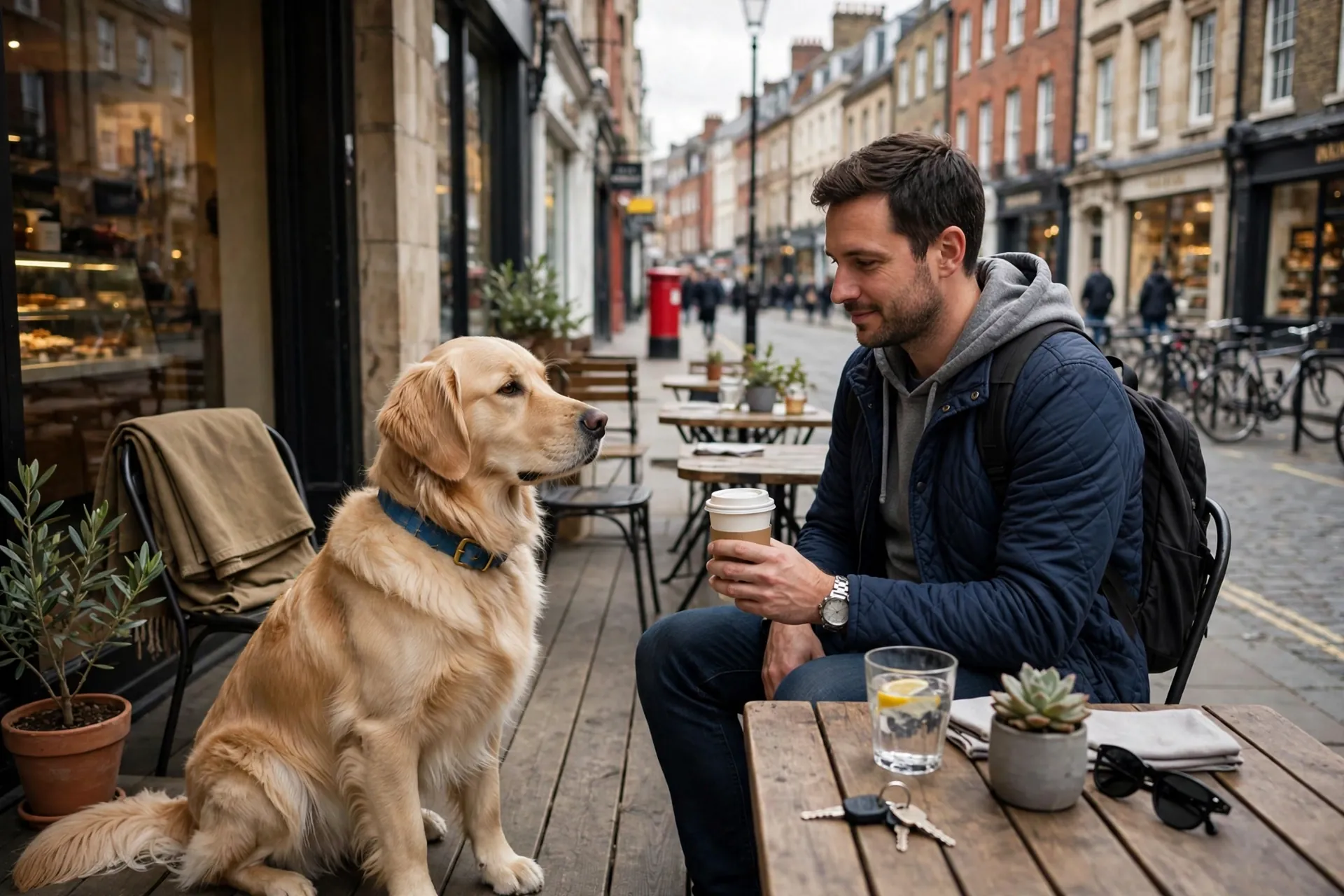
Outdoor seating is the part of Starbucks that genuinely works for dog owners, and it deserves more attention than the indoor debate usually gives it. Many UK stores have something outside: a proper terrace with several tables, two or three pavement tables in front of the window, benches at the side of the building, or a small yard at a drive-thru or retail park site. In those spaces, dogs are often welcome, provided they stay on a lead, settle under or beside the table, and leave a clear route for staff and other customers carrying drinks.
Not all outdoor space is equal, so assess it before you order rather than after you are holding two cups. Look for shade on a warm day and shelter on a wet one, because a terrace that is technically available but fully exposed is only usable for about ten minutes in British weather. Check the surface: smooth paving can be slippery for older dogs, gravel can be uncomfortable for sensitive paws, and artificial grass holds smells that will fascinate your dog far more than you want during a quiet break. Check the boundary, too. A railing with wide gaps beside a busy road is not a relaxing place for a dog that lunges at scooters, while a set-back terrace behind a hedge can suit even a fairly alert dog. Finally, note where the door swing and the collection point are. The best table is rarely the one nearest the entrance; a corner table with your dog tucked against a wall, out of the main walking line, will always be calmer.
Ordering from a terrace takes a small amount of choreography when you are alone. You cannot simply take the dog inside to order if the indoor rule applies, and tying a dog up outside unattended is risky: leads get tangled, dogs get stolen, well-meaning strangers feed things they should not, and a startled dog tied to a table can pull furniture over. Safer patterns include ordering on the app for collection where that store offers it and asking, from the doorway and without bringing the dog in, whether a member of staff can help; visiting with another adult so one person orders while the other stays with the dog; or choosing the drive-thru format described below. If none of those works at that store, the honest answer is that this particular branch, on your own, with a dog, is a takeaway-with-a-bench-elsewhere stop rather than a sit-down one. That is still a perfectly good coffee — it just happens fifty metres away in a square, a churchyard or a park you actually chose.
Terrace availability also shifts with the seasons and the hour. Outside furniture is sometimes stacked in winter, removed in high winds, or reserved in effect by smokers and large groups at peak times. A store that welcomed your dog to an empty terrace at half past eight on a Tuesday may have no workable outside table at lunchtime on a Saturday. Build the habit of scanning the outside space first, choosing a table before you pay, and keeping the visit short if conditions deteriorate. Dogs read routine quickly: arrive, settle on the mat, water, wait, short walk afterwards. Keep that pattern and most dogs learn that a coffee terrace means lying down and watching the world, which is exactly the behaviour that keeps terraces open to the next dog owner.
Drive-thru, mobile order and other workarounds
The drive-thru is the most underrated dog-friendly coffee format in Britain. Your dog stays in the car, safely restrained as the law and common sense require on any journey, and never enters the store at all. Nobody has to rule on whether the dog may come in, nobody is allergic to your back seat, and you can park in the site car park afterwards to drink in peace with the windows cracked and the dog settled. For owners travelling between walks, motorway and retail park drive-thrus solve the coffee problem completely, which is why so many dog people quietly plan long drives around them.
A few drive-thru habits make the experience smoother. Keep the dog away from the collection window side if you can, or at least keep a hand on the lead or harness so an enthusiastic head does not meet a barista holding a very hot drink. Wind the window up most of the way while you pay and collect, open it only as far as you need, and never let a dog ride loose where it can climb into the front as you are handed change and cups. Once you have your order, park properly before you drink. Managing a lid, a straw, a treat bag and a dog that has just spotted a seagull through the windscreen is not a driving task. If you want background on travelling well by car more generally, including restraints and break planning, pair this guide with our wider café advice in dog friendly cafes in the UK, which covers how to judge any café, independent or chain, before you commit to a table.
Mobile ordering, where available at your store, is the second useful workaround, but use it thoughtfully. Ordering ahead shortens the collection moment: you still cannot bring a pet dog inside to collect in most stores, so the pattern only works if the dog is with a companion outside, in the car, or if staff agree to hand your drink to you at the door. Do not leave a dog tied up while you dash in on the assumption that thirty seconds is safe; it rarely is the thirty seconds you planned, queues happen, and the risk is not worth a latte. If you are alone and the store has no drive-thru, a companion-free visit may simply mean ordering a takeaway at a different, independent café that genuinely welcomes dogs indoors, and saving Starbucks for terrace and drive-thru days. Knowing which chain suits which kind of stop is the real skill, and our comparison in dogs in Costa Coffee UK is a useful companion read, because the answer differs between chains and between branches in ways that catch people out.
There is one more workaround that owners forget: the picnic upgrade. A takeaway coffee, collected by a companion or from a drive-thru, plus a bench in a good spot with a chew for the dog, beats a cramped terrace in the rain every time. British towns are full of better dog seating than any coffee chain provides — harbour walls, station forecourts with cover, market squares, canal towpaths and park cafés with competition nearby. Treat Starbucks as a reliable source of a known drink, not as the destination itself, and the indoor rule stops mattering very much at all.
The Puppuccino question, answered honestly
Search for dogs and Starbucks anywhere online and one word dominates: Puppuccino. It is a small cup of whipped cream served for dogs, famous from social media and genuinely offered by Starbucks in the United States, where it has become part of the drive-thru ritual for many American dog owners. Videos cross the Atlantic far faster than menus do, and British owners understandably walk up to a UK counter expecting the same item to exist here.
It is important to be precise about this: the Puppuccino is not a standard item on the Starbucks menu in the UK, and you should not plan a visit, promise a child, or build a dog's routine around being able to order one in Britain. A kind member of staff in a quiet store might improvise something, and individual experiences will always circulate online, but improvisation is not availability. If it is not on the menu board and not in the app for that UK store, treat it as not offered, accept the answer without pressing staff, and do not frame a refusal as poor service. Policies on serving off-menu items, food hygiene and what can be handed to animals differ between markets, and the person at the till is not the right target for a debate about American social media.
There is a health angle worth knowing even where whipped cream cups are available. Whipped cream is high in fat and sugar, contains dairy that many dogs digest poorly, and is a poor choice for dogs that are overweight, prone to pancreatitis, diabetic, or on a controlled diet — which, between them, covers a large share of pet dogs. A small taste will not harm most healthy dogs, but a regular cup-sized habit is not the treat the videos make it look like, and a dog that learns to expect a rich reward at every coffee stop becomes harder to settle in exactly the places where calm behaviour matters. If you want your dog to have a ritual at a coffee stop, make it a ritual that travels: a few pieces of their normal kibble in a snuffle pattern on the mat, a long-lasting chew reserved for café stops, a lick mat with a thin smear of something your vet is happy with, or simply fresh water and a good sniffing walk afterwards. Those work in every country, at every chain, without a menu negotiation.
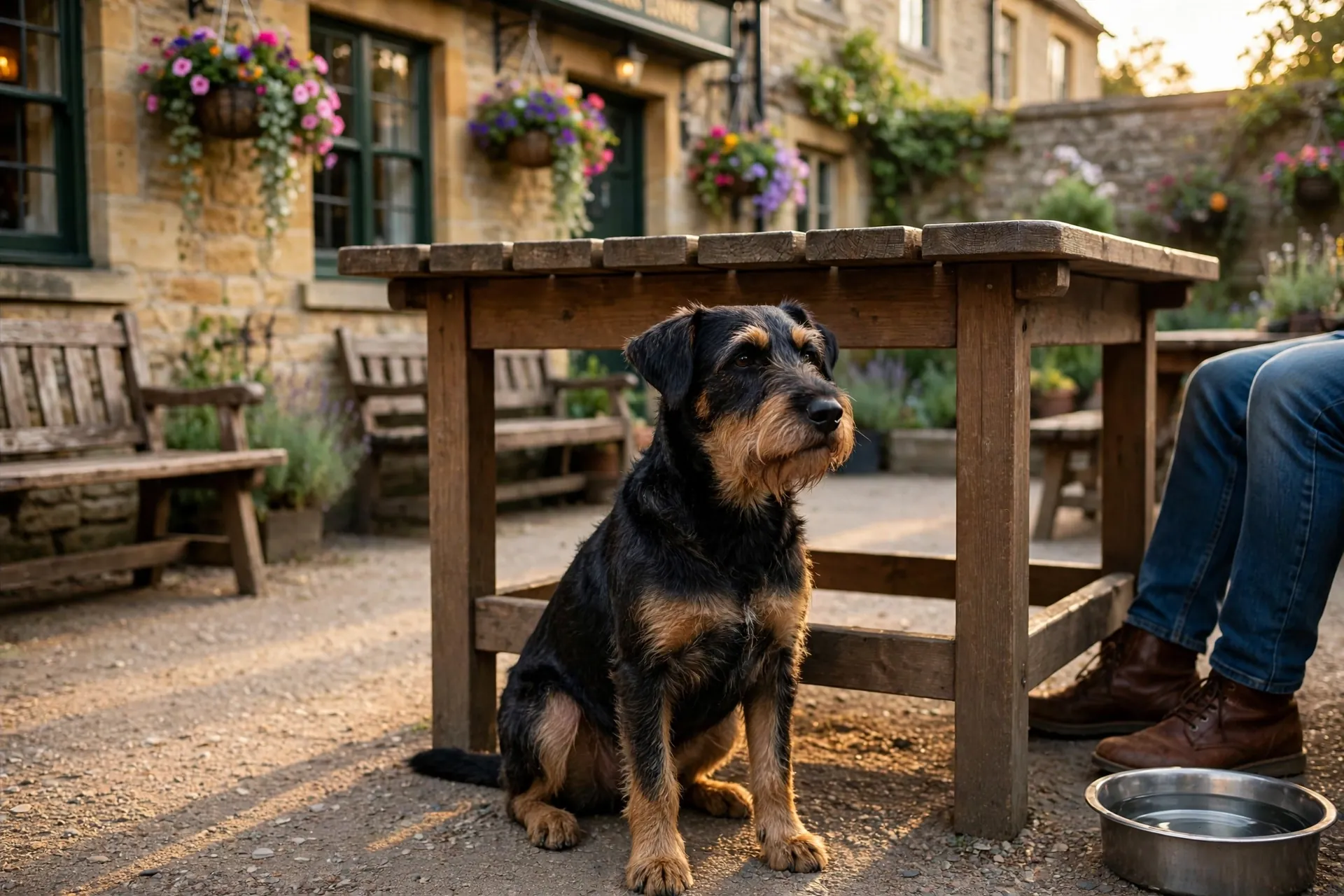
Water is the thing to ask for in the UK. Many stores will happily provide a bowl or a cup of water for a dog on the terrace, and asking for water marks you out as the kind of owner staff are glad to see. Carry a collapsible bowl anyway, because peak times are busy, bowls run out, and a dog that drinks from its own familiar bowl settles faster. On warm days, offer water before you order, keep the dog in shade, and remember that a coffee stop in a heatwave should be short even if the humans are enjoying the air conditioning inside — your dog is outside, in a coat, at pavement temperature. The most dog-friendly sentence at any counter in Britain is not a secret menu name. It is: could we have some water for the dog, please?
How to check one specific store
General rules only get you so far. What you usually need is a yes or a workable no for one named store, on one named day, before a walk or a long drive is planned around it. That check takes about five minutes if you ask the right questions in the right order, and it is worth doing for any store you intend to rely on regularly — your nearest branch, the one near a favourite walk, or the one beside a relative's house where the dog will be a weekly visitor.
Start with the map and the photographs. Look up the exact store and study recent pictures of the outside, not the interior shots the chain supplies. You are looking for a terrace, pavement tables, benches, a side yard or a drive-thru lane, and for clues about the road, the boundary and the shade. A store described as being in a shopping centre, a station concourse or an office block is very likely indoors-only in practice, whatever the chain rule says, because there is no outside space of its own. A retail park, high street or standalone site is far more promising. Satellite view helps too: it shows car parks, green space nearby for a pre-coffee toilet walk, and whether the terrace you spotted in a photograph is actually a smoking corner beside the bins.
Then phone the store, and phone it well. Call outside the morning rush, introduce the question precisely, and ask about the terrace rather than the store in general. Are dogs welcome at the outside tables is a different question from are dogs allowed, and it gets you a different, more useful answer. Ask where the dog should settle, whether you should order at the counter while a companion waits outside, whether the store offers drive-thru or app collection, and whether there are times when outside seating is not available. Write down the answer and the day you asked. If the answer was generous, do not treat it as a lifetime guarantee — teams and layouts change — but do treat it as a good basis for a first visit at a quiet time, which is how regular arrangements with local stores are actually built.
Finally, do a low-stakes first visit. Go at a quiet hour, walk past with the dog before you commit, confirm the signage and the layout match what you were told, and keep the first stay short and successful. A dog that has had one calm fifteen-minute terrace visit, with water, a mat and no incidents, has a reference experience for the next visit. A dog whose first visit was an hour in a packed terrace at lunchtime, with dropped food, a neighbouring dog and a thunderstorm, has a very different one. You are not just checking a policy on that first visit. You are training the routine that makes the policy work, for your dog and for the staff who will decide, next time, how they feel about dogs on the terrace.
If you cannot get a clear answer in advance, plan for the strict version. Bring a companion, bring the car if there is a drive-thru, or bring a plan B café nearby. Never let a whole day out hinge on an unconfirmed coffee stop: dogs are brilliant at enjoying the walk and entirely indifferent to the brand of coffee at the end of it, provided the water is fresh and the human is not stressed. The check exists to remove stress, not to add a research project to a Saturday morning.
Terrace etiquette that keeps dogs welcome
Every dog on a coffee terrace is, fairly or not, an ambassador for the next one. Chains review local arrangements, landlords review leases, and individual managers make judgement calls based on what they have actually seen. The owners who keep terraces open are not the ones with the best-trained dogs in any formal sense. They are the ones whose dogs are almost boring to have around: settled, contained, quiet and clean, with an owner who anticipated problems instead of apologising for them.
The basics are mechanical. Use a short, fixed lead on a terrace, not a flexi lead that can reach three tables and a passing pushchair. Settle the dog on a mat or blanket you brought, under the table or tight against your chair, never on the seats, the table or a bench meant for people, and never in the walkway where staff carry trays. Keep the dog on the floor even if it is small and even if a neighbouring table coos; the photograph of a dog on café furniture is the photograph that gets dogs banned. Feed your dog only its own food, discreetly, from its own bowl or mat, and clear up every crumb and every accident risk before it happens: a water spill mopped by the owner is a non-event, while a water spill discovered by a server's shoe is a story told at handover.
Manage greetings firmly and cheerfully. Not every customer likes dogs, not every dog on a terrace wants to meet yours, and an assistance dog working nearby must never be distracted by a social pet. Keep your dog with you, decline invitations to let them say hello across the walkway, and position your chair so your dog is not nose to nose with the next table's dog. If your dog barks, settle it quickly; if it cannot settle, leave early and without drama. A short visit that ends well protects your welcome far better than an hour of shushing that everyone within twenty metres remembers. Toileting belongs away from the terrace entirely: give the dog a proper chance on grass or a suitable verge before you sit down, carry bags, and take waste to an outside bin rather than leaving it by the table.
Timing is etiquette too. Terraces work best outside the busiest food rush, when staff have time, tables are free and a nervous or young dog is not overwhelmed. Early morning after a walk is usually the sweet spot: the dog is exercised and ready to rest, the terrace is quiet, and the whole visit can be fifteen unhurried minutes. Rainy-day terraces under cover can be lovely for the same reason — fewer people, more space, a dog in a drying coat watching the weather — provided the route in is not a mud bath. What does not work is arriving with an under-exercised dog straight from the car, expecting the terrace to contain energy that a walk was supposed to spend. Coffee is the reward after the walk, for both species, in that order.
Assistance dogs are different — and that difference matters
It is worth pausing on the assistance dog point, because misunderstandings here cause real harm. Assistance dogs are not pets enjoying a perk. They are working dogs trained to support a disabled person, and refusing them entry to a shop, café or other business open to the public will generally be unlawful discrimination under the Equality Act 2010 in England, Scotland and Wales, with a comparable framework in Northern Ireland. They are expected in places where pet dogs are not, including inside a coffee shop, and businesses are expected to welcome them without charge, without requiring proof on the spot, and without directing the handler to sit outside.
For pet owners, the practical implication is simple: never present your pet as an assistance dog, never buy a vest, harness or certificate online to get a pet indoors, and never cite the presence of a working dog inside as evidence that your pet should be allowed in too. Fake assistance dog claims make life harder for genuine handlers, who already face access refusals from staff who have been misled before, and they erode exactly the trust that keeps public access working. If you are challenged about the distinction while your pet waits outside with you, the gracious move is to explain it yourself: mine is a pet, we are using the terrace, that dog is working. Owners who say that sentence out loud do more for assistance dog access than any poster in a window.
If you are a handler planning a visit, the indoor welcome should apply at Starbucks as at other chains, and no pet fee or advance booking is involved. Practical points still help: peak counters are crowded, floors can be slippery with spilled drinks, and a quieter corner away from the collection point usually gives a working dog room to settle out of the foot traffic. If you ever meet a refusal, stay as calm as the situation allows, state that your dog is an assistance dog, and follow up with the business afterwards rather than relying on a doorway debate. The detailed rights guide linked earlier in this article sets out the position and the routes for reporting refusals, and it is the right next read for handlers and pet owners alike.
When the answer is no: better coffee stops with a dog
Sometimes the check comes back as a clean no: no terrace, no drive-thru, a shopping centre store, a dog that is too unsettled for pavement tables, a day that is too hot, too cold or too busy. That is not a failed outing. It is information, and Britain is unusually well supplied with alternatives once you stop insisting that one particular chain must provide the coffee.
Independent cafés are frequently the best dog venues in a town, because the owner who chose the dog policy is often the person serving you, and many independents welcome well-behaved dogs indoors with a bowl, a biscuit jar and a corner that regulars' dogs treat as their own. Pub gardens are another strong option outside food service peaks, farm shops and garden centres often combine a café terrace with a genuinely good dog walk around the site, and market squares, harbours and promenades turn a simple takeaway into the best seat in town. Our national café guide, linked earlier, gives you the checklist for judging any of these on sight: water without asking, space between tables, a floor a dog can grip, staff who look pleased rather than resigned, and a busy-time policy that is written down rather than improvised.
Keep a personal list as you travel. Every dog owner accumulates one eventually: the branch with the sheltered terrace and the kind team, the drive-thru on the way to the coast, the independent café that lets a muddy spaniel dry by the door in January. Note the store, the layout, the quiet time and what worked, because that list, built from your own dog's experience, is worth more than any national policy summary — including this one. Starbucks earns its place on that list for terraces, drive-thrus and reliable takeaway in unfamiliar towns. Let it do what it does well for dog owners, let other venues do the indoor welcome, and every coffee stop on a dog trip gets easier to plan.
One last thought for the doorway moment that started this guide. Staff who enforce an assistance-dogs-only rule indoors are usually not being difficult; they are applying a food business policy, in a small space, in front of a queue. A dog owner who smiles, steps outside, and asks cheerfully about the terrace or the nearest bench gets remembered as the easy customer, and easy customers with dogs are the reason individual terraces stay welcoming. Take the coffee outside, settle the dog on its mat, and enjoy the part of the visit your dog actually cares about: being with you, somewhere interesting, with a walk still to come.
Coffee is only one errand on a day out: Our guide to dogs in UK supermarkets compares every major chain, from Tesco and Sainsbury’s to Aldi and Lidl. Our guide to dogs in the Post Office explains branch-by-branch rules before you queue with a parcel.
Practical questions
Before you go
Are pet dogs allowed inside Starbucks in the UK?
In most UK stores, no. Pet dogs are not normally allowed inside, while assistance dogs must be welcomed. A small number of individual stores may use local discretion, so the sign on that store's door and the answer from staff on the day are what count. Plan on outdoor seating or takeaway if you are with a pet dog.
Can my dog sit with me in outdoor seating at Starbucks UK?
Often, yes. Many UK stores have an outside terrace, pavement tables or benches where dogs are welcome on a lead, under the table and away from the serving route. Not every store has outdoor space, and busy or enclosed terraces may be managed differently, so check the layout before you order and ask staff if you are unsure.
Is the Puppuccino available in the UK?
The Puppuccino is a well-known Starbucks item in the United States, not a standard item on the UK menu, so do not rely on being able to order one in Britain. A UK store may offer a bowl of water for your dog, which is the safer thing to ask for. Any whipped cream is rich and unsuitable for many dogs, so home treats are a better plan.
Can I take my dog through a Starbucks drive-thru in the UK?
Yes, a dog travelling safely restrained in your car can come with you through a drive-thru, because you never enter the store. Keep windows controlled at the speaker and collection window, keep the dog away from the open window when drinks are handed over, and park up to drink rather than trying to manage a hot cup and a dog while driving.
How can I check if a particular Starbucks welcomes dogs outside?
Look for outdoor seating in recent photos of that exact store, check its door signage when you arrive, and phone ahead to ask specifically about the terrace rather than the store in general. Arrive ready with a takeaway and outside plan, so a no inside still leaves you with a workable coffee stop.