This guide is independent and contains no paid placement. If affiliate links are added later, they will be clearly marked and will not change our editorial checks.
Dogs travel free on GWR — no ticket, no booking, up to two dogs per passenger, kept on a lead and off the seats. The main difference is the train: spacious Intercity Express services to Cornwall, Bristol and South Wales, and smaller two-car trains on Cornish and Devon branch lines where space is tighter and stops can be request-only.
The GWR dog rules in plain English
Great Western Railway, known as GWR, is one of the most dog-friendly train operators in Britain, and the headline rule is simple: dogs travel free. You do not buy a ticket for your dog, you do not book a dog place in advance, and there is no pet fee hidden in the fare. The usual allowance under the National Rail Conditions of Travel is up to two dogs per passenger, carried free of charge. If you are travelling with three dogs, or with a larger group, check the official guidance before you travel, because staff may ask you to make alternative arrangements when a train is busy.
The conditions attached to that free travel are straightforward and worth knowing before you reach the platform. Your dog must be kept on a lead at all times, or carried in a suitable pet carrier, and must stay under your control throughout the journey. Dogs are not allowed on seats, even on an empty train, and they must not block gangways, vestibules or doorways. That last point matters more than it sounds: on a busy train the vestibule is where people board with luggage and pushchairs, and a dog stretched across it will be moved on by the guard. Keep the lead short, keep your dog close to your feet, and bring a blanket or travel mat so the dog has a clear place to settle.
Assistance dogs are treated separately from pet dogs. A registered assistance dog travels free, is welcome in all areas of the train including first class, and is not counted against the two-dog allowance. If you travel with an assistance dog, it is still worth letting GWR know in advance through Passenger Assist if you need help boarding, but the dog itself needs no booking and no extra paperwork at the gate.
There is no requirement to muzzle a dog on GWR, and most dogs travel happily without one. If your dog is reactive around other dogs or strangers, a muzzle can still be a sensible choice for a crowded train, and it often reassures fellow passengers more than any explanation. What staff can do is ask you to move, or in extreme cases to leave the train at the next station, if a dog is causing a genuine problem — uncontrolled barking, aggression or blocking an exit. That is rare, and it is almost always avoidable with a bit of planning: travel outside peak hours for the first few trips, choose a quieter service, and keep your dog's first rail journeys short.
One more rule that catches people out is about the dog and the ticket gates. At large stations such as London Paddington, Reading and Bristol Temple Meads, use the wide accessible gate rather than trying to squeeze a dog through a standard barrier. Staff at the gate line will open it for you, and it is far less stressful for a nervous dog than a barrier that closes behind them. Small dogs in carriers can go through in your arms, but a dog on a lead should never be sent through a barrier ahead of you while you follow with the ticket.
Rules do change, and individual operators occasionally tighten conditions during major disruption or special events. If anything in this guide conflicts with what you see on the day, the staff on the platform and the current GWR guidance are the authority — check the official guidance before you travel when the details matter, for example when travelling with more than two dogs, with a very large dog, or during engineering works.
For the rules that apply across all British train operators, not just GWR, our guide to taking a dog on UK trains covers the National Rail conditions, the differences between operators, and what to do when a journey involves more than one company.
Intercity Express trains vs branch lines
The single biggest thing to understand about GWR is that it runs two very different kinds of train, and your dog's experience depends on which one you board. The long-distance services are Intercity Express Trains, known as IETs — the Class 800 and 802 units that run between London Paddington and Bristol, South Wales, Devon and Cornwall. The local services are mostly two-car diesel units, Classes 150, 158, 165 and 166, that work the branch lines and shorter regional routes. Both carry dogs free, but the space, the noise and the boarding routine are not the same.
An Intercity Express Train is a long, modern unit of five or nine coaches with wide vestibules, large luggage racks, a generally smooth ride and a relatively quiet interior. There is floor space beside many seats, space for a medium or large dog to lie down beside a table seat, and room in the vestibule if you prefer to stand with your dog on a short hop. Toilets are accessible, there is a refreshment trolley on many services, and the guard's announcements give you time to prepare before each stop. The main drawback is length: on a nine-coach train the walk from your reserved seat to the doors can be a long one with a dog and a bag, so note your coach letter when you board and sit near the doors when you can.
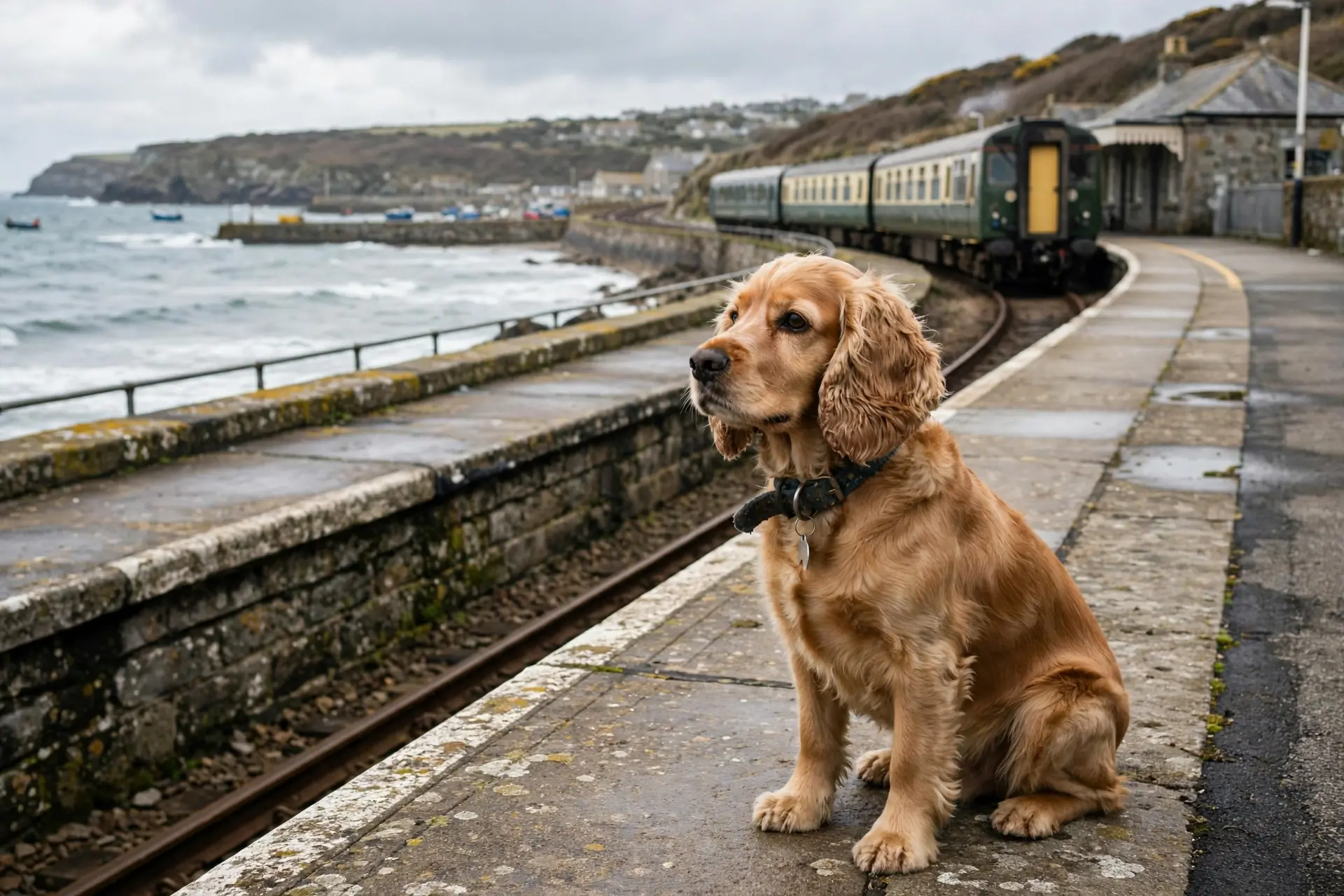
Branch-line trains are a different proposition. A two-car unit has far less floor space, narrower vestibules, and on some routes no toilet at all. The ride can be noisier and bumpier, the doors are often opened by a button rather than automatically, and on the smallest rural halts the platform may be short, so only some doors open. For a confident dog this is all manageable, but for a nervous dog the branch line is the harder half of the journey. Keep the lead short, settle the dog quickly, and do not expect to move around the train once it is moving.
Several branch lines use request stops, where the train only stops if someone asks. On these, you must tell the guard or press the request-stop button in good time before your station, and you must signal clearly to the driver when you want to board. This matters with a dog because a missed request stop can mean a long walk back along a country lane, or a wait of an hour or more for the next train. Lines with request stops include parts of the Heart of Wessex Line, the Tarka Line in Devon and some of the Cornish branches. If your destination is a small halt, check the official guidance before you travel and ask the guard when you board whether your stop is a request stop.
The other practical difference is frequency. Intercity services to the South West generally run at least hourly through the day, so a missed train is an inconvenience. Many branch lines run only every one or two hours, and the last train can be surprisingly early — some Cornish branches finish before 9pm. Build your day around the branch-line timetable, not the other way round, and always check the time of the last train home before you set off for a long walk.
Finally, remember that GWR is not the only operator on these routes. CrossCountry, South Western Railway and Transport for Wales all run services that connect with GWR at stations such as Bristol Temple Meads, Exeter St Davids and Plymouth. The dog rules are broadly the same across operators — dogs travel free under the National Rail Conditions of Travel — but boarding routines and the size of the trains differ, so check the official guidance before you travel when a journey mixes operators.
London to Cornwall, Bristol and Bath: the main routes
Most dog owners meet GWR on the London to Cornwall route, and it is a good one to understand in full before you book. Trains leave London Paddington roughly hourly for Plymouth, Penzance and the South West, calling at Reading, Taunton and Exeter St Davids on the way. The journey to Exeter takes around two hours, to Plymouth around three hours, and to Penzance around five hours, though times vary with the stopping pattern and you should always check the timetable for your date. Five hours is a long time for a dog, so plan it as a journey with stages: a good walk and toilet break before Paddington, water and a settle on board, and a proper break at Exeter or Plymouth if you change trains.
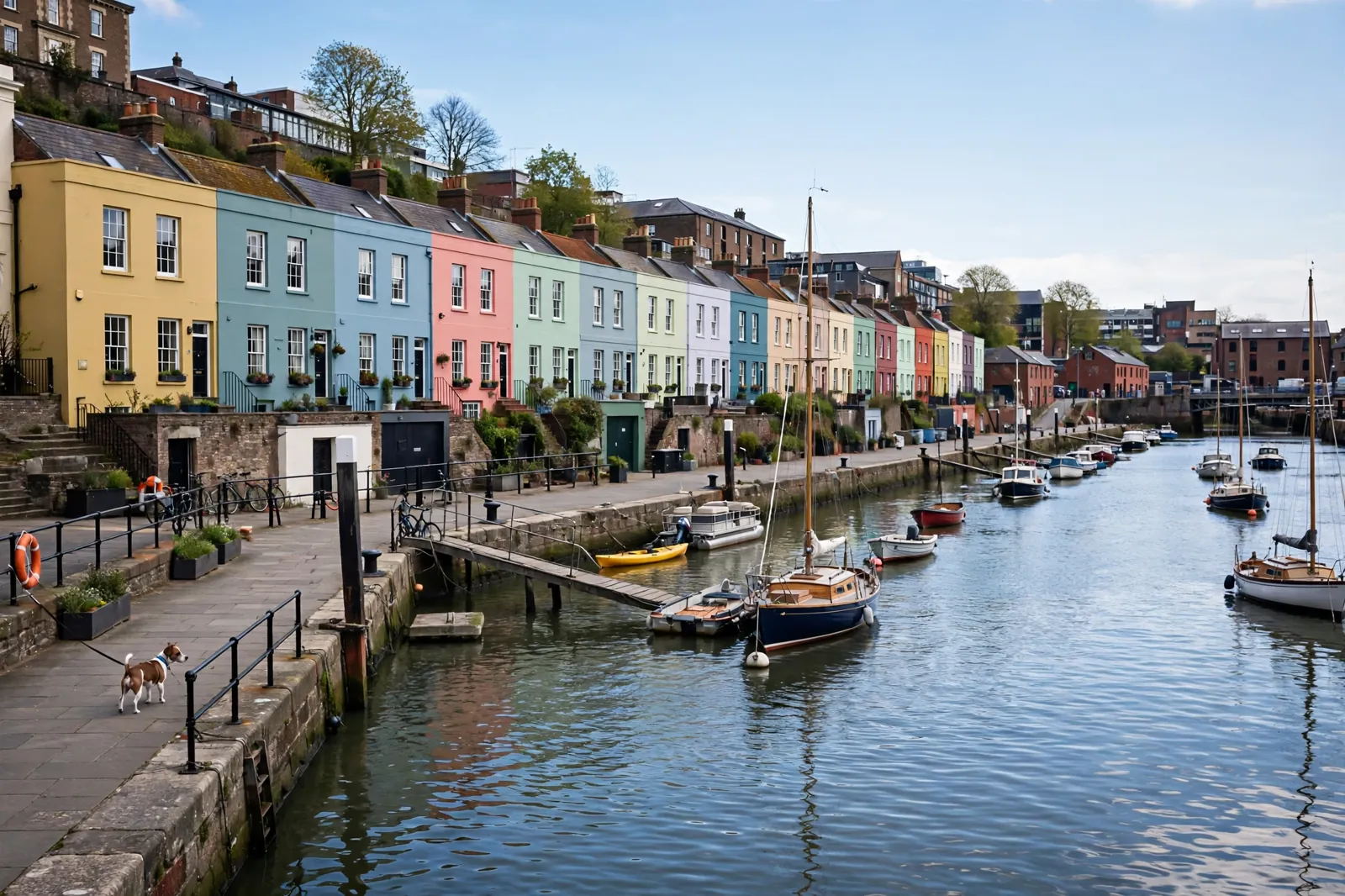
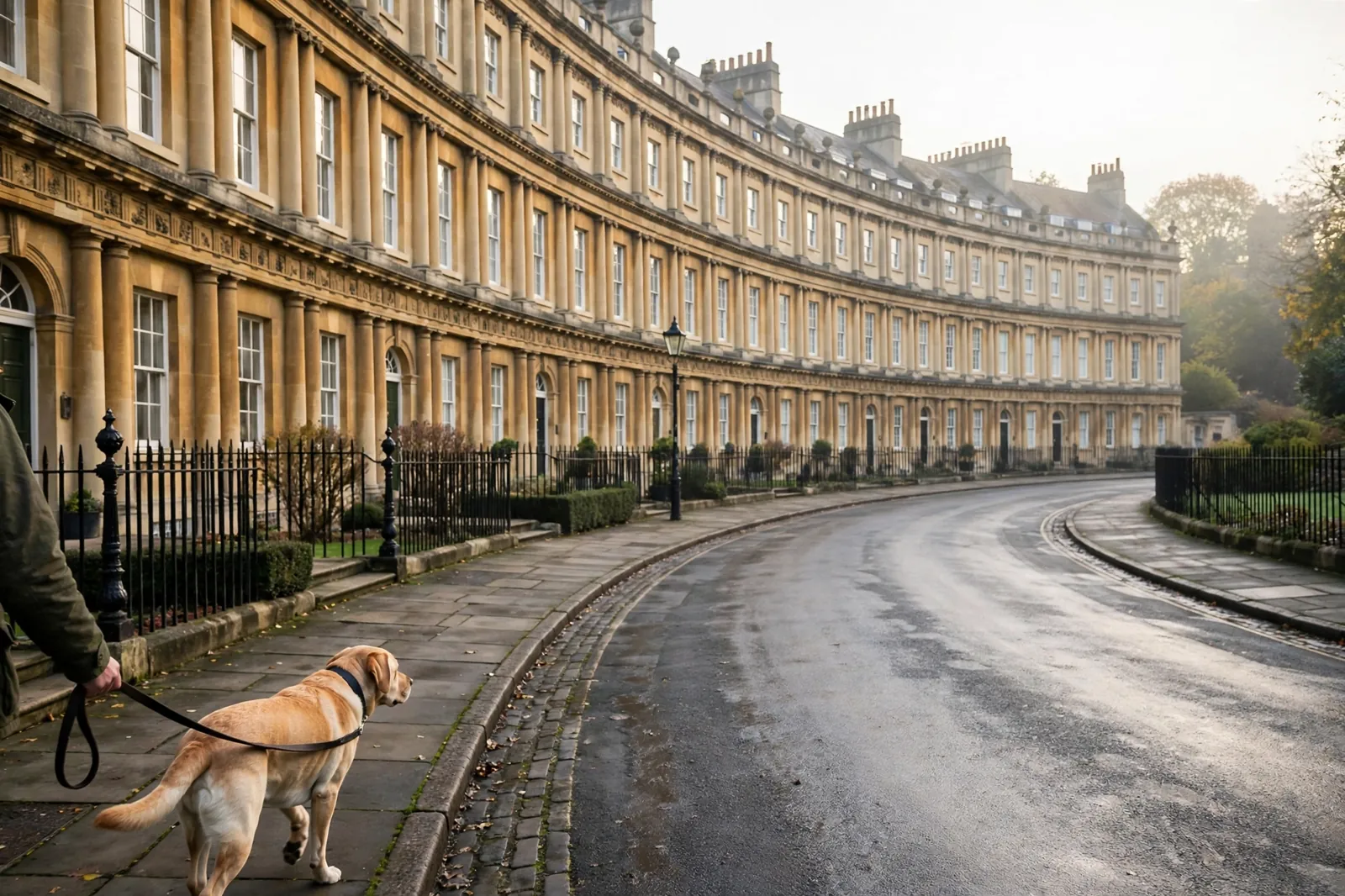
Bristol and Bath are the easiest GWR journeys with a dog. London Paddington to Bristol Temple Meads takes around an hour and a half, and Bath Spa is around an hour and twenty minutes, with frequent services through the day. Both cities are strong dog-friendly destinations in their own right — harbourside walks and open downs in Bristol, riverside and skyline walks in Bath — and both stations sit close to the city centre, so the walk from the platform to the first green space is short. That makes them ideal first rail trips for a dog that has never travelled by train: a short journey, a clear destination, and no change of train.
From Bristol Temple Meads the network fans out in several useful directions. The Severn Beach Line runs from Bristol to Avonmouth and Severn Beach, a short, low-key ride that suits a first outing. Services run on to Weston-super-Mare and the Somerset coast, to Cardiff and South Wales, and south through Bath and Westbury towards Weymouth on the Heart of Wessex Line. The Heart of Wessex is one of the prettiest GWR routes for dog owners — rolling countryside, small stations such as Frome and Yeovil Pen Mill, and a finish at Weymouth's dog-friendly beach and promenade — but it is a slower, less frequent service, so check the timetable and the last train before you go.
Exeter is the gateway to Devon and Cornwall for dog owners. Exeter St Davids and Exeter Central both sit within walking distance of the River Exe and the city's parks. From Exeter, GWR runs the Riviera Line to Paignton via Dawlish and Teignmouth — a famously scenic stretch where the track runs right beside the sea — and the Tarka Line to Barnstaple in North Devon. The Avocet Line runs from Exeter to Exmouth, a short ride to a broad sandy estuary beach. Each of these is a branch-line experience: two-car trains, smaller stations, and a slower pace that suits a relaxed day out rather than a tight schedule.
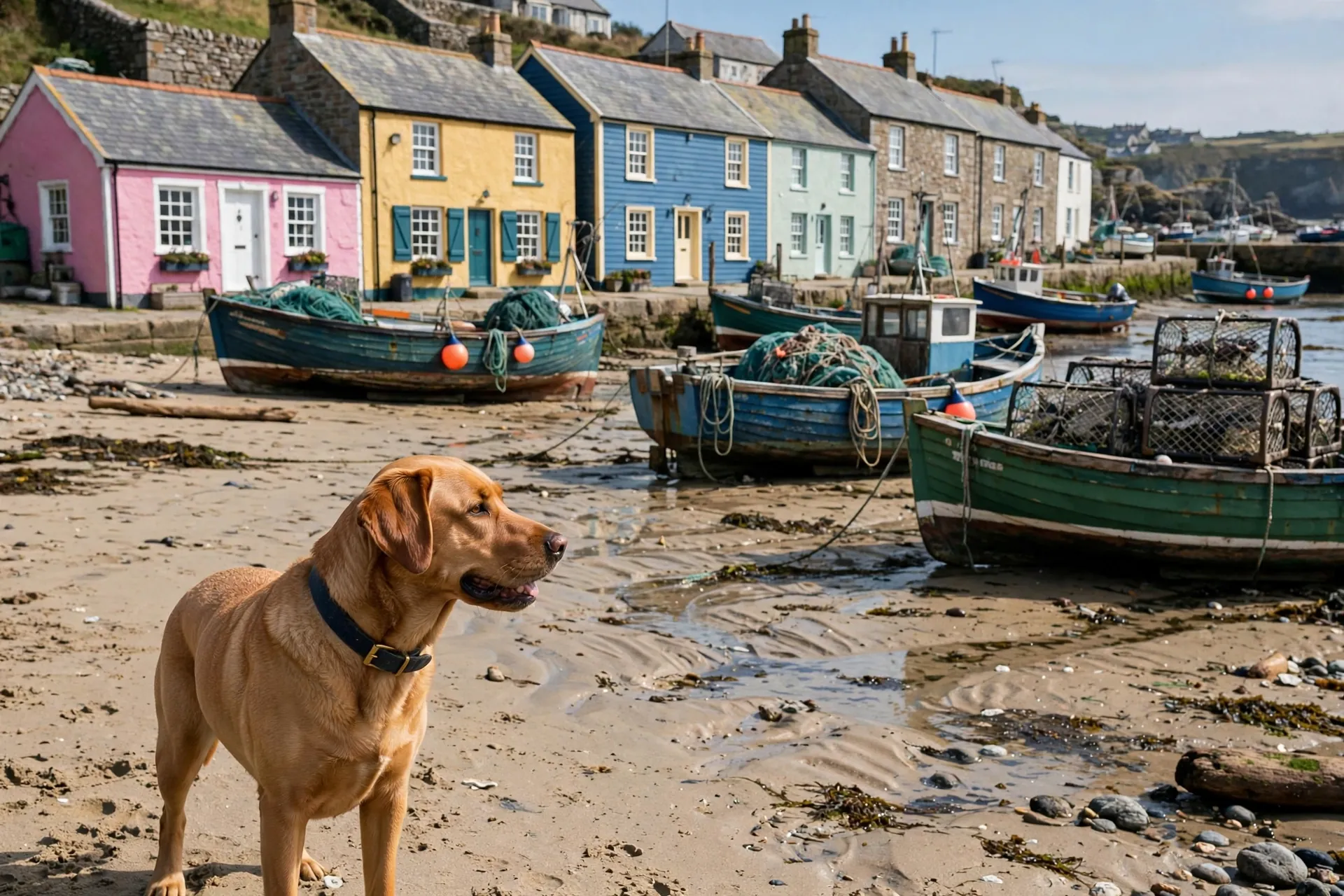
Beyond Exeter, the Cornish main line runs from Plymouth through Liskeard, Bodmin Parkway, Truro and St Erth to Penzance. This is the part of the journey where the dog-friendly holiday really begins: from these stations you can reach the Looe Valley Line to the fishing port of Looe, the Maritime Line from Truro to Falmouth, and the St Ives Bay Line from St Erth to St Ives, one of the most beautiful short branch lines in Britain. The St Ives Bay Line deserves a special mention: the train runs along the beach at Carbis Bay, the views are superb, and St Ives itself is compact enough to explore on foot with a dog — but the branch is busy in summer, the trains are small, and dogs compete for floor space with beach bags and pushchairs. Travel early or late in the day if you can.
Other GWR routes worth knowing include the Cotswold Line from Oxford to Worcester and Hereford, the North Downs Line from Reading to Gatwick Airport via Guildford, and the Thames Valley branches to Henley-on-Thames, Marlow and Windsor. These are shorter, calmer services that work well for day trips from London or Reading, and they put you within a short walk of riverside paths, commons and country parks. GWR also runs the Night Riviera sleeper from London Paddington to Penzance, which is a different kind of journey altogether: dogs are allowed on the sleeper, but a dog in a small cabin overnight is a serious commitment, so check the official guidance before you travel and think carefully about whether your dog would settle in that space.
Booking, seats and where to sit with a dog
You only ever book for yourself on GWR; your dog needs no ticket and no reservation. That said, how you book your own seat makes a real difference to the journey. Advance tickets are the cheapest fares on long-distance services, and they come with a seat reservation, which means you know exactly which coach and seat you will have. Off-Peak and Anytime tickets are more flexible but do not always include a reservation, so if you buy one of these, reserve a seat at the same time or at the station before you travel. A reserved seat is not just about comfort — it gives you a fixed, predictable place to settle your dog, rather than hunting for space on a crowded train.
Where you sit matters more than most people expect. On an Intercity Express Train, look for a table seat rather than an airline-style seat: the floor space under and beside a table is usually larger, and your dog can lie down without blocking the aisle. Seats near the end of a coach, close to the vestibule, are the best choice, because you can get on and off quickly and your dog spends less time walking past rows of strangers. Avoid the quiet coach if your dog is likely to whine, bark or shuffle around — the quiet coach is exactly where other passengers will notice it most. Coach A is usually the quiet coach on GWR IETs, but check the information screens and the signs on the day, as formations can change.
First class is allowed for dogs, but most experienced dog owners choose standard class. The seats are no wider for a dog, the floor space is similar, and a restless dog draws more attention in a quieter carriage where other passengers have paid a premium. If you do travel first class with a dog, the same rules apply: the dog stays on the floor, on a lead, and does not take a seat. The complimentary food and drink service is for passengers, not dogs, so bring your dog's own treats and water.
For short journeys, there is no need to reserve at all. On a branch line or a local service there are no seat reservations, and you simply board and find a space. On these trains, the area by the doors and the seats near the luggage racks are the most practical spots, because you can get off quickly at a small halt and your dog is not trapped in a row. If the train is busy, standing in the vestibule with your dog for a short hop is perfectly acceptable, as long as you keep the gangway clear enough for others to pass.
Families and groups travelling with more than one dog should think about the layout before they board. Two dogs fit comfortably at a table seat; three dogs, or two large dogs, will struggle. In that case, consider splitting across two table seats, or travelling at a quieter time when you can spread out. If you are travelling with children and a dog, put the dog on the side away from the aisle so children are not climbing over it, and keep the lead short enough that it cannot trip a passing passenger.
Finally, keep your ticket and any reservation accessible, not buried in the bag under the dog's blanket. Guards check tickets on most GWR services, and fumbling for a phone while holding a lead is exactly when a dog slips away down the carriage. A ticket in a coat pocket, a phone in your hand, and the lead looped around your wrist is the simplest boarding routine there is.
Stations, changing trains and step-free access
Changing trains with a dog is where good journeys succeed or fail, so plan the change as carefully as the train itself. The main interchange stations on the GWR network are Reading, Exeter St Davids, Plymouth, Bristol Temple Meads, Westbury, Swindon and Truro, and the time you need between trains depends on the station. At Reading, a change between platforms can take five to ten minutes at a brisk walk; at Exeter St Davids or Plymouth, it is usually quicker. Allow at least fifteen minutes for a change with a dog, and twenty if the dog needs a toilet break. A tight five-minute connection that is fine on your own is a missed train with a dog that needs to sniff every lamp post on the way.
London Paddington is the start of most GWR journeys and it is a good station for dogs. It is step-free from the street to the platforms, the concourse is wide, and there is space to settle a dog away from the crowds while you wait. The departure boards are large and clear, and staff are used to dogs. The one thing to watch is the rush: Paddington's concourse fills quickly before a Cornwall departure on a Friday evening, and a nervous dog can find the crowd overwhelming. Arrive early, find a quiet corner near your platform, and board as soon as the platform is announced rather than waiting for the last minute.
Bristol Temple Meads is a large station with a long walk from the entrance to some platforms, and the footbridge and subway can be busy. Lifts serve all platforms, and staff can help if you ask. Bath Spa is smaller and easier, with a compact layout and a short walk to the city centre. Exeter St Davids has a long, sloping approach and a footbridge with lifts, while Exeter Central is closer to the city centre and its shops and parks. Plymouth station is step-free with lifts to all platforms, and Truro is compact and manageable. Penzance, at the end of the line, is a small terminus where the walk from the train to the street takes a minute.
Step-free access is not the same at every GWR station, and it matters for dogs as well as for people. A dog that cannot manage stairs is not the usual problem — most dogs manage stairs fine — but a dog in a carrier, a dog on a lead with a pushchair, or an older dog with stiff joints all benefit from lifts and level access. Small rural halts may have no staff, no lift and only a foot crossing between platforms, and some have steep steps down to the platform. Check the station's access information on National Rail before you travel, and if you need assistance, book Passenger Assist in advance. GWR's Passenger Assist can arrange help with boarding and with luggage, and it is worth using if you are travelling alone with a dog and bags.
Toilet breaks at stations are a practical problem on a long journey. Most large stations have accessible toilets, but there is rarely a dedicated dog toilet area, and the paved forecourt is not a good place for a dog to relieve itself. The best approach is to use the green space near the station: Paddington has Norfolk Square Gardens a short walk away, Bristol Temple Meads has the area around Temple Quay, and Exeter St Davids has paths down towards the river. At smaller stations, a quick walk up the approach road usually finds a grass verge. Always carry poo bags and use them — station staff notice, and other passengers remember.
When you change trains, keep the routine simple: stay on the lead, walk directly to the next platform, and do not let the dog greet every other dog on the platform. Station platforms are exciting places for dogs — new smells, food stalls, pigeons, other dogs — and a dog that pulls towards another dog on a narrow platform is a hazard. A short lead, a calm voice and a treat for walking nicely will get you through the change faster than any amount of negotiation with a distracted dog.
On board: settling your dog for the journey
The first ten minutes on board set the tone for the whole journey. Board calmly, find your seat, lay the blanket or travel mat on the floor, and let the dog sniff the space before asking them to settle. A few treats, a chew, or a favourite toy can help a dog understand that this is a resting place, not a place to patrol. Do not try to settle the dog while the train is still at the platform with people streaming past — wait until the doors close and the train is moving, when the flow of strangers stops and the carriage becomes a stable space.
Water is the most commonly forgotten item on a train journey with a dog. There is no dog water bowl on board, and the air conditioning on an Intercity Express Train can be dry. Bring a collapsible bowl and a bottle of water, and offer small amounts regularly on a long journey rather than a large drink all at once, which can lead to an urgent toilet need with nowhere to go. On a five-hour journey to Penzance, plan for the fact that there is no dog toilet on the train at all: the dog will need to wait until the next station stop, and ideally until a proper break at a change of trains.
Feeding on the train is best kept light. A full meal before a long journey can cause travel sickness, especially on the winding, bumpy sections of the Cornish main line and the branch lines. Feed your dog a smaller meal than usual a couple of hours before departure, and save the main meal for arrival. If your dog is prone to travel sickness, talk to your vet before the journey — medication can help, but it needs to be tried at home first, not for the first time on a moving train. Bring cleaning supplies just in case: poo bags, a small towel and a sealable bag weigh almost nothing and save a great deal of embarrassment.
Noise and movement affect dogs differently. Most dogs settle within ten minutes of departure, lulled by the rhythm of the train. Some dogs are unsettled by the brakes, the announcements, or the sound of the doors, and a few are frightened by the noise in tunnels — the long tunnels west of Plymouth and the tunnels on the approach to Bath can be loud. A familiar blanket, a chew, and your calm presence are usually enough. If your dog is genuinely distressed, do not force the journey: get off at the next station, let the dog recover on the platform, and consider whether a shorter journey or a different mode of travel would suit them better. There is no shame in cutting a trip short; there is a great deal of sense in it.
Other passengers are part of the journey too. Most people like dogs, and many will want to say hello, but not everyone does — some people are allergic, some are afraid, and some simply want to read in peace. Keep your dog close, do not let it approach strangers uninvited, and be ready to move if someone nearby is uncomfortable. Children are often the most enthusiastic greeters, and also the most likely to rush at a dog, so watch for them on boarding and keep your dog's head away from small hands unless you invite the interaction.
On a long journey, give your dog a job: settle, chew, sleep. A lick mat with a smear of dog-safe spread, a long-lasting chew, or a stuffed Kong can occupy a dog for an hour without disturbing anyone. Avoid squeaky toys and anything that sheds crumbs across the carriage. And when the train approaches your destination, pack up early: fold the blanket, gather the lead, and have your bags ready before the train stops, so you can step off promptly with your dog instead of blocking the doorway while you repack.
Busy times, disruptions and delays
Timing is everything on GWR. The network is at its busiest on Friday evenings out of London, on summer Saturday mornings heading for Cornwall and Devon, and during school holidays, when families with dogs, luggage and beach gear all travel at once. On those services, the train can be full before it leaves Paddington, the luggage racks are taken, and the floor space beside seats disappears. If you can, travel on a weekday, or take a mid-morning or early-afternoon service rather than the first train of the day. The difference between a 9am Saturday train and an 11am Tuesday train is the difference between a stressful journey and a calm one.
Summer in Cornwall deserves its own warning. The St Ives Bay Line, the Maritime Line to Falmouth and the main line to Penzance all carry large numbers of holidaymakers in July and August, and the small branch-line trains can be very crowded. Dogs are still welcome, but you may have to stand in the vestibule, and there may be nowhere to put a large dog down. Travel early in the morning or in the evening, when the beach crowds thin out, and consider whether a taxi or a walk from a quieter station would be a better start to the day. The same applies to major events: the Royal Cornwall Show, the Boardmasters festival near Newquay, and the big summer weekends in Bristol and Bath all put extra pressure on the trains.
Disruption is part of rail travel, and it affects dog owners more than most. A cancelled train means a longer wait on a platform, possibly in heat or rain, with a dog that needs water, shade and a toilet break. A delayed train means a missed connection and a rethink of the day. When disruption happens, the first thing to do is look after the dog: find shade or shelter, offer water, and take the dog for a short walk away from the platform if the wait is long. Then sort out the journey — station staff can advise on the next service, and the GWR app and departure boards will show the latest information.
Engineering works are common on the GWR network, especially on Sundays and over bank holidays, and they can replace trains with buses on part of the route. Rail replacement buses are run by coach operators, and their dog policies can differ from the train, so check the official guidance before you travel when a replacement bus is involved. Our guide to dogs on UK buses and coaches explains how bus dog rules work, what to expect on a coach, and how to plan when the bus is the only option. If a replacement bus is not practical for your dog, ask station staff about the next train service or an alternative route — there is often one, even if it takes longer.
Delays also raise the question of compensation. Under Delay Repay, you can claim back part or all of your fare if your train is delayed by fifteen minutes or more, depending on the length of the delay. Keep your tickets, note the actual arrival time, and claim through GWR's website after the journey. The claim is for your fare, not for the dog, but the money back is a small consolation for a disrupted day. If a delay means you miss the last train home, speak to station staff before you leave the station — they can advise on alternative transport, and in some cases arrange a taxi.
Heat is the most serious disruption risk for dogs on trains. On a hot day, a crowded train with air conditioning that is struggling can become uncomfortable quickly, and a dog cannot take off a coat or open a window. Avoid travelling in the hottest part of the day in summer, carry extra water, and watch for signs of overheating: heavy panting, drooling, restlessness or a dog that will not settle. If your dog shows these signs, move to a cooler part of the train, offer water, and get off at the next station if necessary. Never leave a dog in a car at a station car park on a warm day, even for a few minutes, while you buy a ticket or check the board.
Day trips and onward walks from GWR stations
The best thing about travelling with a dog on GWR is how many good days out begin right at the station. You do not need a car to have a proper Cornish or West Country day: step off the train, walk to the coast or the river, and the day is already underway. The routes below are all reachable by train and on foot, and they are the ones that work best when the dog is part of the plan from the start.
St Ives is the classic GWR dog day out. Take the main line to St Erth, change onto the St Ives Bay Line, and ride along the beach to St Ives itself. From the station, the harbour and the town are a few minutes' walk, and the coast path runs in both directions — towards Carbis Bay and Lelant in one direction, and towards Zennor in the other. The beaches around St Ives have seasonal dog restrictions in summer, so check the dates before you go, and the harbour beach is the most convenient for a quick paddle. For a full three days in the area, our three-day Cornwall dog itinerary builds a route around tides, harbours and gardens that works well by train and on foot.
Falmouth is another easy win. The Maritime Line from Truro runs down through Penryn to Falmouth Town and Falmouth Docks, and the town is built for walking: the harbour, the beaches at Gyllyngvase and Swanpool, and the coast path towards Pendennis Castle are all within a short walk of the stations. Looe is similar — the Looe Valley Line from Liskeard winds down through the woods to the fishing port, and the coast path east towards Polperro and west towards Talland Bay gives you a proper walk without ever needing a car.
Bristol is the best city break on the GWR network for a dog owner. Bristol Temple Meads is a short walk from the harbourside, where the flat, traffic-free paths suit dogs of all ages, and the climb to Clifton Downs and the Avon Gorge gives an energetic dog a real workout with views across the city. Our guide to Bristol with a dog covers the harbourside and Downs walks, the gorge and river paths, and the practical details of cafes, stays and local buses.
Bath is quieter than Bristol and in some ways easier with a dog. Bath Spa station is in the city centre, the Kennet and Avon Canal towpath starts nearby, and the Bath Skyline walk climbs out of the city into woodland and open downland. The Georgian streets are pleasant for a stroll, and the city has a good number of dog-friendly pubs and cafes where a tired dog is welcome under the table. Combine Bath and Bristol in a single trip and you have two very different city breaks on one rail ticket.
In Devon, the Riviera Line from Exeter to Paignton is the standout. The train runs beside the sea at Dawlish, through Teignmouth and on to Torquay and Paignton, and each stop gives you a different day: the sea wall walk at Dawlish, the estuary at Teignmouth, the harbour at Torquay, and the broad sands at Paignton and Goodrington. Exmouth, on the Avocet Line, offers a long sandy beach and the Exe estuary trail, while Barnstaple, at the end of the Tarka Line, is the start of the Tarka Trail, a traffic-free path that runs for miles through the North Devon countryside and suits dogs that need a long, flat walk.
Further east, the Thames Valley branches open up a different kind of day. Henley-on-Thames is a gentle riverside town with towpath walks in both directions, Marlow is a pretty riverside stop with a walk to the Chiltern Hills, and Windsor has the Long Walk and the Great Park, where a dog can run for hours. These are short journeys from London, which makes them good choices for a dog's first train trip or for a winter day when you do not want a long journey in the dark.
Packing checklist for a GWR journey
A well-packed bag makes a train journey with a dog noticeably easier, and the list is short enough to fit in a single day pack. The essentials are: a lead and a harness, a collapsible water bowl and a bottle of water, poo bags, a travel blanket or mat, a few treats and a long-lasting chew, a small towel, and your ticket. Everything else is useful but optional, and the golden rule is to pack light enough that you can carry it all with one hand while holding the lead with the other.
The lead deserves a thought of its own. A short, fixed-length lead is far better on a train than a retractable lead, which can tangle around seats, luggage and other passengers' legs. A harness gives you more control than a collar if your dog pulls on a platform, and it is more comfortable for the dog during a long sit. If your dog wears a collar with an ID tag, check that the tag is legible and that your phone number is up to date — a dog that slips its lead on a busy station is a real risk, and a readable tag is the fastest way to get it back.
Water and food need a plan, not just a bottle. A collapsible silicone bowl weighs nothing and folds flat, and a one-litre bottle is enough for most journeys up to three hours — take more in summer, or on a five-hour trip to Penzance. Bring a small bag of your dog's usual food if you will be out all day, and a few high-value treats for settling on the train and for rewarding calm behaviour at stations. Avoid anything crumbly or smelly that will spread across the carriage, and keep the treats in a sealed bag or tub.
Comfort items are what turn a train from a noisy metal box into a place a dog can rest. A familiar blanket carries the smell of home and gives the dog a defined patch of floor; a travel mat does the same job with less bulk. A chew or a stuffed Kong keeps a dog occupied without noise, and a favourite toy can reassure a nervous dog. In winter, a dog coat helps a short-coated dog that will be waiting on a cold platform; in summer, a cooling mat or a damp towel can help a dog that runs hot. A small first-aid kit — a few wipes, a bandage, and any medication your dog needs — is worth the space it takes.
Finally, pack for the weather at the destination, not just the departure station. Cornwall and Devon can be sunny at Paddington and raining at Penzance, and a wet dog on a train home is a miserable experience for everyone. A dog drying coat or a microfibre towel, a waterproof bag for wet leads, and a spare dry blanket will save the return journey. Check the forecast for your destination before you leave, and check the official guidance before you travel if the weather looks severe — GWR can run a reduced service in storms, and the sea wall at Dawlish is sometimes closed to trains in bad weather.
One last check before you leave the house: phone charged, ticket accessible, lead in hand, poo bags in your pocket, water bottle full, dog toileted, and a realistic plan for the last train home. With those in place, the train does the rest — and the South West, from the harbourside in Bristol to the beaches of St Ives, is waiting at the other end of the platform.
Practical questions
Before you go
Do dogs need a ticket on GWR trains?
No. Dogs travel free on GWR trains and you do not need to buy a ticket for your dog. The usual allowance is up to two dogs per passenger, kept on a lead or in a carrier, and your dog must not occupy a seat or block the aisle. Check the official guidance before you travel, as conditions can change.
Are dogs allowed on Intercity Express trains to Cornwall?
Yes. Dogs are welcome on GWR Intercity Express trains between London Paddington and the South West, including services to Plymouth, Truro and Penzance. The same free-travel rule applies, so choose a seat near a vestibule or luggage area where your dog has floor space, and plan toilet breaks at stations because there is no dog toilet on board.
Can my dog sit on the seat next to me on a GWR train?
No. Dogs must stay on the floor and are not allowed on seats, including empty ones. Bring a blanket or travel mat so your dog has a defined spot, keep the lead short, and keep gangways and doorways clear. Other passengers may have allergies, so keeping your dog low and close to you is simple courtesy as well as the rule.
Do I need to book my dog in advance on GWR?
No booking is needed for a dog on GWR. You only book your own ticket and seat reservation. On busy summer services to Cornwall and the West Country it is still worth reserving your own seat in advance, because a reserved seat near the doors gives you and your dog a predictable place to settle.
Are dogs allowed in first class on GWR trains?
Dogs are not barred from first class on GWR, but the same rules apply: they travel free, stay on the floor on a lead, and must not take a seat. In practice most dog owners choose standard class, where there is more floor space near the vestibules and luggage racks, and where a restless dog draws less attention.
What happens to my dog if my GWR train is cancelled and a rail replacement bus runs instead?
Rail replacement buses are run by coach operators, and their dog policies can differ from the train. Many do carry dogs, but space is tighter and boarding may be at the driver's discretion, so check the official guidance before you travel and allow extra time. If a bus is not practical for your dog, ask station staff about the next train service or an alternative route.