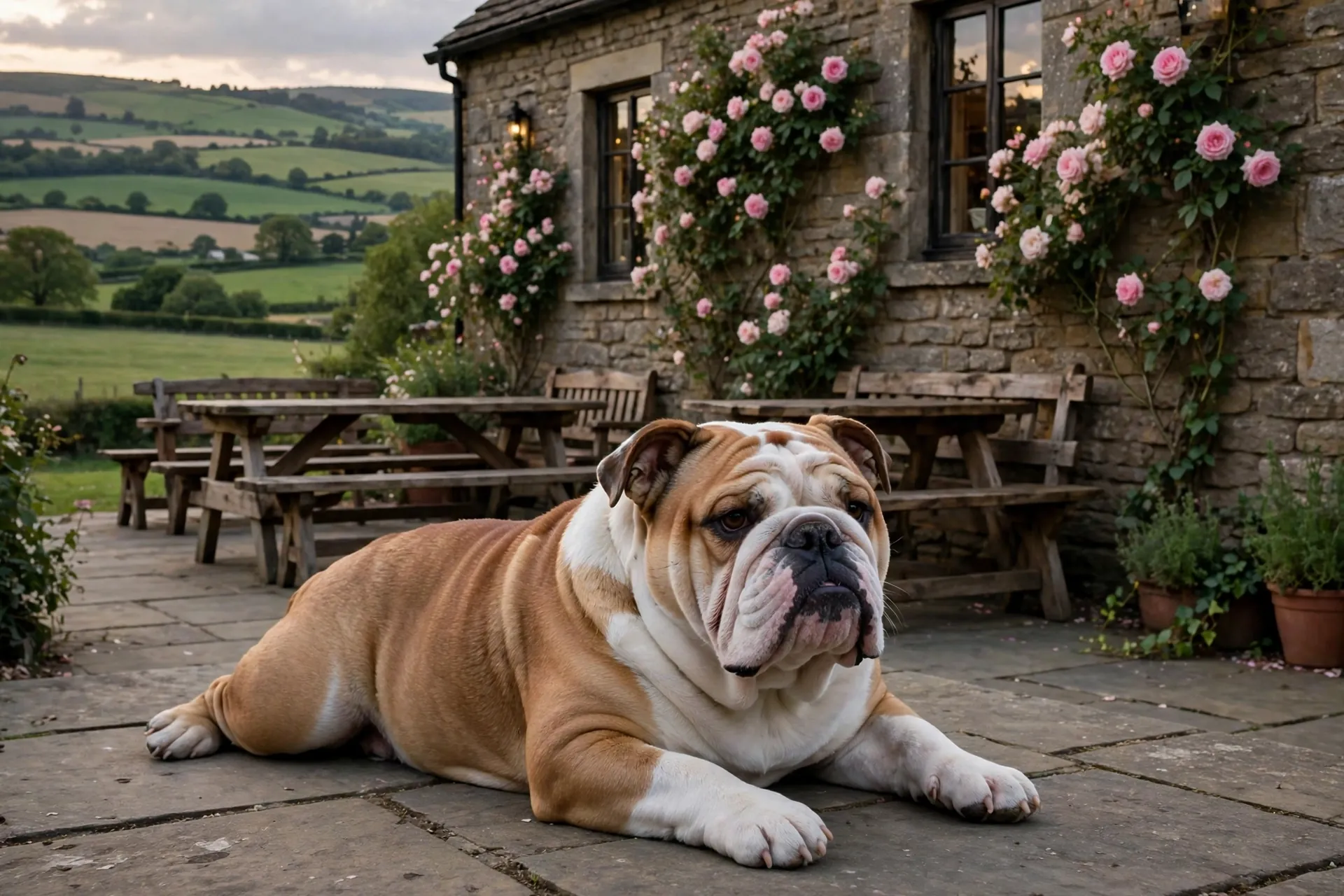
English bulldogs holiday brilliantly in Britain — mild weather, short walks, pub gardens — as long as the plan respects three things: they overheat faster than almost any breed, every extra kilogram makes breathing harder, and their joints do not forgive stairs or long marches. Pick a cool month, a ground-floor stay, short flat loops at dawn and dusk, and a holiday built around rest rather than distance.
The bulldog equation: weight, airway, joints
Planning a bulldog holiday starts with accepting what the breed actually is. An English bulldog carries around twenty to twenty-five kilograms on short legs, breathes through a flattened airway that narrows every effort, and moves joints that were designed for a compact frame rather than a marathoner. None of that makes holidays difficult — it just makes them specific. Get these three facts straight and the rest of the planning almost writes itself.
Weight is the master variable. A kilogram or two over condition does not sound like much until you remember that a bulldog's breathing is already a compromise. Fat tissue presses on the chest wall, reduces the efficiency of each breath, and makes the snorting, snoring sound most owners know well measurably louder and harder. On holiday, when portions creep up and walks shrink, bulldogs can gain weight in a single week. The owners who come home with a dog in exactly the condition they left in are the ones who measured the food before the trip, not the ones who eyeballed it in a holiday kitchen.
The airway is the hard limit. Bulldogs are brachycephalic: shortened muzzle, narrowed nostrils, often a lengthened soft palate and a narrowed windpipe. Panting is a dog's radiator, and a bulldog's radiator is undersized for its engine. This is why a fit bulldog can still overheat on a walk that a springer takes in its stride, and why heatstroke in bulldogs can escalate in minutes rather than the tens of minutes other breeds need. It is also why bulldogs snore so gloriously — and why a separate sleeping space for the humans is not a luxury but a survival measure, as the section on accommodation will explain.
The joints set the geography. Bulldogs' elbows, hips and shoulders take a beating from their own mass on every step down. A staircase that a labrador barely notices is a genuinely risky descent for a twenty-five-kilogram dog with short legs, and a steep coastal path does the same damage in longer doses. Add the breed's notorious allergy-prone skin and you get a dog that does best on flat ground, moderate distances and clean, dry surfaces — which, happily, describes a large share of British countryside holidays once you know where to look.
Put the three together and the ideal bulldog holiday emerges without any ideology: a cool month, a one-level place to stay, short flat walks at the cool ends of the day, and a pace set by the dog's breathing rather than the humans' itinerary. The rest of this guide is that holiday in practical detail.
Choose the season like a heat calendar
If you take one scheduling idea from this guide, make it this: for a bulldog, the month is more important than the destination. A cool September week in the Cotswolds beats a hot August week on the Cornish coast for comfort, safety and fun combined. British summers have grown hotter, and heatwaves — once a rare two-day event — now arrive with increasing regularity. A bulldog's safe upper limit for exercise is far lower than most owners guess: once daytime highs pass the mid-twenties, even gentle walks need serious caution, and above thirty, outdoor exertion becomes dangerous regardless of shade and water.
The sweet spots are late April into May, September, and early October. May brings long daylight, open dog-friendly beaches before summer bans begin (see our beach rules guide for exact dates), and fields full of scent for a dog that would rather sniff than sprint. September is arguably the best month of all: school-term quiet, summer heat broken, beaches reopening to dogs, and pub gardens still warm enough for evenings out. October keeps working well for bulldogs — cooler air suits their breathing, and the only real cost is shorter days and muddier paths, both manageable with a drying coat and a torch.
July and August are the months that demand a genuine decision. They are not impossible — many bulldog owners holiday happily in August — but they require a plan with teeth: dawn walks before nine, no outdoor exercise between eleven and five, accommodation with genuinely cool rooms (stone cottages beat caravans in heat), and a cancellation instinct if a heatwave is forecast. Our guide to travelling with flat-faced breeds covers the non-negotiable heat rules in full detail; read it before booking a summer week, because the plan has to be real, not aspirational.
One practical note on booking: the cool months are also the cheap months. May and September accommodation often costs twenty to forty percent less than August, books up later, and comes with quieter pubs, beaches and footpaths — a triple win for a dog that dislikes crowds as much as heat.
The holiday shape: slow days, not big miles
Bulldogs do not need a packed itinerary; they need a predictable rhythm. The template that works is one proper outing in the morning, a long midday rest, and a second short outing at dusk. Everything else — pub lunch, village browsing, a drive somewhere scenic — slots around the dog's rest, not the other way around. This sounds restrictive until you realise it is exactly the pace a good holiday has anyway: a walk, a long lunch, a nap, an evening stroll.
Build the day around the dog's best windows. Bulldogs do their finest work early, when the air is cool and the paths are empty. A half-hour loop before breakfast, then feeding at home base, then a proper rest while the humans do the heavy sightseeing. The evening walk earns its place: the air cools, scents are stronger for a dog that loves its nose, and a tired-ish bulldog sleeps better at night, which everybody appreciates.
Give the middle of the day up willingly. This is the hardest mental shift for owners used to hiking holidays, but a bulldog napping on a cool kitchen floor while you read a book in the garden is not a wasted afternoon — it is the holiday working. Trying to force a second long walk in the warm afternoon is how bulldogs end up overheating, limping, or both. If the humans want a big walk, take turns: one person stays with the snoring dog while the other does the ridge, then swap.
A word about puppies and seniors. Bulldogs under eighteen months and dogs over eight deserve an even gentler version of the same shape: shorter loops, more rest, and zero embarrassment about turning back. Older bulldogs in particular will simply stop when they have had enough — treat that as information, not stubbornness, and plan routes where stopping can become finishing.
Ground-floor-first accommodation
When you are choosing where to stay, put the access questions before the aesthetics. A twenty-five-kilogram dog that refuses a staircase is not being dramatic; bulldogs' joints and breathing both suffer on stairs, and carrying that much dog up and down twice a day gets old by day three. A ground-floor bedroom — or better, a single-level cottage, bungalow or lodge — removes the problem entirely. Ask for the exact access arrangement to the specific unit before booking: number of steps at the door, whether the parking is beside the unit, and where the dog will sleep.
Once ground floor is settled, look at the floors themselves. Bulldogs skid on slippery laminate and tile, and a sliding dog in a holiday rental is both a joint injury and a damage-deposit risk. Washable non-slip mats or runners along the dog's main routes — door to water bowl, door to bed — solve this cheaply. Our holiday parks guide includes a full step-and-surface checklist worth working through before you pay.
Heat runs through the accommodation decision too. Stone or brick cottages stay naturally cooler than caravans and timber lodges in warm spells; south-facing caravans with big windows become glasshouses by afternoon. Ask where the dog can retreat at midday — a cool utility room, a tiled hallway or a shaded patio — and whether there is a room that stays cool even in a warm week. Ventilation matters for another bulldog-specific reason: a snoring dog in a small, closed bedroom will keep everyone awake, so a layout where the dog can sleep in a separate cool room is genuinely valuable.
The garden should be enclosed and examined, not just photographed. Bulldogs are not escape artists in the terrier sense, but a determined dog can shift a loose gate or squeeze a gap you did not notice, and a heavy dog that pushes through a hedge ends up scratched and possibly eye-injured. Walk the boundary on arrival before letting the dog off lead: check gate latches, fence gaps at ground level (bulldogs are low and go under rather than over), and anything toxic like recently treated lawn edges.
Finally, confirm the noise expectations honestly. Bulldogs snore, grunt and occasionally pass wind with theatrical confidence. A detached cottage absorbs all of this gracefully; a terraced holiday apartment with thin walls does not. Booking an end or detached unit — and mentioning that your dog is a snorer at booking, with humour — prevents the most awkward conversation of the week.
Walking routes that suit a heavy, low dog
The right walk for a bulldog is flat, short, interesting and close to the car. That sounds demanding until you realise it describes most canalside towpaths, most river meadows, many country-park circuits and a surprising number of coastal promenades. What you are ruling out is what most dog walking media glorifies: steep hills, long ridges, scrambles, and any route where the halfway point is the point of no return.
Design every walk as a loop with early exit points. Out-and-back routes commit you to the return leg; a loop through a village or around a small park lets you cut short gracefully when the breathing gets noisy or the pace drops. Twenty to forty minutes of actual moving time is the honest working range for most adult bulldogs, with the lower end for older or heavier dogs and the higher end for fit young adults on cool days. Let the dog sniff — a slow walk with the nose down tires a bulldog more satisfyingly than the same distance at human pace, and it halves the joint loading.
Surface matters more than scenery. Firm, level ground — towpaths, estate gravel drives, promenades, park paths — spares joints and keeps a heavy dog comfortable. Steep stony descents, deep mud, and loose shingle are all poor choices: the first punishes elbows and shoulders, the second exhausts a low-slung dog that has to lift each foot clear, the third moves underfoot and strains everything. After rain, ask locally which paths hold up — countryside accommodation hosts know exactly which lanes turn to clay.
Water on the route is not optional, it is infrastructure. Plan walks with a stream crossing, a pub garden with a water bowl, or a car boot with a full bottle and a bowl halfway round. A bulldog that drinks little on walks is normal — but the water must be there, because the moment overheating starts, rapid cooling with water matters more than anything else you packed.
Above all, set the turnaround rule before you set off and honour it without negotiation: noisy breathing, lagging behind, seeking shade, or lying down mean the walk is finished. Not paused. Finished. Bulldogs will over-commit to please you, so the decision has to come from you, early.
A working heat-management system
Heat planning for a bulldog is not one tip but a system of small decisions that stack. Start with the calendar slot (dawn or dusk, never midday), add the route choice (shade over scenery), and then the kit: a cooling mat for the car and the accommodation, a damp cooling towel or coat for the walk, and water plus a bowl everywhere. None of these are expensive; together they are the difference between a relaxed dog and a panting one.
Know the early signs and act on the first one. Excessive panting that does not settle, drooling more than usual, bright red gums or tongue, restlessness followed by lethargy — any single one means stop, shade, water, cool the belly and paw pads with wet cloths, and get the dog somewhere genuinely cool. Heatstroke in bulldogs can move from distress to emergency in minutes, which is why the cooling kit lives within reach rather than in the boot of the car parked up the hill.
The car is the single most dangerous heat environment on any holiday, and it deserves its own paragraph. A parked car reaches lethal temperatures in minutes, even with windows cracked, even in shade, even on a mild day — and a bulldog's compromised breathing accelerates the whole timeline. Our car safety guide covers crates, harnesses and ventilation for the journey itself; the holiday rule is simpler: never leave a bulldog in a parked car, ever, for any length of time. If the dog cannot come in, someone stays with the dog with the engine and air conditioning running, or the stop gets skipped.
A final heat note for the accommodation: on warm nights, let the dog choose the cool spot rather than confining them to the bedroom you chose. Bulldogs gravitate to tile, stone and shade for sound physiological reasons. A dog that abandons a warm bed for the bathroom floor is telling you exactly what it needs.
Food discipline on a week away
Every bulldog holiday has a hidden risk that has nothing to do with walking: the treats. Pub lunches, generous relatives, the fish-and-chip shop queue, the ice-cream van — a bulldog's pleading face is a precision instrument, and strangers deploy treats with cheerful irresponsibility. One extra sausage here, one shared chip there, and a week later the dog is carrying the weight of its harness plus interest. Set a daily treat budget before you leave and brief everyone in the party, because consistency beats willpower.
Keep the core diet identical to home. New food on holiday risks exactly the digestive upset you do not want in a rental, and bulldogs' sensitive stomachs make them prime candidates. Weigh the week's rations at home and bag them by day — labelled freezer bags mean any family member can feed correctly, and the visual of an empty bag enforces the portion better than any lecture. Pack a day or two extra in case of delays, sealed against damp.
Feeding routine matters almost as much as food. Same times, same place relative to the dog's bed, same wait-before-feeding ritual if that is your habit. Bulldogs are comforted by predictability, and a stable routine settles a dog faster in unfamiliar surroundings than any amount of reassurance. Feed after the morning walk, not before — exercise on a full stomach is uncomfortable for a deep-chested breed and risks bloat-adjacent distress.
Watch the water too, in both directions. Some bulldogs drink less in new places; some drink greedily and then feel sick. A familiar bowl helps, placed in the same spot each day. And keep the food secure: bulldogs are surprisingly resourceful foragers when a holiday kitchen's bins are at nose height, and a rental's cleaning-cupboard lock is worth checking on arrival for reasons that go beyond food.
Swimming: assume the answer is no
This deserves its own blunt section because holiday settings keep suggesting otherwise: rivers, lakes, the sea. English bulldogs are among the worst swimmers in the dog world. Dense muscle, a heavy front end, short legs and a large head mean many bulldogs sink within seconds of losing their footing. This is not a training gap; it is physics. The responsible assumption is that your bulldog cannot swim, and the plan follows from there.
At the coast, the sea is for watching and the shallows are for paddling — on a lead, at the water's edge, where the dog can touch the bottom and the waves are no higher than the chest. Never let a bulldog off lead near deep water, harbour walls, estuary channels or fast rivers, and never throw a ball into water for them to fetch. A bulldog life jacket exists and is worth packing if water features at all, but understand what it is: a paddling aid and an emergency margin, not a swimming licence.
The inland version of the same rule applies to lakes, canals and ponds. Canal edges are often steep and slippery with no easy exit for a dog that goes in; lake shores can shelve suddenly. If other dogs are swimming, keep yours occupied with a game on dry land rather than letting excitement override judgement. Our water safety guide covers the full checklist of entry points, currents and algae risks for the places you will visit.
One constructive option: a shallow paddling spot where the water reaches the belly and no deeper. Bulldogs often love splashing in cool shallow water on a warm day, and it doubles as a cooling mechanism. The difference between a safe paddle and a dangerous swim is measured in centimetres of depth — check the bottom yourself before the dog goes in.
Skin folds, paws and damp Britain
British holidays are often damp, and bulldogs' skin folds are dampness magnets. The rope over the nose, the wrinkles around the face, the tail pocket in dogs that have one — all trap moisture after wet walks, sea spray or rain, and all can develop irritation or infection if left damp day after day. The fix is unglamorous but effective: after every wet outing, dry the folds properly, not just the coat. A soft cloth or unscented wipe between the wrinkles, then a dry cloth after, takes two minutes and prevents most problems.
Pack for the climate the forecast promises, not the one you hope for. Two drying coats beat a pile of towels, because a drying coat works while the dog wears it and a towel cools into a damp rag. Microfibre towels for the folds, a waterproof mat for the dog's sleeping spot, and spare bedding in a dry bag mean a wet week stays comfortable instead of becoming a skin problem with a holiday attached.
Paws deserve the same attention. Bulldogs' feet are compact and their nails often thick; wet ground softens pads and muddy paths pack between toes. A quick paw check after muddy walks — rinse, dry, look for redness or trapped grit — takes a minute. In summer, remember the pavement test: if tarmac is too hot for your hand after five seconds, it is too hot for paws, and a heavy dog stands on the full weight of every step.
Allergies are the background hum of the breed. New countryside — different pollens, different grasses, different hedgerow plants — can trigger flare-ups in dogs that are fine at home. If your bulldog has known allergies, pack their usual treatment and discuss a holiday plan with your vet beforehand; if they develop red ears, chewing paws or weepy eyes mid-holiday, note what changed and mention it at the vet visit rather than trying a new product in a rental kitchen.
The car journey for a 25-kilogram passenger
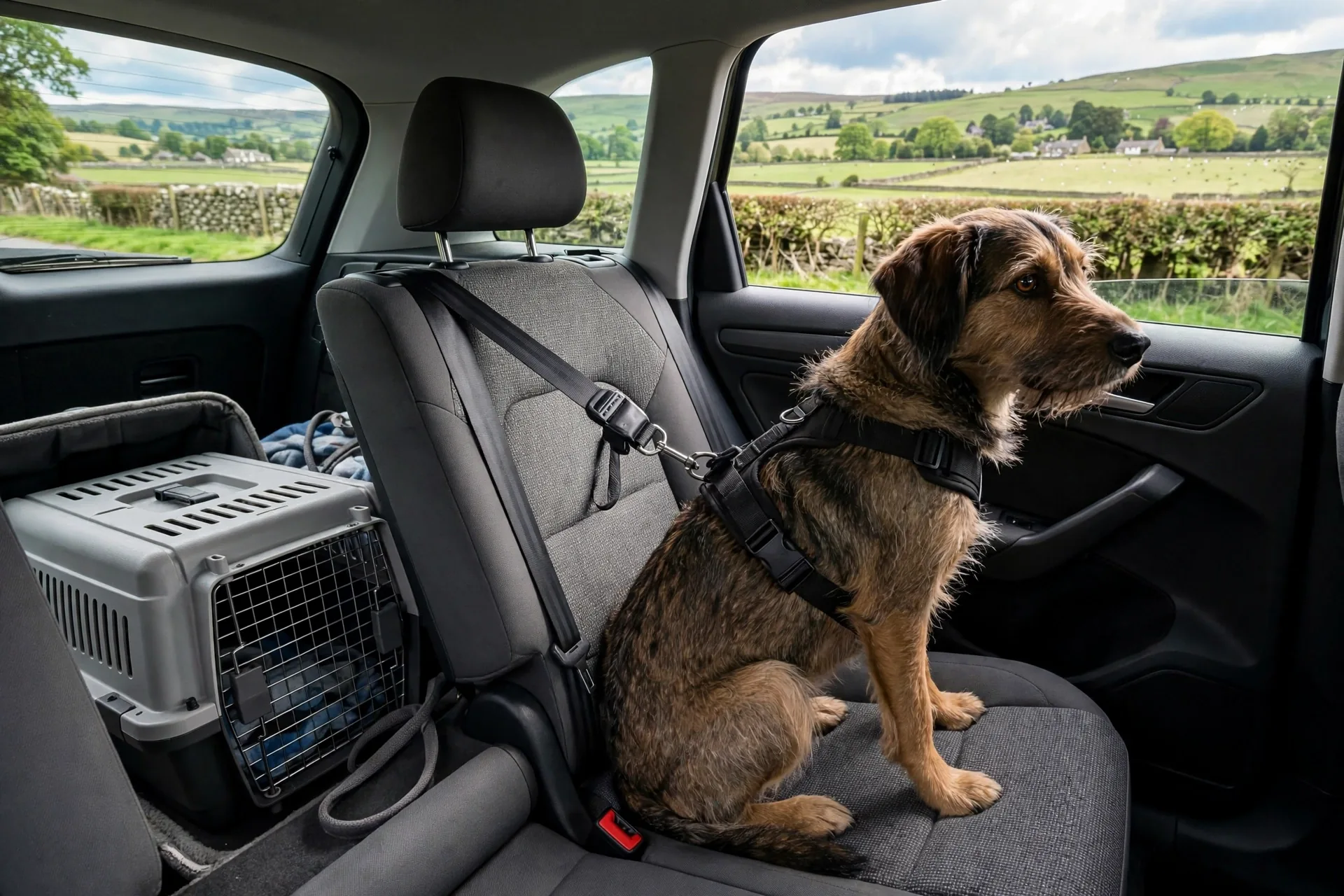
Getting there is part of the holiday, and a bulldog is not a dog you casually lift into a high boot. Twenty to twenty-five kilograms of unwilling dog is a back injury waiting to happen, so plan the loading properly: a non-slip ramp for high boots, or a back seat the dog can step onto, with a tested harness or a secured crate. Whichever system you use, practice it at home first — a holiday morning is not the time to discover the ramp slides on the driveway.
Ventilation is the journey's main variable. Bulldogs overheat in warm cars far earlier than other breeds, so the air conditioning is not a comfort feature on this trip, it is equipment. Aim for a cool, steady temperature rather than blasting cold air at a panting dog, and keep a sunshade on the window beside the dog. In traffic jams — the traditional start of every British bank-holiday drive — watch the dog's breathing closely; a bulldog that was fine at motorway speed can start panting hard within minutes of standing still in warm air.
Schedule stops around the dog, not the fuel gauge. Every ninety minutes to two hours, pull over somewhere the dog can walk a short, shaded loop, drink, toilet and cool down. Motorway service areas vary wildly in shade and green space; the good ones have a proper dog-walking area and the bad ones have a single strip of hot tarmac. A ten-minute check of reviews or a satellite view before the journey pays off here. Never leave the dog in the car at a stop, even for "just paying for fuel" — the heat rules from the previous section apply at every minute of the trip.
On arrival, resist the urge to do everything at once. Unload the dog first, toilet, water, a quiet sniff of the garden, then the bags. A bulldog that arrives flustered needs the boring first hour: familiar bed in the chosen sleeping spot, feeding on schedule, and no visitors, no tour, no excitement. The holiday starts properly on the first calm morning.
The bulldog packing list
Bulldogs reward over-packing. The list below is the difference between a smooth week and a week of improvisation, and everything on it earns its space because it answers a breed-specific need rather than a general one.
- Cooling mat and cooling towel. The mat goes in the car and by the dog's bed; the towel comes on every walk from May to September. Cheap, light, constantly used.
- Non-slip ramp. For high boots and any steps at the accommodation you cannot avoid. Test the footing on grass before trusting it.
- Two drying coats and fold-care supplies. Soft cloths or unscented wipes for the wrinkles, a dry towel for after. Damp Britain plus bulldog folds is a combination that needs managing, not hoping.
- Measured food, bagged by day, plus two days spare. Labelled bags that anyone can feed from. Familiar treats within the daily budget — new treats are a stomach experiment.
- Familiar bed and a familiar-smelling blanket. Bulldogs settle by scent and routine; a bed that smells of home shortens the first-night adjustment dramatically.
- Water, bowl, and a spare bowl. A full water bottle lives in the day bag on every outing. Some bulldogs drink poorly from unfamiliar bowls, so bring the home one.
- Life jacket and a long, light lead. The jacket is for paddling margins, not swimming; the long lead gives sniffing freedom on safe open ground.
- Paw balm, nail file or clippers, and a basic first-aid kit. Include anything your vet has prescribed for allergies or skin, with the dosing written down.
- Shade: a pop-up beach shelter or car sunshade. Bulldogs need shade they can retreat to, not just shade that happens to exist. Create it.
- Cleaning kit for the rental. Enzyme cleaner, spare poo bags in bulk, lint rollers, and a washable throw for the sofa if the dog is allowed up. Leaving a place spotless is how bulldogs stay welcome.
Keep the day bag packed and by the door all week: water, bowl, cooling towel, lead, treats within budget, poo bags, and the fold cloth. If it is not by the door, it will not come on the walk, and the walk is exactly when it is needed.
The vet plan, set before you leave
The time to find the emergency vet is at home, on a weekday, with a cup of tea — not at eleven at night in an unfamiliar county with a dog in distress. Before every trip, look up the nearest emergency vet to your accommodation and save the number in your phone and on paper. Rural practices often close early and hand over to a regional out-of-hours service twenty or thirty minutes away; knowing the route in daylight removes the panic from a genuine emergency.
Give your own vet a call before a long trip if your bulldog has any ongoing conditions: breathing assessments, allergy management, joint medication, or skin treatment. Ask what constitutes an emergency for your specific dog — the threshold differs between a young fit bulldog and an older one with a narrowed airway — and what you can safely manage yourself. Our emergency vet guide explains what to do in the first minutes of common holiday crises; read it once and keep it bookmarked.
Bring the paperwork that a strange vet would want: vaccination record, insurance details, current medication list with doses, and your own vet's contact details. Keep it in the glove box or the day bag, not in a suitcase buried in the boot. If your bulldog has a BOAS grading or any breathing assessment on record, bring that too — it tells an emergency vet more in one page than ten minutes of explanation.
One bulldog-specific emergency note: heat distress and breathing crises escalate faster in this breed than owners expect, and a dog that has "recovered" after cooling can deteriorate again later. If your bulldog has a genuine overheating episode, call the vet even if the dog seems fine afterwards — the follow-up call is always the right call.
Practical questions
Before you go
How far can an English bulldog walk on holiday?
Most adult English bulldogs are happiest with twenty to forty minutes of flat walking, once or twice a day, with plenty of sniffing built in. Older, heavier or breathing-compromised dogs may need less. Plan short loops with an early turning point rather than out-and-back routes, and watch the dog, not the mileage — noisy breathing or lagging behind means the walk is over.
Should I take my English bulldog on holiday in summer?
Shoulder months are safer than July and August. An English bulldog's flat face and heavy body make heatstroke a real risk once temperatures climb, so if you do travel in summer, plan dawn and late-evening outings, avoid the middle of the day entirely, and pick accommodation with genuinely cool rooms and shade. Coastal and upland areas tend to be cooler than inland lowlands.
Can an English bulldog swim at the beach?
Assume no. English bulldogs are dense, front-heavy and short-legged, which makes them poor swimmers that tire and sink quickly. Keep your dog on a lead near deep water, let them paddle at the edge where they can touch the bottom, and never encourage them past their depth — many bulldogs sink in seconds.
Is it ever safe to leave my bulldog in the car?
No — not even briefly, not with windows cracked, not in shade. A parked car heats to dangerous levels in minutes, and a bulldog's compromised breathing means overheating starts earlier and escalates faster than in most breeds. If the dog cannot come into the shop, café or attraction, someone stays in the car with them with the air conditioning running, or you skip the stop.
What accommodation features matter most for a bulldog?
A ground-floor bedroom and step-free access to the outside are the two that matter most — bulldogs are heavy, stairs punish their joints, and a post-lunch toilet trip should not require a staircase. After that, look for cool tile or laminate floors, a secure enclosed garden rather than open communal space, and somewhere genuinely quiet for a dog that snores like a tractor.
How do I keep my bulldog's weight on track during a week away?
Keep the same food and the same measured portions as at home, and set a daily treat budget before the trip — holiday treats from pubs and family members are where bulldog waistlines expand. Extra kilograms make every breath harder for this breed, so favour short extra walks over extra food, and weigh the dog's daily ration in advance into labelled bags so anyone can feed correctly.