This guide is independent and contains no paid placement. Venue dog policies, opening arrangements and path conditions change, so check the latest official information before you travel.
Grasmere is one of the easiest Lake District villages to enjoy with a dog if you time it well. Do the lake circuit early, use the coffin route to Rydal for a longer low-level day, treat Wordsworth interiors as human-only until confirmed otherwise, and keep swimming conditional on clear water with no algae signs.
The gingerbread queue test
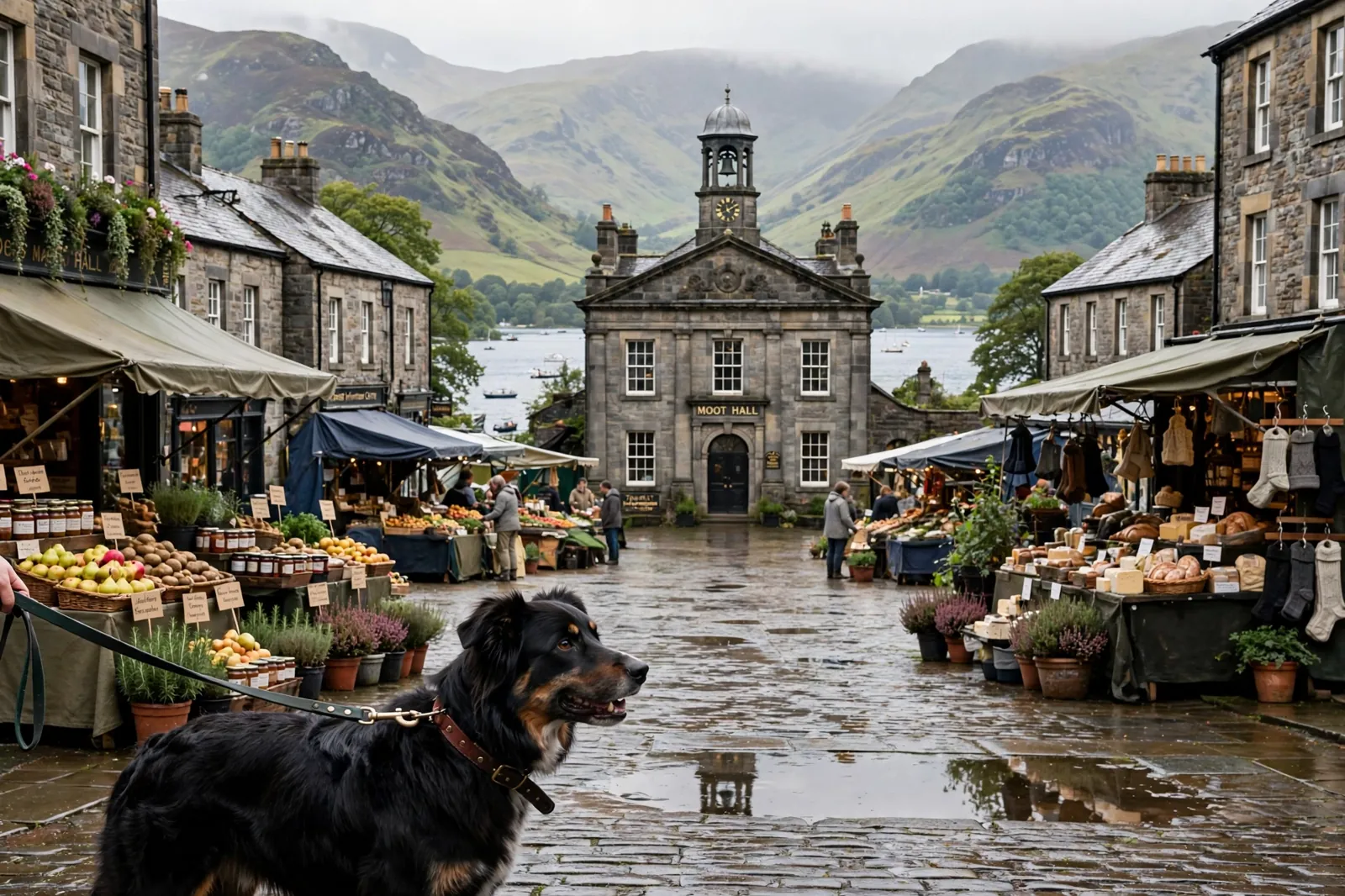
The queue tells you everything first. Outside the little gingerbread shop in the centre of Grasmere, the line can spill along the pavement on a fine morning, bags are passed hand to hand, and a patient dog has to stand close, ignore dropped crumbs and other people's shopping, and wait without lunging at every passing spaniel. If your dog can do that queue calmly, the rest of the village will feel manageable. If the queue undoes them completely, do not write Grasmere off — just change the order of the day. Send one person in, keep the dog in a quieter spot by the churchyard wall or on the green, or come back early or late when the pavement is clear. That small adjustment sets the pattern for the whole visit: Grasmere is genuinely welcoming to dogs, but its most famous corners are small, popular and close together, so success is mostly about timing and spacing rather than finding a secret dog-only version of the village.
Start with that honesty and Grasmere becomes a pleasure. This is a compact village in a broad green vale, ringed by fells that look inviting from almost every street, with a lake that can be circled without special kit and a second, smaller lake at Rydal within easy walking distance. William Wordsworth lived here, wrote here and is buried here, which brings literary visitors in every season, alongside walkers heading for Helm Crag and families who simply want a gentle shore path and an ice cream. Dogs fit naturally into the walking side of that mix. They fit less automatically into small interiors, timed tours and crowded tea rooms, so this guide separates the two clearly: what you can confidently plan around a dog, what you should treat as a take-turns activity, and what to check again on the day.
Practicalities come before scenery. Parking in and around Grasmere fills early on sunny weekends and throughout school holidays, and the village sits on the busy A591 between Ambleside and Keswick, so build arrival time into the plan rather than assuming you will step straight onto a path. Keep a lead handy from the moment the car door opens, even if your dog is usually off lead at home: there are roads, sheep, swans, delivery vans and a lot of other dogs in a small space. Carry water for the dog as well as for yourself, because a short village stroll has a habit of becoming a full lake circuit once the weather turns kind. Pack poo bags and use the bins provided, take a towel for muddy paws before cafe stops, and save the number of a local veterinary practice in your phone before you need it. None of this is complicated, but doing it at the start prevents the familiar Grasmere scramble of searching for water, a bin and a quieter pavement all at once.
The lake circuit walk
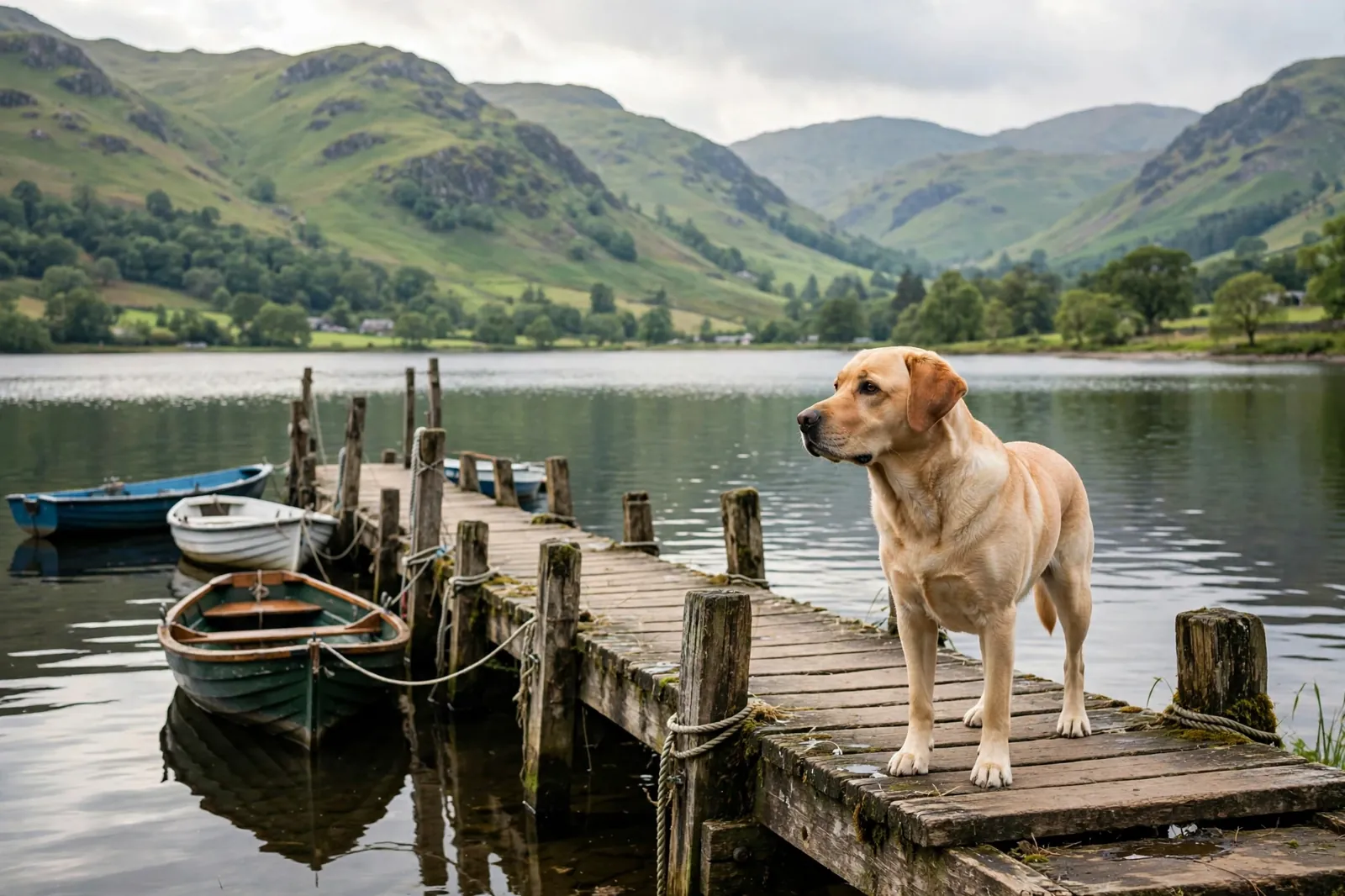
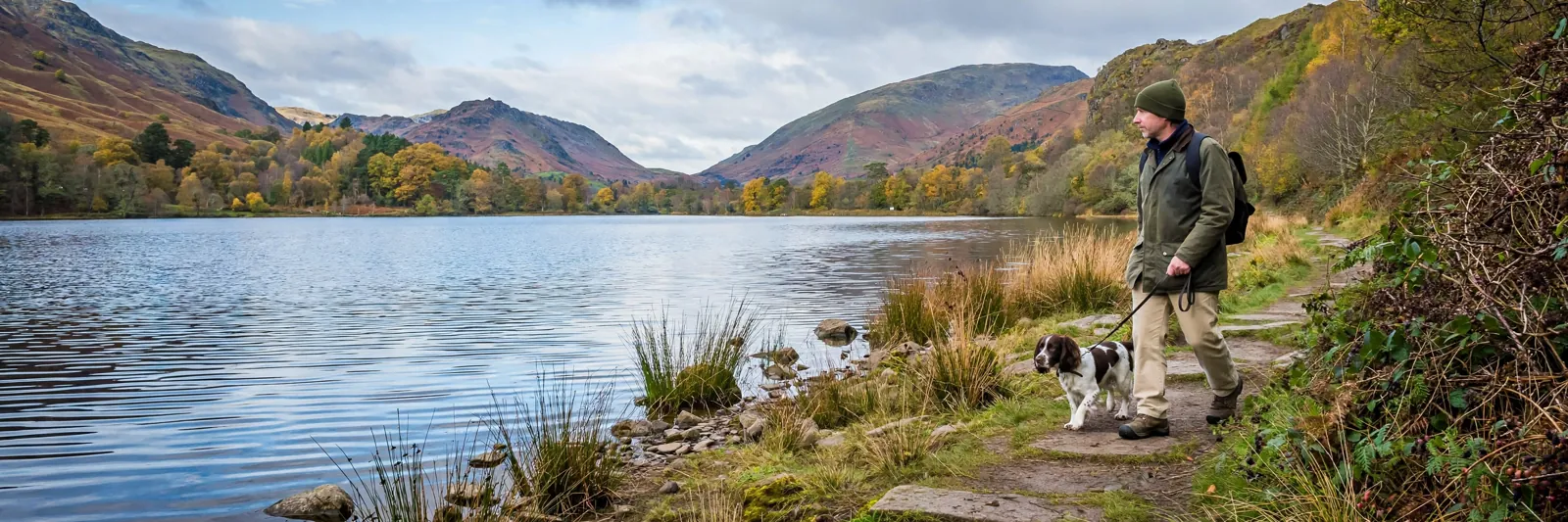
The circuit of Grasmere lake is the walk to build a first day around. Depending on the exact line you take, it is roughly three and a half to four miles, mostly low-level, with a mixture of lakeshore path, woodland track, quiet lane and a short section where care near the road is needed. Allow around two hours at dog pace. That may sound generous for the distance, but the circuit rewards slowness: there are shingle bays where a dog can paddle at the edge if conditions are right, benches with the classic view back towards the village, and long stretches where the fells reflect in still water on a calm morning. Rushed, it is a pleasant loop. Taken slowly, it is the best introduction to the valley you could ask for.
Direction matters less than timing. Starting early gives you the western shore at its quietest and means you reach the busier village end as other people are still parking. Starting later in the afternoon also works, when day visitors begin to leave and the light softens over Loughrigg. In either case, keep your dog on a lead wherever signs ask for it, near livestock, and on any road or lane section, and be especially careful around swans and nesting birds in spring and early summer. The path can be muddy and puddled after rain, with tree roots and uneven stone in the wooded parts, so ordinary walking shoes are a minimum and boots are sensible in winter. For an older dog, the circuit is best split: walk one shore out and back rather than committing to the full loop, because the far side feels longer than the map suggests once paws are tired. For a young, energetic dog, the circuit alone may not be enough, which is where the Rydal extension or a fell option later in the day comes in.
Build in decision points rather than treating the loop as compulsory. If the shore is crowded with picnics, if your dog is unsettled by other dogs in a narrow section, or if the weather closes in, turning back on the same shore is a perfectly good walk and often a calmer one. Watch for cyclists and runners on shared stretches, step aside early, and keep the lead short at blind bends. In hot weather, which does reach the Lakes even if nobody believes it beforehand, start before the middle of the day, use the shaded woodland sections, offer water little and often, and never assume a dog will cool down simply because the lake is nearby. The circuit looks gentle, and it is, but sun, excitement and a warm coat add up quickly for a dog that has been pulling towards every new smell since the car park.
Navigation is straightforward, but a map still helps. The loop combines rights of way and permissive paths, and closures or diversions can follow storms and tree damage, so follow any signs on the ground over a route description written earlier, including this one. If a section is closed, do not improvise through farmland with a dog. Retrace your steps or use the lane alternative only where it is safe and signed. That habit protects livestock, ground-nesting birds and your own dog, and it keeps good relations between walkers and the farms that make this landscape work.
Rydal Water and the coffin route
If the Grasmere circuit is the introduction, the coffin route to Rydal is the chapter most dog walkers remember. The historic track runs between Grasmere and Rydal, passing Rydal Water, Rydal Mount and the area around Rydal Hall, and it takes its name from the days when coffins were carried along it to St Oswald's Church in Grasmere. Today it is a clear, atmospheric, mostly low-level route through woodland and open fell-side, with views down to Rydal Water that feel bigger than the modest height gain suggests. As a there-and-back walk from Grasmere it makes a satisfying half day; combined thoughtfully with the Grasmere shore, it can fill a full day without ever needing a car between walks.
For dogs, the route suits animals that walk well on a lead, cope with gates and occasional stiles, and are not overwhelmed by meeting other walkers head-on on a defined track. The surface varies from good path to uneven stone and mud, and after heavy rain small streams can cross the line of the walk. Keep dogs close near livestock and on any section that drops towards the road, and be respectful around Rydal's houses, gardens and church spaces, where the rules for a working village apply just as they do in Grasmere. Rydal Cave, the large former quarry cave above Rydal Water, is a popular detour from this side of the valley. It can be slippery, echoing and busy, and the stepping-stone approach over water unsettles some dogs entirely. View it as an optional extra for a confident dog in dry conditions, not as a promise, and never drag a reluctant dog across wet stone for a photograph.
Rydal Water itself is smaller and often feels quieter than Grasmere, with wooded shores and the little island views that photographers love. The paths around it are lovely for a lead walk, but the same rules apply as on any Lakeland water: no assumption of swimming, close control near wildlife, and care on narrow shores when other dogs are passing. If you want a longer day, the classic pattern is Grasmere village to Rydal by the coffin route, a pause for coffee or lunch where dogs are welcome, and a return by the lower shore paths where open and signed. Check the line on a current map before setting off, because combining routes is where people most often add an unintended road section at the end of a tiring day. Tired dogs and tired owners make poor decisions at junctions, so decide the return route before lunch, not after it.
Public transport can help here. Buses along the A591 connect Grasmere, Rydal and Ambleside, which opens up one-way walks for some groups, but dog carriage, frequency and stops should all be checked with the operator before you rely on them. If you are driving, do not assume you can simply move the car to Rydal to shorten the walk — parking there is limited and fills quickly. Walking the whole link is usually the calmer and more satisfying option, and it is the version your dog will understand: one continuous adventure, with familiar smells building up on the way home.
Wordsworth sites with a dog: what is realistic
Wordsworth is unavoidable in Grasmere, and rightly so, but dog access needs to be described plainly rather than optimistically. The poet lived at Dove Cottage from 1799 to 1808, later at Allan Bank and Rydal Mount, and he and members of his family are buried in St Oswald's churchyard. Visitors can reasonably expect to enjoy the village, the churchyard, the Wordsworth Daffodil Garden and the wider landscape that inspired the poems with a dog at their side. They should not assume that same dog can follow them inside small historic interiors, museum galleries or on a guided cottage tour. That distinction — outdoors and gardens on one side, interiors on the other — is the honest starting point for every Wordsworth site in the village, and it will save disappointment at a doorway.
Dove Cottage and the Wordsworth Museum, run as Wordsworth Grasmere, are the clearest example. These are intimate, carefully managed heritage spaces, and dog rules there can vary by area, season and exhibition, with assistance dogs treated separately from pet dogs. Before you travel, check the venue's own latest visiting information, and before you join any timed entry, ask at the entrance what applies that day. In practical terms, most two-adult groups handle it by taking turns: one person does the cottage and museum properly, without hurrying, while the other explores the garden areas and village with the dog, then you swap or meet for coffee. Solo travellers with a dog should plan on the outdoor experience only unless the venue confirms otherwise in advance. That is not a failure of the trip. The garden, the lane, the churchyard and the vale itself are a substantial part of why Wordsworth matters here, and a dog gives you a good reason to spend longer in them than most visitors do.
The Wordsworth Daffodil Garden, beside St Oswald's Church, is the most naturally dog-friendly Wordsworth stop, because it is an outdoor garden created in the poet's memory, planted with native daffodils and designed for quiet wandering. Keep your dog on a short lead, stay on the paths, and treat it as a place for a slow ten minutes rather than a run-around. In spring the effect is at its best, but the garden has a calm in every season that contrasts usefully with the busy main street a minute away. St Oswald's churchyard, where Wordsworth's grave lies among family graves near the River Rothay, is also an outdoor visit that a careful dog owner can make respectfully: short lead, no wandering between graves, no fouling, and a low voice. Whether dogs may enter the church building itself is a separate question to check on notices at the door; churches vary, events change the position, and a service or concert always takes precedence over sightseeing.
Allan Bank, the National Trust house above the village where Wordsworth also lived, and Rydal Mount, his home from 1813 until his death, follow the same broad pattern in reverse emphasis: grounds and gardens are usually the dog part of the visit, houses usually the human part, with exact lead, indoor and catering rules set by each property. National Trust dog policies differ between properties and between areas of the same property, so use our dog-friendly National Trust guide alongside each property's own page before you go, and look for the paw-rating and local rules rather than assuming a national standard. The key sentence for all of these sites is the same: please check the latest venue rules before travelling, because dog access is exactly the kind of detail that changes without making headlines.
Alcock Tarn and Helm Crag for fit dogs
Grasmere's low-level walks are enough for many dogs, but fit, experienced hill dogs have two classic options close to the village. Treat both as proper fell walks, not as extensions of a village stroll, with map, weather check, water and an honest assessment of your dog's fitness and paw condition before you start. If there is any doubt, the lake and coffin route will give you a better day than a forced summit.
Alcock Tarn is the gentler of the two in feel, though it is still a real climb. The route rises through woodland and bracken above the village to a small, quiet tarn tucked under the slopes of Heron Pike. The reward is a sense of height and solitude surprisingly close to Grasmere, and a place to pause where a dog can rest in the breeze without the crowds of the valley floor. Paths can be steep, stony and slippery, bracken can hide uneven ground in summer, and sheep may be anywhere, so a lead or very close control is essential and a long line is usually a poor idea on steep, broken ground. Carry extra water: a tarn is not a drinking bowl, and dogs should not be encouraged to charge in and disturb the shoreline. In winter or after heavy rain, expect boggy sections and think carefully about daylight — the descent in fading light on wet stone is the part that catches people out.
Helm Crag, famous for the rock formations known as the Lion and the Lamb, is Grasmere's signature short fell and a bigger undertaking. The ascent is steep and sustained in places, the summit rocks are exposed, and the true top involves scrambling terrain that many dogs should never be taken onto at all. A sensible dog day on Helm Crag means enjoying the climb and the views, keeping your dog on a lead on the narrow and rocky sections, and treating the final rock summit as optional for humans and unnecessary for dogs. There is no prize for getting a dog onto an awkward rock, and a slip or a frightened refusal at height helps nobody. Wind matters here: a blustery day that feels merely fresh in the village can push a dog around on an exposed ridge. Heat matters just as much in summer, because there is little shade and no reliable water on the hill. Start early, carry more water than you think you need, build in rest stops before your dog asks for them, and turn back without negotiation if paws, breathing or confidence say no.
Conditioning is the unglamorous secret behind both walks. A dog whose longest recent walk is forty minutes round a park is not ready for either climb, however keen they look at the start. Build distance and ascent over several weeks, check paws the evening after longer training walks, and consider age honestly: puppies whose joints are still developing and older dogs with arthritis may love the valley routes and should not be asked to prove anything on a fell. For more northern Lakes ideas once Grasmere has gone well, our Keswick with a dog guide pairs naturally with this one, and Windermere with a dog covers the bigger lake to the south.
Cafes, pubs and village stops
Grasmere's food scene works well for dog owners who plan for popularity. The village has cafes, pubs, tearooms and takeaway options within a few minutes of each other, and many welcome dogs in at least part of the premises — a bar area, a terrace, a garden or designated tables — but the exact arrangement differs from place to place and can change with season, refurbishment and how busy the day is. Ask at the door rather than walking straight in with a wet dog, dry paws where you can, keep your dog under the table and out of walkways, and never let them approach other tables uninvited, however friendly they are. Staff remember the dog owners who make life easy, and so do the other customers.
The gingerbread shop deserves its own expectation-setting. It is small, famous and often queued for, and the sensible dog plan is the one from the start of this guide: one person queues, the dog waits somewhere roomier, and nobody tries to take a large or restless dog into a cramped shop doorway. Buy enough while you are there, because going back into the same queue an hour later for a second packet is a self-inflicted wound. The same logic applies to any small shop in the village. Bookshops, gift shops and galleries each set their own dog policy, and a sign on the door beats a hopeful guess. If a shop says no dogs except assistance dogs, accept it gracefully and take turns; Grasmere is compact enough that nobody misses much by waiting outside with a view of the fells.
Timing transforms eating out here. A late breakfast or an early lunch, before the main walking parties descend, is far easier with a dog than a one o'clock arrival at the most obvious cafe. Evenings are calmer again, particularly if you are staying in the village and can walk in after day visitors leave. Book evening meals where booking is offered, mention the dog when you reserve, and ask where dog tables are located so you know whether you need a coat for a terrace or a mat for a stone floor. Pack a small settle kit: a lightweight mat or blanket that smells of home, a chew or lick mat for the waiting parts, water and a collapsible bowl, because not every venue provides them and a dog with a defined place and a job to do settles faster in a busy room. If your dog cannot settle in busy indoor spaces at all, build the day around takeaways, bakery lunches on a shore bench and pub gardens in quieter hours instead. That is a better holiday than apologising through a meal neither of you enjoyed.
Swimming and blue-green algae: the caution that matters
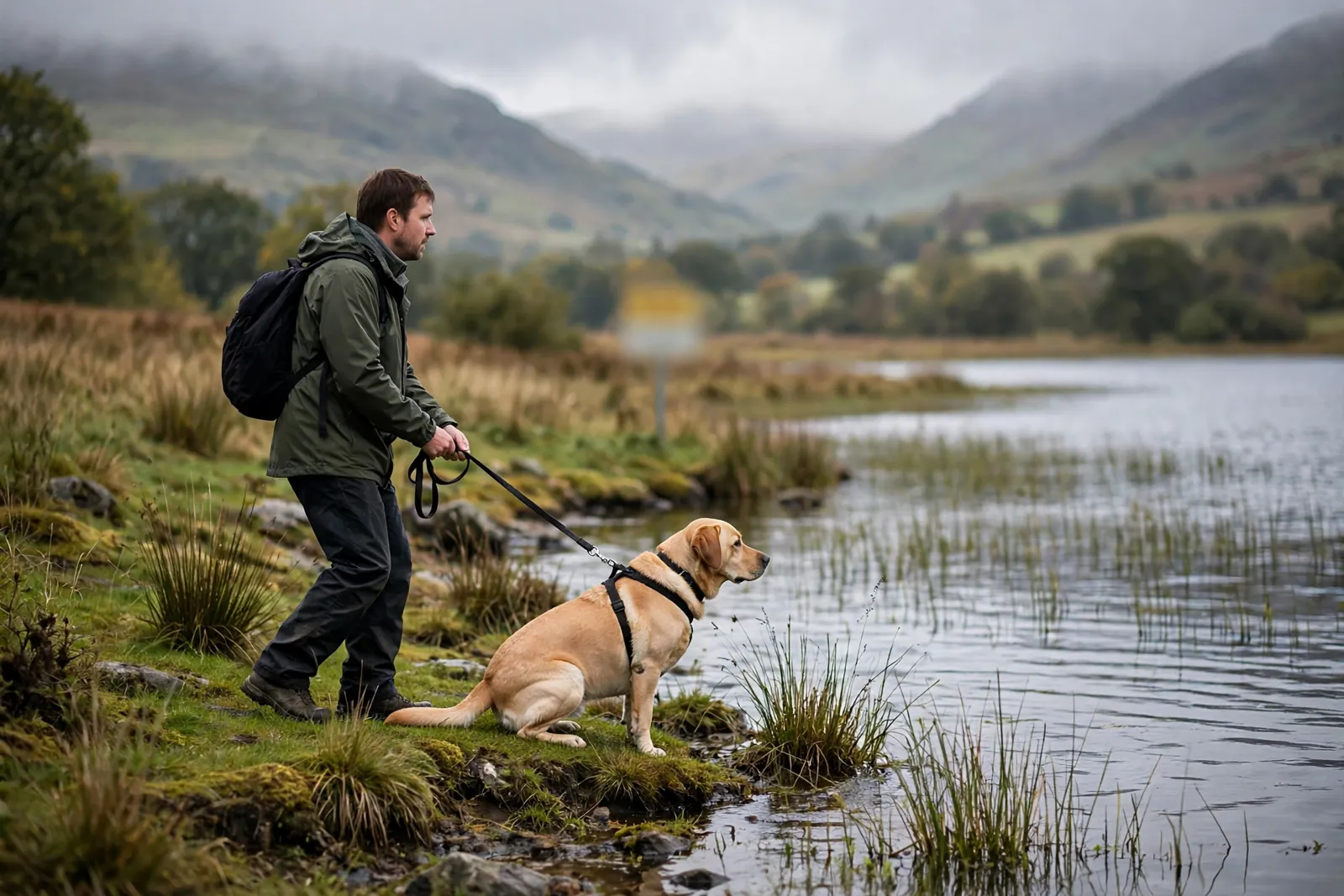
Many dogs will look at Grasmere and Rydal Water and make their intentions clear, and on the right day a paddle at a suitable shore can be one of the joys of the trip. Suitable is doing a lot of work in that sentence. Only use shores where access is permitted and the approach is safe, keep your dog under close control around swans, geese and other water users, avoid disturbing wildlife and reed beds, and call your dog out if they start drinking large amounts of lake water. A lead or long line in the shallows is sensible until you know the bottom, because Lakeland shores can shelve suddenly and old fishing tackle, glass and submerged branches are real hazards in popular spots.
The serious warning is blue-green algae. These cyanobacteria can bloom in warm, still, nutrient-rich water, can look like bright green scum, pea soup, paint-like streaks or turquoise flakes, and can produce toxins that are potentially fatal to dogs, sometimes very quickly. Blooms can appear, move and disperse with wind and weather, which means a shore that was clear yesterday — or clear at the other end of the same lake — is not guaranteed clear today. Warning signs at a lake are important, but their absence proves nothing. If the water looks green, scummy, streaky or smells unpleasant, keep your dog out entirely, including paddling, and do not let them drink from it or lick algae off their coat. Read our dedicated blue-green algae and dogs guide before the trip so the signs are familiar before you are standing on a shore with an eager dog, and pair it with the broader advice in our dog swimming safety guide.
After any swim or paddle in lake water, rinse your dog with clean water, dry them properly, and watch them. If a dog that has been in or near suspect water becomes unwell — vomiting, drooling, diarrhoea, wobbliness, seizures, collapse or unusual lethargy — treat it as an emergency: contact a vet immediately, say that blue-green algae is a possibility, and do not wait to see whether it passes. Speed matters more than certainty in that conversation. The same urgency applies to any dog that deteriorates after swimming anywhere. Most Grasmere swims will be uneventful, and this section is not meant to frighten anyone out of the water altogether. It is meant to replace the vague idea that natural water is automatically clean water with a short, repeatable check: look carefully, smell, look again, and be willing to disappoint your dog. A disappointed dog forgets in five minutes. The alternative is not worth the risk.
Where to stay with a dog
Staying in Grasmere itself changes the character of the trip. You gain the early mornings and evenings that day visitors miss, you can walk from the door onto the lake circuit or coffin route, and you can eat out without a drive at the end of the day. The village and its surroundings offer the usual Lake District spread — hotels, inns with rooms, bed and breakfasts, self-catering cottages, holiday lodges and campsites in the wider valley — and a good proportion accept dogs, but the detail varies enormously. One property's dog-friendly means a dog is tolerated in one ground-floor room for a nightly fee; another's means an enclosed garden, outdoor tap, dog shower, treats in the room and walks from the gate. Ask which version you are booking.
The questions that matter are specific. How many dogs are allowed, is there a per-dog or per-stay charge, are dogs allowed in the restaurant, bar or only in certain areas, can they be left alone in the room and under what conditions, is the garden genuinely enclosed and to what height, and what is the first walk from the door like after dark? In self-catering, add heating, drying space and whether floors are carpeted, because a wet October week with a large dog in a white-carpeted cottage is nobody's idea of rest. In hotels and inns, ask about stairs and lift access for older dogs, and where the nearest grass for a last toilet walk actually is. Around Grasmere, also think about road noise: a room on the A591 side of a property will suit a sound sleeper and undo a nervous rescue, so mention noise sensitivity when you book rather than discovering it at midnight.
Location within the valley is a trade-off worth making deliberately. A cottage right in the village suits people who want cafes and the gingerbread queue on foot and do not mind the daytime bustle. A stay a little way out — towards Rydal, or in the lanes off the main road — suits dogs that need a calmer base and owners happy to walk in. Campsite and lodge stays in the wider area can give more outdoor space and easier mud management, but check lead rules, dog exercise areas and whether the site accepts dogs in all pitches or only some. Wherever you choose, book early for spring daffodil season, summer and autumn colour, because the best dog rooms — ground floor, enclosed garden, walk from the door — are the ones other dog owners are also searching for, and they go first.
A one-day plan that works
A good single day in Grasmere has a shape: big walk early, village in the middle, something gentler to finish. Start with the lake circuit as soon after breakfast as you can manage, while the shores are quiet and the light is on the water. A dog that has had two unhurried hours first thing will be a better cafe companion, a more patient queue-waiter and a calmer traveller home. Back in the village, do the gingerbread run with the one-person-queues system, then take the Daffodil Garden and churchyard slowly while the streets are at their busiest — they are the calmest acres in central Grasmere. If one or more of your group wants Dove Cottage or the museum, this middle part of the day is when to split up, with the dog party taking a long coffee at a dog-welcome table rather than hovering outside a doorway.
After lunch, choose by dog rather than by ambition. A young, fit dog that is still bright-eyed will enjoy the coffin route towards Rydal and back, with the option of stopping at Rydal Water's shores to look, rest and turn around. A dog that has done enough, or a group with limited time, should take the shorter option: one shore of Grasmere as an out-and-back, a paddle check at a clear, permitted spot, and an unhurried hour in a pub garden. Fell options belong in a day of their own, or at the start of a two-day stay, not bolted onto the end of a lake circuit by a dog that has already walked for three hours. The most common Grasmere mistake is stacking the circuit, the coffin route and Helm Crag into one heroic itinerary because they all look close together on the map. They are close together. That does not make them one walk.
Finish the day the way Grasmere does it best. If you are staying, take a short evening loop once the coaches and day cars have gone, when the village smells of woodsmoke and the lake goes still, and let that be the walk your dog learns as the local. If you are driving home, leave enough margin for the A591, give your dog water and a toilet stop before the car, and rinse and dry them if they have been in any water. Check paws for cuts from stony shores, check ears after swimming, and note anything — a new limp, a cough, unusual tiredness — while you still remember which walk it followed. Then, if the day has gone well, you have the best possible problem: deciding whether next time is Rydal first, a fell day, or simply the same perfect circuit, an hour earlier.
Practical questions
Before you go
Can dogs go inside Dove Cottage in Grasmere?
Assume not for the cottage interior and museum unless the venue confirms otherwise on the day. Dogs are generally a question for outdoor spaces and gardens rather than small historic interiors, and rules can change by season and exhibition. Check the Wordsworth Grasmere website or ask at the entrance before joining a tour, and plan for one person to wait outside with the dog if needed.
Can I walk all the way around Grasmere lake with a dog?
Yes, a full circuit is possible by combining lakeshore paths, lanes and a short section near the road, and it is roughly three and a half to four miles depending on the exact line you take. Keep your dog on a lead near livestock, roads and swans, and expect mud after rain. Allow two hours so there is time for sniffing, paddling checks and photo stops.
Is the coffin route from Grasmere to Rydal suitable for dogs?
For most fit, lead-confident dogs, yes. The coffin route between Grasmere and Rydal is a clear, mostly low-level track with stiles, gates and uneven stone in places, so it suits dogs that cope with those features and walk calmly past others. Carry water, keep to a lead near livestock, and turn back if paws, heat or crowds become a problem.
Can my dog swim in Grasmere lake?
Only where access is permitted and the water looks clear and clean on the day. Avoid any water with bright green scum, paint-like streaks or a strong smell, because blue-green algae can be fatal to dogs. Do not let your dog drink lake water, rinse them afterwards, and seek urgent veterinary advice if they become unwell after swimming or paddling.
When is Grasmere quietest to visit with a dog?
Early mornings and late afternoons are usually quietest, especially outside school holidays and sunny weekends. Start the lake circuit before the main car parks fill, do village errands such as the gingerbread queue early or late, and save a short, familiar evening walk for after the day-trip crowds have left.